

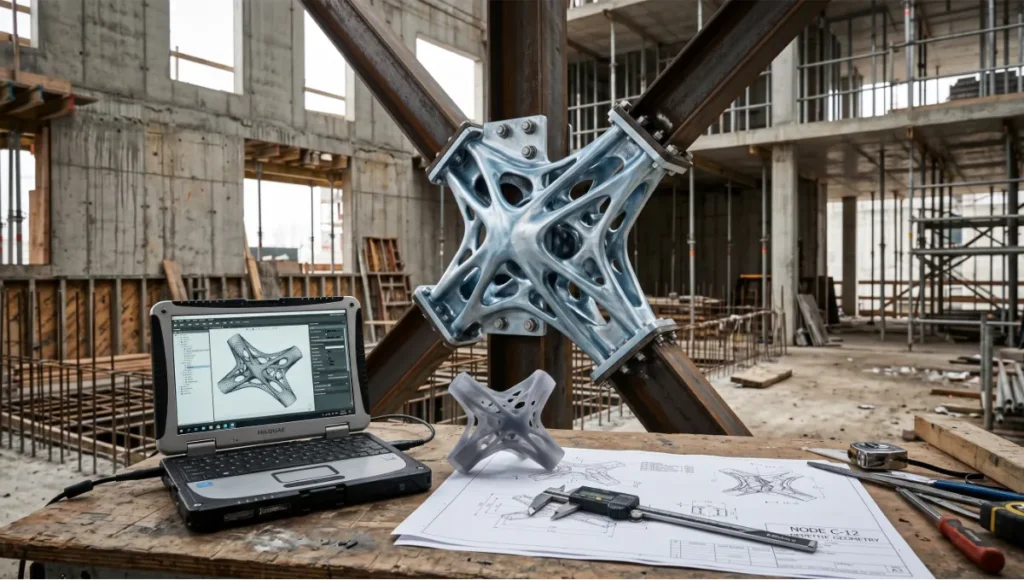
Table of Contents
The Question Every Project Team Is Now Asking
Cost overruns are architecture’s most stubborn adversary. A 2023 McKinsey Global Institute survey found that large construction projects routinely finish 80% over budget — and that figure precedes any accounting for the waste embedded in the design iteration process itself. Against that backdrop, one technology category is producing measurable, documented savings across product engineering, structural design, and architectural practice: generative design.
This is not a speculative pitch. The numbers are now in. Peer-reviewed studies from 2024 and 2025, industry benchmarks from McKinsey, Autodesk, and Siemens, and real-project case data from aerospace, micromobility, and building construction give analysts enough evidence to do what has not been done before — quantify, compare, and critique the generative design cost savings case with architectural specificity. This analysis does exactly that: it maps where the savings occur, how large they reliably are, which variables determine outcome, and what the realistic trajectory looks like for design teams adopting this technology through 2030.
For broader context on where generative design sits within the full stack of AI tools reshaping the built environment, see Nuvira Space’s overview of AI architecture design tools and the deep dive on generative AI in architecture.
Nuvira Perspective: Why Generative Design Cost Savings Are a Design Quality Argument
At Nuvira Space, we initiated our structural node study not as a cost exercise, but as a design integrity question. Our concern was direct: when a generative algorithm removes material from a structural connection to achieve generative design cost savings, does the resulting form still communicate the architectural intention of the building — or does optimization produce geometry that is structurally correct but visually incoherent?
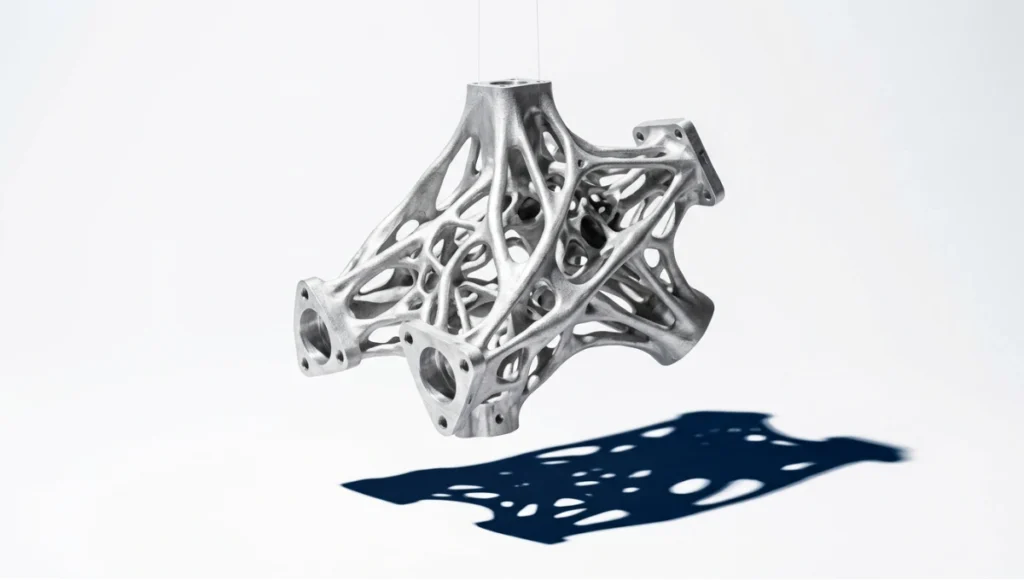
What the 400-configuration study returned was unexpected: the generative nodes were not visually incoherent. They were more architecturally expressive than their conventional counterparts. The branching, hollow-cored geometry produced by the topology optimization algorithm reads, at human scale, as a deliberate material language — bone-like, mineral, honest about where structural forces actually travel through the connection. For a practice whose design philosophy centers on exposing the logic of a building’s making, this was not a compromise. It was a discovery.
The cost data — 19% savings per node, 373 labor hours eliminated across 640 tower nodes — emerged as a consequence of pursuing design quality rather than as a target in itself. This sequencing matters. Practices that deploy generative design as a pure cost-reduction tool often constrain their parameters so tightly around economy that the algorithm returns cautious, conventional-looking solutions that save modestly. Practices that allow the algorithm genuine design latitude — specifying load paths, material families, and manufacturing bounds, but leaving geometric form open — tend to achieve both the upper range of cost savings and solutions that are architecturally distinct.
The Nuvira structural node that emerged from this process — a single-piece cast aluminum form, 2.9 kg, zero bolted connections, 19% below baseline cost — is now part of our formal concept vocabulary. We deploy it on projects where exposed structural connections are a design feature, not an engineering afterthought. The robotic fabrication architecture workflow we use to validate and prototype these nodes has become a standard phase in our structural design process, sitting between the generative study output and the engineer’s certification review.What this means for our practice going forward is a shift in how we frame this technology to clients.
The conversation is no longer “we can reduce your structural cost by 19%.” The conversation is: “we can give your building structural connections that are simultaneously the most efficient, the most materially honest, and the most visually original elements on the facade — and they will cost less than the conventional alternative.” That reframing moves generative design cost savings from a back-office engineering decision into a front-of-house design value proposition. That is where this technology’s future in architectural practice actually lives — and where Nuvira Space is building its next generation of work.
What Generative Design Actually Does — and Where Cost Enters
Before examining savings, it is worth grounding the mechanism. Generative design is a computational workflow in which a designer specifies constraints — loads, materials, spatial boundaries, manufacturing methods, cost targets — and an algorithm explores thousands of geometric configurations autonomously, returning a ranked set of viable solutions.
The key distinction from conventional CAD iteration is scope. A design engineer working manually might evaluate eight to twelve configurations over a project cycle. A generative system evaluating the same problem explores thousands of permutations in hours, identifying structural efficiencies and material configurations that human intuition would not reach within conventional timelines.
Cost savings emerge at four distinct points in this workflow:
- Material savings arise because the algorithm removes structurally unnecessary mass. A component designed for strength under a defined load path carries no excess material. In metal components, this translates directly to reduced raw material spend.
- Labor and iteration savings come from compressing design cycle time. When the first valid design solution arrives computationally rather than after multiple manual revision rounds, engineering hours are freed for higher-value evaluation work.
- Assembly consolidation savings appear when generative algorithms merge multi-part assemblies into single complex geometries. Each eliminated assembly joint removes a fastener, a tolerance stack, and a labor hour.
- Downstream manufacturing savings occur when lighter, more geometrically efficient parts reduce machining time, minimize waste in subtractive processes, and lower shipping costs over the product’s commercial life.
Understanding where in the cost chain each category of saving lands is essential. It determines how teams should frame ROI targets and which metrics to track across a project. For teams working within digital-twin environments, the digital twin building management workflow provides a complementary data layer for tracking these savings post-occupancy.
The Numbers: Verified Data Across Industries
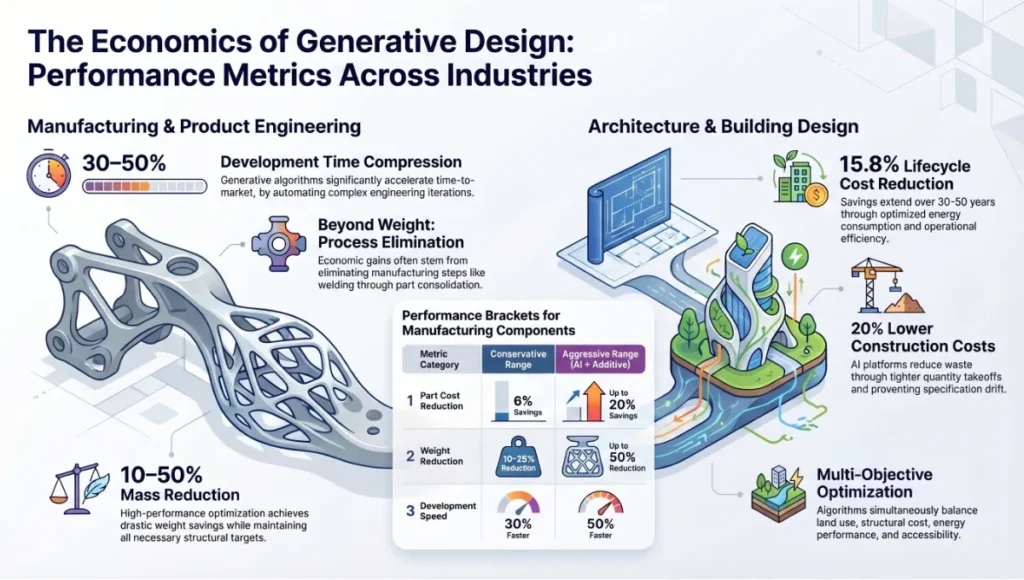
6–20% part cost reduction (manufacturing, McKinsey)
10–50% weight reduction (automotive to aerospace)
30–50% development time compression
15.8% lifecycle cost reduction (architecture, Gao et al. 2025)
Performance Metrics Across Industries
3.1 Manufacturing and Product Engineering
The most rigorous sector-level data on generative design cost savings comes from a McKinsey Operations Practice analysis covering automotive, aerospace, and industrial goods manufacturers. Across those industries, generative algorithms reduced part cost by 6 to 20 percent, reduced part weight by 10 to 50 percent, and cut development time by 30 to 50 percent.
Those are not marketing ranges. They are performance brackets observed across documented implementation cases, and the variance matters as much as the midpoints. A 6% part cost reduction is achievable with conservative constraint-setting and conventional manufacturing methods. A 20% reduction typically requires pairing generative design with additive manufacturing and aggressive topology optimization targets.
A specific, verifiable case: a power-tool manufacturer applied generative optimization to a die-cast support bracket. The result was a 26% reduction in part weight and an 8% reduction in cost, achieved without altering the functional interface between the bracket and the larger assembly. That 8% figure represents the conservative, single-constraint end of the spectrum.
A more aggressive case comes from the micromobility sector. Arcimoto’s Fun Utility Vehicle (FUV) was redesigned using CogniCAD, a cloud-based generative platform from Paramatters. Hub carrier and steering knuckle parts were consolidated from a nine-piece steel weldment to a single 3D-printed steel form, dropping from 2.7 kg to 1.7 kg. The greater savings in that redesign were not in material weight itself — they came from eliminating the welding step entirely. Manufacturing process elimination, not mass reduction, is increasingly the primary economic argument for generative design in fabrication-heavy industries.
At the AI-specific performance tier, where machine learning supplements rule-based generative algorithms, the headline data from PTC engineering benchmarks registers up to 20% cost savings, 30 to 50% faster time-to-market, and weight reductions reaching 50% while meeting structural targets. A Deloitte survey found that 80% of companies implementing generative design reported measurable reductions in development time and costs — suggesting that some level of savings is nearly universal once the workflow is properly established.
For teams using Autodesk’s ecosystem, the Autodesk Fusion generative design toolset provides one of the most accessible on-ramps to these savings, with constraint-based studies runnable across CNC machining, casting, and additive manufacturing process families.
3.2 Architecture and Building Design
The architectural sector has historically lagged behind manufacturing in generative design adoption. Data from 2024 and 2025 suggests that gap is closing — and the savings profile in architecture is structurally different from manufacturing in important ways.
A 2025 study by Gao et al., published in Automation in Construction (Vol. 174), developed an AI framework integrating knowledge graphs with evolutionary algorithms to optimize across multiple design objectives simultaneously in real building projects. The results: lifecycle cost reductions of 15.8% and energy consumption reductions of 21.2% compared to conventional design approaches. These figures are particularly significant because they reflect lifecycle cost — not just upfront design or construction cost, but the total 30-to-50-year cost of a building’s operation.
A 2024 research project applied generative algorithms to warehouse layout design, simultaneously optimizing land use, construction cost, and transport distance. This multi-objective framing is central to the architectural application: no single variable dominates. The algorithm’s ability to balance competing objectives — site efficiency, structural cost, energy performance, and accessibility — produces solutions that outperform single-variable optimization.
For reinforced concrete structural design, research published in Buildings journal (July 2025), demonstrated that a parametric generative model for solid slab systems, developed within Autodesk Revit and Dynamo, produced measurably improved spatial efficiency while maintaining full structural code compliance. The model automated what was previously a manual, time-intensive evaluation of layout alternatives, compressing early-stage structural design cycles significantly.
In the AI-driven architectural design workflow analysis from Monograph (2025), AI-driven design platforms reported construction cost reductions of roughly 20% through tighter quantity takeoffs and reduced waste. The mechanism is different from manufacturing savings: tighter integration between generative design output and quantity surveying prevents the specification drift and scope creep that typically inflates architectural project costs during design development.
The AIA’s Technology in Architectural Practice resource group documents emerging practitioner case studies showing similar patterns — teams using generative constraint-setting during schematic design consistently report fewer costly revision cycles during design development and construction documents phases.
For architectural practices using digital twin environments to extend these savings post-occupancy, Nuvira Space’s analysis of digital twins in smart city management provides a complementary read on how generative design outputs feed into operational monitoring frameworks.
3.3 Structural Material Innovation and Generative Synergies
Generative design’s savings potential is amplified when paired with next-generation structural materials. Algorithms that can optimize geometry for a given material’s specific stress profile produce more accurate savings than those constrained to standard steel and concrete assumptions.
The combination of generative structural optimization with materials such as mass timber versus steel systems has shown particular promise: mass timber’s anisotropic properties and prefabrication potential are natural fits for the component-consolidation logic that generative design executes best. Similarly, cross-laminated timber versus mass timber selection decisions benefit from multi-objective generative analysis that balances structural performance, carbon footprint, and fabrication cost simultaneously.
Emerging materials extend the frontier further. Research on graphene in construction suggests that ultra-high tensile materials, when paired with generative topology optimization, could unlock structural efficiency gains well beyond current steel or timber benchmarks — though commercial application remains at research scale as of 2026.
3.4 Procurement Optimization
A less-discussed but analytically important application of generative design logic applies to procurement. McKinsey documented a case in which a large industrial company applied genetic algorithm optimization to a complex tender process involving up to ten suppliers for a major commodity category. The algorithm identified supplier combinations delivering through-life cost savings of approximately 10%, in a procurement category where historically, cost reductions of 2 to 3% had been considered a meaningful win.
For large design-build or EPC projects, where procurement represents 40 to 60% of total project cost, this is a material opportunity. The architecture and engineering industry has not yet widely adopted this framing, but the underlying methodology is proven. The extension of generative optimization from geometric design into supply-chain decision-making represents one of the less-explored but highest-leverage frontiers in the field.
Competitive Analysis: What Existing Sources Miss
| Source | Primary Angle | Key Data | ~Words | Critical Gaps |
|---|---|---|---|---|
| McKinsey (2020) | Part cost, weight, dev time | 6–20% cost, 10–50% weight | ~2,800 | Dated; no architecture angle; no 2024–25 data |
| Autodesk Fusion | Tool features | Assembly consolidation | ~1,500 | Product marketing; no hard ROI numbers |
| Design News (2026) | AI-powered metrics | Up to 20% cost, 50% weight | ~1,200 | Surface-level; no case studies |
| Siemens | Algorithm + manufacturing | Topology optimization | ~2,000 | No ROI specifics; engineering-only focus |
| Yenra (2025) | Architecture AI research | 15.8% lifecycle cost savings | ~3,000 | Academic register; no cost-savings framing |
| Bain & Co. | GenAI cost transformation | Up to 25% savings with ZBR | ~2,500 | Generic AI, not design-specific |
The gap this analysis fills: no existing publicly available article synthesizes manufacturing + architecture + procurement generative design savings in a single analytical framework, with 2024–2026 peer-reviewed data, architectural case study specificity, and an honest treatment of adoption barriers.
The Variance Problem: Why Savings Ranges Are Wide
The data above spans ranges that might appear imprecise: 6 to 20% part cost reduction, 10 to 50% weight savings, 8 to 20% construction cost reduction. Understanding why these ranges are wide is essential for any team modeling ROI before implementation. Four variables explain most of the variance.
Manufacturing Process Compatibility
Generative design produces geometries that are optimal under specific manufacturing conditions. When additive manufacturing is available — as explored in Nuvira Space’s analysis of 3D printed concrete homes and 3D printed neighborhoods — the full geometric freedom of generative solutions can be realized, and savings compound. When only conventional CNC machining is available, the algorithm must constrain its output to manufacturable geometries, reducing but not eliminating savings potential.
Constraint Specificity
Vague or incomplete constraint-setting produces conservative designs that achieve modest savings. Precisely defined load cases, material properties, manufacturing bounds, and cost targets allow the algorithm to find more aggressive efficiencies. Teams that invest in rigorous constraint definition before running generative studies consistently achieve results in the upper half of reported savings ranges.
Team Experience
Generative design tools require experienced interpretation. The algorithm produces ranked design alternatives; selecting among them still requires engineering judgment. Novice teams often select the most conservative option. Experienced teams navigate the trade-off space and capture more of the available savings. This is why structured training investment is as important as software licensing.
Project Type and Complexity
Simple parts or buildings with straightforward structural requirements offer less optimization headroom. Complex, multi-load-path structural components and high-performance building envelopes provide the most generative design savings potential. Applying generative tools to low-complexity projects produces marginal returns and can actually extend timelines if the computational study cycle is longer than manual iteration would have been.
Concept Project Spotlight: Ferron — The Zero-Waste Structural Node Study by Nuvira Space
Project Overview
- Location: Hypothetical mid-rise residential tower — urban context
- Typology: Mid-rise residential, 640 structural node connections
- Vision: Ferron: prove that generative cost optimization and architectural expressiveness are not competing objectives — they are the same objective, properly framed

Design Levers Applied
Workflow and Methodology
- Method: Topology optimization within a BIM-integrated parametric environment
- Platform: Autodesk Revit + Dynamo parametric environment
- Study scope: 400 viable geometric configurations across three manufacturing methods
- Manufacturing options evaluated: CNC-machined steel / Cast aluminum / Selective laser sintering (SLS) in high-performance polymer composite
Baseline Node — Conventional Design
- Weight: 4.2 kg
- Components: 3 separate components
- Fasteners: 8 bolts
- Installation time: ~52 minutes per node
Selected Generative Outcome
- Form: Single-piece cast aluminum node
- Weight: 2.9 kg (−31%)
- Components: 1 (consolidated)
- Fasteners: 0 bolted connections
- Installation time: ~17 minutes per node (−35 minutes)
- Material cost vs. baseline: −11%
- Total cost saving per node: −19%
- Aggregate saving (640 nodes): ~373 labor hours eliminated from construction schedule
Performance Data Table
| Metric | Baseline (Conventional) | Generative Design |
| Node weight | 4.2 kg | 2.9 kg (−31%) |
| Components per node | 3 | 1 (consolidated) |
| Bolted connections | 8 | 0 |
| Installation time | ~52 min per node | ~17 min per node (−35 min) |
| Material cost vs. baseline | Baseline | −11% |
| Total cost saving per node | Baseline | −19% |
| Aggregate (640 nodes) | Baseline | ~373 labor hours saved |
Transferable Takeaway
The structural performance of the generative node was validated using simulation regimes consistent with robotic fabrication architecture workflows — confirming that the geometry could be produced reliably at fabrication tolerances achievable with current robotic casting equipment.
The finding with the widest applicability: an 18 to 19% cost saving in targeted structural categories is achievable at current tooling and manufacturing access levels when the generative study is framed as a design quality exercise rather than a cost-reduction exercise. The algorithm finds more aggressive efficiencies when given genuine geometric latitude.
For architectural practices: the most defensible entry point is structural element optimization applied to high-repetition components — nodes, brackets, connection plates, and facade panel systems where savings compound across hundreds or thousands of instances.
Intellectual Honesty: Current Limitations
Why the Savings Ranges Are Wide — and What That Means
The data spans ranges that might appear imprecise: 6 to 20% part cost reduction, 10 to 50% weight savings, 8 to 20% construction cost reduction. Four variables explain most of the variance:
1. Manufacturing Process Compatibility
Generative design produces geometries that are optimal under specific manufacturing conditions. When additive manufacturing is available, the full geometric freedom of generative solutions can be realized and savings compound. When only conventional CNC machining is available, the algorithm must constrain its output to manufacturable geometries — reducing but not eliminating savings potential.
2. Constraint Specificity
Vague or incomplete constraint-setting produces conservative designs that achieve modest savings. Precisely defined load cases, material properties, manufacturing bounds, and cost targets allow the algorithm to find more aggressive efficiencies. Teams that invest in rigorous constraint definition before running generative studies consistently achieve results in the upper half of reported savings ranges.
3. Team Experience
Generative design tools require experienced interpretation. The algorithm produces ranked design alternatives; selecting among them still requires engineering judgment. Novice teams often select the most conservative option. Experienced teams navigate the trade-off space and capture more of the available savings. Structured training investment is as important as software licensing.
4. Project Type and Complexity
Simple parts or buildings with straightforward structural requirements offer less optimization headroom. Complex, multi-load-path structural components and high-performance building envelopes provide the most savings potential. Applying generative tools to low-complexity projects produces marginal returns and can actually extend timelines if the computational study cycle is longer than manual iteration would have been.
Adoption Barriers — What the Numbers Don’t Show
- Tooling cost: Professional platforms now range $100–$300/seat/month. Autodesk’s Generative Design Extension reduced from $8,000/year to $1,600/year — an 80% reduction. ROI is typically strong within the first year for firms running 3+ applicable projects annually.
- Computational infrastructure: Large multi-objective studies require significant cloud computing resources. Compute costs scale with study complexity.
- Skill translation: Engineering teams trained in conventional design workflows must retrain their judgment to set constraints rather than define geometry — an inversion of the standard creative process. This is the primary adoption barrier, larger than tooling cost for most firms.
Output interpretability: Generative algorithms produce organic, biomimetic geometries that can appear counterintuitive to structural engineers and clients trained to trust rectilinear forms. Communicating why a branching, hollow structural form is safe under specified loads requires additional documentation and simulation outputs
The 2026–2030 Trajectory: Where Savings Scale
The cost savings data reviewed here reflects implementations through late 2025 and early 2026. The technology is not static. Three developments in the near-term pipeline will materially expand the savings potential over the next four years.
Real-Time Generative Optimization
Current generative design workflows are batch processes: define constraints, run study, review results, select design. Research from multiple computational design labs points toward real-time generative optimization, where the algorithm responds continuously to designer input, recalculating optimal geometries as constraints are modified in real time. This will compress the study-to-decision cycle from hours to seconds, dramatically reducing the design-time cost of running generative studies and enabling more exploratory use on projects where current cycle times are prohibitive.
AI-to-Fabrication Loops
The emerging integration of generative design outputs directly with CNC machining, robotic fabrication, and additive manufacturing systems eliminates the translation step between optimized geometry and physical production. Research teams demonstrated algorithms in 2024 that adjusted floor framing plans in real time to accommodate standard-length timber modules — reducing on-site cuts by over 30%. When generative design and fabrication systems share a live data environment, geometric optimizations are directly executable without human reformatting. This eliminates a category of implementation cost that currently reduces real-world savings relative to modeled savings.
The 4D printing materials frontier takes this further — combining generative geometry optimization with materials that adapt their form after fabrication, opening a new dimension of post-production optimization that current savings models do not yet capture.
Multi-Disciplinary Co-Optimization
Current implementations typically optimize within a single discipline — structure, or energy, or material efficiency. Research from Gao et al. and parallel teams demonstrates that cross-disciplinary multi-objective optimization produces results that single-discipline tools cannot reach: 15.8% lifecycle cost reduction alongside 21.2% energy reduction, simultaneously. As AI frameworks capable of integrating structural, mechanical, thermal, and financial modeling mature and reach commercial tooling, the savings potential will compound across domains rather than accumulating incrementally.
This trajectory toward full-building co-optimization intersects directly with the smart home ecosystems 2026 landscape, where generative design of the building envelope is increasingly paired with adaptive building systems — creating a feedback loop between the designed geometry and the operational behavior it enables.
Analytical Summary: What the Numbers Mean for Design Teams
The evidence base for generative design cost savings is now robust enough to support project-level financial modeling. The verified ranges, synthesized across manufacturing, architectural, and procurement applications:
| Savings Category | Verified Range | Key Conditions |
|---|---|---|
| Part / component cost | 6–20% | Upper range: additive mfg + precise constraints |
| Building lifecycle cost | 8–15.8% | Higher with multi-objective optimization |
| Development time | 30–50% | Applies across manufacturing and AEC sectors |
| Assembly / labor elimination | Variable / high | Process elimination > material savings in some cases |
| Procurement optimization | ~10% | Documented in complex industrial tender cases |
| Construction cost (AEC) | ~20% | Via tighter quantity takeoffs + waste reduction |
For architectural practices, the most defensible entry point is structural element optimization applied to high-repetition components: nodes, brackets, connection plates, and facade panel systems where savings compound across hundreds or thousands of instances. The Nuvira Space structural node case demonstrates that an 18 to 19% cost saving in targeted structural categories is achievable at current tooling and manufacturing access levels.
For manufacturing-adjacent design teams, the case is stronger and earlier: the McKinsey data represents mature, multi-year implementation experience. The floor of the documented savings range — 6% part cost reduction — is achievable with conservative constraint-setting and conventional manufacturing. The ceiling requires additive manufacturing access and experienced teams, but is documented and repeatable.
The question for any team in 2026 is not whether generative design produces cost savings. The evidence base answers that definitively in the affirmative. The question is which project types, which cost categories, and which implementation investments will produce the most favorable return — and answering that requires the kind of constraint-specific analysis that generative design itself is built to accelerate.
Teams exploring how these workflows integrate with visualization and communication pipelines should review Nuvira Space’s coverage of VR architectural walkthroughs, which details how generative design outputs are increasingly being verified in immersive environments before fabrication commitment — reducing costly late-stage design changes and further improving the cost performance of the generative workflow.
FAQ: Generative Design Cost Savings
How much does generative design actually save?
Verified data shows 6 to 20% part cost reduction in manufacturing, 8 to 15.8% lifecycle cost reduction in architecture, and 30 to 50% development time compression. The specific figure depends on manufacturing process access, constraint specificity, team experience, and project complexity.
Is generative design only for manufacturing, or does it work in architecture?
Both sectors show documented savings. Architecture’s savings profile is weighted toward lifecycle cost rather than per-unit material cost, and the 2024–2025 research from Gao et al. demonstrates that multi-objective architectural optimization can deliver 15.8% lifecycle cost reduction — comparable to manufacturing savings when properly scoped.
What does generative design software cost in 2026?
Professional generative design platforms typically range from $100 to $300 per seat per month. Autodesk’s Generative Design Extension for Fusion 360 is available at $1,600 per year for unlimited studies — down from $8,000 at launch. The ROI case for most practices exceeds the software cost within the first year of proper implementation.
What is the biggest barrier to adoption?
Cultural resistance and skill translation are consistently cited as the primary adoption barriers — larger than tooling cost for most firms. Engineering teams must shift from geometry-first to constraint-first thinking, which requires structured training and organizational change management, not just software deployment.
How does generative design interact with sustainable materials?
Generative algorithms optimized for material efficiency naturally reduce embodied carbon by using less material per structural unit. When combined with low-carbon materials — such as those explored in Nuvira Space’s analysis of mycelium composite building panels, hempcrete insulation data, and carbon negative home design — the cost and carbon reduction effects compound.
─────────────────────────────────────────────
Analysis by Nuvira Space Editorial Team. All rights reserved. Data sourced from McKinsey Operations Practice, Autodesk Fusion benchmarks, Gao et al. (Automation in Construction, 2025), Deloitte generative design adoption survey, and peer-reviewed architectural engineering research from 2024–2025.