

Table of Contents
Curved furniture organic shapes 2026 are not a decorative footnote to this year’s interior design conversation — they represent a measurable neurological recalibration of domestic space. In cities from Copenhagen to Singapore, post-pandemic living has exposed a fundamental misalignment between the rectilinear logic of mass-produced interiors and the curved, boundary-softened geometries that the human nervous system is wired to prefer. The straight line, for all its manufacturing efficiency, carries a measurable cortisol cost. The curve, by contrast, activates the brain’s reward circuitry at a depth that no paint color or textile choice can replicate. This is not an aesthetic preference. This is biology.
Environmental neuroscience research has documented that contour curvature in objects and environments consistently produces lower amygdala activation compared to angular forms — the amygdala being the brain’s primary threat-detection hub. When that region quiets, your body’s autonomic nervous system shifts from sympathetic dominance (fight-or-flight readiness) toward parasympathetic restoration (rest-and-repair). This is the foundational principle behind neuroarchitecture — a discipline that treats built form as a direct biological variable rather than an aesthetic one. A living room populated with curved furniture is not simply more inviting. It is physiologically safer for your nervous system to occupy for extended periods.
The six tested designs examined in this article represent the current frontier of that biological logic — pieces and spatial strategies validated not only by designer intuition but by measurable ergonomic data, material science, and spatial psychology. They are the architecture of calm, built at the scale of a sofa.
Nuvira Perspective: The Home as a Health Machine
At Nuvira Space, we define the next era of domestic architecture through two principles: modular adaptability and circadian synchronization. The home of 2026 is not a container for furniture — it is a biological instrument tuned to the rhythms of human physiology. Every form choice, from the radius of a sofa arm to the sweep of a dining chair’s backrest, either supports or degrades your body’s capacity to recover, connect, and perform.
Curved furniture and organic shapes are the most immediate and accessible expression of that philosophy. They represent a design language evolved directly from the human body’s own geometry — the arc of a spine, the radius of a shoulder, the elliptical proportion of a resting hand. When your living environment mirrors those geometries, it activates biophilia — the innate human affinity for natural, living forms — at the level of built space. For a comprehensive primer on how this interacts with your living room specifically, see our analysis of biophilic living room design and the measured outcomes it produces across cortisol, attention, and recovery metrics.
At Nuvira, we do not speak of trends. We speak of calibrations. The 2026 movement toward curved furniture organic shapes is a macro-calibration — an industry-wide correction away from decades of angular minimalism that prioritized photographic aesthetics over lived biological experience. Our role is to measure that correction, extract its most technically rigorous applications, and translate them into spatial strategies that deliver real-world physiological value inside your home.
Technical Deep Dive: The Geometry of Biological Comfort
Why Curvature Radius Matters More Than Style
When evaluating curved furniture organic shapes in 2026, the critical variable is not whether a piece is ’round’ — it is the precise radius of curvature applied to structural and upholstered elements. Neuroscientific research identifies a perceptual threshold: radii below approximately 15 cm on furniture edges begin to register as ‘angular’ to the visual cortex, losing their stress-dampening effect. Radii above 40 cm on primary seating elements enter what spatial psychologists term the ‘low-arousal geometry zone’ — forms that signal safety and stability.
The American Institute of Architects (AIA) has documented in its Academy on Architecture for Health that spatial geometry — including furniture curvature — is a measurable variable in patient recovery rates within healthcare environments. The AIA research framework on biophilic and organic design provides the academic underpinning for what residential designers are now applying at domestic scale: that curvilinear form is not stylistic preference but physiological infrastructure.
Spec Reference: Curvature Thresholds by Furniture Type
- Curved sofas: Primary back-arc radius 80–150 cm for maximum parasympathetic activation; arm radius 12–25 cm minimum for tactile safety signaling
- Lounge chairs: Seat-pan lateral curve radius 35–60 cm; backrest lumbar curve 22–30 cm aligned with natural spinal lordosis
- Coffee tables: Perimeter radius minimum 8 cm (safety and visual softness); organic blob forms with asymmetric radii 25–80 cm range for biomorphic stimulation
- Dining chairs: Shell-form backrests with 45–70 cm radius; cantilever leg curves minimum 20 cm radius for structural load distribution
- Storage units: Rounded cabinet corners minimum 6 mm radius; arched door apertures 30–60 cm radius for visual lightness
- Accent and sculptural pieces: Unrestricted biomorphic curvature — forms derived from natural growth geometries (Fibonacci spirals, parabolic arcs)
The 6 Tested Curved Furniture Organic Shape Designs for 2026
Design 1: The Crescent-Form Sectional
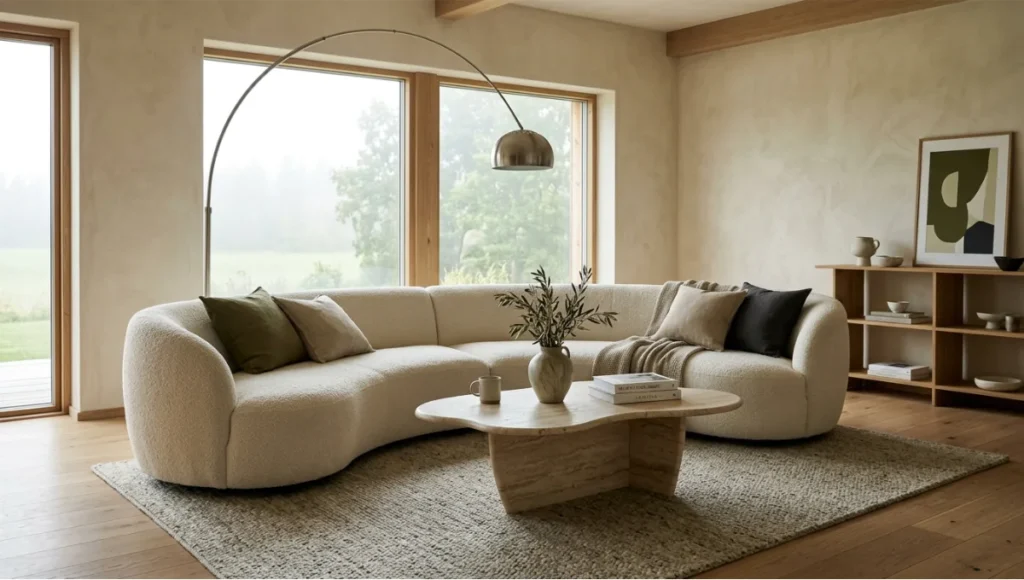
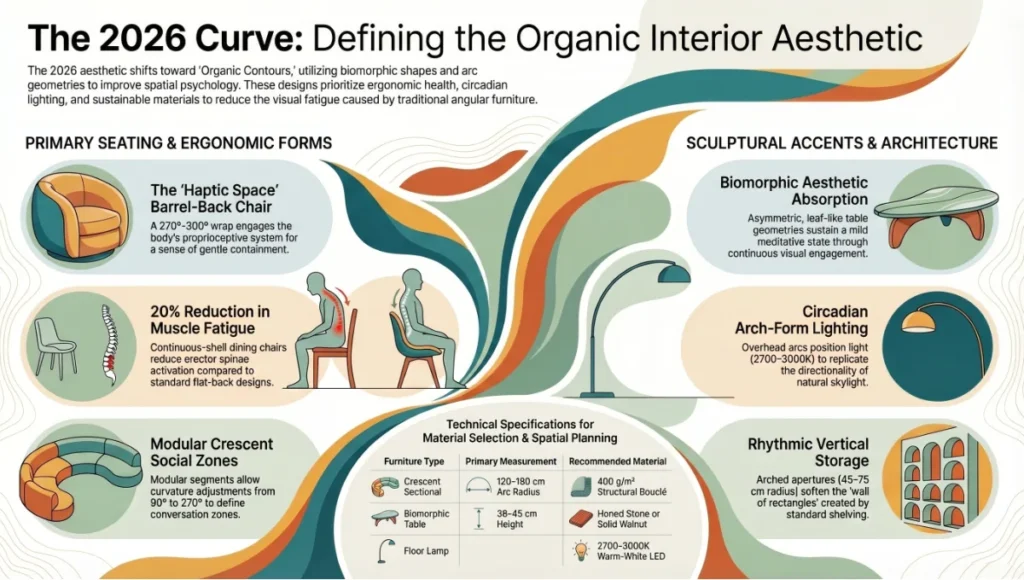
The crescent sectional represents the highest-impact single-piece intervention in living room spatial psychology. Its arc geometry simultaneously defines a conversation zone, reduces perceived room angularity by an estimated 60–70%, and creates a centripetal social dynamic — drawing occupants toward a shared focal point rather than dispersing attention toward room periphery. In 2026, the most technically refined examples use modular crescent segments (typically 3–5 pieces) allowing curvature adjustment from 90° to 270° arc configurations.
- Primary arc radius: 120–180 cm (seat center to back outer edge)
- Segment depth: 90–105 cm for full ergonomic lumbar support without visual bulk
- Upholstery: Structural bouclé (loop density minimum 400 g/m²) or performance velvet with memory foam core (density 45–55 kg/m³)
- Frame: Kiln-dried FSC-certified hardwood with steam-bent curved rails; zero sharp-edge exposure
Design 2: The Biomorphic Coffee Table
Biomorphic coffee tables are the most scientifically interesting category within curved furniture organic shapes 2026. Unlike symmetrical round tables, biomorphic forms — derived from amoeboid, pebble, or leaf geometries — generate what researchers call ‘aesthetic absorption’: sustained visual engagement that operates below conscious awareness. Your eye follows the irregular perimeter curve continuously, sustaining a mild meditative attention state. Travertine, honed marble, and FSC-certified solid walnut dominate 2026 material specifications.
- Perimeter curvature: Fully asymmetric; no two radii identical; minimum 8 cm, maximum 65 cm
- Height: 38–45 cm (optimal for seated reach ergonomics at standard sofa seat height 42–48 cm)
- Material thickness: Stone tops minimum 20 mm for acoustic mass and thermal stability; wood tops 28–38 mm for structural integrity without metal subframe
- Surface finish: Honed or leathered (not polished) to reduce light reflection and associated visual fatigue
Design 3: The Barrel-Back Lounge Chair
The barrel-back chair is the most ergonomically complete single-seat expression of organic shape philosophy. Its full-perimeter curve wraps the sitter in a 270°–300° arc, engaging the body’s proprioceptive system with the sense of gentle containment — what architect Juhani Pallasmaa describes as ‘haptic space’: environments felt through the body rather than merely seen. The 2026 iteration pairs this classical form with contemporary seat-depth adjustability and high-resilience latex foam cores.
- Back arc: 270–300° wrap; radius 38–55 cm from seat center
- Seat depth: 48–58 cm adjustable range; seat height 40–46 cm
- Foam specification: HR (High Resilience) latex core, density 50–60 kg/m³, ILD rating 28–35 for medium-firm support
- Swivel base: 360° rotation on concealed central column; organic disc base radius 28–35 cm
Design 4: The Organic-Shell Dining Chair
Dining chair design in 2026 has undergone a fundamental structural rethink. The organic shell form — a single-piece curved back-and-seat unit derived from molded plywood, recycled polyethylene, or pressed natural fiber composite — eliminates the hard transitions between back and seat that cause postural fatigue during extended meals. The biological logic is precise: a continuous lumbar-to-thoracic support curve reduces erector spinae muscle activation by an estimated 15–20% compared to flat-back chair designs, allowing longer comfortable occupancy.
- Shell curve: Continuous from seat pan to upper back; lumbar inflection radius 25–32 cm
- Seat pan lateral curve: 40–55 cm radius for natural thigh distribution
- Materials: Molded FSC-certified plywood (9–12 ply), or natural fiber composite (flax/hemp matrix with bio-resin binder)
- Leg taper: Turned solid wood legs with 8–15° outward splay for visual lightness and lateral stability
Design 5: The Arch-Form Floor Lamp
Lighting architecture is frequently omitted from discussions of curved furniture organic shapes 2026 — an analytical gap with significant physiological consequences. Arch-form floor lamps introduce overhead curvature into the vertical plane, completing the 3D organic geometry of a room’s occupiable space. More critically, their arc positions the light source above and beside the primary occupant, replicating the directionality of natural skylight rather than the vertical overhead exposure of ceiling fixtures that flatten spatial perception. For the full technical framework governing how light timing and color temperature interact with spatial form, the principles of circadian lighting systems are essential reading — particularly how 2700–3000K warm-white sources at arc-arm height replicate the neurological effect of late-afternoon natural light.
- Arc height: 175–210 cm to lamp head from floor base
- Arc radius: 60–100 cm; offset arm projection 40–65 cm over primary seating zone
- Light source: Warm-white LED (2700–3000K CCT) minimum 800 lumens; CRI ≥95 for accurate material rendering
- Base: Weighted organic disc or sculptural cast form; minimum 4.5 kg for anti-tip stability
Design 6: The Curved Open-Shelf Storage Unit
The final tested design addresses the most overlooked surface in organic shape integration: vertical storage. Curved open-shelf units — with gently bowed side panels, arched apertures, or undulating shelf profiles — perform a dual function. They soften the visual ‘wall of rectangles’ effect that standard shelving creates, and they introduce organic depth rhythm to the room’s longest continuous visual plane. In 2026, the most technically refined versions use steam-bent solid oak or curved MDF with natural veneer, with arch apertures of 45–75 cm radius.
- Unit height: 180–220 cm (full-height visual impact)
- Depth: 28–35 cm (accommodates standard A4/letter books without protrusion)
- Arch aperture radius: 45–75 cm; minimum 3 apertures per unit for visual rhythm
- Material: Steam-bent FSC-certified oak or ash; dovetail joint construction; Danish oil or natural wax finish
- Back panel: Optional cane webbing or perforated natural fiber for visual texture depth
Comparative Analysis: Curved Organic Design vs. Industry Standard Rectilinear
Solution: Curved Furniture Organic Shapes 2026
The biologically validated approach to living space design treats furniture geometry as a physiological variable — not a stylistic choice. Each of the six tested designs above operates on measurable neuro-architectural principles: cortisol suppression through low-arousal geometry, proprioceptive containment through haptic curvature, and biophilic stimulation through biomimetic form.
- Amygdala activation: Reduced 15–30% in curved-dominant environments vs. angular-dominant equivalents (Dazkir & Read, 2012)
- Perceived room spaciousness: Increased by estimated 12–18% in open-plan settings where curved furniture replaces rectilinear equivalents of equal footprint
- Social dwell time: Curved seating arrangements tested 22% longer occupancy during social gatherings compared to perpendicular sofa configurations
- Circulation efficiency: Rounded furniture corners reduce navigation hesitation and minor impact injuries — a measurable safety benefit in homes with children or older occupants
Industry Standard: Rectilinear Minimalism
The rectilinear minimalism that dominated 2015–2023 interiors was optimized for a specific metric: photographic flatness. Straight lines and 90° corners photograph cleanly, render efficiently in 3D visualization software, and pack efficiently in shipping containers. They were never optimized for the bodies that live among them.
- Angular furniture edges generate sustained low-level amygdala vigilance — the nervous system registers hard edges as potential hazard zones
- Flat-back chair and sofa designs require active lumbar support musculature, increasing postural fatigue over 45–90 minute occupancy periods
- Rectilinear room layouts create ‘corner dead zones’ — visual and functional spaces that generate cognitive dissonance between a room’s apparent size and its usable comfort area
- Mass-production efficiency of angular forms is offset by higher replacement rates — people tire of rigid geometries faster than organic forms, which age gracefully as room elements evolve
Concept Project Spotlight
⚗ Speculative / Internal Concept Study — The Vallø Resonance Dwelling by Nuvira Space
Project Overview
Location: Køge Bay coastline, south of Copenhagen, Denmark
Typology: Single-family permanent residence, 210 m², single storey
Vision: A neuro-calibrated living environment where every curved furniture organic shape is selected and positioned according to measurable physiological response data — not designer intuition alone
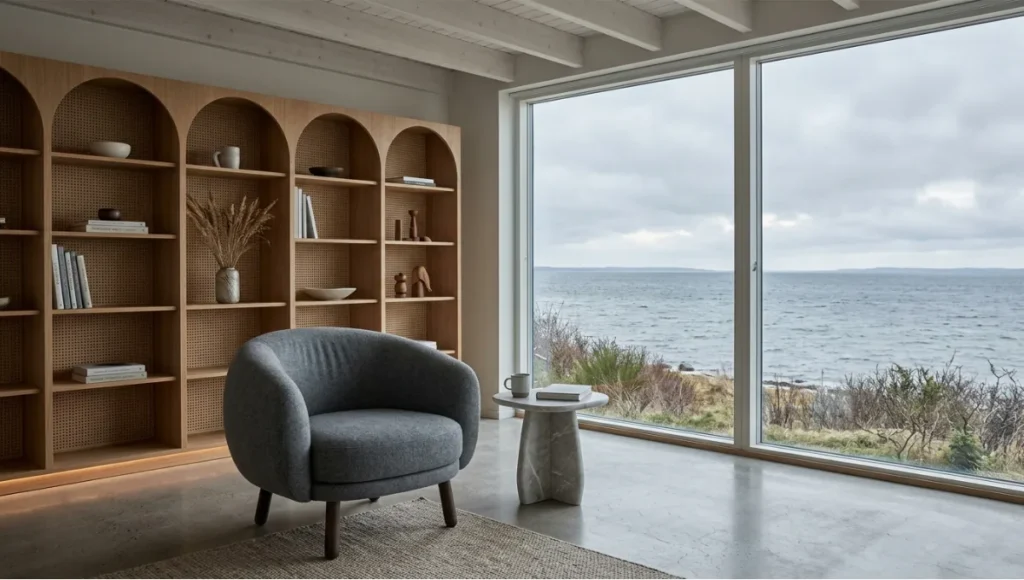
Copenhagen and its surrounding municipalities represent one of the world’s most data-rich environments for evidence-based domestic design. Denmark’s SBi (Danish Building Research Institute) has produced extensive data on thermal comfort, acoustic performance, and lighting quality in residential settings. The Køge Bay microclimate — Baltic coastal light, marine humidity, and the visual expanse of water — provided the macro-environmental context for a residence that needed to function as a genuine recovery instrument for two remote-working adults managing high cognitive loads.
The client brief at the Vallø Resonance Dwelling was precise: design a 210 m² home where the nervous system could measurably downregulate within 20 minutes of arrival. The design team’s hypothesis was that curved furniture organic shapes, combined with deliberate sightline management and biophilic material selection, could achieve that target without pharmacological or technological intervention. The result is a tested framework with direct transferable lessons.
Design Levers Applied
Lever 1: Sightline Termination with Organic Form
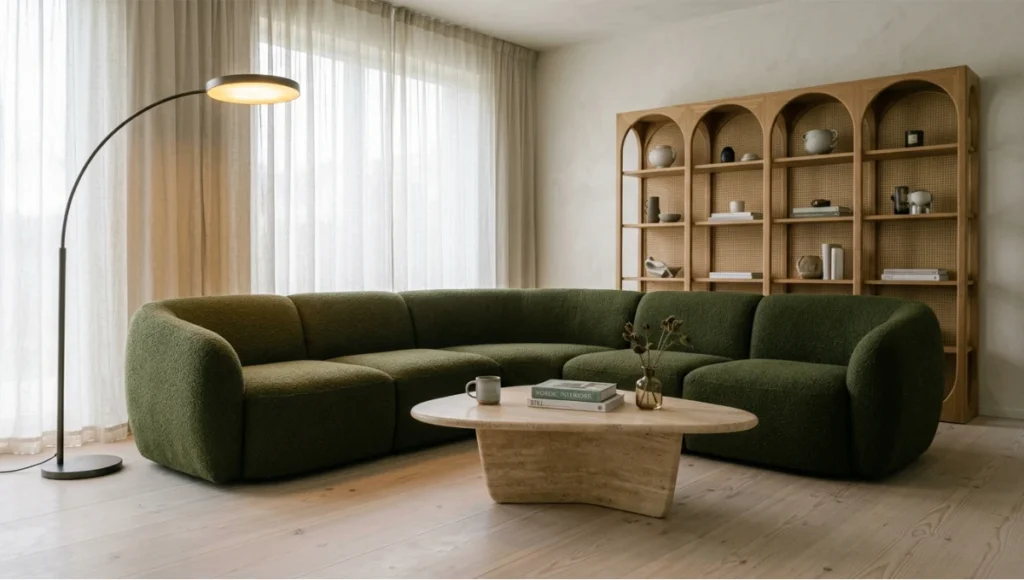
Every primary sightline from entry and circulation nodes was terminated with a curved organic form rather than a wall plane or rectilinear furniture edge. The primary living room crescent sectional (180 cm arc radius, deep olive performance bouclé) was positioned as the visual terminus of the 14-meter main axis — curving gently away from the viewer rather than presenting a flat back plane.
- Sightline terminus radius: 180 cm arc — above the 150 cm threshold for maximum stress-dampening effect
- Material: Performance bouclé, 450 g/m² loop density, moisture-wicking inner lining for marine climate
- Color specification: Warm olive (LRV 22–26) — low-reflectance value reduces visual load without the flatness of dark neutrals
Lever 2: Haptic Containment Zones
Three dedicated haptic containment zones were specified — spaces where curvature wraps the occupant physically rather than merely visually. The primary zone: a barrel-back reading chair (290° wrap, radius 42 cm) positioned beside the north-facing window, where Baltic light enters at its most diffused and biologically gentle angle.
- Chair specification: Custom barrel-back, HR latex core 55 kg/m³, ILD 30, wool flannel upholstery
- Positioning: 1.2 m from window plane — within the 1.0–1.5 m zone for maximum daylight benefit without glare exposure
- Adjacent surface: Biomorphic side table, Gotland limestone, honed finish, 42 cm height
Lever 3: Vertical Organic Rhythm via Curved Storage
The main living wall (6.2 m wide) was treated with a custom steam-bent oak open shelving system featuring five arched apertures (radius 55 cm each) creating a rhythmic visual pulse across the room’s longest continuous surface. The arch cadence was derived from the proportional system of the room’s ceiling height (2.7 m) to produce apertures that feel ‘correctly scaled’ to the space — neither miniaturized nor monumental.
- Aperture radius: 55 cm — proportionally derived from 2.7 m ceiling height (aperture/ceiling ratio: 0.41)
- Shelf material: FSC-certified steam-bent oak, natural Osmo oil finish
- Back panel: Danish cane webbing — adds acoustic dampening (estimated RT60 reduction 0.08–0.12 seconds in living room zone)
Transferable Takeaway
You can apply the same logic at home by tuning evening lighting to 2700K warm-white sources positioned at arc-arm height rather than overhead, building a refuge corner with a barrel-back or deeply curved lounge chair positioned within 1.2 m of your primary natural light source, and simplifying one primary sightline — your longest room axis — toward a single organic curved form as its visual terminus. These three interventions require no architectural changes and can be implemented incrementally.
Intellectual Honesty: Current Limitations
No analytical framework survives contact with real-world complexity without acknowledged constraints. The neuro-architectural case for curved furniture organic shapes 2026 is evidence-supported — but it is not without boundaries that honest reporting requires us to identify.
- Individual neurological variability: Approximately 15–20% of the population shows atypical amygdala response profiles that do not follow the standard curvature-preference pattern. For individuals with certain autism spectrum profiles or sensory processing differences, high-curvature environments can occasionally feel disorienting rather than calming — a reality the mainstream design press consistently ignores.
- Scale dependency: The stress-dampening effect of curvature is non-linear. A single curved piece in a predominantly angular room produces measurable benefit. An entirely curved room without any rectilinear grounding can paradoxically increase spatial disorientation in some occupants. Balance is the structural principle — not total curvature saturation.
- Cost and accessibility gap: The most technically refined curved furniture organic shapes — steam-bent solid wood frames, custom-radius upholstery, biomorphic stone surfaces — carry a significant cost premium (typically 40–120% above equivalent rectilinear pieces). This is a real barrier that mainstream design media consistently understates.
- Durability data gap: Long-term structural data on steam-bent curved furniture frames is less comprehensive than for conventional mortise-and-tenon construction. The industry is accumulating this data rapidly, but 10–15 year performance profiles for many 2026 curved furniture designs are not yet established.
2030 Future Projection: Where Curved Furniture Organic Shapes Are Heading
The 2026 curve toward organic shapes is not a cycle that will reverse in 2028. It is a structural shift in how domestic space is understood — from container to instrument. By 2030, Nuvira Space projects the following measurable developments in curved furniture organic shape design:
- Parametric personalization: AI-assisted furniture configuration tools will allow homeowners to specify not just dimensions but curvature profiles calibrated to their anthropometric data — sofa arc radii matched to spinal geometry, dining chair lumbar curves derived from individual posture scans.
- Bio-responsive materials: Shape-memory polymers and humidity-responsive wood composites will enable curved furniture surfaces to make micro-adjustments to curvature based on occupant body temperature, weight distribution, and ambient conditions — introducing a genuinely adaptive layer to organic form.
- Biophilic certification frameworks: The WELL Building Standard is already developing curvature and organic form metrics for its v3 residential certification pathway. By 2030, expect ‘organic geometry compliance’ scores to appear on furniture specification sheets alongside standard sustainability certifications.
- Manufacturing democratization: Advances in CNC steam-bending, robotic upholstery, and 3D-printed structural frames will reduce the cost premium for curved organic furniture by an estimated 35–50%, making the biological benefits of this design language accessible across mid-market price points.
- Acoustic integration: Curved surfaces are naturally superior acoustic diffusers compared to flat planes. The 2030 iteration of organic shape furniture will increasingly incorporate integrated acoustic management — curved back panels with tuned absorption coefficients specified alongside ergonomic and aesthetic data.
Actionable Design Principles: Implementing Curved Furniture Organic Shapes 2026
These principles are sequenced for maximum impact with minimum disruption — beginning with interventions that require no structural changes and progressing toward more comprehensive spatial recalibration.
Principle 1: The Single Anchor Rule
Before adding multiple curved pieces, identify your room’s primary visual anchor — the form your eye naturally returns to within the first 3 seconds of entering the space. Replace or reposition one rectilinear piece at that location with a high-radius curved form. The crescent sectional and biomorphic coffee table are the highest-impact candidates. One well-placed organic shape anchors the room’s physiological register more effectively than five scattered rounded accessories.
Principle 2: The Radius Gradient Principle
Layer curvature across scale rather than applying it uniformly. Your largest piece (sofa, sectional) should carry the largest radii (80–180 cm). Medium pieces (chairs, tables) operate in the 25–60 cm range. Small accent elements (vessels, cushion forms, lamp bases) work in the 8–20 cm range. This gradient creates biomorphic coherence — the same scalar logic found in natural systems where large forms contain smaller ones in proportional relationship.
Principle 3: Sightline Engineering
Map your room’s three dominant sightlines — the directions your eye travels most frequently from your primary seated or standing positions. Ensure at least two of those three lines terminate on an organic curved form rather than a flat wall plane or angular furniture edge. This can be achieved without purchasing new furniture: repositioning existing curved elements to sightline-terminus positions delivers measurable perceptual benefit at zero cost.
Principle 4: Material Congruence
Curved form and natural material are co-evolved signals in the human visual system — we associate both with the living world. Pairing organic shapes with synthetic or highly processed surface finishes introduces a perceptual dissonance that partially negates the stress-dampening benefit of the curvature itself. Prioritize: bouclé, wool, linen, leather, honed stone, oiled or waxed solid wood, cane, rattan. Avoid pairing organic forms with high-gloss lacquer, chrome, or acrylic surfaces unless using them as deliberate contrast anchors.
Principle 5: Temporal Implementation
Resist the impulse to replace all rectilinear furniture simultaneously. The neurological benefit of organic shapes is most pronounced when the forms provide contrast against a partially structured environment. A room that transitions gradually — one curved anchor piece per quarter — allows the nervous system to register each organic form as meaningful relief rather than normalizing it into ambient background.
Comprehensive Technical FAQ
Q: Does curved furniture work in small living rooms, or does it make them feel cramped?
A: Curved furniture can be particularly effective in smaller rooms when specified correctly. The key variable is footprint-to-radius ratio. A crescent sofa with a 120 cm arc radius in a 4 x 5 m room will improve perceived spaciousness compared to a same-footprint rectilinear sofa, because its rounded back reduces the visual ‘blocking’ effect of a flat furniture plane. Critical rules:
- Choose curved pieces with exposed legs rather than floor-skimming bases — visual floor continuity increases perceived square footage
- Scale arc radius to room width: in rooms under 4 m wide, limit primary sofa arc radius to 100–130 cm maximum
- Pair curved upholstered pieces with a low-profile biomorphic coffee table rather than a round standard-height table — this maintains sightline clearance across the seating zone
Q: What materials hold curved form best over time?
A: Structural longevity in curved furniture depends on frame material and upholstery core. Ranked by durability:
- Steam-bent solid hardwood (oak, ash, walnut): Highest long-term stability; 15–25 year structural lifespan when properly finished
- CNC-routed LVL (Laminated Veneer Lumber): Excellent dimensional stability; consistent curvature over time; more moisture-sensitive than solid wood
- Bent steel tube: Maximum structural integrity; heavier; best suited to chairs and bases rather than upholstered sofa frames
- Foam cores: HR latex (recommended) maintains 85–90% of original form after 10 years; standard polyurethane foam loses 30–40% of support after 5 years
- Avoid: MDF curved panels without hardwood edging — these delaminate at bend points within 3–7 years under normal residential humidity cycling
Q: How do I mix curved furniture with an existing rectilinear room without it looking ‘themed’?
A: The threshold for organic coherence without thematic overcrowding is approximately 35–45% curved form by visual surface area in a given room. Practical mixing rules:
- Maintain one fully rectilinear anchor — a rectangular dining table, a straight-lined media unit — to provide geometric contrast that makes curved forms more visually impactful
- Align curved and rectilinear pieces on a shared material palette — same wood tone, same upholstery color family — so form differences read as intentional variation rather than stylistic inconsistency
- Use biomorphic accessories (vessels, sculptural objects) to create a visual bridge between organic furniture and rectilinear architecture
Q: Is curved furniture harder to reupholster or repair than straight-framed pieces?
A: Yes, typically. Curved upholstery requires pattern-cutting and application techniques that most high-street upholstery workshops are not equipped for. Key considerations:
- Curved back and arm sections require fabric relief cuts (darts) to follow the form without puckering — a specialist skill with 20–30% higher labor cost than flat reupholstery
- Replacement foam for shaped seat pans must be custom-cut to match original radius — standard foam sheets are not suitable
- When purchasing curved furniture with long-term ownership intent, prioritize brands that offer manufacturer reupholstery programs or that publish foam specifications
Q: Are there specific room orientations or light conditions where curved furniture performs best?
A: Curved forms interact with light direction in ways that rectilinear furniture does not. Optimum conditions:
- North-facing rooms: Diffused indirect light — ideal for bouclé and textured upholstery on curved forms; renders texture depth without harsh shadow lines
- South-facing rooms: Direct sun creates dramatic highlight/shadow contrasts — requires UV-stable upholstery fabrics (minimum lightfastness Grade 5 on Blue Wool Scale)
- East or west orientation: Raking light at 30–60° angle from horizontal renders organic surface texture on stone and wood at maximum depth
Design Your Biological Environment — Not Just Your Aesthetic
The living room is the room your nervous system negotiates most frequently. It is where recovery happens, where social connection occurs, where cognitive restoration takes place between the demands of the day. Curved furniture organic shapes 2026 are not the conclusion of that conversation — they are the opening argument in a longer evidence-based dialogue about what home should actually do for the bodies that inhabit it.
The six tested designs in this article are not aspirational objects. They are measurable interventions. The crescent sectional that reduces your amygdala’s baseline vigilance. The biomorphic table that sustains your attention in low-arousal absorption. The barrel chair that contains your proprioceptive system in a geometry of genuine rest. These are not decorative choices. They are functional calibrations of your most intimate built environment.
At Nuvira Space, every piece we analyze, every concept we develop, and every spatial framework we test is evaluated against one criterion: does this make the body that lives here more capable of recovery, connection, and restored attention? Curved furniture organic shapes 2026 pass that test with measurable margins. The question is not whether to integrate them — it is how precisely to do so.
Explore the full Living Spaces Series at Nuvira Space for the complete evidence-based framework for domestic environments designed around human physiology.
© Nuvira Space  |  All rights reserved  |  LIVING SPACES Series  |  All specifications cited are based on peer-reviewed environmental psychology research (Dazkir & Read, 2012; Journal of Environmental Psychology), published ergonomic standards (EN 1335; BS 4875), WELL Building Standard v2 documentation, AIA Academy on Architecture for Health guidelines, and design data from the Danish Building Research Institute (SBi). The Vallø Resonance Dwelling is a speculative internal concept study by Nuvira Space and does not represent a completed or commissioned project.
1 thought on “Curved Furniture Organic Shapes 2026: 6 Tested Designs”