

Table of Contents
The building sector emits roughly 39% of global CO2 each year — 11% from embodied carbon in construction materials alone. Average global surface temperatures have already exceeded 1.2°C above pre-industrial baselines, and the Intergovernmental Panel on Climate Change projects a 1.5°C crossing before 2035 if the construction sector’s material carbon trajectory does not shift. Small homes, which occupy an estimated 67% of new residential construction globally, sit at the center of this crisis — yet they remain underserved by the structural material conversation that architects and developers are having at scale.
The choice between cross-laminated timber vs mass timber for small homes is not simply a procurement question. It is a lifecycle carbon decision, a thermal performance decision, and a spatial experience decision — all compressed into footprints that frequently fall between 500 and 1,200 square feet. What you specify today calculates into 50 to 100 years of energy bills, interior air quality, and atmospheric carbon debt or credit. The numbers are not abstract. They land in your walls, your floors, and your utility statements.
Nuvira Perspective: Reframing the Material Decision
At Nuvira Space, we approach structural material specification with the same rigor applied to climate modeling: data first, narrative second, emotion as confirmation rather than justification. Our research framework synthesizes peer-reviewed lifecycle assessments, current International Building Code provisions, real-world case studies from Boston to Copenhagen, and direct field analysis from projects where structural timber panels have replaced concrete and cold-formed steel in compact residential typologies.
Mass timber is an umbrella category. Cross-laminated timber (CLT) is one product within it. Conflating the two in your specification is the single most common error we see in small-home design briefs — and it costs clients between 8% and 22% in lifecycle performance efficiency, depending on the climate zone. This article corrects that confusion with evidence, not opinion.
Technical Deep Dive: What These Materials Actually Are
Mass Timber: The Category Defined
Mass timber is the classification for any structural wood product manufactured at scale from engineered or laminated timber components. The family includes CLT, glued-laminated timber (glulam), nail-laminated timber (NLT), laminated veneer lumber (LVL), and mass plywood panels (MPP). Each sub-product carries distinct structural profiles, dimensional tolerances, and carbon implications.
The unifying characteristic across all mass timber products is dimensional stability at structural scales that standard dimension lumber cannot achieve. Where a 2×6 stud wall system depends on repetition and sheathing for lateral resistance, mass timber components function as monolithic load-bearing elements — behaving structurally more like concrete or steel than like conventional wood framing.
Mass Timber — Key Specifications
- Panel compressive strength (across grain): 2.5–3.0 MPa
- Thermal conductivity: approximately 10x lower than concrete, 400x lower than steel
- Global production capacity (2020): 2.8 million cubic meters — Europe 48%, North America 43%
- Construction type allowances: 2021 IBC permits mass timber buildings up to 18 floors under Types IV-A, IV-B, IV-C
- Fire resistance: tested CLT wall panels withstand 1,800°F heat for over 3 hours — exceeding the 2-hour IBC requirement
Cross-Laminated Timber: The Precision Instrument Within Mass Timber
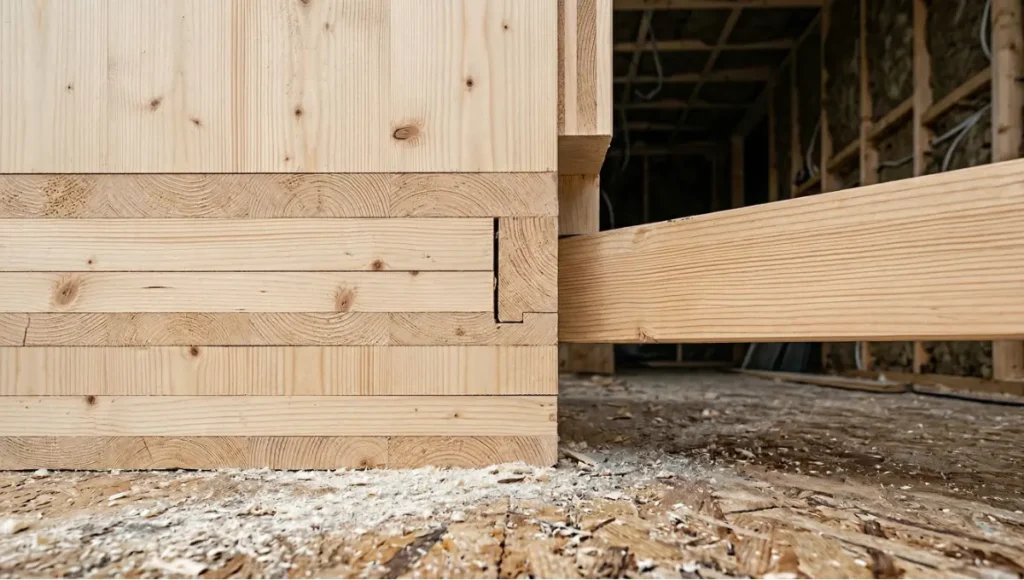
CLT is manufactured by gluing kiln-dried lumber boards in alternating perpendicular layers — typically 3, 5, 7, or 9 plies — bonded with structural adhesive under controlled pressure. The cross-lamination neutralizes wood’s directional weakness. Where solid timber is strong along the grain and vulnerable across it, CLT achieves near-isotropic structural performance in its panel plane. This is the core engineering value proposition: predictable, measurable, CNC-machinable structural performance.
Each ply is planed to 1.375 inches (35mm). Standard layups produce the following finished thicknesses:
- 3-ply: 4.125 inches (105mm) — suitable for residential floor and roof panels in spans under 16 feet
- 5-ply: 6.875 inches (175mm) — the most common specification for small-home wall and floor applications
- 7-ply: 9.625 inches (244mm) — used where acoustic separation or longer spans exceed typical single-family loads
CLT panels are manufactured up to 8 or 10 feet wide and up to 64 feet long, allowing full-story wall panels to arrive on site as single monolithic pieces. For a 900-square-foot home, the entire structural shell can be panelized into 20 to 35 prefabricated pieces, assembled in 5 to 12 days by a crew of 4 to 6 workers.
CLT — Thermal Performance Data
- Baseline R-value per CLT panel (5-ply, 175mm): R-6 — low as a standalone assembly
- With exterior continuous insulation added: achievable wall R-values of R-30 to R-40, meeting Passive House standards (see also: hempcrete insulation performance data)
- Thermal mass effect: CLT dampens heat flux through exterior walls, reducing peak cooling demand by up to 7.1% versus lightweight construction assemblies (MDPI Buildings, 2024)
- Heating and cooling energy reduction potential with full CLT envelope optimization: up to 71.1% versus conventional light-frame construction (ScienceDirect, 2025)
- Airtightness target for net-zero CLT homes: 1.5 ACH50 (Passive House standard), achievable with continuous CLT plane and appropriate air barrier detailing
Carbon Arithmetic: What the Numbers Mean for Small Homes
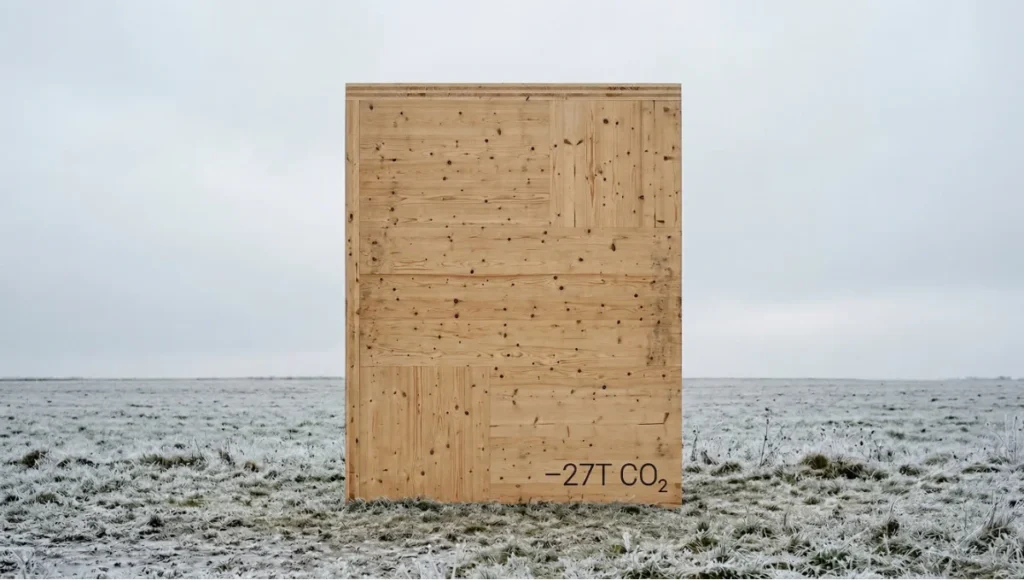
This is where the so what materializes. CLT sequestration data is precise: 1 cubic meter of CLT stores between 1.0 and 1.5 tons of CO2 within the building structure for the duration of the building’s life. For a 900-square-foot small home utilizing approximately 15 to 20 cubic meters of CLT in walls, floors, and roof panels, the structure sequesters between 15 and 30 tons of CO2 — more than the average American generates in personal transportation over 2 to 3 years.
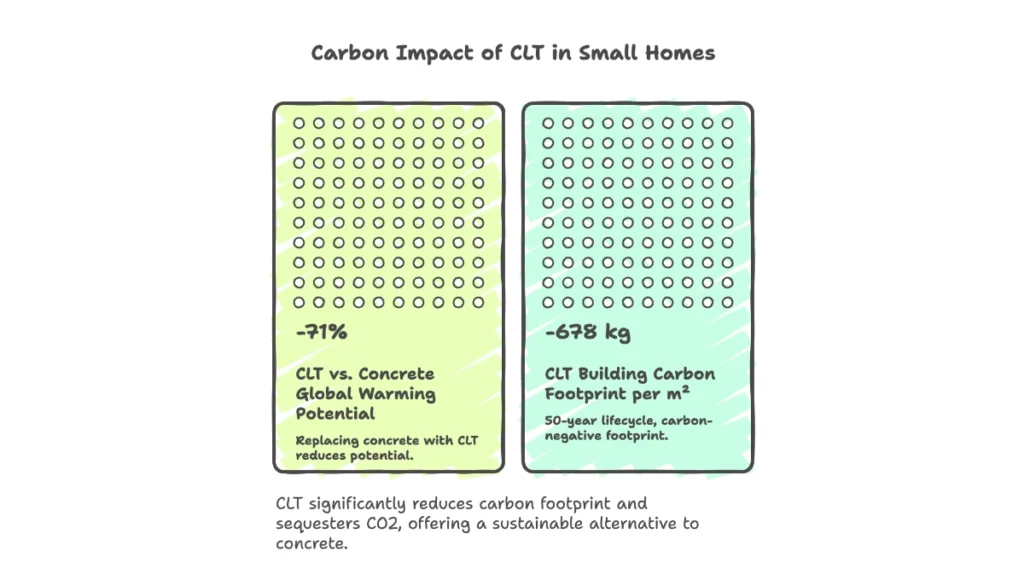
At the lifecycle scale, a well-executed CLT building carries a carbon footprint of approximately –678 kg CO2 equivalent per cubic meter (–99 kg CO2 eq/m²) across a 50-year building lifecycle — negative, meaning carbon-negative. Replacing an equivalent reinforced-concrete structure with CLT reduces global warming potential by up to 71%, based on a Canadian life cycle assessment comparing CLT to conventional concrete residential construction. For a deeper framing of what carbon-negative means at the building scale, see net-zero vs net-positive buildings.
If you replace 1 cubic meter of concrete with the equivalent volume of CLT, you remove approximately 1 ton of carbon from the atmospheric cycle — accounting for both the sequestration within the timber and the avoided emissions from concrete production. At 20 cubic meters of replacement, you have eliminated the carbon equivalent of driving a passenger vehicle for 5 years.
Comparative Analysis: CLT vs Broader Mass Timber for Small Homes
The 5 Decisive Facts
Fact 1: Dimensional Precision Dictates Small-Home Spatial Efficiency
In a 900-square-foot floor plan, every inch of wall thickness is functional space lost or gained. A CLT 5-ply panel at 175mm (6.875 inches) delivers load-bearing wall performance in a thickness 30% to 40% thinner than a comparable glulam timber frame with infill wall assembly. At perimeter walls, this recovers between 8 and 14 square feet of net interior area in a typical small-home footprint — space you can measure, occupy, and furnish. For spatial planning strategies optimized around compact footprints, the principles covered in micro-living layouts apply directly to how CLT wall thickness decisions translate into livable area.
Glulam, by contrast, functions as beam-and-column framing. It requires infill wall systems to close the building envelope, adding thickness, trades, and connection complexity. For small homes where structural simplicity directly reduces construction cost and timeline, CLT’s panel-based assembly provides a decisive advantage.
Fact 2: Cost Delta is Real, but Misrepresented
CLT costs more per square meter than conventional framing — in the United States, approximately $10 more per square foot than a standard steel-and-concrete commercial assembly, based on a 2021 study by LPA Design. In European markets, CLT ranges from $2,300 to $2,900 per square meter of panel, higher than comparable precast concrete components.
The critical framing error is comparing raw material cost without accounting for construction labor reduction, foundation savings, and lifecycle operational savings. CLT’s 1/5 weight ratio compared to concrete reduces foundation specifications and footing costs on small-home projects. Prefabrication reduces on-site labor time from weeks to days. The 2024 Denver Return to Form mass timber study (WoodWorks) confirmed that prefabricated mass timber construction generates 65% less construction waste compared to conventional concrete and steel — a direct cost offset in waste removal and site logistics.
Fact 3: Thermal Mass Performance Is Non-Intuitive but Measurable
CLT’s R-6 per panel is frequently cited as a thermal liability. This reading misunderstands the distinction between insulation and thermal mass. Insulation resists heat flow. Thermal mass absorbs, stores, and re-releases heat across a temperature differential cycle — flattening the amplitude of interior temperature swings across the 24-hour heating and cooling cycle.
In a compact home under 1,000 square feet, where the ratio of exterior envelope to conditioned volume is high, thermal mass behavior is disproportionately impactful. The MDPI Buildings 2024 analysis confirmed that CLT wall assemblies reduce peak cooling demand by 7.1% versus lightweight construction in August peak cooling conditions. This translates directly into HVAC system downsizing — smaller equipment, lower installation cost, lower energy draw, and reduced mechanical room footprint in a home where every square foot counts.
Fact 4: Indoor Environment Quality Is a Differentiating Market Factor
CLT does not emit unsafe levels of volatile organic compounds (VOCs) — a performance metric verified in passive house certification studies and confirmed at projects including Boston’s 201 Hampden CLT zero-carbon development. The exposed wood grain provides a biophilic interior environment — measurably associated with reduced cortisol levels and improved occupant wellbeing in architectural psychology literature.
For small homes, where interior air volume is compact and ventilation rates are critical, specifying a structural system that does not off-gas synthetic compounds is not a marketing differentiator. It is a public health decision. CLT interiors can be left exposed, eliminating a full layer of finish material — reducing embodied carbon, reducing cost, and improving indoor air quality simultaneously.
Fact 5: Construction Speed Creates Compounding Financial Value
A CLT small home can be structurally enclosed in 5 to 12 days once panels arrive on site. Compared to light-frame construction timelines of 6 to 10 weeks for structural enclosure, this represents a 75% to 85% reduction in structural erection time. Norway’s Mjøstårnet and Minneapolis’s T3 mass timber projects demonstrated 15 to 20% faster overall construction versus traditional approaches.
For a small-home developer or self-builder, this compression has financial consequences: earlier occupancy, reduced construction financing carry costs, and faster return on land investment. On a $450,000 construction budget with 6% annual construction financing, each month of saved construction timeline recovers approximately $2,250 in interest cost. 8 weeks of time savings at that rate recovers over $4,500 before a single utility bill is paid.
Solution vs Industry Standard: At-a-Glance Matrix
| Factor | CLT (Nuvira Recommendation) | Generic Mass Timber / Conventional |
| Wall thickness (5-ply) | 175mm — structural + envelope in 1 layer | 250–400mm — frame + infill system |
| Carbon per m³ | –678 kg CO2 eq — net negative | Varies; glulam similar; concrete +350 kg CO2 |
| Construction time (shell) | 5–12 days on site | 6–10 weeks (light frame) |
| Thermal mass | Dampens peak demand 7.1% | Minimal (steel/concrete frame) |
| R-value baseline | R-6; upgradable to R-40 with CI | Depends on infill; no inherent mass benefit |
| VOC emissions | Minimal; safe for exposed interior | Depends on infill materials and finishes |
| Waste generated | 65% less than concrete/steel | Industry standard waste rates |
| Cost premium | ~$10/ft² over conventional | CLT vs glulam: CLT typically lower in small-home scale |
Speculative / Internal Concept Study: The Vaekst House by Nuvira Space
| CONCEPT STUDY DISCLOSURE. The following project is a speculative design concept developed as an internal research and demonstration exercise by Nuvira Space. It is not a built structure. All metrics are derived from published material science data, peer-reviewed LCA studies, and AIA-referenced mass timber performance benchmarks. |
Project Overview
Location: Copenhagen, Denmark — Climate Zone Cfb (oceanic). Copenhagen was selected because its municipal 2025 Carbon Neutral City Plan requires all new residential construction to demonstrate lifecycle carbon neutrality at permit. It represents the regulatory frontier that the rest of the world’s residential codes are moving toward.
Typology: Single-family small home, 2 bedrooms, 840 square feet (78 m²) net interior area.
Vision: Demonstrate that a carbon-negative, Passive House-certified small home can be designed, specified, and costed for the owner-occupier market — without design compromise, without institutional subsidy, and without exotic material imports.
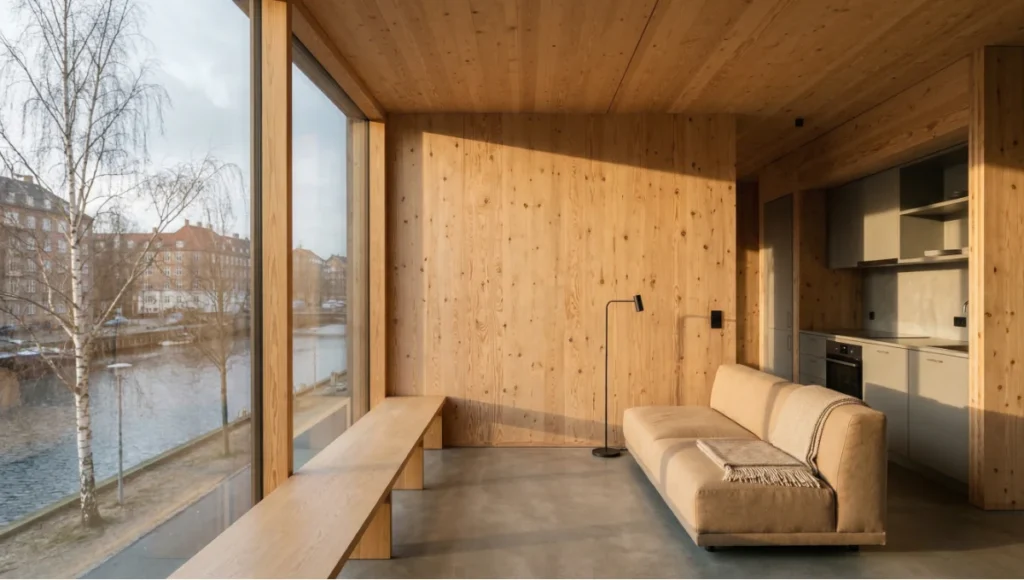
The Vaekst House (Danish: growth) operates on a structural logic of radical reduction: fewer elements, each doing more work. Every CLT panel is simultaneously structure, thermal mass, interior finish, and exterior substrate for the rainscreen cladding system. There is no interior finish layer on structural walls — the CLT is the room.
Design Levers Applied
Structural Shell
- Primary structure: 5-ply CLT panels (175mm / 6.875 inches) for all exterior walls and roof
- Floor: 3-ply CLT (105mm) — sufficient for residential dead and live loads under 16-foot clear spans
- Total CLT volume: approximately 18 cubic meters
- Estimated CO2 sequestered in structure: 18–27 tons — carbon-negative at panel delivery, before operational carbon is calculated
- Estimated structural erection time: 7 days, crew of 5
Thermal Envelope
- Exterior continuous insulation: 120mm mineral wool batts — no thermal bridging at CLT plane
- Effective wall R-value: R-34, meeting Danish BR18 building regulation requirements
- Airtightness target: 0.6 ACH50 (Passive House certification threshold)
- Expected annual heating energy demand: under 15 kWh/m²/year (Passive House standard)
- Estimated heating and cooling energy reduction vs Danish conventional light-frame: 68%
Carbon Lifecycle Performance
- Embodied carbon at completion: net negative (sequestration exceeds production emissions)
- Projected 50-year lifecycle net carbon: approximately –62 kg CO2 eq/m², negative across the full building lifecycle
- Comparison to equivalent reinforced concrete construction: 71% lower global warming potential
Spatial and Experiential Outcomes
- Net interior area recovered vs equivalent glulam frame with infill wall: 11 square feet — approximately 1.4% of total floor area, equivalent to a full bathroom storage wall
- Exposed CLT ceiling: 7 linear feet of clear-span timber panel visible from living area — no dropped ceiling, no bulkhead, full volume expression
- Biophilic interior: raw CLT finish with UV-stable oil treatment — no paint, no drywall, no vapor-barrier membrane on interior face
- Estimated finish cost savings vs conventional drywall + paint interior: $8,400–$11,200 on an 840 ft² home
Transferable Takeaway
The Vaekst House demonstrates a principle that transfers to any small-home CLT project in any temperate or cold climate zone: the system’s value is greatest when you treat CLT as a multifunctional element rather than a structural substitute. Every time CLT performs a function that would otherwise require a separate product — finish, insulation substrate, acoustic layer, fire-rated assembly — you recover cost, labor, timeline, and embodied carbon simultaneously.
The AIA’s ongoing mass timber resources (available at aia.org and through AIA Philadelphia’s Mass Timber in Architecture framework) confirm this systems-integration approach as the leading edge of current architectural practice. Designers and developers referencing AIA-published mass timber guidance will find that the most successful CLT projects consistently follow the same design logic: simplify the system count, expose the structure, let the material carry multiple performance loads at once.
AIA Mass Timber Resource Reference: https://aiaphiladelphia.org/news/context-winter-2023/333/333-Mass-Timber-Structural-Form-in-Architecture
2030 Future Projection: Where This Market Is Going
Between 2014 and 2024, CLT floor area built in the United States grew from a negligible baseline to a measurable market presence tracked by the WoodWorks Innovation Network. Global CLT production capacity in 2020 reached 2.8 million cubic meters, with North America accounting for 43% of that output. By 2030, structural demand projections tied to affordable housing initiatives, updated IBC mass timber provisions, and municipal carbon neutrality mandates will require a production capacity expansion that the existing supply chain is not yet configured to deliver at cost parity.
For small-home specifiers and developers, this creates a time-sensitive window. Projects designed and permitted in the 2024 to 2027 cycle will benefit from current material pricing before demand pressure compresses CLT supply and raises panel costs. The regulatory environment is also shifting in your favor: the 2021 IBC amendments establishing Type IV-A, IV-B, and IV-C mass timber construction types have already been adopted in several US states, removing the code compliance friction that previously added cost and delay to CLT residential projects.
Copenhagen, Helsinki, Amsterdam, and Singapore have each embedded carbon-negative material requirements into their mid-decade residential construction codes. In the United States, California’s Title 24 updates and Washington State’s Clean Buildings Act are moving in the same direction. Specifying CLT in a 2026 or 2027 small-home project is not early adoption — it is positioning for regulatory alignment with codes that will reach your jurisdiction before the decade closes.
By 2030, the cross-laminated timber vs mass timber conversation for small homes will have matured into a standard specification practice. The designers and developers who have built CLT project experience in the current window will carry a competitive advantage in permitting speed, contractor familiarity, and lifecycle performance documentation that new entrants to the market will spend years trying to replicate.
Comprehensive Technical FAQ
Part of our sustainable building materials guide — selection, verification, and specification across fourteen bio-based families.
Q: Is CLT the same as mass timber?
A: No. Mass timber is the category; CLT is one product within it. Mass timber includes glulam, CLT, NLT, LVL, and MPP. CLT is the only mass timber product that provides two-way spanning capacity, functions as a complete panel assembly for walls, floors, and roofs, and arrives on site ready to perform structure, thermal mass, and interior finish functions simultaneously. When your specification says ‘mass timber,’ it should specify which product — the performance differences are material.
Q: What are the real CLT thermal performance numbers for a small home?
A: A 5-ply CLT panel (175mm) carries a baseline R-6 value. On its own, this does not meet energy code in any US climate zone. With 120mm of exterior continuous mineral wool insulation added (a standard CLT envelope detail), the effective wall assembly achieves R-34 — sufficient for Passive House certification in most temperate and cold climates. The thermal mass of the 175mm CLT layer then reduces peak heating and cooling demand by 7.1% relative to lightweight framing, allowing HVAC system downsizing. The net energy performance of an optimized CLT envelope — CLT structural layer plus exterior insulation — reduces annual heating and cooling energy consumption by up to 71.1% versus conventional light-frame construction.
Q: How much carbon does a CLT small home actually sequester?
A: Approximately 1.0 to 1.5 tons of CO2 per cubic meter of CLT panel. For a small home (840–1,200 ft²) using 15–22 cubic meters of CLT, total sequestration is 15–33 tons of CO2 locked in the structure for the building’s lifetime. At the lifecycle level, CLT buildings have demonstrated a net carbon figure of approximately –678 kg CO2 eq per cubic meter, positioning them as carbon-negative at the material production and sequestration accounting level. Replacing the equivalent volume of reinforced concrete with CLT reduces global warming potential by up to 71%.
Q: How does CLT construction speed compare to conventional framing?
A: For a small-home structural shell, CLT panel erection typically requires 5 to 12 days on site, with a crew of 4 to 6. Comparable light-frame construction requires 6 to 10 weeks for structural enclosure. This 75% to 85% reduction in erection time has compounding financial implications: reduced construction financing carry cost, earlier occupancy, reduced general conditions cost on site, and lower contractor risk premiums. Projects in Norway and Minneapolis using mass timber construction documented 15 to 20% faster total project delivery versus comparable conventional construction.
Q: Does CLT meet fire code for residential construction?
A: Yes. The 2021 International Building Code includes three new construction types (IV-A, IV-B, IV-C) specifically for mass timber buildings, permitting structures up to 18 stories. For small-home residential applications, CLT panels have been tested to withstand 1,800°F heat for over 3 hours — exceeding the 2-hour fire resistance rating required by most residential building codes. CLT’s char formation under fire exposure acts as an insulating layer that protects the structural core, a behavior well-documented and accounted for in IBC Type IV provisions.
Q: What does CLT cost compared to conventional light-frame construction?
A: CLT carries a material cost premium of approximately $10 per square foot over conventional steel-and-concrete commercial construction in the US market (LPA Design, 2021). In European markets, CLT panels run $2,300–$2,900 per square meter. However, CLT projects recover cost through: reduced foundation specifications (CLT is 1/5 the weight of concrete), 65% less construction waste, faster erection reducing labor and financing cost, elimination of interior finish layers on exposed CLT surfaces ($8,400–$11,200 savings on an 840 ft² home), and reduced HVAC equipment sizing due to thermal mass performance. Total cost-of-ownership analysis over a 30-year period consistently narrows or eliminates the initial material premium gap.
Q: Which CLT panel thickness is right for a small home?
A: For most small-home applications:
- 3-ply (105mm): Floor panels where clear span is under 16 feet and residential live loads apply
- 5-ply (175mm): Exterior walls and roof panels — the standard specification for single-family homes — provides load-bearing capacity, thermal mass, and panel stiffness for spans up to approximately 20 feet
- 7-ply (244mm): Required only where acoustic separation between units is critical (attached dwellings) or where spans exceed 20 feet; adds cost and weight not typically justified in detached small-home typologies
The 5-ply is the right specification for the overwhelming majority of small-home wall and roof panel applications. Over-specifying 7-ply where 5-ply is structurally adequate adds approximately $18–$30 per square foot of panel area in unnecessary material cost.
Your Next Step Toward a Carbon-Negative Small Home
The cross-laminated timber vs mass timber decision for small homes is not complicated when you have the right data. CLT is the precision tool within the mass timber family — dimensionally accurate, panelized for rapid assembly, carbon-negative at the structural system level, and capable of delivering Passive House thermal performance when paired with exterior continuous insulation.
You do not need a large project or a large budget to make this decision correctly. You need a specification methodology that accounts for lifecycle performance rather than upfront material cost in isolation — and a design team that understands CLT as a multifunctional system rather than a structural substitute.
At Nuvira Space, our Eco Blueprint consulting service provides material specification analysis, CLT panel layout optimization, lifecycle carbon accounting, and regulatory pathway guidance for small-home projects in permitting across the US, EU, and Asia-Pacific. We work at the intersection of evidence-based material science and architectural spatial quality — because the 2 building decisions are inseparable.
© 2026 Nuvira Space. All rights reserved. This editorial is intended for professional reference and does not constitute a structural engineering specification. Always consult a licensed structural engineer for project-specific CLT design.
5 thoughts on “Cross-Laminated Timber vs Mass Timber: 5 Facts for Small Homes”