
Table of Contents
Hyperloop Station Design: The Architectural Pulse of the Frictionless City
| Key Takeaways | Description |
|---|---|
| Modular Synthesis | Shift from monolithic terminals to tessellating, adaptive urban infills based on real-time data. |
| The Energy Prosumer | Infrastructure that generates surplus power via photovoltaic skins and hydro-kinetic harvesting. |
| Cognitive Transit | Data-driven synchronization of cargo and passenger flows to eliminate “dead time” bottlenecks. |
| Resilient Connectivity | Leveraging elevated pylons to preserve ground-level ecology and urban rewilding zones. |
| BIM & Digital Twins | Utilizing hyper-accurate modeling to manage the lifecycle of high-pressure vacuum nodes. |
Nuvira Perspective
At Nuvira Space, we view the city not as a collection of static coordinates, but as a living, breathing machine of human-machine synthesis. The current metropolitan fabric is suffocating under the weight of 20th-century logic—congested, carbon-heavy, and socially fragmented. Our mandate is the radical recalibration of urban velocity through innovative Hyperloop Station Design. Through data-driven logic and the deployment of resilient, hyper-connected infrastructure, we are not merely building transit; we are engineering the future of human proximity. This requires a transition from isolated structures to a cohesive ecosystem where smart city sensorsact as the nervous system for our high-speed arteries, ensuring that movement is no longer a friction point, but a seamless state of being.
The Velocity Deficit
The modern metropolitan experience is defined by a paradox: our digital selves move at the speed of light, while our physical selves are trapped in a 19th-century grid of friction. This “Velocity Deficit” is a structural failure of equity and economic potential. The current urban commute is a dystopian tax on human time, resulting in thousands of lost hours and a mounting carbon debt.
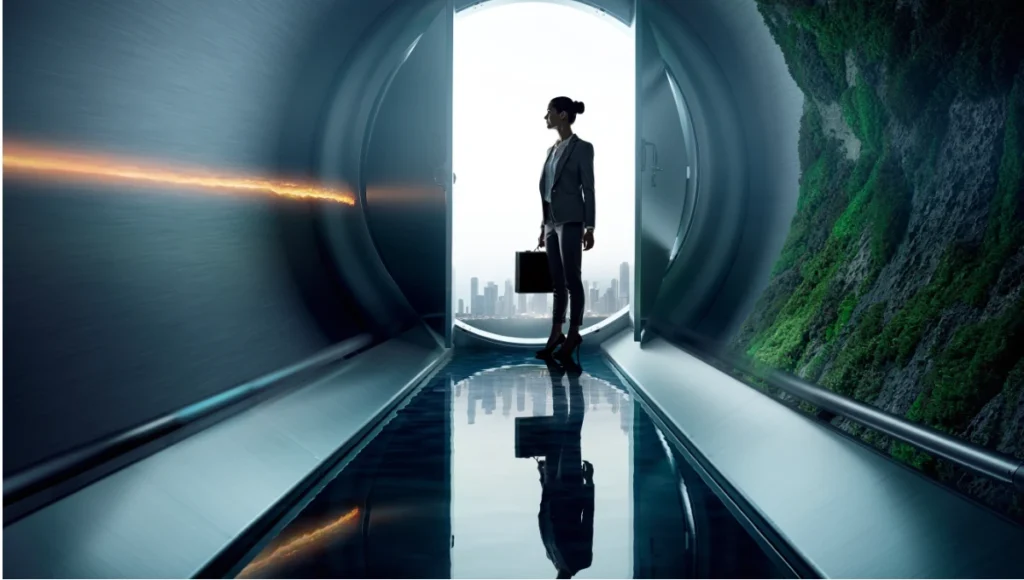
To solve this, we must replace the traditional “terminal”—a place where motion stops—with the “Nexus”—a place where high-velocity transit is woven into the social fabric. Achieving this requires a fundamental shift in Hyperloop Station Design, moving away from the “airport-in-a-city” model toward a decentralized, integrated approach.
The “Blueprint” Solution: 4 Next-Gen Hyperloop Designs
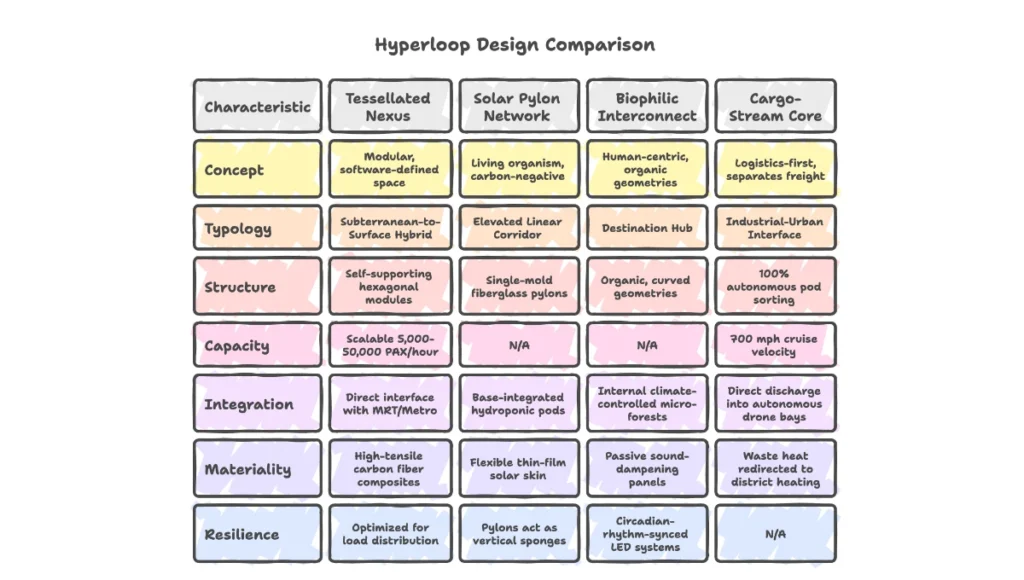
A. The Tessellated Nexus (Modular Urban Infill)
Designed for high-density environments where space is at an absolute premium, this model replaces the “grand hall” with a series of interoperable modules.
- Concept: By utilizing modular vs prefab homes logic at an infrastructure scale, the Nexus can grow or shrink based on real-time population flow. It treats the station as a software-defined space rather than a concrete monolith.
- Typology: Subterranean-to-Surface Hybrid.
- Technical Specs:
- Structure: Self-supporting hexagonal modules in a honeycombed array, optimized for load distribution and seismic flexibility.
- Capacity: Scalable from 5,000 to 50,000 PAX/hour through algorithmic platform allocation.
- Integration: Direct interface with existing MRT/Metro basements using seismic-damping gaskets and “vacuum-lock” seals.
- Materiality: High-tensile carbon fiber composites to reduce dead weight on existing urban foundations.
B. The Solar Pylon Network (Elevated Green-Ways)
This design treats infrastructure as a living organism. By elevating the vacuum tubes on single-mold fiberglass pylons, we reclaim the city floor for the public. This design is the ultimate expression of urban rewilding examples, turning transit corridors into carbon-negative corridors.
- Typology: Elevated Linear Corridor.
- Technical Specs:
- Elevation: 7–10 meters above grade to allow for unimpeded wildlife and pedestrian movement.
- Power: Flexible thin-film solar skin integrated with bladeless wind turbines that harness the “wake effect” of passing pods.
- Ecology: Base-integrated hydroponic pods that contribute to local food security and thermal regulation for the station.
- Resilience: Pylons act as vertical sponges, collecting and filtering rainwater for the surrounding district.
C. The Biophilic Interconnect (Human-Centric Hub)
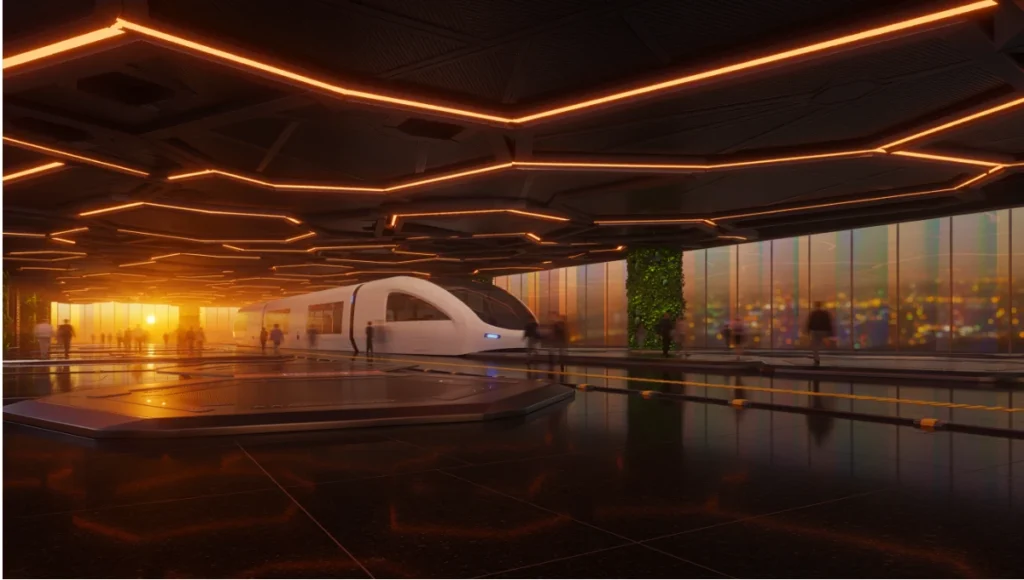
A rejection of the sterile, industrial airport aesthetic. This design uses organic, curved geometries to soften the technical brutality of magnetic levitation. It recognizes that velocity must be balanced with psychological stillness.
- Typology: Destination Hub.
- Technical Specs:
- Air Gap: 15mm magnetic levitation buffer for near-zero vibration and noise.
- Environment: Internal climate-controlled micro-forests utilizing biophilic interior design principles to reduce traveler cortisol levels.
- Acoustics: Passive sound-dampening panels made from recycled mycelium.
- Lighting: Circadian-rhythm-synced LED systems that simulate natural daylight in deep subterranean platforms, ensuring that travelers do not lose their sense of time.
D. The Cargo-Stream Core (Logistics-First Infrastructure)
The “Instant City” requires an infrastructure that can handle the massive throughput of the on-demand economy. This design separates high-speed freight from passenger flows to eliminate logistical bottlenecks.
- Typology: Industrial-Urban Interface.
- Technical Specs:
- Automation: 100% autonomous pod sorting and loading with blockchain-verified cargo tracking.
- Speed: 700 mph cruise velocity for time-sensitive cargo (pharmaceuticals, critical components).
- Last-Mile: Direct discharge into autonomous delivery drone bays located in converted mall adaptive reuse housing projects.
- Thermal Management: Waste heat from vacuum pumps is redirected to local district heating networks, powering adjacent residential zones.
Feasibility Study: The Economic and Political Frontier
The Capital Expenditure (CAPEX) Trap and AIA “Value Capture”
Traditional rail relies on century-old land rights. Hyperloop requires a “clean slate” corridor. The initial investment for a vacuum-sealed system is substantial, ranging from $60M to $100M per mile. However, according to recent AIA (American Institute of Architects) guidelines on transit-oriented development (TOD), the long-term ROI is realized through “Value Capture.”
Value Capture is an economic theory wherein the public sector recoups the cost of infrastructure by taxing the exponential increase in land value that occurs around new transit nodes. The AIA argues that high-performance infrastructure should be funded through multi-generational “Green Bonds,” as its impact outlasts the political cycles that often kill such projects. When a Hyperloop Station Design creates a hub that connects two cities in minutes, the “economic gravity” of those locations shifts, creating a surplus of value that can fund the next 50 years of maintenance.
Regulatory Fragmentation and the Digital Twin Solution
Current safety standards are built for wheels and wings, not pressurized capsules in a vacuum. The lack of a unified “Hyperloop Safety Protocol” creates a legislative bottleneck. We advocate for a “Digital Twin” approach to regulation, where digital twins in smart cities allow regulators to simulate millions of failure scenarios—including seismic events and pressure breaches—before a single passenger boards. This data-first validation is the only way to accelerate the legal framework required for global deployment.
Case Study: The Singapore Paradigm
Singapore serves as the definitive proof-of-concept for the Nuvira ethos. Their Transit-Oriented Development (TOD) model has proven that high-density living is only viable when the “first and last mile” are seamlessly integrated.
By applying Hyperloop logic to the Johor-Singapore link, the city could effectively expand its labor market into a regional “Mega-City” of 10 million people, reducing the cross-border commute from 2 hours to 8 minutes. Singapore’s success is rooted in its refusal to separate “living” from “moving.” It treats infrastructure not as a utility, but as the primary driver of social mobility and regional stability.
Project Spotlight: “The Nuvira Kinetic Atrium” (Rotterdam)
Project Overview
- Location: Rotterdam-Deltas, Netherlands.
- Typology: Multi-Modal Hydro-Terminal.
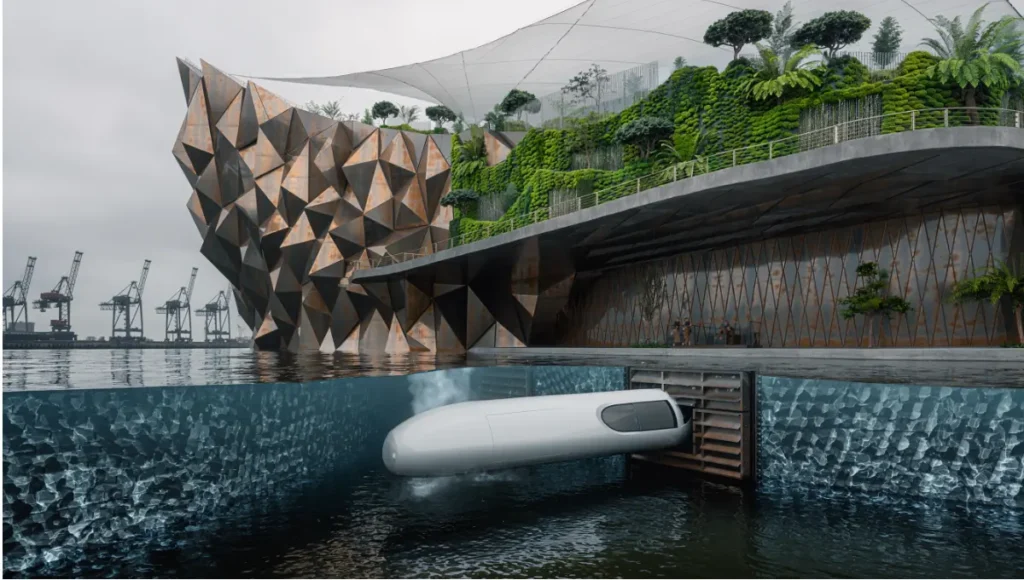
- Vision: A terminal that floats on the Maas river, acting as a gateway for the European Hyperloop network while addressing the floating cities viability in the face of rising sea levels.
Design Levers Applied
- Hydro-Kinetic Stability: The station uses tidal energy to power the terminal’s internal systems, creating a self-sustaining energy loop.
- Dynamic Docking: Pods arrive in a “wet-dock” vacuum seal, allowing for instant passenger discharge into water-taxi hubs.
- Adaptive Facade: Utilizing kinetic architecture facades to manage solar gain and internal temperature without mechanical cooling.
- Technical Specs: – Operational Pressure: 1 mbar (equivalent to the atmospheric pressure at 50km altitude).
- Energy Profile: Net-positive (exports 12% power to city grid).
- Materiality: 3D-printed carbon-negative concrete foundations that double as artificial reefs.
2030 Future Projection: The Death of the Commute
By 2030, the “commute” will be an obsolete concept. We project the emergence of the 100-Mile Neighborhood, where the distance between Paris and Amsterdam is functionally equivalent to a walk across a park.
The metropolitan fabric will move from a radial “hub and spoke” model to a decentralized “mesh” of velocity nodes. This shift will allow for the decentralization of the workforce, breathing life back into rural communities while maintaining urban efficiency. This is the ultimate goal of advanced Hyperloop Station Design: to make the physical location of your home irrelevant to the location of your work.
Comprehensive Technical FAQ
Q: Is the vacuum environment safe for humans?
A: Yes. Pods are designed as pressure vessels similar to aircraft fuselages, maintaining 1-atm (sea level) standards internally. The vacuum exists only in the tube to eliminate drag. In the event of a breach, emergency air-locks and automated repressurization systems (using high-capacity Roots pumps) deploy within 0.5 seconds.
Q: How does the system handle seismic activity?
A: Our pylons use Active Vibration Isolation (AVI) and flexible expansion joints. Furthermore, by using graphene in construction, we can achieve tensile strengths that allow the tube to shift up to 2 meters without losing vacuum integrity. The system is designed to withstand a Magnitude 9.0 event.
Q: Will tickets be affordable for the average citizen?
A: Unlike high-speed rail, Hyperloop’s low operational cost—driven by zero friction and 100% renewable energy—allows for dynamic pricing models. We anticipate fares that compete with regional bus tickets. The goal is mass-market accessibility, not elite travel.
Q: How do you integrate these stations into existing heritage cities?
A: We utilize retrofitting brutalist architecture and other historic structures as “shells” for our modular Nexus modules, preserving the aesthetic soul of the city while upgrading its kinetic heart.
Critical Analysis: The Sociological Impact of High Velocity
The introduction of 700 mph transit is not just an engineering feat; it is a sociological disruption. When distance is removed from the equation, we risk the “homogenization” of culture. If every city is 10 minutes away, does every city start to look the same?
Nuvira’s approach to Hyperloop Station Design combats this through “Hyper-Local Integration.” By using materials and biophilic elements specific to each region, the station acts as a gateway that celebrates the destination rather than just the journey. We are building “Place-Makers,” not just “People-Movers.”
Structural Engineering: The Mechanics of the Tube
The Hyperloop tube is perhaps the most demanding structural element in modern architecture. It must maintain a near-vacuum over hundreds of miles while resisting thermal expansion.
- Thermal Management: Steel tubes can expand up to 300 meters over a 100-mile stretch due to temperature changes. We solve this through modular expansion joints and specialized coatings.
- The Pumping Array: Vacuum integrity is maintained through a distributed network of industrial pumps. By clustering these pumps at the station nodes, we centralize maintenance and noise management, keeping the corridors silent.
The Future is Frictionless
We are no longer asking if the city will change, but how fast you are willing to move. The infrastructure of the past is a cage; the infrastructure of Nuvira is an invitation. The AIA has long advocated for architecture that serves the public good; we believe that velocity is the ultimate public good.
A successful Hyperloop Station Design is one that disappears into the background of a well-lived life. It is the silent partner in your morning coffee in one city and your afternoon meeting in another. It is the end of the commute and the beginning of a truly connected humanity.
Join the Recalibration.