

Table of Contents
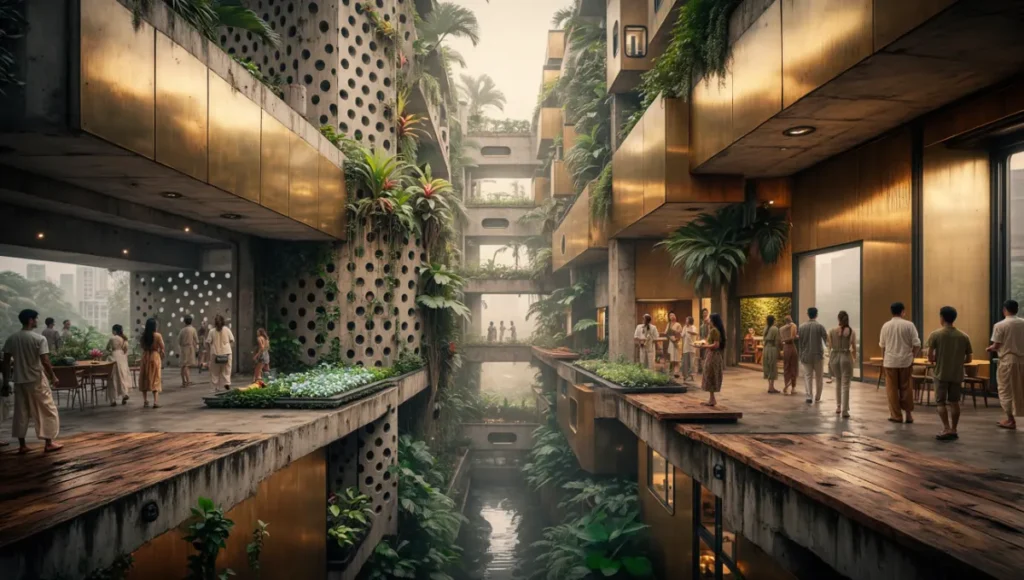
The radical transition toward mall adaptive reuse housing represents the final frontier in our battle against metropolitan obsolescence and the dystopian sprawl of the 20th century.
Key Takeaways
- Asset Recalibration: Transforming underutilized retail “super-boxes” into high-density housing reduces embodied carbon by up to 75% compared to new construction.
- Infrastructure Synergy: Mall conversions act as anchors for Transit-Oriented Development (TOD), utilizing existing parking footprints for green mobility hubs.
- Societal Value: Moving beyond the “dead mall” trope, these projects create “15-minute neighborhoods” that address the global housing crisis and urban isolation.
- Nuvira Logic: Success requires a shift from rigid zoning to fluid, data-driven “Human-Machine Synthesis” in urban planning.
Nuvira Perspective
At Nuvira Space, we view the dying shopping mall not as a tomb of 20th-century consumerism, but as a biological scaffold awaiting a new neural network. We believe the future of the city lies in the radical recalibration of the metropolitan fabric through data-driven design. By treating massive retail footprints as modular substrates, we can synthesize human living requirements with machine-optimized resource management. Our approach transcends mere “renovation”; we are engaged in the surgical extraction of societal value from architectural obsolescence, ensuring that the cities of 2030 are not just survived, but engineered for peak human-machine synergy.
The “Blueprint” Solution: Beyond the Big Box
The dystopian reality of current city planning is its reliance on “tabula rasa”—the destructive urge to level the old to build the “smart.” A more disruptive, resilient approach lies in the Mall Adaptive Reuse Housing model. We must strip the retail shell to its structural essence and re-program it for the 2030 citizen.
The American Institute of Architects (AIA) has frequently highlighted that the greenest building is the one that already exists. In their advocacy for adaptive reuse, the AIA emphasizes that these projects are not merely architectural exercises but essential carbon-reduction strategies. By bypassing the carbon-heavy process of pouring new concrete foundations, we leverage the existing structural integrity of the mall—the deep-piled foundations and heavy-load-bearing steel frames—to create a new urban typology.
Technical Specifications for the Reimagined Mall
- Structural Peeling: Removing central roof sections to create open-air “atrium forests” that provide natural light and passive ventilation to deep-floorplate residential units. This method utilizes kinetic architecture facades to manage solar gain dynamically.
- Micro-Grid Integration: Utilizing vast rooftop acreages for solar harvesting and greywater reclamation systems that serve the entire residential community.
- Modular Unit Insertion: Deploying prefabricated “living pods” that can be slotted into existing 30×30 foot structural bays, reducing onsite waste. This often involves robotic fabrication in architecture to ensure millimeter-precision fitment within aging skeletons.
- Hyper-Mixed-Use Zoning: Erasing the line between “residential” and “commercial” to allow for vertical co-working, urban hydroponics, and healthcare clinics within the same climate-controlled envelope. This is the cornerstone of the 15-minute city feasibility model.
Feasibility Study: Economic and Political Barriers
The transition is currently throttled by antiquated legislative frameworks. To realize a world of mall adaptive reuse housing, we must confront the “Zoning Deadlock.”
The Financial-Political Friction
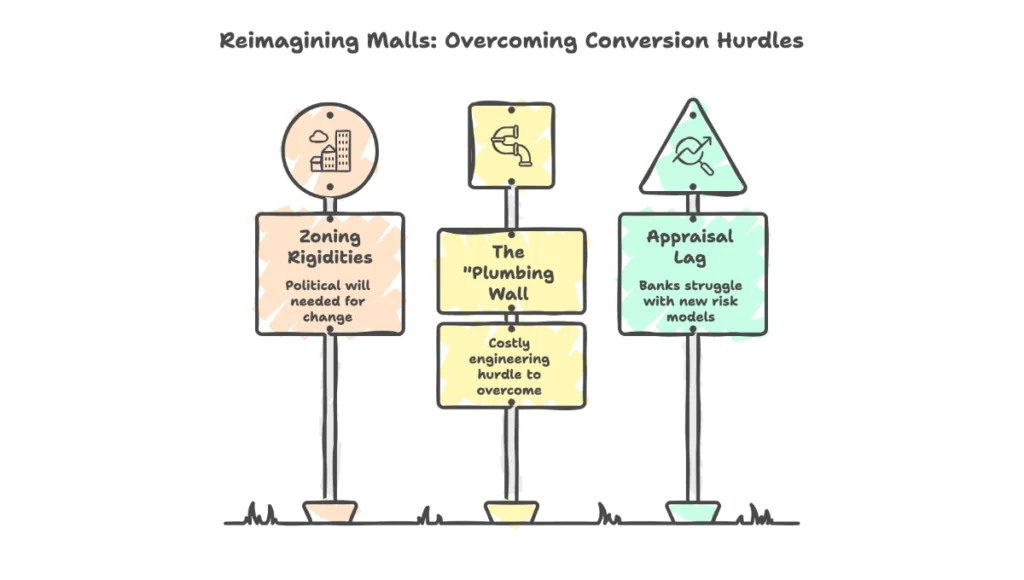
- Zoning Rigidities: Most suburban malls are zoned strictly for commercial use. Re-designating these as high-density residential zones requires a political will that often fears “neighborhood character” shifts.
- The “Plumbing Wall”: Converting a space designed for two massive bathrooms (the food court) into a space for 300 individual bathrooms is a cost-heavy engineering hurdle. Modern solutions now look toward vacuum plumbing systems, similar to those used in aerospace, to circumvent gravity-fed limitations.
- Appraisal Lag: Banks struggle to value a “reimagined mall” because it doesn’t fit the standard multifamily risk model.
Proof of Concept: Singapore’s Vertical Resilience
To ground this analysis, we look to Singapore. As a city-state with finite land, Singapore has mastered the “Human-Machine Synthesis” of space. The Urban Redevelopment Authority (URA) doesn’t just plan buildings; they plan ecosystems. In districts like Paya Lebar, we see the early stages of this transition—integrated hubs where transit, retail, and living quarters are so tightly woven that the “mall” ceases to be a destination and becomes a circulatory system.
This macro-environmental context proves that high-density adaptive reuse is not a speculative dream, but a prerequisite for survival in land-scarce, data-rich environments. Singapore utilizes digital twins for smart city management to simulate the thermal impact of these massive conversions before a single beam is cut.
The AIA Case Study Framework: Resilience in Action
The AIA’s “Framework for Design Excellence” provides a lens through which we can evaluate the success of mall-to-housing conversions. A notable example is The Arcade Providence in Rhode Island. Built in 1828, it is the nation’s oldest indoor shopping mall. Its transformation into micro-lofts serves as a historical precedent for our modern suburban dilemma.
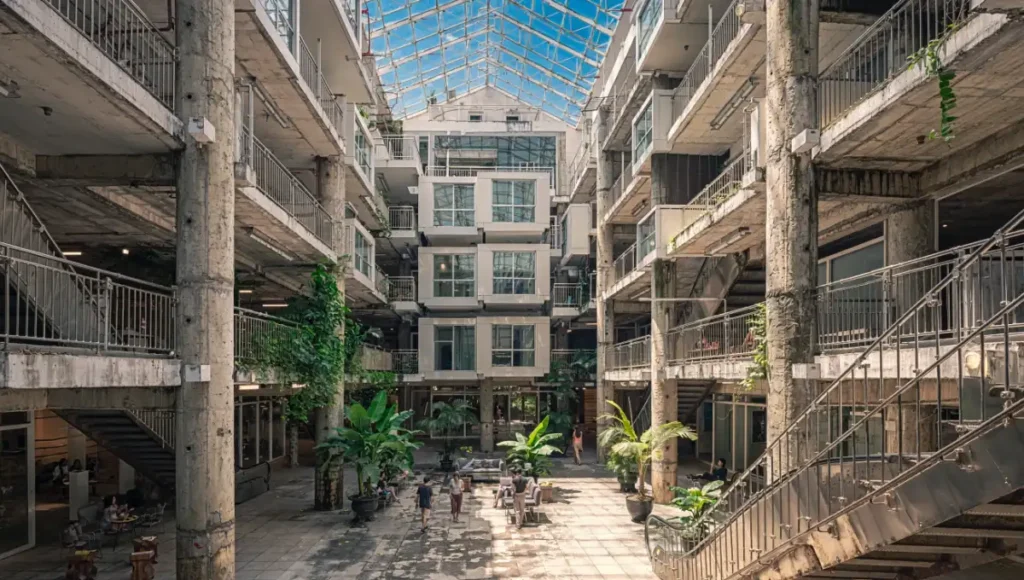
While the scale of a 19th-century arcade differs from a 1970s megamall, the principle remains: The preservation of the “Social Spine.” By maintaining the central atrium as a public or semi-public commons, the project avoided the isolation common in modern apartment blocks.
Concept Project Spotlight: “Neural Hive 01” by Nuvira Space
Speculative / Internal Concept Study: “Neural Hive 01”
Project Overview
- Location: Resilient Urban Zone (RUZ) – Former Suburban Megamall
- Typology: Kinetic Residential / Bio-Digital Commons
- Vision: A self-sustaining habitat that treats the mall’s original steel skeleton as a trellis for vertical forestation and AI-managed micro-housing.
Design Levers Applied
- Automated Spatial Allocation: AI sensors track occupancy levels to adjust lighting, heating, and even wall positions in common areas.
- The “Voxel” Apartment: 350sqft modular units that share a centralized “utility spine” for energy and water efficiency, optimized through generative AI in architecture.
- Transit-Linked Foundation: The former underground parking garage is converted into an autonomous shuttle terminal and drone delivery port.
Transferable Takeaway
The “Neural Hive” proves that the mall’s greatest asset isn’t its floor space, but its existing connectivity to power, water, and transit networks. We aren’t just building housing; we are deploying an urban operating system.
The Sociological Imperative: Solving the Loneliness Epidemic
Current suburban planning induces isolation. Huge parking lots act as moats, separating the individual from the community. Mall adaptive reuse housing offers a “Common Interiority.”
By repurposing the vast interior hallways of malls into “internal streets” lined with stoops, cafes, and co-working pockets, we foster incidental social interactions. This is the application of neuroarchitecture basics—designing spaces that actively reduce cortisol levels and encourage oxytocin through community visibility.
Technical Deep-Dive: Overcoming the Deep Floor Plate
The primary architectural challenge of the mall is its depth. A typical retail floor plate can be 200 feet deep, making it impossible for light to reach the center.
Solution A: The “Light Well” Perforation Using robotic fabrication, we surgically remove sections of the concrete deck to create light wells. These wells aren’t just voids; they are programmed with vertical gardens, using vertical forests evolution to scrub interior air.
Solution B: The “Active Façade” The windowless exterior walls of Department stores (Sears, Macy’s) are replaced with smart glass technology that adjusts transparency based on the sun’s position, ensuring privacy for residents while maximizing lumen intake.
2030 Future Projection
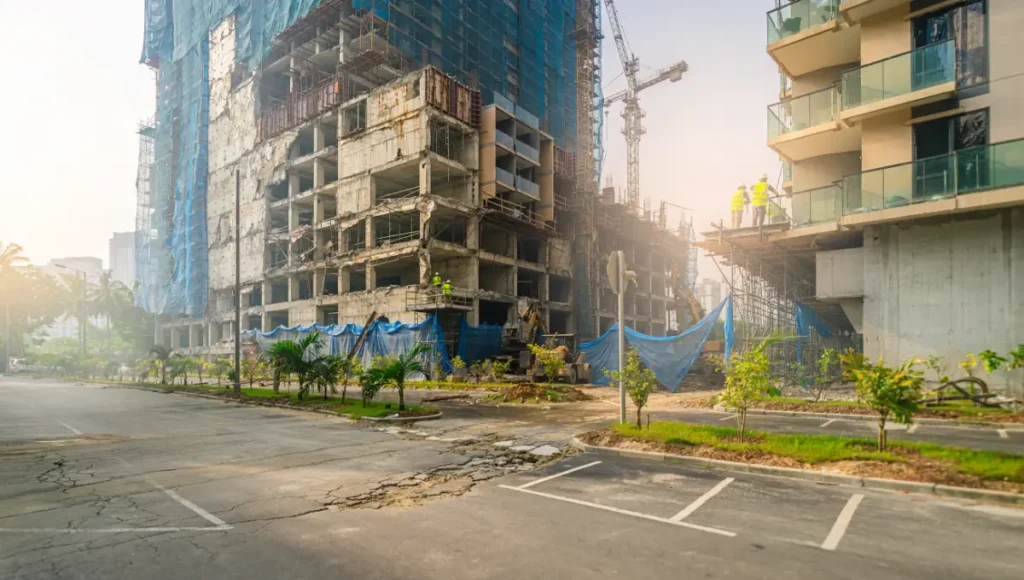
By 2030, the “Shopping Mall” will be an archaic term. We project a landscape where the Mall Adaptive Reuse Housing model has evolved into “Urban Nuclei.” These will be carbon-negative zones where the distinction between “machine” and “nature” is blurred by bio-integrated facades and algorithmic resource sharing.
We expect to see the integration of circular construction design where the mall itself becomes a material bank. If a residential pod needs to be upgraded, the old materials are recycled on-site within the mall’s own fabrication lab.
Comprehensive Technical FAQ
Q: How does adaptive reuse impact the carbon footprint compared to demolition?
A: Adaptive reuse is the ultimate carbon-mitigation strategy.
- Embodied Carbon: Retaining the foundation and steel frame saves ~50-75% of a building’s total life-cycle carbon.
- Waste Diversion: Prevents thousands of tons of concrete from entering landfills.
- Operational Efficiency: Reimagined malls use 40% less energy when retrofitted with Nuvira’s “Smart-Skin” technology and net-zero vs net-positive systems.
Q: Is mall-to-housing conversion economically viable for low-income residents?
A: Yes, through “Infrastructural Subsidy.” Because the land and shell already exist, developers can allocate a higher percentage of units to affordable housing if government incentives offset the plumbing and HVAC costs. Using 3d printed neighborhoods techniques for interior partitions can further drive down costs.
Q: What are the structural limitations of converting retail loads to residential?
A: Generally, retail floors are designed for higher “live loads” (people and stock) than residential floors. This means the mall skeleton is actually “over-engineered” for housing, allowing for the addition of heavy features like rooftop gardens or mycelium furniture showrooms without requiring structural reinforcement.
THE FUTURE IS RECLAIMED. JOIN THE SYNTHESIS.
The era of the “Dead Mall” is over. The era of the “Living Core” has begun. We are not just building apartments; we are re-coding the city. The transition from consumerism to community-driven urbanism is the defining architectural challenge of our decade.
Contact Nuvira Space to consult on your next metropolitan recalibration project.