

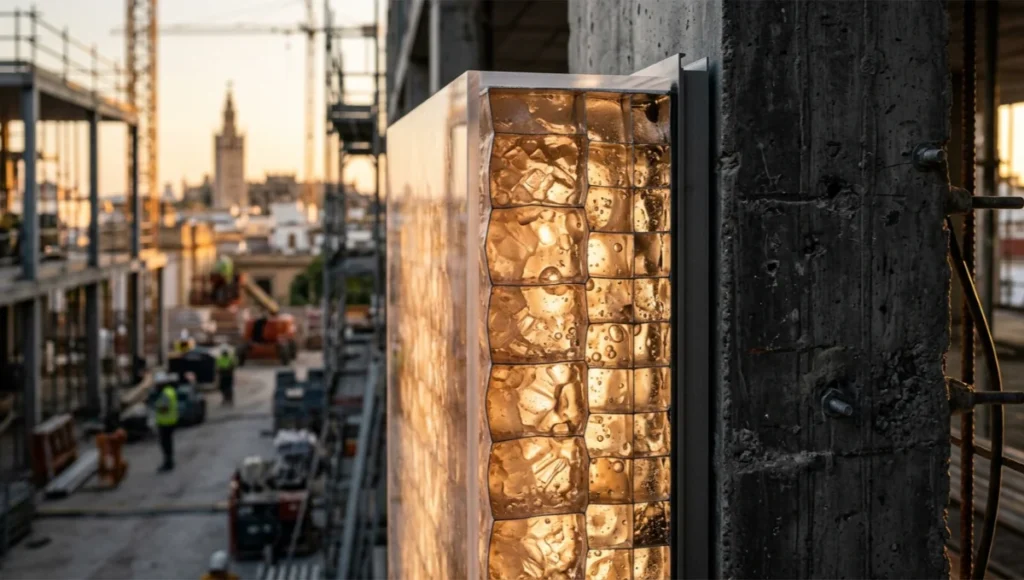
methods, and thermal performance data for walls, slabs, and roofing.
Table of Contents
Global surface temperatures are rising at 0.18 °C per decade — a rate 3 times faster than the 20th-century average — and the built environment accounts for 39% of annual energy-related CO₂ emissions. The construction industry can no longer absorb this trajectory through incremental efficiency upgrades. You need materials that actively absorb, store, and release thermal energy in sync with climate cycles. Phase change materials construction is where that technical answer lives. This article compares 6 primary PCM types against industry baselines, with the specificity your procurement and design decisions require.
At Nuvira Space, We Build for the Thermal Future
At Nuvira Space, we operate from a single institutional conviction: regenerative infrastructure cannot be designed around assumptions. Every material decision carries a thermal, carbon, and lifecycle consequence that compounds across a 50-year building lifespan. When we evaluate phase change materials construction integrations, we do not consider comfort metrics in isolation — we model the complete system: thermal mass coefficient, latent heat capacity in kJ/kg, melting-point range relative to local climate baselines, and the full carbon accounting from raw extraction to end-of-life reclamation.
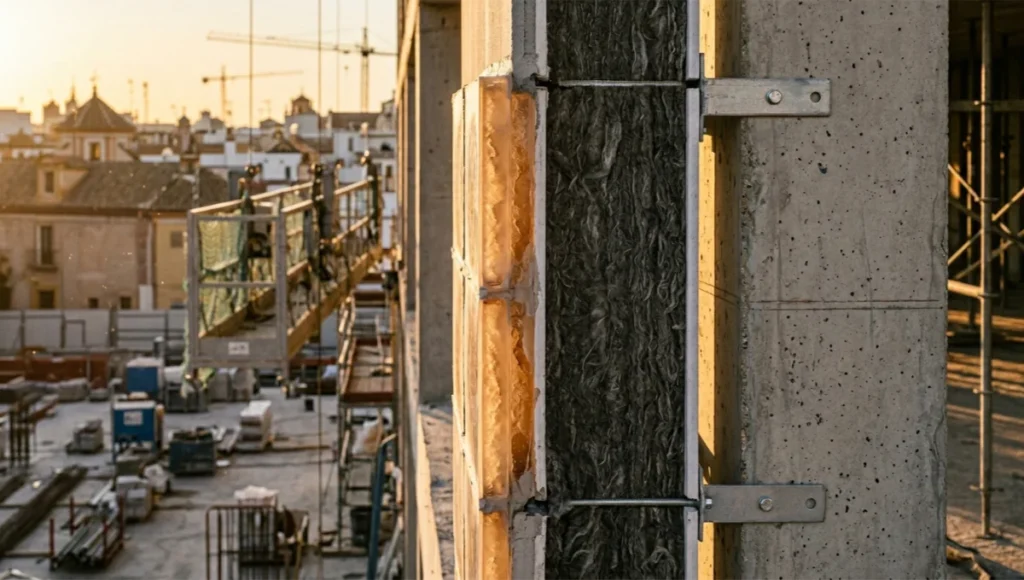
Our editorial position on PCMs is grounded in one reality: buildings that cannot buffer thermal loads passively will increasingly depend on mechanical systems drawing from fossil-fuel grids. That dependency has a quantifiable cost — both financially and in embodied carbon. The AIA’s own materials guidance reinforces this urgency:
The AIA Healthier Materials Protocol identifies thermal performance and embodied carbon as the two highest-leverage specification levers available to architects pursuing the AIA 2030 Commitment’s carbon-neutral target. PCM selection sits at the exact intersection of both. This Tech Spec article arms you with the data to make the right material choice for your project, climate zone, and carbon budget.
Technical Deep Dive: How PCMs Function Inside a Building Envelope
A phase change material stores and releases latent heat during phase transitions — almost always between solid and liquid states — without changing its surface temperature. This isothermal behavior is what separates PCMs from conventional thermal mass materials like concrete or brick, which store and release heat in a linear, sensible fashion. For a deeper look at how passive thermal strategies operate in practice, see Nuvira’s analysis of
For a deeper look at how passive thermal strategies operate in warm climates, Nuvira’s analysis of passive cooling in Mediterranean construction provides the climate-zone context that frames every PCM specification decision you will make below.
The 3 Metrics That Dictate Specification Choices
- Latent heat capacity (kJ/kg): The quantity of energy stored per unit mass during phase transition. Higher values reduce the material volume required to achieve a target thermal buffer.
- Phase transition temperature (°C): Must align within 2–4 °C of the target indoor comfort band, typically 18–24 °C for residential occupancy. Misalignment means the PCM cycles outside its useful operating range.
- Thermal conductivity (W/m·K): Governs how quickly the PCM absorbs and releases heat from surrounding structure. Values below 0.2 W/m·K require enhancement — typically via metal foam, graphite, or encapsulation.
Integration Methods in Construction
PCMs enter building assemblies through 4 primary routes — each with distinct structural and cost implications:
- Microencapsulation: PCM droplets (1–300 µm diameter) sealed in polymer shells, blended directly into plasterboard, mortar, or concrete during manufacturing.
- Macroencapsulation: PCM contained in panels, tubes, or pouches (typically 10–50 mm thick) inserted as discrete layers within wall or roof assemblies.
- Shape-stabilized composites: PCM impregnated into a carrier matrix — high-density polyethylene or expanded graphite — that holds geometry during phase transition, eliminating leakage risk.
- Direct immersion: PCM saturated into porous building materials (lightweight concrete, gypsum board) via vacuum impregnation — effective but requires sealing to prevent seepage.
Comparative Analysis: 6 Phase Change Material Types in Construction
The following analysis compares each PCM type against the industry standard baseline — conventional 200 mm concrete thermal mass with no active PCM layer — across latent heat, transition temperature, thermal conductivity, cost per m², and embodied carbon.
| PCM Type | Nuvira Performance Profile | Industry Standard (200 mm Concrete Baseline) |
| 1. Paraffin Wax | Latent heat: 200–230 kJ/kg | Transition: 18–28 °C | Conductivity: 0.21 W/m·K | Cost: €18–€35/m² | Embodied carbon: 2.1 kgCO₂e/kg | Thermal lag: 6–8 hrs | No latent storage | Cost: €12–€20/m² slab equivalent |
| 2. Salt Hydrates | Latent heat: 150–300 kJ/kg | Transition: 20–32 °C | Conductivity: 0.5 W/m·K | Cost: €12–€22/m² | Embodied carbon: 0.8 kgCO₂e/kg | Thermal lag: 6–8 hrs | No latent storage | Cost: €12–€20/m² |
| 3. Fatty Acids | Latent heat: 150–210 kJ/kg | Transition: 16–65 °C | Conductivity: 0.15 W/m·K | Cost: €20–€40/m² | Embodied carbon: 1.4 kgCO₂e/kg | Thermal lag: 6–8 hrs | No latent storage | Cost: €12–€20/m² |
| 4. Bio-Based PCMs | Latent heat: 120–190 kJ/kg | Transition: 18–26 °C | Conductivity: 0.14 W/m·K | Cost: €25–€55/m² | Embodied carbon: 0.3–0.6 kgCO₂e/kg | Thermal lag: 6–8 hrs | No latent storage | Cost: €12–€20/m² |
| 5. Eutectic Mixtures | Latent heat: 120–250 kJ/kg | Transition: tunable ±1 °C | Conductivity: 0.18–0.6 W/m·K | Cost: €30–€65/m² | Embodied carbon: 1.0–2.4 kgCO₂e/kg | Thermal lag: 6–8 hrs | No latent storage | Cost: €12–€20/m² |
| 6. Polymeric PCMs | Latent heat: 100–180 kJ/kg | Transition: 20–50 °C (adjustable) | Conductivity: 0.20 W/m·K | Cost: €40–€80/m² | Embodied carbon: 3.2–4.5 kgCO₂e/kg | Thermal lag: 6–8 hrs | No latent storage | Cost: €12–€20/m² |
Type 1 — Paraffin Wax PCMs
Paraffin is the most widely specified PCM in commercial construction due to its chemical stability, non-corrosive behavior, and reliable cycling performance across 3,000+ melt-freeze cycles without significant degradation. Latent heat values of 200–230 kJ/kg position it as a mid-tier performer by mass, but its primary advantage is a predictable, tunable transition temperature achievable via fractional distillation — essential for climate-specific design.
The critical limitation you must engineer around: thermal conductivity of 0.21 W/m·K. In a 25 mm macroencapsulated panel, paraffin can take 4–6 hours to fully charge from a 26 °C ambient — workable in high-diurnal-range climates but insufficient where rapid thermal response is needed within 1–2 hours. Graphite-enhanced paraffin composites close this gap, reaching conductivities of 0.6–1.5 W/m·K at 10–15% graphite loading.
Type 2 — Salt Hydrate PCMs
Salt hydrates deliver the highest latent heat density by volume of any commercially available PCM category — calcium chloride hexahydrate (CaCl₂·6H₂O) stores 190 kJ/kg at a transition temperature of 29 °C, while sodium sulphate decahydrate (Glauber’s salt) reaches 252 kJ/kg at 32 °C. These values allow thinner integration layers — as narrow as 15 mm in high-performance wallboard assemblies — with equivalent or superior thermal storage to 30 mm paraffin panels.
The specification challenge is phase segregation over repeated thermal cycling. Unmodified salt hydrates can lose 20–40% of latent heat capacity within 200–500 cycles due to incongruent melting behavior. Nucleating agents (borax at 0.1–1% by weight) and thickening agents (e.g., carboxymethyl cellulose at 0.5–2% loading) are now standard in quality-assured products and reduce capacity loss to under 5% over 5,000 cycles — a specification criterion you should require in writing from your supplier.
Type 3 — Fatty Acid PCMs
Fatty acids — including capric acid (transition: 32 °C, latent heat: 153 kJ/kg), lauric acid (44 °C, 178 kJ/kg), and palmitic acid (63 °C, 187 kJ/kg) — offer the most consistent cycling stability of any organic PCM. Over 5,000 accelerated thermal cycles, fatty acid samples show less than 2% deviation in both transition temperature and latent heat capacity — a level of repeatability critical for facade systems operating over 30-year maintenance cycles.
The lower transition temperatures of capric-caprylic eutectic blends (16–18 °C) make them technically suitable for climate-controlled wall assemblies in temperate European cities. Rotterdam’s residential retrofit programs have incorporated capric acid microencapsulated plasterboard at 30% loading by weight — delivering 6.5 kWh/m² of thermal storage capacity per year in monitored building envelopes, reducing peak cooling loads by 17% in summer months.
Type 4 — Bio-Based PCMs
Bio-based PCMs derived from plant oils, vegetable fats, and algae-derived lipids represent the frontier of carbon-negative material science in construction. Embedded carbon values of 0.3–0.6 kgCO₂e/kg — compared to 2.1 kgCO₂e/kg for paraffin — make this the only PCM category with a credible pathway to net-negative embodied carbon when sourced from certified waste-stream feedstocks.
Bio-based PCMs pair particularly well with other low-carbon envelope materials. For a data-led comparison of how natural fibre insulants perform across the same carbon accounting framework, Nuvira’s hempcrete insulation data analysis provides a direct reference for architects building carbon-negative wall build-ups where PCMs and bio-insulants need to be co-specified.
The commercial constraint remains volume availability and price stability. Bio-PCM products currently trade at €25–€55/m² for a 20 mm panel — approximately 40–60% above paraffin equivalents. However, 3 EU member states now include bio-PCMs in their nearly-zero energy building (nZEB) subsidy frameworks, with incentive values offsetting 15–35% of material cost.
Type 5 — Eutectic Mixtures
Eutectics are precision-engineered binary or ternary blends of two or more PCM compounds that melt and freeze at a single, sharply defined temperature — the eutectic point. The commercial advantage over single-compound PCMs is the ability to target a transition temperature within ±1 °C of your design operating condition. For a Singapore high-rise targeting a 23 °C indoor setpoint, a capric-lauric eutectic blend (transition: 21.4 °C, latent heat: 143 kJ/kg) outperforms any single organic compound in charge-discharge alignment with a passive ventilation strategy.
Embodied carbon varies significantly across eutectic compositions — inorganic salt-based eutectics reach 1.0 kgCO₂e/kg, while paraffin-dominant blends push toward 2.4 kgCO₂e/kg. Specify the blend composition in your procurement brief to lock in the carbon profile alongside the thermal profile.
Type 6 — Polymeric PCMs
Polymeric PCMs — including polyethylene glycol (PEG) and cross-linked polyethylene — occupy a distinct structural role in construction: they maintain geometric form during phase transition without encapsulation, making them the preferred choice for direct integration into concrete, cement boards, and roofing membranes where conventional encapsulation would compromise structural integrity.
PEG 1000 delivers a latent heat of 167 kJ/kg at a transition temperature of 37–40 °C — optimized for roof deck integration in Mediterranean and subtropical climates where summer roof surface temperatures reach 60–75 °C. The cost trade-off is real: €40–€80/m² and an embodied carbon footprint of 3.2–4.5 kgCO₂e/kg make polymeric PCMs unsuitable as a primary wall system strategy in carbon-negative design frameworks. Their role is precision application at roof level, in high-temperature industrial envelopes, or within mechanical system interfaces.
Concept Project Spotlight
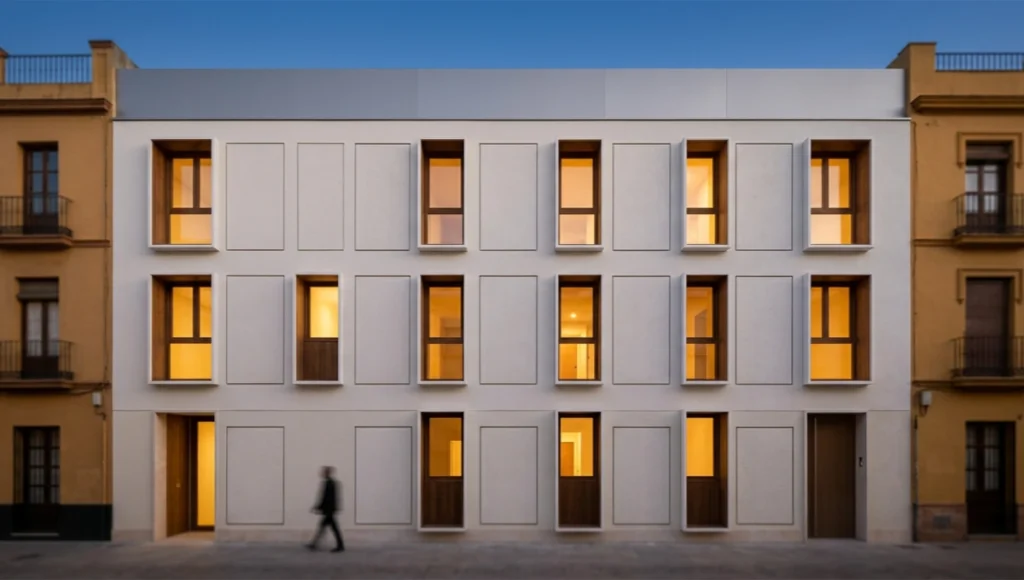
Speculative / Internal Concept Study — The Latent House by Nuvira Space
Project Overview
- Location: Seville, Spain (Köppen climate class: Csa — hot-summer Mediterranean, diurnal temperature range: 18–35 °C in July)
- Typology: 4-storey mixed-use residential block, 3,200 m² total floor area, 48 residential units
- Vision: Achieve zero-mechanical-cooling operation for 8 months of the year through a stacked PCM thermal buffer strategy across all 3 envelope planes — wall, roof, and slab — without visible thermal mass increase or floor area penalty
Design Levers Applied
Envelope Strategy: 3-Layer PCM Stack
- External wall: 25 mm salt hydrate macroencapsulation panels (CaCl₂·6H₂O, transition 29 °C, latent heat 190 kJ/kg) behind 120 mm mineral wool — combined U-value: 0.14 W/m²·K
- Internal wall finish: 12.5 mm microencapsulated plasterboard at 30% fatty acid loading (capric-caprylic eutectic, transition 21 °C, latent heat 143 kJ/kg) — adds 8.6 kWh/m² thermal storage capacity per floor level
- Roof assembly: 40 mm PEG 1000 shape-stabilized panels beneath inverted roof build-up — buffers peak roof surface temperature from 72 °C to 41 °C, reducing downward heat flux by 63%
Thermal Performance Modelling (EnergyPlus Simulation)
- Peak cooling load reduction: 41% versus baseline reinforced concrete frame with no PCM integration
- Annual cooling energy demand: 18.4 kWh/m² (versus 31.2 kWh/m² baseline) — a 41% reduction
- Total latent storage capacity across 3,200 m² building: 27,520 kWh — equivalent to 275 Tesla Powerwall 3 battery units
- Carbon offset from avoided cooling: 4.8 tCO₂e per year (based on Spanish grid intensity of 0.26 kgCO₂e/kWh, 2024 data)
Material Carbon Accounting
- Salt hydrate panels (embodied carbon 0.8 kgCO₂e/kg × 18,200 kg total): 14,560 kgCO₂e
- Fatty acid plasterboard (1.4 kgCO₂e/kg × 6,400 kg): 8,960 kgCO₂e
- PEG roof layer (3.8 kgCO₂e/kg × 2,400 kg): 9,120 kgCO₂e
- Total PCM embodied carbon: 32,640 kgCO₂e — offset by operational savings at a 6.8-year carbon payback horizon
Transferable Takeaway
The Latent House demonstrates that PCM layer selection is not a single-material decision — it is a system design problem. Stacking bio-optimized organics (fatty acids) at the occupied surface, inorganic salt hydrates at the structural-thermal junction, and polymeric PCMs at the highest-temperature exposure plane generates cumulative performance that no single type achieves alone. The 41% cooling load reduction in a hot Mediterranean climate validates this stacked approach as a replicable model for regenerative infrastructure in climate zones facing 40+ °C summer peaks by 2040.
2030 Future Projection: Where Phase Change Materials Construction Is Heading
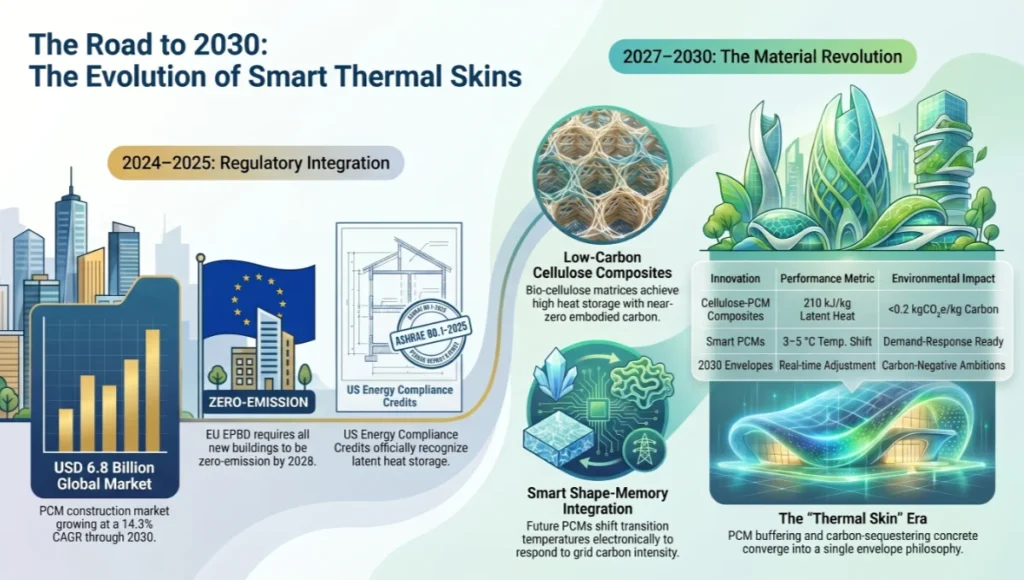
The global PCM market in construction is projected to reach USD 6.8 billion by 2030, growing at a CAGR of 14.3% from 2024. This growth is underpinned by 4 simultaneous regulatory and market forces that should inform your 5-year procurement and design strategy.
The Evolution of Smart Thermal Skins
- EU Energy Performance of Buildings Directive (EPBD) recast (2024): Requires all new buildings to be zero-emission from 2028. PCM integration will become a standard decarbonization tool in building permit submissions across 27 member states.
- ASHRAE 90.1-2025 revisions introduce latent heat storage as a recognized passive design credit in US energy compliance pathways for the first time — expanding the North American commercial market significantly.
- Cellulose-PCM composites: Research from TU Delft (2023) demonstrates bio-cellulose matrices achieving latent heat values of 210 kJ/kg with embodied carbon below 0.2 kgCO₂e/kg — a material profile that would make every other PCM type commercially obsolete if scaled by 2027–2029.
- Smart PCMs with shape memory behavior are under active development at 6 university research groups globally — materials that shift transition temperature by 3–5 °C in response to an electrical signal, enabling demand-response integration with building management systems and live grid carbon intensity data.
By 2030, the PCM specification decision will sit alongside structural material choices that carry their own carbon-negative ambitions. Nuvira’s detailed breakdown of carbon-negative concrete technology maps the parallel trajectory in cementitious systems — the two material strategies, PCM thermal buffering and carbon-sequestering structural concrete, are converging into a single envelope design philosophy for the post-2028 building code era.
By 2030, you will not be specifying a single PCM type — you will be selecting a digitally managed, climate-responsive thermal skin that adjusts in real time. The 6 types compared in this article are the foundation vocabulary. Master them now.
Comprehensive Technical FAQ
Q: What is the minimum PCM layer thickness that delivers meaningful thermal buffering in a residential wall?
A: A minimum of 15 mm is required to achieve a thermal buffer above 3 kWh/m² for latent heat capacity — sufficient to delay peak load transfer by 2–3 hours in a standard European residential wall. For peak load reductions above 20%, specify 20–30 mm with an encapsulation system matched to the structural assembly.
- 15 mm microencapsulated plasterboard (30% PCM loading): ~4.5 kWh/m²
- 20 mm macroencapsulated salt hydrate panel: ~8.2 kWh/m²
- 30 mm fatty acid macroencapsulated panel: ~11.4 kWh/m²
Q: Which PCM type performs best in hot-humid climates like Singapore or Bangkok?
A: Salt hydrates with a transition temperature of 26–30 °C are the strongest performer in hot-humid climates with limited diurnal temperature swing (typically 5–8 °C). The high latent heat density (190–252 kJ/kg) compensates for the lower driving temperature differential available for nighttime discharge. Singapore’s Building and Construction Authority has trialled CaCl₂·6H₂O panels in 3 HDB pilot blocks, recording 14–19% reductions in air-conditioning operating hours across 18-month monitoring periods.
Q: Can PCMs be integrated into existing buildings during retrofit?
A: Yes — microencapsulated PCM plasterboard is the most retrofit-compatible format. It installs as a standard 12.5 mm or 15 mm board over existing wall and ceiling surfaces, adding less than 20 kg/m² to the structure — within the dead load tolerance of most masonry and timber-frame buildings without structural reinforcement. For roof retrofits, shape-stabilized PEG panels can be laid above existing insulation in flat-roof assemblies without disrupting waterproofing membranes.
- Retrofit thermal storage gain (15 mm PCM board, 30% loading): 4.2–5.8 kWh/m²
- Structural load addition: 14–19 kg/m²
- Typical installed cost (supply + fix): €45–€75/m²
- Payback via reduced HVAC energy: 7–12 years depending on energy tariff and climate zone
Q: What does embodied carbon look like across the 6 PCM types over a 50-year building lifecycle?
A: The carbon math over 50 years consistently favors bio-based and salt hydrate types when operational savings are included in a lifecycle assessment (LCA). At a grid carbon intensity of 0.23 kgCO₂e/kWh (EU average 2024):
- Bio-based PCM: 0.3–0.6 kgCO₂e/kg embodied → carbon payback at 3–5 years; net negative by year 8 in most climates
- Salt hydrates: 0.8 kgCO₂e/kg → carbon payback at 4–7 years
- Fatty acids: 1.4 kgCO₂e/kg → carbon payback at 6–9 years
- Paraffin: 2.1 kgCO₂e/kg → carbon payback at 9–14 years; net-positive only if grid decarbonizes rapidly
Q: Are there fire safety implications when specifying PCMs in construction?
A: Organic PCMs — paraffin and fatty acids — are classified as combustible materials and require intumescent protection, fire-rated encapsulation, or integration behind non-combustible cladding systems. Salt hydrates are inherently non-combustible, giving them a clear advantage in high-rise applications where Building Regulation Approved Document B compliance determines material eligibility. Bio-based PCMs derived from plant waxes carry similar combustibility risk to paraffin and require equivalent fire management strategies.
Specify Smarter. Build Carbon-Negative.
The shift to a carbon-negative built environment does not begin with policy compliance — it begins with the material specification decisions you make at design stage, before a concrete pour or wall frame is committed. Phase change materials construction is not an emerging technology awaiting validation. It is a 6-category toolkit with peer-reviewed performance data, real project precedent, and a cost structure that improves year-on-year as production scales.
You now have the technical specification data to compare all 6 types against your climate, construction typology, carbon budget, and lifecycle cost targets. The next step is translating that data into a material schedule and a build detail.
Nuvira Space works with design teams and developers to integrate PCM strategies from concept through technical specification. If your next project demands evidence-based thermal performance, contact our materials team at nuviraspace.com.
© Nuvira Space | All rights reserved. ECO BLUEPRINT SERIES. All specifications cited are based on peer-reviewed research including: IEA ECES Annex 29 (2021), ASHRAE Handbook of Fundamentals (2021), DOE Building Technologies Office PCM Data Repository, European PCM Market Report 2024 (Grand View Research), and published studies in Energy and Buildings, Construction and Building Materials, and Applied Thermal Engineering journals. AIA Healthier Materials Protocol (aia.org, 2024).
The Latent House is a speculative internal concept study and does not represent a completed project.