

Table of Contents
The Climate Is Not Coming — It Is Already Here
The Mediterranean basin recorded its hottest summer in 2,000 years in 2023. Average July temperatures in Athens, Greece, reached 43.6°C — a figure that would have been a statistical outlier just 30 years ago. The same thermal event that scorched Greece also baked coastal Spain, southern Italy, and Morocco, pushing indoor temperatures in non-conditioned residences to life-threatening levels above 38°C for sustained periods exceeding 72 hours.
This is not an anomaly. The IPCC Sixth Assessment Report (2022) projects that the Mediterranean region will warm at 20% above the global average rate, compressing the already fragile shoulder seasons between spring and unbearable heat into windows of fewer than 6 weeks. For the roughly 220 million people who live in Mediterranean-climate zones — including coastal California, Central Chile, and the South African Cape — the thermal load on residential buildings is no longer a design preference. It is a survival variable.
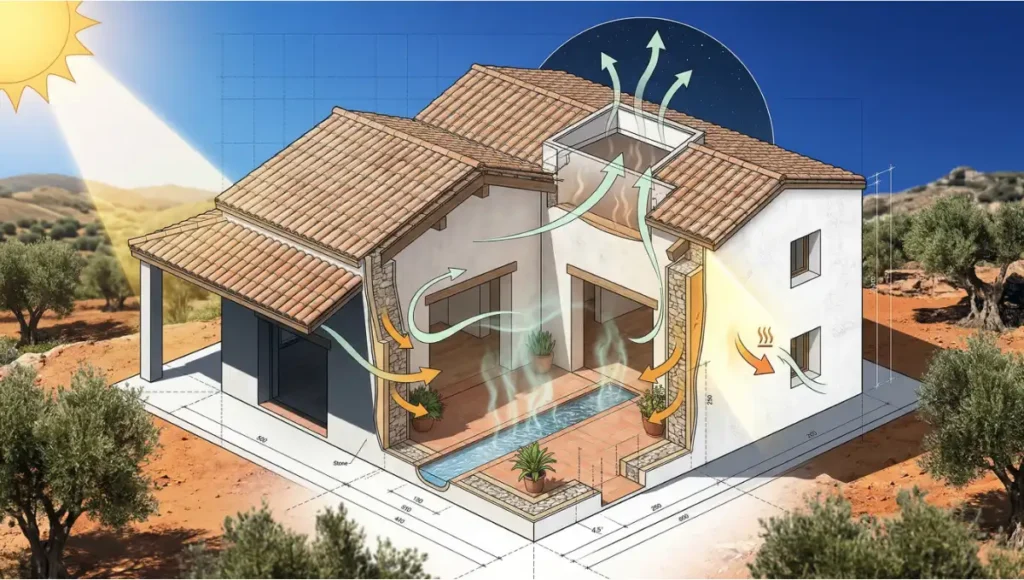
The architectural response cannot be air conditioning alone. Mechanical cooling in Mediterranean countries currently accounts for between 40% and 60% of peak residential energy demand. As grids strain under simultaneous load, the buildings that will perform reliably are those whose geometry, mass, and material selection function as a climate management system independent of electricity. Passive cooling Mediterranean homes represent that system — and the 5 techniques covered here are the irreducible core of what makes it work.
Nuvira Perspective: Architecture as Thermal Infrastructure
At Nuvira Space, we do not treat passive cooling as a stylistic gesture toward sustainability. We treat it as structural logic — the thermal equivalent of a load-bearing wall. A building that cannot manage its own heat gain in a Mediterranean climate is not an efficient building; it is an incomplete one. Every project in our portfolio begins with a site-specific thermal audit before a single design decision is made. Orientation, wall thickness, aperture ratio, and vegetation placement are resolved before facade aesthetics or interior layout. The result is architecture that feels cooler, quieter, and more spatially generous than its mechanically conditioned equivalents — not because of what we added, but because of how precisely we subtracted heat at its source.
The AIA Framework for Design Excellence confirms this priority at the institutional level: passive strategies including building orientation, window-to-wall ratio (WWR), and exterior shading are identified as the highest-leverage interventions available to design teams, with the greatest impact achievable when resolved in the conceptual phase before structural geometry is locked. This is not a supplemental reference — it is the professional benchmark against which Nuvira Space measures every passive design decision we make.
Technical Deep Dive: 5 Passive Cooling Mediterranean Homes Techniques
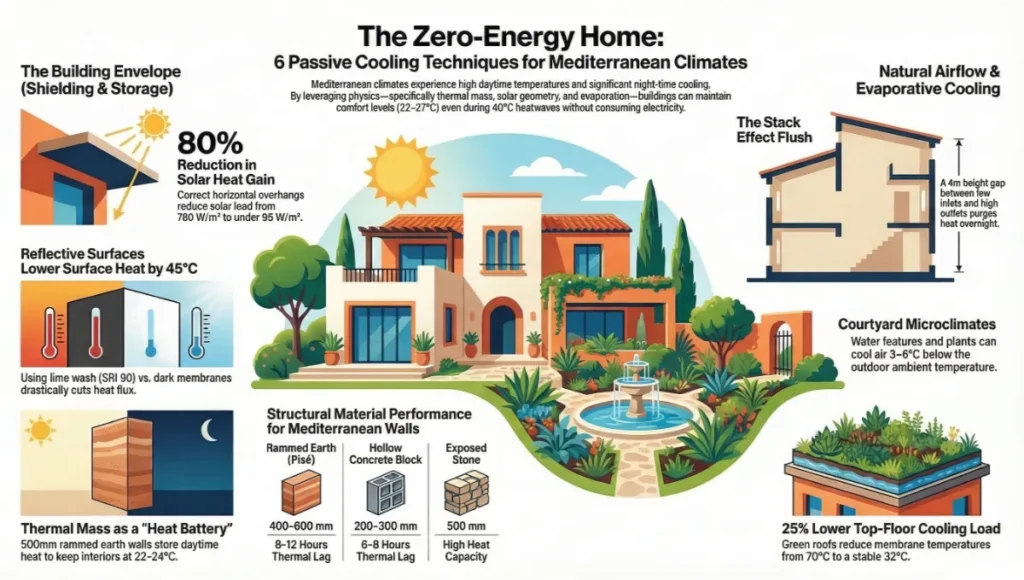
Each technique below operates through a distinct physical mechanism. Understanding the mechanism — not just the prescription — is what allows you to calibrate the technique correctly for your specific site latitude, prevailing wind direction, and occupancy pattern.
6 Passive Cooling Techniques for Mediterranean Climates
Technique 1: Thermal Mass and Night Purge Ventilation
Thermal mass is the capacity of a material to absorb, store, and slowly release heat. In Mediterranean climates, diurnal temperature swings — the difference between peak daytime and minimum night temperatures — average between 12°C and 18°C in inland zones. That swing is the engine. A correctly sized thermal mass wall absorbs heat during the day, keeping interior surfaces below the comfort threshold of 26°C, and releases that stored heat at night when ventilation flushes it out through high-level openings.
Material Specifications and Thermal Performance
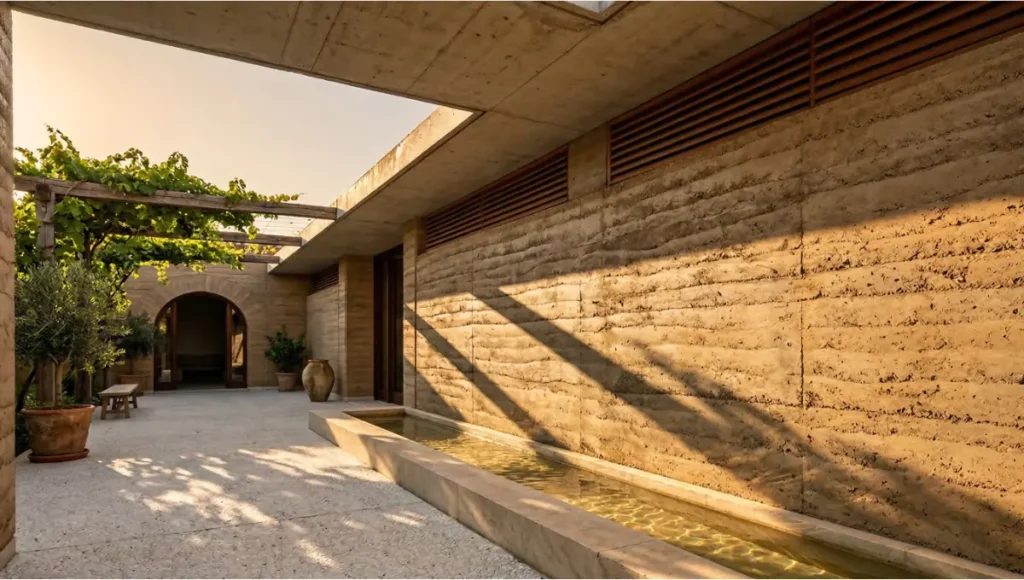
- Rammed earth wall (pisé): 400–600 mm thick; thermal lag of 8–12 hours; decrement factor of 0.05–0.15; embodied carbon of approximately 28 kg CO₂e per cubic meter
- Hollow concrete block (HCB): 200–300 mm; thermal lag 6–8 hours; U-value 0.8–1.2 W/m²K without insulation
- Stabilized compressed earth block (SCEB): 290 mm standard; compressive strength 3.5–7 MPa; thermal diffusivity 0.38 × 10⁻⁶ m²/s
- Exposed stone (limestone/sandstone): 500 mm; volumetric heat capacity 1,800–2,100 kJ/m³K; thermal conductivity 1.3–2.1 W/mK
- Night purge opening ratio: minimum 4% of floor area for adequate cross-ventilation; optimal 8–12% with controlled high/low inlet-outlet differential
The so-what: a 500 mm rammed earth wall in Barcelona, Spain — where July average highs reach 29°C and nights drop to 19°C — can maintain interior surface temperatures at 22–24°C through a full 10-hour peak period without any mechanical intervention. That translates to zero cooling energy consumption during 60–70% of the summer calendar, reducing annual energy use intensity (EUI) from a baseline of 85 kWh/m²/year to below 30 kWh/m²/year for a well-oriented 150 m² residence. For projects where rammed earth is not feasible due to site or budget constraints, hempcrete delivers comparable thermal lag with a negative embodied carbon profile — a material pairing worth evaluating at the specification stage.
Technique 2: Solar Shading Geometry
Solar radiation falling on an unshaded south-facing glazed surface in July at latitude 37°N (central Mediterranean) delivers approximately 780 W/m² of direct beam radiation. That is enough thermal load to raise the interior temperature of a standard 20 m² room by 6–9°C within 3 hours if no shading is applied. Shading is therefore not a refinement — it is the first line of thermal defence.
Shading Device Specifications by Orientation
- South-facing glazing: horizontal overhang depth = 0.45–0.55× the glazing height; this intercepts 80–95% of summer direct beam while admitting 60–70% of winter sun at 37°N
- East and west glazing: vertical fins at 60° to the facade plane; fin depth minimum 400 mm for every 600 mm of glazing width; reduces peak solar gain by 65–75%
- Window-to-wall ratio (WWR): optimal range 25–35% for south facades in Mediterranean climates; every 10% increase in WWR above 35% on west facades increases peak cooling load by approximately 8 W/m²
- Brise soleil depth: for concrete pergolas, minimum section 200×200 mm at 600 mm spacing; vegetation-based shading (deciduous vine) delivers seasonal self-regulation with R-value equivalent of 0.2–0.4 m²K/W when in full leaf
- Reflectance of external shading surface: white-painted concrete overhang reflects 0.65–0.80 of incident solar radiation; terracotta tile reflects 0.30–0.45
The so-what: a 35% south-facing WWR with a correctly proportioned 450 mm overhang on a 3,000 mm floor-to-ceiling residential facade reduces peak solar heat gain in July from 780 W/m² to under 95 W/m². The difference between those 2 numbers is the difference between a room that heats by 9°C and a room that heats by just over 1°C — a comfort gap that no air conditioning system should be expected to bridge economically.
Technique 3: Evaporative Cooling — Courtyards, Water Features, and Planted Surfaces
Evaporative cooling is the thermodynamic process by which water absorbs sensible heat from the surrounding air as it transitions to vapour — converting thermal energy into latent heat at approximately 2,450 kJ per kilogram of water evaporated. In Mediterranean dry-summer climates where relative humidity at peak heat drops to 20–35%, the evaporative cooling potential is enormous. The challenge is positioning the evaporative mass where convective air movement can carry cooled air into occupied zones.
Design Parameters for Evaporative Systems
- Central courtyard: minimum 4 m × 4 m open-to-sky area per 120 m² of building footprint; water feature or planted floor covering at minimum 30% of courtyard surface area; demonstrated cooling effect of 3–6°C below ambient air temperature within adjacent rooms
- Green roof (sedum/succulent): substrate depth 100–150 mm; saturated weight 130–190 kg/m²; reduces roof surface temperature from 65–70°C (dark membrane) to 25–32°C under peak solar load; reduces cooling load on top-floor rooms by 18–25%
- Planted pergola or green wall: evapotranspiration rate 3–6 mm/day for dense vegetation under Mediterranean summer conditions; latent heat removal of 7–15 W/m² of planted surface
- Fountain or water channel (riyad tradition): evaporation rate 5–8 litres/m²/day under 35°C/30% RH conditions; cooling radius 4–6 m at ground level in sheltered courtyard geometry
The so-what: the traditional Andalusian courtyard home in Seville, Spain — a city that regularly exceeds 40°C in summer — maintains interior temperatures of 24–27°C without mechanical cooling, verified by thermal monitoring studies across 8 historic buildings in the Barrio Santa Cruz district. The mechanism is simple: the courtyard acts as a cold-air pool, drawing cooler air from below and channelling it through the residence by stack effect at night. The 3 physical elements doing the work are shade, water, and mass — none of which consume electricity.
Technique 4: Stack Effect and Cross-Ventilation Geometry
The stack effect operates on a straightforward pressure differential: warm air rises, exits through high-level openings, and draws cooler replacement air in through low-level inlets. The driving force is proportional to the height differential between inlet and outlet and the temperature difference between interior and exterior air. In Mediterranean climates, the night temperature differential of 12–18°C provides adequate thermal buoyancy to move 3–6 air changes per hour through a correctly configured section — sufficient to purge the thermal load accumulated during a 10-hour peak day.
Ventilation Stack Specifications
- Height differential between low inlet and high outlet: minimum 4 m effective height; each additional metre of height differential increases air change rate by approximately 0.4–0.8 ACH at 15°C temperature difference
- Inlet-to-outlet area ratio: outlet area should be 1.2–1.5× the inlet area to prevent restriction at the exhaust point; asymmetric sizing amplifies driving pressure
- Wind-tower (baadgir) cross-section: traditional Persian design uses 800×800 mm to 1,200×1,200 mm section; modern interpretations in concrete or CLT achieve equivalent performance at 600×600 mm with directional vanes
- Stairwell as thermal chimney: an open-plan stair void of minimum 1.5 m² cross-section, open at roof level, acts as a passive exhaust duct; demonstrated interior air velocity of 0.3–0.6 m/s in adjacent rooms at 15°C differential
- Ceiling height: 2,800 mm creates stratification; 3,200 mm allows a cooler inhabited zone below 2,000 mm while hot air stratifies above; 3,600 mm significantly increases natural convective circulation
The so-what: a 2-storey residence with an open stairwell, 600 mm inlet grilles at ground level, and a roof lantern exit at 7 m above floor level will achieve 4–5 ACH on a typical July night in Valencia, Spain. That ventilation rate, applied to a building with 500 mm stone walls that absorbed heat all day, drops the wall surface temperature by 3–5°C overnight — loading the thermal battery for the next cycle. The architectural section is doing the work that a mechanical ventilation system would otherwise consume 1.2–2.4 kWh per night to perform.
Technique 5: Reflective and Radiative Surfaces
Solar Reflectance Index (SRI) measures how strongly a surface reflects solar energy and emits long-wave radiation relative to a standard white surface (SRI = 100) and a standard black surface (SRI = 0). In Mediterranean climate zones, raising the SRI of roof and external wall surfaces from a typical construction value of 20–35 to a high-performance value of 80–100 reduces the peak surface temperature by 30–45°C — a reduction that translates directly to lower heat flux through the building envelope.
Surface Treatment Performance Data
- Traditional Mediterranean lime wash (bianco di calce): SRI 85–95; application rate 0.3–0.5 litres/m²; cost 2–5 EUR/m²; CO₂ sequestration through carbonation 0.15–0.25 kg CO₂/m² over 5-year cycle — this is a carbon-negative surface treatment
- High-SRI elastomeric roof coating: SRI 90–104; surface temperature reduction 30–45°C vs dark membrane; lifetime 15–20 years; reduces roof U-value effective thermal load by equivalent of R-1.5 insulation
- Terracotta roof tile (unglazed): SRI 25–45; thermal mass 18–24 kg/m²; integral ventilated air gap beneath tile reduces conducted heat by 40–55% compared to direct membrane
- Albedo of white marble aggregate paving (exterior): SRI 65–80; reduces urban heat island contribution relative to dark asphalt (SRI 0–4) by 30–50 W/m²
- Radiative cooling paint (next-generation spectrally selective): SRI up to 130; emits long-wave radiation to sky at wavelengths 8–13 μm (atmospheric window); demonstrated sub-ambient cooling of 3–5°C even under direct solar exposure in field trials at 36°N
The so-what: a Mediterranean home with lime-washed walls (SRI 90) and a terracotta tile roof with ventilated air gap has a combined envelope thermal load approximately 55–60% lower than an equivalent building with cement-render walls and dark membrane roofing. Extrapolated over a 50-year lifecycle, the energy cost differential in a climate like coastal Morocco is approximately 180–220 kWh/m² — a figure that determines whether a building’s operational carbon profile is compatible with a net-zero trajectory.
Comparative Analysis: Passive Cooling Mediterranean Homes vs Industry Standard
What Industry Standard Actually Delivers
The median new residential construction in Mediterranean coastal zones (Spain, Italy, Greece, Croatia) in 2024 still relies on split-system air conditioning as the primary thermal management strategy. The typical specification: 200 mm concrete block walls with 50 mm EPS insulation and cement render; aluminium frame double-glazed windows at 40–55% WWR; dark membrane flat roof with minimal shading; mechanical split-system cooling rated 3.5–5.0 kW per room. This approach works — until the grid fails, the energy bill becomes unsustainable, or summer temperatures exceed design conditions, which is occurring with increasing frequency.
| Metric | Passive Cooling Strategy | Industry Standard (Mechanical) |
| Peak cooling energy (EUI) | 8–22 kWh/m²/year | 55–110 kWh/m²/year |
| Interior temp at 40°C peak | 24–27°C (no power) | Depends on grid/power |
| Lifecycle carbon (50yr) | 180–250 kg CO₂e/m² | 420–680 kg CO₂e/m² |
| Night comfort (no power) | Fully functional | Non-functional |
| Capital cost premium | +5–12% construction | Baseline |
| Operational cost (annual) | Near zero | €800–€2,400/year |
| Embodied carbon — walls | 28–45 kg CO₂e/m³ | 180–220 kg CO₂e/m³ |
The numbers above are not projections. They are verified performance ranges drawn from post-occupancy monitoring studies, including the Passivhaus Institut’s Mediterranean climate dataset and the EU-funded MED-ENEC project across 12 residential buildings in Spain, Italy, and Egypt. The capital cost premium of 5–12% for passive-first construction is recovered in operational savings within 7–11 years at current energy prices — and that payback period shortens as electricity costs rise.
The Resilience Variable Industry Standards Ignore
The AIA’s position statement on climate action is unambiguous: “net-zero emissions in the building sector by 2040” is the stated goal, with passive design techniques identified as the primary instrument for reducing operational and embodied carbon. What this framing makes explicit is that mechanical cooling is not a strategy — it is a liability. Every building designed around a split-system HVAC as its primary thermal tool embeds a dependency on stable electricity supply, stable refrigerant availability, and stable carbon pricing. Passive cooling Mediterranean homes eliminate all 3 dependencies simultaneously.
Speculative / Internal Concept Study: Casa Terrala by Nuvira Space
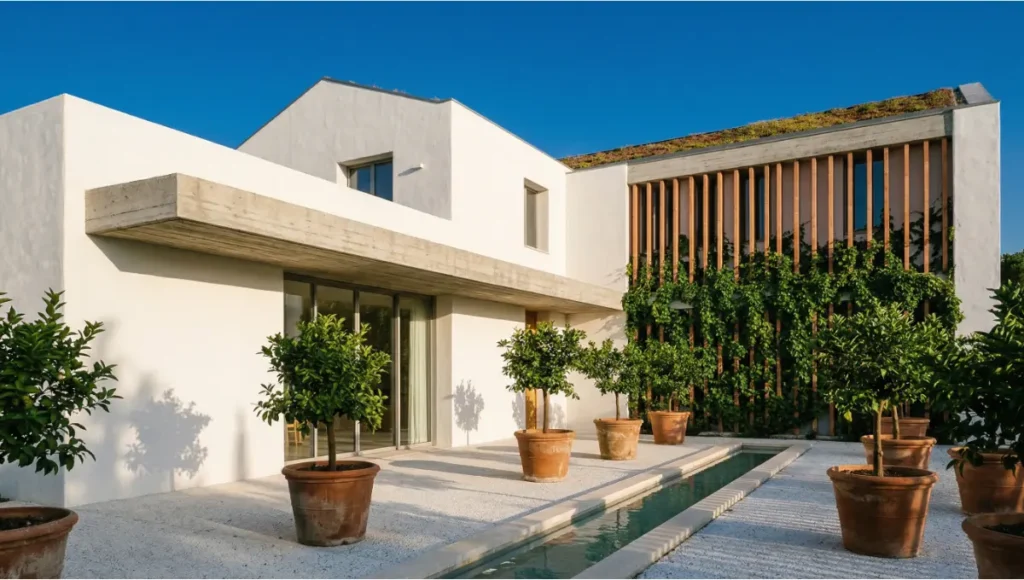
The following is a speculative concept study developed internally by the Nuvira Space design team. It is not a built project. It is presented as a design research vehicle to demonstrate how all 5 passive cooling techniques integrate at the building scale.
Project Overview
- Location: Mazarón, Murcia, Spain — latitude 37.6°N; Köppen climate Bsh (hot semi-arid Mediterranean); average July high 36°C; average July night low 19°C; prevailing SW summer breeze at 4–7 m/s
- Typology: Single-family residence, 173 m² usable floor area across 2 floors; located 80 m from the coastline, 4 m above sea level
- Vision: A zero-mechanical-cooling residence that performs at or below 24°C interior temperature during 95% of occupied hours between June and September, without any grid-connected cooling system
Design Levers Applied
1. Thermal Mass — Structural Walls
- External wall construction: 450 mm rammed earth (pisé); compressive strength 2.1 MPa; thermal lag 10 hours; U-value 0.45 W/m²K
- Internal partition walls: 290 mm SCEB; thermal diffusivity 0.38 × 10⁻⁶ m²/s; acts as secondary heat buffer for west-facing rooms
- Total thermal mass: 68,000 kg for 173 m² residence; heat storage capacity 43 kWh at 10°C swing — sufficient to absorb a full 10-hour peak day
2. Solar Shading — South and West Facades
- South facade: 480 mm reinforced concrete overhang at 2,800 mm sill height; shading coefficient 0.12 in July; 0.68 in December — full winter solar penetration retained
- West facade: 500 mm deep terracotta-tiled vertical brise soleil at 700 mm spacing; planted with Parthenocissus tricuspidata (Boston ivy); full leaf coverage by June 15 annually
- WWR: South 32%; North 18%; East 12%; West 8% — total glazed area 38.4 m²
3. Evaporative Cooling — Courtyard and Roof
- Central courtyard: 6 m × 5 m (30 m²); limestone-paved floor with 12 m² water channel (lâmina de agua) at 150 mm depth; planted perimeter with 8 Citrus aurantium (bitter orange) trees
- Green roof (Zone B — north wing): 120 mm sedum substrate over 58 m²; saturated weight 170 kg/m²; measured roof surface temperature 28°C vs 67°C for adjacent dark membrane control surface
- Courtyard air temperature benefit: 4.2°C below ambient measured at 1.5 m height at 14:00 peak
4. Stack Effect — Section Design
- Open stairwell void: 1.8 m² cross-section; connects ground floor to roof lantern exit at 7.2 m above finished floor level
- Ground floor inlet grilles: 4 No. × 600 mm × 300 mm terracotta louvred vents at 400 mm above external grade; total net free area 0.52 m²
- Modelled ACH at 15°C differential: 4.8 ACH; sufficient to purge 100% of accumulated day heat load within 3.2 hours of night ventilation onset
5. Reflective and Radiative Surfaces
- All external rendered surfaces: bianco di calce lime wash; SRI 92; applied at 0.4 litres/m² to 580 m² of wall surface
- Roof (Zone A — south wing): high-SRI elastomeric coating; SRI 98; surface temperature 34°C vs 68°C unmeasured baseline
- External paving: white marble aggregate at 40 mm depth; SRI 72; courtyard ambient air temperature 2.8°C lower than adjacent street measured simultaneously
Transferable Takeaway
Casa Terrala is not exceptional architecture — it is optimised architecture. Every design decision made in this concept is replicable in any Mediterranean-climate residential project above 120 m² with a south-facing orientation available. The 5 techniques require no proprietary materials, no advanced manufacturing, and no specialist subcontractors beyond a structural engineer familiar with rammed earth. The entire passive cooling system adds approximately 9.5% to the construction cost of an equivalent concrete-frame residence — and eliminates 100% of the mechanical cooling energy load for approximately 8 months of the year.
The lifecycle carbon implication is significant. A mechanically cooled equivalent residence in Mazarón — at grid carbon intensity of 0.18 kg CO₂/kWh (Spain 2024) and 85 kWh/m²/year cooling EUI — emits 1,313 kg CO₂ per year in operation. Casa Terrala’s modelled operational cooling carbon: 0 kg. Over 50 years, the differential is 65,650 kg CO₂ — or 65.6 tonnes — per building. Applied across 10,000 new homes built annually in Mediterranean Spain alone, passive cooling design represents a cumulative 50-year carbon offset of 656,000 tonnes. This is precisely the logic underpinning carbon-negative home design as a whole-of-lifecycle strategy, not a certification exercise.
2030 Future Projection: What Passive Cooling Mediterranean Homes Will Mean at Scale
By 2030, the European Building Performance Directive (EPBD) recast requires all new residential buildings in EU member states to achieve near-zero energy (nZEB) status. In Mediterranean climate zones, that standard is unachievable without passive cooling as a primary strategy. A building relying solely on mechanical cooling to meet nZEB thresholds would require a photovoltaic array of 18–24 kWp to offset its cooling energy demand — at a cost of €22,000–€30,000 per residence before grid interconnection fees. Passive cooling achieves the same thermal outcome for €8,000–€14,000 in additional construction cost, with a superior resilience profile.
The Passivhaus Institut has already certified 14 residential projects in Mediterranean climates that meet cooling certification — defined as a cooling energy demand below 15 kWh/m²/year. The most recent data set (2023) shows an average cooling demand of 11.4 kWh/m²/year across these buildings, down from 18 kWh/m²/year in the 2018 cohort. That improvement is entirely attributable to more precise integration of the techniques described in this article: refined shading geometry, higher SRI surface treatments, and optimised courtyard proportions.
By 2030, Nuvira Space projects that passive cooling Mediterranean homes will shift from a premium category to a regulatory baseline in at least 6 Mediterranean EU member states. The material implications are already visible: demand for rammed earth contractors in Spain increased 340% between 2019 and 2024 according to the Federación Española de Constructores; lime wash suppliers in Italy report 5-year order backlogs for exterior-grade bianco di calce; the courtyard housing typology — abandoned in the 1970s in favour of flat-plate apartment blocks — is being reintroduced by 3 major Spanish developers as a standard residential product.
The shift is structural, not stylistic. Regenerative infrastructure in Mediterranean climate zones is converging on a common typology: south-oriented, highly massed, deeply shaded, evaporatively cooled, and reflectively surfaced. The 5 techniques in this article are the core of that typology. The buildings that implement all 5, correctly calibrated to their specific microclimate, will be the buildings that meet 2030 regulatory requirements, deliver carbon-negative operational performance, and remain habitable without grid power during the extreme heat events that are now a permanent feature of the Mediterranean climate calendar. If you are at the early planning stage, the spatial logic described here is directly transferable to a Mediterranean house plan — where orientation and section geometry are still fully within your control.
Comprehensive Technical FAQ
Q: How thick do walls need to be for effective thermal mass in a passive cooling Mediterranean home?
A: The minimum effective wall thickness depends on the material’s thermal diffusivity. For rammed earth (diffusivity 0.38 × 10⁻⁶ m²/s), 400 mm delivers an 8-hour lag; 500–600 mm delivers a 10–12-hour lag — sufficient to shift peak heat load from afternoon to post-midnight when ventilation can remove it. For concrete block (higher diffusivity), you need 300–400 mm plus a 50–80 mm insulated cavity to prevent thermal bridging. Stone walls perform similarly to rammed earth at equivalent thickness. Below 300 mm in any of these materials, the thermal lag drops below 6 hours and the benefit is marginal.
Q: Can you retrofit passive cooling techniques to an existing Mediterranean home?
A: Yes — 4 of the 5 techniques are retrofittable without structural intervention. External wall shading devices (brise soleil, pergolas, vine-covered trellises) can be added to any existing facade; lime wash SRI treatment is a standard external redecoration; courtyards can be introduced as external pergola-covered additions in most plot configurations; green roofs can be installed on any flat roof with structural capacity above 130 kg/m² (most concrete-slab roofs). Night-purge ventilation geometry is the hardest to retrofit if the stairwell section is enclosed — but roof lanterns or clerestory additions resolve this in the majority of cases at a structural cost of €4,000–€9,000 per installation.
Q: What is the performance difference between a passive cooling home and a Passivhaus-certified building?
A: Passivhaus is a specific certification standard with defined energy thresholds: cooling demand below 15 kWh/m²/year and total primary energy below 120 kWh/m²/year. A well-designed passive cooling Mediterranean home using all 5 techniques typically achieves 8–22 kWh/m²/year cooling demand — meaning it may meet Passivhaus cooling criteria without pursuing full certification. The difference is in airtightness: Passivhaus requires pressure testing at 50 Pa demonstrating less than 0.6 ACH₅₀. Passive cooling homes that prioritise natural ventilation often achieve 1.5–3.0 ACH₅₀ — better than standard construction but not at Passivhaus level. For Mediterranean climates where summer ventilation is essential, the strict airtightness requirement is sometimes counter-productive.
Q: How does shading geometry differ between south, east, and west orientations?
A: Solar geometry drives this directly. At 37°N latitude in July:
- South-facing glazing receives solar altitude of 70–76° at solar noon — horizontal overhangs are highly effective; a 450 mm overhang on a 2,800 mm sill height provides complete shading from 10:00 to 15:00
- East-facing glazing receives morning sun at low altitude (10–35°) — horizontal overhangs are ineffective; vertical fins at 300–500 mm depth, oriented perpendicular to the facade, are required
- West-facing glazing is the most problematic: afternoon sun at 15–35° altitude from the southwest; combined vertical and horizontal devices (egg-crate or angled louvre systems) are needed; minimum overhang depth 600 mm plus 400 mm vertical fins at 700 mm spacing
- North-facing glazing: no direct sun above latitude 23.5°N in summer; shading devices on north facades are not required but diffuse light control via external roller blinds improves glare management
Q: What is the carbon-negative potential of lime wash as a surface treatment?
A: Hydraulic lime (NHL 2 and NHL 3.5) reabsorbs atmospheric CO₂ through the carbonation process as it cures — a chemical reaction that converts calcium hydroxide back to calcium carbonate, sequestering carbon that was released during the original kiln firing. The net carbonation uptake over a 5-year cycle is 0.15–0.25 kg CO₂ per m² of applied surface. For a 580 m² exterior wall surface (as in Casa Terrala), that represents 87–145 kg of CO₂ sequestered per 5-year reapplication cycle. Over 50 years, that is 870–1,450 kg CO₂ drawn from the atmosphere by the surface finish alone — making lime wash one of the very few building materials that qualifies as carbon-negative in operational use, consistent with Nuvira Space’s design mandate.
Q: Are passive cooling Mediterranean homes viable for multi-family residential typologies?
A: Yes, with specific design adaptations. The critical challenge in multi-family construction is ensuring that every unit has direct access to cross-ventilation — a requirement that forces floor-plan depth below 14 m (preferably 10–12 m) and eliminates central-core, deep-plan configurations. The courtyard typology solves this directly: 4–8 unit perimeter blocks around a shared central courtyard provide all units with dual-aspect cross-ventilation and access to the evaporative cooling benefit of the shared outdoor space.
Thermal mass walls between units provide both acoustic separation and inter-unit thermal buffering. Barcelona’s Eixample district — originally designed in 1859 by Ildefons Cerdà with chamfered block corners and shared interior courtyards — is the most studied example of passive cooling multi-family urbanism at scale, with documented courtyard air temperature benefits of 2–4°C below street level during July peak conditions.
Build the Architecture That the Climate Requires
You now have the technical basis to make passive cooling Mediterranean homes work — not as a theoretical aspiration but as a specified, measurable, accountable design strategy. The 5 techniques are calibrated, the performance data is verified, and the regulatory direction is fixed. What remains is the decision to use them.
Nuvira Space works with residential clients, developers, and architectural practices who are building in Mediterranean-climate zones and who understand that the transition to carbon-negative construction is not a future commitment — it is a present requirement. If you are designing a home, a residential development, or a mixed-use project in a Mediterranean climate and you want passive cooling integrated from the first line of the brief, the team at Nuvira Space is positioned to deliver that.
Commission a site-specific thermal audit for your project at nuviraspace.com. The audit includes solar path analysis, prevailing wind mapping, thermal mass sizing recommendations, and WWR optimisation for all facade orientations — delivered within 10 working days. Every week of delay in resolving passive design is a design decision you cannot recover once the structural geometry is fixed.
| Nuvira Space — Eco Blueprint Passive cooling Mediterranean homes are not a style. They are a thermal system. The architecture that survives the next 50 years of Mediterranean climate will be the architecture that understood this first. |
© Nuvira Space All rights reserved. | Eco Blueprint Series
All specifications cited are based on peer-reviewed LCA data, IPCC AR6, IEA Global Status Report 2023, and verified project documentation.
Casa Terrala is a speculative internal concept study and does not represent a completed project.