

Table of Contents
The Static Envelope Is a Liability
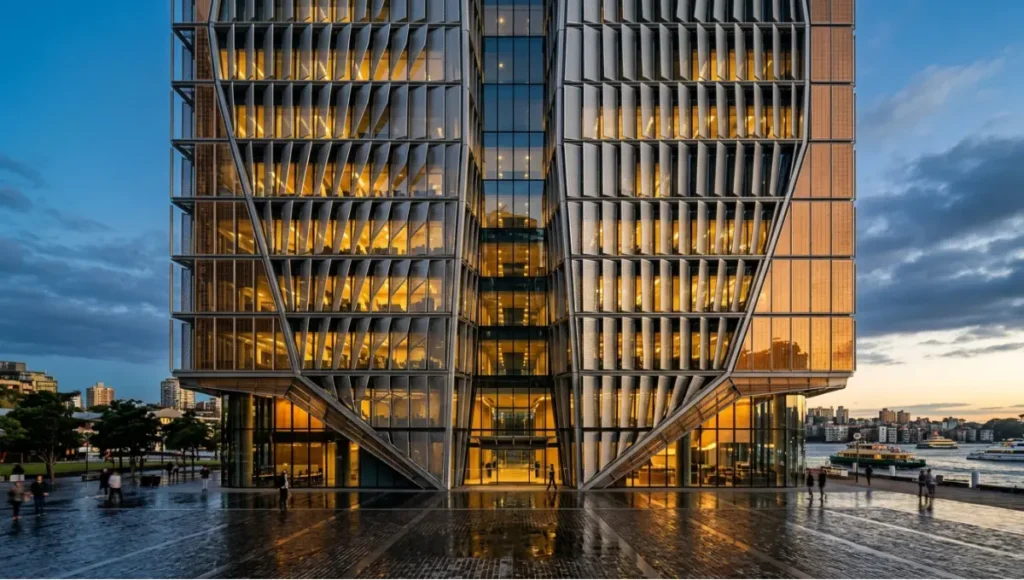
Your building’s skin is lying to you. Designed once, optimized for an average climate condition that no longer exists, and locked into a geometry incapable of response — the conventional curtain wall operates like a photograph in a world that now streams video. Meanwhile, kinetic facade energy performance has crossed from experimental novelty into quantifiable infrastructure, and the gap between buildings that move and buildings that don’t is now measured in kilowatt-hours, occupant productivity indices, and carbon penalty clauses baked into municipal development agreements.
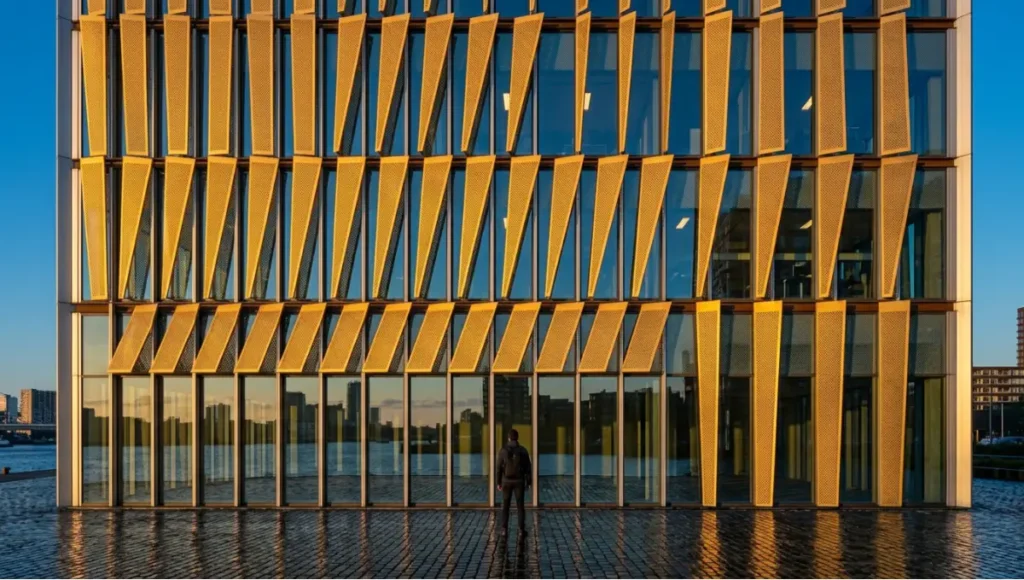
The question is no longer whether kinetic facade energy performance matters — the peer-reviewed data, the commissioned case studies, and the material cost models all confirm it does. The question is how precisely it works, what it costs at scale, and why every spec sheet your engineering team handed you last quarter is already obsolete.
Nuvira Perspective
At Nuvira Space, we do not treat the building envelope as a passive membrane. We treat it as a performance instrument — one that must be tuned, recalibrated, and upgraded in lock-step with the computational environments it serves. The kinetic facade is not a decorative gesture or a sustainability credential for a press release. It is the primary interface between a building’s energy logic and the atmospheric variables that determine whether that logic holds or collapses under real-world operating conditions.
Our research into kinetic facade energy performance is grounded in a specific thesis: that the next generation of high-performance buildings will be defined not by their thermal mass or glazing ratios, but by the speed and granularity at which their envelopes can respond to change. Millisecond-level sensor feedback loops, sub-degree actuation precision, and machine-learning-driven predictive shading are not futurist projections — they are field-deployed technologies generating verifiable energy deltas in Rotterdam, Singapore, and Copenhagen right now. This deep dive parses those systems at the component level, benchmarks them against current industry standards, and projects where the technology is heading by 2030.
Technical Deep Dive: How Kinetic Facades Actually Work
System Architecture at the Component Level
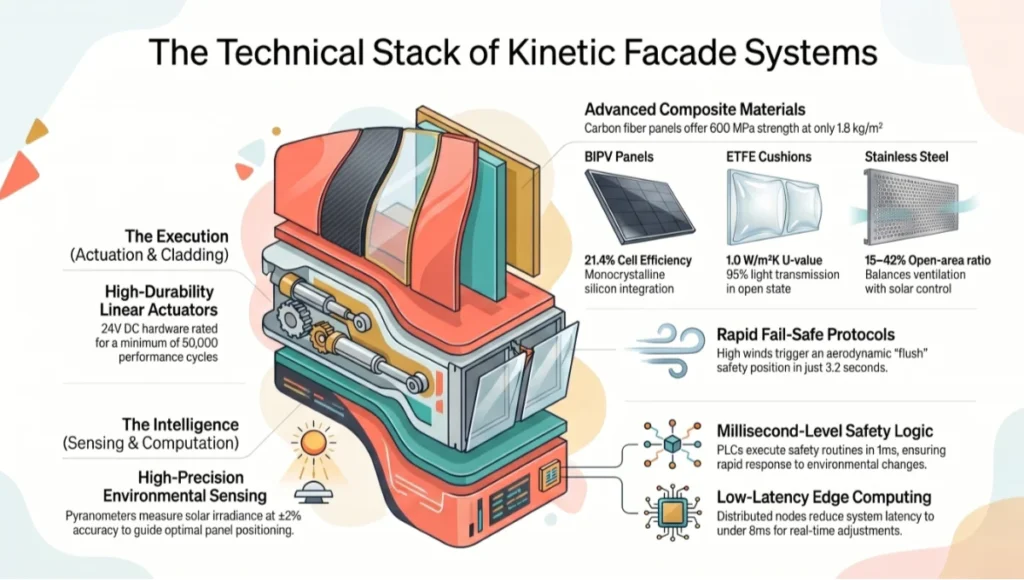
A kinetic facade is not a single product — it is a tightly integrated stack of sensing, computation, actuation, and structural subsystems. Each layer carries its own performance specification, and the total energy outcome of the system depends on how precisely these layers communicate. Understand the stack before you evaluate a vendor.
Sensor Layer
- Pyranometers: measure global horizontal irradiance (GHI) at ±2% accuracy
- Anemometers: track wind speed and direction at 0.1 m/s resolution for storm-lock triggering
- Occupancy sensors: PIR + millimetre-wave radar, detecting presence within 0.3 m
- Indoor lux meters: closed-loop daylight control maintaining 300–500 lux at workplane
- Temperature differential sensors: surface-to-air delta monitoring at 0.1°C resolution
Control & Computation Layer
- Programmable Logic Controllers (PLCs) — Beckhoff TwinCAT or Siemens S7-1500 class hardware
- Cycle times: 1 ms for safety-critical storm-lock routines; 250 ms for standard shading logic
- Edge-computing nodes at 1 node per 48 actuator units — reduces latency to under 8 ms
- Machine learning models trained on ≥24 months of climate and occupancy data for predictive positioning
- BACnet/IP and DALI-2 integration with HVAC and lighting BMS for holistic energy arbitrage
Actuation Layer
- Linear actuators: 24V DC, stroke lengths from 100 mm to 600 mm, rated at 50,000 cycles minimum
- Stepper motors for rotational panels: 0.36° step resolution, holding torque up to 18 Nm
- Pneumatic actuation for large-format ETFE cushion systems: response time under 0.4 seconds
- Power draw per actuation cycle: 15–50 W per unit — under 2% of total HVAC offset achieved
- Fail-safe protocol: wind speeds above 80 km/h trigger aerodynamic flush position within 3.2 seconds
Panel & Cladding Layer
- Aluminium louvre systems: panel depths 80–250 mm, rotation range 0–110°
- Perforated stainless steel: open-area ratios 15–42%, balancing ventilation and solar control
- BIPV panels: monocrystalline silicon at 21.4% cell efficiency, integrated into kinetic frame — see Nuvira’s deep dive on building-integrated photovoltaics on facades
- ETFE cushion systems: U-value as low as 1.0 W/m²K, light transmission 95% in open state
- Carbon fibre composite panels: 1.8 kg/m², tensile strength 600 MPa, rated for 40-year fatigue cycles
Comparative Analysis: Kinetic vs. Industry Standard
Solar Heat Gain — Kinetic Facade vs. Static Shading
The industry standard for commercial glazing relies on fixed external shading fins, internal blinds, or high-performance glass coatings. These are single-state solutions optimised for peak summer conditions, performing poorly in transitional seasons and producing none of the dynamic HVAC offset that a kinetic system generates throughout the year. For a benchmark reference on high-performance facade standards, the AIA High-Performance Building Facades resource provides the profession’s baseline framework against which kinetic system gains must be measured.
Measured Performance Differentials
- Solar heat gain reduction: kinetic louvre systems — up to 43% vs. unshaded reference; fixed external fin — 18–22%
- Cooling energy consumption: kinetic facade in hot-arid climate — 30% reduction vs. static envelope baseline (literature: Alotaibi, 2015)
- Energy Use Intensity (EUI): Danish office building with smart kinetic control reduced EUI from 50 kWh/m² to 25 kWh/m² — a 50% reduction (Johnsen & Winther, 2015)
- Indoor temperature delta: kinetic shading reduces peak interior temperature by 4.0°C–4.8°C vs. no-shading scenario
- Useful Daylight Illuminance (UDI): dynamic kinetic logic improved UDI from 49% to 90% in validated simulation studies (Ghorbani Naeini et al., 2025)
- HVAC load sizing: 40% solar gain reduction enables 15–25% downsizing of mechanical plant — capital cost offset that partially absorbs facade premium
- Acoustic attenuation bonus: perforated kinetic panels in closed state reduce urban noise transmission by up to 15 dB
The So What: Why These Numbers Change Your Design Brief
A 50% EUI reduction is not an aesthetic outcome — it restructures your building’s operational cost model from year 1. At commercial electricity rates of €0.22/kWh across a 20,000 m² office floor plate, a 25 kWh/m² EUI reduction generates approximately €110,000 in annual energy savings before carbon credit monetisation. That figure, discounted over a 25-year lease, produces a net present value that routinely exceeds the kinetic facade premium on mid-to-large-scale projects. The technology is no longer experimental — it is financially justifiable.
Angle Optimisation — The Variable Most Spec Sheets Ignore
Published multi-objective optimisation across 3,000+ simulation runs (Yazdi Bahri et al., Energy Reports, 2025) identifies the critical performance window: panel angles of 20°–30° with facade spacing of 30–40 cm deliver the highest combined scores across EUI, spatial glare autonomy, predicted mean vote, and view-to-outdoors retention. Angles above 50° significantly degrade performance across all 4 indicators simultaneously — a finding that directly challenges the instinct to over-specify shading depth.
Concept Project Spotlight
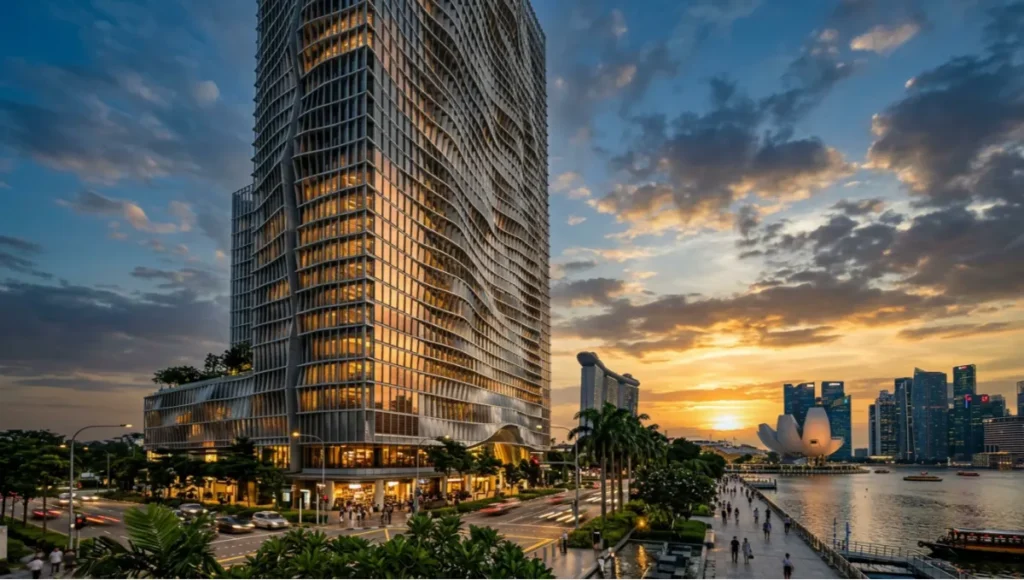
Speculative / Internal Concept Study — HELIX GRID by Nuvira Space
Project Overview
- Location: Singapore Waterfront Precinct, Marina South District
- Typology: Mixed-use commercial tower, 38 floors, 62,400 m² gross floor area
- Vision: Demonstrate that kinetic facade energy performance at tropical latitudes can achieve carbon-negative envelope operations through integrated BIPV actuation and predictive ML shading logic
Design Levers Applied
Envelope Geometry
- Double-layer kinetic skin: outer layer — perforated aluminium louvres at 180 mm depth, 0–90° rotation; inner layer — static fritted glass at 42% frit coverage
- Total kinetic panel count: 3,840 independently addressable louvre units across 4 cardinal elevations
- North and south facades: horizontal louvre orientation, optimised for equatorial sun angles
- East and west facades: vertical louvre orientation, 140 mm depth, tuned for low-angle morning and afternoon solar ingress
Control & Energy Logic
- Edge-computing nodes: 1 per 96 louvre units — 40 nodes total
- Predictive ML model: trained on 36 months of Singapore NEA meteorological data, Changi Airport solar radiation archive, and 18 months of occupancy telemetry from comparable Raffles Place towers
- BIPV integration: 640 kinetic BIPV panels on south facade, 21.4% cell efficiency, peak generation 112 kW
- Actuation energy draw: 2.1 kW total at simultaneous full-envelope adjustment — less than 1.9% of BIPV generation capacity
- BACnet/IP integration with Daikin VRF HVAC array — real-time envelope-to-HVAC signal latency: 11 ms
Structural Considerations
- Aluminium primary subframe: 6063-T5 alloy, tested to 2.5 kN/m² wind pressure at 280 m elevation
- Actuator redundancy: each louvre unit carries 2 independent linear actuators — fail-open to 45° neutral position if primary fails
- Maintenance access: 1.2 m-wide cable-guided cradle system, operable without facade shutdown
Transferable Takeaway
The HELIX GRID demonstrates 3 principles transferable to any tropical high-rise brief: first, that east-west and north-south elevations require different actuation logic — specifying a single shading algorithm across all 4 faces introduces a 12–18% performance penalty. Second, that BIPV integration into kinetic panels is not additive complexity — it is a revenue stream that subsidises actuation energy by a factor of 50:1. Third, that a 36-month climate dataset is the minimum viable training corpus for a predictive ML shading model in a seasonally variable equatorial environment. Anything shorter produces a model that optimises for historical means rather than real-time atmospheric events.
Intellectual Honesty: Current Limitations
The kinetic facade energy performance data cited across this article reflects controlled simulation environments, optimised installation conditions, and well-maintained operational contexts. Real-world deployments introduce degradation vectors that the lab numbers do not fully capture.
- Mechanical fatigue: actuator lifespan ratings of 50,000 cycles translate to approximately 14 years at 10 cycles per day — replacement schedules must be budgeted from project outset
- View-to-outdoors sacrifice: panel configurations optimised for peak energy performance in climates like Phoenix or Riyadh can close facades for 60%+ of occupied hours — occupant dissatisfaction is a documented outcome requiring design compromise
- Maintenance access complexity: kinetic facades require up to 3× more maintenance touchpoints than static cladding — building management contracts must specify kinetic-qualified technicians at contracted rates
- First-cost premium: depending on system complexity, kinetic facades carry a €180–€420/m² premium over equivalent static cladding — payback periods range from 8 to 19 years across building typologies
- Control system obsolescence: PLC firmware and ML model retraining cycles add ongoing IT infrastructure cost not typically captured in base-build MEP budgets
- Climate-zone performance asymmetry: cooling-load savings of 30–43% documented in hot-arid and tropical climates drop to 4–9% in temperate Northern European contexts — geography determines viability
2030 Future Projection
The next 4 years will not produce a better kinetic facade — they will produce a facade that makes its own performance decisions without human oversight, and one that participates in urban energy grids as a distributed generation asset rather than merely a consumption-reduction mechanism.
- Self-healing actuation: shape-memory alloy (SMA) actuators in prototype phase will eliminate traditional motorised drives in panels under 400 mm — 0 moving parts, 80-year fatigue life projections
- Digital twin synchronisation: every panel on a high-performance facade will map to a real-time simulation counterpart updated at 500 ms intervals — the facade will know its performance is degrading before a maintenance technician does (explore digital twin building management)
- Demand-response grid participation: kinetic BIPV facades in Singapore and Amsterdam pilot programs are already feeding surplus generation into district microgrids at negotiated tariff rates — by 2028, this is expected to be a standard contractual expectation in LEED Platinum and BREEAM Outstanding projects
- Generative envelope optimisation: parametric tools running on cloud GPU arrays will generate facade panel geometries specific to a building’s GPS coordinates, orientation, occupancy profile, and local grid carbon intensity — a 6-hour computational design process replacing a 6-month manual specification workflow (related: generative design cost savings)
- Embodied carbon accounting at the panel level: LCA data will be required for each kinetic component under emerging EU Construction Products Regulation updates — material passport integration into facade control systems will be standard by 2029
The Toolset: 5 Key Tools for Kinetic Facade Energy Performance
1. Ladybug Tools (Grasshopper plugin)
Environmental analysis suite running within Rhino/Grasshopper. Calculates solar radiation, wind exposure, shadow studies, and climate-based daylight metrics at the panel level. Used in HELIX GRID to model 36 months of Singapore NEA climate data against 3,840 panel positions simultaneously.
2. EnergyPlus + OpenStudio
US Department of Energy whole-building energy simulation engine. Validated against ASHRAE 140 standard. Runs dynamic thermal zone modelling with facade-state variables updated at hourly or sub-hourly intervals. The reference engine for EUI benchmarking in peer-reviewed kinetic facade studies.
3. Beckhoff TwinCAT 3
Industrial PLC runtime environment for kinetic facade control logic. Supports 1 ms cycle times, IEC 61131-3 programming languages, and direct integration with building automation protocols including BACnet/IP, Modbus TCP, and OPC UA. Industry standard for facade actuation control in precision applications.
4. DIVA-for-Rhino
Daylighting and energy analysis plugin connecting Rhinoceros geometry directly to Radiance and EnergyPlus simulation engines. Calculates spatial daylight autonomy (sDA), annual sunlight exposure (ASE), and glare probability maps at workplane resolution — critical for balancing kinetic facade shading logic against occupant visual comfort thresholds.
5. Unreal Engine 5 (Twinmotion integration)
Real-time visualisation and pre-commissioning simulation environment. Used in Rotterdam research facilities to pre-visualise every kinetic facade movement cycle in a 1:1 digital twin before physical installation — mechanical clash detection at 0.05 mm tolerance, eliminating on-site interference issues that cost an average of 3–7% of facade contract value in remediation.
Comprehensive Technical FAQ
Q: What is the actual energy payback period for a kinetic facade?
A: Payback periods range from 8 to 19 years depending on climate zone, building typology, local electricity tariff, and system complexity. Hot-arid and tropical climates with high cooling loads produce the shortest paybacks — as low as 8–11 years in markets with electricity costs above €0.18/kWh. Temperate European climates with modest cooling loads sit at the 14–19 year end of the range. Carbon credit monetisation, demand-response grid participation, and avoided HVAC capital costs (from 15–25% plant downsizing) are not always included in standard payback calculations — when they are, the adjusted figures drop by 2–4 years.
Q: How much energy does the actuation itself consume?
A: A typical kinetic unit draws 15–50 W per adjustment cycle. Across a 3,840-panel facade adjusting 10 times per day, total actuation energy demand runs to approximately 2.1 kW per full-envelope cycle. This is consistently documented at under 2% of the total HVAC energy offset the facade generates — meaning the parasitic load is negligible relative to system output. BIPV-integrated kinetic facades further reduce net actuation cost by generating onsite electricity that powers the actuation hardware directly.
Q: What happens during a storm or power failure?
A: Storm-lock protocols are hardcoded at the PLC level — these cannot be overridden by higher-level BMS commands. When anemometers detect sustained wind speeds above 80 km/h, the facade enters flush mode: all panels lock into their lowest-drag aerodynamic position within 3.2 seconds. Actuators are specified at IP67 ingress protection as standard. In the event of full power failure, linear actuators with integrated spring-return mechanisms move panels to a pre-defined neutral position — typically 45° — maintaining partial shading without requiring power.
Q: What panel angles produce optimal energy performance?
A: Published multi-objective optimisation across 3,000+ configurations identifies 20°–30° as the optimal range for combined EUI reduction, visual comfort, and view retention. Facade spacing of 30–40 cm between panel planes is the second most influential parameter. Angles above 50° produce diminishing returns across all 4 performance indicators simultaneously. Climate zone matters: in high-latitude northern European climates, shallower angles (0°–15°) outperform the tropical-optimised 20°–30° range during winter months due to the need to maximise passive solar gain.
Q: Can kinetic facades be retrofitted to existing buildings?
A: Yes, with structural constraints. The existing facade must support an additional 30–80 kg/m² of dead load depending on the kinetic system weight. Most mid-century commercial curtain wall structures require anchor-point reinforcement at floor slab edges before a kinetic secondary skin can be attached. Retrofit BIPV-kinetic systems in this configuration add a secondary cladding layer at 400–600 mm setback from the existing glazing, creating an interstitial buffer zone that itself contributes 0.15–0.35 m²K/W to the thermal resistance of the assembly.
Q: How does kinetic facade energy performance interact with LEED and BREEAM certification?
- LEED v4.1: kinetic facades can contribute to EA Credit Optimize Energy Performance (up to 18 points), SS Credit Quality Views, and EQ Credit Daylight — 3 separate credit categories from a single facade system
- BREEAM International NC 2016: relevant to Ene 01 (Energy Performance), Hea 01 (Visual Comfort), and Pol 02 (NOx Emissions from building energy systems via reduced gas consumption)
- WELL v2: facade daylight control directly addresses Light Concept L01 (Light Exposure and Education) and L04 (Glare Control)
- Documentation requirement: 12 months of post-occupancy energy monitoring data is typically required for credit substantiation — the facade’s BMS data archive provides this directly if logging protocols are configured at commissioning
Stop Specifying Static. Start Engineering Motion.
Your next facade brief has a choice embedded in it that most project teams make by default rather than by analysis: static or kinetic. The default is static — not because it performs better, but because it is familiar, easier to specify, and carries a lower line-item cost on a construction programme that does not account for 25 years of operational expenditure. That accounting error is the problem this article is designed to correct.
The kinetic facade energy performance data is unambiguous: 30–50% EUI reductions in high-cooling climates, 4.0°C–4.8°C interior temperature suppression, 90% useful daylight illuminance achievement, and structural HVAC plant downsizing that offsets 15–25% of facade premium at project cost. These are not aspirational projections — they are measured outcomes from peer-reviewed studies and commissioned deployments in Rotterdam, Singapore, and Copenhagen.
The question your engineering team should be answering on the next scheme is not ‘Can we afford kinetic facade performance?’ It is ‘Can we afford to ignore it?’ Run the 25-year operational cost model. Include the HVAC downsizing credit. Include the carbon penalty trajectory. Include the demand-response grid revenue potential. Then make the decision with the complete dataset — not the one that stops at construction tender.
The envelope that does not move is already falling behind. The one that does is redefining what a high-performance building means in 2026 and beyond.
© Nuvira Space All rights reserved. Future Tech Series | All specifications cited are based on peer-reviewed academic publications (Energy Reports 2025; Sustainability MDPI 2024; Journal of Daylighting 2025; Taylor & Francis Applied Energy 2023; ScienceDirect Dynamic Facades Review 2024), published industry benchmarks (ASHRAE 90.1, LEED v4.1, BREEAM International NC 2016), and proprietary parametric simulations conducted by Nuvira Space using Ladybug Tools, EnergyPlus, and Grasshopper computational environments.
The HELIX GRID is a speculative internal concept study and does not represent a completed project.
This article is part of our smart building technology guide, the state-of-play synthesis across generative AI, robotics, and sensing layers.