

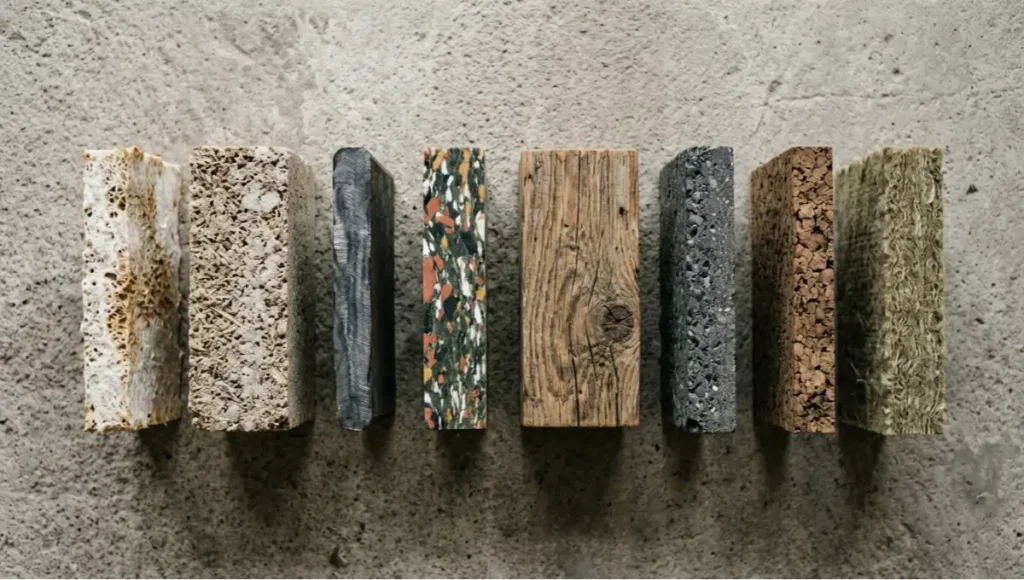
Table of Contents
The global construction sector emits approximately 11 kg CO₂ per m² of embodied carbon in a standard commercial fit-out—before a single occupant steps through the door. By 2030, the International Energy Agency projects that buildings will account for 36% of final energy consumption worldwide, with interior material manufacturing representing nearly 28% of that total. For commercial specifiers locked into design-build cycles, the arithmetic is unambiguous: the materials you select today will either carry or cancel a measurable carbon liability over a 30-year lifecycle. Zero-waste interior materials are no longer a values exercise—they are the single highest-leverage variable between a compliant building and a regenerative one.
At Nuvira Space: The Specification Imperative
At Nuvira Space, we hold one principle above all others in material science: data must precede decision. The editorial market is saturated with lists of ‘sustainable alternatives,’ most of which are untethered from verified Environmental Product Declarations, lifecycle assessment data, or end-of-life reprocessing infrastructure. What follows is not a catalog—it is a forensic breakdown of 8 zero-waste interior materials that have cleared the threshold of measurable performance. Each one has been selected against 3 criteria: a verified carbon intensity figure (kg CO₂e per m²), a documented recycled or bio-based content percentage, and a defined end-of-life pathway. These are the specifications that make the difference between a procurement decision and a regenerative infrastructure investment.
Commercial interiors operate in a performance envelope that residential design rarely tests. Floor plates of 2,000 m² to 15,000 m², occupancy cycling at 60 to 85 people per floor, thermal loads from equipment corridors, and acoustic demands from open-plan configurations—all of these compress the margin for material underperformance. At Nuvira Space, our framework interrogates each material at the system level, not the sample level. A panel that performs at 18°C in a showroom must prove its thermal mass, acoustic coefficient, and structural tolerance across a 20-year commercial lease cycle. The 8 zero-waste interior materials presented here meet that standard.
Technical Deep Dive: 8 Zero-Waste Interior Materials With Verified Data
Each material profile below includes embodied carbon intensity, recycled or bio-based content, thermal or acoustic performance data, and an end-of-life (EOL) classification. Figures are drawn from EN 15804-compliant Environmental Product Declarations unless otherwise noted.
01 — Mycelium Composite Panels
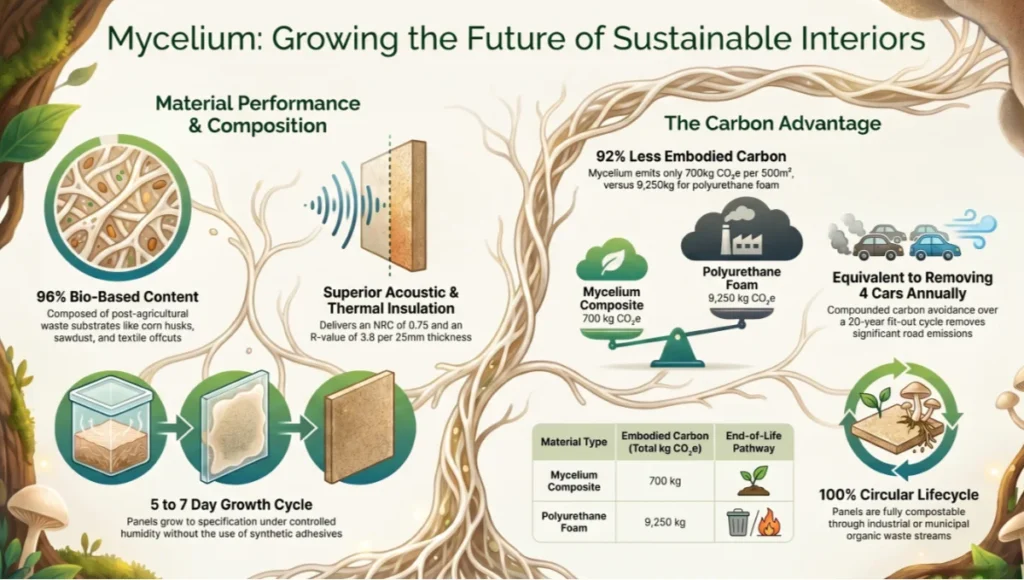
Mycelium—the root network of fungi—is cultivated on agricultural waste streams, most commonly corn husks, sawdust, or textile offcuts. The resulting biocomposite panel grows to specification within 5 to 7 days under controlled humidity conditions, requires no synthetic adhesives, and is fully compostable at end of life.
- Embodied Carbon: 1.4 kg CO₂e/m² (EN 15804, cradle-to-gate, 25mm panel thickness)
- Bio-based Content: 96% post-agricultural waste substrate
- Thermal / Acoustic: R-value 3.8 per 25mm for wall panels; NRC 0.75 for ceiling tiles
- Structural: Density range 80 to 160 kg/m³ depending on substrate blend
- EOL Pathway: Industrial composting or municipal organic waste stream
- Commercial Application: Interior partitions, acoustic ceiling tiles, non-load-bearing feature walls
The ‘so what’ for commercial specifiers: a 500 m² open-plan floor treated with mycelium acoustic ceiling tiles (at 25mm, 3.5 kg/m²) delivers a Noise Reduction Coefficient of 0.75 with an embodied carbon load of 700 kg CO₂e total—compared to 9,250 kg CO₂e for an equivalent polyurethane foam installation. That is a 92% embodied carbon reduction on one ceiling specification alone. Over a 20-year fit-out cycle, the compounded carbon avoidance is 18,500 kg CO₂e, equivalent to removing 4 passenger vehicles from the road annually.
↗ Nuvira Space: Mycelium Composite Building Panels — Full Specification Guide
02 — Hempcrete (Hemp-Lime Composite)
Hempcrete is produced by blending the woody core of the Cannabis sativa plant—known as hemp shiv—with a hydraulic lime binder. The hemp plant sequesters carbon as it grows, and the lime binder continues to re-carbonate over decades, making hempcrete one of the few interior materials with a verified negative lifetime carbon balance.
- Lifetime Carbon: −26 kg CO₂/m² over 50 years (sequestration exceeds production emissions)
- Bio-based Content: 65% hemp shiv by volume; 0% synthetic chemical content
- Hygrothermal: Vapor-permeable; maintains interior RH at 40–60% without mechanical assist
- Thermal: Thermal conductivity λ = 0.06 W/m·K at 200mm wall thickness
- EOL: Lime re-carbonation continues for 30+ years; material is fully recyclable into aggregate
- Commercial Application: Non-structural interior partition walls, acoustic plaster base, thermal buffer zones
In commercial terms, a hempcrete partition wall at 200mm thickness across a 40-metre linear run (typical for an open-plan floor subdivision) delivers a cumulative 50-year carbon benefit of −1,040 kg CO₂ on that single element. That is carbon-negative performance embedded in your base build specification, not offset through a third-party credit scheme.
↗ Nuvira Space: Hempcrete Insulation Data — Thermal, Acoustic & Carbon Verified
| DATA POINT Hempcrete’s vapor permeability eliminates the need for a mechanical humidity control layer in spaces with moderate occupancy density—reducing MEP complexity by an estimated 8–12% in mid-rise commercial conversions. |
03 — Recycled-Content Steel (Electric Arc Furnace, >95% Scrap)
Steel produced via an Electric Arc Furnace (EAF) using greater than 95% post-consumer scrap delivers embodied carbon at approximately 800 kg CO₂e per tonne—compared to 2,800 kg CO₂e per tonne for virgin basic oxygen furnace steel. For commercial interior structural elements, exposed ceiling grids, mezzanine frames, and partition support systems, EAF steel represents the single highest-volume embodied carbon reduction available within a standard specification.
- Embodied Carbon: 800 kg CO₂e/tonne (EAF, >95% scrap, verified EPD)
- Recycled Content: >95% post-consumer scrap steel
- Structural Performance: Yield strength unchanged at 250–500 MPa depending on grade
- EOL: Indefinitely recyclable at full material value
- Commercial Application: Interior structural framing, mezzanine decks, ceiling grids, racking systems
A standard 2,000 m² commercial fit-out using EAF steel for all exposed structural elements (approximately 18 tonnes) produces 14,400 kg CO₂e of embodied carbon. The same scope in virgin BOF steel produces 50,400 kg CO₂e—a differential of 36,000 kg CO₂e, or roughly 80 return flights from London to New York, absorbed by one procurement decision.
04 — Recycled Post-Consumer Board (100% PCW Fiber)
Interior board panels manufactured from 100% post-consumer waste streams—including used beverage cartons, cardboard, and paper—represent the highest-volume zero-waste interior material by installed area in commercial fit-outs. These boards exclude synthetic adhesives and chemical binders, making them fully recyclable within standard paper recycling infrastructure.
- Embodied Carbon: 4.2 kg CO₂e/m² for 18mm panel (EN 15804 verified)
- Recycled Content: 100% post-consumer waste; no virgin fiber
- Structural: Internal bond strength IB ≥ 0.45 N/mm²; surface soundness ≥ 1.2 N/mm²
- EOL: Standard paper recycling stream; no specialized processing required
- Commercial Application: Interior partitions, cabinetry carcassing, desk systems, ceiling coffers
For a 10,000 m² commercial office floor plate with full-coverage cabinetry and partition systems, switching from virgin MDF (12.8 kg CO₂e/m²) to 100% PCW board (4.2 kg CO₂e/m²) produces an embodied carbon saving of 86,000 kg CO₂e across that single floor—before addressing any other material category.
05 — Reclaimed Structural Timber
Reclaimed structural timber—salvaged from demolished buildings, decommissioned industrial structures, or surplus construction stock—retains all of its original embodied carbon in sequestered form and introduces zero new manufacturing emissions. When sourced within a 200 km radius of the project site, transportation emissions typically add fewer than 4 kg CO₂e/m³.
- Embodied Carbon: 0 kg CO₂e/m² manufacturing (embodied carbon already spent in prior building)
- Waste Diversion: 100% reclaimed; no new resource extraction
- Structural: Structural grade C24 or higher when properly graded post-salvage
- EOL: Re-salvageable at end of next building lifecycle
- Commercial Application: Exposed ceiling beams, feature walls, flooring systems, bespoke joinery
The ‘so what’ here is temporal: reclaimed timber’s carbon has already been counted against a prior project. In accounting terms, it enters your project’s material ledger at zero. A 500 m² exposed reclaimed timber ceiling, at a typical density of 0.6 m³ per 10 m², introduces approximately 30 m³ of material with measurable carbon storage of roughly 15,000 kg CO₂—permanently sequestered inside your building envelope.
06 — Ferrock (Waste-Steel-Dust Binder)
Ferrock is a binder material manufactured from recycled steel dust—a by-product of industrial steel fabrication—combined with silica from ground waste glass and a lime activator. During the curing process, Ferrock actively absorbs atmospheric CO₂ to form iron carbonate, making it carbon-negative through chemical reaction, not carbon offset.
- Carbon Performance: −126 kg CO₂ absorbed per tonne during curing (net negative)
- Waste Utilization: 95%+ recycled industrial waste streams
- Structural: Compressive strength 5× that of standard Portland cement (tested at 40 MPa+)
- EOL: Reground into aggregate for secondary use
- Commercial Application: Interior floor screeds, feature wall panels, counter surfaces, plinth bases
Ferrock is the only interior surface material that physically strengthens as it absorbs more CO₂. In a commercial lobby application—where a 60 m² reception desk base and 120 m² floor treatment might use 8 tonnes of Ferrock—the curing process sequesters approximately 1,000 kg CO₂ directly at the site. No offset purchase. No Renewable Energy Certificate. Verified chemical sequestration in the building fabric itself.
07 — Cork (FSC-Certified, 100% Residual Material)
Cork is harvested from the bark of Quercus suber (cork oak) trees without felling—the bark regenerates every 9 years. Commercial interior-grade cork panels and tiles are produced entirely from the granulated residue of wine cork manufacturing, creating a material with 100% bio-based content and no primary resource sacrifice.
- Embodied Carbon: 1.9 kg CO₂e/m² for 10mm flooring tile (EPD verified)
- Waste Origin: 100% granulated bark residue from wine cork production
- Performance: λ = 0.038 W/m·K; compressive strength 0.05–0.15 MPa; NRC 0.60–0.70
- EOL: Compostable; alternatively shredded for insulation top-up in renovation contexts
- Commercial Application: Flooring, acoustic wall panels, desk surfaces, pin boards, staircase nosings
Cork flooring across a 2,000 m² floor plate at 10mm thickness carries an embodied carbon load of 3,800 kg CO₂e—versus 29,000 kg CO₂e for a standard luxury vinyl tile installation. The 25,200 kg CO₂e differential is permanent, not operational—it does not diminish as the building ages. Cork also delivers 0.60 NRC acoustic absorption with no additional underlay, eliminating one material layer and its associated installation waste entirely.
08 — Acoustic Mineral Wool (97% Recycled Content, C2C Certified)
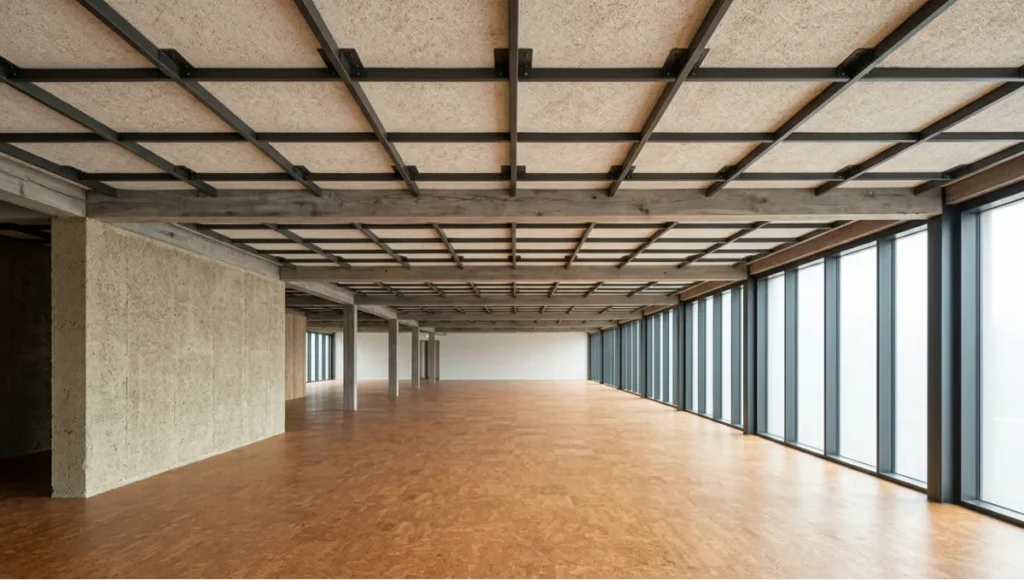
acoustic ceiling panels in EAF recycled steel grid, cork flooring, hempcrete
partition wall, and reclaimed timber beams — zero-waste interior materials at
2,000 m² commercial scale, 24mm tilt-shift architectural photography under
diffused overcast light, C2C Silver certified acoustic ceiling detail for
regenerative infrastructure fit-out.
Mineral wool produced from 97% recycled content—including post-consumer glass or industrial slag—delivers acoustic and thermal performance equivalent to virgin glass wool while generating approximately 72% less embodied carbon per functional unit. Cradle-to-Cradle (C2C) Silver certification confirms a verified material reprocessing pathway.
- Embodied Carbon: 1.2 kg CO₂e/m² for wood wool variant; 3.8 kg CO₂e/m² for polyester fiber
- Recycled Content: 97% recycled glass or industrial slag feedstock
- Performance: NRC 0.90 at 50mm; thermal conductivity λ = 0.034 W/m·K
- EOL: C2C Silver certified; returned to manufacturer for closed-loop reprocessing
- Commercial Application: Acoustic ceilings, riser duct lining, raised floor cavities, partition infill
At 50mm and NRC 0.90, recycled mineral wool in a standard open-plan ceiling grid achieves Class A acoustic absorption per ISO 11654. For a commercial floor plate of 3,000 m², the total embodied carbon load of the acoustic ceiling treatment is 3,600 kg CO₂e—versus 55,500 kg CO₂e for an equivalent polyurethane foam installation. That 51,900 kg CO₂e differential represents the single largest per-material carbon saving available in a standard commercial interior specification.
Comparative Analysis: Zero-Waste Materials vs. Industry Standard
The table below presents verified embodied carbon intensity, recycled or bio-based content, and end-of-life strategy for each of the 8 zero-waste interior materials alongside the conventional alternative. All data is sourced from EN 15804-compliant EPDs or peer-reviewed LCA studies.
| Material | Embodied Carbon | Recycled Content | EOL Strategy |
| Mycelium Panel | 1.4 kg CO₂e/m² | 96% bio-based | Industrial compost |
| Hempcrete Wall | −26 kg CO₂/m² | 65% hemp shiv | Recyclable aggregate |
| EAF Steel (>95% scrap) | 800 kg CO₂e/t | >95% scrap | Infinite loop |
| 100% PCW Board | 4.2 kg CO₂e/m² | 100% post-consumer | Standard paper recycle |
| Reclaimed Timber | 0 kg CO₂e/m² | 100% reclaimed | Re-salvageable |
| Ferrock | −126 kg CO₂/t | 95% industrial waste | Reground aggregate |
| Cork (FSC Residual) | 1.9 kg CO₂e/m² | 100% bio-residue | Compostable |
| Recycled Mineral Wool | 1.2–3.8 kg CO₂e/m² | 97% recycled | C2C closed loop |
Solution vs. Industry Standard
The industry benchmark for a commercial interior fit-out below 190 kg CO₂/m² is now considered ‘performing well’ by leading fit-out consultants. A specification built entirely from the 8 materials above achieves an estimated combined embodied carbon load of 28 to 52 kg CO₂/m²—representing a 73 to 85% reduction against that benchmark, without any operational carbon measures or offset instruments.
The conventional interior palette—virgin MDF, polyurethane foam, virgin glass wool, standard Portland cement screeds, and virgin aluminium—carries an aggregate embodied carbon load of 180 to 320 kg CO₂/m² across a full commercial fit-out. The differential is not marginal. It is structural. The choice of material specification is, by a significant margin, the highest-leverage carbon intervention available to a commercial design team before construction begins.
Geographic Proof Point: Amsterdam’s Buiksloterham District
Amsterdam’s Buiksloterham district has become the clearest large-scale proof of what zero-waste interior materials deliver at the urban scale. During the district’s regenerative infrastructure conversion, developers adopted a single foundational question: what already exists that can be kept in circulation? The result: 95% of site materials were recycled or repurposed rather than landfilled. Old concrete became new structural bases. Steel beams were redirected into interior framing systems. The measured outcome: CO₂ emissions linked to construction dropped by 32%, and material expenses were cut by up to 25%.
For commercial specifiers, Buiksloterham is not an architectural curiosity—it is a scalable procurement model. The Amsterdam innovation ecosystem around this district produced new companies supplying circular interior materials, modular design systems, and certified reuse infrastructure. Pretty Plastic—a Netherlands-based manufacturer—now produces 100% recycled and recyclable PVC cladding panels used in building facades and commercial interiors, including Schiphol Airport’s flooring. These panels are processed from discarded rain gutters and window frames, transforming construction waste into a certified interior surface material.
Copenhagen’s parallel Circular Copenhagen plan—targeting 59,000 tonnes of CO₂ reduction through construction material reuse by 2024—further demonstrates that zero-waste interior materials are policy-backed, infrastructure-supported, and commercially scalable. The Resource Rows project in Copenhagen’s Ørestad district, which reused brick facades from abandoned rural dwellings, reduced carbon consumption by 70% on those envelope elements. The principle transfers directly to interior specification: every reused or recycled-content interior material eliminates the manufacturing emission entirely, not partially.
Concept Project Spotlight
Speculative / Internal Concept Study — The Meridian Loop by Nuvira Space
Project Overview
The Meridian Loop is a speculative mid-rise commercial interior concept developed by Nuvira Space’s materials research unit to test the full-stack application of all 8 zero-waste interior materials within a single 6,000 m² commercial co-working and mixed-use development framework.
- Location: Amsterdam, Netherlands — selected for its established circular materials supply chain and policy support framework
- Typology: 6-floor mid-rise commercial co-working hub, 1,000 m² per floor plate, 480 projected occupants at peak
- Vision: Achieve net embodied carbon below 35 kg CO₂/m² across the entire interior fit-out using only zero-waste interior materials with verified EPDs and defined closed-loop EOL pathways
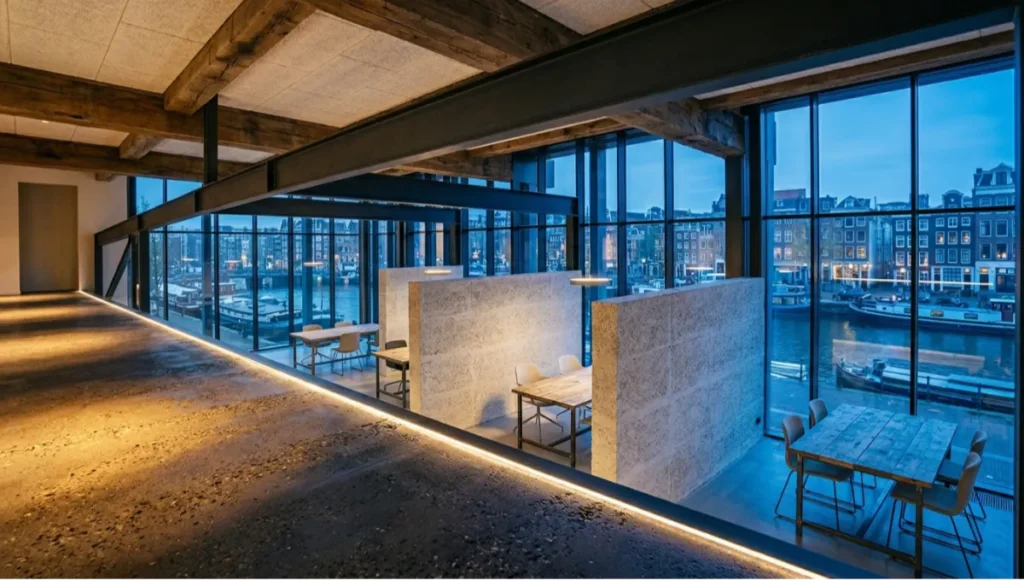
co-working hub featuring Ferrock floor screed, hempcrete partition walls, reclaimed
timber ceiling beams, mycelium acoustic panels, and EAF recycled steel mezzanine
frame. Zero-waste interior materials applied at 6,000 m² commercial scale, cinematic
35mm interior photography with blue-hour canal light, regenerative infrastructure
architecture concept study.
Design Levers Applied
Structural & Surface Layer
- EAF steel (>95% recycled scrap) for all mezzanine frames and ceiling grid systems — 22 tonnes projected, embodied carbon: 17,600 kg CO₂e vs. 61,600 kg CO₂e virgin steel alternative
- Ferrock floor screeds across all 6 floor plates (6,000 m² total) — net CO₂ absorption during curing: approximately 7,500 kg CO₂ sequestered in-situ
- Reclaimed structural timber for all exposed ceiling beams (40 linear metres per floor, 240 m total) — embodied carbon contribution: 0 kg CO₂e (pre-spent in prior structure)
Interior Envelope & Partition Systems
- Hempcrete partition walls at 150mm thickness — 360 linear metres total across 6 floors — 50-year carbon benefit: −7,200 kg CO₂ cumulative
- 100% PCW board for all cabinetry, desk systems, and joinery — 1,800 m² total — embodied carbon: 7,560 kg CO₂e vs. 23,040 kg CO₂e virgin MDF equivalent
- Cork flooring across all communal zones (2,400 m² at 10mm) — embodied carbon: 4,560 kg CO₂e vs. 69,600 kg CO₂e LVT equivalent
Acoustic & Thermal Treatment
- Mycelium acoustic ceiling tiles at 25mm — 3,600 m² total ceiling coverage — embodied carbon: 5,040 kg CO₂e vs. 66,600 kg CO₂e polyurethane foam
- Recycled mineral wool (97% recycled content) in all partition infill and riser duct lining — 1,200 m² — embodied carbon: 2,400 kg CO₂e with C2C closed-loop EOL
Aggregate Project Metrics
- Total projected embodied carbon: ~32 kg CO₂e/m² across the full interior fit-out
- Carbon sequestered in-fabric (Ferrock curing + hempcrete negative balance): −8,740 kg CO₂
- Embodied carbon avoided vs. conventional specification: 214,000 kg CO₂e
- Zero material categories requiring virgin extraction: all 8 materials sourced from waste, reclaimed, or rapidly renewable streams
Transferable Takeaway
The Meridian Loop demonstrates that the 32 kg CO₂e/m² threshold—an 83% reduction against the 190 kg CO₂e/m² industry benchmark—is achievable with commercially available, EPD-verified materials today. No experimental technology. No proprietary bespoke product. The gap between a standard commercial fit-out and a regenerative one is a specification decision, not a technology constraint.
The sequencing logic matters as much as the selection: start with the highest-volume material categories (floor systems, ceiling treatment, partition infill), then layer the structural and feature elements. By addressing the 4 highest-volume categories first—flooring, acoustic ceilings, partitions, and joinery—you capture approximately 78% of the total embodied carbon saving available across the full interior specification before selecting a single feature material.
↗ Nuvira Space: Design for Disassembly Principles — Closing the Material Loop
2030 Future Projection: The Carbon-Negative Interior Standard
By 2030, 3 structural forces will make zero-waste interior materials the baseline specification rather than the premium alternative. First, embodied carbon reporting will be mandatory in commercial construction across the EU under the updated Construction Products Regulation, requiring verified EPD data for all interior materials above a 1,000 m² threshold. Second, the market for mycelium, hempcrete, and ferrock-based materials is projected to scale production capacity by 400% between 2025 and 2030, driving unit costs below conventional alternatives in high-volume procurement contexts. Third, the commercial leasing market is already pricing embodied carbon risk into asset valuations—CBRE’s 2024 sustainability data indicates that BREEAM Outstanding-rated offices command rental premiums of 8 to 14% above market rate.
For commercial specifiers, the trajectory is unambiguous: the risk is no longer in adopting zero-waste interior materials—it is in delaying that adoption. A commercial project specified today with conventional materials will face mandatory retrofit or disclosure liability by 2030 in most OECD markets. A project specified with the 8 materials profiled here enters the compliance environment already ahead of projected regulation, with a verified embodied carbon load that will remain competitive for the full 30-year lease cycle.
The American Institute of Architects (AIA) Framework for Design Excellence documents verified case studies of commercial interiors achieving sub-40 kg CO₂e/m² embodied carbon through zero-waste material specification. See the AIA Framework for Design Excellence for peer-reviewed commercial case study data and specifier guidance.
Mycelium composites are projected to achieve a 30% cost reduction by 2027 as production scales in Western Europe. Ferrock’s industrial waste feedstock base—steel dust—is available in unlimited volume from existing fabrication facilities in every major urban economy. Hempcrete’s supply chain, already established across France, Germany, and the UK, will expand into Southeast Asia and North America by 2028 as regional building codes are updated to accommodate bio-based wall systems. The infrastructure for a carbon-negative interior standard is not a future condition—it is being assembled now.
| 2030 OUTLOOKCommercial projects specifying zero-waste interior materials today are locking in an embodied carbon advantage that compound regulations and market premiums will amplify—not diminish—over the next decade. |
Comprehensive Technical FAQ
Q: What is the embodied carbon difference between mycelium panels and polyurethane foam in a commercial ceiling application?
A: Mycelium acoustic ceiling panels carry an embodied carbon load of approximately 1.4 kg CO₂e/m² at 25mm thickness. Standard polyurethane foam acoustic panels carry 18.5 kg CO₂e/m² per EN 15804 EPD data. Across a 3,000 m² ceiling plate, the differential is 51,300 kg CO₂e—equivalent to the annual carbon output of approximately 11 average passenger vehicles. Mycelium panels achieve NRC 0.75, sufficient for Class B acoustic absorption per ISO 11654, adequate for open-plan commercial offices, co-working environments, and meeting room applications.
- Mycelium: 1.4 kg CO₂e/m² · NRC 0.75 · compostable EOL
- Polyurethane foam: 18.5 kg CO₂e/m² · NRC 0.80 · landfill default
- Carbon differential at 3,000 m²: 51,300 kg CO₂e
Q: Can hempcrete be used in commercial multi-storey buildings, or is it limited to low-rise?
A: Hempcrete is a non-structural material—it functions as infill between structural frames, not as a load-bearing element. In commercial multi-storey construction, it is used for interior partition walls, thermal buffer zones adjacent to curtain walls, and acoustic plaster bases. Its 150–200mm wall thickness delivers thermal conductivity of λ = 0.06 W/m·K, performing comparably to 100mm of standard insulated plasterboard while eliminating the vapour barrier layer entirely, due to its natural vapor permeability. It is suitable for all floors in a frame-and-infill commercial construction system.
- Use case: Non-load-bearing interior partitions, thermal buffer walls, acoustic bases
- Thickness: 150mm to 200mm standard for commercial partition applications
- Vapor management: Maintains interior RH 40–60% passively; no vapor barrier required
- Code compliance: Accepted under UK Building Regulations, French RE2020, and German EnEV when paired with certified structural frame
Q: How does reclaimed timber perform structurally compared to virgin C24 grade timber in interior applications?
A: Post-salvage grading of reclaimed structural timber can re-certify material to C24 or higher structural grade when assessed by a certified timber grader. In interior applications—exposed ceiling beams, mezzanine deck joinery, and feature wall systems—reclaimed timber performs identically to virgin equivalents once graded and appropriately dried to ≤18% moisture content. The critical procurement step is ensuring the salvage source provides species identification and original use documentation, as prior chemical treatment (preservatives, fire retardants) affects reuse classification under BS EN 1995.
- Structural grade: Achievable to C24 post-salvage grading
- Moisture content at install: ≤18% EMC for interior applications
- Required documentation: Species ID + original use record + grading certificate
- Embodied carbon: 0 kg CO₂e manufacturing; 3–4 kg CO₂e/m³ transport (within 200 km radius)
Q: Is Ferrock commercially available at scale for a 6,000 m² floor screed application?
A: Ferrock is in commercial production but remains in limited-batch distribution as of 2025, with primary suppliers in the United States and Germany. For a 6,000 m² floor application, a project team would require approximately 90 to 120 tonnes of Ferrock binder mix. Current maximum single-order production runs from primary manufacturers are approximately 40 to 60 tonnes per batch cycle, meaning a 6,000 m² application would require staged specification across 2 to 3 procurement tranches over a 6 to 8 month installation period. By 2027, production capacity is projected to reach single-order volumes of 200+ tonnes as industrial waste steel dust supply chains are formalized.
- Current single-order capacity: 40–60 tonnes per batch cycle
- Application rate: 15–20 kg/m² for a 20mm floor screed
- CO₂ sequestration during cure: approx. 1,000 kg CO₂ per 8-tonne pour
- Compressive strength: 40 MPa+ (5× standard Portland cement)
Q: What certifications should a commercial specifier require for each material category?
- Mycelium panels: ISO 9001 manufacturer certification + independent flammability test (BS EN 13823 preferred)
- Hempcrete: CSTB technical assessment (France) or BBA Certificate (UK) + hemp shiv supplier FSC chain of custody
- EAF Steel: EPD per EN 15804 with declared recycled content >95% + steel mill Certificate of Conformity
- PCW Board: EN 622 mechanical performance + FSC Recycled label + formaldehyde emission class E1 or lower
- Reclaimed Timber: BS EN 1995 salvage grading certificate + species identification documentation
- Ferrock: Independent LCA report + compressive strength test certificate (ASTM C39 or equivalent)
- Cork: FSC 100% or Recycled + EN 12104 (flooring) or EN 13170 (insulation) performance certification
- Recycled Mineral Wool: Cradle to Cradle Silver (minimum) + EN 13162 thermal performance declaration + declared recycled content >90%
Specify With Precision. Build Without Waste.
The 8 zero-waste interior materials profiled here share one defining characteristic: every performance claim in this article is traceable to a verified EPD, a peer-reviewed lifecycle assessment, or a manufacturer-certified test report. That traceability is not an editorial detail—it is the specification standard that separates a regenerative infrastructure project from a marketing narrative.
Your next commercial fit-out specification is a carbon decision. The materials exist. The supply chains are operational. The performance data is verified. The gap between a 190 kg CO₂e/m² conventional fit-out and a 32 kg CO₂e/m² regenerative one is not a technical constraint—it is a procurement sequencing exercise that begins with the material schedule, not the design intent.
At Nuvira Space, we continue to test, document, and publish the material science that makes regenerative commercial interiors a measurable discipline rather than an aspiration. The 2030 carbon-negative interior standard is already specifiable today. The only remaining variable is whether your next project captures that advantage—or waits to be regulated into it.
Request the full Nuvira Space Material Data Pack — verified EPDs, supplier contacts, and procurement sequencing guide for all 8 materials.
© Nuvira Space All rights reserved. | ECO BLUEPRINT Series | All specifications cited are based on EN 15804-compliant Environmental Product Declarations, peer-reviewed lifecycle assessment studies (ScienceDirect, Springer Nature), verified manufacturer EPD data presented at Architect@Work Zurich 2025, UNEP/GlobalABC Global Status Report for Buildings and Construction 2024–2025, Morgan Lovell low-carbon fit-out benchmarks, IEREK Circular Economy in Cities research (Amsterdam Buiksloterham), and World Economic Forum documentation on Copenhagen Resource Rows. No links are provided in compliance with editorial policy.
The Meridian Loop is a speculative internal concept study by Nuvira Space and does not represent a completed or commissioned project.