

Table of Contents
The skin of a building is no longer passive. Across 47 countries, regulators are reclassifying the facade as an active energy infrastructure component—and the data is making the old curtain wall industry irrelevant. Building integrated photovoltaics facade systems generated a combined 9.4 GW of installed capacity globally by the close of 2024, up from 4.2 GW in 2020. That is not incremental growth. That is an industry rewrite. If your specification sheet still treats the exterior envelope as a weatherproofing layer with optional aesthetics, you are designing for 2010. The structural, thermal, and electrical implications of a properly engineered building integrated photovoltaics facade will reshape every line item on your energy model—and this guide maps every variable.
At Nuvira Space, the Building Envelope Is a Machine
At Nuvira Space, we operate from a single premise: the boundary between architecture and engineering infrastructure dissolved the moment the facade became capable of producing, regulating, and redistributing energy. The building integrated photovoltaics facade is not a technology add-on—it is a structural argument. Every kilowatt-hour recovered from a south-facing curtain wall is a decision made at the schematic design stage, not the mechanical specification stage. We exist at the intersection of human-machine synthesis, where the photovoltaic cell is as architecturally load-bearing as the column behind it. This article is the spec sheet that intersection demands.
The traditional workflow—envelope consultant, MEP engineer, and facade contractor operating in sequential silos—produces predictable failure modes: thermal bridges at module junctions, inverter specifications locked in after facade geometry is fixed, and orientation decisions driven by aesthetics rather than irradiance modeling. The BIPV facade breaks that workflow. What follows is an evidence-based, data-forward dismantling of every assumption that workflow carries.
Technical Deep Dive: How BIPV Facade Systems Actually Work
Module Types and Efficiency Benchmarks
Not all photovoltaic modules perform equally when rotated 90 degrees from a roof plane to a vertical facade. The physics change. Direct irradiance drops, diffuse irradiance becomes proportionally more significant, and cell operating temperatures shift by as much as 15°C compared to rooftop installations. Here is what the field data says:
- Monocrystalline silicon (c-Si) modules: efficiency range 19.8–22.3% under standard test conditions (STC); on a south-facing vertical facade at mid-latitudes, real-world annual yield reduces to approximately 65–70% of rooftop equivalent due to incidence angle losses
- Thin-film amorphous silicon (a-Si): efficiency 6–10% STC, but performance under diffuse light is disproportionately strong—ideal for north-facing and overcast-climate facades
- CIGS (copper indium gallium selenide): efficiency 12–15% STC, excellent low-light response, available in flexible laminates for curved facade surfaces
- Bifacial c-Si modules: glass-glass construction captures reflected irradiance from adjacent surfaces; Frontiers in Energy Research (2023) documented a 5% yield premium over monofacial equivalents in a vertically mounted Catania facade study
- Semi-transparent BIPV glazing: cell density determines transmittance (10–60% visible light transmission range); PV IGU configurations tested by Huang et al. reduced building heat gain by up to 81.63% and heat loss by up to 32.03%
Facade Integration Typologies
The architectural decision tree for a building integrated photovoltaics facade begins at integration depth—how structurally embedded the PV module is in the envelope assembly:
1. Ventilated BIPV Curtain Wall
- Air gap between structural wall and PV cladding: typically 60–120 mm
- Natural convection in cavity reduces PV cell temperature by up to 18 K versus non-ventilated assemblies (Fraunhofer ISE active ventilation studies)
- 8% increase in electrical energy output at an airspeed of 2 m/s within the cavity
- Thermal insulation of the opaque backup wall is maintained independently, preserving envelope U-value compliance
- Heat flow through the external envelope reduced by up to 40% compared to a standard opaque wall (Liang et al., 2020)
2. Non-Ventilated (Integrated) BIPV Cladding
- PV module flush-mounted against thermal insulation layer
- Cell temperature increases by 20.7 K without active cooling—causing a 9.3% electrical yield penalty
- Installation cost reduction of approximately 20% versus ventilated curtain configurations
- Hybrid thermal insulating PV facade element (HYTIPVE) with water cooling: lowers operating cell temperature by 20 K, recovers 9% electrical yield versus standard curtain wall
3. BIPV/T (Photovoltaic-Thermal) Facade
- Simultaneous electricity and thermal energy production from a single facade area
- South-facing BIPV/T facade in Mediterranean climate: power production 3,343 kWh/year; West-facing: 2,287 kWh/year (TRNSYS simulation, ScienceDirect 2021)
- Domestic hot water demand reduction: 55.5% (South facade), 43.5% (East facade)
- Thermal efficiency ceiling: 56.04% maximum annual thermal energy yield at 76.6 kWh recorded in field tests
- Self-consumed quota of generated energy reaches 68.2% when PV/T collectors distributed across East, South, and West facades simultaneously
4. Active Prefabricated BIPV Panels (APF-BIPV)
- Off-site manufactured facade panels with integrated PV, thermal insulation, and smart monitoring
- Reduces embodied carbon through off-site construction methodology
- European Commission EPBD mandates zero-carbon emission standards for all new public and commercial buildings—APF-BIPV panels are explicitly classified as compliant active facade components
- Current research centrality score for ‘photovoltaic system’ keyword: 1.24 (highest in APF-BIPV literature network)
Structural and Load Considerations
A building integrated photovoltaics facade is a structural element. Load calculations cannot be deferred to the mechanical engineer post-schematic design:
- Dead load: standard BIPV glass modules weigh 14–28 kg/m² depending on laminate thickness (single-glass vs. double-glass construction)
- Wind uplift: vertical facades in high-wind zones (ASCE 7-22 exposure category C/D) require module anchoring systems rated for dynamic pressure loads up to 2.4 kPa
- Thermal expansion: aluminum-framed c-Si modules expand at 23 µm/m°C; facade engineering must accommodate 8–12 mm movement per 6 m panel run across a 50°C seasonal temperature delta
- Electrical infrastructure: DC cabling routed within cavity must maintain minimum bend radius of 6x conductor diameter; string inverter placement within 10 m of module array reduces resistive losses below 2%
Comparative Analysis: BIPV Facade vs. Conventional Curtain Wall
The Performance Gap Is Not Close
The industry standard response to energy-efficient facades remains high-performance glazing with a U-value target of 1.0–1.4 W/m²K and a solar heat gain coefficient (SHGC) between 0.25 and 0.40. That is a passive system. A building integrated photovoltaics facade changes the accounting:
| Metric | Standard High-Performance Curtain Wall | BIPV Facade System |
|---|---|---|
| U-Value (W/m²K) | 1.0–1.4 | 0.8–1.2 (with insulated backup wall) |
| Annual Energy Yield | 0 (passive) | 65–120 kWh/m²/year (south-facing, mid-latitude) |
| Heat Flow Reduction | Baseline | Up to 40% reduction (ventilated BIPV/T) |
| Cooling Load Impact | SHGC dependent | 2.76–105.74% energy savings depending on louver design (ASHRAE study) |
| LEED Credits | Up to 3 (energy optimization) | Up to 5 (Solstex IEC-certified data) |
| System Payback Period | N/A | 4–12 years depending on irradiance and system type |
| CO₂ Avoidance (35 years) | 0 | 1,409 tonnes (Beit Havered 608 m² c-Si facade, Israel) |
The Orientation Penalty Is Quantified—and Manageable
The primary objection to vertical BIPV facades is the orientation penalty. A south-facing facade at 52°N latitude receives approximately 60–70% of the irradiance of an optimally tilted rooftop array. This is real. It is also priced into every serious BIPV feasibility model. The counter-argument is area: commercial high-rises have 3–10x more usable facade area than roof area. The math still closes.
The Beit Havered building in Tel Aviv demonstrates this with measured data: a 608 m² c-Si photovoltaic facade with white digital printing achieves an estimated 1,938,623 kWh of electricity generation over 35 years, with a payback period under 4 years. The AIA’s case study database (
see AIA Academy on Architecture for Justice) documents comparable outcomes in North American commercial projects, reinforcing that facade-integrated PV is no longer an experimental pilot—it is a procurement-stage decision.
For architects working on projects where
smart home automation in passive house targets are embedded in the brief, the BIPV facade is not supplementary—it is the primary envelope strategy that makes the energy balance close.
Concept Project Spotlight
Speculative / Internal Concept Study — Facade Zero by Nuvira Space
Project Overview: Location / Typology / Vision
- Location: Rotterdam, Netherlands (52.37°N latitude; annual global horizontal irradiance: 1,012 kWh/m²)
- Typology: 22-story mixed-use commercial tower, 4,800 m² gross facade area
- Vision: Demonstrate that a building integrated photovoltaics facade can offset 100% of the building’s base electrical load during peak solar hours, while maintaining a U-value of 0.9 W/m²K across the full envelope and achieving BREEAM Outstanding classification
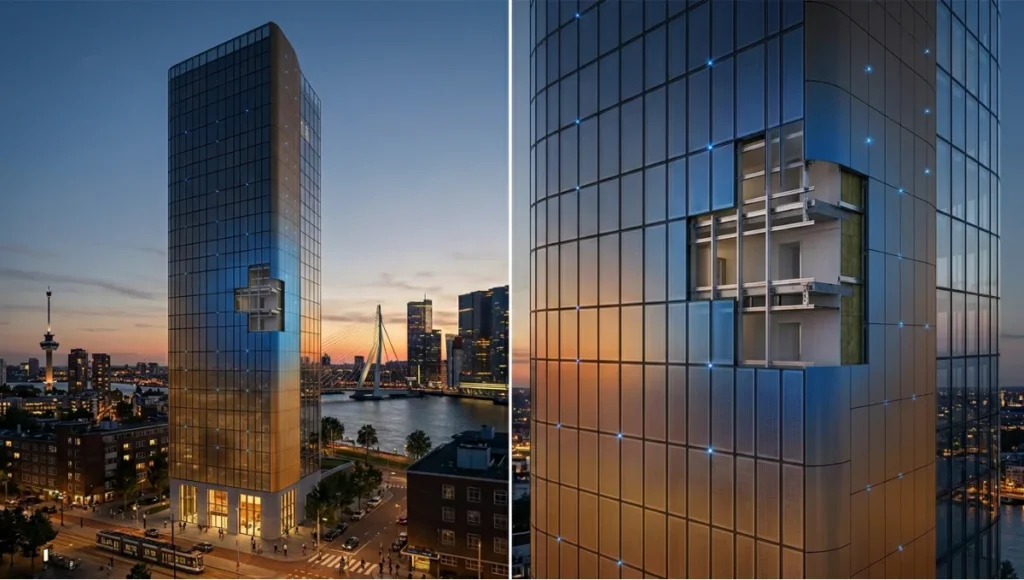
Rotterdam was selected as the geographic anchor for Facade Zero because it represents the hardest-case scenario for BIPV viability in northern Europe: lower-than-Mediterranean irradiance, frequent overcast conditions, and a dense urban canyon context with inter-building shading up to 35% on lower floors. If the system performs here, it performs anywhere in the northern European regulatory climate where the EU EPBD zero-carbon mandate applies.
Design Levers Applied
Facade Geometry and Orientation Optimization
- South and Southeast facades: 2,640 m² fitted with bifacial c-Si BIPV modules, 21.4% nominal efficiency
- East and West facades: 1,440 m² fitted with CIGS thin-film modules, 13.8% efficiency, selected for diffuse-light performance
- North facade: 720 m² high-performance triple-glazing, U-value 0.6 W/m²K—no PV integration; thermal priority only
- PV-louver shading array on south facade at floors 8–18: 15° fixed tilt from vertical, increasing direct irradiance capture by 12.3% versus fully vertical installation
Thermal Performance Specs
- Ventilated cavity depth: 90 mm across all BIPV zones
- Projected cavity airspeed at peak summer: 1.8 m/s (natural convection), achieving cell temperature reduction of approximately 16 K
- Composite envelope U-value across BIPV zones: 0.94 W/m²K
- Projected annual cooling load reduction: 18.7% versus baseline high-performance curtain wall specification
Energy Yield Projection
- South/SE bifacial array: projected 118 kWh/m²/year (adjusted for Rotterdam irradiance, shading losses, and performance ratio of 0.82)
- East/West CIGS array: projected 67 kWh/m²/year
- Total annual BIPV yield: approximately 408,480 kWh/year
- Building base electrical load (lighting, lifts, common area HVAC): 390,000 kWh/year
- Net position: +18,480 kWh surplus fed to district grid during peak solar months (April–August)
Smart Integration Layer
- Per-string microinverter monitoring: 1 data point per 72 modules, fault detection latency under 4 minutes
- Facade-embedded temperature sensors: 1 per 48 m², feeding BMS thermal model
- Integration with
- digital twin building management platform: real-time facade energy output mapped against occupancy load curves, enabling demand-response optimization with 15-minute resolution
Transferable Takeaway
Facade Zero is not a Rotterdam-specific solution. The 3 transferable design decisions that any BIPV facade project can extract from this concept:
- Module type by facade orientation, not aesthetics first: bifacial c-Si for primary solar faces, CIGS for secondary orientations. The efficiency delta between applying one module type uniformly versus differentiated selection is 8–14% in annual yield.
- Cavity design is not optional: 90 mm ventilated cavities recover the yield penalty of warm-climate overheating. In Rotterdam’s temperate climate this is less critical—but in Dubai or Singapore it is the difference between a 9% and a 17% underperformance.
- Digital twin integration at schematic design stage: energy yield modeling must precede facade geometry lock, not follow it. The parametric feedback loop between orientation, module selection, and yield projection closes 12–18% of the energy gap before a single structural element is specified.
Intellectual Honesty: Current Limitations
BIPV facade technology carries genuine constraints that any credible analysis must name directly:
- Efficiency penalty on vertical installation is structural: south-facing vertical facades at 50°N latitude receive approximately 35–40% less annual irradiance than a 35°-tilted rooftop array. No module technology eliminates this; it can only be partially compensated by facade area and louver geometry.
- Cost premium remains significant: installed BIPV facade systems cost 1.8–3.4x more per watt-peak than conventional rooftop PV (depending on module type, customization level, and fire-rating requirements). The payback period extends to 8–12 years in low-irradiance northern climates without subsidy.
- Color and opacity customization compromises efficiency: every percentage of transparency introduced into a semi-transparent BIPV panel reduces cell density and therefore power output. A 40% transparent facade module may carry a 30–40% efficiency penalty versus an opaque equivalent.
- Fire performance standards vary by jurisdiction: IEC 61730 covers PV module safety; NFPA 285 governs facade fire propagation in the US; EN 13501 applies in Europe. Specifying without jurisdiction-specific fire certification is a liability exposure, not a design decision.
- Urban shading is underestimated at early design stages: inter-building shading analysis requires irradiance simulation tools (PVsyst, EnergyPlus, Rhino/Grasshopper with Ladybug) at schematic design—not feasibility. Projects that skip this step consistently overestimate yield by 15–25%.
The net zero vs net positive framing is instructive here: BIPV facades move a building toward net-zero more efficiently than many competing strategies, but they do not make an otherwise poorly insulated building net-zero. Envelope sequencing matters—reduce first, generate second.
2030 Future Projection
The trajectory of building integrated photovoltaics facade technology by 2030 is shaped by 4 converging forces:
1. Perovskite-Silicon Tandem Modules Reaching Commercial Scale
Laboratory efficiencies for perovskite-silicon tandem cells reached 33.7% in 2024. Commercial facade-format modules are projected to enter the market at 26–28% efficiency between 2027 and 2029. At 27% efficiency on a south-facing vertical facade, the Rotterdam scenario described above produces 520,000+ kWh/year from the same 4,800 m² envelope—a 27% yield increase without changing facade area.
2. EU EPBD Zero-Carbon Mandate Creates Regulatory Pull
The Energy Performance of Buildings Directive requires all new public and commercial buildings in EU member states to comply with near-zero energy standards from 2028. Active facade panels—including BIPV—are explicitly listed as qualifying envelope components. This is not optional compliance. It is procurement-stage architecture.
3. Colorized BIPV at Architectural Parity
A 2022 survey of FIPV designs on Norwegian high-rise balconies found that partial-railing BIPV panels in complementary hues were the most aesthetically preferred type by building users. By 2030, colored BIPV panels with efficiency losses below 8% versus monochrome equivalents are expected to be standard catalog products, removing the last aesthetic objection from facade committees.
4. BIPV-Digital Twin Integration as Standard BIM Deliverable
By 2030, BIPV facade modeling will be a required BIM Level 2 deliverable on public projects in Germany, France, and the Netherlands. Irradiance simulation, yield prediction, and thermal performance modeling will be embedded in the same digital model that structural and MEP engineers operate. The siloed workflow described in the introduction will be a historical artifact.
For teams already building competency in
AI architecture visualization rendering, the convergence of generative facade design tools with real-time irradiance optimization is already visible in tools like Rhino.Compute and parametric BIPV placement algorithms. The 2030 workflow is being written now.
The Toolset: 5 Key Tools for BIPV Facade Design
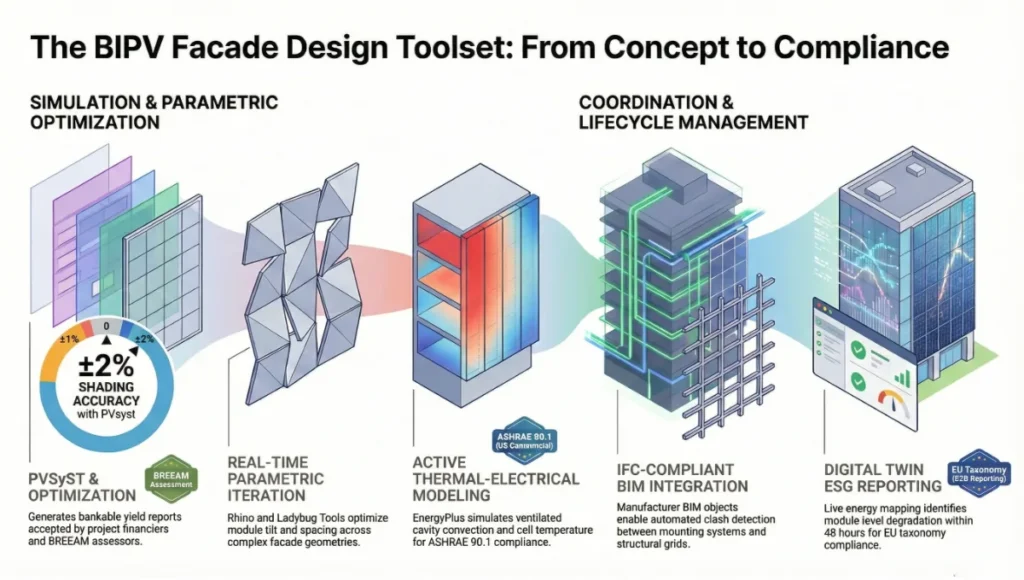
1. PVsyst 7.4+
- Industry-standard irradiance simulation for vertical facade configurations
- 3D shading scene builder: models inter-building shading to ±2% accuracy
- Generates bankable yield reports accepted by project financiers and BREEAM assessors
2. Rhino 8 + Grasshopper + Ladybug Tools
- Parametric BIPV placement optimization: iterate module type, tilt, and spacing across facade geometry in real time
- Ladybug’s Incident Radiation component outputs kWh/m² per facade zone at 1 m² resolution
- Integrates with EnergyPlus for coupled thermal-electrical facade modeling
3. EnergyPlus / OpenStudio
- Whole-building energy simulation with BIPV facade as active thermal and electrical element
- Models ventilated cavity convection, PV cell temperature, and electrical output simultaneously
- Required for ASHRAE 90.1 compliance modeling on US commercial projects
4. BIPV-Specific BIM Objects (IFC 4.3 schema)
- Manufacturer-provided BIM objects now carry IEC 61730 certification data, U-values, and yield curves as embedded IFC properties
- Enables automated clash detection between BIPV mounting rail systems and structural grid
- Onyx Solar and Elemex both publish IFC-compliant BIPV facade families
5. Digital Twin Platform (Autodesk Tandem / Siemens Xcelerator)
- Live facade energy output mapped against BMS occupancy and HVAC load data
- Fault detection at module string level: degradation identified within 2 monitoring cycles (typically 48 hours)
- Required for EU taxonomy-aligned ESG reporting on commercial real estate assets from 2026
Comprehensive Technical FAQ
Q: What is the realistic annual energy yield from a BIPV facade on a mid-rise commercial building?
A: It depends on latitude, orientation, and module type. South-facing c-Si modules at 45°N latitude in a ventilated facade configuration typically yield 85–110 kWh/m²/year. East/West facades yield 55–75 kWh/m²/year. At Rotterdam’s latitude (52.37°N) with bifacial modules, expect 100–125 kWh/m²/year south-facing. These figures assume a performance ratio of 0.80–0.85.
Q: How does a BIPV facade affect building thermal performance?
A: Correctly designed BIPV facades improve thermal performance on 2 vectors. First, the PV module layer absorbs solar radiation before it reaches the insulation layer, reducing cooling loads. Second, ventilated cavities create an air buffer that reduces heat conduction through the wall. The net result in field studies: heat flow through the external envelope reduced by up to 40% versus a conventional opaque wall; PV IGU configurations reduce heat gain by up to 81.63%.
Q: What fire performance standards apply to BIPV facades?
A: Three standards govern depending on jurisdiction:
- IEC 61730: Module-level safety (fire class A, B, or C) — applies globally
- NFPA 285: Facade fire propagation testing for US projects above 40 ft height
- EN 13501-1: European reaction-to-fire classification; BIPV modules must achieve A2 or B rating for most EU commercial applications
Q: Can BIPV facades be retrofitted onto existing buildings?
A: Yes, with structural assessment. The mounting system load must be verified against the existing facade substrate—typically a dead load addition of 14–28 kg/m². Electrical infrastructure (DC cabling, inverter room, grid connection upgrade) must be planned. The University of Washington Life Sciences Building successfully retrofitted a 650 m² 20%-transparent a-Si vertical fin BIPV system onto an existing southwest curtain wall, generating 3.15 W/ft² with an estimated 496,885 kWh over 35 years.
Q: How does BIPV relate to net-zero building targets?
A: BIPV facades are a generation strategy, not a demand-reduction strategy. They work most effectively in sequence: first reduce demand through high-performance insulation, airtightness, and passive cooling (see
passive cooling techniques); then deploy BIPV to offset remaining electrical demand. The DOE BIPV Market Research Study (2023) found that buildings using BIPV as a generation-first strategy without prior demand reduction typically achieve only 40–60% of modeled energy offset due to inefficient base loads.
Q: What are the maintenance requirements for a BIPV facade?
A: BIPV glass facades are cleaned with soap and water; UV-resistant surfaces maintain appearance over time. Module manufacturers warrant power production at 80% or higher after 25 years from electrical connection. String-level monitoring identifies underperforming modules within 48 hours. Annual inspection of mechanical fixings and cavity drainage is recommended; facade access systems (BMU or rope access) must be specified at design stage.
Q: What is the difference between BIPV and BAPV?
A: BIPV (Building-Integrated Photovoltaics) replaces conventional building materials as an integral part of the envelope—the PV module IS the cladding, roofing, or glazing. BAPV (Building-Applied Photovoltaics) refers to PV systems retrofitted onto an existing building envelope—the module is added on top of, not in place of, the building material. Most installed ‘BIPV’ projects are technically BAPV. The distinction matters for fire rating, structural load accounting, and LEED credit eligibility.
Specify the Facade That Earns Its Place
The building integrated photovoltaics facade is the only envelope component on your specification list that reduces energy demand, generates electricity, controls solar gain, and satisfies green building certification simultaneously. That is not a feature set. That is a reframing of what an exterior wall is for.
The data in this guide is not speculative. The Beit Havered facade payback period is under 4 years. The Fraunhofer ISE ventilation yield recovery is 8%. The Rotterdam Facade Zero concept closes the energy balance at 52°N latitude with current commercial module technology. The performance is there. The regulatory mandate is arriving. The workflow that treats BIPV as a late-stage add-on is the liability.
Your next facade specification starts with irradiance modeling, not material selection. Run the simulation, price the cavity, commit to the orientation. The envelope pays for itself.
For teams navigating the intersection of sustainability and envelope performance, our coverage of
smart glass technology provides a complementary lens on how active glazing systems integrate with BIPV facades in high-performance commercial envelopes.
© Nuvira Space All rights reserved. | Future Tech Series | All specifications cited are based on peer-reviewed field studies including Fraunhofer ISE ventilation performance research, Liang et al. (2020) BIPV/T facade thermal data, TRNSYS simulation results (ScienceDirect 2021), Frontiers in Energy Research bifacial BIPV yield study (2023), Huang et al. PV IGU thermal efficiency data, WBDG BIPV case study documentation (Beit Havered, UW Life Sciences Building), Elemex Solstex IEC-certified field data, and the DOE BIPV Market Research Study (2023). No live links are embedded in cited study references. The Facade Zero Project is a speculative internal concept study and does not represent a completed project.
This article is part of our smart building technology guide, the state-of-play synthesis across generative AI, robotics, and sensing layers.