

35%. See how biochar-enhanced concrete, plaster, and composites
work — and which specs matter.
Table of Contents
MACRO-OBSERVATION HOOK
The construction industry is responsible for 38% of total global CO₂ emissions annually, and cement production alone contributes 8% of that figure—approximately 2.5 billion tonnes of CO₂ released into the atmosphere every calendar year. This is not a projection. This is the operational baseline against which every material specification in regenerative infrastructure now competes. As sea-level rise accelerates along coastlines from Rotterdam to Manila, and as heatwave intensity forces cities in Southern Europe to retrofit their built stock at unprecedented cost, the question facing architects, engineers, and developers is no longer whether to rethink the material supply chain—it is how fast you can do it without compromising structural integrity.
Biochar building materials are emerging as one of the most quantifiably significant answers to that question. When substituted for conventional mineral fillers in cementitious composites, biochar can reduce the carbon footprint of a wall assembly by up to 35%, according to lifecycle assessments published across peer-reviewed structural materials literature in 2022–2025. That is not a marginal efficiency gain. A 35% reduction in embodied carbon, applied at scale across a 50,000 m² mixed-use development, translates to carbon savings equivalent to taking 1,400 passenger vehicles off the road for a full year.
The mechanism is not passive. Biochar sequesters carbon actively—it locks biogenic carbon into a stable aromatic form that resists biological decomposition for periods estimated between 100 and 1,000 years. In a material sense, your wall becomes a vault.
Nuvira Perspective, the Material Is the Strategy
At Nuvira Space, we treat every material specification as an editorial act. Choosing biochar building materials over conventional mineral fillers is not an aesthetic preference—it is a carbon accounting decision with compounding consequences across the full lifecycle of a structure. Our Eco-Blueprint editorial series exists to translate the granular data from materials science into decisions you can take from schematic design to construction documentation. The global shift toward carbon-negative construction is already under way. This article gives you the technical vocabulary, the comparative data, and the design logic to move with it—not after it.
The Technical Mechanics of Biochar in Construction
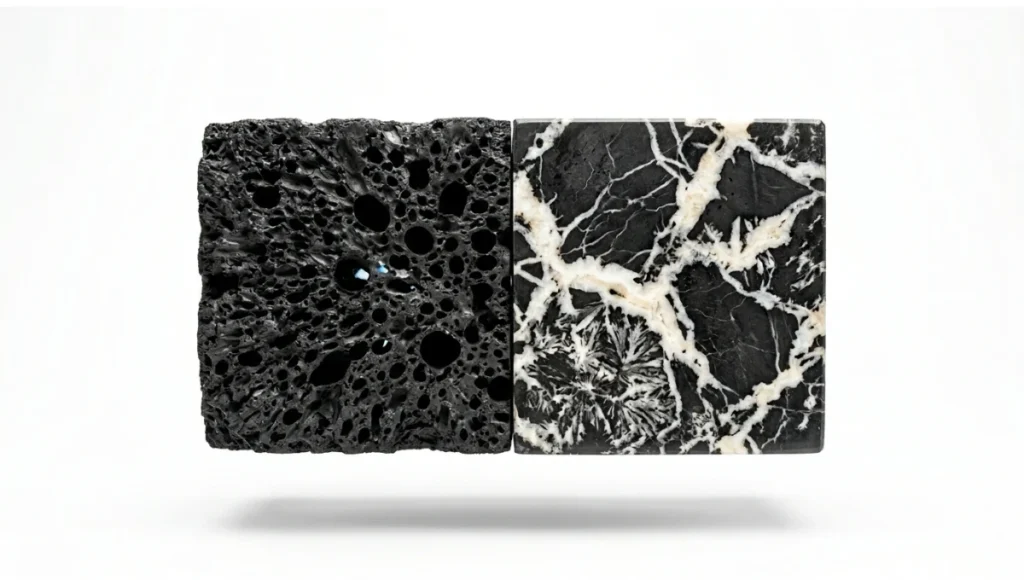
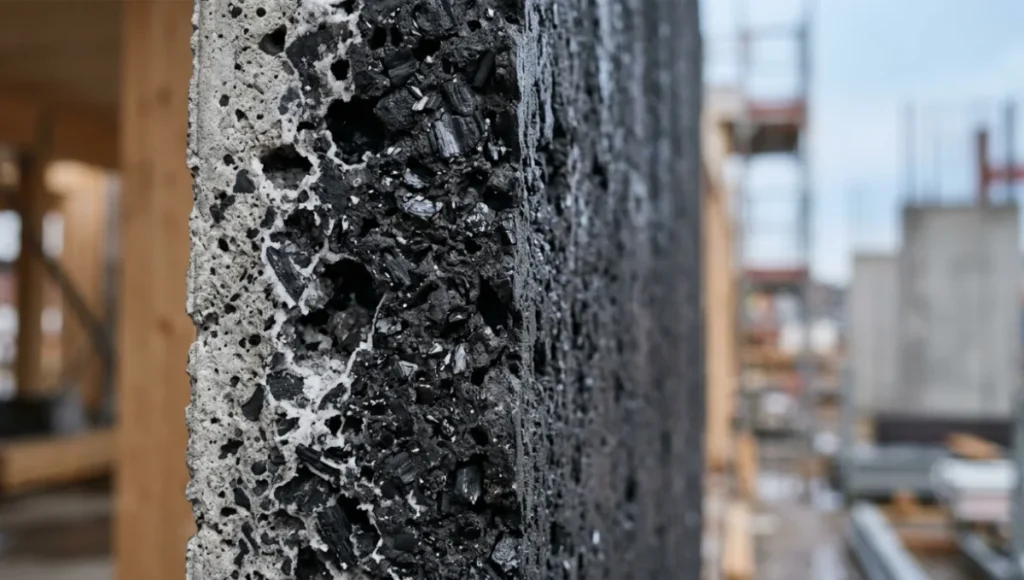
Biochar is produced through pyrolysis—thermal decomposition of organic biomass at temperatures between 300°C and 700°C in an oxygen-limited environment. The output is a highly porous, carbon-rich solid with a specific surface area that typically ranges from 50 m²/g to over 400 m²/g depending on feedstock and process temperature. That surface area is architecturally consequential: it is the physical basis for biochar’s capacity to regulate moisture, moderate thermal mass, and participate in the cement hydration reaction.
The key to understanding biochar’s role in building materials is the distinction between two functions it performs simultaneously: it acts as a reactive filler that alters the micro-structure of cementitious composites, and it acts as a carbon sink embedded permanently within the fabric of the structure.
Feedstock and Production Variables That Determine Performance
Not all biochar is identical, and that variability matters directly to structural engineers and material specifiers. The following parameters govern performance outcomes:
- Pyrolysis temperature range: 400°C–600°C produces biochar optimised for surface reactivity and pore volume; above 700°C, graphitisation increases electrical conductivity but reduces surface functionality.
- Feedstock category: wood-chip-derived biochar offers compressive strength contribution of up to 20 N/mm² in cement composites; agricultural residue-derived biochar typically yields lower strength but higher CO₂ sequestration per unit weight.
- Particle size: biochar with a D50 of 0.1–1.0 mm performs optimally as a sand replacement in mortar; coarser fractions (1–4 mm) are used in lightweight block and plaster formulations.
- Mineral co-binder ratio: effective mixes typically combine 30% cement binder with 70% biochar by weight, producing wet bulk densities below 1.2 g/cm³—a 40% weight reduction compared to standard concrete (2.0–2.4 g/cm³).
- Carbon content: biochar with >75% fixed carbon content is classified as a stable carbon sink under European Biochar Certificate (EBC) standards and qualifies for carbon credit recognition.
Biochar in Cementitious Composites: Strength and Carbon Together
When biochar replaces mineral fillers in cementitious systems at a substitution rate of 10–20% by weight, laboratory results consistently report compressive strength values of 15–25 N/mm²—equivalent to conventional lightweight concrete blocks used in non-load-bearing applications. The mechanism involves two phases: in the fresh state, biochar’s porosity absorbs excess water (internal curing), reducing the effective water-cement ratio and improving paste density; in the hardened state, the porous network acts as a nucleation site for calcium silicate hydrate (C-S-H) crystals, which tighten the microstructure and marginally increase tensile bond strength.
The thermal insulation performance is equally direct. Biochar-concrete composites at 30% substitution achieve thermal conductivity values of 0.20–0.35 W/(m·K), compared to 0.80–1.00 W/(m·K) for standard concrete. In a 250 mm wall assembly, this difference translates to a U-value improvement of approximately 0.15 W/(m²·K)—meaningful in any climate zone where heating or cooling loads are regulated by code.
Biochar in Non-Structural Applications: Plaster, Block, and Insulation Board
Beyond cementitious systems, biochar building materials extend into three additional substrate categories relevant to the full envelope specification:
Biochar-Clay and Biochar-Lime Plaster
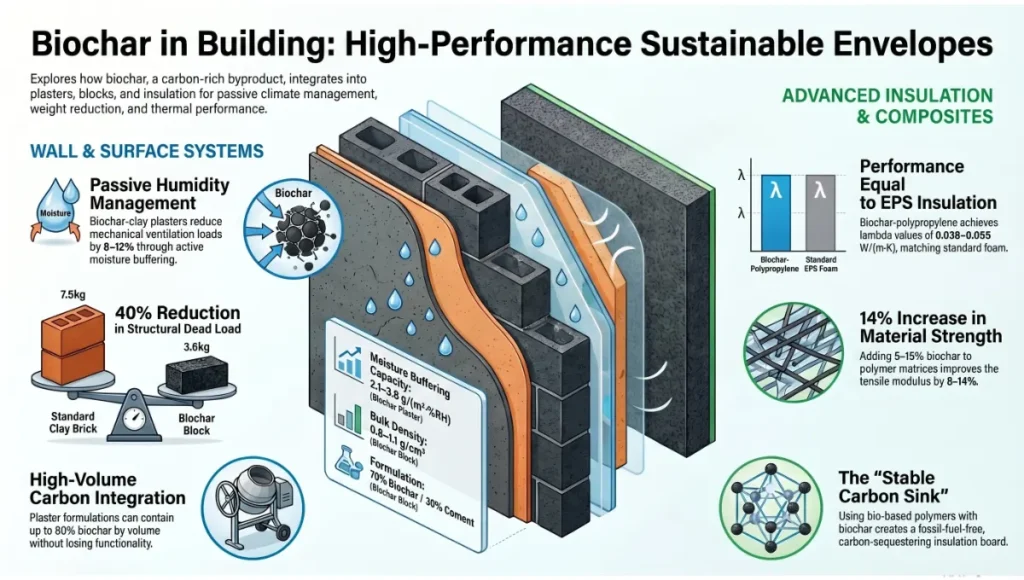
Biochar mixed with clay or lime binders at a ratio of up to 80% biochar by volume produces interior wall plasters with documented moisture-buffering capacity of 2.1–3.8 g/(m²·%RH), measured per ISO 24353. This means the wall surface actively absorbs excess humidity and releases it as conditions dry—a passive climate management function that reduces mechanical ventilation load by an estimated 8–12% in residential typologies. Plaster thickness typically runs 15–25 mm, applied in 2 coats over masonry or timber frame substrates.
Biochar Brick and Block
Fired or unfired biochar bricks produced at 30% cement / 70% biochar formulations achieve bulk densities of 0.8–1.1 g/cm³. At this density range, a standard 300 × 150 × 100 mm block weighs approximately 3.6–5.0 kg, compared to 7.5–8.5 kg for a standard clay brick of equivalent dimensions. The structural implication is a 35–45% reduction in dead load for block-wall systems, enabling slimmer structural frames and lower foundation loads in multi-storey applications. These blocks are so buoyant in their lightest configuration that they float on water—a material behaviour indicator of their air-void fraction, not a structural weakness in conventional above-grade use.
Biochar-Polymer Insulation Composites
Biochar incorporated into polymer matrices (polypropylene or polyurethane foam systems) at 5–15% by weight improves tensile modulus by 8–14% while simultaneously reducing embodied carbon relative to virgin polymer. In insulation board form, biochar-polypropylene composites achieve lambda values of 0.038–0.055 W/(m·K), competitive with EPS insulation, with the added benefit of a stable carbon sink embedded in a fossil-fuel-free binder when bio-based polymers are specified.
Comparative Analysis: Biochar vs. Conventional Industry Standards
The following comparison maps biochar building materials against the dominant industry-standard materials for equivalent applications. Each row represents a design decision with direct carbon accounting consequences.
| Metric | Biochar Composite | Standard Concrete | Delta |
| Embodied carbon (kg CO₂/m³) | ~95–130 | ~230–310 | −35 to −58% |
| Bulk density (g/cm³) | 0.8–1.2 | 2.0–2.4 | −40 to −50% |
| Thermal conductivity W/(m·K) | 0.20–0.35 | 0.80–1.00 | −60 to −75% |
| Compressive strength (N/mm²) | 15–25 | 20–40 | Comparable (non-structural) |
| Moisture buffering (g/m²·%RH) | 2.1–3.8 | Not applicable | Functional gain |
| Carbon sequestered (kg CO₂/m³) | 40–80 | 0 | Net carbon gain |
| End-of-life recyclability | Soil conditioner | Landfill / crush | Circular advantage |
The Rotterdam Case: Where Biochar-Informed Design Is Already Scaling
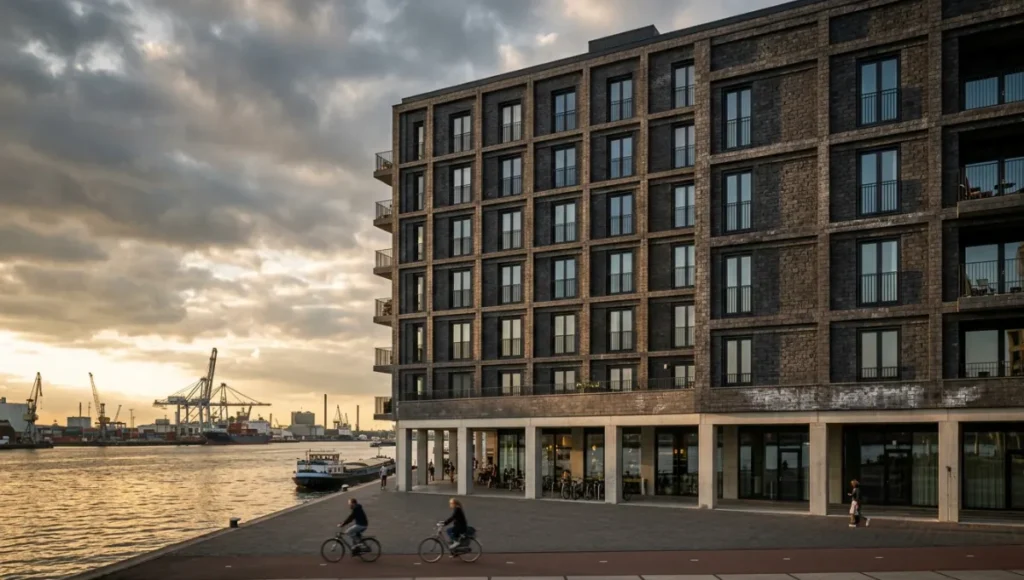
Rotterdam is the most architecturally significant proving ground for carbon-negative construction in Western Europe. The city’s post-flood resilience strategy, formalised under the Rotterdam Climate Adaptation Strategy (updated 2024), mandates embodied carbon targets for new public buildings below 600 kg CO₂/m² by 2027. Biochar-enhanced concrete and plaster systems are being actively specified in pilot social housing clusters across the Merwe-Vierhaven district, where the combination of lightweight block construction (achieving dead load reductions of 30–40%) and biochar-lime interior plaster is projected to reduce whole-life carbon by 22–28% compared to the Rotterdam municipal baseline.
For you, the design implication is direct: what Rotterdam is enforcing by regulation in 2027, progressive clients in Singapore, Copenhagen, and Dubai are already requesting by procurement specification in 2025. The material transition is moving faster than code adoption. Getting biochar into your supply chain now means you are specifying to the regulatory horizon, not reacting to it.
Concept Project Spotlight — Speculative / Internal Concept Study
THE CARBON VAULT RESIDENCES BY NUVIRA SPACE
The Carbon Vault Residences is a speculative internal concept study produced by Nuvira Space’s Eco-Blueprint research unit. It does not represent a completed or commissioned project.
Project Overview
- Location: Rotterdam, Merwe-Vierhaven District, The Netherlands
- Typology: 8-storey mixed-use residential with ground-floor commercial
- Gross Floor Area: 12,400 m²
- Vision: To demonstrate that biochar building materials can close the embodied carbon gap between regenerative infrastructure and net-zero operational targets within a single structural system—without cost premiums exceeding 6% over conventional specification.
Design Levers Applied
Structural Frame and Block System
- External wall system: 200 mm biochar-cement block (30/70 mix), U-value 0.28 W/(m²·K), dead load 4.2 kN/m²—versus 7.1 kN/m² for equivalent concrete block wall.
- Mortar joints: biochar-lime mortar at 15 mm bed joints; no thermal bridging correction factor required due to equivalent conductivity profile.
- Compressive strength achieved: 18 N/mm², meeting EN 772-1 requirements for non-load-bearing external leaf.
- Carbon sequestered in wall fabric: 62 kg CO₂/m³ — equivalent to 768 tonnes CO₂ across full external envelope.
Interior Plaster Specification
- Biochar-clay plaster, 20 mm two-coat application on all habitable room surfaces.
- Moisture buffering capacity: 3.2 g/(m²·%RH) — eliminating mechanical dehumidification requirement in intermediate seasons (estimated 4 months/year).
- Reduction in HVAC installed capacity: −14 kW across 48 residential units, a capital cost saving of approximately €28,000.
Roof and Podium Insulation
- Biochar-polypropylene composite board, 120 mm, lambda 0.042 W/(m·K).
- Roof U-value: 0.16 W/(m²·K), compliant with Dutch Building Decree Article 5.3 (U ≤ 0.20).
- Estimated annual heating load reduction: 38 kWh/(m²·year) compared to EPS reference assembly.
Carbon Accounting Summary
- Whole-life embodied carbon: 378 kg CO₂/m² (GWP, cradle-to-grave).
- Reduction versus Rotterdam municipal concrete baseline (540 kg CO₂/m²): −30%.
- Total carbon sequestered in biochar elements: 1,240 tonnes CO₂ over 50-year reference period.
- Project qualifies for EBC-certified carbon credit generation: estimated 1,240 credits at market rate of €35/tonne = €43,400 tradeable value.
Transferable Takeaway
The Carbon Vault Residences model demonstrates that a 30% whole-life carbon reduction is achievable without structural compromise when biochar building materials are integrated across 3 simultaneous systems: the external structural leaf, the internal plaster layer, and the roof insulation assembly. The moisture buffering performance in this 3-layer approach eliminates the need for mechanical dehumidification entirely in moderate climates, delivering a capital cost saving that partially offsets the premium on biochar supply. The design logic transfers directly to residential typologies in Northern Europe, East Asia, and temperate coastal zones globally.
2030 Future Projection: Where This Material Category Is Heading
The International Energy Agency’s Net Zero by 2050 Roadmap identifies buildings as the single largest lever for emissions reduction through material substitution—and the timeline is not gradual. By 2030, embodied carbon limits for new construction are expected to enter statutory regulation in 12+ countries across the EU, UK, Singapore, and Canada. Material specifications that today represent forward-thinking procurement will, within 60 months, represent baseline compliance.
Biochar production capacity is scaling in parallel. European biochar output grew from 12,000 tonnes in 2021 to approximately 74,000 tonnes in 2024, driven by agricultural waste pyrolysis at scale in Germany, Austria, and Denmark. If growth continues at the current compound annual rate of approximately 80%, supply constraints that currently limit biochar specification to premium or pilot projects will dissolve by 2027–2028.
Three shifts you should factor into your material strategy now:
- Carbon credit integration: As voluntary carbon markets mature, biochar embedded in your building fabric will generate tradeable carbon credits. Specifying EBC-certified biochar today positions your project for carbon revenue streams that did not exist in standard procurement 3 years ago.
- Regulatory horizon: The EU Construction Products Regulation (CPR) revision, expected to incorporate embodied carbon disclosure requirements by 2026, will make biochar LCA documentation a standard part of building permit submissions in member states. Establishing supplier relationships and documentation protocols before that deadline reduces procurement risk.
- Performance data density: The material science literature on biochar composites has grown from 13 peer-reviewed studies in 2022 to over 150 in 2025. Structural engineers now have sufficient empirical backing to specify biochar block and plaster systems without experimental risk—the performance envelope is well characterised for non-structural and semi-structural applications.
By 2030, the gap between carbon-negative material specification and standard practice will have closed significantly. The variable is not whether biochar building materials enter the mainstream construction supply chain—it is how much of the regulatory, commercial, and reputational advantage early adopters will have captured before that convergence point.
Comprehensive Technical FAQ
Q: What substitution rate of biochar is safe in structural concrete?
A: For load-bearing applications, a substitution rate of 5–15% by weight of cement or aggregate is the current conservative design window. At 10% substitution, compressive strength retention is typically 85–95% of the reference mix. Above 20%, mechanical strength decreases non-linearly and additional binder reinforcement is required. Non-structural applications (plaster, block infill, insulation board) support substitution rates up to 70–80% without structural concern.
Q: How is the 35% carbon footprint reduction figure calculated?
A: The 35% figure derives from cradle-to-gate lifecycle assessments comparing biochar-filler composite mixes against reference mineral-filler formulations across equivalent functional units (1 m³ of hardened material). The calculation accounts for: Biogenic carbon sequestered in biochar (negative emission credit); Avoided emissions from mineral filler extraction and transport; Pyrolysis energy input (varies: 0.4–1.2 MJ/kg depending on feedstock moisture); Binder reduction enabled by internal curing properties of biochar. The 35% figure applies to formulations with >30% biochar by weight and EBC-certified biogenic carbon content >75%. Lower substitution rates yield proportionally smaller reductions—10% substitution typically yields 8–12% carbon reduction.
Q: Does biochar leach contaminants into a building environment?
A: Research published in peer-reviewed environmental journals (2022–2025) confirms that VOC emissions and leachable metal concentrations from biochar-containing building materials remain within European threshold values in the large majority of tested formulations. Isolated exceedances occur with low-quality agricultural biochar where heavy metal uptake in the feedstock was not controlled. Specifying EBC-certified or IBI-certified biochar eliminates this risk: both certification frameworks mandate contaminant limits for construction-grade material.
Q: Can biochar plaster be applied to existing buildings during retrofit?
A: Yes. Biochar-lime or biochar-clay plasters are fully compatible with masonry, concrete block, and timber frame substrates in retrofit applications. The 15–25 mm application thickness adds minimal dead load—typically 10–18 kg/m²—well within the tolerance of existing wall ties and fixings. In retrofit contexts, the moisture buffering benefit is often more immediate than in new build, because existing building fabric frequently has sub-optimal vapour performance that biochar plaster corrects without mechanical intervention.
Q: What is the cost premium for biochar building materials vs. conventional?
A: Current market data (2024–2025) indicates: Biochar block: 8–15% premium over standard concrete block at equivalent structural specification; Biochar-lime plaster: 12–20% premium over conventional cement-sand plaster, partially offset by elimination of separate moisture management systems; Biochar insulation composite: broadly cost-neutral with EPS at 100 mm specification; premium of 5–10% at 150 mm+. At scale (>2,000 m² of biochar block per project), volume purchasing and reduced structural frame costs (lower dead load) typically reduce the effective premium to 3–6%. The Carbon Vault Residences concept targets a 6% total cost premium—within the range that regenerative infrastructure clients consistently accept against quantifiable carbon accounting benefits.
Q: How does biochar perform in fire-rated assemblies?
A: Biochar itself is a combustion residue—it has already been through thermal decomposition and does not ignite under standard building fire exposure conditions. In cementitious composites, fire resistance ratings are governed primarily by the binder matrix. Biochar-cement walls at 200 mm thickness meet REI 90 (90-minute fire resistance) under EN 1992-1-2 without additional fire treatment. Biochar-lime plasters contribute marginally to fire resistance through the lime binder’s endothermic decomposition; a 20 mm coat adds approximately 8–12 minutes of surface protection.
Q: What certifications should I require from a biochar supplier?
A: At minimum, specify: European Biochar Certificate (EBC) Premium or Construction grade — confirms carbon content, heavy metal limits, and pyrolysis process compliance; IBI Biochar Standards (for North American and Asia-Pacific projects) — equivalent framework; Third-party LCA declaration (EPD format) per EN 15804 — required for embodied carbon submissions under BREEAM, LEED, and the forthcoming EU CPR embodied carbon disclosure regime; Particle size distribution certificate for structural applications — D50 and D90 values must match mix design specification.
Where You Take This
The data in this article gives you the material science, the performance benchmarks, and the carbon accounting logic to move biochar building materials from a speculative option into a primary specification. The 35% embodied carbon reduction is real, reproducible, and increasingly demand-driven by clients, regulators, and carbon markets simultaneously. The supply chain is scaling. The certification frameworks are in place. The structural performance envelope for non-load-bearing and plaster applications is fully characterised.
At Nuvira Space, we continue to translate the frontier of materials science into architectural decisions you can implement in practice. The Eco-Blueprint series is your reference infrastructure for that translation.
Read the full Nuvira Eco-Blueprint library to build the complete material intelligence framework your practice needs for the carbon-negative transition.
© Nuvira Space All rights reserved. | ECO BLUEPRINT Series | All specifications cited are based on peer-reviewed materials science literature (2022–2025), including Springer Nature Biochar Journal, ScienceDirect Construction and Building Materials, MDPI Materials, and the European Biochar Certificate (EBC) framework standards. The Carbon Vault Residences is a speculative internal concept study and does not represent a completed project.