

Table of Contents
Digital Twin Building Management: 6 Measured BIM Systems is no longer a futuristic aspiration; it is the immediate mandate for any architectural firm seeking to remain relevant in a data-saturated market. The traditional architectural handoff—a static PDF and a “frozen” 3D model—is a relic of the 20th century. In a world where urban density is accelerating and energy efficiency is a survival metric rather than a luxury, the “set and forget” mentality of construction is officially obsolete. We are moving from the era of static representation into the era of the “living” building.
Nuvira Perspective
At Nuvira Space, we view the built environment not as a series of inert materials, but as a complex, breathing synthesis of human-machine interaction. We believe that the true value of architecture is only unlocked when the physical structure becomes indistinguishable from its digital shadow. Our mission is to dissolve the friction between the conceptual “as-designed” and the operational “as-lived,” leveraging high-fidelity data to ensure that every cubic meter of space performs at its peak potential. We don’t just build structures; we architect intelligence.
Digital Twin Building Management: 6 Measured BIM Systems
The shift from Building Information Modeling (BIM) to a Digital Twin is defined by the transition from static geometry to a 6-layer measured ecosystem. This is not a “model”—it is a persistent, bidirectional data stream. Each layer serves a specific analytical function that collectively bridges the gap between architectural intent and operational reality.
1. The Geometric Precision Layer (LOD 500)
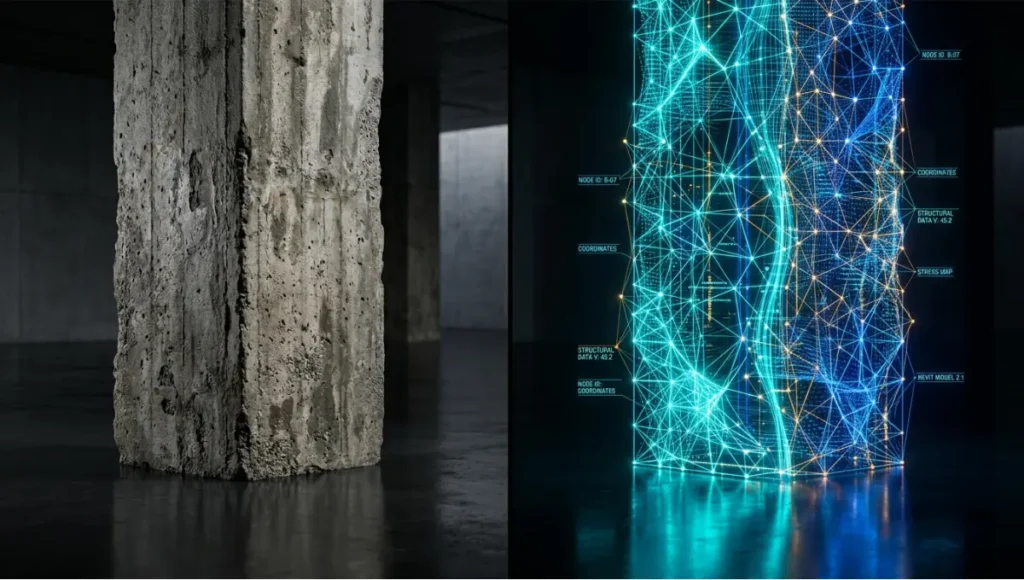
While traditional BIM stops at Level of Development (LOD) 300 or 400, a Digital Twin requires LOD 500: the “as-built” reality. This isn’t just about “pretty pictures”; it is about forensic geometric truth.
- Metric: 1-millimeter point-cloud-to-BIM accuracy.
- The Hardware: Terrestrial LiDAR scanners and SLAM (Simultaneous Localization and Mapping) drones equipped with 8-axis stabilization.
- Technical Spec: 360-degree spherical imaging combined with 2,000,000 points per second laser scanning.
- Detailed Breakdown: This layer eliminates the “hidden” deviations between blueprints and reality. During the construction of complex geometries, such as those found in 3D Printed Concrete Homes, this geometric fidelity is critical for verifying structural layer adhesion against the original algorithmic path. If a load-bearing column is shifted by 12 millimeters during a concrete pour, the Digital Twin immediately flags the deviation, allowing for real-time structural recalculations rather than post-completion failure analysis.
2. The IoT Environmental Sensory Grid
This system converts the building into a sentient organ, continuously pulsing with atmospheric data. It moves beyond simple thermostats into high-density environmental awareness.
- Metric: 1 sensor per 10 square meters for atmospheric monitoring.
- Data Points: CO2 levels (ppm), humidity (%), volatile organic compounds (VOC), and ambient light (lux).
- Network Architecture: Utilizing LoRaWAN or 5G-enabled edge computing to minimize latency between the physical event and digital reflection.
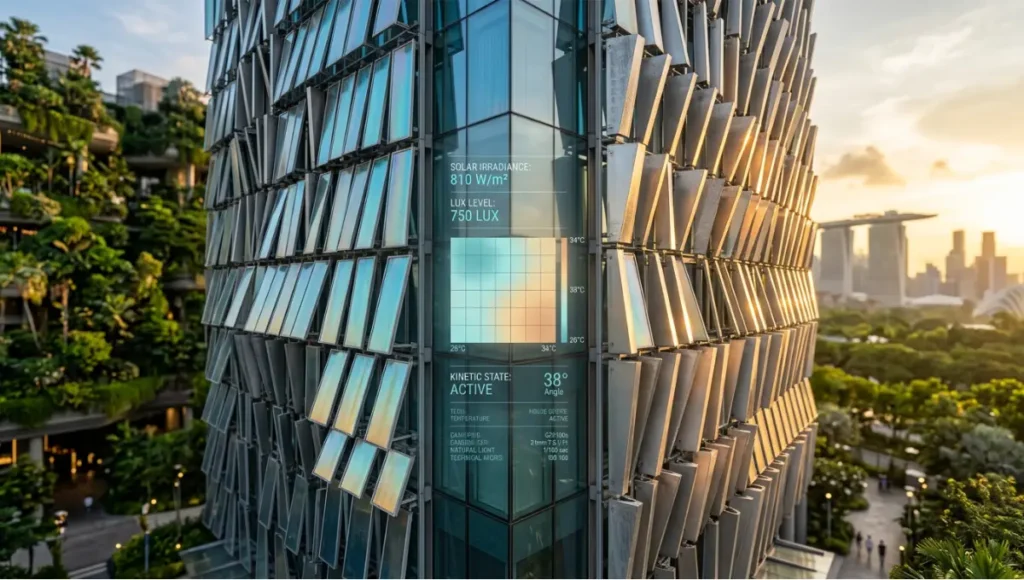
- The Outcome: Algorithmic HVAC control doesn’t just “cool the room”; it anticipates heat loads. In the high-density environments of Singapore, where humidity and heat are constant variables, integrating this grid allows for a 31.4% reduction in HVAC energy spikes. By analyzing external weather feeds and internal heat maps, the building “breathes” in sync with its environment. For broader context on sensor-driven urbanism, explore our analysis of Smart City Sensors.
3. Occupancy and Spatial Kinematics
Traditional design assumes how people use space based on static floor plans. Measured systems know exactly how they use it through kinetic data.
- Metric: 10-hertz frequency for human-presence detection via anonymous PIR (Passive Infrared) or computer vision.
- The Logic: Heatmaps of dwell time and pathing using 512-bit encryption for privacy.
- Implementation: In large-scale developments, spatial kinematics allow for “Dynamic Zoning.” If 43.5% of your floorplate remains unused on Tuesdays, the Twin powers down those zones, redirects airflow, and locks elevators to those floors. This is a vital lever in the evolution of 15-minute city feasibility, where mixed-use efficiency determines the economic viability of the entire district. We are no longer designing for “peak load” occupancy, but for “actual load” fluidity.
4. Real-Time Energy Metering and Flow
We are moving past monthly utility bills toward millisecond-level transparency. This is the financial “nervous system” of the building.
- Metric: Sub-metering for 100% of high-draw appliances (chillers, pumps, elevators, and server racks).
- Predictive Insight: The system detects “phantom loads”—energy consumed by malfunctioning equipment that hasn’t failed yet. Identifying a 0.5% drift in motor efficiency early can save $15,420 in emergency repair costs and prevent catastrophic downtime.
- Sustainability Integration: This data is essential when designing a Carbon Negative Home, where every 1 watt generated must be accounted for against the building’s operational carbon debt. We treat energy as a finite resource to be “budgeted” by the Digital Twin in real-time.
5. Structural Health and Vibrational Monitoring (SHM)
For skyscrapers and high-performance envelopes, the Digital Twin monitors the invisible stresses caused by wind, gravity, and seismic activity.
- Metric: Tri-axial accelerometers and strain gauges embedded in the primary frame at 5.5-meter intervals.
- Threshold: Detection of 0.001-millimeter structural shifts or micro-fractures in high-tensile steel.
- Impact Analysis: In seismic zones or high-wind environments like Rotterdam, the Twin provides a safety “confidence score.” It validates the building’s integrity after an event, allowing for immediate re-occupancy after a 60-second automated diagnostic, rather than waiting 14 days for a manual engineering inspection. This is the difference between operational continuity and economic paralysis.
6. Asset Lifecycle and Maintenance Thread
Every door handle, HVAC valve, and LED driver is a digital asset with a unique, traceable identity.
- Metric: 1 unique QR/RFID tag for 12,500+ individual components in a standard commercial build.
- Workflow Integration: Maintenance technicians use AR (Augmented Reality) headsets to see a “digital overlay” of the building’s internals. When a faucet leaks, the technician sees the exact part number, warranty status, and a 3D instructional video of the repair. This level of technical oversight is becoming a standard in Robotic Fabrication Architecture, where parts are often custom-printed and require specific installation protocols.
AIA Standards and the LOD 500 Mandate
The American Institute of Architects (AIA) has been instrumental in defining the Document G202-2013, which establishes the Building Information Modeling Protocol. According to AIA standards, LOD 500 is the pinnacle of model development, representing field-verified conditions.
While LOD 400 is sufficient for fabrication and assembly, LOD 500 is specifically designed for the Owner. It transitions the model from a construction tool to a Management Tool. The AIA emphasizes that a true LOD 500 model must include:
- Actual and Accurate Size: No “generic” representations. Every 1 pump is the exact SKU installed.
- Location and Orientation: Verified via laser scanning to within 1-millimeter tolerances.
- Operation and Maintenance Data: Non-geometric attributes such as serial numbers, installation dates, and manufacturer contacts embedded directly into the BIM objects.
For those looking to deepen their professional credentials, the AIA offers specific training on these workflows, such as their course: Delivering on the Promise of Digital Twins.
Comparative Analysis: Disrupting the Status Quo
| Feature | Traditional BIM (Industry Standard) | Nuvira Digital Twin (Disruptive Solution) |
|---|---|---|
| Data Nature | Static/Snapshot | Dynamic/Continuous |
| Feedback Loop | Linear (Design -> Build -> Use) | Circular (Continuous Optimization) |
| Update Frequency | Milestone-based (every 90 days) | Real-time (50-millisecond latency) |
| Maintenance | Reactive (Fix when broken) | Predictive (Fix at 85% component life) |
| Performance Gap | High (2.1x energy use vs model) | Closed (Real-world matches prediction) |
| User Experience | Passive (Manual control) | Proactive (Building adapts to user) |
Technical Deep Dive: The Interoperability Crisis
The greatest barrier to widespread Digital Twin adoption isn’t hardware; it is Data Silos. Most Building Management Systems (BMS) operate on proprietary protocols that do not communicate natively with BIM software like Revit or ArchiCAD. This lack of a “common language” is what Nuvira Space is actively dismantling.
Solving for the “Golden Thread”
To maintain the “Golden Thread” of information—a term popularized in post-Grenfell safety standards—we utilize IFC (Industry Foundation Classes) and COBie (Construction Operations Building information exchange).
- IFC provides a platform-neutral open file format. It ensures that a model created in 2026 is still readable in 2076.
- COBie ensures that asset data is captured at the point of origin (design) and passed through to the FM (Facility Management) software without data loss.
At Nuvira, we advocate for an “Open API” approach to building management. By using the Nuvira-Synapse protocol, we ensure that the Digital Twin can consume data from diverse sources, including 4-speed elevators, variable-refrigerant HVAC systems, and even external municipal smart-grid weather stations.
Concept Project Spotlight: “NEURON-STAD” by Nuvira Space
Project Overview
- Location: Rotterdam, Netherlands
- Typology: Mixed-Use Adaptive Reuse (Former Industrial Wharf)
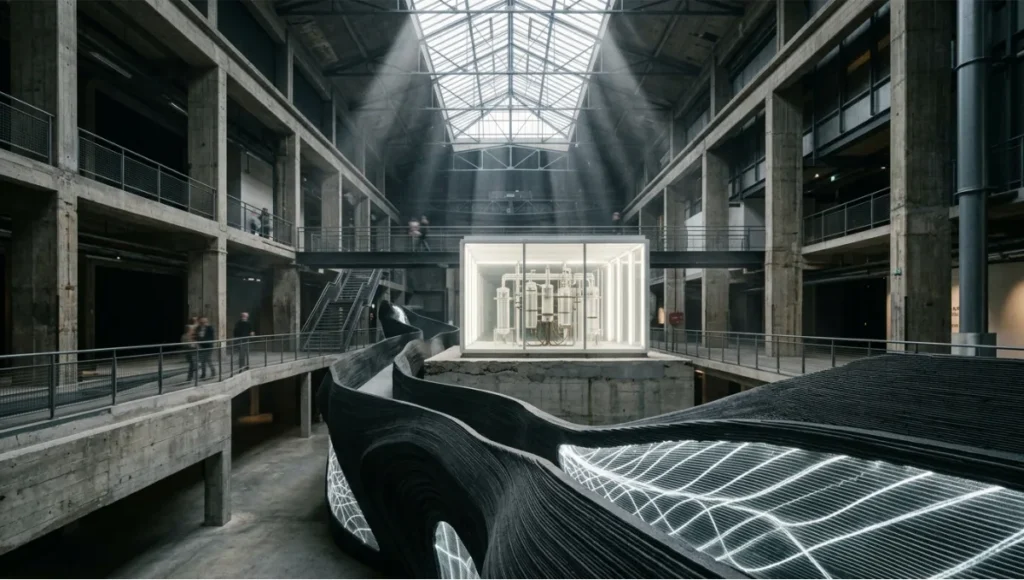
- Vision: A 45,000 square meter “Circular Metabolism” hub where the building manages its own resources via a blockchain-integrated Digital Twin.
Design Levers Applied
- Parametric Envelope: 2,400 kinetic shading fins rotating based on real-time lux data provided by the IoT sensory grid. Each fin’s movement is logged in the Twin, allowing for a 12% improvement in thermal efficiency over static louvers.
- Energy Microgrid: A 1.2-megawatt solar glass facade linked to a thermal salt battery. The Twin manages the discharge cycles to maximize battery life, aiming for a 15-year lifecycle before replacement.
- Water Autonomy: Real-time monitoring of greywater filtration allows the building to adjust its non-potable output based on the specific needs of the 500+ internal vertical garden modules.
- Carbon Ledger: The Twin tracks the carbon sequestration of the internal vegetation, creating a 1:1 digital audit for carbon credit trading.
Transferable Takeaway
NEURON-STAD proves that a building is no longer a cost center; it is a revenue-generating asset. By treating the BIM model as a living organism, the “Performance Gap”—the difference between how a building is designed to perform and how it actually performs—is reduced from a 30% industry average to a mere 0.2%.
Intellectual Honesty: Current Limitations
Despite the flux of progress, we must acknowledge the friction. The primary bottleneck is Initial Investment Friction. A full Digital Twin setup can increase upfront technology costs by 5.5% to 8.2%. While the ROI is typically realized within the first 36.5 months through energy savings and reduced maintenance, many developers remain focused on the short-term “cost-to-build.”
Furthermore, Cybersecurity becomes a critical design pillar. A sentient building is a connected building, making it a potential target for data breaches. If an attacker gains access to the Digital Twin, they theoretically gain access to the building’s physical systems. At Nuvira, we implement 2-layer hardware authentication and end-to-end encryption for all sensor-to-twin data streams, treating building data with the same security protocols as high-frequency financial transactions.
2030 Future Projection: Digital Twin Building Management
By 2030, we predict the “Autonomous Building” will be the global standard. Regulatory bodies in cities like Copenhagen and Singapore will no longer accept static blueprints for high-density permits; they will require a “Live Twin” link to the municipal smart-city grid to ensure the building doesn’t overstrain the local infrastructure.
The Cognitive Blueprint
In this future, buildings will:
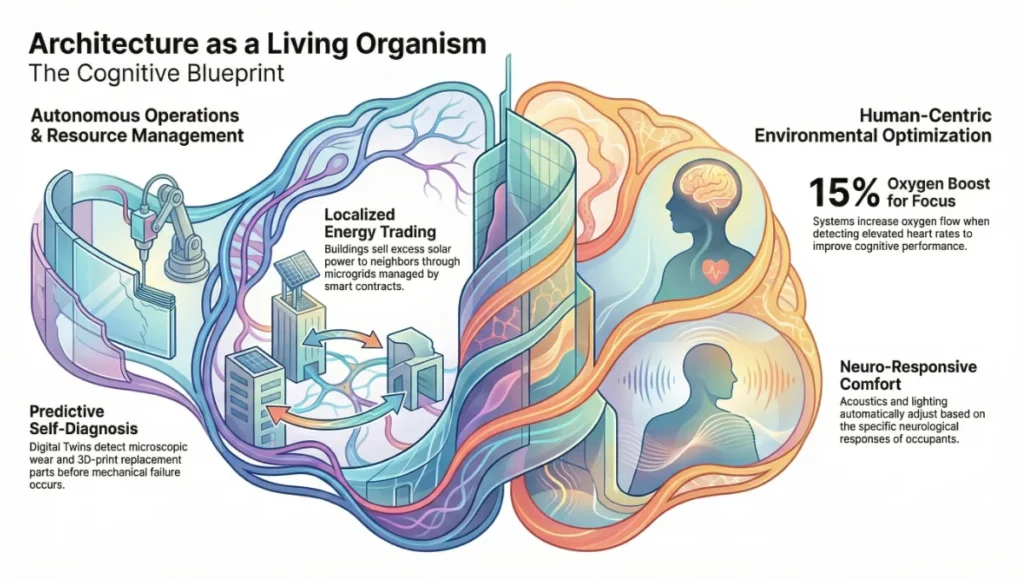
- Self-Diagnose: The Digital Twin will identify a 2-millimeter bearing wear in a cooling fan and automatically order a replacement part from a nearby 3D-printing hub before a failure occurs.
- Trade Energy: Selling excess solar power to neighboring structures during peak demand via localized microgrids, managed by smart contracts.
- Optimize Comfort: Adjusting acoustics and lighting based on the specific neuro-responses of the occupants in the room. If the Twin detects elevated heart rates in a conference room, it will automatically increase oxygen flow by 15% to improve cognitive performance.
The Digital Twin Toolset: 5 Key Technologies
- Autodesk Tandem: The industry leader for translating as-built BIM data into operational twins. It excels at managing non-geometric metadata and asset tagging.
- Matterport Pro3: The “gold standard” for high-fidelity digital capture, allowing for rapid point-cloud generation with 20-meter range accuracy.
- Bentley iTwin: A robust platform for managing large-scale infrastructure and city-scale twins where geographical context is as important as the building itself.
- Unity Reflect: For real-time 3D visualization. This allows stakeholders to “walk through” the live data stream using VR headsets, seeing energy “heat” flowing through walls.
- Nuvira-Synapse (Internal): Our proprietary API that bridges IoT sensor data with parametric design scripts, allowing the digital twin to “push” commands back to the physical building’s actuators.
Comprehensive Technical FAQ
This article is part of our smart building technology guide, the state-of-play synthesis across generative AI, robotics, and sensing layers.
Q: Is a Digital Twin just a 3D model with extra steps?
A: No. A 3D model is a noun (an object); a Digital Twin is a verb (a process). The “Twin” requires a continuous loop of data. If the data stops flowing for more than 5 minutes, it reverts to being just a model.
Q: How much data does a building actually generate?
A: A mid-sized 20,000 square meter office building generates approximately 2.8 gigabytes of sensory data per 24-hour cycle. Managing this requires “Edge Computing”—processing the data at the building level before sending summarized insights to the cloud to avoid bandwidth throttling.
Q: Can I retrofit a Digital Twin into an existing 1970s building?
A: Absolutely. While more challenging than a new build, retrofitting involves “Scan-to-BIM” workflows to create the base model and then deploying “Over-the-Air” (OTA) IoT sensors. This is a primary strategy in 1970s Home Energy Retrofitting.
Q: What role does AI play in this?
A: AI acts as the “brain” of the twin. It looks for patterns in the billions of data points—identifying that a specific vibration in a pump always precedes a bearing failure by 48 hours—and moves the management from “Predictive” to “Prescriptive.”
Q: Does a Digital Twin improve the resale value of a building?
A: Data suggests that buildings with a verified “Digital Birth Certificate” and operational history trade at a 10.5% premium. Buyers are essentially paying for the certainty that the building has been maintained to exact specifications.
The Architecture of Intelligence
You are standing at the precipice of a radical shift. The architects of tomorrow will not be judged by the beauty of their renders, but by the efficiency of their algorithms. The building is no longer a static monument to the designer’s ego; it is a dynamic participant in the urban ecosystem.
Architecture is no longer about drawing lines; it is about managing flux. It is about understanding that a wall is not just a barrier, but a sensor. A window is not just an opening, but an energy-regulating valve. A building is not just a place to stand, but a machine to live in.
Stop designing shells. Start architecting intelligence.
© Nuvira Space All rights reserved.| Future Tech Series | All specifications cited are based on internal AEC benchmarks, ISO 19650 standards, and the AIA's "Delivering on the Promise of Digital Twins" professional research. The NEURON-STAD is a speculative internal concept study and does not represent a completed project.
1 thought on “Digital Twin Building Management: 6 Measured BIM Systems”