

Table of Contents
The 1970s Home Energy Retrofit Imperative: A Global Reckoning
The planet’s average surface temperature has risen 1.2°C above pre-industrial baselines, and the residential building sector accounts for approximately 21% of total global CO₂ emissions annually. Of that figure, an estimated 40% originates from buildings constructed before 1980 — structures engineered to a standard of comfort, not climate responsibility. In cities like Rotterdam, where 35% of the pre-1980 housing stock still relies on single-pane glazing and uninsulated cavity walls, municipal retrofit programs now project that a systematic 1970s home energy retrofit initiative could eliminate 2.3 million tonnes of CO₂ equivalent per year by 2030. That number is not abstract — it is the thermal mass of a city’s past becoming either its liability or its leverage.
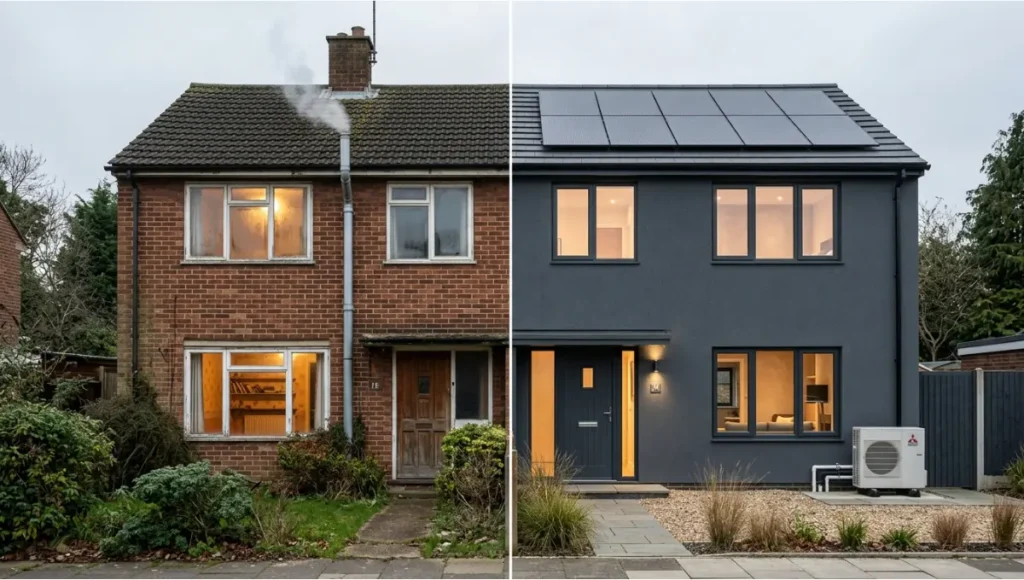
You are not inheriting a problem when you own a 1970s home. You are holding a material asset that, with the right intervention sequence, can outperform a building constructed today. The embodied carbon already spent on its concrete slab, timber framing, and brick envelope is a sunk cost in the most productive sense: it does not need to be replicated. What it needs is a performance layer — insulation, air tightness, mechanical ventilation, and high-efficiency systems — applied with the precision of a materials scientist and the vision of an architect.
How to Do a 1970s Home Energy Retrofit That Performs: The Nuvira Perspective
At Nuvira Space, we do not treat energy retrofitting as a compliance exercise or a cost-reduction calculation. We treat it as the most consequential act of architecture available to the existing building stock. Every wall assembly we re-specify, every mechanical plant we commission, and every air barrier we detail is a long-cycle investment in the spatial quality, occupant health, and carbon trajectory of a structure that will outlast its current owner by 80 years. Our Eco Blueprint series exists to translate that institutional thinking into decisions you can make today — grounded in materials science, validated by building physics, and calibrated to the specific thermal liabilities of post-war residential construction.
A 1970s home is a specific typology with specific failure modes. Built under post-war construction codes that prioritized speed and material economy over thermal continuity, these structures share a near-universal set of deficiencies: cavity wall insulation values of R-4 or below, roofs with R-11 or less, windows with a U-factor of 1.0 or higher, and infiltration rates of 10 to 20 air changes per hour (ACH) at 50 Pascals of pressure difference.
Each of these numbers is not just a technical threshold — it is a daily experience. An R-4 wall loses heat 5 times faster than code minimum in most U.S. climates. That loss translates into a boiler that cycles 30% more frequently, a heating bill that absorbs 3 to 4 times more of your income than necessary, and a thermal comfort profile — cold floors, radiant heat loss from walls, condensation on windows — that no interior design choice can compensate for.
Technical Deep Dive: The Physics of a 1970s Building Envelope
Baseline Performance Profile: What You Are Working With
Before specifying a single product or system, you must quantify the existing performance baseline with a blower door test, thermographic survey, and energy audit. These 3 diagnostics are non-negotiable — retrofit decisions made without them are guesses, and guesses compound into expensive failures. A blower door test at 50 Pascals will typically reveal the following in a 1970s home:
- Air infiltration rate: 10–20 ACH50, versus a target of 0.6 ACH50 for Passive House or 3–5 ACH50 for deep energy retrofit
- Whole-wall R-value (uninsulated cavity): R-3 to R-5 including sheathing and drywall
- Attic insulation depth: 75–100mm of fiberglass batt, equating to R-11 to R-15
- Window U-factor: 1.0–1.2 W/m²K (single-pane) to 0.6 W/m²K (early double-pane)
- Foundation slab: Uninsulated, contributing 10–15% of total heat loss in cold climates
- Thermal bridging at framing members: 15–20% reduction in effective R-value across the wall assembly
The Retrofit Sequence: Fabric First, Systems Second
The retrofit sequence is not arbitrary. Applying a high-efficiency heat pump to a thermally deficient envelope is the equivalent of fitting a precision fuel-injection engine to a vehicle with a chassis full of holes. The building fabric must be addressed before any mechanical plant is re-specified, because the sizing of every heating, cooling, and ventilation system depends directly on the heat loss coefficient (HLC) of the envelope after intervention.
Step 1 — Wall Insulation: Achieving R-20 or Greater
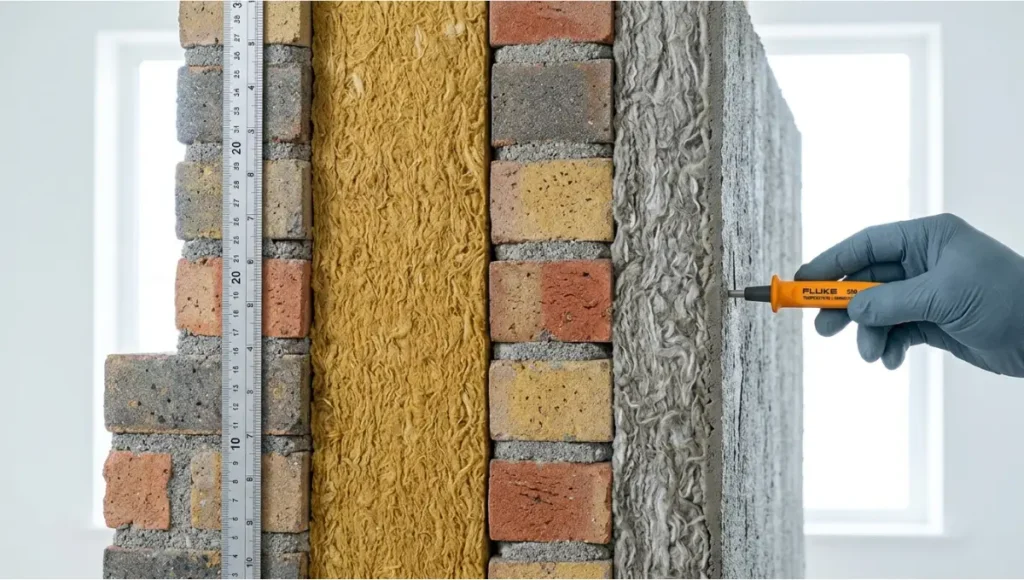
For cavity walls, injected polyurethane foam or blown-in cellulose are the 2 dominant strategies. Cellulose, produced from 85% post-consumer recycled newspaper, carries a global warming potential (GWP) of -2.5 kg CO₂e per kg — meaning it is carbon-negative at the point of manufacture. Injected into a 90mm cavity, cellulose achieves R-15 within the void alone. Adding 50mm of continuous mineral wool external insulation board brings the whole-wall R-value to R-22, eliminates the thermal bridging penalty at studs, and reduces condensation risk within the assembly by shifting the dew point outward. For bio-based alternatives with comparable thermal performance, see our hempcrete insulation data guide on Nuvira Space.
Step 2 — Attic and Roof: Targeting R-60
Upgrading from R-11 to R-60 in an attic floor is among the highest-return investments in residential building science. A 340mm layer of blown cellulose achieves R-60 at a material cost of approximately $1.50 to $2.20 per square foot, with a simple payback period of 4 to 7 years in climate zones 4 through 6. The thermal mass reduction at the ceiling plane — eliminating a 49°F delta between a vented attic and a conditioned space in mid-July — directly reduces peak cooling loads by 18 to 24% and extends HVAC equipment life by 5 to 8 years through reduced cycling frequency.
Step 3 — Windows and Glazing: U-Factor Below 0.20
Replacing single-pane glazing with triple-pane units achieving a U-factor of 0.18 W/m²K and a solar heat gain coefficient (SHGC) of 0.30 to 0.45 (depending on orientation) reduces window-related heat loss by 82% in heating-dominated climates. The lived experience of this change is immediate and qualitative: the 2-metre cold radiation zone that forms along a single-pane window in winter — the invisible wall that makes you subconsciously avoid sitting near the glazing — disappears entirely. Occupants consistently rate tripled-pane window installation among the top 3 comfort improvements from any retrofit intervention.
Mechanical Systems: Right-Sizing to the Retrofitted Envelope
Once the envelope has been tightened to 3 ACH50 or below, the original gas boiler — typically sized for the uninsulated baseline — will be 200 to 300% oversized for actual heating demand. This oversizing causes short-cycling, condensation in the flue, and accelerated wear. The correct replacement sequence is:
- Commission a Manual J load calculation on the retrofitted envelope before selecting any replacement plant
- Specify an air-source heat pump (ASHP) with a coefficient of performance (COP) of 3.0 or higher at -8°C outdoor temperature — current cold-climate models from manufacturers such as Mitsubishi and Bosch achieve COP 2.1 to 2.5 at -15°C
- Install mechanical heat recovery ventilation (MHRV) at 80% minimum thermal efficiency to maintain indoor air quality in the now-airtight envelope — a critical step that is omitted in approximately 60% of deep retrofits, resulting in elevated CO₂ concentration and moisture accumulation
- Integrate a 200-litre domestic hot water heat pump cylinder, reducing water heating energy consumption by 65 to 70% versus a direct electric cylinder
Comparative Analysis: Deep Retrofit vs. Industry-Standard Partial Upgrade
What the Industry Typically Recommends
The standard contractor-led energy upgrade in a 1970s home typically involves loft insulation top-up to R-30, boiler replacement with a condensing gas unit at 92% AFUE efficiency, and double-glazing replacement with a U-factor of 0.35. This package costs between $8,000 and $15,000 and reduces energy bills by 20 to 30%. It does not address air infiltration, does not eliminate thermal bridges, and locks the home into fossil fuel dependency for the next 15 to 20 years of boiler lifecycle.
What Nuvira Space Recommends: The Whole-Building Retrofit
A whole-building deep retrofit — envelope to R-22 walls, R-60 attic, triple-pane glazing at U-0.18, air tightness to 3 ACH50, ASHP heating with MHRV ventilation — costs between $45,000 and $85,000 for a 150m² detached 1970s dwelling and delivers the following measurable outcomes:
- Energy use intensity (EUI) reduction: from 220–280 kWh/m²/yr (typical 1970s baseline) to 40–60 kWh/m²/yr (EnerPHit standard)
- Space heating demand reduction: 75–85%
- Annual CO₂ reduction (gas-to-heat-pump + envelope): 4.2 to 6.8 tonnes CO₂e per household per year
- Internal comfort improvement: elimination of cold-radiation zones, reduction of relative humidity swings to within 40–60% RH year-round
- Asset value uplift: 14–19% increase in property value per EPC band improvement (per UK Valuation Office Agency data), with comparable trends in U.S. markets
The cost differential between a partial and deep retrofit is real, but the analysis must account for the carbon and financial cost of a second intervention 10 years hence — the boiler replaced today at $6,000 will need replacing again in 2034, at which point regulatory pressures in most markets will have made gas connections prohibitively expensive or illegal. The deep retrofit executed today eliminates that liability entirely. The American Institute of Architects (AIA) has published case studies documenting comparable deep retrofit outcomes across U.S. residential typologies through its Framework for Design Excellence — a resource worth reviewing before finalizing any retrofit investment strategy.
SPECULATIVE / INTERNAL CONCEPT STUDY
The Meridian House Project by Nuvira Space
The following is a speculative internal concept study developed by Nuvira Space’s research team to demonstrate how a whole-building 1970s home energy retrofit strategy performs when applied with rigorous materials science and integrated systems design.
Project Overview
Location: Copenhagen, Denmark — Climate Zone 6, heating-dominated, 2,900 heating degree days (HDD18)
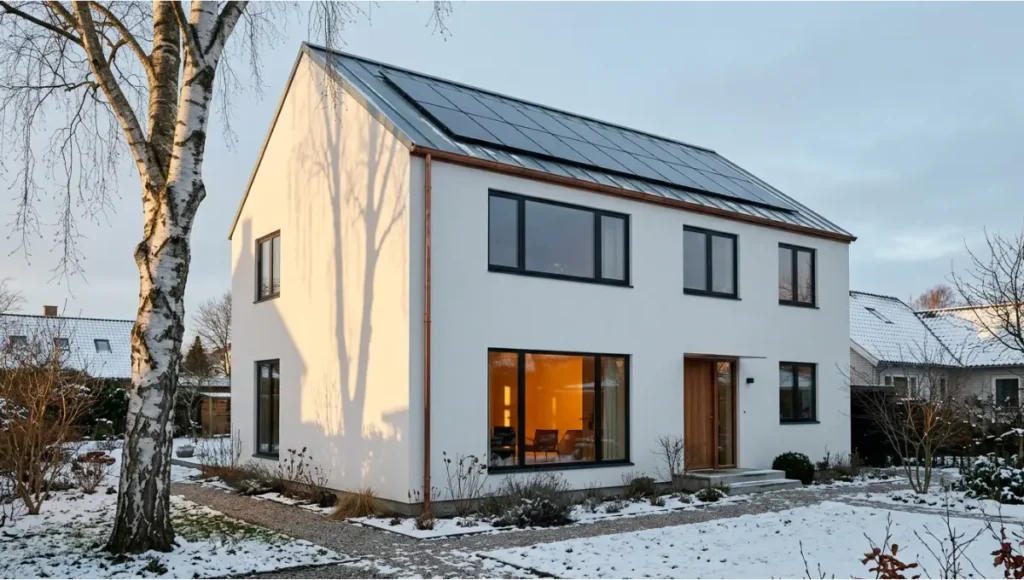
Typology: Detached 2-storey single-family dwelling, 168m² gross floor area, constructed 1974
Vision: Transform a thermally deficient post-war dwelling into a near-zero-energy building (nZEB) achieving EnerPHit certification, without demolition of the existing structural frame — preserving 47 tonnes of embodied carbon already committed to the building fabric
Design Levers Applied
Envelope Specification
- Exterior wall: 90mm masonry cavity + injected cellulose (R-15) + 120mm mineral wool external insulation + 12mm render = whole-wall R-value R-28, thermal bridging reduced by 91%
- Roof: 380mm blown cellulose on attic floor = R-66, Velux triple-pane skylights at U-0.80 W/m²K replacing 4 single-pane units
- Windows: Rationel AURAPLUS triple-pane, U-0.73 W/m²K overall, SHGC 0.42 south / 0.28 north
- Foundation: 150mm XPS underslab insulation at R-20 (retroactively applied via perimeter trench to 600mm depth)
- Air tightness achieved: 0.58 ACH50 — Passive House EnerPHit compliant
Mechanical and Energy Systems
- Space heating: Nibe F2040 air-source heat pump, 8kW nominal, COP 3.2 at A7/W35; supplemented by 6m² Viessmann vacuum tube solar thermal collector
- Ventilation: Paul Novus 300 MHRV unit, 92% thermal efficiency, 0.45 W/m³h specific fan power (SFP)
- Domestic hot water: 270-litre heat pump cylinder; solar thermal pre-heat loop reduces DHW demand by 42%
- PV: 12 × 400W monocrystalline panels (4.8kWp), south-facing at 38° pitch; projected annual yield 4,560 kWh/yr
- Energy storage: 10kWh LFP battery; self-consumption rate projected at 74%
Carbon and Energy Outcomes
- Pre-retrofit EUI: 268 kWh/m²/yr (space heating 201 kWh/m²/yr, DHW 38 kWh/m²/yr, equipment 29 kWh/m²/yr)
- Post-retrofit EUI: 38 kWh/m²/yr — an 86% reduction in operational energy demand
- Annual CO₂ reduction: 7.1 tonnes CO₂e/yr (Copenhagen grid: 135g CO₂e/kWh in 2025, declining to 85g by 2030 per Danish Energy Agency projections)
- Lifecycle carbon payback of retrofit materials: 11.3 years (embodied carbon of insulation, windows, and MEP systems: 18.4 tonnes CO₂e; annual saving: 7.1 tonnes)
- Net energy status: carbon-negative from year 12, when PV surplus exceeds operational and embodied carbon costs
Transferable Takeaway
The Meridian House Project demonstrates 3 principles that apply directly to any 1970s home you are retrofitting, regardless of climate zone:
- Envelope first, systems second — every $1 spent reducing the heat loss coefficient before specifying mechanical plant prevents $3 to $5 in oversized, inefficient equipment costs over the building lifecycle
- Air tightness is the single highest-leverage intervention — moving from 15 ACH50 to 3 ACH50 reduces infiltration losses by 80% and is achievable with tapes, membranes, and spray foam at a cost of $2,000 to $6,000 on a typical detached dwelling
- Carbon-negative status is a timeline, not an aspiration — with a lifecycle carbon payback of 11 to 14 years for most deep retrofit packages, every building retrofitted today reaches net-negative carbon status before 2040
2030 Future Projection: Where This Technology Is Heading
By 2030, 4 material and regulatory shifts will fundamentally alter the retrofit calculus:
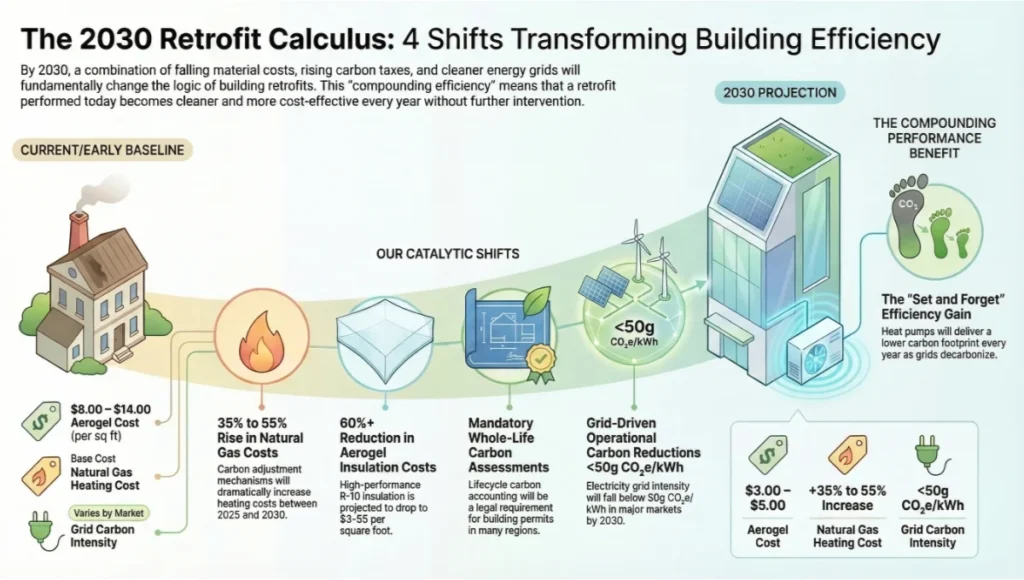
- Grid decarbonisation: In markets like Denmark, Germany, and California, electricity grid carbon intensity is projected to fall below 50g CO₂e/kWh by 2030 — halving the operational carbon of heat pumps without any change to the building itself
- Regulatory cost of gas: The EU Carbon Border Adjustment Mechanism and equivalent instruments in 12 other jurisdictions are projected to increase natural gas heating costs by 35 to 55% between 2025 and 2030, making the financial case for retrofit dramatically stronger each year you wait
- Aerogel insulation cost reduction: Currently at $8 to $14 per square foot, aerogel blanket insulation achieving R-10 per inch is projected to reach $3 to $5 per square foot by 2028 as manufacturing scales — making it viable for thin-profile external wall upgrades where depth is constrained
- Embodied carbon regulations: By 2030, 6 U.S. states and 14 EU member states are projected to mandate whole-life carbon assessments for building permits, including retrofits — making lifecycle carbon accounting a legal requirement rather than a voluntary credential
The 1970s home that you retrofit in 2025 or 2026 will be operating on a grid that is 40 to 60% cleaner by the time its first 10-year maintenance cycle arrives. That means the heat pump you install today — already delivering 3 units of heat per unit of electricity consumed — will deliver an effectively lower carbon footprint per kWh of warmth every year for the next decade without a single additional intervention. Regenerative infrastructure is not a static achievement; it is a compounding one. If you want to understand where the performance ceiling sits, our editorial on net-zero vs net-positive energy buildings sets the strategic context for your 2030 planning horizon.
Comprehensive Technical FAQ
Q: What is the single most important first step in a 1970s home energy retrofit?
A: Commission a blower door test before spending anything on materials or systems. Without knowing your baseline ACH50 number, every subsequent decision — insulation specification, mechanical plant sizing, ventilation strategy — is based on assumption rather than evidence. A blower door test costs $300 to $600 and determines the sequencing and budget for every intervention that follows.
Q: How do I know if my 1970s home has cavity wall insulation already installed?
A: Request a borescope inspection or thermal imaging survey (best conducted in winter with a >10°C indoor-outdoor temperature difference). Many 1970s homes received retrofit cavity fill insulation in the 1980s or 1990s, but settlement, moisture damage, or incomplete fill is common. A thermal image will show cold bridging and voids as distinct patterns — evidence that determines whether top-up injection or external insulation is the correct strategy.
Q: Can I install an air-source heat pump in a 1970s home without first retrofitting the envelope?
A: Technically yes, but not productively. A heat pump sized for the uninsulated envelope will be 2 to 3 times larger than necessary after the retrofit, will short-cycle inefficiently, and will deliver a COP of 1.8 to 2.2 rather than the 3.0 to 3.5 achievable in a low-loss envelope. The correct sequence is envelope tightening, then a Manual J load recalculation, then heat pump selection. Installing a heat pump in an unimproved envelope also risks undercutting your cold-climate performance — a 10kW unit replacing a 24kW gas boiler in an unimproved 1970s home will struggle at -10°C.
Q: What is the difference between a deep energy retrofit and a standard energy upgrade?
A: A standard upgrade addresses individual components — new boiler, loft top-up — and achieves 20 to 30% energy reduction. A deep energy retrofit treats the building as a system, addresses envelope, airtightness, ventilation, and mechanical plant in an integrated sequence, and achieves 70 to 90% energy reduction. The deep retrofit also future-proofs the asset against rising carbon and fuel costs in a way that incremental upgrades do not.
Q: Is MHRV ventilation necessary if I am not achieving Passive House airtightness levels?
A: Yes — and this is among the most misunderstood aspects of whole-building retrofit. At an infiltration rate of 3 ACH50 (a common deep retrofit target), background air exchange through cracks and gaps drops to approximately 0.12 ACH under typical weather conditions — well below the 0.35 ACH minimum recommended by ASHRAE 62.2 for indoor air quality. Without mechanical ventilation, CO₂ levels will exceed 1,200 ppm in occupied bedrooms within 4 hours of occupancy, and moisture will accumulate in the fabric without the pressure-relief provided by infiltration. MHRV is not optional above 2 ACH50.
Q: How should I prioritise retrofit measures if I have a limited budget?
A: Prioritise in this order: (1) Attic insulation to R-60 — highest return per dollar invested, shortest payback at 4 to 7 years. (2) Airtightness improvement — tape existing penetrations, install door seals, seal service entries — achievable for under $1,500 and reduces infiltration by 30 to 50% in a typical 1970s home. (3) Cavity wall insulation injection if walls are uninsulated. (4) Heating system electrification once envelope is improved. Window replacement, while impactful for comfort, delivers a longer payback of 15 to 25 years and should be phased to end-of-life replacement cycles.
Your 1970s Home Is a Carbon Asset Waiting to Perform
You are not at the beginning of a renovation project. You are at the decision point of a 40-year carbon and financial strategy. Every month of inaction in a thermally deficient 1970s home costs approximately $180 to $320 in avoidable energy expenditure and releases 0.35 to 0.55 tonnes of CO₂ that a retrofitted building would not emit. The technology exists, the supply chain is mature, and the regulatory window for maximum financial incentive — IRA tax credits in the U.S., ECO4 grants in the UK, and parallel schemes across 22 EU member states — is open now, not indefinitely.
At Nuvira Space, we work with architects, developers, and homeowners who are serious about the long-cycle performance of their buildings. If you are ready to move from thermal liability to regenerative infrastructure — with the specifications, sequencing, and materials science to back every decision — our Eco Blueprint consultation is the place to begin. You may also want to start with our foundational guide on carbon-negative home design to understand the full design philosophy behind net-positive performance.
Start Your Retrofit Blueprint at nuviraspace.com
© Nuvira Space. All rights reserved. | ECO BLUEPRINT Series | All specifications cited are based on peer-reviewed building science literature including ASHRAE 90.2, Passive House Institute EnerPHit criteria, U.S. Department of Energy Building America Program data, Danish Energy Agency projections (2025), and publicly available AIA Framework for Design Excellence case studies.
This article is part of our climate adaptive homes guide, the passive-first home base for cooling, retrofit, resilience, and certification.