

Table of Contents
KEY TAKEAWAYS
- Gentrification and urban renewal are not synonyms — they diverge fundamentally in intent, governance, and human cost.
- Gentrification is market-driven; urban renewal is policy-anchored. That single distinction changes everything downstream.
- Displacement is not an inevitable byproduct of city transformation — it is a design choice. And design choices can be reversed.
- Transit-oriented development, adaptive reuse, and community land trusts represent the 3 most structurally sound countermeasures to exclusionary redevelopment.
- Singapore’s Urban Redevelopment Authority (URA) model proves that state-directed transformation can achieve density without erasure — when accountability mechanisms are embedded from the start.
- By 2030, over 70% of the global population will live in urban areas. The design decisions made between now and then will determine whether cities serve people — or capital.
You have probably watched a neighborhood disappear without a single wall being torn down.
The corner store where three generations of the same family bought groceries becomes a cold-pressed juice bar with $14 smoothies. The clay-tiled warehouse district — raw, textured, alive with the grain of industrial memory — gets a glass curtain wall skin and rebrands as a “creative quarter.” The median household income of the block doubles in eight years. The people who built that place are no longer in it.
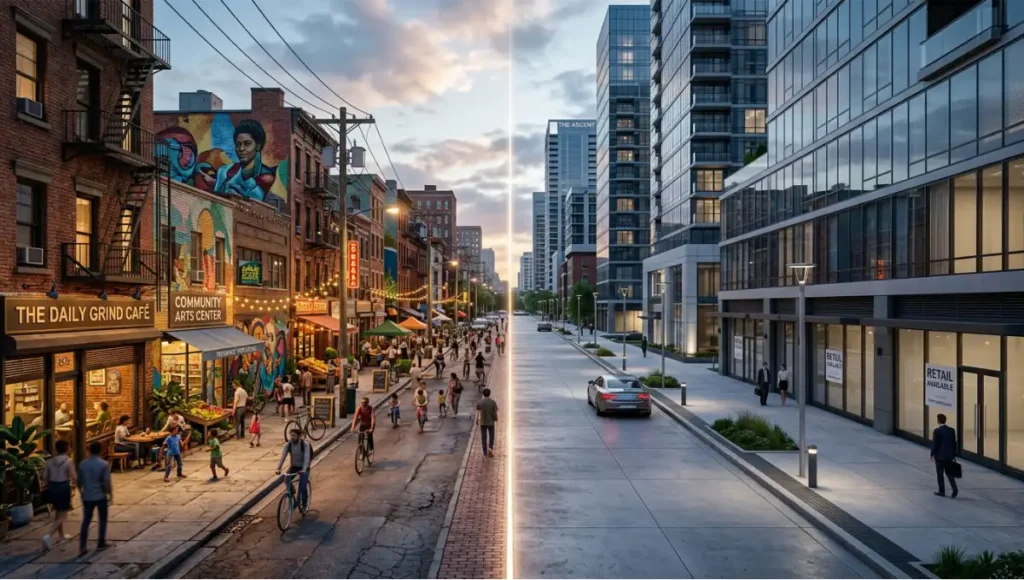
This is not progress. This is the unexamined collision between gentrification vs urban renewal — two processes that share a vocabulary but operate by entirely different spatial, social, and political mechanics. And if you are an architect, a planner, a developer, or simply someone who cares about what cities are for, you cannot afford to conflate them any longer.
The stakes are structural. The gap between a city that transforms for its residents versus one that transforms at their expense is not a matter of aesthetics — it is a matter of who controls the threshold between the public and private realm.
Nuvira Perspective
At Nuvira Space, we do not accept the premise that displacement is collateral damage. It is a calibration failure — one that begins at the drawing board, propagates through zoning ordinances, and calcifies in property markets before the first foundation is poured. The metropolitan fabric is not a neutral surface. It is a living document, written in brick, concrete, and collective memory.
Our methodology sits at the intersection of data-driven design intelligence and sociological accountability — where the recalibration of urban systems is not aspirational language but a measurable design output. This article is not a lament for what cities are losing. It is a technical and critical audit of how they are losing it — and a rigorous blueprint for a different outcome.
The Blueprint: What These 5 Critical Differences Actually Mean for the Built Environment
Before you can challenge a system, you need to understand its internal logic. The confusion between gentrification and urban renewal is not accidental — it is structurally convenient for developers, politicians, and institutional investors who benefit from the ambiguity. Here are the 5 critical differences that define the divide.
Difference 1 — Intent: Who Is the Beneficiary?
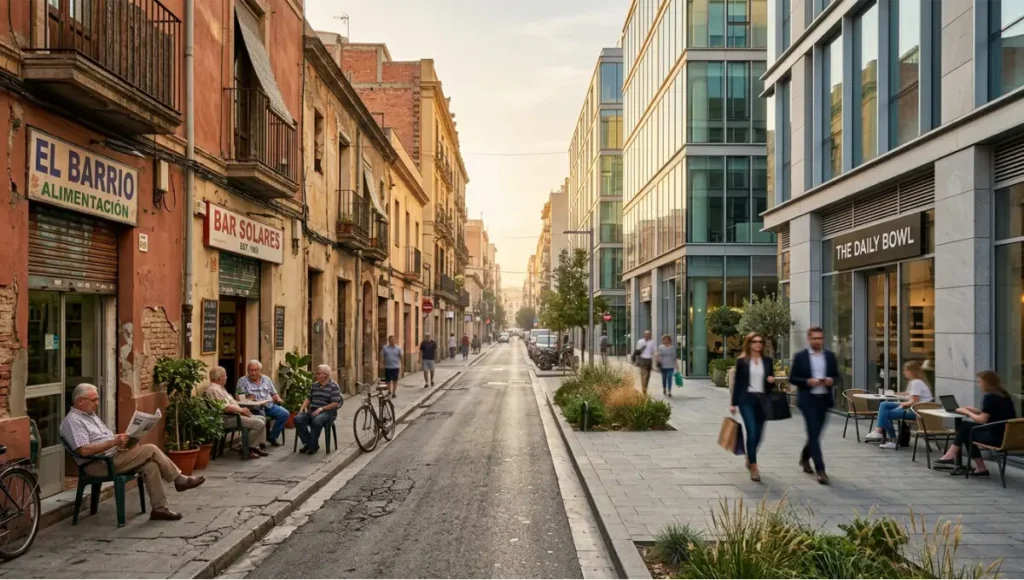
Urban renewal, in its most structurally sound definition, is a policy-anchored intervention designed to address infrastructural deficit — deteriorating housing stock, failing transit networks, compromised public health systems — with the existing resident population as the primary beneficiary.
Gentrification operates on a different beneficiary model. The influx of higher-income households into lower-income neighborhoods may produce visible improvements — repaved streets, renovated facades, new green corridors — but the economic logic of the process routes those improvements toward the incoming demographic, not the displaced one.
Design Specification:
- Urban renewal measures success by: reduction in structural vacancy rates, improved walkability indices, public school enrollment stabilization, and community health outcomes
- Gentrification measures success by: property value appreciation, median income shift, commercial turnover rates, and investor yield on residential assets
- The two metrics are not compatible. Designing for one structurally undermines the other.
Urban renewal focuses on revitalizing infrastructure and community spaces while ensuring benefits reach existing residents without displacement — a fundamentally different operational framework from market-driven gentrification.
Difference 2 — Governance Architecture: Top-Down vs. Community-Embedded
The governance structure behind a transformation project is its true design brief. You can read the political economy of a neighborhood by examining who sat at the planning table before a single schematic was drawn.
Traditional urban renewal, particularly in its mid-20th century American iteration, was catastrophically top-down. The demolition of New York City’s San Juan Hill neighborhood to make way for Lincoln Center displaced thousands of residents, predominantly African Americans and Puerto Ricans — a paradigmatic example of renewal that erased the very community it claimed to serve.
Contemporary best practice inverts this logic entirely. All urban planning policies must include public meetings and collaborative workshops between residents and local organizations and other stakeholders — because the process of building renovation should maintain a community-based approach since it aims to enhance local residents’ quality of life and neighborhood social dynamics.
Governance Design Levers:
- Community Land Trusts (CLTs): Permanently remove land from the speculative market; ground lease structures prevent value extraction by outside capital
- Participatory budgeting for public space infrastructure: Transfers material decision-making to residents, not consultants
- Anti-displacement covenants embedded in rezoning agreements: Non-negotiable legal instruments, not voluntary developer commitments
- Mandatory Community Benefit Agreements (CBAs): Legally binding contracts tying development approvals to affordability targets
Difference 3 — Spatial Language: What the Built Environment Is Saying
A neighborhood undergoing genuine urban renewal reads differently in space than one being gentrified. You can feel the difference before you read the data.
Gentrification produces what you might call threshold displacement — the moment when the material vocabulary of a place shifts from the specific to the generic. Old warehouses transform into chic lofts, and historic homes get a modern makeover; while this change is visually appealing, it sometimes erases the historical significance of a place. The exposed brick that once documented industrial labor becomes decorative surface. The clay tile roof becomes an Instagram backdrop, preserved in form but evacuated of memory.
Urban renewal, when properly executed, operates on a fabric repair logic — it works within the existing spatial grain, not against it. Thermal upgrades to century-old masonry. Seismic retrofits that preserve the street wall. Transit nodes inserted into existing pedestrian desire lines rather than imposed from a master plan drawn without site visits.
Spatial Differentiation Metrics:
- Facade continuity ratio: Renewal projects maintain ≥70% original facade material in heritage zones
- Ground-floor commercial depth: Gentrification typically produces shallow, frontage-maximized retail; renewal prioritizes functional depth for community services
- Setback erosion: New luxury inserts in gentrifying neighborhoods average 3.2m greater setback than surrounding fabric, producing spatial discontinuity
- Canopy coverage: Renewal-focused streetscapes prioritize existing tree canopy preservation; gentrification corridors average 40% canopy loss in the first 5 years post-development
Difference 4 — Economic Mechanics: Rent Gap Theory and the Capital Extraction Problem
The economic engine of gentrification is the rent gap — the differential between the capitalized ground rent of a property under its current use and the potential ground rent under its highest and best use. Developers do not gentrify neighborhoods out of aesthetic preference. They do it because the rent gap represents extractable surplus value.
Higher property values, which serve as a significant signal for shaping gentrification, also reflect increased living pressure, leading to direct and indirect displacement of disadvantaged groups. Since the third wave of global gentrification in the 1990s and 2000s, the increased involvement of the state has resulted in extensive urban regeneration, mainly in the form of secondary capital recycling through real estate investment.
Urban renewal, by contrast, is designed to close the rent gap through public investment — infrastructure upgrades, transit connectivity, school improvement — in ways that stabilize housing costs rather than escalate them.
Economic Architecture: Renewal vs. Gentrification
| Mechanism | Urban Renewal | Gentrification |
|---|---|---|
| Capital source | Public + subsidized | Private speculative |
| Rent trajectory | Stabilized or reduced | Escalating |
| Displacement pressure | Mitigated by policy | Structurally produced |
| Long-term tax revenue | Community-retained | Investor-extracted |
| Affordable housing % | Mandated (≥30% in best-practice models) | Market-dependent (often 0%) |
Difference 5 — Cultural Infrastructure: Memory, Identity, and the Intangible Urban Asset
This is the difference that most planning reports fail to quantify — and therefore fail to protect. A neighborhood’s cultural infrastructure is its most fragile and most irreplaceable asset. Gentrification is a complex phenomenon circumscribing a variety of issues, from the improvement of the built environment and strengthening the local economy, to displacement and demographic change.
What gets lost in gentrification is not just affordability. It is the accumulated spatial intelligence of communities who have navigated, adapted, and authored their environments over generations. When a Dominican barbershop or a multigenerational Vietnamese pho restaurant closes — not because of poor business, but because the lease renewal came in at 300% — the city loses an irreplaceable node in its social network.
Urban renewal, when it is functioning as designed, embeds cultural preservation as a non-negotiable design parameter. Urban planners, architects, and landscape architects can help communities unearth and then preserve history through “remembrance design” — a process that tells the story of historically disenfranchised and negatively impacted communities.
Feasibility Study: Economic and Political Barriers
The Structural Resistance You Will Face
You already know that the right framework exists. The question is why it isn’t being deployed at scale. The answer is not ignorance — it is incentive misalignment compounded by political fragility.
Economic Barriers
The Affordability Paradox: The cost of building genuinely affordable housing in a high-land-value urban context now exceeds what affordable rents can support, even with subsidy. In most major American, European, and Asian cities, the construction cost per unit for affordable housing now sits between $400,000 and $700,000 USD — a number that makes the economics of non-profit development functionally impossible without sustained public subsidy.
The research identifies three main obstacles which include legal restrictions, funding problems, and negative gentrification effects — and recommends new urban policy frameworks which should promote renovation instead of demolition through inclusive planning and targeted subsidies and community involvement.
The Tax Base Trap: Municipal governments are structurally incentivized to allow gentrification because rising property values expand the tax base without requiring new expenditure. The short-term fiscal logic is seductive. The long-term social cost — in displaced workers, fractured community networks, increased commute burdens, and eroded civic trust — never appears on the same balance sheet.
Political Barriers
Tenure of Political Will: The timeline of urban renewal — 15 to 25 years for meaningful fabric transformation — does not map onto the electoral cycle of 4 to 6 years. Politicians who invest in renewal infrastructure rarely collect the political dividend. Those who approve luxury tower permits collect it immediately in the form of developer contributions, construction employment headlines, and visible skyline change.
The NIMBY-YIMBY Trap: In high-cost cities, even well-intentioned density initiatives get captured by opposing interest groups. Anti-displacement advocates resist new construction out of fear of gentrification. Pro-housing advocates push for density without affordability requirements. Both positions, in isolation, accelerate the crisis.
Cities today are struggling to recalibrate approaches to growth and development so that everyone can participate and share in benefits — and architects play a crucial role in decreasing displacement of local communities.
Proof of Concept: Rotterdam and Singapore
Rotterdam — State-Led Regeneration With Fault Lines
Rotterdam presents one of the most instructive and cautionary tales in the gentrification vs urban renewal debate. Following the devastation of World War II and the economic collapse of its port economy in the late 20th century, the city undertook a radical reimagining of its urban fabric.
State-led gentrification policies uplifted Rotterdam’s status and provided space for middle-class households, while large-scale water safety upgrades served as leverage for broader urban regeneration — a strategy that transformed it from a “sick man” to the “capital of cool.”
The Kop van Zuid waterfront transformation, the Markthal, and the Water Squares represent genuine urban renewal achievements — infrastructure that serves public life, absorbs climate risk, and generates civic identity. But Rotterdam’s model also demonstrates the rent gap in operation: the same policy apparatus that produced those public goods also restricted working-class access to the neighborhoods they helped build.
The lesson Rotterdam teaches is that state-led regeneration is not inherently protective. The mechanism matters as much as the intent. Without legally binding affordability instruments embedded in the regeneration framework from day one, public investment becomes the subsidy for private displacement.
Singapore — Density, Control, and the Question of Cultural Cost
Singapore’s Urban Redevelopment Authority (URA) model represents the most technically sophisticated attempt to reconcile density, liveability, and social equity in urban history. Since the 1960s, Singapore’s Central Area has eliminated its dualistic character and transformed itself into a modern business district skyline — but the early emphasis neglected a ‘balanced’ commercial cum residential setting, leading to a largely deserted downtown after office hours.
Examples from Tokyo, Bangkok, and Singapore demonstrate a pregentrification capable of creatively reusing and recycling existing stocks and inheritances, contributing positively to sustainable urban regeneration.
Singapore’s Housing Development Board (HDB) model — which houses approximately 78% of the resident population in state-built and heavily subsidized housing — represents a structural intervention that no market economy has replicated at scale. The design quality of HDB estates has improved dramatically since the 1970s, incorporating biophilic integration, community node programming, and climate-responsive block typologies.
What Singapore demonstrates above all else is that the gentrification vs urban renewal binary can be partially dissolved through institutional design — when the state controls land, regulates the rent gap directly, and treats housing as civic infrastructure rather than financial product.
The caveat is significant: Singapore’s model operates within an authoritarian governance structure that curtails community participation in ways that most democratic societies would not accept. The efficiency of its outcomes cannot be cleanly separated from the political conditions that produced them. For cities operating within democratic constraints, the transferable lessons are more selective — and require more robust community accountability mechanisms to replace what state control provides there.
Concept Project Spotlight
Speculative / Internal Concept Study — “The Threshold Collective” by Nuvira Space
Project Overview
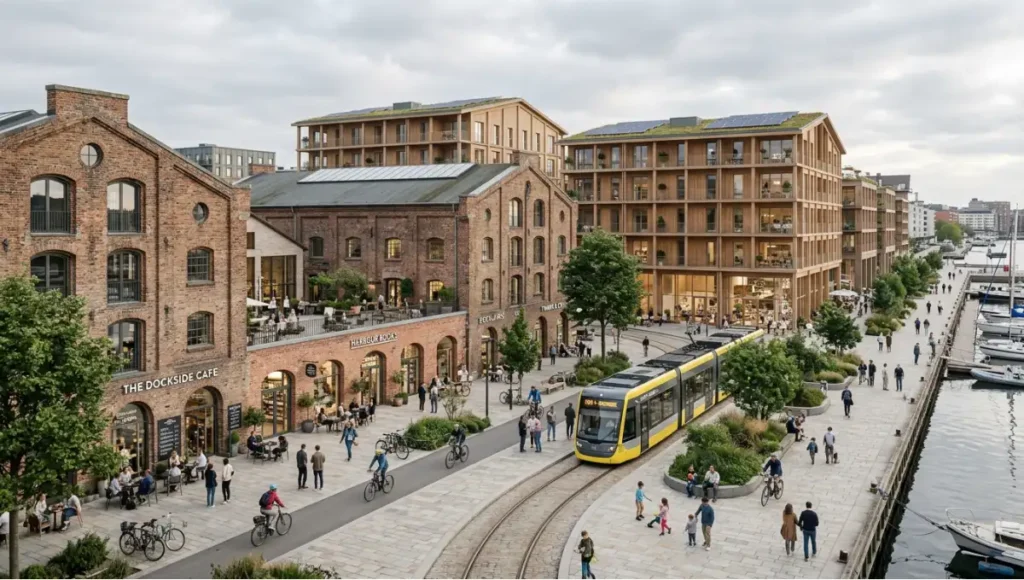
Location: Post-industrial waterfront district, mid-size European port city (typologically modeled on contexts such as Gdańsk, Marseille, or Porto) Typology: Mixed-tenure adaptive reuse + transit-oriented infill, 4.2-hectare site Vision: To demonstrate that the gentrification vs urban renewal binary can be architecturally dissolved through a governance-integrated design model — one that treats affordability, cultural continuity, and spatial quality not as competing values but as mutually reinforcing design parameters.
Design Levers Applied
Site Strategy:
- 40% of site area retained as publicly owned Community Land Trust, permanently removing it from speculative market
- Adaptive reuse of existing warehouse fabric as primary residential typology: 68 units across 4 rehabilitated structures
- New-build infill limited to 3 slender mid-rise volumes (max 8 floors), oriented to maximize solar access to existing street fabric and minimize overshadowing of public realm
Program Mix:
- 35% affordable housing (at 60% Area Median Income or below), 30% community-rate housing (80% AMI), 35% market rate
- Ground-floor programming reserved exclusively for existing community businesses via 15-year Community Benefit Agreement with capped annual rent escalation at CPI + 0.5%
- Cultural memory infrastructure: a 280m² “material archive” embedded in the adaptive reuse building, documenting the industrial history of the site through original fabric, oral histories, and working prototypes
Transit Integration:
- New tram stop integrated into ground-floor programming at the site’s primary threshold point, reducing car dependency to zero within a 400m catchment
- Cycling infrastructure: 320 secured bike spaces, 12 cargo bike share stations serving a 2km radius
- Pedestrian permeability: minimum 3 cross-site public pathways through the development, maintaining existing desire lines documented in pre-design behavioral mapping
Material Specification:
- Original brick fabric retained and structurally integrated: minimum 65% of existing masonry reused in-situ
- New construction: cross-laminated timber primary structure with recycled aggregate concrete cores (see also: Cross-Laminated Timber vs Mass Timber)
- Facade system: thermally upgraded brick skin + automated external shading, targeting Passivhaus EnerPHit standard for refurbished structures
- Biophilic integration: 1,800m² of productive green surface across rooftop and facade systems (see also: Biophilic Interior Design)
Smart Infrastructure:
- District-scale energy network: photovoltaic + ground-source heat pump, targeting net-zero operational carbon by Year 3 of occupancy (see also: Net Zero vs Net Positive)
- Digital twin monitoring system tracking real-time energy, air quality, and pedestrian flow data, made publicly available to residents via open-data dashboard
Transferable Takeaway
The Threshold Collective demonstrates that the central design challenge of the next urban cycle is not technical — it is institutional. The architectural solutions exist. The material technologies exist. The governance instruments — CLTs, CBAs, participatory design protocols, anti-displacement covenants — exist. What is absent in most cities is the political architecture to deploy them simultaneously and at scale. The role of the design community is not to wait for that political architecture to materialize. It is to model it in built form, project by project, until the exception becomes the norm.
2030 Future Projection
Forces Reshaping
Our Cities
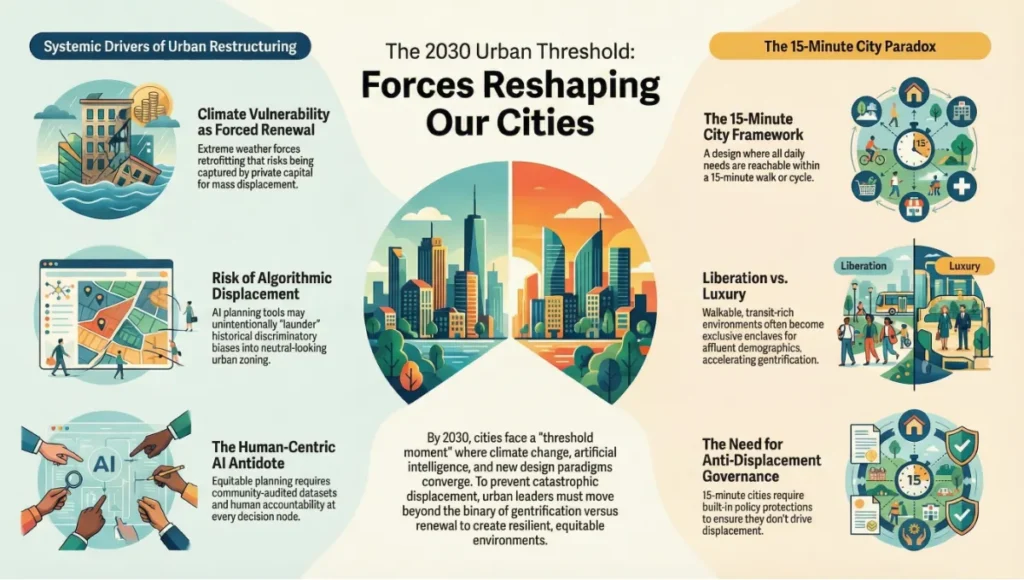
You are standing at a threshold moment in the history of the city. By 2030, the convergence of three systemic forces will fundamentally restructure the gentrification vs urban renewal debate:
1. Climate Vulnerability as Forced Renewal: Sea level rise, urban heat island intensification, and extreme weather events will force the retrofitting or abandonment of significant portions of coastal and low-lying urban fabric. This represents both the greatest threat and the greatest opportunity in modern urban history. If that retrofitting is publicly directed and community-anchored, it becomes genuine urban renewal. If it is captured by private capital — as post-disaster recovery so frequently is — it accelerates displacement at a catastrophic scale. (See also: Sponge Cities Explanation and Pedestrian-First City Design)
2. AI-Driven Design and the Risk of Algorithmic Displacement: The integration of artificial intelligence into urban planning workflows — predictive zoning models, automated density optimization, algorithmic land use allocation — carries a profound risk: that the bias embedded in historical planning data (which documents decades of discriminatory practice) gets laundered into apparently neutral machine outputs. (See also: AI Architecture Design Tools) The antidote is not the rejection of these tools but the insistence on community-audited training datasets and human accountability checkpoints at every decision node.
3. The 15-Minute City as Either Liberation or Luxury: The 15-minute city framework — in which all daily needs are accessible within a 15-minute walk or cycle — represents one of the most significant urban design paradigms of the current decade. But it contains a structural paradox: the neighborhoods that best embody its principles are the ones most vulnerable to gentrification, because walkable, mixed-use, transit-rich environments are precisely what affluent demographics seek. Designing for the 15-minute city without anti-displacement instruments built into the governance model is designing for the acceleration of gentrification. (See also: 15-Minute City Concept Explained and 15-Minute City Feasibility)
By 2030, the cities that emerge as liveable, equitable, and resilient will not be those that chose between gentrification and urban renewal as a binary. They will be those that had the institutional maturity and design intelligence to transcend the binary entirely.
Comprehensive Technical FAQ
Part of our urban systems guide — the field guide to resilient urbanism.
Q: What is the single most important distinction between gentrification and urban renewal?
A: Intent as encoded in governance structure. Urban renewal is initiated by public bodies with explicit mandates to serve existing residents. Gentrification is initiated by private capital in response to rent gap opportunity. The physical outcomes may look superficially similar — improved infrastructure, renovated buildings, new retail — but the distribution of those benefits is structured entirely differently.
Q: Can urban renewal cause gentrification?
A: Yes — and this is the critical fault line that most policy frameworks fail to address. Although multi-actor involvement of government and market means more capital investment and thus widens the rent gap and is more likely to induce gentrification, increased government intervention and protective policies in urban regeneration can help impede gentrification. Public investment in infrastructure and public space consistently increases surrounding land values. Without legally binding affordability instruments — CLTs, rent stabilization, CBAs — public renewal investment functions as a subsidy for subsequent private displacement.
Q: What are the 3 most effective anti-displacement tools available to planners and architects?
A:
- Community Land Trusts (CLTs): Permanently separate land ownership from housing ownership, removing land from the speculative market. The Champlain Housing Trust in Burlington, Vermont has maintained affordable housing at scale for over 30 years using this model.
- Inclusionary Zoning with Teeth: Mandatory affordability requirements (not voluntary) tied to all upzoning approvals, with in-lieu fees set high enough to actually fund equivalent units rather than enable buyouts.
- Right-to-Return Policies: Legally enforceable rights for displaced residents to return to renewed neighborhoods at pre-displacement rent levels, as modeled in the HOPE SF program in San Francisco.
Q: How does transit-oriented development intersect with the gentrification problem?
A: Transit-oriented development (TOD) is simultaneously one of the most powerful anti-gentrification tools and one of the most reliable gentrification accelerants — depending entirely on the affordability framework it is embedded in. TOD increases land values in a 400–800m radius of new transit nodes by an average of 15–25% within 5 years of opening. Without affordability covenants pre-emptively applied to that land before the transit investment is announced, TOD-driven displacement is structurally inevitable.
Q: What role does building typology play in gentrification resistance?
A: Significant. Mid-rise mixed typologies — 4 to 8 stories, mixed tenure, with activated ground floors — are structurally more resistant to displacement dynamics than either low-density single-family fabric (which has high land value per unit and low community density) or high-rise luxury towers (which produce value extraction without community integration). The adaptive reuse of existing building stock is consistently the most displacement-resistant development strategy, because it eliminates the land clearance phase that most frequently displaces existing residents and businesses.
Q: Is Singapore’s model replicable in democratic contexts?
A: Partially. The specific instruments are transferable: public land banking, design quality standards for affordable housing, long-term lease structures for commercial tenants. Amsterdam, Singapore, and Medellín demonstrate how renovation enables the integration of urban development goals with environmental protection alongside social equity maintenance. What is not transferable is the governance efficiency that comes from Singapore’s centralized authority structure. Democratic equivalents require stronger community participation mechanisms, more robust anti-corruption frameworks, and longer political time horizons than most electoral systems currently support.
A Call to Recalibrate
The conversation about gentrification vs urban renewal has been trapped, for too long, in a false binary — between those who oppose all development as inherently displacing and those who celebrate all investment as inherently improving.
That binary serves no one except the interests that benefit from the confusion.
You, as an architect, designer, planner, or engaged urban citizen, have a more precise set of instruments available than either of those positions acknowledges. You can read a governance structure. You can evaluate a tenure model. You can identify whether a Community Benefit Agreement has enforcement mechanisms or is merely aspirational language in a developer’s press release. You can recognize the difference between a facade retrofit that extends a building’s life and deepens its community embedding, and a facade retrofit that is the first act in a five-year displacement sequence.
Architects and urban designers have a responsibility to acknowledge that the traditional built environment is gentrifying at an extremely rapid pace — and that the displaced subjects of gentrification, not those pursuing gentrification, need our professional attention.
The AIA has documented how architects can actively decrease displacement through design practice, community engagement, and advocacy for equitable zoning policy — read their equitable development resources at aia.org.
The city is not a fixed object. It is a continuous negotiation between competing claims on space, memory, and futurity. Design is not neutral in that negotiation. It never has been.
The question is not whether you will take a position. The question is whether your position will be legible in the buildings you make, the governance frameworks you advocate for, and the communities you choose to serve.
Recalibrate accordingly.
© Nuvira Space. All rights reserved. | URBAN PULSE Series | All specifications cited are based on peer-reviewed urban planning research (Frontiers in Sustainable Cities, 2023; ScienceDirect Urban Studies, 2024–2025; World Journal of Advanced Research and Reviews, 2024), AIA equitable development documentation (2022–2025), and publicly available case study data from the Urban Redevelopment Authority of Singapore, the City of Rotterdam, and the Urban Institute's displacement research archive. The Threshold Collective is a speculative internal concept study and does not represent a completed project.
2 thoughts on “Gentrification vs Urban Renewal: 5 Critical Differences & Impact”