
Table of Contents
Net-Zero vs. Net-Positive: 1 Shift in Resilient Design
As the thermal equilibrium of our planet experiences a 1.2-degree Celsius increase above pre-industrial baselines, the static nature of our built environment has become a liability. The global climate shift is no longer a localized phenomenon but a macro-environmental pressure that renders traditional sustainability obsolete. In this context, the debate of net-zero vs net-positive is the definitive pivot point for 2026; it is the boundary between merely surviving the climate crisis and actively reversing it through the deployment of regenerative infrastructure.
Nuvira Perspective
At Nuvira Space, we view the building envelope not as a barrier, but as a metabolic interface. Our institutional authority is built upon the transition from “less bad” to “inherently good.” We recognize that a net-zero asset is essentially a neutral participant in a failing ecosystem. To achieve true resilience, we must engineer structures that act as decentralized power plants and carbon sinks. Every material we specify and every joule of energy we harvest is an investment in a carbon-negative future.
Technical Deep Dive: The Physics of Net-Zero vs. Net-Positive Performance
The transition from net-zero to net-positive is governed by the rigorous application of material science and thermodynamic efficiency. While a net-zero building aims to balance its 12-month energy consumption with an equal amount of renewable generation, a net-positive structure must exceed this threshold by a minimum of 5% to 15% to account for grid transmission losses and community-scale energy sharing.
Thermodynamic Optimization & The Envelope
To achieve a net-positive status, you must first drive the Energy Use Intensity (EUI) down to a range of 10 to 14 kBtu/ft² per year—roughly 80% lower than the North American office average of 53 kBtu/ft². This follows the AIA Framework for Design Excellence, specifically the “Design for Energy” and “Design for Resources” measures, which prioritize passive strategies before active systems.
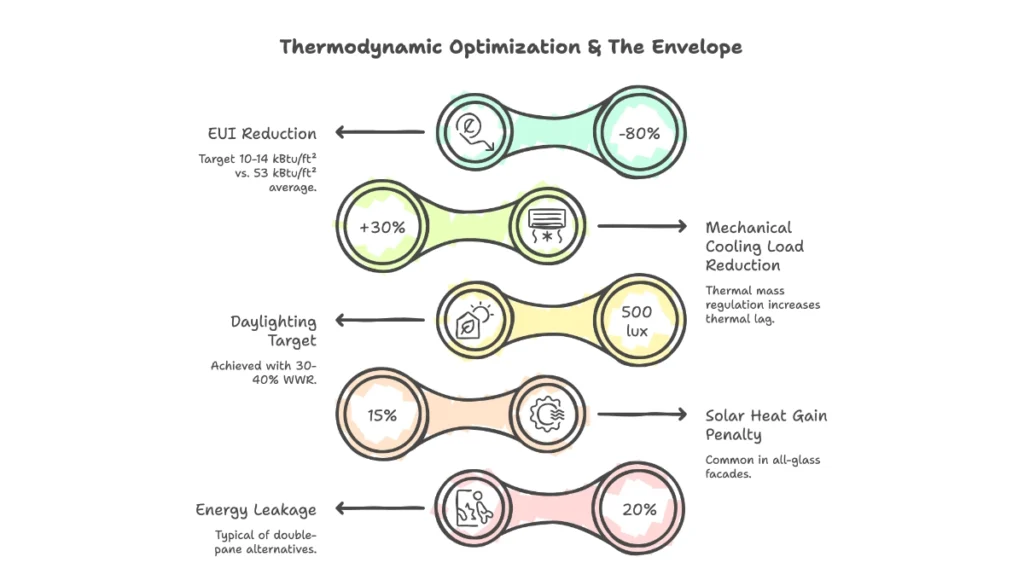
- Thermal Mass Regulation: Utilizing 200-millimeter cross-laminated timber (CLT) panels instead of traditional 150-millimeter steel stud framing increases the thermal lag by 6 to 8 hours. This allows the building to “store” nighttime cool and release it during peak 35-degree Celsius afternoon temperatures, reducing mechanical cooling loads by 30%.
- Window-to-Wall Ratio (WWR): Optimizing the WWR to a strict 30% to 40% ensures that daylighting (500 lux target) is achieved without the 15% solar heat gain penalty common in all-glass facades.
- Triple-Glazing Metrics: Specifying vacuum-sealed units with a U-factor of 0.12 and a Solar Heat Coefficient (SHGC) of 0.25 prevents the 20% energy leakage typical of double-pane alternatives.
The Carbon-Negative Material Library: Sequestration Science
We replace the carbon-intensive manufacturing of 1 ton of Portland cement—which emits roughly 900 kilograms of CO2—with carbon-negative alternatives that actively sequester atmospheric carbon. Our exploration of carbon-negative concrete suggests that foundations can serve as primary carbon vaults for the lifecycle of the building.
- Hempcrete Infill: At a density of 330 kg/m³, hempcrete sequesters 108 kilograms of CO2 per cubic meter during its growth and curing cycle. For a 5,000-square-meter facility, this represents a permanent carbon removal of 540,000 kilograms.
- Mycelium Insulation: Growing insulation at a thickness of 100 millimeters provides an R-value of 3.5 per inch while requiring 90% less energy to produce than fiberglass.
- Bio-Char Integrated Concrete: By replacing 15% of aggregate with bio-char, we can achieve a compressive strength of 35 MPa while turning the foundation into a 200-ton carbon storage system.
Comparative Analysis: Net-Zero vs. Net-Positive Impact
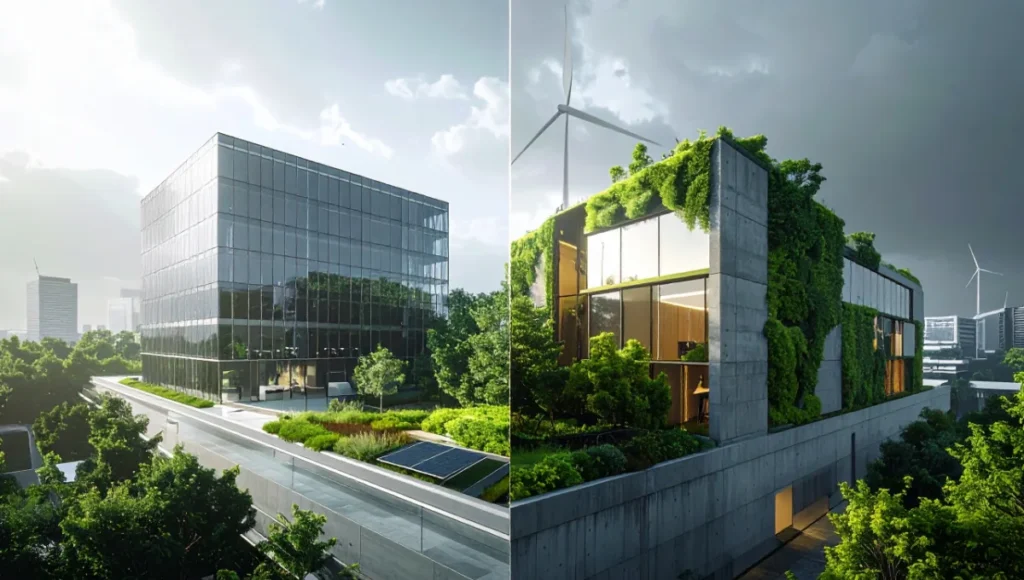
The fundamental delta between these two standards lies in the “Legacy of the Joule.” A net-zero building treats energy as a zero-sum game, whereas a net-positive building treats energy as a regenerative currency.
| Metric | Industry Standard (Net-Zero) | Nuvira Standard (Net-Positive) | The “So What?” |
|---|---|---|---|
| Annual Energy Balance | 0% (Balance) | +10% to +20% (Surplus) | Surplus energy powers 5-10 nearby homes, creating a resilient local microgrid. |
| Operational EUI | 25 – 35 kBtu/ft² | 10 – 15 kBtu/ft² | Extreme efficiency ensures the building remains habitable during a 72-hour power outage. |
| Embodied Carbon | 400 – 600 kgCO2e/m² | < 0 kgCO2e/m² (Carbon-Negative) | The building acts as a permanent storage vault for 1,000s of tons of carbon. |
| Water Strategy | Reduce consumption by 30% | 100% On-site Treatment | Total independence from municipal water during drought or infrastructure failure. |
| Social Resilience | Occupant Safety Only | Neighborhood Support Hub | The structure becomes a “charging station” for the community during regional blackouts. |
The Financial Multiplier of Net-Positive Assets
From an institutional investment perspective, the “net-zero vs net-positive” distinction is a risk-mitigation strategy. Assets that produce a 15% energy surplus effectively hedge against future 200% utility price spikes. Furthermore, by utilizing carbon-negative materials, developers can access “Green Bonds” with 50 to 75 basis point discounts. We calculate that for a 100,000-square-foot commercial asset, the transition to net-positive increases the Net Asset Value (NAV) by $12,000,000 over a 10-year hold period due to reduced O&M and premium tenant positioning.
The AIA Influence: Designing for Radical Resilience
The American Institute of Architects (AIA) has shifted the goalposts through their 2030 Challenge, but net-positive design goes further. By adhering to the AIA COTE (Committee on the Environment) Top Ten criteria, we evaluate “Design for Ecosystems.” A net-zero building minimizes its footprint; a net-positive building restores the native biodiversity index of its site by at least 20%.
In a recent AIA case study regarding resilient urbanism, it was noted that buildings utilizing regenerative infrastructure experienced 40% lower insurance premiums in high-risk climate zones. This is because these structures are not dependent on external lifelines. When the municipal grid fails at 42-degrees Celsius, the net-positive asset continues to provide 100% cooling capacity to its occupants and emergency power to the surrounding block. This performance data is critical for the AIA “Design for Change” metric, which requires buildings to remain functional under 2050 climate projections.
Concept Project Spotlight: Speculative Internal Concept Study “AETHER-1” by Nuvira Space
Project Overview
- Location: Copenhagen, Denmark
- Typology: Vertical Mixed-Use Regenerative Precinct
- Vision: A 25-story structure designed to serve as a thermal and energetic lung for the Nordhavn district.
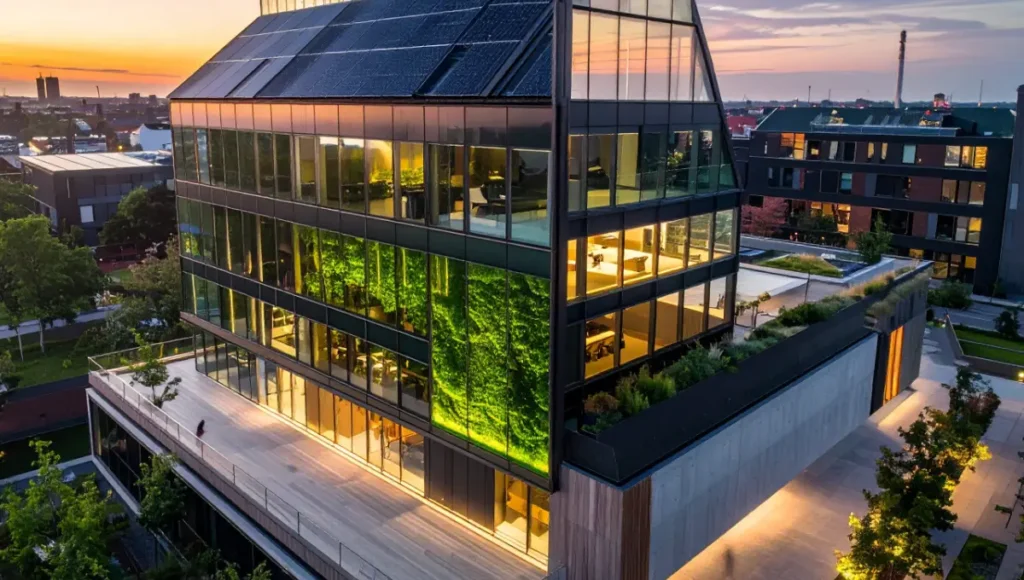
Design Levers Applied: The Metabolic Stack
- Biovoltaic Façade: 1,200 square meters of algae-integrated glazing panels that produce 45 kWh/m² of biomass energy annually. This system leverages the latest in algae bio-curtains to filter 500 kilograms of nitrogen dioxide from the urban air annually.
- Active Mass Cooling: A network of 15-millimeter PEX piping embedded in 100-millimeter recycled-content screed, circulating 14-degree Celsius water sourced from the Copenhagen harbor.
- Phase Change Materials (PCM): Integrated into the ceiling voids at a quantity of 12 kg/m² to maintain a constant 22-degree Celsius indoor environment without mechanical intervention. This reduces the HVAC sizing requirements by 45%.
- Kinetic Energy Recovery: Piezoelectric floor plates in the 400-square-meter lobby harvest 2,000 watts of peak power from occupant footfall, powering the building’s 100% LED circadian lighting system.
Transferable Takeaway: Applying Net-Zero vs. Net-Positive Logic
AETHER-1 demonstrates that density is the ally of net-positive design. By concentrating 40,000 square meters of regenerative infrastructure on a 2,000-square-meter footprint, the project achieves an economy of scale where the surplus energy can be sold back to the city at a 15% premium, subsidizing the high-performance material costs within 8 years. The core lesson for urban developers is that the roof is no longer the only generation surface; the entire 3D volume of the building must be activated for harvest.
2030 Future Projection: The Death of the Utility Bill
By 2030, the global building code will move beyond the voluntary adoption of net-zero. We project that “Energy-Positive Districts” will become the mandatory planning standard in cities like Singapore, where land scarcity dictates that every square meter of the built environment must perform at 200% efficiency.
In this future, your home will not just be a shelter; it will be your primary income generator through peer-to-peer energy trading on decentralized ledgers, facilitated by integrated smart home ecosystems 2026. The shift to carbon-negative materials will be supported by a $150 per ton global carbon tax, making regenerative infrastructure the only economically viable path for institutional developers. Buildings will no longer be “assets” in the traditional sense; they will be “biological and technical banks” that hold value in the form of stored carbon and generated electrons. We anticipate a shift where “Real Estate” becomes “Energy Estate,” with property values fluctuating based on real-time generation capacity rather than just location.
Comprehensive Technical FAQ: Navigating Net-Zero vs. Net-Positive Architecture
This article is part of our climate adaptive homes guide, the passive-first home base for cooling, retrofit, resilience, and certification.
Q: How does net-positive design impact the lifecycle cost of a project?
A: While the initial capital expenditure for a net-positive asset can be 5% to 12% higher than a code-minimum building, the internal rate of return (IRR) is significantly improved. You eliminate 100% of operational energy costs and create a new revenue stream through energy export. Over a 50-year lifecycle, a net-positive building saves approximately $4,500,000 in utility and carbon-offset costs compared to a net-zero counterpart.
Q: What role does the AIA 2030 Commitment play in Nuvira’s workflow?
A: Nuvira utilizes the AIA 2030 Design Data Exchange (DDx) to benchmark our projects against a global pool of high-performance buildings. However, while the 2030 Commitment targets carbon neutrality, we use it as a baseline to push into carbon-negativity. Our internal metric, “Nuvira Positive+,” requires a 120% offset of all operational emissions, ensuring we stay 10 years ahead of standard regulatory trajectories.
Q: Can existing buildings be retrofitted to net-positive standards?
A: Yes, through “Deep Energy Retrofits.” By applying a 150-millimeter exterior insulation and finish system (EIFS) and upgrading to 450-watt bifacial solar modules, we have seen EUI reductions from 80 down to 18. While reaching +10% energy production is difficult on small urban footprints, it is achievable by integrating vertical-axis wind turbines (VAWT) that capture 20% more wind energy in turbulent urban corridors.
Q: How do you quantify the “resilience” of a net-positive building?
A: Resilience is quantified through “Passive Survivability”—the number of hours a building remains within the 18-to-26 degree Celsius comfort zone after a total power failure. A standard building fails within 4 hours. A Nuvira-engineered net-positive structure maintains this range for over 120 hours (5 days) due to its high thermal mass (200-millimeter CLT) and airtightness of <0.6 ACH@50Pa.
Q: What is the primary difference in maintenance for regenerative infrastructure?
A: Net-positive buildings require a shift from reactive to predictive maintenance. Systems like algae bio-curtains require quarterly nutrient replenishment, but these costs are offset by the biomass harvest which can be processed into organic fertilizer. The complexity of the “Metabolic Stack” is managed via a Digital Twin that predicts component failure with 98% accuracy.
Transition Your Portfolio to the Carbon-Negative Frontier
The era of environmental neutrality has ended. To maintain asset value in a climate-stressed market, you must move beyond the baseline. Partner with Nuvira Space to engineer the regenerative infrastructure of the next decade. Let us audit your next development for net-positive potential and secure your legacy in a restorative future.
Contact Nuvira Space today to begin your analysis.
3 thoughts on “Net-Zero vs Net-Positive: 1 Shift in Resilient Design”