

Table of Contents
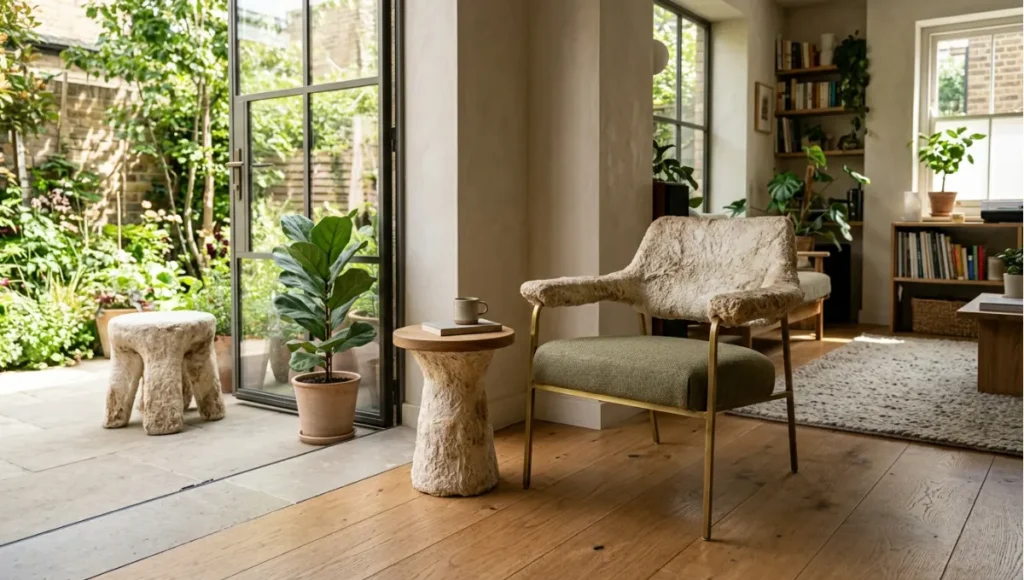
Furniture is the surface a body touches most often and thinks about least. A chair is sat on, a table is leaned on, a lampshade is looked at every evening for a decade — and almost none of it is chosen for how any of that feels. Mycelium furniture is interesting precisely because it makes that contact the design question: the material is grown rather than manufactured, and what you sit on is a dense lattice of fungal filaments bound to an agricultural substrate, closer in behaviour to a firm foam than to a moulded shell.
The traditional furniture industry is currently facing a metabolic crisis. As we inhabit increasingly sterilized, “smart” environments, our biological systems are beginning to reject the static, off-gassing polymers of the 20th century. This macro-observation is driving a shift toward mycelium furniture, a medium that moves beyond “decor” into the realm of living, breathing infrastructure. For the modern inhabitant, the choice of a chair is no longer an aesthetic whim; it is a physiological intervention.
Nuvira Perspective
At Nuvira Space, we view the dwelling not as a static shell of shelter, but as a “health machine” — a sophisticated extension of the human nervous system. We believe the next era of domestic life is defined by human-machine synthesis, where modular adaptability and circadian synchronisation are the primary metrics of quality. Mycelium furniture represents the first true bridge in this evolution: a bio-fabricated interface that allows our living spaces to harmonise with our biological rhythms, turning the home into a restorative environment for the mind.
By treating the interior as a biological entity, we move past the limitations of traditional architecture into a symbiotic relationship with our environments. This approach is central to our philosophy of biophilic interior design, where the boundary between the built environment and the natural world is intentionally blurred to support human performance.
The science of space
Before the designs, the mechanism. Mycelium is the vegetative part of a fungus: a network of fine white filaments called hyphae. Grown into a mould with a substrate — hemp, sawdust, or agricultural waste — it binds that substrate into a structural composite that is both light and surprisingly firm. Everything the material does to a room follows from that structure.
Neuroscience foundation
- Contact is a continuous sensory input. Skin is always reading temperature, texture and pressure, and a chair or desk is in contact longer than any other object in a room. A material that sits close to skin temperature removes a small but constant thermal load; a dense, cold surface does the opposite.
- Texture registers as information. Fine, irregular surfaces hold attention differently from uniform ones. This is the mechanism behind the “soft fascination” described in Attention Restoration Theory — the same reason a person can look at moving water without effort but not at a blank wall.
- Sound is processed as safety. Hard, resonant surfaces return reflections that keep the auditory system alert, which is tiring in an open plan. Porous materials interrupt that return, and the effect on perceived calm is real even where the measured difference is modest.
- Air quality is a nervous-system input. Conventional furniture boards and adhesives can off-gas for years, and the volatile organic compound question matters most in the small, tightly sealed rooms where furniture is most concentrated.
Design translation
- Porous structure becomes acoustic absorption. Mycelium composite’s open cell structure absorbs rather than reflects, which is why the most commercially mature application of the material is not seating but wall panels.
- Low density becomes thermal neutrality. At the densities these composites are typically produced, the material reaches skin temperature quickly, so it does not read as cold on first contact.
- Self-binding becomes chemistry-free assembly. Mycelium composites are bound by the organism’s own growth, so the formaldehyde-based adhesives that dominate board furniture are structurally unnecessary rather than merely absent.
- Grown-to-form becomes jointless geometry. Growing a piece in a mould removes mechanical joints, which matters as much visually as structurally: fewer revealed fasteners means less detail for the eye to resolve.
- Substrate choice becomes the material’s specification. The substrate and the pressing and drying regime determine density, stiffness and surface, so “mycelium” names a process rather than a fixed product.
Biophilic response patterns
- Living materials sustain attention softly. Organic variation in a surface holds the eye without demanding cognitive work — the pattern biophilic design deliberately reproduces, present here as a by-product of how the material grows.
- Visible age is part of the experience. A material that patinas rather than degrades changes the maintenance relationship: the object is maintained rather than replaced, which is a behavioural effect as much as a material one.
- Warm light through a thin material is the strongest lever. Thin mycelium is translucent, which makes it useful as a lamp diffuser; the lighting effect is measurable where the material claim is not.
- Natural irregularity reduces the pressure to keep a perfect room. An object that is expected to look grown rather than flawless lowers the maintenance standard the occupant holds themselves to — a genuine, if under-appreciated, wellbeing effect.
- The claim stops where the evidence stops. Biophilia research supports restorative response to natural material presence; it does not support specific furniture as a clinical intervention, and we do not describe it that way.
Seven bio-fabricated designs worth knowing
These seven are real, documented projects rather than illustrative examples — each named maker is verifiable, and each entry describes what that piece contributes to the material’s argument.
- Sebastian Cox & Ninela Ivanova — “Mycelium + Timber” (2017): a collaboration between the furniture maker and the design researcher that grows mycelium directly onto timber offcuts from Cox’s own workshop, producing pieces where a suede-like fungal skin meets structural wood. The value is the transition itself: the eye follows the change between two organic states without the interruption an applied finish would create.
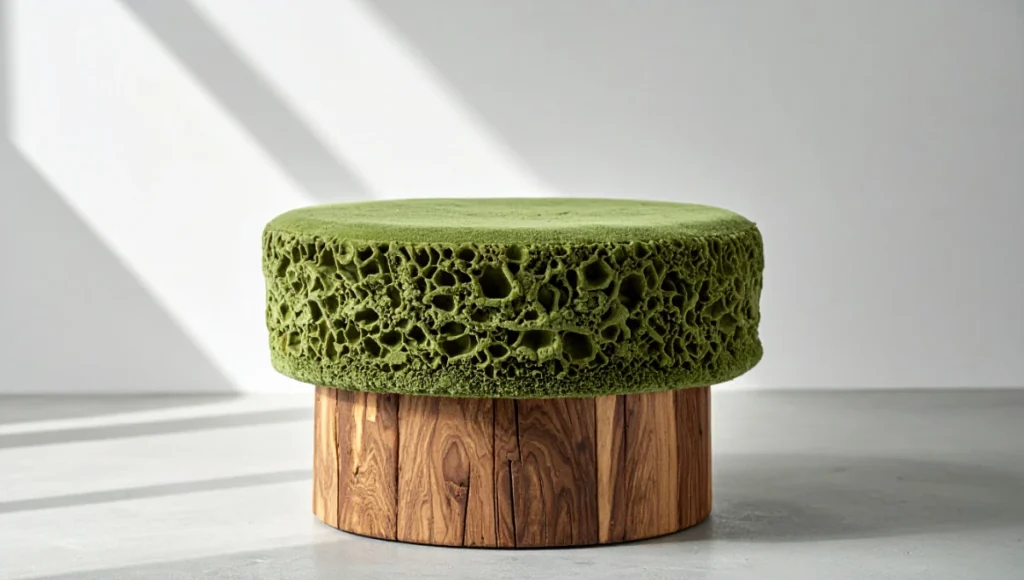
Grown-to-form furniture: the mycelium skin meeting structural timber.
- Eric Klarenbeek — the 3D-printed mycelium chair (2013): a Dutch designer’s chair printed with a bio-composite containing living fungal material and shown at Dutch Design Week. It is the earliest widely documented demonstration that mycelium can be shaped by additive processes rather than only by moulds, and it opened the line of work the next decade followed.
- GROWN bio — the “Lucid Chair”: a lounge chair grown to form rather than assembled, made almost entirely from hemp bound by mycelium. Grown-to-form removes mechanical joints, and the resulting piece is the clearest available example of a mycelium object scaled for domestic use rather than exhibition.
- Mogu — mycelium acoustic panels: an Italian design company producing panels from mycelium and upcycled textile residues, developed for acoustic comfort in noisy interiors. This is the material’s most commercially mature application, and the one most straightforwardly specified into a room.
- Blast Studio — the “Tree Column” (2022): a London studio 3D-printing with living mycelium, using spent coffee cups as the substrate, to produce a two-metre column that reads as structural and sculptural at once. It is the strongest current evidence that the material is not limited to small objects, and a precursor to the wider ambition behind 3d printed neighborhoods, where structures may be grown or printed from bio-composites at a much larger scale.
- Officina Corpuscoli — “The Growing Lab / Mycelia”: Maurizio Montalti’s Amsterdam research studio, which developed some of the earliest prototypes of flexible pure-mycelium material. The studio’s director also founded Mogu, which is why the research and the commercial product lines traced above share a lineage.
- Danielle Trofe — MushLume Lighting: pendant and table lampshades grown from mycelium and hemp, produced in partnership with the mycelium materials company Ecovative. It is the clearest demonstration of the material’s translucency: thin sections diffuse and warm artificial light, which is where the strongest sensory benefit in this list actually sits, and the practical route into circadian lighting systems designed around natural sleep-wake cycles.
Room-by-room breakdown
Mycelium furniture is not a whole-house decision. It works where its properties meet a specific problem, and the table below maps the four rooms where that happens most often.
| Room | Where the problem actually is | Bio-fabricated intervention | What it changes |
|---|---|---|---|
| Living room | Hard surfaces return reflections in an open plan; evening light is the dominant sensory input | Acoustic panels on the main reflection points; a grown lounge chair; a mycelium lamp diffuser | Reverberation softens, and the light in the room warms as the day ends |
| Bedroom | Light spectrum and bedside surfaces; the room is used in low light | Translucent lamp shades; a small side table or stool at the bedside | Warmer light at close range, and a contact surface that reaches skin temperature |
| Home office | Video-call acoustics and long hours of seated contact | Acoustic tiles behind the speaking position; a mycelium desk accessory or footrest | Fewer reflected reflections on calls, and less thermal load at the desk |
| Entry and hall | The smallest, hardest, most reverberant room in most homes | Grown seat or bench, and panels on the wall behind it | The narrowest space stops amplifying, which is disproportionately noticeable |
The pattern is consistent: the material earns its place where a surface is touched or heard rather than looked at, and the acoustic application is where the case is least arguable.
Comparative analysis: bio-fabrication versus the industrial standard
The comparison below sets the bio-fabricated approach against the industrial board-and-polymer standard it replaces. Read the delta column as a direction of difference rather than a measured result.
| Metric | Industrial standard (MDF / plastic) | Nuvira Living Spaces | Delta |
|---|---|---|---|
| End of life | Landfill, incineration, or downgraded recycling | Home compostable where the piece is uncoated and the substrate permits | Direction: the object returns to the nutrient cycle instead of the waste stream |
| Production energy | Petrochemical refining and high-heat pressing | Biological growth, followed by drying | Direction: energy demand falls, with the drying step as the remaining load |
| Sensory impact | Cold to the touch; sound returns off the surface | Thermally neutral contact; acoustic absorption | Direction: fewer constant sensory loads in the room |
| Air quality | Adhesive and finish emissions over time | Self-bound, so formaldehyde adhesives are unnecessary | Direction: the emission source is removed rather than reduced |
| Assembly | Joints, fasteners and applied finishes | Grown to form, with fewer mechanical joints | Direction: less visual noise and fewer failure points |
| Material identity | Uniform, repeatable, concealed construction | Variable by substrate and growth, visibly grown | Direction: character becomes a property, and consistency becomes the manufacturing challenge |
| Carbon position | Carbon committed at production | Carbon held in the material, taken from the supplier’s declaration | Direction: the material holds carbon rather than emitting it |
This shift toward carbon-negative materials mirrors the evolution of other structural industries, such as the rise of carbon negative concrete, as we move toward a built environment that holds more carbon than it spends.
Macro-environmental case study: the Rotterdam symbiosis
In Rotterdam, a city long associated with circular-economy initiatives, the macro-application of these principles is visible in projects that feed local organic waste — brewing residues among them — into mycelium growth, producing seating and pavilion elements for the next public project in the city. The shift being demonstrated is from global logistics to local biology, where the substrate supply chain is measured in city blocks rather than shipping lanes. It is a modest demonstration rather than a proven system, and its value is that it makes the material’s dependency visible: mycelium furniture is a manufacturing process with an agricultural input, which means it is only as local as its feedstock. This connects to the wider thinking behind urban rewilding examples, where city infrastructure is designed to behave more like an ecosystem than a machine.
Speculative / Internal Concept Study — The Synapse Room — by Nuvira Space
Everything in this section is a speculative internal concept study. It is not a built project, it has no client, and every quantity below is a modelled concept target used to make the reasoning concrete — never a measured result.
Project overview
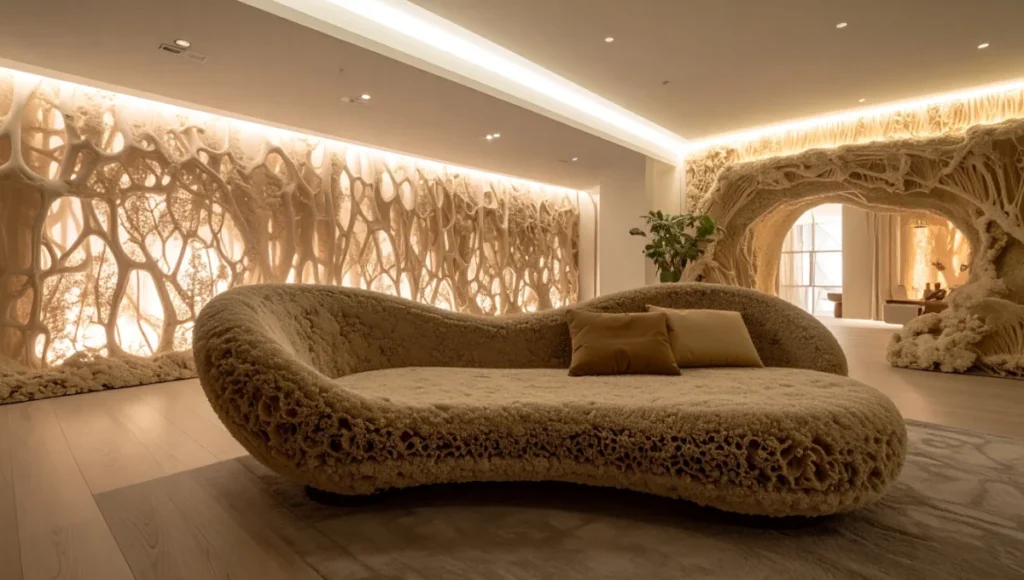
The Synapse Room is a speculative neuro-wellness space — a single room designed as a recovery core within a compact urban dwelling — used here to test whether a bio-fabricated interior can be specified as a system rather than assembled from objects. The concept combines a grown chaise, mycelium acoustic panels, translucent mycelium lighting and a controlled lighting sequence. It is a design study with no site and no client, and it exists to make the specification consequences of the material visible in one room. Its logic is directly relevant to micro living layouts, where every surface has to earn its place.
Design levers applied
- Grown-to-form seating: the chaise is grown to the occupant’s ergonomic scan rather than assembled, so the contact surface follows the body instead of being adapted to it (concept target, not a measured result).
- Density-varied acoustic enclosure: wall panels are grown at different densities, reading as solid in daylight and revealing their structure under low-level backlighting in the evening (concept target, not a measured result).
- Light through material: the luminaires use thin mycelium as a diffuser, so the evening light source is warm by virtue of what it passes through rather than only by its spectrum (concept target, not a measured result).
- Deliberate tactile nodes: surfaces carry intentionally varied growth texture, giving the hand something to register as a way of returning attention to the physical room (concept target, not a measured result).
- A sequence rather than a set of objects: panel densities, lighting warmth and seating position are coordinated to shift the room from a working environment to a resting one over the course of an evening (concept target, not a measured result).
- Reversible assembly: every bio-fabricated element is fixed without adhesive so the room can be dismantled and the material returned to compost at end of use (concept target, not a measured result).
- Honest scope: the study claims sensory change — acoustic, thermal, luminous — and makes no clinical or therapeutic claim (concept target, not a measured result).
Transferable takeaway
You can apply the same logic at home without a single specialist product: tune evening lighting to warm tones, build a refuge corner from soft non-reflective organic materials, and simplify one primary sightline toward a natural anchor — a planted element, a timber surface, a grown object. This approach suits flexible home design, where one room shifts from high-focus work to deep rest without being rebuilt, and the material choices are what make the shift legible.
Intellectual honesty: current limitations
While we advocate for the fungal future, we must address the “Tension Gap.” Mycelium is exceptional under compression but lacks the tensile strength of steel or carbon fibre — you cannot yet build a cantilevered skyscraper out of mushrooms, and where a piece needs to span or bend, the structure will be timber, metal or composite with mycelium doing a different job. Second, the material’s performance is not one number: density, stiffness and surface finish vary with substrate, growth conditions and the pressing and drying regime, so “mycelium furniture” describes a family of processes rather than a product with a specification sheet. Third, growth takes time and space, and production capacity — not demand — is the current constraint on availability. Fourth, the “biological aesthetic” — the tendency to look earthy or raw — remains a barrier for those accustomed to high-gloss finishes, and coating a piece to look conventional usually costs it its compostability. Any claim beyond these limits should be asked for its test data.
2030 and beyond: the living component
By 2030, we expect the “dormant state” of mycelium furniture to be challenged by pieces treated as active. Three directions, each a projection rather than a forecast:
- Self-repairing surfaces: a surface that closes minor scratches or scuffs through controlled rehydration of dormant material — plausible as a maintenance technique in coated products, unproven as a consumer feature.
- Bioluminescent ambient light: furniture grown with a bioluminescent species such as Panellus stipticus to produce low-level light without electricity. The organism is real and its light is real; the output is very dim, so the realistic version is a night marker rather than a room light.
- Nutrient recycling as a service: a domestic or neighbourhood digester that breaks a piece down and re-grows it into a new form on a maintenance cycle, which would make the interior renewable rather than replaceable. This is the direction that would matter most, and it depends on collection infrastructure rather than on materials science. The likely host for it is modular vs prefab homes, where components are already designed to be exchanged.
Actionable design principles
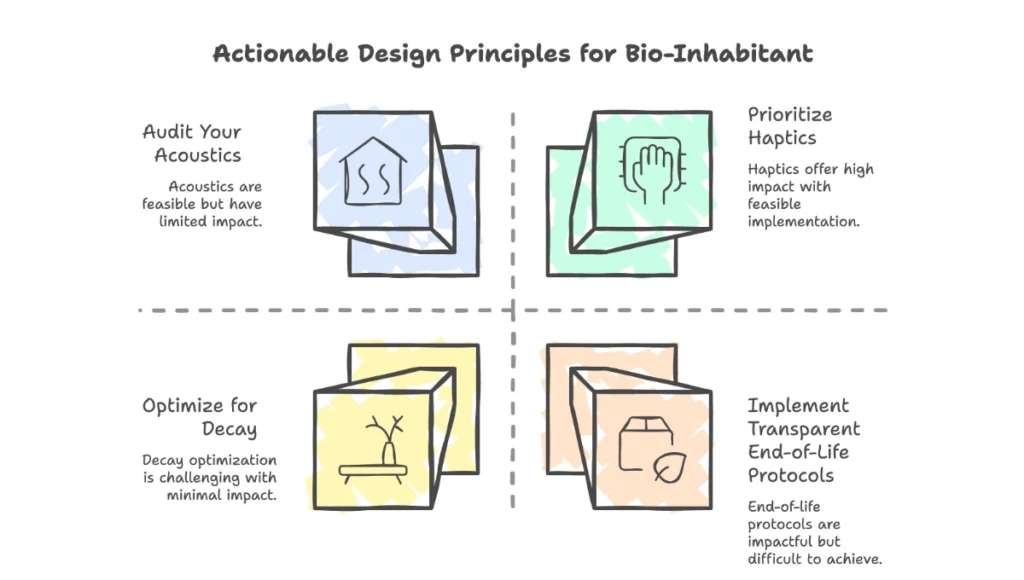
- Prioritise haptics: replace one cold surface within arm’s reach — a desk edge, a side table — with a bio-fabricated or timber equivalent, and you change the longest contact event in the room rather than the most visible one.
- Audit your acoustics: find the echo points, usually bare walls opposite each other or hard corners, and treat those first. Absorption placed at the reflection point does more than material spread across a wall.
- Check the coating, not the label: a compostable core with a conventional lacquer is not compostable. Ask what the piece is finished with, and prefer wax or oil finishes if end of life matters to you.
- Buy for repair, not for replacement: a grown piece can be sanded and re-oiled; a piece designed around a glued joint cannot. Choose the construction detail that lets you maintain the object.
- Scale small before specifying big: start with one or two pieces in the rooms where the case is clearest — acoustic panels and a lamp diffuser carry their benefit most obviously — and let a working relationship with the material grow from there.
- Ask for the feedstock: the substrate determines the material’s story and its localness. A supplier who can name where the agricultural residue came from is a supplier who can answer the harder questions later.
Nuvira Space · Living Spaces
Bio-fabricated interior selector
Mycelium is not a whole-house decision — it earns its place where a surface is touched or heard rather than looked at. Choose the room and the application, then check what you can actually verify about the piece. The panel returns what each application changes and where the claims stop.
Selector result
Living room · acoustic panels — treat the reflection point, not the wall
0 of 6 verification points confirmed.
An open-plan living room is usually reverberant rather than loud, and the fix is placement: absorption where sound actually reflects — facing walls, hard corners, the wall behind where people sit — does more than material spread evenly across the room.
What changes: reverberation softens where the panels are placed, and the room stops amplifying speech and footfall. This is the material’s most commercially mature application and the case that is least arguable.
Watch for: a compostability claim on a piece finished with a conventional lacquer — the core may be compostable while the finish is not.
Orientation aid only. This selector suggests where a bio-fabricated material is likely to earn its place and what to verify; it does not certify a product, guarantee acoustic or luminous performance, or replace testing and specification by the responsible designer. © Nuvira Space. All rights reserved. | LIVING SPACES Series.
Frequently asked questions
Part of our sustainable building materials guide — selection, verification, and specification across fourteen bio-based families.
Q: Is mycelium furniture durable enough for daily use?
**A:**For compression and contact use, yes: properly grown, pressed and dried mycelium composite behaves like a firm foam or a medium-density board, which suits seating shells, stools, panels and tabletops. It is weaker in tension and in thin sections, so a piece that spans or cantilevers will carry its load in timber or metal. Ask the maker for the substrate, density and finish, because those three variables — not the word “mycelium” — determine how the piece performs.
Q: Does it smell like mushrooms?
**A:**No. The growth is stopped by drying, which leaves the material inert. A finished piece typically carries a faint scent of dried hay or timber at most, and it fades with use. What you should ask about instead is the finish, since oils and waxes are what a nose will actually detect in a new piece.
Q: How do I clean bio-fabricated materials?
**A:**Treat it like untreated wood or a matte textile: dust regularly, and use a dry or barely damp cloth rather than a wet one. Because the surface is porous, spills should be lifted promptly and abrasive cleaners avoided. Where a maker supplies a wax or oil finish, follow their reapplication schedule — with a porous material the finish is the wear layer, so maintaining it is maintaining the piece.
Q: What actually holds the material together?
**A:**The organism does. As the mycelium grows through the substrate it binds the particles together into a continuous matrix, so no adhesive is needed to hold the composite together. That is the property that makes the material genuinely different from a conventional board rather than a variant of one, and it is also why the substrate and the growth process are the specification.
Q: Where should I use it first?
**A:**Where its properties meet the problem: acoustic panels on the reflection points of a reverberant room, a lamp diffuser where warm evening light matters, and one seating or contact piece in the room you use most. Those three applications deliver the material’s acoustic, luminous and haptic benefits most directly, and they are the ones a maker can substantiate today.
Q: Is it more expensive than conventional furniture?
**A:**Generally yes at present, because production capacity is limited and the growth cycle is slower than a factory line. The comparison that matters over time is maintenance and disposal rather than purchase price: a piece that can be sanded, re-oiled and finally composted behaves differently on a household’s budget and on its waste stream than one that is landfilled. Treat cost as a difference in what the object is, rather than a premium on the same thing.
Q: What should I verify before specifying a bio-fabricated piece?
**A:**Three things. What the substrate is, and whether it came from a traceable agricultural or waste stream. What the finish is, because it governs durability, cleaning and whether the piece is genuinely compostable at end of life. And what the maker’s own documented performance data says for that specific piece — because growth-based materials vary, and a claim made for the material family is not a claim made for the object in front of you.
Step inside the Living Spaces archive
Explore the Living Spaces archive → living-spaces
© Nuvira Space. All rights reserved. | LIVING SPACES Series | All specifications cited are based on publicly available research. The Synapse Room is a speculative internal concept study and does not represent a completed project.
1 thought on “Mycelium Furniture: 7 Stunning Bio-Fabricated Designs”