

Table of Contents
Macro-Observation: The End of Static Geometry and the Rise of Flexible Home Design
The traditional home is a rigid artifact of the industrial age—a series of boxes defined by “rooms” that remain stagnant while your biological and professional needs fluctuate. As we navigate a global shift toward hybrid existence, the demand for flexible home design has transitioned from a luxury to a physiological necessity. We are witnessing the death of the “single-purpose space.” In its place, we find a requirement for environments that breathe, contract, and expand in alignment with the occupant’s cognitive load.
To live in a static floor plan is to live in a container that ignores the fluidity of human neurobiology. When your environment cannot adapt to the transition between a high-cortisol deep-work state and a low-stimulus recovery phase, the burden of adaptation falls entirely on your nervous system. This results in chronic “spatial friction”—a phenomenon where the physical constraints of a home actively impede the user’s metabolic and psychological regulation. To solve for the future, we must stop viewing architecture as a shelter and start viewing it as an adaptive interface.
Nuvira Perspective: The Evolution of the Home into a Bio-Adaptive Health Machine
At Nuvira Space, we view the domestic environment not as a collection of furniture, but as a sophisticated “health machine” designed for human-machine synthesis. Our philosophy rejects “decor” as a superficial layer, focusing instead on spatial hacking that prioritizes circadian synchronization and cognitive recovery. We believe the future of habitation lies in the seamless integration of modular adaptability.
By treating walls as kinetic interfaces rather than structural boundaries, we transform the home into a responsive partner that supports metabolic health, reduces cortisol through biophilic alignment, and evolves alongside the user’s life stages. In this paradigm, the “architect” is no longer just a builder of walls, but a curator of biological outcomes. We don’t just design for how a space looks; we design for how it regulates your heart-rate variability (HRV) and your prefrontal cortex’s ability to focus. The home of the 2030s is not a place you inhabit; it is a system that optimizes you.
Technical Deep Dive: 4 Genius Flexible Home Design Solutions
1. Kinetic Partitioning: The Programmable Wall
Moving beyond the “open plan”—which often results in acoustic chaos and visual clutter—kinetic partitioning uses track-mounted, decoupled wall systems to redefine volume in real-time. This is the cornerstone of flexible home design.
- Acoustic Specs: STC (Sound Transmission Class) of 45+ using recycled PET felt cores and internal mass-loaded vinyl.
- Mechanism: Ceiling-recessed triple-bypass tracks for zero-threshold floor transitions, ensuring no tripping hazards or visual breaks in the floor plane.
- Neuro-Impact: Reduces “visual noise” during deep-work states by physically isolating the professional zone from the domestic rest zone. This allows for a “psychological boundary” that is essential for preventing professional burnout in remote-work environments.
2. Sub-Floor Modular Storage & Utility “Trenches”
Borrowing from high-tech laboratory and data center design, we utilize the verticality of the floor itself to house “plug-and-play” utility nodes and storage. This clears the visual horizon of the home, removing the cognitive load associated with visible clutter.
- Depth: 150mm–300mm raised floor systems using adjustable pedestals.
- Capacity: Integration of localized HEPA filtration and concealed cable management for mobile workstations that can be “docked” anywhere.
- Neuro-Impact: Clears the floor plane to trigger “spaciousness” signals in the amygdala. A cluttered floor is perceived by the brain as a cluttered environment, which can trigger a low-level “fight or flight” response.
3. Circadian-Responsive Volumetric Lighting
Flexibility is not just physical; it is atmospheric. By utilizing tunable-spectrum LED arrays integrated into modular ceiling baffles, the “function” of a room shifts with the Kelvin scale, regardless of where the walls are positioned.
- Spectrum range: 1800K (melatonin-friendly amber) to 6500K (cortisol-stimulating blue-white).
- Control: Automated logic based on local solar noon and occupant heart-rate variability (HRV) sensors.
- The Science: This isn’t about mood; it’s about hormonal regulation. By mimicking the natural progression of sunlight, we reduce the incidence of modern sleep disorders and seasonal affective disorder.
4. Transformative Millwork: The “Swiss Army” Core
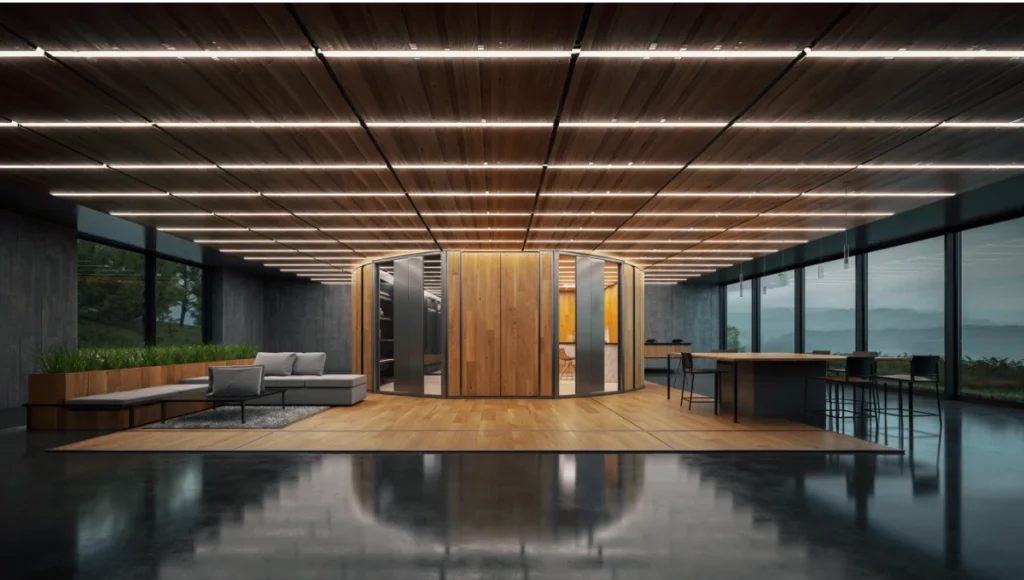
A central, non-load-bearing “pod” that contains the heavy infrastructure—kitchen, wet bar, and workstation—allowing the perimeter of the home to remain entirely fluid and open to natural light.
- Materials: Antibacterial linoleum surfaces and cross-laminated timber (CLT) for a lower carbon footprint and a “biophilic” haptic response.
- Hardware: Heavy-duty soft-close pivots and 3D-adjustable hinges capable of supporting 200kg of concealed shelving.
- Application: This core acts as the “anchor” of the home. While the rest of the space changes, this hub provides a sense of permanence and security.
Comparative Analysis: Adaptive Logic vs. Industry Standard
| Feature | Industry Standard (Static) | Nuvira Flexible Design (Dynamic) |
| Room Definition | Fixed drywall; single-use (e.g., “Guest Room”) | Kinetic dividers; multi-modal (Work/Rest/Gym) |
| Storage | External cabinets; high visual clutter | Integrated into structural cores; zero-profile |
| Air Quality | Centralized HVAC; stagnant zones | Localized, sensor-driven HEPA nodes in partitions |
| Lighting | Static “Warm White” bulbs | Biological spectrum tracking; task-specific zones |
| Connectivity | Visible wires and fixed outlets | Under-floor “trenches” with inductive charging |
| Lifespan | Requires demolition for layout changes | Infinite reconfiguration via hardware adjustment |
Concept Project Spotlight: Speculative Internal Concept Study “AETHER-01” by Nuvira Space
Project Overview: Location / Typology / Vision
Location: Singapore (Central Business District Adaptive Reuse) Typology: 45m² Micro-Habitation Unit Vision: To prove that high-density urban living can nourish rather than deplete the human nervous system through extreme flexibility.
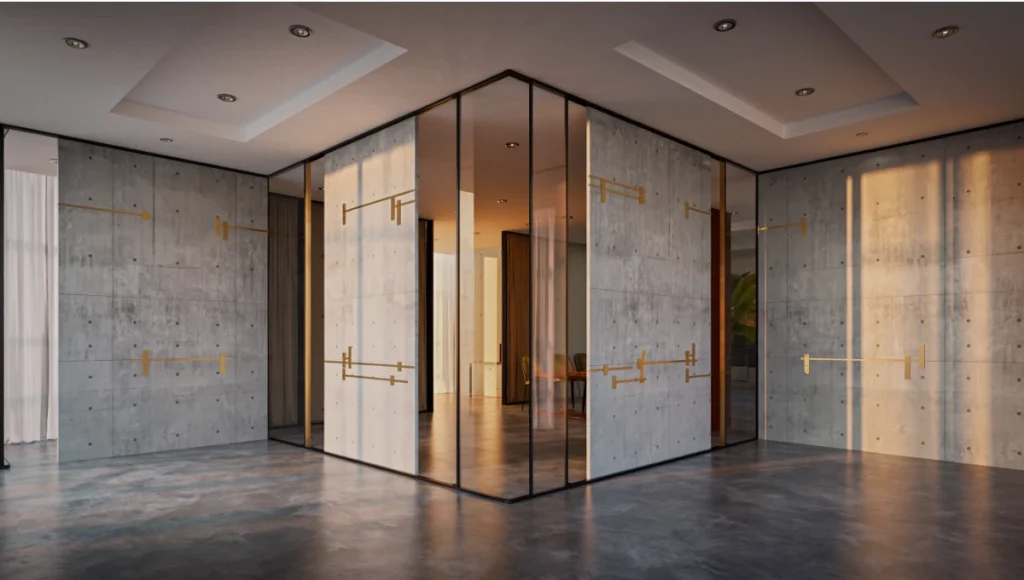
In a city like Singapore, where spatial scarcity is the primary design constraint and 85% of residents live in compact high-rise environments, AETHER-01 uses “volumetric shifting” to create the psychological illusion of a 100m² residence. We chose Singapore for this case study because its macro-environment—high heat, high humidity, and extreme density—demands a design that can provide immediate psychological refuge. The goal was to eliminate the “boxed-in” feeling associated with traditional micro-living through a high-performance, flexible skin.
Design Levers Applied
- Verticality Hacking: A motorized sleeping platform that retracts into the ceiling during daylight hours. This frees up 10m² of floor space for a movement/meditation zone.
- Spec: 500kg lifting capacity with redundant safety sensors and aerospace-grade aluminum honeycomb supports.
- Hydroponic Dividers: Living walls that act as both acoustic insulation and natural air scrubbers.
- Spec: Integrated UV-C sterilization for recycled greywater irrigation, providing a constant biophilic visual and olfactory stimulus.
- Bio-Feedback Sensors: Floors that track gait and pressure. If the system detects “rushed” or “stressed” movement patterns, it automatically dims the lighting and introduces 432Hz “alpha wave” soundscapes to ground the occupant.
Transferable Takeaway
You can apply the same logic at home by tuning your evening lighting to 2000K two hours before bed, building a “refuge corner” with high-density acoustic materials, and simplifying one primary sightline toward a natural anchor, such as a large-leaf plant or a window framing the sky.
Intellectual Honesty: Current Limitations
We must be transparent about the hurdles of implementing truly flexible home design.
- Mechanical Complexity: Kinetic walls and motorized furniture require precision engineering. Unlike a static wall, these systems have moving parts that require periodic maintenance and specialized hardware.
- Acoustics: Maintaining a high STC rating is difficult when walls do not have permanent, air-tight seals at the floor and ceiling. We solve this with expensive pneumatic gaskets, but it remains a technical challenge for DIY enthusiasts.
- Building Codes: Current legislation in many global cities is lagging. Laws often require a “closet” to define a bedroom or specific window-to-floor ratios that don’t account for walls that move twice a day.
- Financial Barrier: The upfront cost of flexible infrastructure is higher than standard construction. It is an investment in the “long-term health” of the building and the occupant, but it requires a shift in how we calculate ROI from “price per square foot” to “value per cognitive hour.”
2030 Future Projection: The Sentient Skin
By 2030, we predict the “Flexible Home” will move beyond mechanical tracks into the realm of Sentient Materials. We are currently researching:
- Shape-Memory Polymers: Walls that can change their translucency or texture based on a voice command or biometric trigger, allowing for privacy without physical movement.
- Inflatable Architecture: Structural components that can stiffen or soften, allowing for “furniture” to emerge from the floor or walls on demand via localized air compression.
- Molecular Air-Scrubing Surfaces: Wall finishes that actively neutralize pathogens and VOCs (Volatile Organic Compounds) at the molecular level without the need for mechanical fans.
The home will no longer be a shell; it will be a “sentient skin” that acts as an externalized immune system, filtering the stresses of the urban environment before they reach your biology.
Actionable Design Principles for the Modern Futurist
- Prioritize Geometry Over Ornament: Stop buying “stuff” to fill rooms. Invest instead in high-quality sliding hardware and hidden storage that clears the visual field.
- The 80/20 Rule of Lighting: 80% of your light should be indirect (bouncing off walls or ceilings) to reduce glare. Direct “task lighting” should only be used for focused work or cooking.
- Visual Quietude: Treat every visible wire as a “biological stressor.” Integrate all technical infrastructure into the architecture to minimize cognitive distraction.
- Material Sincerity: In a world of digital screens, use haptic-rich materials (unfinished wood, cold stone, heavy wool) in areas of high tactile contact. This provides “sensory grounding,” which is vital for neuro-regulation and reducing digital fatigue.
Comprehensive Technical FAQ
Q: Does flexible home design affect the resale value of a property?
A: Paradoxically, yes—upwardly. Data from urban centers like Copenhagen and Rotterdam suggests that “Future-Proof” apartments with convertible layouts command a 15-20% premium. Buyers value the ability to adapt a space to their specific needs (e.g., converting a home office into a nursery) without a total renovation.
Q: How do you handle acoustics in a home with movable walls?
A: We utilize a three-tier approach:
- Dual-Duralon Gaskets: Compressed seals that engage when the wall is locked.
- Internal Buffers: 40mm acoustic wool inside the panels.
- Mass-Loaded Vinyl (MLV): To block low-frequency sound (like a neighbor’s bass).
Q: Is flexible design more expensive than traditional renovation?
A: The initial CAPEX (Capital Expenditure) is 25-30% higher due to precision engineering. However, the OPEX (Operational Expenditure) is lower because the home does not require demolition to evolve. Over a 10-year period, flexible design is significantly more cost-effective.
Engineering Your Evolution with Nuvira Space
The era of the “house as a box” is over. We invite you to stop decorating and start optimizing. Whether you are retrofitting a compact urban loft or conceptualizing a sprawling wellness retreat, the principles of flexible home design are the tools of your biological liberation.
Connect with our design futurists today to begin the synthesis of your space and your health.
1 thought on “4 Genius Flexible Home Design Solutions”