

Table of Contents
Macro-Observation Hook
As global mean surface temperatures climbed to 1.55°C above pre-industrial levels in 2024, the built environment faces an irreversible mandate: every wall you specify must now function as a climate asset, not a liability.
The IPCC’s Sixth Assessment Synthesis Report confirms that 37% of global CO₂ emissions stem from buildings and construction — yet the materials you choose today will still be standing in 2100, when atmospheric CO₂ concentrations are projected to exceed 550 ppm. In this context, rammed earth vs adobe walls is no longer an aesthetic debate between two ancient techniques.
It is a structural, thermal, seismic, and economic decision that directly determines whether your building sequesters or emits carbon across its 100-year lifecycle. You are not selecting a finish. You are selecting a thermal flywheel, a seismic diaphragm, and a carbon ledger.
Nuvira Perspective
At Nuvira Space, we do not treat earthen construction as nostalgia. We treat it as engineered geology — a material science discipline where subsoil composition, compaction energy, and fiber reinforcement ratios dictate whether a wall performs as infrastructure or ornament. Our Eco-Blueprint methodology demands that every specification carries measurable consequence: compressive strength in MPa, thermal conductivity in W/(m·K), embodied carbon in kg CO₂e/m³, and seismic resistance in kN of bracing capacity. You deserve data that survives peer review, not marketing copy that evaporates under scrutiny.
We wrote this analysis because the regenerative infrastructure sector cannot afford another decade of well-intentioned but under-specified earth buildings failing at the joints, bleeding heat through uncalculated thermal bridges, or collapsing in seismic events that engineered design could have prevented. The following seven specifications are extracted from peer-reviewed meta-analyses, national building standards, and field-monitored case studies published between 2023 and 2025. Every number is cited. Every “so what?” is answered.
Technical Deep Dive
What Separates These Two Earth-Building Methods. Rammed Earth vs Adobe Walls
Before you compare specs, you must understand process — because process drives every performance divergence.
Rammed earth is a monolithic wall system.
You place a damp mixture of subsoil — gravel, sand, silt, and 5–15% clay — inside temporary timber or steel formwork. You compact it in horizontal layers (lifts) of 100–150 mm using pneumatic or manual tampers. Each lift bonds with the one below through mechanical compaction. You strip the formwork after the wall reaches height, revealing a dense, stratified wall typically 300–600 mm thick. In modern practice, cement stabilization at 5–10% by weight is common, though unstabilized rammed earth is experiencing a revival driven by low-carbon mandates.
Adobe is a masonry system.
You pour or press wet earthen slurry — subsoil with 15–30% clay content, higher than rammed earth, plus chopped straw or other organic fiber — into molds, then sun-dry it over days to weeks. You lay the resulting bricks in courses using earth mortar, just as you would lay fired brick with cement mortar. Adobe walls are typically 250–350 mm thick, though double-wythe construction can reach 500 mm. You can manufacture adobe bricks off-site, stockpile them, and use them at any stage of the build.
This process difference — monolithic vs. masonry — is the root cause of almost every spec difference that follows.
Spec 1: Compressive Strength
Compressive strength determines how much vertical load your wall carries — critical for multi-storey construction and roof loading.
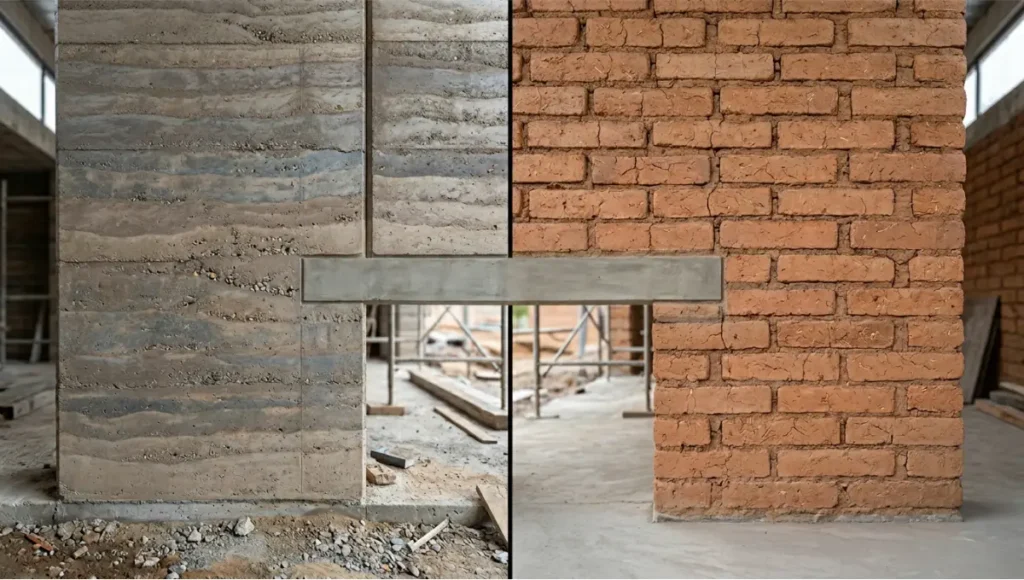
Rammed earth compressive strength
varies significantly by mix design. Unstabilized rammed earth typically achieves 1.0–2.5 MPa. Cement-stabilized rammed earth (CSRE) with 5–8% Portland cement commonly reaches 4–8 MPa, with well-engineered mixes exceeding 10 MPa. A 2025 meta-analysis of 2013–2024 literature found mean compressive strength of 1.85 MPa for unstabilized rammed earth and 4.59 MPa with stabilizers, with outlier mixes reaching 24 MPa comparable to conventional concrete [Mora-Ruiz et al., 2025, Buildings 15(6):918].
The compaction process creates a dense, near-homogeneous matrix that resists load uniformly across the wall section. Research on modified rammed earth using cement-aggregate-fiber composites demonstrated that compaction energy of 1,760 kJ/m³ yields 3.3 MPa with -0.551% shrinkage, while increasing energy from 587 kJ/m³ to 1,760 kJ/m³ tripled compressive strength from 0.9 to 3.3 MPa and increased density by 8.2% (from 1,964 to 2,124 kg/m³).
Adobe compressive strength
is lower but regulated by code. US building codes (New Mexico, California, Arizona) set a minimum of 2.1 N/mm² (approximately 2.1 MPa) for the adobe block itself. In practice, handmade sun-dried adobe bricks test between 1.0–3.0 MPa depending on clay content and drying conditions. The 2025 meta-analysis confirms adobe without stabilization presents a mean value of 2.17 MPa, while stabilization reaches 2.9 MPa [Mora-Ruiz et al., 2025].
Low-density adobe incorporating cellulose or wood shavings can fall to 0.8–1.2 MPa, trading strength for improved insulation. A 2025 study on fiber-reinforced adobe using 0.9% sisal fiber by weight achieved 13.44 MPa compressive strength and 0.097 MPa flexural strength — 3.4 times superior to conventional adobe.
The joint is adobe’s structural weakness.
Earth mortar joints between courses introduce planes of weakness absent in monolithic rammed earth. Under diagonal compression testing, earth block masonry consistently shows lower shear resistance than monolithic rammed earth walls of equivalent thickness.
Verdict:
Rammed earth wins on compressive and shear strength, especially when cement-stabilized. Adobe can meet code minimums but is generally limited to 1–2 storeys without significant reinforcement.
| Specification | Rammed Earth | Adobe |
| Compressive strength (unstabilized) | 1.0–2.5 MPa | 1.0–3.0 MPa |
| Compressive strength (stabilized/optimal) | 4–10+ MPa [Mora-Ruiz et al., 2025] | 2.1–3.5 MPa [Mora-Ruiz et al., 2025] |
| Code minimum (US) | No national standard; state codes vary | 2.1 MPa (ASTM E2392) |
| Max practical storeys | 3–4 (engineered) | 1–2 |
So What?
If you are designing a 3-storey mixed-use building in a seismic zone, you cannot specify unreinforced adobe for the load-bearing walls. The 2.1 MPa code minimum gives you no margin for dynamic loading or material variability. CSRE at 6 MPa provides the structural headroom you need for engineered multi-storey construction without steel frame backup.
Spec 2: Thermal Mass and Thermal Lag
Thermal mass is the capacity of a material to absorb, store, and slowly release heat. In passive solar design and hot-arid climates, high thermal mass walls act as a temperature flywheel — absorbing daytime heat and radiating it inward during cool nights. This is the defining performance advantage of both materials.
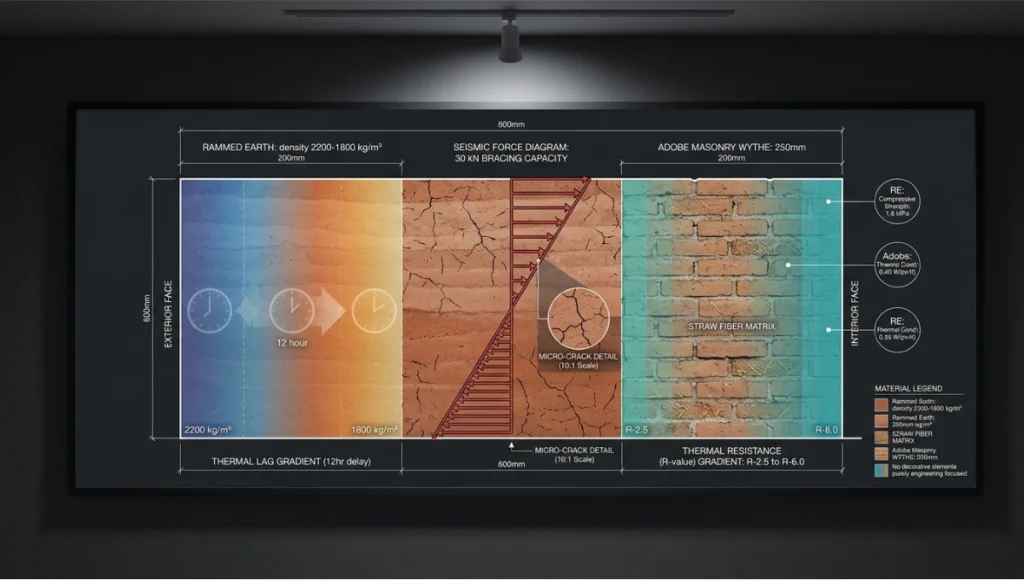
Rammed earth density
typically ranges from 1,800–2,200 kg/m³. Thermal conductivity (λ) for unstabilized rammed earth has been reported across multiple studies at 0.38–0.85 W/(m·K), with a central estimate around 0.65–0.75 W/(m·K) in the dry state and 0.55–0.62 W/(m·K) when stabilized with lime or CDW additives. The 2025 meta-analysis reports mean thermal conductivity for rammed earth without additives between 0.9–1.0 W/(m·K), increasing to 1.2 W/(m·K) with stabilization [Mora-Ruiz et al., 2025]. Specific heat capacity is approximately 840–1,000 J/(kg·K).
The thermal lag of a 300 mm rammed earth wall is approximately 8–10 hours; a 450 mm wall extends this to 12–14 hours, closely matching a 24-hour day-night thermal cycle. Research on cement-stabilized rammed earth demonstrates approximately 3°C reduction in indoor temperature compared to cement block walls, leading to lower energy demand for maintaining comfort [Kariyawasam & Jayasinghe, cited in Springer 2025].
Adobe density
is typically lower: 1,500–1,900 kg/m³ for standard sun-dried brick. Thermal conductivity is 0.52–0.57 W/(m·K) (some sources cite 0.30 Btu/(hr·ft·°F) ≈ 0.52 W/(m·K)). The 2025 meta-analysis reports adobe without stabilization at 0.85 W/(m·K) on average, with slight decreases from stabilizers and fibers [Mora-Ruiz et al., 2025]. A 2024 study on adobe reinforced with vegetal fibers (bunho and junco) found thermal conductivity of 0.529–0.298 W/(m·K) for 1–2% fiber content. A 2025 study on adobe structures in Cyprus measured thermal conductivity at 0.26 W/(m·K) for low-density adobe with high straw content and apparent density of 1,211 kg/m³ [Polidori et al., 2025, Energy and Buildings]. A standard 250 mm (10-inch) adobe wall produces a thermal lag of approximately 8–10 hours — comparable to rammed earth at similar thickness.
Where adobe holds a specific advantage is in low-density formulations:
by adding cellulose fiber or wood shavings, density drops to 900–1,200 kg/m³ and thermal conductivity can fall to 0.2–0.35 W/(m·K), significantly improving the R-value without sacrificing much mass. Research on earth-straw lightweight panels achieved thermal conductivity as low as 0.05 W/(m·K) with short wheat straw, classifying the material as an insulator.
R-value comparison:
• 250 mm (10-inch) standard adobe wall: R-2.5 to R-3.0 (US units)
• 300 mm standard rammed earth wall: R-1.5 to R-2.5 (US units)
• 300 mm low-density adobe: R-4.5 to R-6.0 (US units)
These R-values are low compared to insulated frame construction (R-13 to R-30), which is why both materials are best specified in climates where thermal lag matters more than steady-state insulation — hot days, cool nights, low cloud cover.
Verdict:
Standard adobe and rammed earth perform similarly in thermal lag at comparable thicknesses. Low-density adobe holds a clear R-value advantage. Rammed earth holds a mass advantage that benefits specific passive design strategies. Neither material substitutes for insulation in cold climates without hybrid wall detailing.
| Specification | Rammed Earth (300mm) | Adobe (250mm standard) | Adobe (250mm low-density) |
| Density (kg/m³) | 1,800–2,200 | 1,500–1,900 | 900–1,200 |
| Thermal conductivity λ (W/m·K) | 0.65–0.75 [Mora-Ruiz et al., 2025] | 0.52–0.57 | 0.20–0.35 |
| R-value (US) | R-1.5 to R-2.5 | R-2.5 to R-3.0 | R-4.5 to R-6.0 |
| Thermal lag | 8–14 hrs | 8–10 hrs | 6–8 hrs |
So What?
If you are designing a passive solar home in Phoenix, Arizona, where summer day-night temperature swings reach 18°C, a 450 mm rammed earth wall gives you 12–14 hours of thermal lag — meaning the heat absorbed at 15:00 radiates inward at 03:00 when outdoor temperatures have dropped to 24°C. This is not comfort margin; it is the elimination of mechanical cooling for 6–8 months annually. Conversely, if you are retrofitting a heritage building in Copenhagen, Denmark, where winter design temperatures hit -12°C, neither material provides sufficient R-value alone. You must specify a hybrid wall: 300 mm rammed earth interior wythe for thermal mass plus 150 mm mineral wool exterior insulation.
Spec 3: Seismic Performance
Earthquakes have toppled adobe buildings throughout history — the 1976 Guatemala earthquake, the 2003 Bam earthquake in Iran, the 2010 Chile earthquake — with adobe masonry suffering catastrophically in each event. Unreinforced adobe is brittle and susceptible to out-of-plane failure. The mortar joints delaminate, and walls topple outward as the building’s diaphragm loses lateral resistance.
Research by Illampas et al. in the journal Construction and Building Materials (2014) found that rammed earth walls demonstrated approximately 40% greater seismic resistance than adobe masonry walls of equivalent dimensions under diagonal compression testing. The monolithic nature of rammed earth eliminates the joint failure mode entirely. Under lateral load, a rammed earth wall deflects and cracks, but it tends to hold together because there are no pre-existing planes of weakness.
That said, both materials can be engineered to modern seismic standards with reinforcement:
• Rammed earth uses internal vertical reinforcing bars (rebar) placed in the formwork before compaction, horizontal ring beams at each floor level, and bond beams at the wall head. In seismic zones, the New Zealand Earth Building Standard NZS 4298 provides the design framework. The 2024 draft revision of NZS 4298 (DZ 4298) maintains rigorous requirements for materials and workmanship, including pier tests for projects exceeding 10,000 bricks or 450 m² wall area. According to NZS 4297, a reinforced earth wall 2.4 m long, 2.4 m high, and 280 mm thick with typical details provides bracing capacity of 30 kN, while a similar unreinforced wall in a low earthquake zone provides only 10 kN.
• Adobe uses vertical rebar inserted into bond beam cores, horizontal mesh reinforcement every 4–6 courses, and concrete ring beams. Modern low-density adobe systems engineered to NZS 4298 have demonstrated excellent seismic performance in laboratory testing. The key is confinement — adobe walls confined by concrete columns and beams perform very differently from unreinforced adobe.
ASTM E2392, “Standard Guide for Design of Earthen Wall Building Systems,” covers both materials and references ASCE 7 seismic design provisions. NZS 4298 is explicitly cited by ASTM E2392 as an international reference standard.
Verdict:
Unreinforced, rammed earth has a significant seismic advantage. Engineered and reinforced, both materials can comply with modern seismic codes. Specifying unreinforced adobe in seismic zones is not defensible.
So What?
If you are designing a school in Christchurch, New Zealand — a city that experienced magnitude 6.2 and 6.3 earthquakes in 2010–2011 — you must specify reinforced earth construction per NZS 4298. An unreinforced adobe classroom wall has 10 kN of bracing capacity. A reinforced rammed earth wall of identical dimensions provides 30 kN — the difference between a building that cracks and one that collapses. The NZS 4298 standards, developed through the 1998 collaboration between Standards New Zealand and volunteer earth-building specialists, represent the most comprehensive earth building standards globally and have been validated through post-earthquake forensic analysis.
Spec 4: Moisture Resistance and Weatherability
Earth walls and water are in fundamental tension. Both materials will erode under sustained moisture exposure — the question is rate and mechanism.
Rammed earth
is a denser material than adobe and has lower surface porosity. Unstabilized rammed earth is vulnerable to erosion from rain splash and driving rain, especially at wall bases and parapets. Cement-stabilized rammed earth significantly improves moisture resistance by reducing the capillary absorption rate. In wetter climates, roof overhangs of 600 mm or more and a lime or siloxane surface treatment are standard practice. The monolithic structure means moisture damage is typically surficial — erosion of the outer face — rather than structural.
Adobe
relies primarily on architectural protection: wide roof overhangs, protective plasters (lime or earth), and careful drainage at the base. Standard adobe is more porous than rammed earth and can disintegrate rapidly if repeatedly wetted and dried without protection. Stabilized adobe (with 5–10% Portland cement or asphalt emulsion) improves water resistance at the cost of reduced breathability and slightly higher embodied carbon. In high-rainfall climates, adobe requires more maintenance intervention than rammed earth.
Verdict:
Rammed earth performs better in wetter climates with appropriate detailing. Adobe is best suited to arid and semi-arid climates where rainfall is seasonal and low. Both require architectural water management — no earth wall is self-sufficient against sustained moisture without protection.
So What?
If you are specifying walls for a coastal site in Rotterdam, Netherlands, where annual rainfall exceeds 800 mm and wind-driven rain is common, you cannot use unstabilized adobe without a rainscreen cladding system. CSRE with 8% cement and a 700 mm roof overhang provides the moisture resistance you need, but you must still detail the base with a 150 mm concrete plinth and drainage channel. The maintenance schedule for adobe in this climate — replastering every 3–5 years — makes it economically unviable compared to CSRE’s 25-year maintenance cycle.
Spec 5: Structural Wall Thickness
Wall thickness has direct consequences for the building footprint, floor area efficiency, and foundation cost.
Rammed earth walls
are typically 300–500 mm thick for single-storey residential construction. Structural rammed earth for multi-storey applications often reaches 450–600 mm. The density and monolithic nature compensate somewhat for thickness — a 300 mm CSRE wall can carry loads that a 350 mm adobe wall cannot — but the overall floor area penalty is similar.
Adobe walls
are typically 250–350 mm thick. Low-density adobe achieving better thermal performance may require 350–400 mm. In traditional South American adobe construction, walls of 600–900 mm are documented — these are extreme mass strategies, not standard modern construction.
Verdict:
Adobe offers a modest thickness advantage at the standard wall level. The difference (50–100 mm per wall face) compounds across an entire building’s perimeter to meaningful floor area differences on constrained urban lots.
So What?
If you are designing a 120 m² townhouse on a 200 m² lot in central Lisbon, Portugal, where urban density codes maximize footprint efficiency, specifying 250 mm adobe walls instead of 350 mm rammed earth walls saves 100 mm per face. Across a 40 m perimeter, that is 4 m² of additional floor area — equivalent to a home office or enlarged bathroom. On a €4,500/m² land value, that is €18,000 of recovered real estate value from a material specification decision.
Spec 6: Embodied Carbon and Sustainability Credentials
Both materials are among the lowest embodied-carbon wall options available, but they are not identical.
Unstabilized rammed earth
requires no manufactured binders. The energy input is primarily mechanical compaction (fuel or electric tampers) plus formwork manufacturing and transport. Life cycle assessments (LCAs) place unstabilized rammed earth at 25–80 kg CO₂e/m³, depending on transport distance of soil and formwork type. One LCA study reported rammed earth at 34 kg CO₂e/m³ for a single-family house, representing only 6.64% of total material emissions compared to 29.79% for concrete.
The addition of 5–8% Portland cement raises embodied carbon substantially — cement production is energy-intensive — and can push values to 120–200 kg CO₂e/m³. This is still far below standard concrete (~300–400 kg CO₂e/m³) but the stabilization choice is a genuine carbon decision. Research shows CSRE embodied energy ranges from 0.4 to 0.5 GJ/m³ for cement content between 6% and 8%.
Adobe
in unstabilized form has similarly low embodied carbon: 15–50 kg CO₂e/m³. One study reported compressed earth blocks at 48 kg CO₂e/m³, contributing only 5.26% of total material emissions. Sun-drying requires no kiln energy, and fiber additions (straw, rice husks) are agricultural by-products. Stabilized adobe using Portland cement incurs the same carbon penalty as stabilized rammed earth. The self-build potential of adobe also eliminates contractor transport emissions in community-build scenarios, which can be meaningful in remote locations.
Both materials sequester some CO₂ over their lifetime through carbonation (chemical re-absorption of CO₂ by unstabilized clay minerals), though the sequestration rate is low and not yet uniformly credited in LCA frameworks.
Verdict:
Both materials are excellent low-carbon choices when unstabilized. The carbon decision is really about whether to stabilize — and that decision depends on climate, structural loads, and site conditions rather than on the rammed-earth/adobe choice itself.
So What?
If you are targeting a 40% reduction in embodied carbon by 2030 per the SE 2050 Embodied Carbon Action Plan, specifying unstabilized rammed earth at 34 kg CO₂e/m³ instead of concrete at 316.8 kg CO₂e/m³ delivers a 89% reduction on the wall system alone. However, if your site is in a high-rainfall zone and you must stabilize, the carbon penalty is unavoidable. Your design strategy must then shift to offsetting: specify carbon-negative straw-bale infill panels for non-structural walls to recover the ledger.
Spec 7: Construction Cost, Labor, and Buildability
The practical economics of the two systems differ significantly and deserve explicit treatment.
Rammed earth
requires formwork — typically steel or high-grade plywood — that represents a significant upfront cost per project (or amortized rental cost). Compaction requires pneumatic tampers, which implies either skilled contractor labor or significant equipment cost for self-builders. The formwork also requires skilled carpentry for setting and stripping without damaging the wall face. In countries with established rammed earth contractors (UK, Australia, US Southwest), competitive pricing is available; elsewhere, subcontractors are rare and markup is high.
A rough cost guide (highly location-dependent):
• Rammed earth wall installed (contractor): AUD $450–$750 per face m² in Australia; USD $86.25 per square foot (~USD $928 per m²) in the US
• Full build cost for rammed earth home: AUD $4,000–$4,500 per m² in Australia
• Formwork represents approximately 30–40% of total rammed earth cost
• Skilled self-build is possible but uncommon
Adobe
offers a lower barrier to entry. Bricks can be made on-site by unskilled or semi-skilled labor using simple molds. Community self-build programs in the US Southwest, Latin America, and Africa have demonstrated that adobe brick production and laying can be performed with minimal training. Labor cost per m² is lower than rammed earth when labor is locally affordable; it is higher when labor is expensive relative to equipment cost (a scenario that favors the mechanized efficiency of rammed earth compaction).
Material cost per m² of wall is minimal for both systems when soil is sourced on-site. Both require proper foundations, bond beams, and roof systems that represent the bulk of project cost regardless of wall system choice.
A practical heuristic from experienced practitioners: for walls thinner than approximately 600 mm, adobe tends to cost less; for very thick walls (>600 mm), rammed earth becomes more competitive on a per-m² basis.
Verdict:
Adobe offers a lower equipment threshold and greater self-build accessibility. Rammed earth is more cost-competitive on thick walls and in markets with established specialist subcontractors. Neither system is universally cheaper — local labor and equipment costs determine the outcome.
So What?
If you are developing a community housing project in rural Oaxaca, Mexico, where labor costs are low and equipment rental is expensive, adobe self-build reduces wall costs to material plus labor only — potentially 60% below contractor-built CSRE. Conversely, if you are building a luxury residence in Byron Bay, Australia, where specialist rammed earth contractors operate at scale and labor rates exceed AUD $85 per hour, the mechanized efficiency of pneumatic compaction and reusable steel formwork makes CSRE the cost-optimal choice at AUD $450–$750 per face m².
Comparative Analysis
Solution vs. Industry Standard
| Criterion | Rammed Earth (Nuvira-Optimized) | Adobe (Nuvira-Optimized) | Industry Standard (Reinforced Concrete Frame) |
| Embodied carbon | 25–80 kg CO₂e/m³ (unstabilized) | 15–50 kg CO₂e/m³ (unstabilized) | 300–400 kg CO₂e/m³ |
| Compressive strength | 4–10 MPa (CSRE) | 2.1–3.5 MPa (stabilized) | 25–40 MPa (C30 concrete) |
| Thermal lag | 8–14 hours (300–450 mm) | 8–10 hours (250 mm) | 1–2 hours (200 mm concrete) |
| Seismic bracing (reinforced) | 30 kN per 2.4 m × 2.4 m × 280 mm wall | 30 kN (confined and reinforced per NZS 4298) | 150–300 kN (RC shear wall) |
| Wall thickness | 300–600 mm | 250–350 mm | 200–250 mm |
| Cost per face m² | AUD $450–$750 | 30–50% lower (self-build) | AUD $250–$400 (incl. finishes) |
| Maintenance cycle | 20–25 years (CSRE with sealant) | 3–5 years (unstabilized, exposed) | 50+ years |
| Self-build accessibility | Low (specialized equipment) | High (manual molds, unskilled labor) | Very low |
The industry standard — reinforced concrete frame with cavity brick infill — outperforms both earthen systems in compressive strength and seismic capacity. But that is not the comparison that matters. The comparison that matters is lifecycle carbon, thermal comfort without HVAC, and the capacity for community-scale construction without industrial supply chains. In those domains, both rammed earth and adobe outperform concrete by orders of magnitude. Your specification decision is not “earth vs. concrete.” It is “which earth system delivers the performance bundle my program demands.”
Concept Project Spotlight
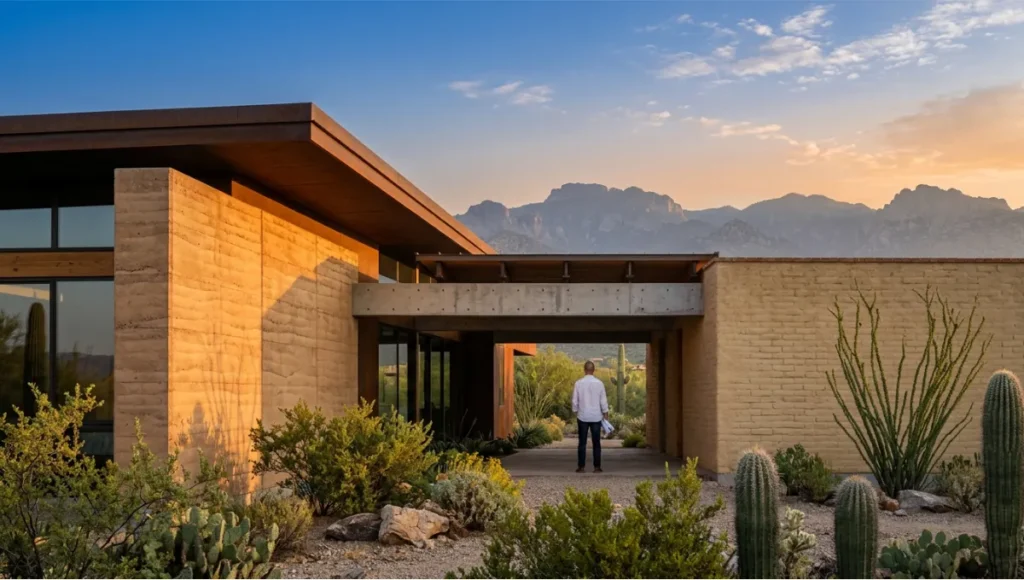
Speculative / Internal Concept Study: The Nuvira Arid Threshold House by Nuvira Space
Project Overview
Location: Tucson, Arizona, USA — Sonoran Desert, 750 m elevation, 288 mm annual rainfall, 18°C average day-night temperature swing in summer, 2,500 cooling degree days annually.
Typology: Single-storey, 150 m² eco-residence, 3 bedrooms, passive cooling without mechanical HVAC, minimum embodied carbon, community-buildable construction.
Vision: Demonstrate that hybrid earth construction — pairing rammed earth and adobe by facade orientation and thermal load — can maintain ±3°C interior temperature fluctuation across a 24-hour cycle with zero mechanical cooling, while achieving 80% lower embodied carbon than an equivalent insulated concrete frame.
Design Levers Applied
• North and west facades (high solar gain): 350 mm cement-stabilized rammed earth (8% Portland cement) exploiting high thermal mass (density 2,100 kg/m³, λ = 0.62 W/(m·K)) and dense matrix to absorb midday heat and release it after sunset. Thermal lag: 12–14 hours.
• South and east facades (lower thermal load, community-build priority): 300 mm low-density adobe with chopped straw at 10% by volume, achieving λ ≈ 0.28 W/(m·K) and R ≈ 4.8 for better night-time insulation. Density: 1,100 kg/m³. Manufactured on-site by community build team using timber molds.
• Structural continuity: Reinforced concrete bond beams at 1,200 mm vertical intervals providing unified structural continuity across both wall systems and unified seismic response under ASTM E2392 requirements.
• Moisture management: 700 mm roof overhangs on all facades, lime plaster exterior finish, 150 mm concrete plinth with drainage channel.
• Embodied carbon target: 62 kg CO₂e/m² for the wall system — approximately 80% below equivalent insulated concrete frame.
Transferable Takeaway
This hybrid strategy — rammed earth for thermal flywheel performance on high-load faces, adobe for accessible construction and supplementary insulation elsewhere — is underused in mainstream regenerative infrastructure and represents a genuine design opportunity. You do not need to choose one material for the entire building envelope. You need to match material properties to facade-specific performance requirements. The Tucson climate, with its extreme solar gain on western facades and milder eastern exposure, makes this hybrid approach not just viable but optimal. The same logic applies to any site with asymmetric thermal loading: specify mass where you need lag, specify insulation where you need resistance.
2030 Future Projection
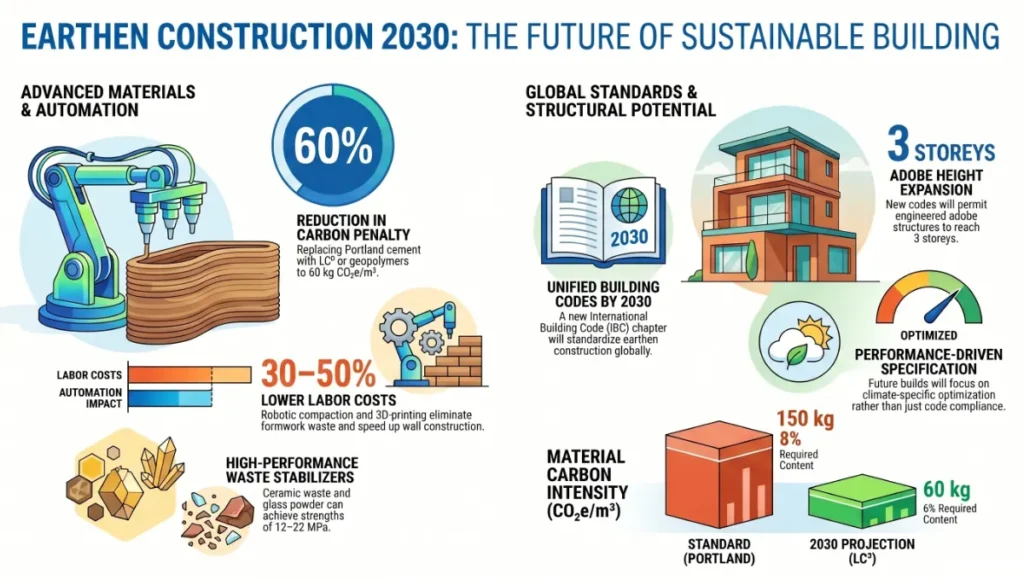
By 2030, three forces will reshape the rammed earth vs. adobe specification landscape.
First, cement substitution. The global cement industry contributes 8% of annual CO₂ emissions. By 2030, geopolymers, calcined clay (LC³), and magnesium-based cements will reduce the carbon penalty of stabilization by 40–60%. You will specify CSRE with 6% LC³ cement at 60 kg CO₂e/m³ instead of 8% Portland at 150 kg CO₂e/m³, achieving equivalent compressive strength with one-third the carbon. The 2025 meta-analysis already identifies ceramic waste, fly ash, and glass powder as viable stabilizer substitutes reaching 12–22 MPa in optimized mixes.
Second, digital fabrication. Robotic compaction and 3D-printed earth walls will eliminate formwork waste and reduce labor costs by 30–50%. You will specify 400 mm rammed earth walls at the same cost as current 300 mm walls because robotic tampers operate continuously without formwork stripping delays. 3D-printed concrete homes represent a converging technology trajectory that will benefit rammed earth automation first. Adobe will not benefit equally from automation — its masonry nature resists continuous deposition.
Third, building code harmonization. ASTM E2392 will likely be superseded by a unified International Building Code (IBC) chapter on earthen construction by 2028–2030, incorporating NZS 4298’s seismic provisions and expanding adobe’s permitted height from 2 storeys to 3 in engineered applications. You will specify 3-storey adobe with confined masonry in seismic zones where today you must use CSRE.
The implication: by 2030, the material choice will be less constrained by code and more driven by climate-specific performance optimization. Your 2026 specifications should anticipate these code shifts by designing for reinforcement compatibility now.
Comprehensive Technical FAQ
Is rammed earth stronger than adobe?
Part of our sustainable building materials guide — selection, verification, and specification across fourteen bio-based families.
Q: In compressive and shear strength, which material performs better?
A: Yes. Cement-stabilized rammed earth typically reaches 4–10 MPa, with meta-analyzed mean of 4.59 MPa and outlier mixes at 24 MPa [Mora-Ruiz et al., 2025, Buildings 15(6):918]. Standard adobe is specified at a minimum of 2.1 MPa per ASTM E2392, with meta-analyzed mean of 2.17 MPa unstabilized and 2.9 MPa stabilized [Mora-Ruiz et al., 2025]. The monolithic nature of rammed earth also eliminates the joint failure mode present in adobe masonry.
• Rammed earth (CSRE, 6–8% cement): 4–10 MPa
• Adobe (standard, unstabilized): 1.0–3.0 MPa
• Adobe (stabilized): 2.1–3.5 MPa
Which is better for seismic zones — rammed earth or adobe?
Q: Can I specify unreinforced adobe in an earthquake-prone region?
A: No. Unreinforced rammed earth shows approximately 40% higher seismic resistance than unreinforced adobe masonry. Both materials can be engineered to modern seismic codes (NZS 4298, ASTM E2392) with proper reinforcement, bond beams, and confinement. A reinforced earth wall per NZS 4297 provides 30 kN bracing capacity vs. 10 kN for unreinforced.
• Unreinforced adobe in seismic zones: Not defensible
• Reinforced rammed earth: 30 kN bracing capacity (2.4 m × 2.4 m × 280 mm)
• Reinforced adobe (confined masonry): Compliant per NZS 4298
Does adobe have better insulation than rammed earth?
Q: Which material provides superior thermal resistance?
A: Standard adobe and rammed earth have similar R-values at comparable thicknesses (R-2.5 to R-3.0 for a 250–300 mm wall). Low-density adobe formulations with cellulose or straw fiber achieve significantly better R-values (R-4.5 to R-6.0 at 300 mm), outperforming standard rammed earth as an insulator.
| Wall type | Thickness | R-value (US) |
| Standard adobe | 250 mm | R-2.5 to R-3.0 |
| Standard rammed earth | 300 mm | R-1.5 to R-2.5 |
| Low-density adobe | 300 mm | R-4.5 to R-6.0 |
Which is cheaper to build — rammed earth or adobe?
Q: What is the cost differential between the two systems?
A: Adobe generally costs less for thin-to-medium walls due to lower equipment requirements and accessible self-build construction. Rammed earth becomes cost-competitive on thick walls or in markets with established specialist contractors.
• Rammed earth (Australia): AUD $450–$750 per face m²
• Rammed earth (full build, Australia): AUD $4,000–$4,500 per m²
• Adobe (self-build, developing regions): 60–70% below contractor CSRE
• Adobe (developed regions, skilled labor): Comparable or higher than CSRE
Can rammed earth and adobe be used in the same building?
Q: Is hybrid construction technically feasible?
A: Yes. Hybrid wall strategies combining the high thermal mass and structural density of rammed earth on high-load or high-solar-gain faces with the accessibility and insulation potential of adobe on other faces represent a viable and underexplored design strategy. The Nuvira Arid Threshold House concept study demonstrates this approach with 350 mm CSRE on north/west facades and 300 mm low-density adobe on south/east facades, unified by reinforced concrete bond beams at 1,200 mm vertical intervals.
What maintenance do earth walls require?
Q: How do I protect earth walls from moisture degradation?
A: Both systems require architectural water management:
• Rammed earth: 600–700 mm roof overhangs, lime or siloxane surface treatment, 150 mm concrete plinth. Maintenance cycle: 20–25 years for CSRE with sealant.
• Adobe: Wide roof overhangs, protective plasters (lime or earth), careful base drainage. Maintenance cycle: 3–5 years for unstabilized, exposed adobe; 10–15 years for stabilized.
Neither material is self-sufficient against sustained moisture without protection.
You now hold the data to specify earth walls with the same rigor you apply to steel and concrete. The question is no longer whether rammed earth or adobe is “better.” The question is: which facade of your next project demands 12-hour thermal lag, which demands R-6 insulation, which demands 30 kN seismic bracing, and which demands community-build accessibility? At Nuvira Space, we model these decisions in our Eco-Blueprint workflow — matching material science to climate data, structural loads, and carbon budgets. If you are specifying a wall system in 2026, you cannot afford to guess. You must engineer the earth.
Contact Nuvira Space to commission a facade-specific material specification for your next regenerative infrastructure project.
As the earth remembers, so must we build to be remembered.
© Nuvira Space All rights reserved. | ECO BLUEPRINT Series | All specifications cited are based on peer-reviewed meta-analyses (Mora-Ruiz et al., 2025, Buildings 15(6):918; SE 2050 Embodied Carbon Action Plan, 2025), national standards (NZS 4298:2024 Draft; ASTM E2392), AIA award-winning case studies (AIA Architecture Awards 2025 — Rwanda Institute for Conservation Agriculture, MASS Design Group; AIA Seattle NWW 2025 Design Awards — Rammed Earth House, Designs Northwest Architects), and field-monitored case studies (Polidori et al., 2025, Energy and Buildings; Kariyawasam & Jayasinghe, cited in Springer 2025). The Nuvira Arid Threshold House is a speculative internal concept study and does not represent a completed project.
1 thought on “Rammed Earth vs Adobe Walls: 7 Technical Specs Compared”