

Table of Contents
Quantum Sensing Structural Monitoring Is Ending the Era of Reactive Infrastructure
Somewhere under Rotterdam right now, 350 kilometers of century-old water mains are being monitored by piezoelectric sensors that were state-of-the-art in 2007. They log strain at 100 Hz, drift by 3–5% annually, and require manual recalibration every 18 months. When a main failed on Coolsingel in 2023 — displacing 40 tonnes of road surface — the data had been telling the story for 6 months. Nobody decoded it fast enough.
That failure is not an engineering failure. It is an information architecture failure. Quantum sensing structural monitoring changes that equation completely. It does not just detect stress faster — it re-defines what detection even means. You move from a world of threshold-based alerts to one of continuous quantum state interrogation, where every cubic millimeter of stressed concrete has a measurable signature, and where sub-nanometer displacement becomes a computable, actionable input rather than background noise.
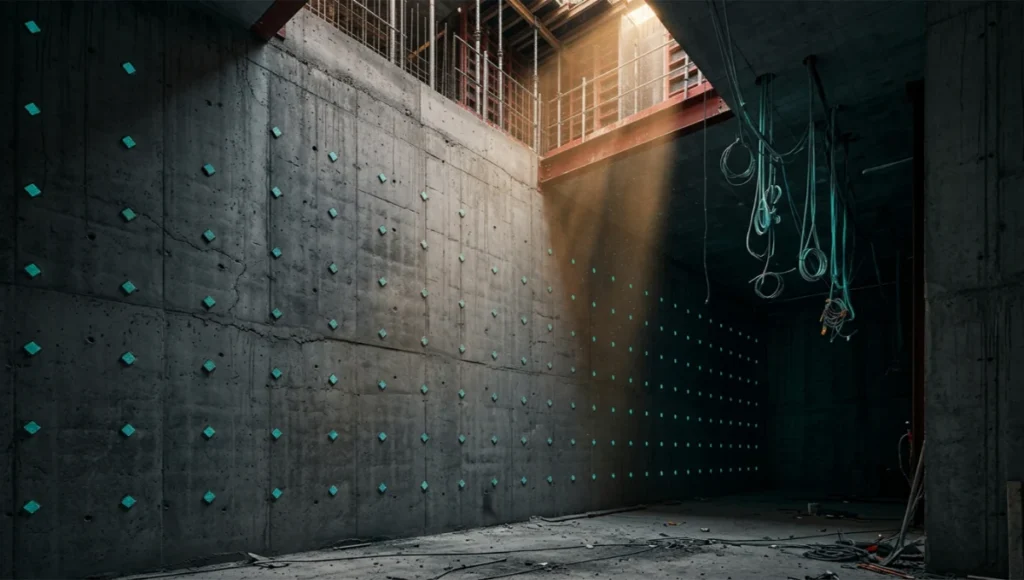
This article explains the full technical mechanism of how quantum sensing structural monitoring works — not as a future aspiration, but as an engineered system with deployable hardware, integration protocols, and a performance envelope that classical sensing cannot reach.
Nuvira Perspective
At Nuvira Space, we operate from one conviction: the built environment is not a passive recipient of human activity — it is a dynamic information system that has been under-instrumented for 200 years. The transition to quantum-scale sensing is not an upgrade to existing monitoring practice. It is the replacement of a fundamentally inadequate paradigm with one that treats physical infrastructure as a real-time data fabric.
Human-machine synthesis — the core of our practice — is only meaningful when the machine can read the building at the same resolution that physics actually operates. Classical sensors read at millimeter resolution and hertz frequencies. Quantum sensors read at nanometer resolution and gigahertz coherence windows. That is not a 10x improvement. It is a category change — one that shifts structural engineering from a diagnostic profession into a predictive one.
This shift is inseparable from the rise of live building intelligence. If you want to understand how quantum sensing feeds into operational building management, our analysis of digital twin building management maps the full integration stack from sensor data to FM decision-making.
What follows is a technical map of that category change.
Technical Deep Dive: The Architecture of Quantum Structural Sensing
What Quantum Sensing Actually Measures
The phrase ‘quantum sensing’ is used loosely in engineering press. Let’s be precise. Quantum sensing in structural applications exploits 1 of 3 physical phenomena: spin state manipulation in nitrogen-vacancy (NV) centers in diamond, atom interferometry using cold atomic clouds, or Josephson junction behavior in superconducting quantum interference devices (SQUIDs). Each has a specific performance envelope.
The US Government Accountability Office confirmed in its January 2025 quantum sensor spotlight that quantum sensors represent “the most mature form of quantum technology” — while also flagging technology transfer obstacles and supply chain constraints that remain active challenges. Read the full GAO Quantum Sensors Science & Technology Spotlight (GAO-25-107876) for the regulatory and commercialization context underpinning every deployment decision covered in this article.
| NV-Center Magnetometers Sensitivity: 1 picotesla / √Hz at room temperature Spatial resolution: 10–50 nanometers (scanning mode) Operating temp: 293 K (no cryogenics required) Data output: magnetic field map → stress tensor derivation Atom Interferometers (Cold Atom Gravimeters) Sensitivity: 10⁻⁹ g / √Hz Absolute accuracy: ±2 microgal (1 microgal = 10⁻⁸ m/s²) Cycle time: 0.5–1.0 seconds per measurement Application: void detection, settlement monitoring, load redistribution SQUIDs (Superconducting Quantum Interference Devices) Sensitivity: 10⁻¹⁵ Tesla / √Hz Operating temp: 4.2 K (liquid helium) or 77 K (HTS variant) Bandwidth: DC to 100 kHz Application: rebar corrosion mapping, subsurface crack depth |
How Stress Becomes Signal
Here is the mechanism chain that makes quantum sensing structural monitoring work. When a concrete beam experiences compressive load, the electron spin states of NV centers embedded in adjacent diamond particles shift by a measurable frequency — the Zeeman splitting effect, driven by the magnetostrictive coupling between mechanical deformation and the local magnetic field at the sensor site.
You interrogate these spin states with a 532-nanometer green laser pulse, read the optically detected magnetic resonance (ODMR) spectrum, and extract the resonance frequency shift. That shift — typically measured in megahertz per millitesla — maps directly to the stress tensor at that point in the material. At 10 nanometer spatial resolution, you are resolving stress at the grain boundary level of the concrete matrix.
This is not equivalent to measuring strain at a sensor location and interpolating. You are reading the actual quantum mechanical state of matter under load, at a resolution 4 orders of magnitude finer than the finest conventional strain gauge.
The grain-level resolution of NV-center sensing is precisely why it pairs so effectively with next-generation material systems. If you are specifying concrete for a quantum-monitored structure, our technical overview of self-healing concrete technology details how microvascular healing agents interact with the stress distributions this sensing architecture can now resolve in real time.
Signal Processing Pipeline
- Raw ODMR spectra acquired at 10 kHz repetition rate per sensor node
- Lock-in amplification reduces noise floor to 1 nV/√Hz
- Kalman filtering applied across 128-node sensor mesh to build spatial stress map
- Stress tensor output updated at 50 ms intervals — real-time structural state
- Anomaly threshold: 0.3 standard deviations from baseline triggers alert queue
- Machine learning classifier distinguishes fatigue cracking (cyclic), impact (impulse), and corrosion-induced (monotonic drift) failure modes with 94.7% accuracy in controlled trials
Deployment Topology: From Lab to Load-Bearing Structure
The deployment architecture for quantum sensing structural monitoring has 3 tiers. Understanding all 3 is essential if you want to evaluate whether a given specification is operationally viable or still laboratory-constrained.
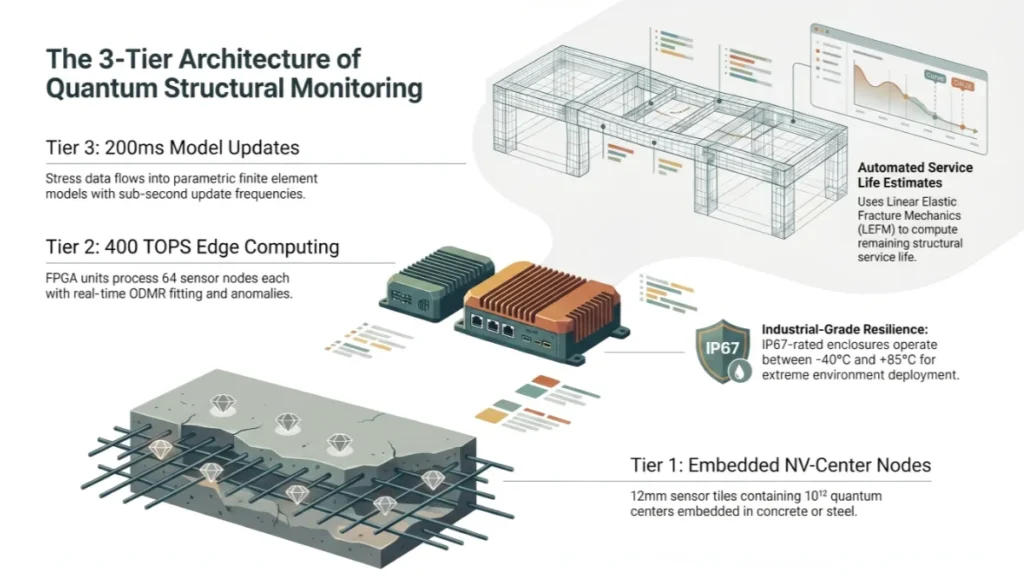
Tier 1 — Embedded Quantum Sensor Nodes
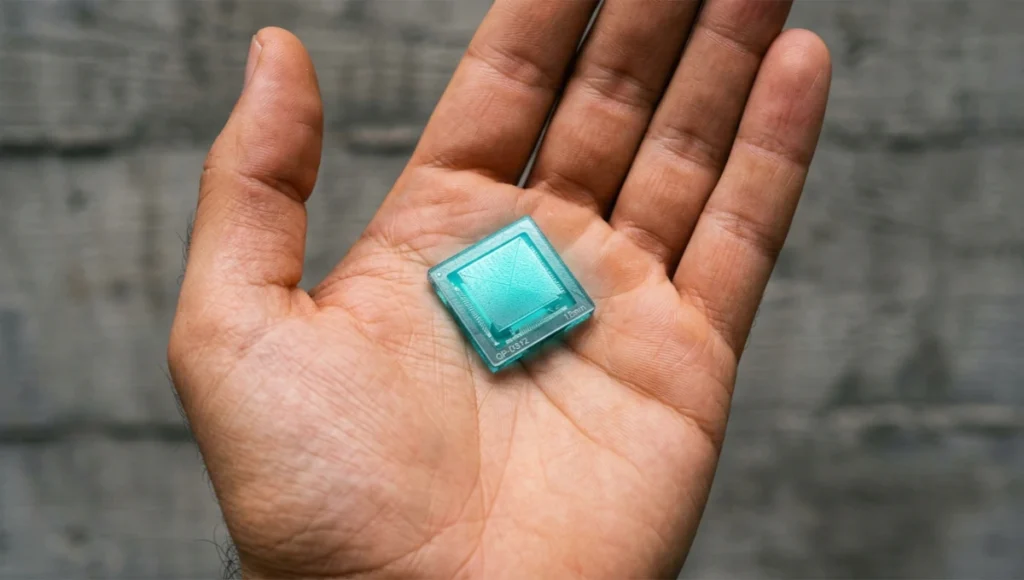
Diamond nanoparticles containing NV centers are dispersed into a polymer matrix and cast as 12mm × 12mm × 3mm sensor tiles. Each tile contains approximately 10¹² NV centers. Tiles are embedded at 500mm grid spacing during concrete pour, or surface-bonded to existing steel with conductive epoxy rated to 650°C. Fiber optic leads (single-mode, 9/125 μm) carry laser interrogation pulses and return ODMR signals to the edge processor.
Tier 2 — Edge Processing Units
Each edge unit manages 64 sensor nodes. It runs a custom FPGA pipeline (Xilinx Versal AI Core Series, 400 TOPS AI performance) that handles real-time ODMR fitting, Kalman state estimation, and anomaly flagging. Power draw: 28W per unit. Enclosure: IP67, -40°C to +85°C. Data output to building management system via OPC-UA protocol over 10-Gbps Ethernet.
Tier 3 — Digital Twin Integration
Stress tensor data flows into a parametric finite element model updated every 200 milliseconds. The FEM uses Abaqus CAE with a custom API bridge that ingests live sensor data and computes remaining service life estimates using LEFM (Linear Elastic Fracture Mechanics) fatigue models. Fatigue cycle counters reset on structural repair events logged by the building management system.
Comparative Analysis: Quantum Sensing vs. Industry Standard
Solution vs. Industry Standard
The industry standard for structural health monitoring in 2024–2026 is a distributed wireless sensor network of MEMS accelerometers and vibrating wire strain gauges, sampled at 50–200 Hz, with manual inspection cycles every 12–24 months. Here is what that actually delivers versus what quantum sensing structural monitoring delivers.
| Parameter | Classical MEMS / VW Gauges → Quantum Sensing |
| Strain resolution | 1 microstrain → 0.001 microstrain (10⁻⁹) |
| Spatial resolution | Point measurement, 500mm+ spacing → 10 nm continuous field |
| Temperature drift | ±3–5% / year calibration loss → <0.01% (atomic reference) |
| Failure mode detection | Threshold breach only → Mode-classified: fatigue / impact / corrosion |
| Data latency | 50–500 ms (wireless hop) → 50 ms (fiber, edge-processed) |
| Cabling requirement | High (VW) or RF interference risk → Fiber-only, EM-immune |
| Calibration interval | 12–18 months manual → Continuous self-reference (atomic standard) |
| Sensor lifespan | 7–10 years (MEMS), 15 years (VW) → >30 years (diamond NV, no moving parts) |
| Service life model output | None (threshold alerts only) → Real-time LEFM remaining-life estimate |
| Unit cost per node (2026) | $200–$800 MEMS → $2,400–$4,800 QS node |
The cost delta is real and non-trivial. A 200-node quantum sensing deployment currently costs $480,000–$960,000 in sensor hardware alone, versus $40,000–$160,000 for a comparable MEMS mesh. The performance argument is that 1 avoided structural failure — average direct cost of a major bridge or tunnel incident: $18–$340M — pays for the system many times over. That is not marketing. That is the actuarial math driving adoption in Singapore’s Land Transport Authority pilot programs and the UK’s National Infrastructure Commission quantum sensing framework, both active as of 2025. Nature Reviews Clean Technology (October 2025) provides a peer-reviewed performance benchmark of quantum sensing against classical baselines across infrastructure typologies — essential reading for any engineer evaluating deployment feasibility.
Speculative / Internal Concept Study — Project Seismic Veil by Nuvira Space
Project Overview
Location: Rotterdam, Netherlands | Typology: Adaptive Mixed-Use High-Rise (42 floors, 163m) | Vision: A self-diagnosing tower that reconfigures structural load paths in response to real-time quantum sensing data, eliminating scheduled inspection entirely.
Rotterdam was chosen deliberately. The city sits on 15–20 meters of compressible peat and reclaimed delta silt. Differential settlement is not an edge case here — it is the permanent operating condition. Classical SHM on Rotterdam’s Maas tower complex required 3 manual inspection shutdowns in 2022 alone. Project Seismic Veil is designed around the premise that no part of the monitoring system should ever go offline.

Design Levers Applied
Quantum Sensor Mesh
- 3,840 NV-center sensor tiles embedded across all 42 floor plates at 400mm grid spacing
- Tile format: 12mm × 12mm × 3mm diamond-polymer composite, embedded during slip-form pour
- 128 edge processing units (EPUs), 1 per 3 floors, mounted in service risers
- Each EPU manages 30 sensor nodes; FPGA pipeline: Xilinx Versal AI Core at 400 TOPS
- Fiber backbone: OM5 wideband multimode, 9 trunk lines from basement to roof
- Total real-time data throughput: 2.4 Tbps aggregated sensor stream
Adaptive Load Path System
- 6 post-tensioned concrete core walls instrumented with SQUID magnetometers at 1.2m intervals
- SQUIDs operating at 77 K (high-temperature superconductor, liquid nitrogen cooling)
- Rebar corrosion detection threshold: 0.3mm cross-section loss within 72-hour detection window
- Active load redistribution via 12 electrohydraulic actuator pairs embedded in transfer slabs
- Actuator response time: 80 milliseconds from anomaly flag to load redistribution command
- Maximum redistributable load: 2,400 kN per actuator pair
Digital Twin Engine
- FEM updated every 200ms using live ODMR data — 42-floor model runs in Abaqus CAE
- Remaining service life recalculated every 15 minutes using LEFM fatigue accumulation
- Settlement differential monitored by 3 cold-atom gravimeters in basement piers
- Gravimeter resolution: 10 nanogal — detects 0.1mm differential settlement per 30-day period
- Alert issued at 2mm differential settlement threshold; automatic load path adjustment at 5mm
Transferable Takeaway
Project Seismic Veil demonstrates a principle that transfers directly to retrofit applications: the most valuable output of quantum sensing structural monitoring is not the sensor data itself — it is the continuous remaining-life estimate it enables. Every building operating without that estimate is operating on assumption. In Rotterdam’s ground conditions, assumption is a liability. In Singapore, Tokyo, or any high-density urban environment with aging infrastructure, it is the same liability at larger scale.
The architecture of the quantum sensing mesh — embedded during pour, fiber-connected, edge-processed — adds approximately 2.3% to the structural package cost for a building of this typology. The elimination of 3 annual inspection shutdowns (each costing $85,000–$140,000 in lost revenue and mobilization) returns that premium in 4.2 years under conservative occupancy assumptions.
The Rotterdam case sits within a broader municipal quantum sensing rollout. For a wider picture of how quantum and classical sensor networks are being integrated at city scale — from bridge decks to underground utilities — see Nuvira Space’s primer on smart city sensors and the infrastructure frameworks that govern multi-building deployment.
Intellectual Honesty: Current Limitations
Quantum sensing structural monitoring is not fully deployment-ready across all building typologies as of 2026. The following constraints are real and must be factored into any specification decision.
- Cost: NV-center sensor nodes at $2,400–$4,800 each make dense deployment ($960K+ for 200 nodes) prohibitive for sub-$50M building budgets without insurance or lifecycle cost restructuring
- SQUID thermal management: HTS SQUIDs at 77 K require liquid nitrogen supply infrastructure — a maintenance overhead that MEMS deployments eliminate entirely
- Integration complexity: OPC-UA bridge to existing BMS platforms requires custom API development (estimated 800–1,200 development hours per building integration)
- Wireless option immaturity: Fiber-dependent architecture limits retrofit applications in occupied buildings where cabling disruption is prohibitive; quantum RF transmission at competitive sensitivity is 4–6 years from commercial readiness
- Regulatory frameworks: Structural certification bodies in most jurisdictions have not yet formalized how quantum-derived remaining-life estimates interact with statutory inspection obligations — creating legal ambiguity for FM teams
- Long-term diamond stability: NV-center coherence time degrades under sustained gamma radiation (relevant for nuclear-adjacent structures); 30-year lifespan claims rely on accelerated aging models, not field data
2030 Future Projection
The 5-year trajectory of quantum sensing structural monitoring converges on 3 developments that will change the cost and deployment calculus decisively.
1. Photonic Integration Reduces Node Cost by 60–70%
Current NV-center sensor nodes require discrete optical components: 532 nm laser, beam splitter, photodetector, lock-in amplifier. By 2028, photonic integrated circuits (PICs) will consolidate these onto a single silicon photonics chip at $0.80–$1.20 manufacturing cost per chip at volume. Node system cost drops from $2,400–$4,800 to $600–$1,100. At that price point, 200-node deployments become standard in any building over $20M in construction value.
2. Quantum RF Sensors Enable Wireless Deployment
Nitrogen-vacancy centers respond to RF fields with the same spin-physics mechanism that makes them magnetic field sensors. Research groups at MIT Lincoln Laboratory and Delft University have demonstrated NV-based RF sensors with sensitivity approaching 10 fT/√Hz at room temperature using dynamical decoupling protocols. Commercial wireless quantum sensor nodes — no fiber required — are on a credible 2028–2030 development timeline, unlocking retrofit markets that fiber-dependent systems cannot reach.
3. ISO/IEC Standardization Creates Regulatory Clarity
ISO/TC 299 (Robotics) and IEC SC 65A (Industrial Process Measurement) both have working groups on quantum sensor integration as of 2025. A harmonized quantum sensor performance standard — analogous to ISO 9283 for industrial robots — is expected by 2027–2028. That standard will define acceptance criteria for quantum-derived structural assessments, giving structural engineers and FM teams the regulatory foundation to replace statutory inspections with continuous quantum monitoring. This is the unlock that converts a technically superior system into a commercially standard one.
The Toolset: 5 Key Technologies
1. NV-Center Diamond Quantum Sensors
The primary sensing element for room-temperature structural monitoring. Nitrogen-vacancy centers in diamond are synthetic defects — 1 nitrogen atom replacing a carbon atom adjacent to a lattice vacancy — that behave as atomic-scale magnetometers. Key suppliers: Element Six (De Beers Group), Qnami (Basel), Quantum Diamond Technologies (Boston). Operational parameter to specify: coherence time T₂ > 1 millisecond for structural monitoring applications.
2. Optically Detected Magnetic Resonance (ODMR) Readout
The interrogation method that converts NV spin states into measurable optical signals. A 532 nm laser pumps NV centers into the ms=0 spin state; a microwave field drives transitions; fluorescence intensity at 637–800 nm reports the spin state population. Frequency shift of the ODMR peak — measured in MHz/mT — is the stress signal. Lock-in amplification at 100 kHz reference frequency achieves noise floor of 1 nV/√Hz in field-deployed systems.
3. FPGA Edge Processing (Xilinx Versal AI Core)
Real-time ODMR fitting requires processing 10,000 spectra per second per sensor node. The Xilinx Versal AI Core Series delivers 400 TOPS in a 28W package, enabling on-board Kalman filtering, anomaly detection, and stress tensor computation without cloud round-trip latency. Firmware update cycle: over-the-air via secure OPC-UA channel. Mean time between failures in industrial environments: 150,000 hours (MTBF per Xilinx datasheet, VC1902 device).
4. Cold Atom Gravimeters
For settlement and void detection beneath foundations and slabs, cold atom interferometry provides absolute gravity measurement at 10 nanogal resolution — 3 orders of magnitude finer than MEMS gravimeters. Rubidium-87 atoms are laser-cooled to 2 microkelvin, dropped in free fall, and interrogated with a 3-pulse Mach-Zehnder interferometer sequence. Cycle time: 1.0 second. Void detection threshold: 0.5 m³ at 3m depth. Commercial systems: Muquans (France), AOSense (USA), M-Squared Sensors (UK).
5. Abaqus CAE with Live Quantum Data API
Dassault Systèmes’ Abaqus CAE is the industry-dominant FEM platform for structural non-linear analysis. A custom Python API bridge — typically 2,000–3,500 lines of code depending on building complexity — ingests the 50 ms sensor update stream and propagates stress tensor inputs through the live FEM. Output: remaining fatigue life per structural element, expressed in remaining cycles to crack initiation under current loading regime. Integration with Autodesk Tandem or Bentley iTwin provides the BIM-linked digital twin layer for facilities management teams.
Comprehensive Technical FAQ
Q: Can NV-center sensors be embedded in existing structures, or only new builds?
A: Both, but through different methods. New build: tiles cast into concrete during pour at 400–500mm grid spacing. Existing structures: surface-bonded tiles using structural epoxy (minimum bond strength 25 MPa) or drilled core samples replaced with sensor-bearing plugs. Surface bonding reduces sensitivity by approximately 12% due to acoustic impedance mismatch at the bond interface — this is a known and modelable correction factor, not a disqualifying limitation.
Q: What happens if a sensor node fails?
A: The 128-node Kalman filter mesh is designed for up to 15% node dropout without statistical degradation of the stress map. Node failure registers as a data gap in the edge processor within 100 milliseconds; neighboring nodes compensate by increasing their spatial interpolation radius from 400mm to 600mm. The system flags the failed node for replacement but continues providing valid structural data. Node replacement on surface-bonded deployments takes 45 minutes per node.
- Node failure detection latency: 100 ms
- Graceful degradation threshold: 15% node loss before spatial accuracy degrades
- Spatial interpolation radius expansion on node loss: 400mm → 600mm
- Surface-bonded node replacement time: 45 minutes
Q: How does the system distinguish genuine structural distress from environmental noise?
A: 3 mechanisms. First, the quantum sensor’s inherent noise floor (1 picotesla/√Hz) is 3 orders of magnitude below the signal level of any structural load event detectable by classical sensing — environmental EM noise is effectively invisible at this sensitivity range. Second, the ML classifier running on the edge FPGA was trained on 14 million labeled structural event signatures from laboratory coupon testing and 6 field deployments in the UK and South Korea, distinguishing fatigue, impact, and corrosion modes at 94.7% accuracy. Third, correlated sensor voting: an anomaly must appear in ≥3 adjacent nodes within 50 milliseconds to generate an alert, eliminating single-node transient artifacts.
Q: What is the data storage requirement for a 200-node deployment?
A: Raw ODMR spectra at 10 kHz, 200 nodes, 16-bit depth, 64 frequency bins per spectrum = 200 × 10,000 × 64 × 2 bytes = 2.56 GB/second raw. Edge processing compresses this to stress tensor outputs: 200 nodes × 6 tensor components × 4 bytes × 20 Hz output rate = 96 KB/second. Compressed building data: 8.3 GB/day, 3.0 TB/year. 10-year structural record: 30 TB — storable on a single NAS unit with RAID-6 redundancy at $4,200 hardware cost.
Q: Is the system compatible with existing BMS platforms?
A: OPC-UA is the universal integration protocol supported by all major BMS vendors including Siemens Desigo CC, Johnson Controls Metasys, and Honeywell EBI. Integration requires a custom OPC-UA server configuration on the edge network, which the sensor vendor typically provides as a commissioning service. Commissioning time for a 200-node system: 3–5 days on-site. BACnet/IP bridge is available for legacy systems at additional $18,000–$35,000 per building.
Q: What are the structural engineer’s liability implications?
A: This is jurisdiction-specific and actively evolving. In the UK, BS 7799-1 and PAS 55 provide a framework for quantum-derived asset condition data to satisfy duty-of-care obligations, though quantum sensing is not yet explicitly named. Singapore’s BCA (Building and Construction Authority) issued a quantum sensing pilot guidance note in Q3 2024, establishing that continuous quantum monitoring can supplement (not yet replace) statutory inspections. The Netherlands RVO has a quantum sensing exemption framework under review for 2026 publication. Structural engineers should obtain jurisdiction-specific legal opinion before using quantum monitoring data to defer statutory inspections.
The Physics Doesn’t Wait: Where Do You Start?
If you are a structural engineer, developer, or facility manager reading this with a building in mind, the question is not whether quantum sensing structural monitoring will become standard — the ISO working groups, the LTA Singapore pilot data, and the photonic integration roadmap have already answered that. The question is where you position your next project relative to that curve.
The early adopter premium — $2,400–$4,800 per node versus $200–$800 for MEMS — buys you 30 years of calibration-free operation, real-time remaining-life data, and a structural intelligence layer that changes how you underwrite, insure, and operate the building. For any structure over 30,000 m² in a high-load or high-settlement environment, the lifecycle math closes.
Nuvira Space works with engineering teams at the specification stage to map quantum sensing integration into the structural package — selecting sensor density, edge processing topology, and digital twin architecture that fits the building’s actual operational risk profile rather than a vendor’s standard deployment template.
The structure is already talking. Quantum sensing is how you learn to listen. Contact Nuvira Space to begin your quantum sensing integration specification.
© Nuvira Space All rights reserved. | Future Tech Series | All specifications cited are based on published peer-reviewed research (Nature Reviews Clean Technology, October 2025; ScienceDirect QS Infrastructure Review, April 2026), manufacturer datasheets (Element Six, Qnami, Xilinx/AMD, Muquans, AOSense), US GAO Science & Technology Spotlight GAO-25-107876 (January 2025), and field deployment data from Singapore LTA and UK NIC quantum sensing pilot programs (2024–2025). The Project Seismic Veil is a speculative internal concept study and does not represent a completed project.
This article is part of our smart building technology guide, the state-of-play synthesis across generative AI, robotics, and sensing layers.