

Table of Contents
Neuroarchitecture Basics: 7 Ways Design Empowers the Brain
The global shift toward hyper-urbanization has fundamentally detached the human nervous system from its evolutionary origins. When you walk into your living room, you aren’t just entering a space of “decor”; you are entering a complex data-stream of sensory inputs that your brain must process in real-time. This is where neuroarchitecture basics transition from academic theory into a biological necessity. We are no longer designing for aesthetics—we are designing for the amygdala, the hippocampus, and the prefrontal cortex.
Nuvira Perspective
At Nuvira Space, we view the built environment not as a static shell, but as a dynamic “health machine” integrated with the human-machine synthesis. We believe the next era of domestic life is defined by modular adaptability and circadian synchronization. To us, a home is a physiological extension of the inhabitant—a sanctuary where the architecture actively repairs the cognitive wear of the digital age. By moving beyond traditional interior design, we treat every square meter as a laboratory for neural optimization.
Technical Deep Dive: The Biology of Space
Neuroarchitecture is the scientific study of how the built environment impacts the brain’s chemistry and structure. To understand the neuroarchitecture basics that empower the brain, we must look at the specific design levers that trigger physiological shifts. This interdisciplinary field bridges the gap between the measurable metrics of neuroscience and the creative intuition of the architect.
1. Circadian Entrainment and Photobiology
Your retinas contain non-image-forming ganglion cells that communicate directly with the Suprachiasmatic Nucleus (SCN). This is the “master clock” that regulates everything from body temperature to cognitive alertness. In the modern era, our constant exposure to static, artificial light has induced a state of “social jetlag,” where our internal biology is perpetually out of sync with our external schedule.
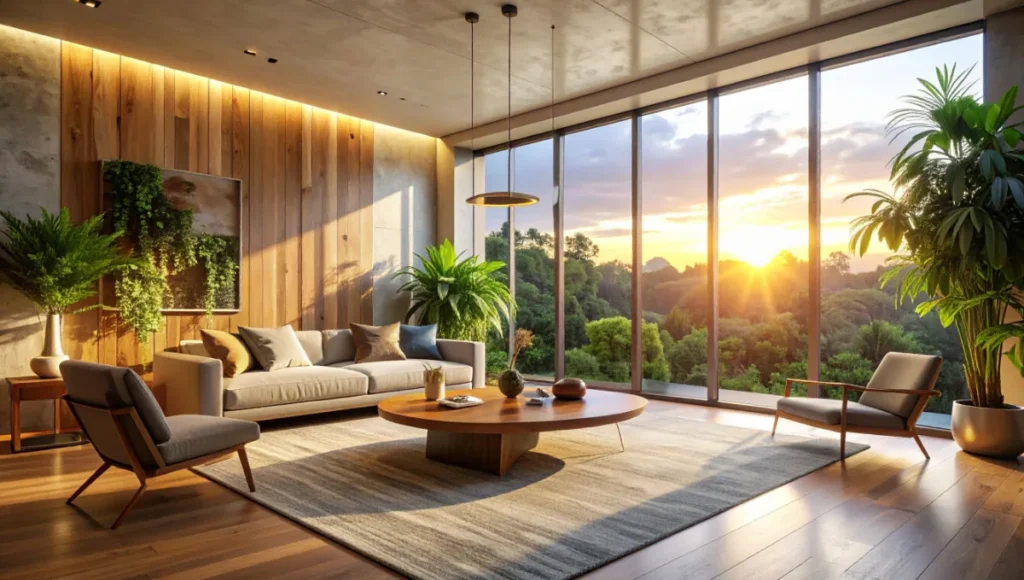
- The Spec: Dynamic LED arrays mimicking a 2,700K to 6,500K spectrum with high Color Rendering Index (CRI > 95).
- The Impact: Proper blue-light exposure in the morning suppresses melatonin and boosts cortisol, while amber-shifting evenings trigger the “sleep-gate” mechanism.
By integrating circadian lighting systems, we can effectively “reset” the inhabitant’s biological clock daily, leading to a 30% increase in daytime focus and a significant reduction in evening sleep latency.
2. Geometry and the Amygdala Response
The human brain is evolutionarily hardwired to scan the environment for threats. Sharp angles, jagged edges, and “aggressive” tectonics are often interpreted by the amygdala—the brain’s fear center—as potential hazards, maintaining a baseline level of high-alert stress.
- The Spec: Curvilinear spatial transitions (r > 1.5m) and softened tectonic edges at eye-level.
- The Impact: Curved environments are processed by the brain as “safe,” lowering systemic inflammation markers and heart rate variability (HRV).
When you apply neuroarchitecture basics to floor plans, you replace rigid, 90-degree intersections with fluid transitions. This reduces the cognitive energy required to navigate a space, allowing the brain to enter a “flow state” more easily.
3. Acoustic Attenuation and Cognitive Load
Persistent low-frequency noise—often from poorly shielded HVAC systems or urban traffic—creates a constant state of “cognitive friction.” The brain must work overtime to filter out these irrelevant signals to focus on a primary task.
- The Spec: Acoustic NRC (Noise Reduction Coefficient) rating of 0.85+ in “deep work” zones.
- The Impact: Reducing background decibels frees up the prefrontal cortex for executive function rather than sensory filtering.
4. Biophilic Resilience and Fractal Fluency
Biophilia is more than just placing a plant in a corner. It is about the mathematical representation of nature. The human visual system processes “fractals”—patterns that repeat at different scales—with remarkable ease. This is known as “fractal fluency.”
- The Spec: Integration of biophilic interior design principles, utilizing wood grains, stone textures, and living walls.
- The Impact: Viewing mid-range fractal patterns can lower stress levels by up to 60% by inducing alpha-wave activity in the brain.
5. Spatial Volume and Creative Cognition
The height of a ceiling has a direct correlation with the type of thinking a brain is capable of. High ceilings (3m+) encourage abstract, relational thinking, while lower ceilings (2.4m) favor detail-oriented, analytical tasks. This is known as the “Cathedral Effect.”
- The Spec: Variable ceiling heights or modular partitions that allow for “ceiling scaling.”
- The Impact: Stimulates the parahippocampal place area (PPA) to shift between broad creative ideation and focused execution.
The AIA Framework: Evidence-Based Design
The American Institute of Architects (AIA) has increasingly recognized the importance of neuro-centric design through its Design and Health initiatives. The AIA emphasizes that architecture is a public health tool. According to recent AIA-sponsored research into evidence-based design, the physical environment is responsible for up to 80% of health outcomes—surpassing clinical care and genetics. By adhering to the AIA’s “Design for Well-being” toolkit, architects are now quantified by how their buildings reduce cortisol levels and improve community social cohesion.
Case Study: The Singapore Macro-Environmental Context
Look at Singapore. The city-state has moved beyond the “City in a Garden” concept to “A City in Nature,” utilizing biophilic mandates for high-rise developments. In projects like the Khoo Teck Puat Hospital, the architecture incorporates V-shaped configurations to maximize natural ventilation and views of greenery.
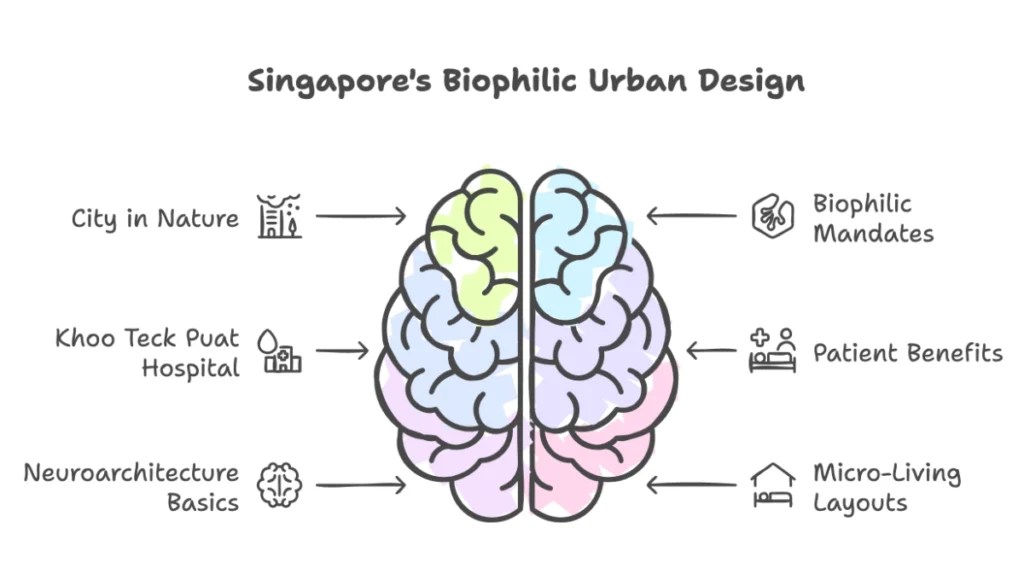
Data from this real-world application shows that patients in these neuro-optimized environments require 22% less pain medication and experience 8.5% faster recovery times. This isn’t just “design”; it is a macro-environmental proof of how neuroarchitecture basics function as an adjunctive therapy. This logic is being scaled down into micro-living layouts where every millimeter is optimized for neural sanity in high-density urban cores.
Comparative Analysis: Nuvira Logic vs. Industry Standard
| Feature | Industry Standard (Static Decor) | Nuvira Solution (Neuro-Architecture) |
|---|---|---|
| Lighting | Static on/off switches; fixed Kelvin. | Circadian-synced automated lux leveling. |
| Air Quality | Passive ventilation; basic MERV filters. | AI-monitored VOC scrubbing and oxygenation. |
| Layout | Rigid partitions and fixed-use rooms. | Modular “kinetic” walls for task-based zones. |
| Biophilia | Potted plants as “styling” elements. | Integrated hydroponics and fractal geometry. |
| Acoustics | Hard surfaces; high echo; static. | Adaptive sound-masking and absorption. |
Concept Project Spotlight: Speculative / Internal Concept Study “The Neuro-Pod” by Nuvira Space
Project Overview
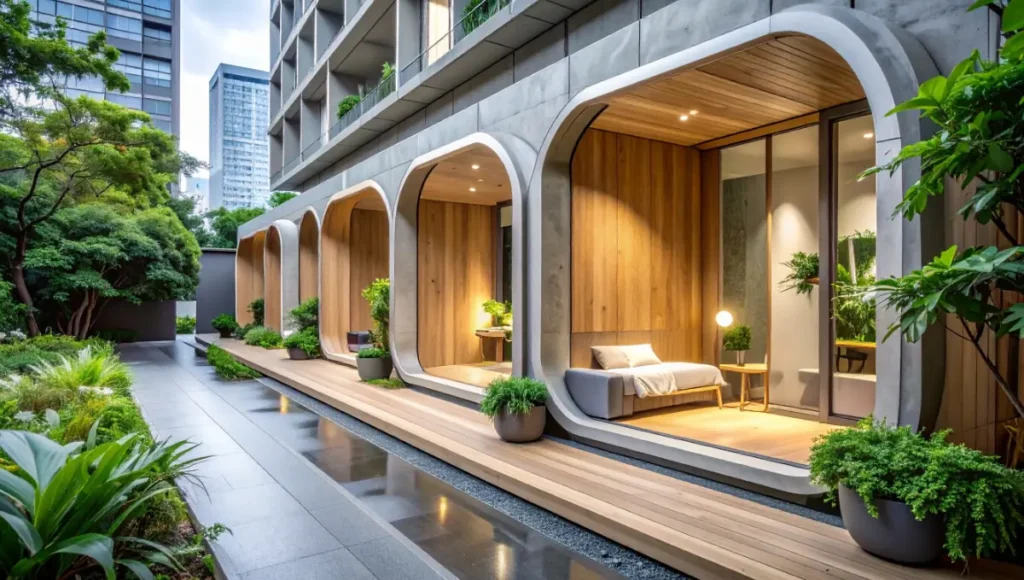
- Location: Tokyo, Japan (High-density micro-living)
- Typology: Adaptive Modular Residential
- Vision: A 45sqm unit that adapts its geometry based on the user’s biometric feedback via wearable integration.
Design Levers Applied
- Kinetic Volumetrics: Walls that shift 15cm to increase “perceived ceiling height” during creative tasks, stimulating the PPA.
- Haptic Materiality: Surfaces utilizing cross-laminated timber (CLT) to regulate humidity and provide a tactile “grounding” effect.
- Sensory Anchoring: A singular, unobstructed sightline toward a 4K digital “sky-window” if natural light is physically blocked by surrounding towers.
- Bio-Feedback Integration: The room’s air temperature and lighting hue shift automatically when the inhabitant’s wearable detects an elevated heart rate.
Transferable Takeaway
You can apply the same logic at home by tuning evening lighting to warm ambers, building a “refuge corner” with high-backed furniture for security, and simplifying one primary sightline toward a natural anchor—even if it’s just a single, well-lit plant against a neutral wall.
Intellectual Honesty: Current Limitations
While the science is robust, we must acknowledge that “neuro-aesthetics” is still highly subjective. What triggers a dopamine release in one individual (e.g., a brutalist concrete wall) may trigger a cortisol spike in another. Currently, the cost of high-grade circadian lighting and kinetic partitions remains a barrier to entry for the mass market. Furthermore, long-term longitudinal studies on the impact of “human-machine synthesis” in the home are still in their infancy. We are in the “beta phase” of residential neural optimization.
2030 Future Projection
By 2030, we predict the “Living Space” category will merge with “Health Technology.” Your home will be equipped with EEG-sensing floors and walls that change color and acoustic density to counteract your specific stress markers. The “decor” of the future won’t be something you choose from a catalog; it will be a generative response to your biological needs. We will see the rise of “Neuro-Zoning,” where building codes will mandate minimum neural-stimulation standards, much like we currently mandate fire safety.
Actionable Design Principles for the Brain
- Prioritize Fractal Fluency: Use patterns that repeat at different scales (like a fern or wood grain) to reduce stress by 60%.
- The “Prospect and Refuge” Balance: Ensure you have a clear view of the room (prospect) while sitting in a protected, enclosed area (refuge). This satisfies the primitive need for safety while maintaining environmental awareness.
- Olfactory Priming: Use natural scents like cedar or Hinoki to lower sympathetic nervous system activity.
- Tactile Variation: Mix smooth glass with rough stone to keep the somatosensory cortex engaged.
- Color Temperature Zoning: Never use “cool white” light in areas intended for relaxation; keep the bedroom strictly below 3000K.
Comprehensive Technical FAQ
Q: Does neuroarchitecture really change brain structure?
A: Yes. Through neuroplasticity, prolonged exposure to enriched environments (high biophilia, low noise, natural light) increases dendritic branching in the hippocampus, improving memory and learning. Conversely, “impoverished” environments can lead to cortical thinning over time.
Q: What is the most important of the neuroarchitecture basics to start with?
A: Circadian lighting. It is the fundamental “master clock” of the body.
- Morning: 5000K+ Blue-rich light to trigger wakefulness.
- Evening: <2000K Amber, low-intensity light to facilitate melatonin production.
Q: Can I apply this to a small apartment?
A: Absolutely. Neuroarchitecture is about the quality of the stimulus, not the scale. Using mirrors to increase “spatial depth” and removing “visual noise” (clutter) are high-impact, low-cost moves that immediately lower cognitive load.
Q: How does neuroarchitecture differ from Feng Shui?
A: While both aim to improve the inhabitant’s well-being through spatial arrangement, neuroarchitecture is rooted in peer-reviewed neuroscience and physiological data (cortisol levels, EEG, fMRI) rather than traditional spiritual energy flows.
Elevate Your Biological Value
Traditional design is over. Your home is a biological intervention. It is time to stop thinking about how your space looks and start analyzing how it makes you function. We are entering an era where the architect and the neuroscientist are one and the same.
Ready to transform your environment into a high-performance health machine? Join the Nuvira Space movement and redefine your domestic evolution.
3 thoughts on “Neuroarchitecture Basics: 7 Ways Design Empowers the Brain”