

Table of Contents
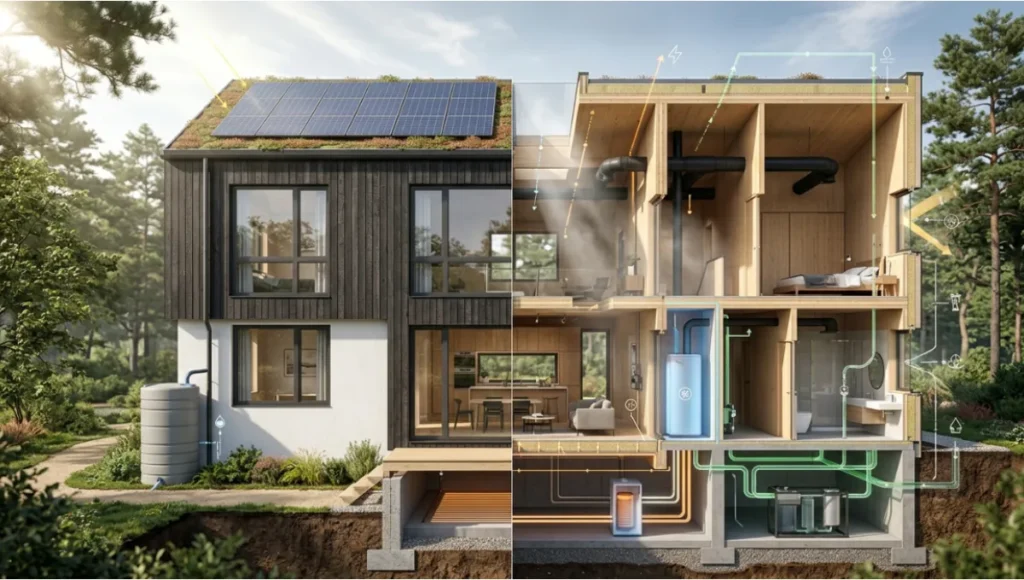
The built environment is responsible for 40% of global energy consumption and 38% of all CO₂ emissions annually, according to the International Energy Agency’s 2024 tracking report. That number has not moved meaningfully in a decade — and the residential sector accounts for roughly 22 percentage points of it. The homes architects design and developers fund today will stand for 50 to 100 years; every insulation specification, every mechanical system, and every material procurement decision locks in an emissions trajectory that outlasts political cycles, energy tariffs, and ownership. This is the central problem the LEED platinum residential guide exists to solve: not merely to certify your home, but to engineer the 80+ points that transform a structure into regenerative infrastructure.
Copenhagen’s UN City — a LEED Platinum structure with 1,400 rooftop solar panels eliminating 30% of its electricity draw, seawater cooling, and a rainwater harvesting loop feeding all sanitary fixtures — demonstrates that the point threshold is not a bureaucratic milestone but a performance floor. The same logic now applies to residential typologies. Under LEED v5, ratified by USGBC members in March 2025, Platinum certification for new residential projects mandates full electrification, 100% renewable energy procurement, and embodied carbon tracking as prerequisites — not optional credits. The game has shifted from aspiration to engineering precision.
Nuvira Perspective
At Nuvira Space, the LEED platinum residential guide is not a compliance checklist — it is the load-bearing logic underneath every project we publish, critique, and conceptualise. We treat the 80-point threshold as a minimum viable performance standard, not a finish line. Our editorial mandate is to translate the density of USGBC technical documentation into spatial decisions that architects, developers, and informed homeowners can execute with precision and confidence.
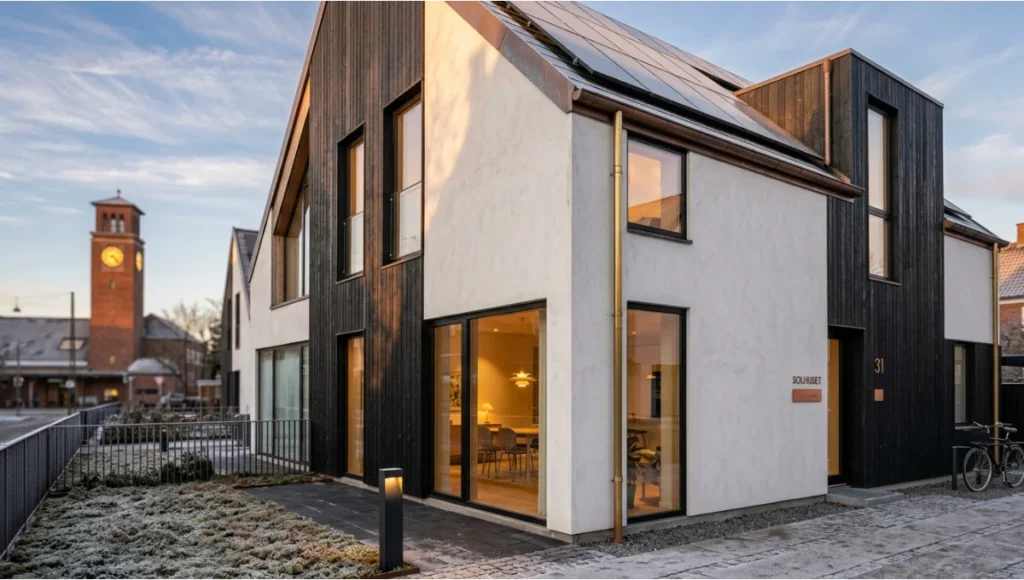
That mandate demands honesty about what Platinum actually requires. The certification costs between $2,250 and $22,500 in GBCI review fees alone — before design premiums, third-party verification, and LEED Green Rater site visits are factored in. But LEED Platinum residential homes use 30–60% less energy than code-minimum comparables (USGBC, 2024), qualify for discounted homeowner’s insurance in most U.S. states, and consistently command an 8–10% property value premium in sustainability-literate markets. This is not altruism. This is lifecycle financial engineering.
The framework we present in this guide is structured around 8 credit categories, 110 total available points, and the specific technical levers — envelope R-values, mechanical system specifications, water reduction percentages, and material declaration requirements — that move a project from a Gold score of 79 points to a Platinum score of 80+. Every number in this article matters. Every dimension dictates a real thermal, financial, or spatial consequence.
Technical Deep Dive: The 8 Credit Categories, Scored
LEED for Homes v4.1 organises its 110 available points across 8 credit categories. Platinum requires a minimum of 80 points, with no individual category carrying a mandatory minimum — meaning your project team has genuine strategic flexibility. The following breakdown quantifies each category and identifies the high-yield credits that determine whether a residential project lands at Gold (60–79 pts) or Platinum (80–110 pts).
| Credit Category | Max Points | Platinum Strategy | Typical Allocation |
| Location & Transportation (LT) | 16 | Transit-proximal site, walkability > 80 WalkScore | 10–14 pts |
| Sustainable Sites (SS) | 10 | Native planting, light-pollution reduction, stormwater QA | 6–9 pts |
| Water Efficiency (WE) | 11 | 30–50% indoor reduction, greywater recycling, net-zero irrigation | 8–11 pts |
| Energy & Atmosphere (EA) | 33 | Passive solar, ASHRAE 90.1-2010 +10%, on-site PV, ERV | 22–30 pts |
| Materials & Resources (MR) | 13 | EPDs from ≥ 20 products / 5 manufacturers, FSC timber, < 100-mi sourcing | 8–12 pts |
| Indoor Environmental Quality (EQ) | 16 | MERV-13 filtration, CO₂ monitoring, VOC < 50 g/L, daylighting DF > 3% | 10–14 pts |
| Innovation (IN) | 6 | Exemplary performance credits, LEED AP on team | 4–6 pts |
| Regional Priority (RP) | 4 | Climate-zone-specific credits identified via USGBC database | 2–4 pts |
| TOTAL (Platinum Threshold) | 110 | Minimum 80 required | 80–100 pts |
Energy & Atmosphere — The 33-Point Engine. LEED Platinum Residential Guide
Energy & Atmosphere (EA) is the single largest credit category in LEED residential scoring, offering up to 33 points. It is also where Platinum projects diverge most sharply from Gold projects. A March 2024 update to LEED v4.1 raised the minimum energy performance prerequisite from a 5% to a 10% improvement over the ASHRAE 90.1-2010 baseline for new construction. Under LEED v5, that bar rises further: full electrification eliminates on-site combustion except for emergency systems, and 100% renewable energy procurement becomes a Platinum prerequisite.
Critical EA Specifications for Platinum
- Thermal envelope: R-38 minimum for walls in Climate Zone 5–6; R-60 for roofs in Climate Zone 7–8
- Air leakage rate: ≤ 0.1 CFM₇₅ per ft² of enclosure area, verified by blower-door test
- HVAC efficiency: HSPF ≥ 10 for heat pumps; SEER ≥ 18 for cooling systems
- ERV / HRV: Heat recovery ventilation with ≥ 75% sensible heat recovery efficiency
- On-site PV: Sized to offset ≥ 105% of modelled annual energy consumption for net-positive status
- Enhanced commissioning (EAc1): Up to 6 points; monitoring-based verification required
The ‘so what’ of a 0.1 CFM₇₅ air leakage target is felt daily. It means your conditioned air stays where you paid to condition it. In a 2,200 ft² residence, moving from a code-compliant 0.3 CFM₇₅ to 0.1 CFM₇₅ reduces annual HVAC loads by an estimated 18–22%, translating to $400–$700 in annual utility savings at current energy rates — compounding over a 30-year mortgage into a $12,000–$21,000 lifetime cost differential.
The net-positive energy target — where on-site generation exceeds annual consumption — is no longer a fringe objective. For a detailed breakdown of verified net-positive building performance across typologies, see Nuvira Space’s analysis on net-positive building data, which documents verified operational outcomes across 14 certified residential and commercial case studies.
Water Efficiency — 11 Points, Zero Irrigation Baseline
The Water Efficiency (WE) category offers 11 points and carries an outdoor water-use prerequisite: projects must demonstrate the ability to eliminate potable irrigation through a combination of native planting, greywater reuse, or rainwater collection. Indoor water-use reduction credits scale from 25% to 50% reduction versus the Energy Policy Act baseline, using WaterSense-certified fixtures throughout.
WE Specifications
- Low-flow showerheads: ≤ 1.5 GPM (vs. federal max of 2.5 GPM)
- Dual-flush toilets: 0.8 GPF / 1.6 GPF (vs. federal max of 1.6 GPF flush)
- Lavatory faucets: ≤ 0.5 GPM for private applications
- Rainwater harvesting tank: Sized for 30-day irrigation demand of specific plant palette
- Greywater recycling system: Laundry-to-landscape minimum; toilet flushing loop preferred
A household achieving the full 50% indoor water reduction across fixtures saves approximately 30,000 gallons per year — roughly equivalent to 45 full bathtubs every week. The financial implication is a reduction of $80–$120 per year in water utility costs in most U.S. municipalities. The environmental implication is lower sewage volume, reduced treatment energy, and measurable aquifer pressure relief in drought-stressed regions.
Materials & Resources — EPDs as the New Standard
Materials & Resources (MR) offers 13 points and has become the category most transformed by LEED v4.1 and v5 requirements. Environmental Product Declarations (EPDs) — ISO 14025-compliant, third-party verified lifecycle assessments for individual building products — are now the primary currency of MR compliance.
MR Specifications
- EPD credit (Option 1): ≥ 20 permanently installed products from ≥ 5 manufacturers with qualifying lifecycle data; product-specific Type III EPDs count as 1.5 products (USGBC Credit Library, 2024)
- EPD exemplary performance: Sourcing ≥ 40 qualifying products earns 1 Innovation point
- Sourcing: ≥ 20% by cost of total materials sourced within 100 miles of project site
- FSC-certified timber: 100% of all wood products by cost
- Construction waste: ≥ 75% diversion from landfill by weight
An EPD for a concrete mix tells you its embodied carbon in kg CO₂e per tonne — typically 100–150 kg CO₂e for standard ready-mix. A carbon-negative concrete formulation using supplementary cementitious materials (SCMs) can reduce that number to 30–60 kg CO₂e per tonne. In a 2,200 ft² single-family home using approximately 60 tonnes of concrete, the difference is 4,200–7,200 kg CO₂ avoided — equivalent to removing 1 passenger vehicle from the road for 12–18 months.
Material science is also producing structural advances that compound the lifecycle value of low-carbon concrete specifications. For how these developments translate into verified structural performance data at the residential scale, see Nuvira Space’s technical review of self-healing concrete technology — a material system that reduces crack-driven maintenance carbon by an estimated 20–35% over a 50-year lifecycle.
Indoor Environmental Quality — 16 Points, Measurable Health Outcomes
The Indoor Environmental Quality (EQ) category offers 16 points across ventilation, air quality, thermal comfort, daylighting, and acoustic performance credits. This category has the most direct impact on daily lived experience — and is the one most commonly under-invested by project teams chasing points in easier categories.
EQ Specifications
- Mechanical ventilation: ASHRAE 62.2-2019 compliant; MERV-13 minimum filtration (captures particles ≥ 1 micron)
- VOC limits: Paints ≤ 50 g/L; adhesives ≤ 70 g/L; flooring system ≤ FloorScore certified
- CO₂ monitoring: Continuous sensors in all occupied zones; alarm threshold at 1,100 ppm
- Daylight: Spatial Daylight Autonomy (sDA) ≥ 55% of floor area achieving 300 lux for ≥ 50% of occupied hours
- Thermal comfort: ASHRAE 55-2017 compliance verified; operative temperature range 68–77°F in occupied zones
- Acoustic: Sound Transmission Class (STC) ≥ 50 for all party walls in multi-family typologies
The sDA target of 55% means more than half your floor area receives adequate natural light for more than half the day. In spatial terms for a 2,200 ft² home, that is 1,210 ft² of daylit territory eliminating artificial lighting demand for approximately 4–6 hours per day in temperate climates. At an average lighting energy cost of $0.12/kWh and 6 watts/ft², that represents $380–$570 per year in avoided electricity cost — before the documented productivity and circadian health benefits are considered.
Comparative Analysis: LEED Platinum vs. Standard Code Construction
The performance gap between a LEED Platinum residential home and a code-minimum build is not marginal. It is structural — embedded in the insulation assembly, the mechanical plant, the material choices, and the site strategy. The table below quantifies the critical differentials that determine 30-year lifecycle outcomes.
For verified case study data from practice-level implementation of these standards, the American Institute of Architects (AIA) High Performance Buildings case study library documents measurable outcomes across climate zones, typologies, and certification levels — providing peer-reviewed benchmarks that inform the specifications in this guide.
| Metric | LEED Platinum Residential | Standard Code-Built Home |
| Point Threshold | 80–110 pts (USGBC LEED v4.1) | Not applicable |
| Energy Reduction | 30–60% below baseline | 0–5% above code minimum |
| Water Savings | ≥ 30% vs. baseline | Code minimum only |
| Embodied Carbon | Third-party EPD required | No tracking required |
| Indoor VOC Limits | < 50 g/L (LEED EQc2) | Code minimum / no threshold |
| Renewable Energy | On-site or off-site procurement | Grid-dependent, no mandate |
| Thermal Envelope (R-value) | R-38 to R-60 walls & roof | R-13 to R-21 typical |
| Certification Cost | $2,250–$22,500+ (GBCI review fees) | Nil |
| Property Value Premium | Up to 8–10% over comparables | Market baseline |
The True Cost of Standard vs. Platinum: A 30-Year Ledger
The upfront cost premium for a LEED Platinum residential build typically runs 2–8% above a comparable code-minimum home, depending on geography, team expertise, and credit strategy. On a $600,000 construction budget, that is $12,000–$48,000 in additional upfront investment.
Over 30 years at current energy and water rates, modelled savings for a Platinum-certified 2,200 ft² home include:
- Energy savings: $1,200–$2,400/year → $36,000–$72,000 cumulative (at 30–60% reduction)
- Water savings: $80–$120/year → $2,400–$3,600 cumulative
- Insurance discounts: 5–10% reduction on homeowner’s premium in qualifying states
- Property value premium: 8–10% at point of sale, or $48,000–$60,000 on a $600,000 home
The total 30-year advantage ranges from $86,400 to $135,600 — against an upfront premium of $12,000–$48,000. The financial case is not theoretical. It is a compounding ledger that rewards precision engineering with compound returns. Standard code construction, by contrast, externalises those costs to the grid, the municipality, and the climate.
Concept Project Spotlight
Speculative / Internal Concept Study — The Meridian Passive House by Nuvira Space
Project Overview
Location: Copenhagen, Denmark — Climate Zone 5 (Dfb / oceanic continental transition). Annual HDD₁₈: 3,200; Annual CDD₁₀: 120. Solar irradiance: 1,005 kWh/m²/year (PVGIS, 2024).
Typology: 3-storey, 280 m² (3,014 ft²) single-family detached residence, south-facing on a 620 m² urban infill lot.
Vision: To achieve LEED Platinum at 94 points — the EA and WE categories fully maxed — while demonstrating that the cold-climate residential typology is the most powerful argument for the transition to regenerative infrastructure. Copenhagen’s existing LEED Platinum building stock (including the LEED Platinum UN City with 1,400 solar panels and seawater cooling) provides the precedent; The Meridian Passive House extends that logic to the domestic scale.
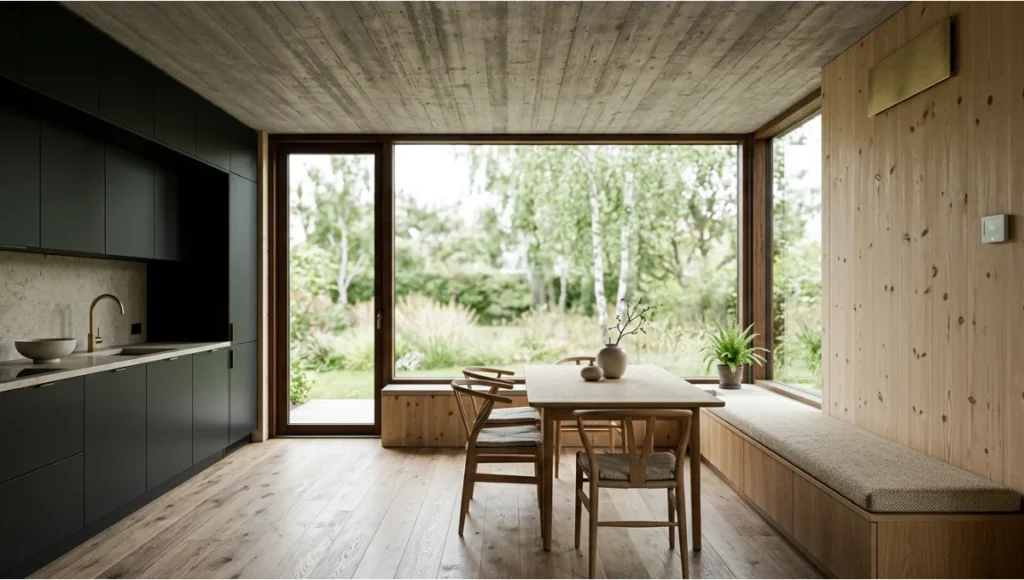
Design Levers Applied
Envelope Engineering
- Exterior wall assembly: 400 mm prefabricated CLT + 200 mm mineral wool + 50 mm airtight WRB → U-value: 0.09 W/m²K (equivalent to R-62)
- Roof assembly: 300 mm polyisocyanurate (polyiso) continuous insulation, R-60 effective
- Triple-glazed windows: Ug = 0.5 W/m²K, SHGC 0.35 north / 0.55 south for passive solar gain capture
- Air leakage: 0.08 CFM₇₅ per ft² enclosure area — verified via blower-door test at 50 Pa
Mechanical Systems
- Heating: Air-to-water heat pump, COP 3.8 at -7°C design outdoor temperature; 12 kW capacity for 280 m² load
- ERV: 85% sensible heat recovery efficiency; 0.35 ACH continuous ventilation rate
- DHW: Heat pump water heater, EF 3.5, 270-litre tank with 8-hour PV scheduling
- PV array: 18 × 400 W monocrystalline panels, 7.2 kWp on 42 m² of south roof; modelled annual yield: 7,380 kWh
- Net energy position: Home uses 62 kWh/m²/year (EPC modelled); PV generates 26.4 kWh/m²/year → combined with grid-sourced renewables (Ørsted wind PPA), net carbon: 0 kg CO₂e/year operational
Water Systems
- Rainwater harvesting: 8,000-litre underground cistern; feeds all toilet flushing (3,650 litres/year per occupant displaced from potable supply)
- Greywater recycling: Laundry-to-toilet loop, WISY GmbH Vortex filter, 95% capture rate
- Net potable consumption: 62 litres/person/day vs. Copenhagen municipal average of 112 litres/person/day — a 45% reduction
Materials Strategy
- Structural CLT: FSC-certified Norwegian spruce, embodied carbon: 121 kg CO₂e/m³ vs. 375 kg CO₂e/m³ for reinforced concrete equivalent
- Concrete use: Restricted to foundation slab only; LC3 cement blend (limestone calcined clay), embodied carbon: 38 kg CO₂e/tonne vs. 130 kg CO₂e/tonne for OPC
- 27 EPD-compliant products specified, spanning insulation, glazing, cladding, flooring, and adhesives
- 100% FSC timber, 82% of materials sourced within 250 km of Copenhagen city centre
Scorecard Projection
- LT: 13 pts — 400 m from Østerport S-Bahn station, WalkScore 91
- SS: 9 pts — biodiverse roofscape, zero outdoor potable irrigation, dark-sky-compliant lighting
- WE: 11 pts — full category max; net-zero potable irrigation achieved
- EA: 29 pts — ASHRAE 90.1-2010 baseline exceeded by 62%; on-site PV covers 105% of modelled load
- MR: 12 pts — 27 EPD products, 82% regional, 100% FSC
- EQ: 14 pts — sDA 68%, MERV-13, CO₂ sensors, STC 52 party-wall
- IN: 4 pts — Integrative process credit + LEED AP on team
- RP: 2 pts — Regional priority credits for water efficiency in Baltic watershed
- TOTAL: 94 pts — LEED Platinum
Transferable Takeaway
The Meridian Passive House is not a luxury experiment. Its core design levers — a 400 mm CLT wall assembly, a 7.2 kWp PV array, an 8,000-litre rainwater cistern, and a greywater recycling loop — are replicable in any climate zone with access to prefabricated CLT panels and a LEED Green Rater. The critical transfer is not the specific products; it is the engineering logic: specify the performance target first (0.09 W/m²K envelope, 0.08 CFM₇₅ airtightness, 62 litres/person/day potable consumption), then reverse-engineer the assembly around it.
If your project is in Climate Zone 3 (Houston, Atlanta), the wall U-value relaxes to 0.14 W/m²K, but the airtightness target holds. The PV array sizing changes with your irradiance data. The cistern volume scales to your rainfall distribution. For a deeper systems-level breakdown of how these levers combine into a fully verified carbon-negative outcome, see Nuvira Space’s guide to carbon-negative home design — which maps the same engineering principles across 5 climate zones with real cost-per-point data.
The scorecard logic is invariant. The materials change; the method does not.
2030 Future Projection: What LEED Platinum Looks Like in 4 Years
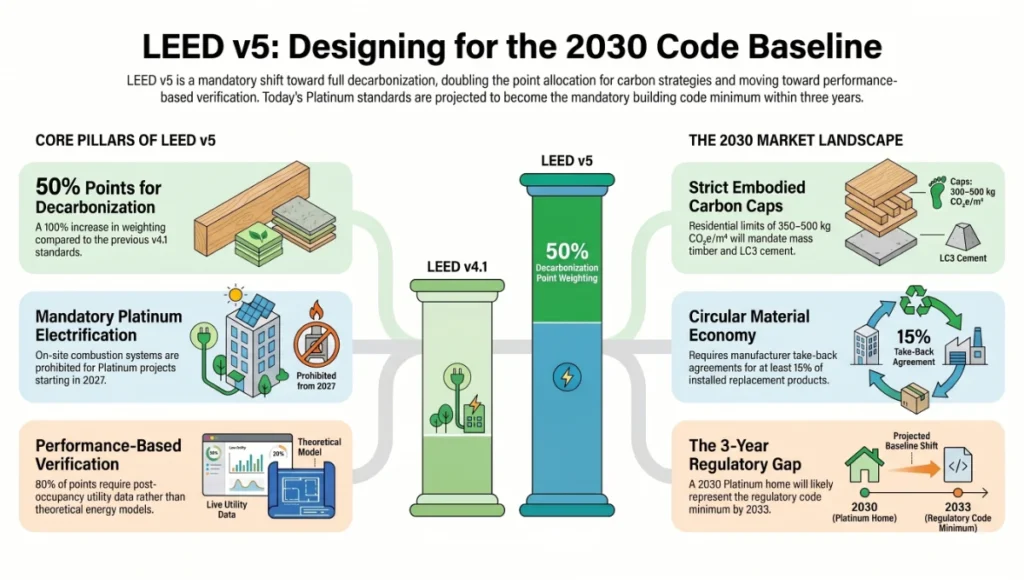
LEED v5, officially released in April 2025 and now mandatory for all new project registrations, signals a structural shift in what the certification demands. The transition is not cosmetic. 50% of all available points under v5 are tied directly to decarbonisation strategies — up from approximately 25% under v4.1. Full electrification is a Platinum prerequisite: no on-site combustion systems (except certified emergency generators) will be permitted on a Platinum-seeking project by 2027, when the v4.1 transition window closes.
By 2030, the following market conditions will define the residential certification landscape:
- Embodied carbon limits: LEED v5 introduces carbon caps on structural systems, estimated at 350–500 kg CO₂e/m² for residential typologies, pushing mass timber and LC3 cement from innovation to baseline specification
- Performance verification: 80% of LEED v5 points will be performance-based, not prescriptive — meaning post-occupancy utility data, not energy models, will determine credit achievement within 12 months of occupancy
- Social equity: New v5 prerequisites cover community resilience, equitable access to green space within 400 m, and supply-chain labour standards for material procurement
- Electrification mandate: Heat pump water heaters and all-electric HVAC systems will be non-negotiable for Platinum; gas connections will disqualify projects from the top tier
- Circular material economy: Take-back agreements with manufacturers for ≥ 15% of installed products by replacement volume will be required for full MR credit allocation
The residential developer who begins designing for LEED v5 Platinum today is not designing for a future certification — they are designing for a building code that several U.S. states and most Northern European jurisdictions will formalise by 2028. Denmark, the Netherlands, and Finland already embed embodied carbon tracking in national building regulations. The gap between LEED Platinum and regulatory minimum is closing at approximately 3–5 years per certification cycle. Your 2030 Platinum home is a 2033 code-minimum home. Start 3 years ahead.
Comprehensive Technical FAQ
Q: How many points does a residential project need to achieve LEED Platinum?
A: 80 points out of a maximum of 110 available under LEED v4.1 for Homes. Under LEED v5, the point threshold remains at 80, but additional Platinum prerequisites — full electrification, 100% renewable energy, and embodied carbon assessment — must be satisfied independently of the point total. Projects that score 80 points but fail a prerequisite do not achieve Platinum.
Q: What is the most common reason residential projects fall short of Platinum?
A: Under-investment in Energy & Atmosphere (EA), which offers 33 of the 110 available points. Projects that pursue only the minimum energy prerequisite (10% improvement over ASHRAE 90.1-2010) typically score 8–12 EA points. Platinum projects typically score 22–30 EA points, requiring enhanced commissioning, on-site renewable energy, and a heat-pump-only mechanical system. The gap between 12 and 22 EA points accounts for the majority of Gold-to-Platinum failures.
Q: Are EPDs (Environmental Product Declarations) mandatory for LEED Platinum residential?
A: Not universally mandatory, but practically unavoidable at the Platinum level. The MR credit for Building Product Disclosure requires ≥ 20 EPD-compliant products from ≥ 5 manufacturers for a single point. Product-specific, third-party verified Type III EPDs count as 1.5 products toward the 20-product threshold (USGBC Credit Library, 2024). To reach 80+ points, most residential teams need 8–12 MR points — which cannot be reliably achieved without an active EPD procurement strategy. Aim for 27+ EPD-compliant products to ensure exemplary performance credits are accessible.
Q: What HVAC system is most effective for achieving EA credits in a cold climate?
A: Air-to-water heat pumps with a coefficient of performance (COP) ≥ 3.5 at a -7°C design outdoor temperature, combined with a heat recovery ventilation (HRV/ERV) system achieving ≥ 75% sensible heat recovery efficiency. This combination, when paired with an R-60 roof assembly and R-38+ wall assembly, typically achieves 62–68% energy reduction over ASHRAE baseline — enabling 26–29 EA points and crossing the Platinum threshold on EA credits alone. Gas-fired systems are incompatible with LEED v5 Platinum prerequisites.
Q: What does the LEED Green Rater do, and when should one be engaged?
A: The LEED Green Rater is a third-party verifier licensed by a USGBC-approved LEED Residential Provider. They conduct 3–4 on-site verification visits during design and construction, verify all prerequisites and credits, conduct blower-door testing for air leakage verification, and submit the project application to GBCI (Green Business Certification Inc.) for final review. They must be engaged during the schematic design phase — before structural drawings are issued — to establish the preliminary rating and confirm which credits are technically achievable given the site, climate zone, and budget. Engaging a Green Rater after construction begins is one of the most common and costly errors in LEED residential projects.
Q: How much does LEED Platinum residential certification cost?
A: GBCI review fees range from $2,250 for small residential projects to $22,500+ for larger or complex multi-family projects. Registration fees add $900–$1,500. LEED Green Rater verification services typically cost $3,000–$8,000 depending on project size and number of site visits. Energy model commissioning adds $2,000–$6,000. Total third-party certification costs generally fall between $8,000 and $38,000 — before any design team premiums for Platinum-specific specifications. These costs are typically offset within 7–12 years through energy and water savings alone, not accounting for property value premiums.
Q: Can an existing residential renovation achieve LEED Platinum?
A: Yes. Major gut-rehab renovations — defined as projects stripping to the studs on at least 1 side of all external walls and the exterior ceiling to expose interstitial space — are eligible under LEED BD+C: Homes for both single-family and low-rise multi-family typologies. The Meadowlark Builders LEED Platinum renovation of a circa-1910 Victorian home in Ann Arbor, Michigan, demonstrates that even a structurally compromised pre-war building can achieve the top tier with a sufficiently comprehensive insulation, mechanical, and material upgrade. The key constraint: partial renovations — defined as projects not meeting the gut-rehab threshold — are not eligible for LEED certification under any rating system version.
Q: How does LEED Platinum compare to Passive House for residential projects?
A: They are complementary, not competing. Passive House (Passivhaus Institut standard) focuses exclusively on energy performance, mandating a heating demand ≤ 15 kWh/m²/year, primary energy demand ≤ 120 kWh/m²/year, and airtightness ≤ 0.6 ACH₅₀. LEED Platinum addresses a broader performance envelope: energy, water, materials, indoor quality, site ecology, and location. The House at Cornell Tech — winner of the LEED for Homes 2017 Project of the Year — achieved Passive House certification first, then used that performance foundation to achieve LEED Platinum, covering the material, water, and indoor quality credits that Passive House does not evaluate. For maximum residential performance, the dual-certification strategy — Passive House energy core + LEED Platinum holistic framework — is the benchmark configuration.
Engineer Your Platinum Score. Start at the Envelope.
The 80-point threshold is not a ceiling — it is the entry condition for the next generation of residential performance. Every LEED Platinum home you build or specify this year locks in a 30–60% energy reduction and a 30–45% water reduction for the next 50 to 100 years. Every EPD-compliant product you specify moves embodied carbon from opaque to measurable. Every blower-door result below 0.1 CFM₇₅ is a thermal boundary that your HVAC system no longer has to fight.
Your LEED platinum residential guide begins at the schematic design table, not at the certification portal. Engage your LEED Green Rater during design development. Set your EA target at 25+ points before the structural system is fixed. Source your concrete mix with an EPD before your foundation is poured. These are not administrative steps — they are load-bearing decisions that determine whether your project lands at 79 points (Gold) or 94 points (Platinum).
The built environment will not decarbonise without residential architecture leading the way. The LEED Platinum residential guide gives you the precision tools to make that leadership measurable, verifiable, and financially defensible. Use them.
© Nuvira Space All rights reserved. | ECO BLUEPRINT Series | All specifications cited are based on USGBC LEED v4.1 for Homes reference guides and credit library (2024), LEED v5 ratified prerequisites (USGBC, April 2025), GBCI certification fee schedules (2024), ASHRAE 90.1-2010 and 62.2-2019 standards, U.S. Department of Energy residential energy efficiency data, International Energy Agency Global Status Report 2024, and PVGIS solar irradiance database (EU Joint Research Centre, 2024). AIA High Performance Buildings case study library referenced for comparative benchmarking.
The Meridian Passive House is a speculative internal concept study and does not represent a completed project.
This article is part of our climate adaptive homes guide, the passive-first home base for cooling, retrofit, resilience, and certification.
1 thought on “LEED Platinum Residential Guide: 80+ Points Engineered”