


Table of Contents
Specification sections get written at the worst possible moment: the drawing set is late, the section is the last one open, and the product the design team liked has a data sheet instead of a declaration. What gets written in that hour determines whether a bio-based assembly performs or quietly reverts to the conventional product the contractor already knows — which is why the discipline below is about enforceable language rather than product preference.
Specifying bio-based assemblies on a live project — hempcrete walls, mass timber frames, mycelium partitions — demands a different specification discipline than conventional materials: performance language instead of brand names, EPD-gated submittals, substitution control that protects the carbon case, and verification closeout. This practitioner guide walks the full sequence, drawing on our comparison matrix for selection and our sourcing guide for procurement.
Nuvira Perspective
At Nuvira Space, we write specifications as enforceable instruments, not product brochures: every bio-based assembly that fails in the field failed first in vague language, unverified submittals, or unpriced substitutions. Our position, from the practitioner side of the table: performance values with EPD dates, or-equal clauses evaluated on numbers, and mockups before mass — the three habits that separate regenerative outcomes from green claims. What follows is the working method.
Spec-writing checklist for bio-based assemblies
Start every bio-based section with performance values: R-value or U-value targets, fire ratings with test references, vapor permeability ranges, and EPD conformance (EN 15804 or ISO 21930 scope) as acceptance criteria. Name products only as basis-of-design with or-equal clauses tied to those values — never as sole-source poetry. Require current-dated EPDs, chain-of-custody certificates, and test reports in submittals; hold mockups for assemblies installers have never touched. Close with verification: batch numbers logged, installed work matched to approved submittals, closeout package reconstructing harvest, EPD, and date per assembly.
Submittal review protocol
Review in cost-of-failure order. First, EPD validity and declared-unit match — expired or mismatched documents stop the review. Second, test currency for fire, moisture, and structural claims. Third, chain-of-custody completeness for feedstock assertions. Fourth, aesthetics and finish — last, deliberately. Log every decision with the performance delta recorded; substitutions evaluated on price alone are where carbon cases go to die, usually discovered two years later when nobody remembers approving them. Reject anything that cannot show its numbers; approve conditionally only with dated remediation attached.
Substitution evaluation matrix

| Criterion | Weight | Pass threshold |
|---|---|---|
| Performance values match | Eliminatory | R-value, rating, permeability equal or better with test references |
| EPD currency + scope | Eliminatory | Current-dated, matching declared unit and scope |
| Carbon equivalence | High | Lifecycle profile within approved band per project EPDs |
| Installer familiarity | Medium | Mockup required where crew lacks assembly history |
| Schedule impact | Medium | No critical-path delay without float cover |
| Cost delta | Low (evaluated last) | Considered only after all technical gates pass |
Cost evaluated last is deliberate: price-led substitution is the documented killer of bio-based carbon cases. Any substitution failing an eliminatory row is rejected regardless of savings — record the rejection with reasons so value engineering cannot quietly resurrect it two months later.
Technical deep dive
Material innovation: what a bio-based specification section actually has to contain
A bio-based specification section is not a conventional section with a different product name in it. It asks for evidence a conventional section never had to ask for, and that demand changes the anatomy of the section itself.
- Performance values replace product identity. Each assembly is specified by outcome — R-value or U-value, fire rating with the test reference and assembly listing, vapour permeability as a numeric range with direction — with the product named only as basis-of-design so the or-equal clause has a performance standard to test against rather than a resemblance to judge.
- EPD conformance is an acceptance criterion, not an appendix. Write the declaration requirement into the clause that governs acceptance, with the declared unit, scope (EN 15804 or ISO 21930) and a current validity window stated in the same sentence, so a submittal reviewer has one place to look and one standard to hold.
- Declared units are stated in the specification’s own terms. Bio-based products declare in cubic metres, square metres at a stated thickness or kilograms, and the section should name the unit it is buying in — because a unit mismatch invalidates a comparison even when both declarations are valid documents.
- Biogenic carbon claims carry their programme rules. Where a specification asserts sequestration or low-carbon performance for hemp, timber or straw, it names the accounting programme alongside the number, since the same material evaluated under different programme rules produces legitimately different figures.
- Custody requirements attach to the feedstock, not the brand. Chain-of-custody to harvest or feedstock origin is a submittal requirement for timber, straw and natural fibre assemblies, and contaminant screening is a submittal requirement for recovered streams — both belong in the section’s evidence list rather than in a covering letter.
- Test references are named, never implied. Fire, moisture and structural claims cite the test method and, in composite assemblies, the tested assembly listing — because familiarity with a product family does not transfer a rating from one build-up to another.
System integration
A specification is a coordination instrument as much as a purchasing document, and bio-based systems punish siloed coordination harder than conventional ones.
- Structural interfaces are declared at design development. Mass-timber connection zones, the lateral contribution of hemp-lime infill and partition loads from composite systems need to reach the structural engineer before the analysis closes — a specification cannot retrofit a load path into a model that never saw it.
- Service routing is resolved on the drawing, not at installation. Service cavity depths, penetration sealing protocols for vapour-open walls and locations for panelboards and ducts all depend on the assembly build-up, and the assembly the specification describes is the one the services have to fit inside.
- Humidity control sequence is part of the assembly. Where hygroscopic buffering is claimed as a design benefit, the mechanical sequence that assumes it is written into the specification’s coordination notes rather than left to commissioning.
- One assembly log carries the decisions. Interface details, substitution rulings and mockup outcomes belong in a single shared record reviewed at each phase gate, because coordination debt compounds exactly like technical debt — invisibly, and then all at once.
- Documentation obligations sit with named parties. Program documentation, product declarations and custody certificates should each name who produces them by when, so credit intent is documented during design development rather than reconstructed at documentation crunch.
- Tolerances are agreed before fabrication. Bio-based assemblies are tolerance-sensitive, and the deviation allowances in the specification should match what the fabricators and installers can actually hold rather than what a conventional section habitually states.
Construction workflow
The specification leaves the practice and becomes a site process, and the workflow around it decides whether the written performance survives to handover.
- Mockups happen before mass, after submittal approval. A signed mockup is the reference standard for texture, tolerance and finish, and it is where installer unfamiliarity surfaces cheaply instead of expensively.
- Submittals are reviewed in cost-of-failure order. Validity and unit match first, test currency second, custody completeness third, aesthetics last — deliberately, so an expired declaration never survives to the finish review.
- Batch records are captured at the gate. Delivery tickets matched to approved submittals and batch numbers logged against declaration validity windows on arrival, not at closeout when the paperwork is already incomplete.
- Substitutions are logged with their performance delta. A monthly review catches price-led swaps while they can still be reversed; an annual one catches them after the carbon case is gone.
- Concealed conditions are photographed before close-up. Bio-based assemblies hide their installation details behind finishes faster than conventional ones, and the photograph is the only record of what went inside the wall.
- Closeout reconstructs rather than asserts. The package should let a third party establish what was installed, from which feedstock, under which declaration, on which date — which is what makes the specification’s claims verifiable years later.
Comparative analysis: conventional specification versus performance specification
Both columns describe written specifications for the same building. They differ in what they treat as the object of the clause — the product, or the performance the product has to reach.
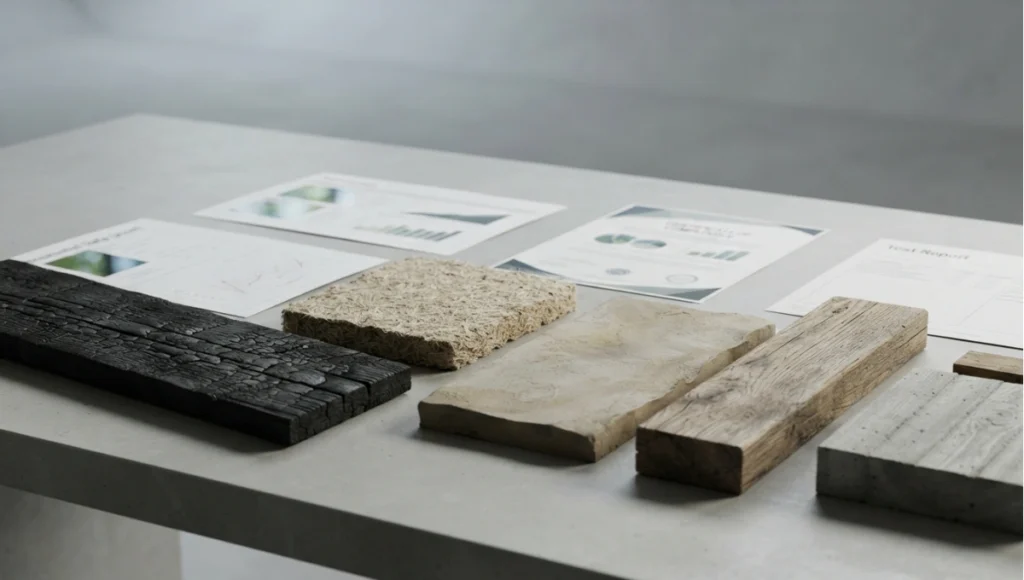
| Metric | Conventional | Nuvira Eco Blueprint | Delta |
|---|---|---|---|
| Basis of specification | Named manufacturer and product, with or-equal judged on resemblance and price | Performance values (R-value, fire rating with test reference, permeability range) with the product named only as basis-of-design | Direction: the clause becomes testable without naming a winner |
| Evidence standard | Data sheets, marketing literature and manufacturer assurances | Current-dated EPDs with matching declared unit and stated scope, plus custody and test documentation | Direction: acceptance turns on third-party evidence rather than confidence |
| Substitution control | Or-equal approved informally, judged on appearance and cost | Substitution log with the performance delta recorded, eliminatory gates applied before price is considered | Direction: value engineering cannot quietly delete an agreed performance |
| Coordination timing | Interfaces resolved as shop drawings arrive | Structural, service and humidity interfaces settled at design development and held in one assembly log | Direction: conflicts surface while they are still cheap to resolve |
| Installer unfamiliarity | Treated as the contractor’s risk to manage | Priced as a programme item: mockups, manufacturer representation for first runs, weighted inspection checkpoints | Direction: unfamiliarity is bought down at the mockup rather than at the punch list |
| Closeout record | Drawing set, warranties and a maintenance file | Reconstruction package: delivery tickets, batch numbers within validity windows, custody certificates, retained mockups, concealed-condition photographs | Direction: installed performance becomes auditable instead of asserted |
| Failure cost | Discovered at submittal, at installation or after handover | Front-loaded: documentation and mockup time spent early, against fewer reworks, substitutions and disputes | Direction: cost moves earlier, where it can still change the outcome |
The trade is real rather than rhetorical: this discipline costs specification time, mockup money and coordination effort in the first half of a project. The return arrives in the second half — submittals that hold their standard, assemblies that match their declarations, and a documentation package that survives its first audit intact.
LEED documentation map
LEED v4.1 integrates EPDs into Materials and Resources credits as a scoring factor; LEED v5, mandatory for registrations from July 2026, continues EPD-anchored credits in updated structures — confirm current credit language at specification time. Map each specified assembly to its credit contribution during design development, not at documentation crunch: EPD conformance per product, chain-of-custody per bio-based claim, and low-emitting verification where applicable. Equivalent mechanics under BREEAM, WELL, and DGNB follow the same discipline with different forms. Never promise credits in proposals; promise the documentation rigor that earns them.
Assembly examples from our reviews
Hempcrete walls: specify by R-value per inch, REI fire performance at stated thickness, and vapor-open finish systems — full data in our hempcrete review. Mass timber frames: panel thickness, char-rate fire design, and carbon arithmetic per our CLT guide. Bio-based partitions: species, lifespan, and moisture detailing per our mycelium review. Each example links performance values first, products second — the pattern to replicate.
Verification closeout: proving what was built
Closeout converts verified procurement into permanent record: delivery tickets matched to approved submittals, batch numbers logged against EPD validity windows, chain-of-custody filed, mockups retained as reference for punch-list disputes, concealed conditions photographed before close-up. The package should let a third party reconstruct exactly what was installed, from which harvest, under which EPD, on which date. Anything less converts verified procurement into unverifiable history — and history without evidence will not survive audit, dispute, or certification review.
Working with unfamiliar installers
Bio-based assemblies routinely meet crews installing them for the first time. Budget explicitly for it: pre-construction mockups with sign-off hold points, manufacturer technical representation for first runs, tolerance discussions framed as training rather than criticism, and inspection checkpoints weighted toward moisture detailing and air-barrier continuity — the two failure modes unfamiliar crews repeat. A crew trained on one hempcrete or mass-timber project becomes the local capacity the next project hires; treat training spend as market development, not overhead — the crew trained on this project becomes the qualified bidder pool the whole local market needs next.
When to walk away from a bio-based specification
Intellectual honesty requires exit criteria. Walk away — back to conventional assemblies — when: no current EPD exists and the schedule forbids the testing program to create equivalency; the authority having jurisdiction rejects the assembly and appeals exhaust; moisture exposure exceeds what detailing can credibly manage; or the only available supplier fails vetting with no qualified second source. Document the walk-away with the same rigor as a specification: failed bio-based specs teach the market, silent substitutions merely delay the lesson. Our sourcing guide holds the vetting sequence this decision executes.
Performance language patterns that survive submittals
Write clauses an inspector can enforce. State the value, the test reference, and the acceptance threshold in one sentence: insulation batt performance at stated R-value per inch per the cited test method, not “high-performance insulation”; fire performance as the required rating with the assembly listing referenced, not “fire-resistant material”; vapor permeability as a numeric range with direction, not “breathable wall.” Ban adjectives as acceptance criteria — “premium,” “sustainable,” and “high-quality” specify nothing and enforce less. Each performance clause should name its submittal (EPD, test report, mockup) in the same paragraph, so review has a single place to look and a single standard to hold. Number the performance requirements sequentially through each section — R-1 for thermal, F-1 for fire, M-1 for moisture, E-1 for environmental — giving reviewers, submitters, and inspectors a shared reference language that survives personnel changes.
Coordinating structure, envelope, and MEP around bio-based assemblies
Bio-based systems punish siloed coordination more than conventional ones. Structural engineers need early notice of mass-timber connection zones, hempcrete lateral-bracing contributions, and mycelium partition loads they did not model. MEP designers need service cavity depths, penetration sealing protocols for vapor-open walls, and humidity control sequences matched to hygroscopic buffering behavior. Convene the coordination review at design development with the assemblies on the table — late coordination discovers that the beautiful hemp wall has nowhere for the panelboard, and the fix is either ugly or late. Document decisions in one shared assembly log, not scattered emails — and review that log at every phase gate, because coordination debt compounds exactly like technical debt: invisibly, then all at once.
The practitioner’s standing orders
Pin these where specifications are written. Performance values with EPD dates, or the section stays unwritten. Or-equal clauses evaluated on numbers, never appearance or price. Mockups for everything unfamiliar, signed before mass. Substitutions logged with performance deltas, reviewed monthly. Closeout that reconstructs harvest, EPD, and date per assembly. And the standing veto: any product claim that cannot survive an EPD read, a supplier audit, and a greenwashing screen does not enter the building — regardless of who specified it, including the specifier.
Selling bio-based specifications to clients and teams
The practitioner’s hardest submittal is often internal: convincing owners, contractors, and authorities to accept unfamiliar assemblies. Argue in their currencies. Owners hear lifecycle cost, risk allocation, and certification outcomes — present EPD-backed carbon performance alongside maintenance and durability data, never as moral injunction. Contractors hear buildability: mockups, tolerances, sequencing clarity, and single points of technical contact. Authorities hear precedent and paperwork: test reports, code paths walked before, and peer jurisdictions’ acceptances. Never lead with planetary virtue in a budget meeting; lead with the performance values, verified supply, and documented risk controls that make virtue the safe choice.
Retrofit applications: bio-based systems in existing buildings
Retrofits reward bio-based systems disproportionately: vapor-open insulation for solid-wall upgrades, mycelium acoustic treatments where demolition is off the table, bio-based plasters over prepared substrates. The constraints invert from new-build — existing moisture loads, unknown substrates, occupied phasing — so lead with investigation (opening-up works, moisture mapping, services survey) before specification, and detail junctions where new bio-based layers meet old fabric, because that interface is where retrofits succeed or rot. Our retrofit-adjacent coverage informs the approach; the verification protocol stays identical.
Maintenance and lifecycle stewardship
Specification responsibility extends past handover: maintenance manuals written for bio-based realities (re-oiling schedules, limewash cycles, inspection points for moisture detailing), lifecycle performance reviews against EPD assumptions, and feedback loops from operations into the next specification. A material library that never learns from installed performance is a museum. Close every project with a lessons log — what the EPDs predicted, what the building delivered, what the next spec changes — and the practice compounds competence while competitors repeat first-principles mistakes. Share anonymized lessons with the teams that will specify after you: the bio-based transition is collective infrastructure, and every documented lesson shortens someone else’s learning curve. Specify well, verify relentlessly, publish the method.
How this guide was built: method note
Every procedure above derives from cited references and our linked technical reviews — LEED credit structures from current USGBC references, EPD mechanics from program documentation, assembly data from the spoke reviews with test conditions attached. Where our coverage is qualitative, the text says so; where figures appear, their source is named. No project anecdotes are invented here: the failure patterns described are composite lessons documented across industry literature on submittal failures, substitution disputes, and verification lapses. Treat this guide as a working method to adapt, not a memoir to admire — and report back discrepancies so the method improves.
Speculative / Internal Concept Study — Ledgerfield House — by Nuvira Space
Everything in this section is a speculative internal concept study. It is not a built project, it has no client, and every quantity below is a modelled concept target used to make the reasoning concrete — never a measured result.
Project overview
Ledgerfield House is a speculative two-storey infill building used here to demonstrate the specification protocol on a project small enough to see all of it at once: a mass-timber frame, hemp-lime infill to the exposed west wall, and bio-based partitions and finishes internally. The building is deliberately modest. The point of the study is not the assemblies — it is that a section written to the seven-row comparison above reads differently from one written the conventional way, on the same drawings, for the same client.

Design levers applied
- Performance values written before products: every assembly specified by R-value or U-value, fire rating with its test reference, and permeability range, with manufacturers named only as basis-of-design (concept target, not a measured result).
- Evidence obligations in the clause that governs acceptance: declared unit, scope and validity window stated in the same sentence as the acceptance criterion, so a submittal reviewer has one standard to hold (concept target, not a measured result).
- Interfaces settled at design development: mass-timber connection zones, service cavity depths and penetration sealing for the vapour-open wall resolved and logged before the structural analysis closed (concept target, not a measured result).
- Mockups as a priced programme item: hold points for the unfamiliar infill and partition assemblies with manufacturer representation on first runs, weighted inspection toward moisture detailing and air-barrier continuity (concept target, not a measured result).
- Substitution control held through construction: monthly log review with the performance delta recorded and eliminatory gates applied before cost is considered (concept target, not a measured result).
- Closeout that reconstructs the building: delivery tickets, batch numbers within validity windows, custody certificates, retained mockups and concealed-condition photographs handed over with the maintenance file (concept target, not a measured result).
Transferable takeaway
Take the ordering, not the assemblies. Write the performance standard before the product name, put the evidence requirement inside the acceptance clause, settle the interfaces before the analysis closes, buy down unfamiliarity at the mockup, hold the substitution line through construction, and hand over a package that lets a third party check the work. The same seven moves apply to a conventional material specified with unusual rigour — which is why the protocol travels further than the material families that prompted it.
2030 and beyond
Three projections, each about practice rather than products. First, performance-based specification should become ordinary rather than a bio-based speciality: once declarations are machine-readable and project-linked, writing a clause that tests a value rather than a brand becomes the cheaper option, and the discipline stops being a differentiator. Second, the assembly log should migrate from a document into project data, so a substitution ruling at one phase is visible at every later gate without anyone remembering to forward an email — which is the failure mode most substitution breaches actually rely on. Third, closeout registers may become a handover norm, with operators inheriting declarations and installed-performance records alongside the drawing set. None of this removes the specification judgement the method requires; all of it makes skipping the evidence more conspicuous than producing it.

Nuvira Space · Eco Blueprint
Specification clause builder
Pick the assembly and the performance dimension, and the builder returns the shape a clause has to take — the value, the reference, the threshold, and the submittal owed in the same paragraph. Then check the evidence list before the section leaves the office.
Clause builder result
Thermal — write the value, the reference and the threshold in one sentence
0 of 6 clause elements in place.
State the required thermal value at the stated thickness, cite the test method the value is measured by, set the acceptance threshold, and name the submittal that proves it — in the same clause. The product enters only as basis-of-design, so the or-equal clause has a number to test rather than a resemblance to judge.
Hemp-lime walls: specify by R-value per inch, fire performance at the stated thickness, and a vapour-open finish system. The permeability of the finish is part of the wall’s performance, not an aesthetic decision made later.
Red flag in the draft clause: an adjective standing in for a threshold. “High-performance”, “premium” and “sustainable” specify nothing and enforce less.
Orientation aid only. This builder shows the shape a performance clause takes and the evidence it owes; it is not model specification text, does not replace project-specific code and programme requirements, and must be reviewed by the responsible specifier before use. © Nuvira Space. All rights reserved. | ECO BLUEPRINT Series.
Frequently asked questions
Part of our sustainable building materials guide — selection, verification, and specification across fourteen bio-based families.
Q: How do I start specifying bio-based materials with no prior project experience?
**A:**Begin with one assembly on a real project — a hempcrete infill wall, a CLT floor, a mycelium partition package — specified with performance values, vetted suppliers, and a mockup. One verified assembly teaches more than ten studied ones.
Q: What EPD should I ask for first?
**A:**The product-stage EPD (A1–A3 minimum) with matching declared unit and current validity, conforming to EN 15804 or ISO 21930 scope — then expand to transport, use, and end-of-life modules where the EPD provides them.
Q: How do I handle a client who wants the aesthetic without the cost?
**A:**Separate looks from performance in writing: show which cost lines buy carbon, durability, and health outcomes versus appearance, and let value decisions happen against that breakdown rather than against lump sums.
Q: Can small firms run this protocol, or is it enterprise-only?
**A:**Scaled down, yes: current EPDs on top-impact materials, one reference call per supplier, mockups for the unfamiliar, batch numbers at delivery — the same discipline, fewer line items.
Q: What fails most often in bio-based submittals?
**A:**Expired EPDs, mismatched declared units, missing chain-of-custody, and price-led substitutions — reviewed cheapest-first in the protocol above.
Q: How do LEED v4.1 and v5 differ for materials documentation?
**A:**v4.1 integrates EPDs into Materials and Resources credits; v5 continues EPD-anchored credits in updated structures and is mandatory for registrations from July 2026 — confirm current credit language per project.
Q: When should mockups happen?
**A:**Before mass, after submittal approval, with sign-off hold points — mockups are where installer unfamiliarity surfaces cheaply instead of expensively.
Q: How do I keep up as standards and products evolve?
**A:**Calendar discipline: re-verify EPD validity windows, program rule revisions, and credit language at each project start; subscribe to program-operator updates rather than relying on memory; and treat this guide plus our matrix and sourcing pages as living references — version currency notes mark what moves fastest.
Q: What is the minimum viable bio-based specification for a conventional practice?
**A:**One assembly, fully verified: performance values, current EPDs, vetted supplier, mockup, batch logging. A single verified hempcrete wall or CLT floor teaches the whole protocol and de-risks the second project. Start narrow, verify completely, expand deliberately.
Practitioner directory
Select in our comparison matrix; verify supply in our sourcing guide; detail hempcrete in our insulation review, timber in our CLT guide, and bio-composites in our mycelium review.
Explore the Eco Blueprint archive
Explore the Eco Blueprint archive → eco-blueprint
© Nuvira Space All rights reserved.| ECO BLUEPRINT Series | All specifications cited are based on publicly available research. Ledgerfield House is a speculative internal concept study and does not represent a completed project.