

Table of Contents
Every year, the global flooring industry installs more than 20 billion square feet of material into residential and commercial interiors. Of that, the split between hardwood vs engineered wood flooring accounts for one of the most consequential — and most misunderstood — decisions a property owner will make. Not because one is objectively superior, but because buyers are routinely given oversimplified marketing copy when what they actually need is a precision map of performance variables across installation context, climate zone, and time horizon.
In Singapore, where mean annual relative humidity sits above 80%, a specifier who installs solid hardwood in a riverfront apartment is not making a design decision — they are scheduling a future crisis. In Copenhagen, where radiant underfloor heating is the norm in 60% of modern residential builds, the thermal cycling that occurs across a seasonal spread of 45°C demands a flooring material with dimensional stability engineered into its molecular structure. These are not edge cases. They are the rule for most of the world’s inhabited climate zones.
The question is not whether hardwood or engineered wood is “better.” The question is: better at what, under which conditions, across what time horizon, and for whom? This article gives you the structural data to answer that question with precision rather than preference.
Nuvira Perspective
At Nuvira Space, we have stopped treating the floor as a surface. We treat it as a sensory interface — the one element of the built environment that interacts with the human nervous system through every waking hour of domestic life. The foot, with its 200,000 sensory nerve endings per square inch, is continuously transmitting data about texture, temperature, acoustic resonance, and structural rigidity. The material underfoot is not aesthetic background. It is neurological signal.
Our framework is grounded in the synthesis of spatial psychology, materials science, and circadian biology. The home of 2026 is not a shelter — it is a health machine. And within that machine, the floor is the primary haptic layer: the tactile membrane through which human biology interfaces with built space. That framing changes how we evaluate flooring entirely.
In the hardwood vs engineered wood flooring debate, we are not asking which looks more expensive in a showroom photograph. We are asking which material more reliably sustains the biological quality of the space across its full operational lifespan. Which maintains thermal consistency to support circadian rhythm lighting systems without cold-floor stress response at 6 AM? Which resists the acoustic artifacts — hollow resonance, micro-vibration amplification — that increase cortisol in work-from-home environments? Which allows the biophilic integrity of visible wood grain to persist over 30 years without catastrophic delamination?
These are the questions Nuvira Space asks before any floor specification reaches a floor plan.
Technical Deep Dive
Material Anatomy: What Each Floor Is Actually Made Of
Before performance data can be interpreted, construction must be understood at the structural level. These two materials share a visual category but belong to distinct engineering disciplines.
Solid Hardwood: Structural Specifications
- Composition: Single milled timber plank, one species, no adhesive bonding
- Thickness: Standard 3/4 inch (19mm) — the full structural depth
- Width range: 2.25 inches to 7 inches; narrower boards show less movement
- Refinishing depth: 4–10 sanding cycles across 80–100 year lifespan
- Species hardness (Janka rating): Oak 1290 lbf · Maple 1450 lbf · Hickory 1820 lbf · Brazilian Cherry 2350 lbf
- Hygroscopic behavior: High — wood cells absorb and release moisture freely
- Moisture tolerance: Relative humidity must be maintained at 35–55% for dimensional stability
- Subfloor compatibility: Wood subfloor only; not suitable for concrete slabs or below-grade
- Radiant heat compatibility: Incompatible above 27°C surface temperature
- Material cost range: $5–$28 per square foot depending on species and grade
Engineered Wood: Structural Specifications
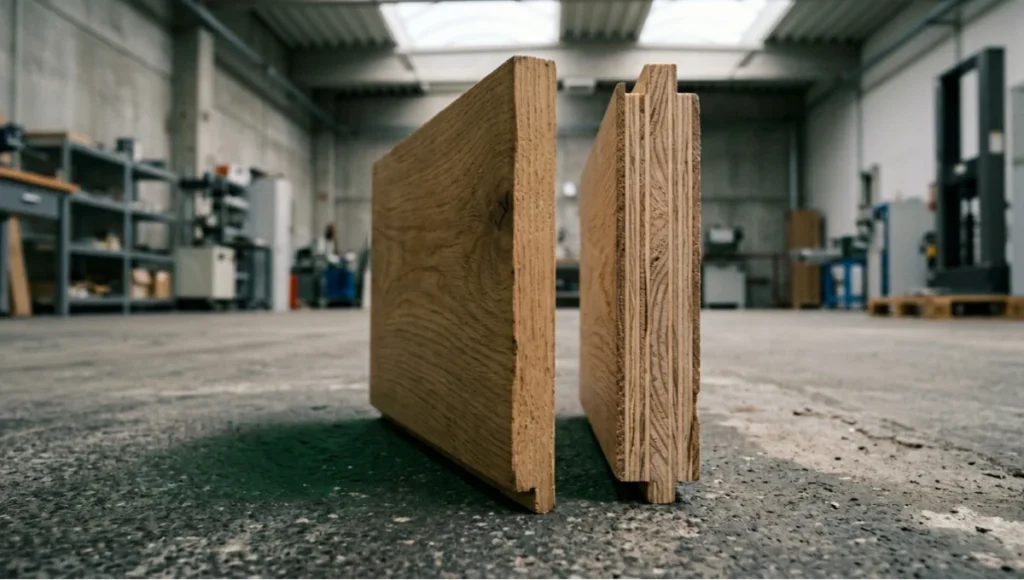
- Composition: Real hardwood veneer bonded to cross-grain plywood or HDF core under heat and pressure
- Core layer count: 5–12 plies arranged in opposing grain directions
- Total thickness: 10–20mm; veneer layer 0.6mm–6mm
- Refinishing potential: 0 cycles (thin veneer <2mm) · 1–2 cycles (2–4mm) · 3+ cycles (4mm+)
- Dimensional stability: Superior — cross-grain core construction reduces seasonal movement by 60–75% vs solid
- Moisture tolerance: Extended range; optimal at 30–60% RH; waterproof variants available
- Subfloor compatibility: Wood, concrete, and below-grade installations
- Radiant heat compatibility: Most engineered products approved for systems up to 29°C surface temperature
- Width availability: Up to 9–12 inch planks; wider formats structurally stable unlike solid
- Material cost range: $4.50–$16 per square foot; premium collections comparable to solid
| KEY TECHNICAL INSIGHT The dimensional stability of engineered wood is not a cosmetic feature — it is an engineering outcome of cross-grain lamination physics. When one layer expands with moisture absorption, adjacent layers oriented at 90° resist the movement. The result is a net movement rate of 1–2mm per 1% RH change, versus 3–5mm for the equivalent solid plank. In a 200sqft room, this translates to 18–36mm of cumulative floor movement across seasonal cycles — enough to cause gapping, cupping, or finish fracture in solid wood, but negligible in a 9-ply engineered substrate. |
Acoustic and Thermal Performance
Floor material selection has measurable impact on acoustic and thermal behavior — two factors with documented neurological consequences in residential environments.
Acoustic Behavior
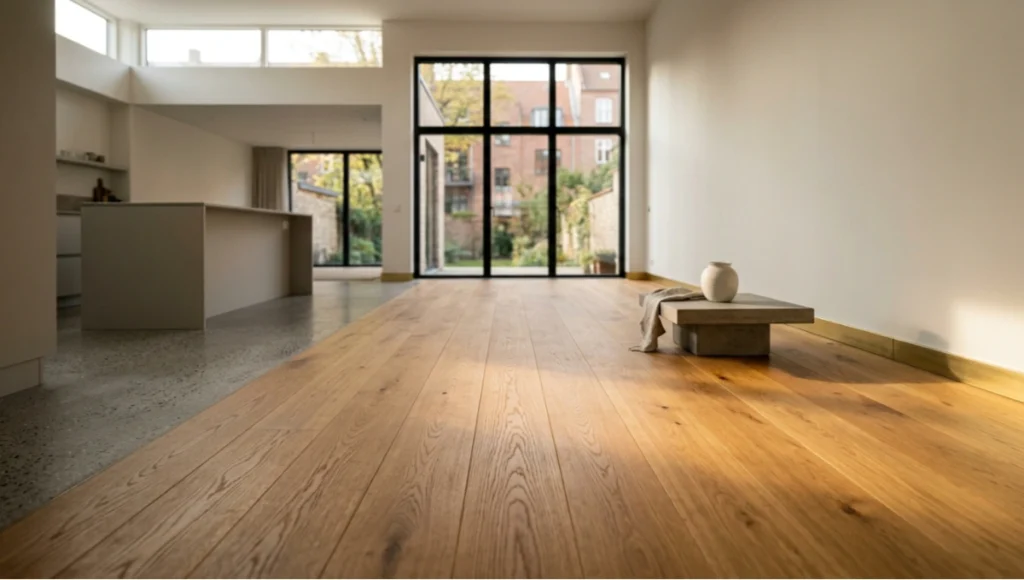
Solid hardwood, nailed directly to a structural subfloor, produces a dense, low-resonance acoustic profile. Impact sound transmission (IIC rating) for solid hardwood over wood subfloor averages 45–52, depending on installation method. This is suitable for ground floor residential applications but insufficient for multi-storey buildings without acoustic underlayment. For home office configurations, acoustic insulation design strategies should be specified alongside any wood floor selection to prevent the low-frequency resonance that elevates cortisol during focused work periods.
Engineered wood in floating installation introduces an air cavity between floor and subfloor, which can increase hollow resonance — the phenomenon Nuvira Space references as acoustic cortisol: the low-frequency vibration feedback that elevates stress response during high-footfall periods. However, glue-down engineered installation eliminates this effect, delivering acoustic performance equivalent to solid hardwood at IIC 48–55 with comparable underlayment systems.
Thermal Interface Performance
At 6 AM, the barefoot contact temperature of a flooring surface is a circadian trigger — cold floor contact activates sympathetic nervous system arousal regardless of ambient air temperature. Solid hardwood, with its high thermal mass and natural wood conductivity, delivers a surface temperature typically 2–4°C above ambient in winter conditions. Engineered wood over radiant heating reaches thermal equilibrium faster due to thinner substrate — critical for circadian comfort systems where morning warm-up cycles are programmed to align with the occupant’s wake window.
Comparative Analysis: Solution vs. Industry Standard
Seven Performance Variables — Measured, Not Marketed
The flooring industry defaults to narrative marketing. Nuvira Space defaults to performance matrices. The following analysis maps both materials across the seven variables that determine real-world outcomes in residential and light commercial environments.
| Factor | Solid Hardwood | Engineered Wood |
|---|---|---|
| Lifespan (well-maintained) | 80–100+ years | 25–80 years (veneer-dependent) |
| Refinishing cycles | 4–10 cycles | 0–4 cycles (by veneer thickness) |
| Moisture tolerance | Low — 35–55% RH strict | Moderate-High — 30–60% RH |
| Installation locations | Above-grade, wood subfloor only | All grades, concrete, below-grade |
| Radiant heat compatible | No (above 27°C) | Yes (most, up to 29°C) |
| Material cost (per sqft) | $5–$28 | $4.50–$16 |
| Width format flexibility | Up to 7 inches | Up to 12 inches |
| Dimensional stability | Low — seasonal movement 3–5mm/1%RH | High — movement 1–2mm/1%RH |
| Resale value impact | High — buyers pay premium | Moderate-High — premium for thick veneer |
| Carbon footprint | Higher — solid timber use | Lower — less old-growth timber per sqft |
Where the Industry Gets It Wrong
The standard industry narrative presents solid hardwood as the premium choice and engineered wood as the “compromise” for budget-constrained buyers or awkward installations. This framing is functionally incorrect and commercially misleading for the following reasons:
- Premium engineered products with 4mm+ veneers cost the same as entry-level solid hardwood and deliver superior performance in 70% of real-world climatic conditions
- Resale perception is shifting — buyers in high-humidity markets now recognize engineered wood as the technically superior specification
- The 100-year lifespan of solid hardwood is real but irrelevant in markets where residential renovation cycles run 15–25 years
- Wide-plank solid hardwood (7″+) shows exponentially higher seasonal movement — a premium aesthetic that often delivers degraded structural performance
- Biophilic value — the primary psychological benefit of wood flooring — is delivered equally by both materials; the brain’s stress-reduction response to visible wood grain does not discriminate between solid and engineered substrates
The Nuvira Specification Framework
Rather than recommending one over the other categorically, Nuvira Space applies a conditional specification matrix:
- Install solid hardwood when: heritage restoration requires material authenticity · climate is stable and dry · building is above grade with wood subfloor · 100-year stewardship horizon is the owner’s stated intent
- Install engineered wood when: installation is on or below concrete grade · radiant heating is present or planned · climate zone delivers >15% annual RH variance · plank width aesthetic preference exceeds 5 inches · renovation cycle is 15–30 years
- Specify premium veneer (4mm+) in any engineered specification where refinishing is anticipated beyond year 15
Concept Project Spotlight
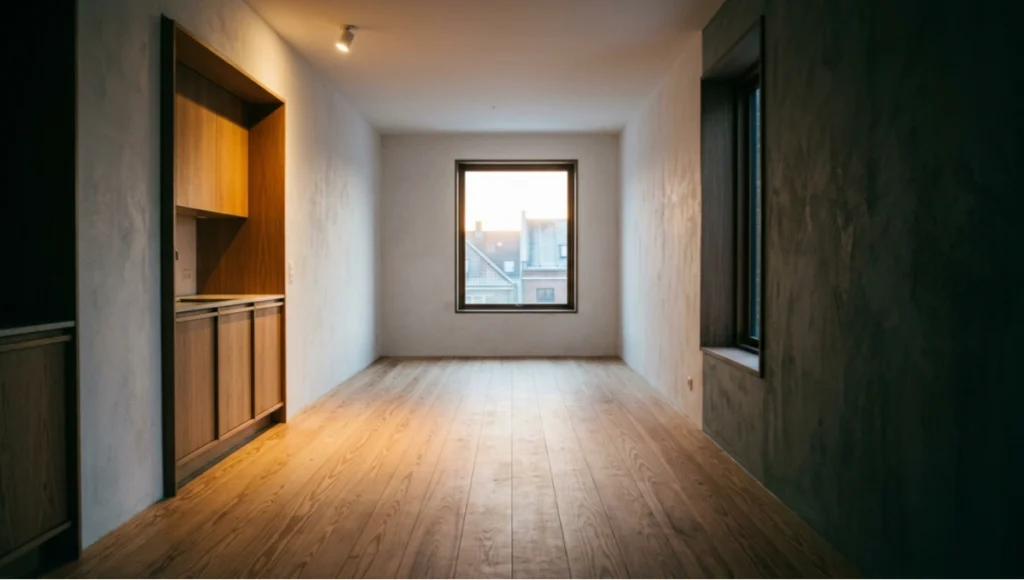
Speculative / Internal Concept Study — “The Copenhagen Thermal Floor Project” by Nuvira Space
Project Overview
- Location: Copenhagen, Denmark — a North Atlantic climate with mean winter temperature of 0°C and summer peaks of 22°C, producing a 45°C annual thermal range
- Typology: 95sqm second-floor apartment, concrete slab subfloor, hydronic radiant heating system installed at 2021 renovation
- Vision: To demonstrate how engineered wood flooring, specified to clinical precision, can function as a circadian health layer — not merely a decorative surface — within a northern climate high-performance domestic envelope
Design Levers Applied
Material Specification
- Product: 15mm engineered white oak, 4.2mm veneer, 9-ply Baltic birch core
- Width: 220mm (8.6″) — wide plank format only possible with engineered construction at this stability level
- Finish: UV-cured hardwax oil, 12% sheen — selected for biophilic matte texture that amplifies wood grain legibility at low circadian-light levels
- Installation method: Full-spread urethane adhesive over radiant-heated concrete — eliminates hollow resonance, maximises thermal conductivity to floor surface
Circadian Interface Design
- Morning warm-up protocol: Radiant system programmed to reach 22°C floor surface by 06:30 — reduces cold-floor sympathetic arousal
- Timber tone selection: Light-spectrum oak (Kelvin correlation 2900K visual warmth) — calibrated to reinforce amber morning light from east-facing windows
- Acoustic treatment: 3mm cork underlayment on perimeter 15% of floor area — attenuates impact transmission to lower-floor occupants without compromising central thermal performance
Biophilic Integration
- Grain orientation: Planks run perpendicular to primary sightline from kitchen to living — creates visual depth cue that expands perceived spatial volume. For a deeper exploration of how wood surfaces and natural material palettes affect spatial psychology, see Nuvira Space’s guide to biophilic interior design
- Texture continuity: Same oak species used in kitchen cabinetry and bedroom door frames — creates material echo that reduces cognitive load of moving between zones
Transferable Takeaway
You can apply the same logic at home by tuning evening lighting toward amber-spectrum sources that complement the warm undertone of your wood floor, building a refuge corner with a visually grounded anchor surface in natural oak or walnut, and simplifying one primary sightline toward a natural anchor — whether a window, a textured wall, or a low piece of furniture — so the eye finds rest rather than stimulation when you enter the room.
Intellectual Honesty: Current Limitations
Any evidence-based analysis of hardwood vs engineered wood flooring must acknowledge what the data cannot yet fully resolve:
- Long-term veneer delamination data for engineered floors beyond 40 years is sparse — most product categories are not old enough to produce statistically valid failure-rate studies
- The biophilic response literature, while robust in demonstrating the stress-reduction benefit of visible wood grain, has not systematically differentiated between solid and engineered substrates in controlled neurological studies
- Carbon lifecycle analysis for wood flooring remains contested — solid hardwood sequesters more carbon per unit but requires more old-growth or managed timber per installation than engineered formats
- Waterproof engineered products (HDF core, sealed edges) eliminate the primary moisture concern but introduce a new variable: the acoustic behavior of fully sealed floating systems in multi-storey residential buildings is not yet standardised in most building codes
- Resale value data for engineered wood has historically lagged solid hardwood, but this premium gap is narrowing in high-performance real estate markets — the trajectory, not the current figure, is the relevant metric for anyone installing today
2030 Future Projection
The hardwood vs engineered wood flooring landscape of 2030 will be defined by three convergent forces:
1. Acoustic Intelligence
Engineered wood panels with embedded acoustic dampening layers — 1–2mm viscoelastic polymer integrated between plies at manufacture — will deliver IIC ratings above 65 without separate underlayment. This eliminates the floating-floor hollow resonance problem entirely and makes engineered wood the acoustic specification of choice for multi-storey residential and hybrid work environments.
2. Thermal-Responsive Veneers
Phase-change material (PCM) integration at the veneer-core interface — already in prototype testing in German building science labs — will allow engineered floors to absorb thermal energy during peak radiant heat periods and release it gradually, functioning as passive thermal mass without the weight penalty of stone or concrete. The floor becomes a thermal battery integrated into the circadian health system of the home.
3. Biological Traceability
Consumer demand for chain-of-custody verification of timber origin will accelerate adoption of blockchain-tracked wood provenance, where every plank can be verified to a specific managed forest parcel. This transparency will close the perceived “authenticity gap” between solid and engineered products — the final market barrier to full commercial parity between the two categories.
Actionable Design Principles
Hardwood Specification:
6 Essential Design Principles
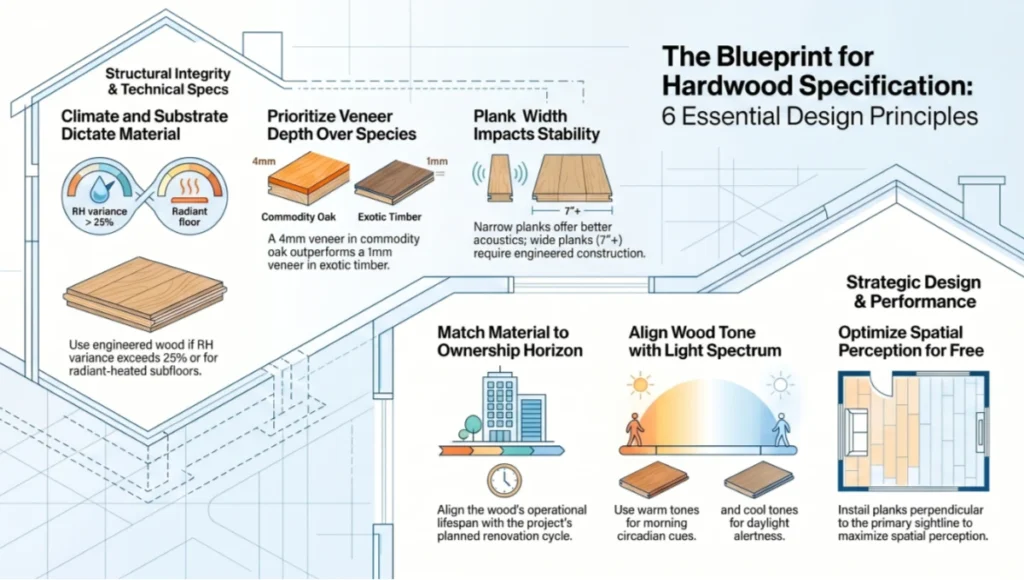
Apply these seven principles before any flooring specification reaches your contractor or procurement list:
- Map your climate zone first — obtain your local annual relative humidity variance before choosing a product category. If your RH spread exceeds 25% across seasons, engineered wood is the structurally rational choice regardless of budget.
- Specify veneer thickness before species — for engineered wood, a 4mm veneer in a commodity oak species will outperform a 1mm veneer in an exotic timber. Veneer depth is the primary longevity variable.
- Decide your time horizon — a 30-year renovation cycle does not require a 100-year solid hardwood floor. Match the material’s operational lifespan to your actual ownership horizon.
- Audit your subfloor — concrete slab, below-grade, and radiant-heated substrates are disqualifying conditions for solid hardwood. If one of these applies, the specification decision is already made.
- Choose plank width for acoustic, not aesthetic, reasons first — narrow planks (2.5–4″) deliver better acoustic grounding and dimensional stability; wide planks (7″+) require engineered construction to avoid cupping.
- Align wood tone with your light spectrum — warm-toned floors (amber oak, honey walnut) reinforce circadian amber cues in morning light; cool-toned floors (ash, birch) amplify daylight-spectrum alertness during work hours.
- Install perpendicular to your primary sightline — regardless of material, plank orientation relative to the room’s main axis of travel is the single highest-leverage spatial perception variable available at zero additional cost.
Comprehensive Technical FAQ
Q: Is engineered wood flooring as durable as hardwood?
A: Under most real-world conditions, yes — with a critical caveat about the definition of “durable.” Solid hardwood with a 3/4″ thickness can be refinished 4–10 times and has documented lifespans exceeding 100 years. Premium engineered wood with a 4mm+ veneer can be refinished 3–4 times and achieves a lifespan of 40–80 years. For installation contexts involving moisture, temperature cycling, or below-grade positioning, engineered wood delivers superior durability because solid hardwood will not survive those conditions structurally, regardless of its theoretical lifespan. Durability must always be evaluated within the specific installation environment, not in the abstract.
Q: Which is more precise for commercial or high-specification residential applications?
A: Engineered wood offers significantly greater specification precision for three reasons:
- Width formats up to 12″ are dimensionally stable, enabling large-format design grids impossible with solid hardwood
- Radiant heat compatibility allows integration with building management systems and circadian HVAC programming
- Consistent pre-finished surface tolerances (±0.1mm thickness) across production batches reduce installation variation in high-volume projects
Q: What should I look for in the veneer layer of engineered wood?
A: The veneer layer is the single most important quality variable in an engineered floor. Evaluate:
- Thickness: minimum 2mm for light-use residential; 3mm for high-traffic or planned refinishing; 4mm+ for commercial or multi-generational residential
- Species Janka hardness: above 1000 lbf for areas with rolling loads or high footfall
- Finish type: aluminum oxide for maximum scratch resistance; hardwax oil for biophilic texture and repairability
- Edge treatment: micro-bevel or square edge — avoid deep bevels in high-humidity environments where moisture can infiltrate the seam
Q: Can engineered wood be installed over radiant heating?
A: Yes — most engineered wood products are approved for radiant heat systems with a maximum surface temperature of 27–29°C. The cross-grain plywood core resists the thermal cycling that causes solid wood to gap or cup. Key requirements: the radiant system must be brought up to operating temperature gradually (2°C per day) before floor installation; the floor must never be heated from cold to operating temperature in less than 72 hours after installation; and hydronic systems are preferred over electric mat systems due to more uniform heat distribution.
Q: How does humidity affect each type of flooring?
A: Wood is a hygroscopic material — it absorbs and releases atmospheric moisture throughout its lifetime. The critical difference between solid and engineered construction is the rate and magnitude of the resulting dimensional change:
- Solid hardwood: 3–5mm movement per 1% RH change across the width of each plank
- Engineered wood: 1–2mm movement per 1% RH change — cross-grain lamination resists expansion in opposing directions simultaneously
- Practical consequence: in a 4m wide room with 15% seasonal RH variance, solid hardwood may move 45–75mm cumulatively; engineered wood moves 15–30mm — the difference between visible gapping and acceptable seasonal behavior
For Singapore, Bangkok, or Miami climates, where RH consistently exceeds 70%, engineered wood is the only wood-category product that maintains structural integrity without active dehumidification to clinical precision.
Q: Which option has a better return on real estate investment?
A: Solid hardwood has historically commanded a resale premium of 3–5% on residential properties, particularly in North American markets where buyers associate solid hardwood with construction quality. However, three factors are shifting this equation:
- High-humidity coastal and tropical markets increasingly recognize engineered wood as the technically superior specification — the premium gap has narrowed to <1% in Singapore, Hong Kong, and Miami luxury residential data
- Buyers under 45 show reduced preference for the “lifetime floor” narrative — renovation frequency in this demographic is 15–25 years, making the 100-year lifespan of solid hardwood a marketing point, not a purchase driver
- Premium engineered products (5mm veneer, wide plank, live-edge or wire-brushed finish) now photograph identically to solid hardwood, eliminating the visual differentiation that previously drove showroom preference
Q: What maintenance regime does each material require?
A: Maintenance requirements differ primarily in what damages each material most severely:
- Solid hardwood: greatest risk is moisture infiltration — clean spills immediately; use only dry or barely damp mopping; maintain 35–55% RH year-round with humidifier/dehumidifier as needed
- Engineered wood: greatest risk is surface abrasion of the veneer — use felt pads on all furniture legs; avoid rubber-backed rugs that trap humidity; re-coat with manufacturer-approved finish oil every 3–5 years for hardwax-oil finished floors
- Both: vacuum or dry sweep weekly; avoid steam mopping on any wood flooring; use pH-neutral cleaner diluted per manufacturer specification for damp cleaning
Q: Are there established professional standards for specifying wood flooring in commercial projects?
A: Yes. The American Institute of Architects (AIA) publishes specification guidelines and case studies for interior finish selections in commercial and institutional projects, including floor material durability standards. The National Wood Flooring Association (NWFA) provides technical installation and maintenance standards referenced by architects, interior designers, and general contractors across North American commercial projects. Both bodies publish freely accessible technical resources that complement the performance data in this article.
Your Floor Is a Decision About Your Biology, Not Just Your Budget
The hardwood vs engineered wood flooring question is, at its structural core, a materials science question that intersects with spatial psychology, climate engineering, and long-term asset management. Answering it well requires a specification framework — not a showroom preference.
If you install solid hardwood in a humid coastal city, you are not choosing luxury — you are scheduling structural remediation within a decade. If you install budget engineered wood with a 0.6mm veneer in a family home you plan to own for 30 years, you are specifying a product that will not survive its context. Precision, in flooring, is not a premium feature. It is the baseline requirement for any floor that will actually perform.
At Nuvira Space, we build specification frameworks that match material performance to climate data, occupancy pattern, neurological objective, and ownership horizon simultaneously. The result is a floor that is not just beautiful — it is calibrated. If you are ready to specify your floor with the precision your space deserves, start with the data in this article, and use it as the filter every specification should pass through before a single plank is ordered.
| NUVIRA SPACE — LIVING SPACES SERIES Your home is not a backdrop. It is a biological instrument. Every specification decision — material, dimension, orientation, finish — is a tuning variable. Tune deliberately. |
© Nuvira Space All rights reserved | LIVING SPACES Series | All specifications cited are based on published data from the National Wood Flooring Association (NWFA), manufacturer technical datasheets (Bruce Flooring, Robbins Hardwood, Floordi), peer-reviewed environmental psychology research on biophilic response to wood surfaces, the American Institute of Architects (AIA) interior finish specification guidelines, and climate data from the Danish Meteorological Institute (Copenhagen case study). The Copenhagen Thermal Floor Project is a speculative internal concept study and does not represent a completed project.