


Table of Contents
You stand at the edge of a paradox the modern city refuses to name out loud: every crane that lifts a beam into a gleaming skyline is, in the same motion, dragging a diesel-bound supply chain through streets never designed to absorb it. Decarbonized construction logistics is not a marketing phrase invented to soften that contradiction — it is the operating system a city must install if it intends to keep building without strangling the air its residents breathe.
For decades, urban growth and urban decay have arrived in the same convoy: cement trucks, flatbeds, and diesel generators idling outside half-finished towers, normalized as the unavoidable cost of progress. That normalization is the dystopia you have been asked to accept. It does not have to be the one you inherit.

Notice who actually absorbs that normalization. It is the resident on the third floor above the staging lane, the schoolchild walking past the idling fleet at eight in the morning, the delivery driver paid by the trip and therefore incentivized to run the engine rather than wait quietly. The dystopia of unmanaged construction logistics has never been distributed evenly, and a critical reading of the modern skyline has to start there — not with the architecture, but with the bodies standing closest to the exhaust while the building rises above them.
KEY TAKEAWAYS
- Decarbonized construction logistics is governed by twelve engineering KPIs, spanning fleet, material, and hub-level performance.
- Rotterdam’s Zero-Emission Zone, paired with urban consolidation centers, cut freight emissions inside the cordon by roughly 90 percent in simulation studies.
- Singapore’s DfMA mandate is pushing off-site prefabrication toward 70 percent of gross floor area, removing site-bound freight trips at the source.
- The dominant barrier is rarely technical — it is the political willingness to price logistics emissions into procurement and permitting.
- Nuvira Space treats construction logistics as civic infrastructure, not a contractor’s line item.
Nuvira Perspective
At Nuvira Space, you are not reading a sustainability newsletter. You are reading the working notes of a practice that treats the metropolitan fabric as a single, recalibratable system — one where human movement, machine logistics, and material flow are designed together rather than reconciled after the fact. Our authority on this subject does not come from advocacy; it comes from refusing to separate “construction” from “city” in the first place.
A delivery truck idling outside a site is not a contractor’s externality — it is urban infrastructure failing in public, in front of the people who live with the consequence. When we describe human-machine synthesis, we mean the literal choreography of autonomous freight, electrified fleets, and human site labor sharing the same streets without one degrading the other. That is the lens through which the rest of this analysis is written: not as commentary on the construction industry, but as a recalibration of the city it builds. We measure success less by the polish of a rendering than by whether the street outside it remains breathable while construction is underway, and that priority shapes every recommendation that follows.
The “Blueprint” Solution
If the dystopia is the unmanaged convoy — trucks queuing outside a gate, exhaust pooling at pedestrian height, deliveries timed by guesswork instead of design — the blueprint is the choreography that replaces it. You do not decarbonize construction logistics with a single technology or a single mandate. You decarbonize it the way an engineer tunes a system: by isolating each variable, setting a target for it, and holding the whole assembly accountable to the sum of its parts. What follows are the twelve variables that matter most, grouped by where each one acts on the city.
Fleet and Mobility KPIs
The vehicles themselves are the most visible lever, and the easiest one for a city to mandate outright.
Fleet Electrification Rate — the share of construction-logistics vehicles operating on battery or hydrogen drivetrains. Cities piloting zero-emission freight zones increasingly treat 100 percent within the cordon as the non-negotiable floor, not an aspiration.
Modal Shift Ratio — the proportion of bulk material tonnage moved by rail, barge, or inland waterway instead of road. Every percentage point shifted off asphalt removes a corresponding slice of corridor congestion and curb-side exhaust.
Empty-Running Coefficient — the share of vehicle-kilometers driven with no payload. Logistics planners treat anything above one-fifth of total mileage as a routing failure, not an unavoidable cost of doing business.
Last-Mile Delivery Density — deliveries completed per vehicle-kilometer inside the final urban mile. Density rises sharply once consolidation hubs replace direct-to-site dispatch from dozens of individual suppliers.
Why Electrification Outpaces Modal Shift in Dense Cores
In a sprawling logistics corridor, rail and barge can absorb tonnage that trucks would otherwise carry. Inside a dense urban core, that option frequently does not exist — there is no siding, no berth, and no room to build one without demolishing the very fabric you are trying to protect. Electrification becomes the default lever not because it is the most efficient option on paper, but because it is the only lever the geometry of the city actually allows.
Material and Site KPIs
The second cluster moves the question off the road entirely, asking how much freight a project generates before a single truck is dispatched.
Off-Site Prefabrication Index (DfMA Adoption Rate) — the share of gross floor area manufactured off-site under Design-for-Manufacturing-and-Assembly protocols. Cities with mature DfMA programs have pushed adoption from under half of GFA toward roughly seventy percent, collapsing the number of site-bound delivery trips at the source rather than cleaning them up after the fact.
Embodied Carbon Intensity — kilograms of CO2-equivalent per tonne-kilometer of material moved, tracked from factory gate to site gate using environmental product declarations rather than generic estimates. The AIA 2030 Commitment and Architecture 2030’s Embodied Carbon Challenge both treat this metric as a core reporting requirement for signatory firms, with targets escalating to 65% reduction by 2030 and net-zero by 2040.
Material Circularity Rate — the share of delivered material volume, by mass, sourced from reused or recycled stock rather than virgin extraction.
Noise and Dust Footprint Reduction — the decibel and particulate reduction achieved by shifting cutting, drilling, and finishing work into a controlled factory environment instead of the open street.
Hub and Governance KPIs
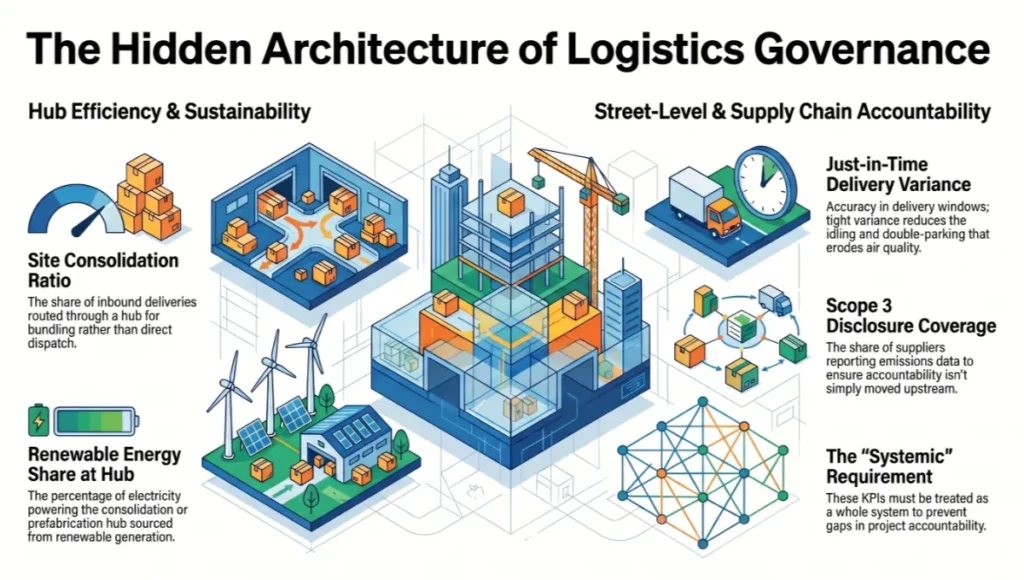
The third cluster is the least visible and the hardest to mandate, because it lives in scheduling software and supplier contracts rather than on the street — yet it is what determines whether the first two clusters hold up under real operating pressure.
Site Consolidation Ratio — the share of inbound deliveries routed through an urban consolidation center for bundling, rather than dispatched directly from individual suppliers.
Renewable Energy Share at Hub — the percentage of electricity powering a consolidation or prefabrication hub sourced from renewable generation.
Just-in-Time Delivery Variance — the average deviation, in minutes, between a scheduled delivery window and actual arrival. Tight variance reduces the idling and double-parking that erode air quality block by block.
Scope 3 Disclosure Coverage — the share of suppliers in a project’s logistics chain reporting their own emissions data, closing the visibility gap that has historically let upstream freight emissions go unaccounted.
Treated individually, each of these twelve numbers is a footnote in a procurement document. Treated as a system, they describe a city deciding, deliberately, what kind of street it wants outside its construction sites. A project that hits eleven of the twelve and skips Scope 3 Disclosure Coverage has simply moved its accountability gap upstream, to a supplier no one is asking. The discipline is in refusing to let any single KPI stand in for the whole.
Feasibility Study: Economic and Political Barriers
None of the twelve KPIs above are mysteries. The harder question is why so few cities hold contractors to them. The honest answer sits in economics and politics far more than it sits in engineering.
The Capital Question
Electrified fleets, prefabrication hubs, and consolidation centers all share a structural problem: the capital sits with the carrier or the developer, while the benefit — cleaner air, quieter streets, less congestion — accrues to the public. A shipper weighing the upfront premium of zero-emission trucks against a thin operating margin will rationally hesitate, especially when charging infrastructure along the route has not yet been built. Industry surveys have repeatedly found that a majority of logistics operators still lack a clear decarbonization plan, not from indifference but from genuine uncertainty over total cost of ownership and asset resale value once a technology generation turns over.
The Political Question
The political barrier is sharper and less forgiving than the financial one. A zero-emission zone is, in effect, a tax on incumbency — it penalizes the fleet operator who bought diesel trucks five years ago and rewards the one who waited. That asymmetry generates organized resistance long before a single emission target is debated on its technical merits.
Layer onto that the patchwork of municipal, regional, and national jurisdiction over freight corridors, and you arrive at a regulatory landscape where a consolidation center can be mandated in one district and irrelevant three kilometers away. Carbon border mechanisms now emerging in trade policy are beginning to externalize this pressure — turning embodied emissions in imported materials into a line item on a balance sheet — but enforcement at the scale of a single construction site remains, for now, voluntary across most of the world.
The Labor Question
There is a third barrier that rarely makes it into a feasibility memo, and it is sociological rather than financial: the construction workforce did not sign up for a factory shift. Moving fabrication off-site, as Singapore’s DfMA program demonstrates, genuinely reduces injury rates and removes labor from extreme weather and height exposure — but it also relocates jobs from a fragmented, site-based trade into a centralized, factory-disciplined one, with different hours, different unions, and a different relationship between worker and employer.
Cities that treat this purely as an engineering transition tend to underestimate how much of the resistance to consolidation and prefabrication comes not from contractors protecting margins, but from a workforce protecting an identity built around the open site. Any credible decarbonization roadmap has to budget for retraining and transition support as deliberately as it budgets for charging infrastructure.
Proof of Concept: Singapore, Rotterdam
Skepticism about decarbonized construction logistics tends to collapse the moment you point at a city already running the experiment.
Singapore — Off-Site by Mandate
Singapore’s Building and Construction Authority did not ask the market to adopt Design-for-Manufacturing-and-Assembly voluntarily — it built the incentive structure and then moved the goalposts. Adoption by gross floor area has climbed from under half toward a 2025 target of roughly seventy percent, with co-funding schemes covering a significant share of the cost premium for firms installing prefabrication technology.
The clearest evidence sits in large-scale residential developments built using fully volumetric precast modules, which have demonstrated site productivity gains of up to forty percent and saved tens of thousands of labor-days by moving fabrication into a factory setting. Prefabricated mechanical, electrical, and plumbing systems assembled under the same program have cut installation time on comparable projects by more than half, simply by removing the coordination delays that come from multiple trades occupying the same floor at the same time. Every module assembled off-site is a delivery convoy that never enters the street grid in the first place — the city decarbonizes its construction logistics not by greening the trucks, but by eliminating the need for as many of them.
Rotterdam — Consolidation at the Cordon
Rotterdam took the opposite entry point: instead of redesigning what gets built, it redesigned how everything reaches the site. The city’s Zero-Emission Zone, paired with urban consolidation centers on its outskirts, forces a transition to zero-emission vehicles for the final approach into the urban core.
Simulation work on the policy found emissions inside the zone falling by roughly ninety percent once the consolidation centers came online, with construction logistics specifically identified as one of the segments most likely to shift its drivetrain mix from diesel toward biofuel and hybrid power as the covenant matures. The city has paired the mandate with a broader commitment to cut municipal CO2 output by close to half by 2030 — construction freight is treated as one accountable slice of that target, not an exempted category sitting outside it.
Read side by side, Singapore and Rotterdam are not competing strategies — they are the two ends of the same lever. Singapore intervenes upstream, at the point where a building is designed, so fewer deliveries are ever generated. Rotterdam intervenes downstream, at the point where deliveries enter the city, so the ones that remain do less damage. A city serious about decarbonized construction logistics eventually needs both: a mandate that shrinks the convoy at the source, and a cordon that disciplines whatever convoy is left.
Concept Project Spotlight — Speculative / Internal Concept Study: Meridian Logistics Spine by Nuvira Space
The KPIs above describe a system. Meridian is our attempt to draw what that system looks like at the scale of a single city block — a working hypothesis, not a commission, built to stress-test the twelve metrics against an actual floor plan rather than a spreadsheet.
Project Overview
Location — a composite mid-rise coastal corridor, modeled on the density and tidal infrastructure common to Southeast Asian and Northern European port-adjacent districts.
Typology — mixed-use vertical infill — residential, light-industrial, and civic program stacked above an embedded logistics undercroft.
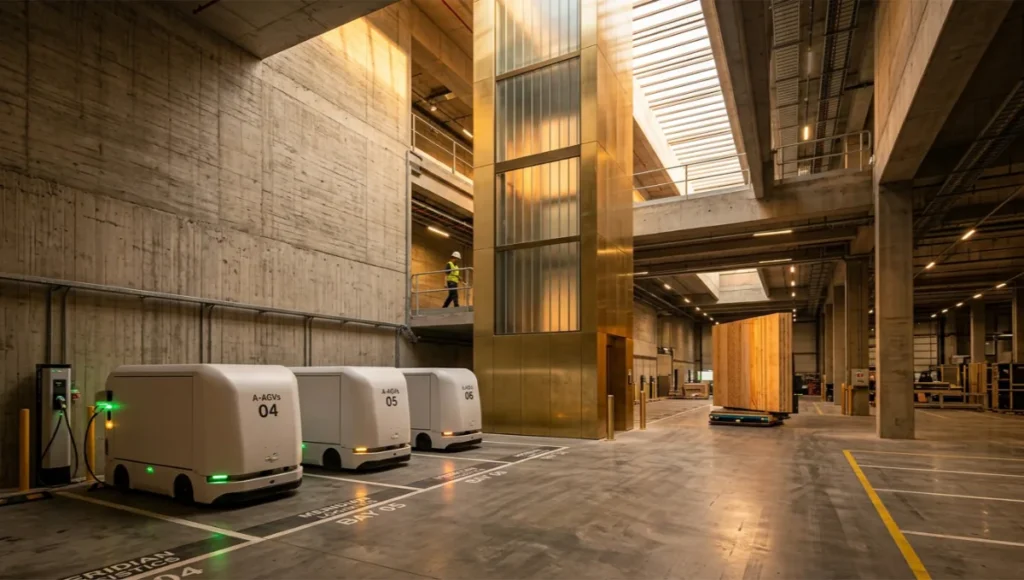
Vision — a city block where the loading dock is not hidden in shame behind the building, but designed as visibly as the lobby — a public acknowledgment that material flow is civic infrastructure, not a contractor’s secret.
Design Levers Applied
- A sub-grade consolidation undercroft replacing six separate ground-level loading bays with one shared, electrified dock.
- A vertical material lift integrated into the building core, removing crane-and-truck choreography from the street for all but the heaviest structural pours.
- Modular facade and MEP packages delivered pre-finished, cutting projected site delivery trips by roughly half relative to a conventional build sequence.
- Rooftop and undercroft solar arrays sized to cover the electricity draw of the on-site charging bays.
Transferable Takeaway
What travels from Meridian to any other city is not the architecture — it is the principle that logistics infrastructure deserves the same design attention as the building it serves. A loading dock treated as an afterthought will always behave like one, regardless of how disciplined the KPI dashboard upstream claims to be. The lesson scales down as easily as it scales up: a single mid-rise infill project can apply the same undercroft-and-lift logic at a fraction of Meridian’s footprint, which is precisely why we built the concept as a study rather than a one-off design exercise.
2030 Future Projection
By 2030, the cities that took decarbonized construction logistics seriously will not look dramatically different from the street — the visible change is quieter than that. Fewer trucks idling at the curb. Fewer half-loaded flatbeds threading through school drop-off traffic. What will have changed is the accounting: procurement contracts that price embodied carbon the way they already price labor and materials, building permits that require a logistics plan with the same rigor as a structural one, and insurance underwriters who treat a documented KPI dashboard as a risk-reduction discount rather than a public-relations exercise.
The cities that ignored the shift will face a different kind of 2030: carbon border adjustments folding into material costs from the supply side, a generation of skilled labor unwilling to work the diesel-heavy job sites their peers in other cities no longer tolerate, and a widening gap between developments that can attract institutional capital — which increasingly screens for climate-disclosure quality — and developments that cannot. The recalibration of the metropolitan fabric will not arrive as a single dramatic policy. It will arrive as the slow, compounding weight of a dozen small mandates, each one looking, in isolation, like a technical footnote.
There is an equity dimension worth stating plainly rather than leaving implicit. The neighborhoods that have historically absorbed the worst of unmanaged construction traffic — the ones nearest the freight corridors, the ones with the least political leverage to demand a consolidation center of their own — are also the ones least likely to benefit first from a voluntary, market-led transition. A 2030 worth wanting is one where the twelve KPIs are written into permitting requirements precisely because they cannot be relied upon to arrive through goodwill alone.
Comprehensive Technical FAQ
Q: What is the single highest-leverage KPI to start with?
A: For most mid-sized cities, Site Consolidation Ratio offers the fastest return. It requires no new vehicle technology, only a shared facility and a routing contract, and it reduces the Empty-Running Coefficient as an automatic side effect.
Q: Does fleet electrification alone qualify as decarbonized construction logistics?
A: No. A fully electrified fleet still making direct-to-site deliveries with high empty-running rates has decarbonized one variable while leaving the other eleven untouched. The KPI set is designed to be read together, not selected from individually.
Q: How is embodied carbon intensity actually tracked at the site level?
A: Through environmental product declarations attached to each material batch, cross-referenced against regional freight-emissions benchmarks rather than generic global averages, since grid composition and transport distance vary sharply by location.
Q: Why does off-site prefabrication reduce logistics emissions rather than simply relocate them?
A: Because consolidated factory production allows a single optimized delivery of a finished module to replace dozens of fragmented deliveries of raw components, lowering total vehicle-kilometers even after the factory-to-site leg is counted.
Q: Is a Zero-Emission Zone enforceable without a consolidation center?
A: In practice, rarely. Without a bundling point on the periphery, a zone simply pushes the same volume of fragmented deliveries onto a smaller pool of permitted vehicle types, raising costs without proportionally cutting trips.
Q: What political mechanism has shown the most traction for closing the capital gap?
A: Co-funding schemes that subsidize the cost premium of low-carbon equipment, paired with phased mandates that give incumbent operators a visible runway rather than an abrupt cutoff.
Q: Can a mid-sized city realistically run a Singapore-style DfMA mandate?
A: Partially, and that is still worth pursuing. A full island-wide mandate requires regulatory authority most cities lack, but the underlying mechanism — co-funding the cost premium of off-site manufacturing and counting prefabrication rate as a permitting criterion on public projects — scales down to a single district pilot without needing national legislation.
Q: How does decarbonized construction logistics interact with transit-oriented development?
A: Directly. A transit-oriented district concentrates population and reduces private vehicle dependence for residents, but it also concentrates construction activity during the build-out phase. Routing that construction freight through the same logistics discipline — consolidated, electrified, off-site-heavy — prevents a neighborhood designed to reduce car traffic from spending a decade absorbing diesel truck traffic instead.
- Typical KPI dashboard cadence: monthly fleet and hub metrics, quarterly embodied-carbon and circularity audits.
- Minimum viable starting set for a single project: Site Consolidation Ratio, Fleet Electrification Rate, Embodied Carbon Intensity.
- Common data source for Scope 3 Disclosure Coverage: supplier-submitted Environmental Product Declarations, cross-checked annually.
What to Do Next
You do not need to wait for a national mandate to start measuring what your own project moves through the street. Pick three of the twelve KPIs above — Site Consolidation Ratio, Fleet Electrification Rate, and Embodied Carbon Intensity are the fastest to instrument — and put them on the same dashboard you already use for cost and schedule. The city does not decarbonize in the abstract. It decarbonizes one delivery window, one consolidated dock, one electrified vehicle at a time, and it moves faster the moment the people specifying buildings start asking contractors for data instead of promises.
Bring decarbonized construction logistics into your next project brief — not as a sustainability appendix, but as a line item with the same authority as your structural specification. The convoy outside your site is not background noise to the project. It is the project, judged by the street it leaves behind.
© Nuvira Space. All rights reserved. | URBAN PULSE Series | All specifications cited are based on publicly available municipal program data, industry research, and engineering literature referenced throughout this analysis. The Meridian Logistics Spine is a speculative internal concept study and does not represent a completed project.