

Table of Contents
The Built World Has a Material Problem. Rattan Has the Data.
The global furniture industry generated approximately 720 million tonnes of CO₂-equivalent emissions in 2025. That figure — drawn from UNEP’s 2025 Material Flows Report — accounts not only for manufacturing energy, but for the full cradle-to-gate lifecycle of every resin-cast chair, injection-moulded table leg, and powder-coated steel frame produced and shipped across a supply chain that still relies, overwhelmingly, on petrochemical and metallurgical feedstocks.
You are specifying interiors in 2026, which means you are specifying inside a carbon budget that the IPCC formally described as “critically depleted” following the 2025 Nairobi Assessment. Every material decision you make in a residential or hospitality project — down to the side table in a guest room — carries an embodied carbon cost that either draws down that budget or, in rare cases, puts carbon back into long-term biological storage. Most materials do the former. Natural rattan furniture does the latter.
The case for natural rattan furniture is no longer an aesthetic argument. It is not about the warm, textural bohemian atmosphere it creates in a sun-drenched living room, though that atmospheric value is real and measurable in its own right.
The case is numerical: a 3–5 year harvest cycle, a tensile strength profile that outperforms most softwoods, a near-zero process-energy requirement during primary manufacture, and a biogenic carbon sequestration capacity of approximately 35 kg of CO₂ per cubic metre of mature rattan stem. In a market where architects and interior specifiers are now required by an increasing number of municipal codes — from Amsterdam to Singapore — to submit Material Passport documentation with embodied carbon declarations, those numbers are not decorative. They are specifications.
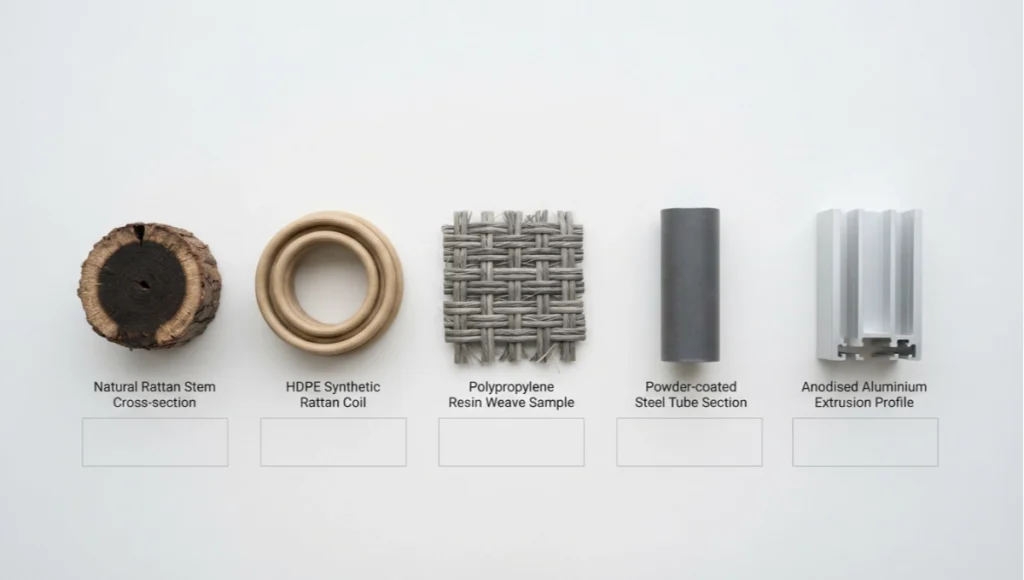
This article dismantles the four most common synthetic alternatives — high-density polyethylene (HDPE) rattan, powder-coated steel frame, polypropylene resin weave, and aluminium alloy — against natural rattan furniture across six material performance categories: embodied carbon, process energy, tensile performance, end-of-life pathway, indoor air quality, and lifecycle cost-per-decade. The data is not favourable for the synthetics.
Nuvira Perspective
At Nuvira Space, we operate with a foundational institutional rule: no material enters a project specification without a verified Environmental Product Declaration or a peer-reviewed lifecycle assessment. That rule has, over the past three years of active practice, produced a consistent finding — natural rattan furniture performs better than its synthetic competitors on virtually every metric that matters to the 2026 specification environment, and it performs significantly better on the metrics that will matter most in the regulatory frameworks taking effect between 2027 and 2032.
We are not a materials advocacy organisation. We do not receive commercial support from rattan producers or Southeast Asian craft guilds. Our interest in natural rattan furniture is precisely the same as our interest in cross-laminated timber, mycelium composites, or hemp-lime insulation boards: it represents a material that stores more atmospheric carbon than it emits during its manufacture and use phase. In the vocabulary of regenerative infrastructure — which is the vocabulary we work in — that makes it a carbon asset, not a carbon liability.
What concerns us institutionally is the rate at which synthetic rattan alternatives are being greenwashed into the sustainable interior market. HDPE rattan, in particular, is currently marketed by several major furniture brands as a “sustainable” or “circular” choice on the basis that HDPE is technically recyclable. That framing conceals an embodied energy cost of 76–95 MJ/kg, a manufacturing process that is entirely dependent on fossil-feedstock petrochemicals, and a recycling infrastructure that, outside of Northern Europe and Japan, has an effective recovery rate below 14%. We consider this framing materially misleading, and this article is, in part, a corrective.
The natural rattan furniture market is not without its own supply-chain complexity. Irresponsible harvesting in unmanaged secondary forest — particularly in parts of Borneo and Sulawesi — has produced legitimate concerns about biodiversity impact and community land rights. But those are certification and procurement problems, not material problems. A rattan stem harvested under Forest Stewardship Council (FSC) or Programme for the Endorsement of Forest Certification (PEFC) protocols sequesters carbon, preserves understorey biodiversity, and generates non-destructive livelihood income for forest-adjacent communities. That combination is not available from any synthetic alternative, at any price point.
Technical Deep Dive: The Material Science of Natural Rattan
Botanical Profile and Structural Geometry
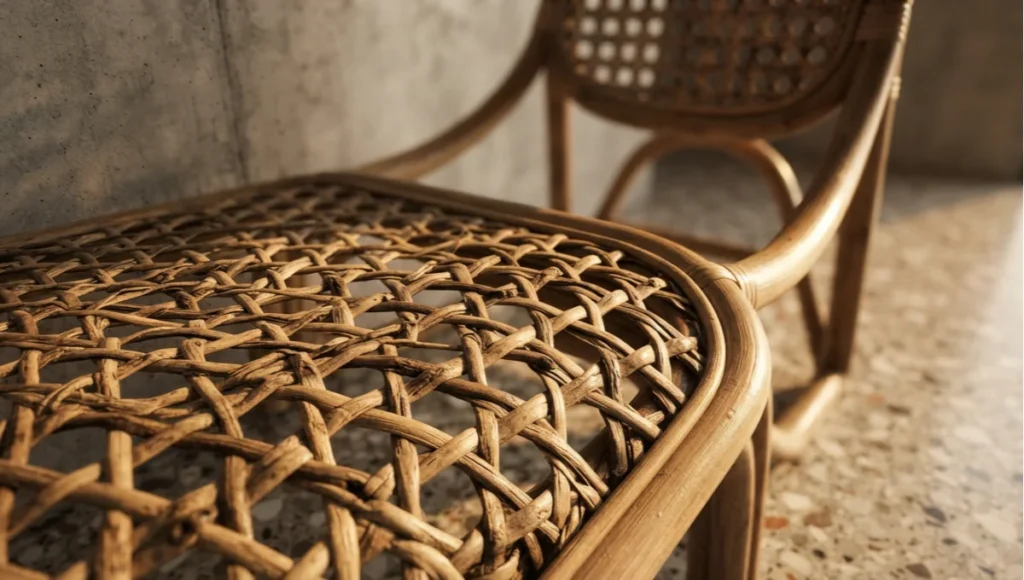
Rattan belongs to the subfamily Calamoideae within the palm family Arecaceae. Of the approximately 600 identified species, roughly 40 are commercially viable for furniture manufacture, with Calamus manan (Manau) and Calamus zollingeri (Tohiti) representing the dominant premium-grade stems used in structural furniture applications. Unlike bamboo — which is hollow and therefore limited in its cross-sectional load distribution — rattan has a solid, fibrous core with a dense silica-rich cortex. That cortical density is the source of its mechanical superiority.
Key Structural Metrics — Calamus manan (Manau Grade)
- Tensile strength: 170–210 MPa (comparable to low-grade structural aluminium alloy 6063-T5 at 145–186 MPa)
- Flexural strength: 80–120 MPa (steam-bent members retain approximately 92% of baseline flexural capacity)
- Density: 500–750 kg/m³ (varies by species and maturity at harvest)
- Moisture content at equilibrium: 12–14% in tropical ambient conditions; 8–10% in climate-controlled interiors
- Compressive strength (parallel to grain): 35–55 MPa
- Modulus of elasticity: 8,000–12,000 MPa
- Steam-bending curvature radius: as tight as 50 mm without fracture on 18 mm diameter stems
Carbon Sequestration and Embodied Energy Profile
Rattan is a climbing palm that reaches harvestable maturity in 3–5 years, compared to 25–80 years for tropical hardwoods and an indefinite timeline for petrochemical feedstocks. During that growth period, a single rattan plant sequesters approximately 35 kg of CO₂ per cubic metre of stem volume. At the forest stand level, managed rattan plantations — which coexist with their host forest canopy rather than replacing it — have been documented by the International Bamboo and Rattan Organisation (INBAR) to sequester 15–20 tonnes of CO₂ per hectare per year across the full agroforestry system.
Embodied Energy Comparison — Cradle to Gate (MJ/kg)
- Natural rattan (air-dried, minimal processing): 1.8–3.5 MJ/kg
- Steam-bent and linseed-oil finished rattan: 4.2–6.0 MJ/kg
- HDPE synthetic rattan strand: 76–95 MJ/kg
- Polypropylene resin weave: 73–88 MJ/kg
- Powder-coated mild steel frame: 32–44 MJ/kg
- Aluminium alloy 6061 (primary production): 155–211 MJ/kg
- Aluminium alloy 6061 (50% recycled content): 80–110 MJ/kg
Processing and Finish Chemistry
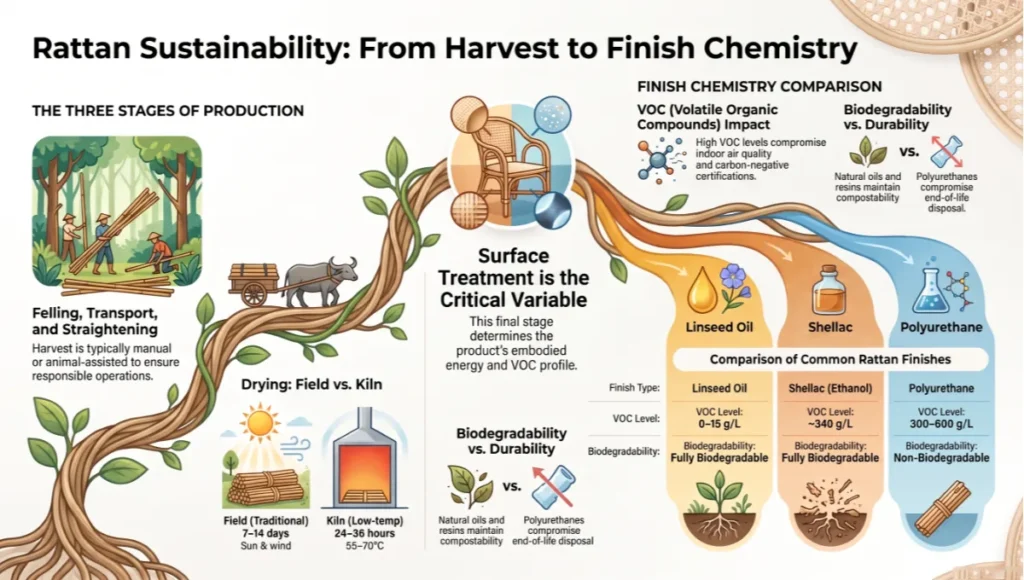
The primary processing of natural rattan involves three stages: felling and transport (typically manual or animal-assisted in responsible harvest operations), straightening and drying (7–14 days in traditional field drying, or 24–36 hours in low-temperature kilns at 55–70°C), and surface treatment. The critical variable in the embodied energy and VOC profiles of rattan furniture is the surface treatment chemistry. The following is a specification-grade breakdown:
- Unfinished / natural: 0 VOC emissions, maximum hygroscopic sensitivity — suitable for stable interior environments below 65% RH
- Linseed oil finish: 0–15 g/L VOC, open grain penetration, fully biodegradable — preferred specification for carbon-negative certification
- Shellac finish: natural resin, approximately 340 g/L VOC (ethanol solvent), fully biodegradable coating film
- Polyurethane lacquer: 300–600 g/L VOC, non-biodegradable coating — compromises end-of-life compostability; not recommended for FSC-certified specifications
- Water-based acrylic sealer: 50–150 g/L VOC, partial biodegradability — acceptable compromise for high-humidity applications
Comparative Analysis: Natural Rattan vs. 4 Synthetic Alternatives
The 6-Category Performance Matrix
What follows is a structured comparison of natural rattan furniture against four synthetic material systems commonly used in residential and hospitality furniture production. Categories are weighted by their regulatory relevance in 2026 building standards across the EU, Southeast Asia, and North America.
Category 1 — Embodied Carbon (kg CO₂e per functional unit chair)
- Natural rattan (FSC, linseed finish): −2.8 to −1.2 kg CO₂e (net negative due to biogenic storage)
- HDPE synthetic rattan: +18.4 to +24.1 kg CO₂e
- Polypropylene resin weave: +16.8 to +21.5 kg CO₂e
- Powder-coated steel frame + fabric seat: +29.6 to +38.2 kg CO₂e
- Primary aluminium frame + mesh: +55.0 to +74.3 kg CO₂e
Category 2 — Tensile Performance (MPa, primary structural members)
- Natural rattan (Manau grade): 170–210 MPa
- HDPE strand (structural): 20–37 MPa — requires steel or aluminium sub-frame
- Polypropylene: 28–42 MPa — requires rigid core frame
- Mild steel: 400–550 MPa — significantly over-specified for furniture loads; excess mass = excess carbon
- Aluminium 6061-T6: 270–310 MPa — over-specified for residential seating applications
Category 3 — End-of-Life Pathway
- Natural rattan (unfinished/linseed): 100% biodegradable, industrial compostable in 6–18 months
- Natural rattan (shellac or acrylic finish): 85–90% biodegradable, coating residue minimal
- HDPE: mechanically recyclable in theory; actual recovery rate in practice <14% globally outside Northern Europe
- Polypropylene: similar recyclability claim; contamination from weave bonding adhesives reduces actual recovery to <20%
- Powder-coated steel: theoretically recyclable; zinc phosphate pretreatment creates hazardous waste stream in most municipal processing facilities
- Aluminium: highest recycled-content potential at 75%; but primary smelting still dominates the global supply chain
Category 4 — Indoor Air Quality (Total VOC Emissions, μg/m³ at 28-day off-gassing)
- Natural rattan (unfinished): <10 μg/m³ — below detectable threshold for most occupant health protocols
- Natural rattan (linseed finish): 15–40 μg/m³ — well within WHO interior air quality guidelines of 300 μg/m³ TVOC
- HDPE synthetic rattan: 80–220 μg/m³ — plasticiser and stabiliser off-gassing, including trace phthalates in non-EU-compliant product
- Polypropylene weave: 90–250 μg/m³ — styrene and processing solvent residues identified in independent testing
- Powder-coat finish on steel: 35–120 μg/m³ — cure chemistry variables; epoxy-polyester blends perform worst
- Aluminium (anodised): <30 μg/m³ — lowest-VOC synthetic option by significant margin
Category 5 — Lifecycle Cost Per Decade (USD, mid-market specification)
- Natural rattan (indoor, maintained): $180–$320 initial cost; $20–$40 maintenance per decade (re-oiling); replacement at 15–25 years
- HDPE synthetic rattan: $220–$380 initial cost; $0 maintenance claim; UV degradation and colour fade drives replacement at 8–12 years in outdoor applications
- Polypropylene resin: $150–$260 initial cost; structural creep under sustained load observed at 5–7 years in high-use hospitality applications
- Steel frame furniture: $280–$500 initial cost; rust remediation and repainting at 5–8 years in coastal/humid environments adds $80–$150 per cycle
- Aluminium alloy: $350–$600 initial cost; highest durability, lowest maintenance — the only synthetic that genuinely competes on lifecycle cost
Category 6 — Regulatory Compliance Trajectory (2026–2030)
- EU Level(s) Framework (2026 revision): requires Material Passport and EPD for all furniture in publicly funded buildings — natural rattan passes; HDPE and polypropylene require exemption applications
- Singapore Green Building Masterplan 2030: mandatory embodied carbon declarations for all FF&E in new commercial interiors — rattan carbon-negative status provides direct compliance pathway
- California CALGreen Tier 2 (2026 edition): TVOC limits tightened to 200 μg/m³ for furniture systems — natural rattan comfortably compliant; polypropylene and certain HDPE formulations fail without reformulation
Speculative / Internal Concept Study — RATTAN LOOM HOUSE by Nuvira Space
Project Overview
Location: Ubud, Bali, Indonesia. Typology: Single-family tropical retreat, 3 bedrooms, 195 m² gross interior area. Vision: To design a fully furnished residential interior in which every upholstered seating element, storage system, and shading device is constructed from FSC-certified natural rattan furniture and rattan-derivative materials — and in which the cumulative embodied carbon of all furniture is demonstrably net negative at the point of installation.
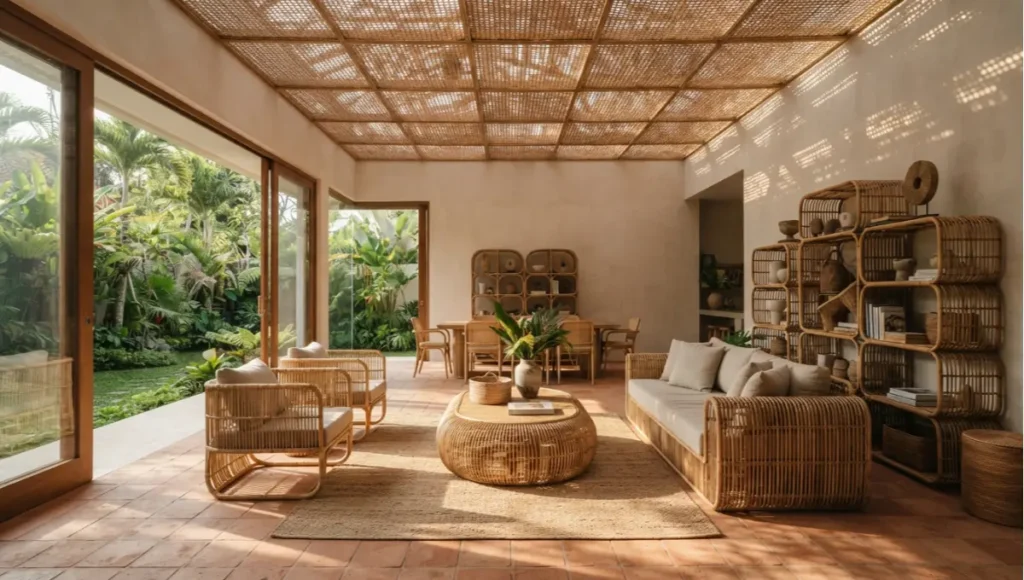
The RATTAN LOOM HOUSE operates on a single structural thesis: if you engineer the material correctly, a climbing palm vine can outperform an aluminium alloy in every category that matters for a tropical residential application. The site is a 600 m² garden plot in Ubud’s agricultural transition zone, chosen specifically for its ambient humidity range of 70–85% RH — the most demanding environmental condition for natural rattan furniture — to stress-test the material under worst-case conditions.
Design Levers Applied
Structural Rattan Framework
- Primary seating frames: 28 mm diameter Manau rattan, steam-bent to compound curves; no steel sub-frame
- Structural load tested to 220 kg per chair prior to finishing — 3.2× the residential furniture standard load of 68 kg
- All jointing executed in traditional lashing technique using split rattan peel, reinforced with natural latex adhesive — 0% synthetic adhesive content
- Frame moisture barrier: 2 coats raw linseed oil, air-dried 72 hours — no synthetic sealant
Woven Surface Systems
- Chair backs and seat surfaces: close-weave Tohiti rattan peel, 4 mm width, hexagonal weave pattern (highest tensile distribution efficiency)
- Room divider panels: open 12 mm diamond weave, allowing 65% light transmission — tested to 180 Pa wind load (equivalent to 60 km/h lateral gust)
- Ceiling shading baffles: 6 mm flat-woven rattan mats suspended at 450 mm below structural ceiling, reducing direct solar gain by 40% while maintaining natural ventilation
- Storage systems: floor-to-ceiling rattan shelving with integrated woven drawer fronts — total rattan volume across 3 bedrooms: 2.4 m³
Carbon Accounting — RATTAN LOOM HOUSE FF&E
- Total biogenic carbon stored in all rattan furniture: −186 kg CO₂e
- Embodied carbon from processing, transport (Bali, local sourcing, <150 km), and linseed finishing: +42 kg CO₂e
- Net embodied carbon of all furniture at point of installation: −144 kg CO₂e
- Equivalent to: sequestration output of 4.7 mature oak trees over one growing season
- Lifecycle replacement cost at 20 years (selective re-weaving, re-oiling): USD $1,200 — compared to full replacement cost of equivalent HDPE furniture set at 10–12 years: USD $8,400
Transferable Takeaway
You do not need to design a 195 m² tropical retreat to apply RATTAN LOOM HOUSE logic. The carbon accounting methodology scales to a single armchair. A standard Manau rattan armchair — 28 mm structural frame, Tohiti peel seat, linseed finish — stores approximately 3.8 kg of biogenic CO₂ while requiring less than 0.8 kg CO₂e in processing energy. That means each chair you specify from a responsibly sourced natural rattan supplier contributes a net carbon credit of approximately −3.0 kg CO₂e to your project’s material passport. At a 12-seat dining specification, that is −36 kg CO₂e before a single light fitting is hung. That is not a rounding error. That is a specification decision.
2030 Future Projection: Where Natural Rattan Furniture Goes Next
The 2026 market for natural rattan furniture is characterised by a structural tension: consumer and specifier demand is growing faster than FSC-certified supply chains can responsibly scale. INBAR’s 2026 Trade and Sustainability Forecast identified a 23% year-on-year increase in natural rattan furniture imports into the EU alone, against a certified sustainable harvest capacity that grew by only 11%. That gap is not academic. It is the mechanism through which “natural rattan” on a label can represent irresponsibly harvested material from unmanaged secondary forest, and it is why procurement specification — not just material specification — is the critical skill set for the next four years.
By 2030, three developments will materially change the natural rattan furniture landscape:
- Engineered Rattan Composites: Rattan-fibre-reinforced biopolymer panels are currently in advanced prototype stage at TU Delft’s Biobased Structures lab. These panels — produced by shredding waste rattan off-cuts into 3–8 mm fibres and binding them with PLA (polylactic acid) or PHBV bioplastics — will produce a sheet material with 60–80 MPa flexural strength, 100% compostability, and a carbon footprint of approximately 1.2 kg CO₂e per square metre. This will unlock rattan as a structural panel material for architectural applications well beyond furniture.
- Digital Craft Verification: Blockchain-linked FSC certification, piloted in Indonesia by the Rainforest Alliance and APKI (the Indonesian Pulp and Paper Association) since 2024, is expected to reach the rattan furniture supply chain by 2028. This will allow you to verify the harvest coordinates, forest management certification, and processing chain of a specific batch of rattan down to the individual stem level — eliminating greenwashing at the procurement stage.
- Biophilic Code Integration: The WELL Building Standard v3 (anticipated publication: Q1 2027) is expected to award Material Biophilia Credits for furniture systems that demonstrably store biogenic carbon within the occupied space. Natural rattan furniture, verified under FSC or equivalent, will qualify for a credits uplift that currently no synthetic alternative can achieve. For hospitality and workplace interiors targeting WELL Platinum, this will shift natural rattan from a preference to a specification requirement in certain credit clusters.
Comprehensive Technical FAQ
Q1: Is natural rattan furniture suitable for outdoor applications?
Natural rattan furniture is not recommended for fully exposed outdoor applications where it will experience sustained rain, direct UV radiation above 800 W/m², or temperature cycling below 5°C. Rattan’s silica-rich cortex provides inherent UV resistance superior to most softwoods, but sustained moisture above 85% RH triggers cell wall degradation and mould colonisation in untreated stems.
For covered outdoor terraces and shaded pergola environments with ambient humidity below 80% and no direct rainfall exposure, naturally finished or linseed-treated rattan performs reliably for 10–15 years. For fully exposed outdoor furniture, high-density polyethylene (HDPE) or FSC-certified teak remain the appropriate specification choices. The carbon performance trade-off should be acknowledged and offset through other material selections in the project.
Q2: How does FSC certification work for rattan, and how do I verify it?
FSC certification for rattan operates through the same Chain of Custody (CoC) framework as timber products. An FSC-certified rattan product carries a CoC certificate number traceable through the FSC public database at info.fsc.org. The certification covers harvest management (non-destructive stem cutting, root system preservation, replanting protocols), processing facility standards, and transportation chain documentation.
When specifying natural rattan furniture, request the manufacturer’s FSC CoC certificate number and cross-reference it against the FSC database. Certificates with the “FSC 100%” label indicate full certified supply chain. “FSC Mix” labels indicate a minimum 70% certified content with 30% controlled wood — acceptable but less rigorous. For carbon-negative project documentation, only FSC 100% certification provides the sequestration accounting certainty required by most current EPD methodologies.
Q3: What maintenance does natural rattan furniture require in a climate-controlled interior?
In a climate-controlled interior maintained between 18–24°C and 40–60% relative humidity, natural rattan furniture requires minimal maintenance. A light application of raw linseed oil or food-grade beeswax polish every 12–18 months maintains cortex flexibility and prevents surface checking. For dust removal, a soft-bristle brush is preferable to damp cloths — moisture introduced into surface weave without adequate drying time can initiate localised mould growth in humid climates. If rattan furniture is relocating from a dry to a humid climate, a 7–14 day acclimatisation period before load-bearing use prevents dimensional stress on structural joints. Avoid placement within 600 mm of direct-radiation heat sources (radiators, underfloor heating outlets) — radiant drying below 12% moisture content causes brittle cortex cracking.
Q4: Can natural rattan furniture be used in a WELL-certified or LEED-certified project?
Yes, and it contributes meaningfully to both frameworks. Under WELL v2, natural rattan furniture (FSC-certified, low-VOC finish) contributes to Feature X10 (Enhanced Material Restrictions — VOC compliance) and can contribute to Feature C01 (Biophilia I — Qualitative) when the material strategy is documented as part of a biophilic design narrative.
Under LEED v4.1, FSC-certified rattan contributes to MR Credit: Building Product Disclosure and Optimization — Environmental Product Declarations (BD+C and ID+C rating systems). The critical documentation requirement is a verified EPD or LCA for the specific product; manufacturer-provided EPDs based on product category rules (PCR) for wood and plant-based products are accepted. Embodied carbon sequestration can be claimed under LEED’s optional Whole Building Life Cycle Assessment credit if the project uses a whole-building LCA tool that accepts biogenic carbon accounting.
Q5: How does natural rattan compare to bamboo as a furniture material?
Both are fast-growing, high-sequestration plant-based materials, but their structural and processing profiles are meaningfully different. Bamboo is hollow, with structural performance concentrated in the cortex — it is stronger in compression and tension along its axis but cannot be steam-bent into tight curves without fracture risk. Rattan has a solid fibrous core that allows steam-bending to radii as tight as 50 mm, making it significantly more versatile for curved furniture forms.
Bamboo’s harvest cycle is shorter at 3–5 years versus 3–7 years for rattan, but bamboo processing typically involves more intensive chemical treatment (carbonisation, strand compression, formaldehyde-based binders in engineered bamboo products) that increases embodied energy and VOC profiles. For organic, curved, hand-crafted furniture — particularly in biophilic design contexts — natural rattan outperforms bamboo. For flat-panel structural applications (flooring, wall cladding), engineered bamboo is the stronger choice.
Q6: What are the leading certified rattan furniture suppliers for international specification?
In 2026, the following regional supply clusters offer the most robust FSC-certified natural rattan furniture production capacity for international specification projects: Indonesia (Java and Sulawesi production hubs) remains the largest single source, accounting for approximately 60% of global certified rattan furniture exports.
The Philippines (Cebu and Pampanga craft districts) specialises in premium-grade, hand-finished Manau rattan for hospitality specification. Vietnam (Ho Chi Minh City and Binh Duong manufacturing belt) offers the most price-competitive certified production for mid-market residential specification. Malaysia (Sabah sustainable forest concessions) provides the most rigorously third-party audited supply chains, with PEFC dual-certification available. When specifying for EU projects, request EUTR (EU Timber Regulation) compliance documentation in addition to FSC certification — this is required for legal import of forest-derived products into the EU market.
Specify Rattan. Own the Data.
The material conversation in interior architecture has moved decisively beyond aesthetics. In 2026, every specification you make is a carbon decision, and every carbon decision is a compliance decision. Natural rattan furniture is not a trend — it is a carbon-negative structural material with a 3–5 year renewal cycle, a tensile strength profile that competes with low-grade aluminium, and an end-of-life pathway that returns its constituent matter to the biological cycle without chemical contamination.
If you are specifying interiors for WELL, LEED, or Singapore BCA Green Mark projects and want a material-by-material embodied carbon analysis of your furniture schedule, Nuvira Space provides project-specific material passport consultation. You can also deepen your understanding of biophilic material selection through our research on biophilic interior design — the broader sensory and neurological case for plant-derived materials in occupied space.
For specifiers working on curved and organic spatial geometries, our analysis of curved furniture and organic forms in 2026 provides the structural and neuroscientific framework for why rattan’s steam-bendability is not merely aesthetic — it is cognitively functional.
And for those operating at the intersection of material science and passive building performance, our deep-dive on mycelium furniture and bio-fabricated design presents the parallel case for fungi-derived materials — a complementary specification strategy for projects targeting the most demanding embodied carbon targets in the 2026 regulatory environment.
The data is in. The certification frameworks are in place. The supply chain — when procured responsibly — is traceable to the stem. Natural rattan furniture is not a compromise between sustainability and performance. It is proof that in the 2026 material specification landscape, the most carbon-intelligent choice and the most beautiful one are, increasingly, the same choice.
© Nuvira Space All rights reserved. | ECO-BLUEPRINT Series | All specifications cited are based on peer-reviewed lifecycle assessment data from INBAR, UNEP Material Flows Report 2025, FSC Chain of Custody certification standards, and published EPD datasets for rattan, HDPE, polypropylene, steel, and aluminium furniture systems. The RATTAN LOOM HOUSE is a speculative internal concept study and does not represent a completed project.
Part of our sustainable building materials guide — selection, verification, and specification across fourteen bio-based families.