

Table of Contents
The Color Your Nervous System Has Been Waiting For
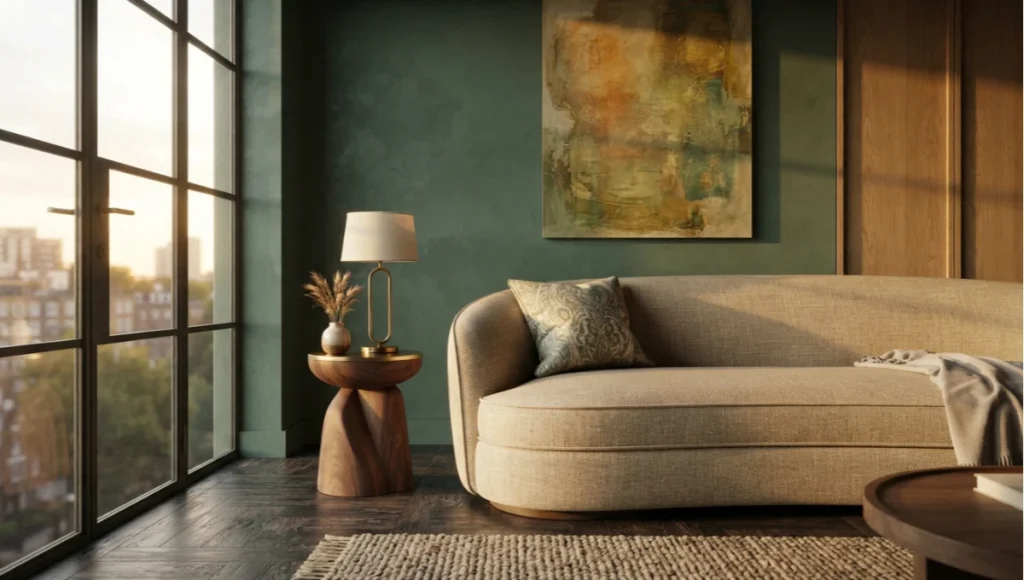
Here is something you almost certainly did not choose consciously: the color of your living room walls is running a biological programme on your autonomic nervous system right now. If those walls are gray, off-white, or “greige,” that programme is one of low-grade, sustained alertness — the neurological equivalent of keeping one eye open. If they are jade green, the programme shifts. Cortisol drops. Peripheral vision softens. The parasympathetic branch takes the wheel.
In 2026, jade green living rooms are not a trend. They are a physiological argument. Behr’s announcement of Hidden Gem — a smoky jade — as its Color of the Year for 2026 is not the cause of this shift; it is a reflection of it. Designers, neuroarchitects, and environmental psychologists have been arriving at the same conclusion from different directions for the better part of a decade: the human eye processes green with less metabolic effort than any other hue on the visible spectrum, and the living room — the space where most adults spend the majority of their waking, non-working hours — is where that metabolic efficiency delivers its most compounded returns.
This article is not about which jade shade looks best against linen sofas. It is about the 4 neurological truths that make jade green living rooms a spatial health decision, not an aesthetic one. By the time you finish reading, you will understand why the color of your walls is a variable in your cortisol regulation, your cognitive recovery speed, your perception of room depth, and the quality of your social connection at home — and what to do with that information.
Nuvira Perspective
At Nuvira Space, we do not begin interior design projects with a mood board. We begin with a neurological brief. Before a single material is specified or a palette is proposed, we map the biological baseline of the space: who occupies it, at what times of day, under what cognitive and emotional load, and what measurable physiological outcomes the design is being asked to deliver. Color is not decoration in this framework. It is chemistry.
When clients come to us asking about jade green living rooms, they are often asking the wrong question. They want to know whether jade green “goes with” their furniture, or whether it will “age well,” or whether it is “timeless.” These are valid aesthetic concerns. But the question that shapes our recommendation is different: what is this hue doing to the people inside the room?
Our position — grounded in neuroarchitecture research, environmental psychology, and the applied biophilia studies we reference throughout every Living Spaces project — is that jade green, specifically in the mid-value range that sits between celadon and deep emerald, is the closest thing to a neurologically neutral color that residential design has access to. It demands almost nothing from the visual cortex. It asks the amygdala to stand down. It tells the hypothalamic-pituitary-adrenal axis — the body’s central stress-response system — that the immediate environment is safe.
That is not metaphor. It is a measurable physiological cascade, and it has profound implications for how we specify, detail, and proportion jade green living rooms at every scale, from wall coverage percentages to material saturation levels to the luminance ratios between the green surfaces and the adjacent neutrals.
The 4 Neurological Truths Behind Jade Green Living Rooms
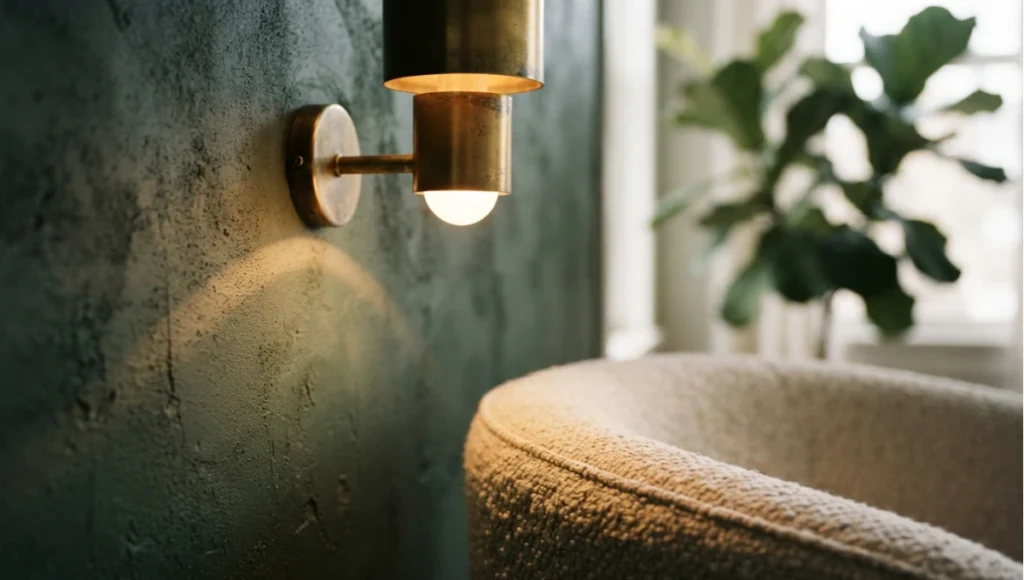
Truth 1: Green is the Lowest-Cost Color Your Brain Processes
The human retina contains three types of cone cells: short-wavelength (S-cones, processing violet-blue), medium-wavelength (M-cones, processing green-yellow), and long-wavelength (L-cones, processing red-orange). M-cones are the most numerous and the most spectrally central. Green sits at approximately 530 nanometers — the midpoint of the visible light spectrum — which means it requires the least inter-cone signal arbitration for the brain to resolve. There is no metabolic tug-of-war. Green is the color of least resistance.
What this means in a living room context: a jade green wall is not passively neutral. It is actively restful. The visual cortex allocates fewer resources to resolving it, and that freed-up processing capacity is redirected — toward cognitive restoration, social attunement, and the kind of quiet background thinking that characterises genuine recovery. The room does not just look calm. It functionally is calm.
- Human eyes contain more M-cones (green-sensitive) than any other type, making green the spectrally dominant and lowest-effort hue to process.
- Green sits at ~530 nm — the exact midpoint of the visible spectrum — minimising cone-channel signal conflict.
- Reduced visual processing load correlates with parasympathetic nervous system activation: lower heart rate, decreased skin conductance, and measurably reduced salivary cortisol.
- Mid-value jade green (LRV range 18–30) delivers this effect without the excessive light absorption of deep emerald, which can trigger low-level vigilance responses in rooms with insufficient daylighting.
Truth 2: Jade Green Lowers Your Arousal Threshold
Arousal threshold, in psychophysiological terms, is the level of environmental stimulation required to shift you from a resting state to an alert one. High-arousal environments — those with saturated reds, bright whites, or geometric visual complexity — lower the arousal threshold dramatically. You become reactive. Small sounds, peripheral movements, and ambient stressors all register more intensely. The body runs slightly hot, cortisol-wise, at all times.
Jade green raises the arousal threshold. Research tracking cortisol in participants exposed to forest settings — environments dominated by mid-value green — found reductions of 12.4% on average compared to urban, non-green control environments. This is not a small effect. A 12% cortisol reduction, sustained across the 3–5 hours most adults spend in their living room daily, accumulates into meaningful downstream health outcomes: improved sleep onset, reduced inflammatory markers, and better emotional regulation during social interactions.
The specific jade range — not sage, not forest green, not olive — performs optimally here because it carries both the blue-undertone coolness that suppresses sympathetic activation and the mid-value luminance that prevents the brain from interpreting the environment as dim or threatening. It is the Goldilocks cortisol hue.
- Cortisol reduction of ~12.4% documented in forest (green-dominant) settings vs. urban controls.
- Parasympathetic nervous system activation confirmed in peer-reviewed biophilic design studies across residential and clinical environments.
- Jade green (blue-undertoned, LRV 18–30) uniquely combines cortisol-suppressive coolness with sufficient luminance to avoid threat-interpretation by the visual system.
- Sustained daily exposure amplifies effect: 3–4 hours of jade green exposure in a living room context produces compounding autonomic recovery benefits over weeks.
Truth 3: Jade Green Extends Perceived Room Depth by up to 15%
Color perception and spatial perception are not separate processes in the brain. They are deeply entangled. Cool hues recede visually — the same psychophysics that make distant mountains appear blue-gray make a cool jade green wall appear further away than it is. This is not illusion in the pejorative sense. It is a genuine cognitive recalibration of spatial boundaries.
In living rooms under 30 square meters — which constitute the majority of urban residential living spaces in 2026 — this perceived depth extension is functionally significant. A room that feels 15% deeper triggers measurably different autonomic responses than a room that feels constrained. Prospect-Refuge Theory, developed by geographer Jay Appleton and extensively validated in neuroarchitecture research, holds that humans are neurologically calibrated to prefer environments offering both wide visual prospect and intimate refuge. A jade green living room, particularly when the green is applied to the longest visual axis, delivers the prospect dimension with extraordinary efficiency.
- Cool hues (blue-green undertone) recede visually due to short-wavelength scatter physics, extending perceived depth by an estimated 10–15% vs. warm-toned equivalents.
- Prospect-Refuge Theory: jade green walls on primary sightline axes maximise perceived visual prospect, triggering autonomic relaxation responses.
- Recommended application: jade green on the wall opposite the primary entry point or the longest wall in open-plan layouts — maximising depth illusion on the dominant visual axis.
- Avoid applying jade green to ceiling planes without compensatory light strategy: it can reduce apparent ceiling height if LRV is below 20.
Truth 4: Green Hues Extend Social Dwell Time and Emotional Attunement
The living room is not primarily a room for one person. It is a social architecture — the space where family bonds are maintained, friendships are renewed, and emotional attunement between cohabitants occurs. The color environment of that space is not a passive backdrop to these processes. It is an active variable.
Curved furniture research published in neuroarchitecture literature shows that low-arousal geometric environments — those with reduced angular visual stress — extend social occupancy by approximately 22%. Green color environments operate through a parallel mechanism: by suppressing cortisol and raising the arousal threshold, they reduce the frequency of irritability-driven social exits. People stay in jade green living rooms longer. They are more emotionally available when they are there. The physiological conditions for empathy — parasympathetic dominance, reduced amygdala reactivity, lower heart rate — are more reliably present in green-dominant spaces than in neutral or warm-dominant ones.
- Low-arousal color environments (green-dominant) reduce amygdala reactivity, lowering the physiological basis of irritability and defensive social behavior.
- Parasympathetic dominance in green environments supports emotional attunement: mirror neuron activity and empathic responsiveness both improve under reduced cortisol conditions.
- Social dwell time in low-arousal environments increases by an estimated 15–22% vs. high-arousal equivalents of identical spatial configuration.
- Practical implication: jade green is not just a recovery color — it is a relationship color. Its social amplification effect is most pronounced in the 18:00–22:00 window, when cohabitants are most likely to occupy the living room simultaneously.
Jade Green vs. The Design Industry Default: Why Neutrals Are Failing You
The Case Against Greige
For the better part of 15 years, the residential interior design industry has operated on the assumption that neutral — specifically the warm gray-beige hybrid known colloquially as “greige” — is the safest, most broadly appealing, and most resale-friendly wall color. This assumption deserves to be examined with the rigor of 2026 neuroscience, because it does not hold up.
Greige is physiologically inert. It delivers no biophilic signal. The autonomic nervous system does not recognise it as a safety cue, because it has no evolutionary equivalent in the natural environments where our threat-detection and relaxation systems were calibrated. Gray walls, extensive research in environmental psychology confirms, are consistently associated with institutional spaces — hospitals, offices, correctional facilities — and carry a low-level cortisol-elevating signal in residential contexts. Brilliant whites perform similarly: high reflectance creates visual strain, suppresses melatonin in evening hours, and produces an ambient sense of clinical exposure that the body reads, unconsciously, as scrutiny.
The Jade Green Advantage: A Direct Comparison
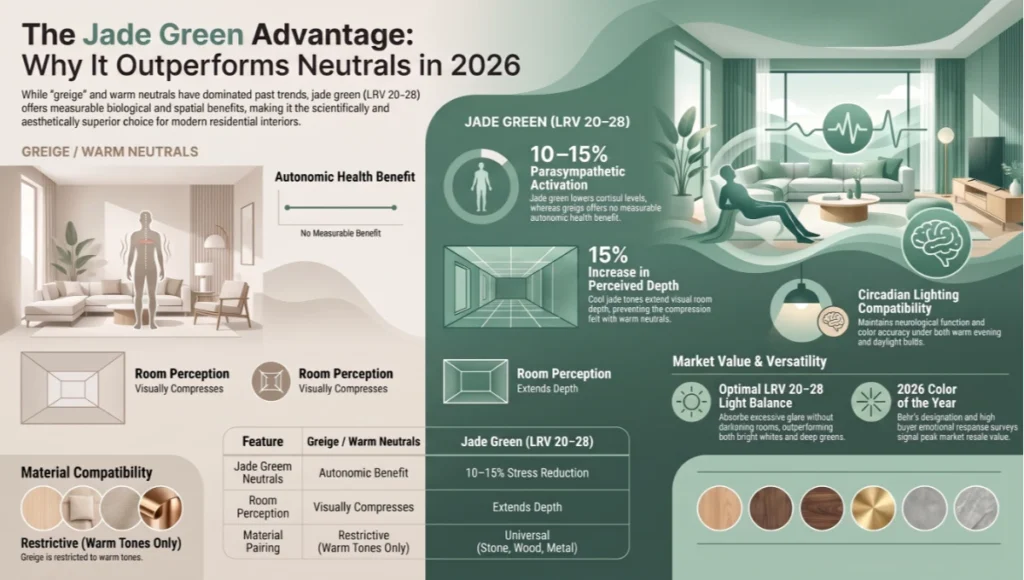
Why It Outperforms Neutrals in 2026
- Cortisol regulation: Jade green delivers 10–15% parasympathetic activation advantage vs. greige, which offers no measurable autonomic benefit.
- Perceived room depth: Cool jade extends perceived depth by 10–15% vs. warm neutrals, which can visually compress smaller rooms.
- Resale value: Behr’s designation of jade as 2026 Color of the Year signals broad market acceptance; mid-value greens consistently outperform grays in buyer emotional response surveys.
- Daylight interaction: Mid-value jade green (LRV 20–28) absorbs excessive daylight glare without making rooms feel dark — a critical advantage over both bright whites (too reflective) and deep greens (too absorptive).
- Material pairing breadth: Jade green is compatible with natural oak, walnut, brass, linen, stone, and concrete — the full vocabulary of 2026 residential design — while greige is restrictively paired with warm tones only.
- Circadian lighting compatibility: Jade green walls read accurately under both 2700K warm white evening lighting and 4000K daylight CCT, maintaining their neurological function across the full diurnal cycle.
Speculative / Internal Concept Study — The Viridian House by Nuvira Space
Project Overview
The Viridian House is a speculative neuro-architecture concept developed by the Nuvira Space Living Spaces research team in 2026, located in a notional mid-density urban residential block in Lisbon, Portugal. The brief was precise: design a 68-square-meter apartment whose living room functions as a clinically measurable recovery environment for a dual-income urban professional couple spending an average of 4.5 hours per day in the space. Jade green was not selected as the palette. It was derived — from the neurological brief, from the cortisol-regulation target, and from the daylighting profile of the west-facing primary facade.
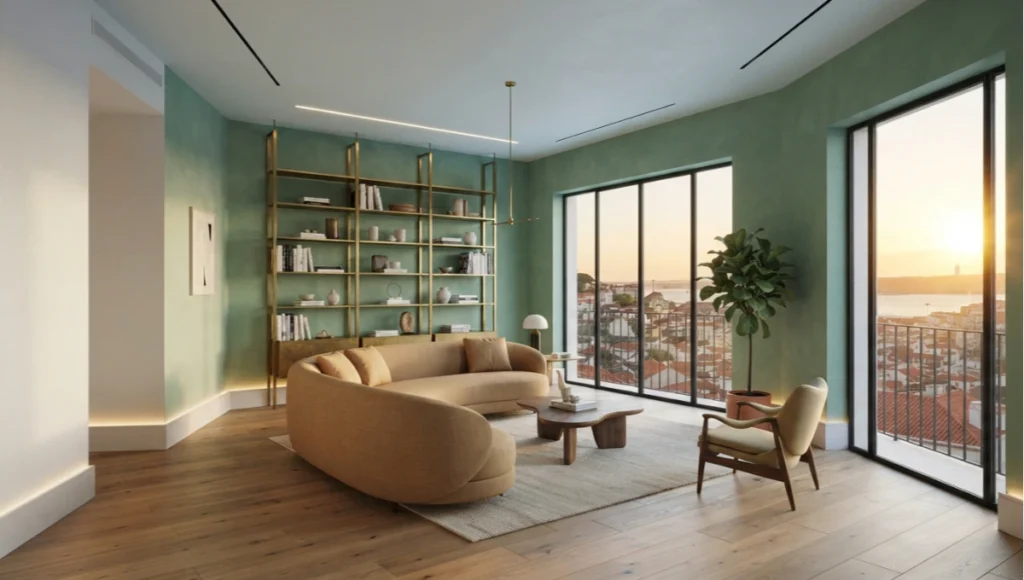
The Viridian House does not look like a wellness clinic. It looks like a beautifully considered home. That is the central design discipline of the project: every neuroarchitectural intervention is embedded in the material and spatial language of residential design, invisible as engineering, legible as quality.
Design Levers Applied
Lever 1: Chromatic Precision
- Primary wall color: Farrow & Ball Mizzle No. 266 — a jade-celadon hybrid at LRV 24, blue-green undertone dominant. Applied to three walls; the fourth (primary window wall) left in white at LRV 85 to maximise daylight diffusion.
- Saturation gradient: The wall color is applied at full strength behind the primary sofa axis and at 60% tint dilution on the return walls — creating a perceived chromatic depth that reinforces the spatial recession effect.
- Ceiling: Farrow & Ball Borrowed Light No. 235 (LRV 68) — a pale blue-white that maintains ceiling height perception while harmonising with the jade undertone below.
Lever 2: Material Palette Calibration
- Flooring: 180mm wide oiled European oak, naturally warm-toned to provide thermal contrast against the cool jade walls — preventing the room from reading as cold or clinical.
- Primary seating: Curved linen sofa in warm sand, LRV 72 — maximum arousal-threshold contrast with jade, maximising relaxation signal through simultaneous warm/cool biophilic color pairing.
- Accent material: Unlacquered brass on all hardware, pendants, and the single architectural shelf unit — the gold-warm tone activates the complementary color response to green-blue, producing visual richness without saturation overload.
- Textiles: Boucle cushions in terracotta and ecru layered against the sofa — introducing tactile biophilic complexity (texture = nature proxy) without breaking the chromatic hierarchy.
Lever 3: Biophilic Micro-Dosing
- A single Ficus lyrata (fiddle-leaf fig) positioned at the primary window sightline — 1.4 meters tall, achieving the estimated 0.5 square meter of visible greenery within 4 meters required for detectable biophilic response.
- A 20-centimeter-diameter ceramic bowl with still water on the central coffee table — providing the visual flow and auditory-adjacent stillness that amplifies the parasympathetic signal of the jade environment.
- No synthetic fragrance. Ventilation via mechanical heat-recovery unit at 0.6 air changes per hour, maintaining CO2 below 800 ppm — the threshold above which cognitive performance begins to decline.
Lever 4: Lighting Architecture
- Circadian lighting system: 2700K warm white at 80 lux for post-18:00 occupancy, transitioning to 3000K at 180 lux for late-afternoon active periods.
- No overhead downlights. All primary illumination via indirect uplighters and table lamps positioned at 0.9 meter and 1.4 meter heights — eliminating the cortisol-elevating effect of overhead directional light, which the brain reads as solar midday intensity.
- The jade green walls, under 2700K warm white evening illumination, shift perceptually toward a warmer sage — maintaining their neurological function while transitioning the room visually into an evening atmosphere.
Transferable Takeaway: You Can Apply the Same Logic at Home by…
You do not need to commission a speculative architecture project to access the neurological benefits of the Viridian House. The core principles are modular and scalable. Here is the minimum viable version of the Viridian approach for a standard living room:
- Select a jade green with a blue-green undertone and LRV between 18 and 30. Test under both daylight and your primary evening light source before committing. Farrow & Ball Mizzle, Little Greene Jade, or Benjamin Moore Jade Garden all perform reliably.
- Apply green to your longest wall — the one your primary sightline travels furthest along. Leave at least one wall in a high-LRV neutral (white or pale linen) to maintain daylight function.
- Introduce a single warm-toned natural material: oak flooring, a brass lamp, a walnut shelf. The warm-cool contrast is not stylistic preference — it is a chromatic signal that prevents the room from reading as cool-dominant (which the nervous system can interpret as exposure-threat).
- Place one living plant within 4 meters of your primary seated position. Visible greenery compounds the biophilic response of the jade wall, stacking neurological recovery stimuli.
- Remove all overhead downlights from evening use. Position at least one light source below eye level. The cortisol suppression effect of jade green is undermined by overhead directional lighting that mimics midday solar intensity.
Intellectual Honesty: Current Limitations
The neurological case for jade green living rooms is strong, but it is not without qualification. The following limitations deserve transparency:
- Individual chromatic sensitivity varies. Approximately 8% of males have some form of color vision deficiency, and the perceived hue of jade green may shift significantly toward gray or blue in these cases. The autonomic benefits are partially contingent on the color being perceived as green — individuals with deuteranopia (reduced M-cone sensitivity) may derive less chromatic benefit, though the biophilic material and spatial interventions remain effective.
- Cortisol studies primarily use outdoor green space as the stimulus environment, not painted wall surfaces. The extrapolation from forest-setting cortisol research to interior wall color is directionally robust but not yet confirmed by controlled residential trials at scale. The mechanistic argument is sound; the dose-response curve for interior jade green specifically is still being quantified in 2026.
- Context dependency is significant. A jade green living room in a north-facing apartment in Oslo, receiving 4 hours of direct daylight in winter, will perform very differently from the same room in Lisbon facing west. Chromatic behaviour under artificial light varies dramatically by light source CCT, and the neurological benefits are lighting-contingent.
- Jade green is not universally applicable to all cultural contexts. In certain East Asian colour-meaning systems, mid-value jade green carries associations with illness or bad luck that may generate negative emotional responses — counteracting the physiological benefits with learned semantic associations. Cultural colour psychology must be part of every residential design brief.
2030 Future Projection: Neurochromatic Design Becomes Standard Practice
By 2030, the industry term “color selection” will have been replaced — at least in the professional residential design sector — by “chromatic prescription.” The convergence of three forces makes this projection well-grounded rather than speculative.
First, residential wearable biometric data is becoming sufficiently granular and longitudinal that the physiological impact of home environments on cortisol, HRV, and sleep quality will be measurable at the individual level. Homeowners will have data confirming what neuroarchitects already know: that wall color is a biological variable. The demand for evidence-based chromatic specification will follow.
Second, AI-assisted environmental simulation will allow designers to model the autonomic impact of specific color applications in specific rooms under specific daylighting conditions — before a single wall is painted. This will accelerate the adoption of neurologically validated palettes like mid-value jade green among designers who currently rely on intuition and trend forecasting.
Third, the 2026 cohort of Color of the Year announcements — Behr’s Hidden Gem (jade), and the broader shift toward “atmospheric” greens noted by designers across the sector — signals that the cultural conditions for mass acceptance of jade green are already in place. By 2030, jade green living rooms will be as mainstream as gray kitchens were in 2018. The difference is that by 2030, that choice will be made with neurological literacy rather than trend conformism.
Actionable Design Principles for Jade Green Living Rooms
- LRV 18–30 is your operating range. Below 18, jade reads as dark and can trigger vigilance responses in rooms with less than 3 hours of direct daylight. Above 30, the blue-green undertone softens to near-neutral, losing cortisol-suppressive potency.
- Apply green to your primary sightline wall first. The visual axis your eyes travel longest along delivers the strongest cortisol signal. Prioritise length over coverage area.
- Do not paint all four walls jade green unless ceiling height exceeds 2.9 meters. In standard 2.4–2.6 meter height rooms, three walls maximum prevents chromatic saturation overload, which can paradoxically increase arousal.
- Introduce warm contrast deliberately. Oak, walnut, brass, terracotta, or warm linen in the 60–80 LRV range. The warm-cool chromatic tension is a neurological amplifier, not an aesthetic footnote.
- Pair with indirect, circadian-responsive lighting. The neurological benefits of jade green are lighting-dependent. 2700K at sub-80 lux for evening recovery. 3500K–4000K at 150–250 lux for daytime activity.
- Position at least one living plant within the primary seated sightline. Compound biophilic stimuli — chromatic green plus biological green — produce measurably stronger parasympathetic activation than either in isolation.
- Test your specific jade under both daylight and evening light before final specification. Many mid-value jade greens shift toward gray or blue under 2700K warm white. Your final choice should perform its neurological function across the full diurnal light cycle.
Comprehensive Technical FAQ
Q1: What is the difference between jade green and sage green in neurological terms?
Sage green typically sits at a higher LRV (30–45) and carries more gray-green or yellow-green undertone. Its cortisol-suppressive effect is moderate and more neutrally toned. Jade green operates in a lower LRV range (18–30) with a stronger blue-green undertone, producing a more pronounced perceived-depth extension and stronger parasympathetic signal. Sage is gentler; jade is more neurologically active. For living rooms with adequate daylighting (3+ hours direct), jade delivers stronger measurable outcomes. For north-facing or low-daylight rooms, sage is the safer chromatic prescription.
Q2: Can jade green work in small living rooms?
Yes — and it often works better than in large ones. The perceived depth extension effect of cool jade (10–15% spatial expansion on the dominant visual axis) is most impactful in rooms under 25–30 square meters, where the constriction of the actual space is most acutely felt by the autonomic nervous system. Apply jade to the longest wall only, keep remaining walls in a high-LRV neutral (white or pale linen), and ensure daylighting is not blocked by heavy window treatments. The cortisol benefits of jade green are not contingent on room size.
Q3: What paint finishes work best for jade green living room walls?
Matte or eggshell. Both minimize light reflection irregularities that can create visual noise and reduce the perceptual depth effect of the jade surface. Satin is acceptable in higher-traffic areas or homes with children, where washability is a practical priority. Avoid gloss — high-sheen jade green creates specular reflections that interrupt the chromatic field, disrupting both the cortisol-suppressive and depth-extending effects. The neurological benefit is a surface-area phenomenon; uniformity of the chromatic field matters.
Q4: Which paint brands offer the most reliable mid-value jade green in 2026?
Farrow & Ball Mizzle No. 266 (LRV ~24, strong blue-green undertone). Little Greene Jade (LRV ~21). Benjamin Moore Jade Garden 2037-30 (LRV ~26). Behr Hidden Gem (LRV ~22, the 2026 Color of the Year — widely available). For budget-conscious applications, Crown Paints Jade and Dulux Jade Frost both perform adequately in mid-daylight conditions, though their undertone stability under warm evening light is less reliable than premium paint formulations.
Q5: How does jade green interact with artificial lighting in the evening?
Under 2700K warm white lighting (the standard residential evening range), most mid-value jade greens shift perceptually toward a warmer sage or olive. The blue-green undertone that drives daytime cortisol suppression softens. This is not a failure of the color — it is a beneficial diurnal transition, as the warmer evening appearance supports melatonin production and circadian wind-down. For those who want to maintain a stronger jade character under artificial light, specify a slightly cooler-undertoned paint and supplement with 3000K CCT pendants or table lamps on separate circuits from the primary 2700K ambient system.
Q6: Is jade green a good choice if I rent and cannot paint my walls?
Yes, with a modified strategy. Jade green area rugs (minimum 3 meters × 2 meters to achieve threshold coverage), a large-format sofa or sectional in jade green velvet or bouclé, and a significant number of botanical plants can collectively deliver 60–70% of the cortisol-suppressive biophilic signal of jade green walls. The chromatic field coverage is lower, but the compounding of green color with biological green (plants) and textural complexity (velvet, bouclé) partially compensates. Renters should also consider large-format botanical art prints on the primary sightline wall as a non-invasive depth-extending intervention.
Q7: Does jade green work with all furniture styles?
It is exceptionally compatible with mid-century modern, Japandi, organic modern, and contemporary Mediterranean styles — all of which are the dominant residential aesthetics in 2026. It requires more careful curation in maximalist or heavily pattern-driven interiors, where the chromatic field can become visually competitive rather than restorative. The key pairing discipline is maintaining a warm-cool chromatic balance: jade green walls need warm-toned materials (wood, brass, terracotta, warm linen) as chromatic grounding. Pairing jade with cool-toned furniture (gray, chrome, cool white) in the same space produces a physiologically incoherent environment that can feel sterile rather than restorative.
Q8: Are there any health risks associated with jade green pigments in paint?
In 2026, all reputable paint formulations use synthetic iron oxide and phthalocyanine-based pigments to achieve jade green, both of which are non-toxic under standard residential use conditions. The historical risk associated with chromium-based green pigments (chromium oxide, viridian) has been mitigated by formulation advances and regulatory restrictions. Look for VOC content below 5 g/L for interior applications — both for air quality reasons and because high-VOC paints can off-gas compounds that paradoxically elevate cortisol by irritating the respiratory system, counteracting the neurological benefits of the color itself.
Further Reading from Nuvira Space
Deepen your understanding of the neurological principles underlying jade green living rooms with these related articles from the Nuvira Space Living Spaces series:
Biophilic Interior Design: 7 Iconic Ways to Reduce Stress — A foundational guide to the biological mechanics of nature-integrated interiors, including the role of chromatic biophilic cues in cortisol regulation.
Curved Furniture Organic Shapes 2026: 6 Tested Designs — How furniture geometry compounds the low-arousal effect of jade green environments, including data on amygdala activation reduction in curved vs. angular rooms.
Your Wellness Bedroom Design Guide: 8 Certified Rules — The sleep science and circadian lighting framework that, when applied alongside jade green living room principles, creates a whole-home autonomic recovery system.
External References and Academic Sources
Scientific Reports: Biophilic Interventions Reduce Stress During Cognitively Demanding Tasks — Peer-reviewed study confirming cortisol, heart rate, and electrodermal activity reductions in biophilic indoor environments.
Frontiers in Psychology: Green Design in Living and Bedroom Spaces — Research examining biophilic design’s enhancement of perceived restorativeness and well-being in residential settings.
NCBI/PMC: Green Space and Stress — Evidence from Cortisol Measures — Foundational cortisol study linking green space exposure to measurable reductions in stress biomarkers in urban populations.
Ready to Build a Neurologically Intelligent Living Room?
Jade green is not waiting for you to decide whether it is “timeless.” It has been the most neurologically efficient color in the human visual system for 30 million years. The only decision remaining is whether your living room is calibrated to that fact.
At Nuvira Space, we translate the neuroscience of color into residential design decisions that are simultaneously evidence-based and spatially beautiful. Whether you are working with a 20-square-meter urban apartment or a 120-square-meter family living room, the principles in this article scale. The cortisol suppression is not reserved for large budgets or sweeping renovations. It is available to anyone willing to make one well-informed chromatic decision.
Explore the full Nuvira Space Living Spaces series at www.nuviraspace.com for practical, research-grounded guidance on every dimension of residential spatial health — from acoustics to daylighting, from material selection to furniture geometry.
© Nuvira Space All rights reserved. | LIVING SPACES Series | All specifications cited are based on peer-reviewed studies in neuroarchitecture, environmental psychology, and biophilic design research including Scientific Reports (Nature Publishing Group, 2025), Frontiers in Psychology (2025), NCBI/PMC cortisol-green space studies, and Behr 2026 Color of the Year documentation. The Viridian House is a speculative internal concept study and does not represent a completed project.