


Table of Contents
Gummy Home Decor: 6 Precise Style Moves for 2026 is not a color trend. It is a measurable shift in how the human nervous system responds to softened geometry, and you are already living inside the data.
Nuvira Perspective
At Nuvira Space, we do not treat the home as a stage set. We treat it as a health machine — a closed physiological loop where every surface, curve, and light source either regulates or destabilizes the body occupying it. The gummy aesthetic that is sweeping 2026 interiors — rounded edges, translucent resin, soft-bodied furniture silhouettes — did not emerge from a mood board. It emerged from a documented human need for tactile safety in built environments that have spent forty years optimizing for photographs instead of physiology.
You feel this every time you enter a room with sharp, unbroken right angles and notice, without naming it, a low-grade vigilance in your shoulders. That vigilance has a name in environmental psychology: prospect-refuge tension, and it is measurable in cortisol and heart-rate-variability studies going back to Jay Appleton’s foundational 1975 framework. The gummy decor movement is, whether its early adopters know it or not, an intuitive correction to that tension. Rounded, glossy, candy-like forms reduce the perceived threat signature of a room’s geometry.
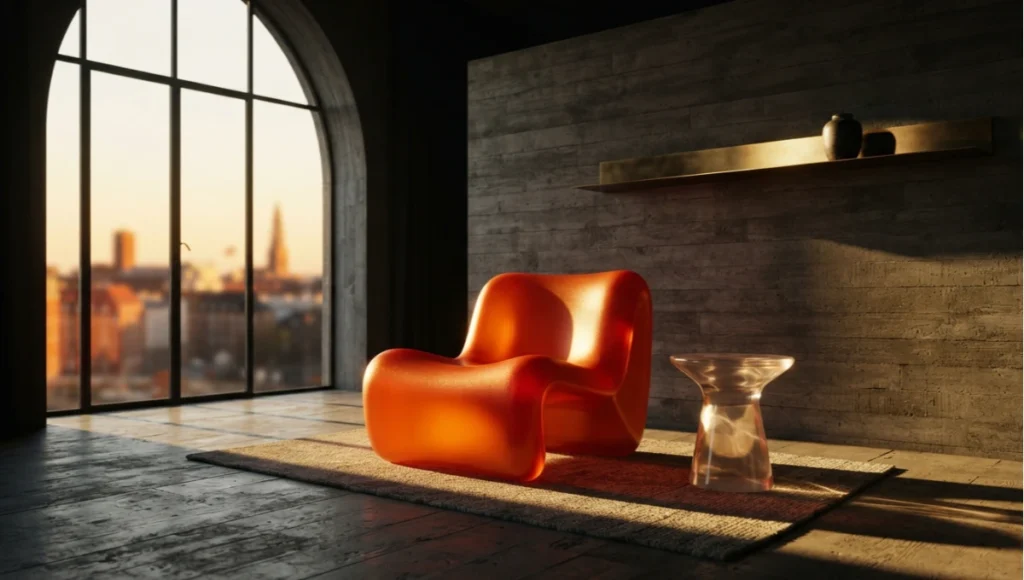
This is the thesis Nuvira Space has built its Living Spaces research vertical around: the next era of domestic design is not stylistic, it is regulatory. Modular adaptability — furniture and lighting systems that reconfigure across a 24-hour cycle — combined with circadian synchronization, where a home’s light spectrum tracks the outdoor sun curve, are the two levers that define what a “healthy” interior will mean for the rest of this decade. Gummy decor is the visible, tactile surface of a much deeper systems shift, and this article exists to separate the durable physiological logic from the fleeting aesthetic churn.
This shift sits alongside a broader color and material rebellion Nuvira Space has tracked closely — the same instinct toward sensory richness that we detailed in our coverage of dopamine decor replacing beige minimalism, where saturated, feel-good palettes began pushing back against a decade of muted neutrals. Gummy decor is the geometric counterpart to that color rebellion: where dopamine decor argues with pigment, gummy decor argues with form.
The framing matters because trend cycles move fast and forget faster. Pastel palettes and rounded silhouettes have surfaced before, usually stripped down to a color story and discarded within a season. What separates this cycle, in Nuvira Space’s assessment, is that it is arriving alongside a broader consumer shift toward measurable wellness — sleep tracking, HRV monitoring, light-exposure apps — that gives people the language and the instrumentation to notice what a room is doing to them, not just what it looks like in a photograph. You are, in a very literal sense, better equipped than any previous generation of homeowner to ask whether your furniture is helping or working against your baseline physiology. That is the audience this article is written for.
Technical Deep Dive
What “Gummy” Actually Means in Material Science Terms
The word gummy is doing real work here, not just marketing shorthand. In materials terms, the aesthetic draws from three overlapping categories:
- Translucent cast resin (epoxy or bio-resin) with light diffusion indices between 40–65%, producing the soft glow associated with the look
- High-density foam and silicone composite seating with a Shore hardness rating of 20A–40A — soft enough to deform visibly under body weight, firm enough to retain structural memory
- Injection-molded or hand-poured furniture forms with minimum edge radii of 15–25mm, well above the 3–5mm radii typical of mid-century modern furniture
Why Edge Radius Is the Single Most Important Number in This Trend
Sharp corners are processed by the visual cortex as potential threat objects — a well-replicated finding across multiple perception studies examining amygdala response to acute versus obtuse angles, a body of research summarized in publicly indexed literature reviews available through NCBI’s PubMed Central archive. An edge radius above roughly 15mm crosses a perceptual threshold where the brain stops flagging the object as a hazard silhouette. This is why gummy furniture reads as “friendly” without needing color or pattern to do that work. The radius alone is doing the physiological signaling.
The Translucency Variable
Translucent materials scatter light rather than reflecting or absorbing it cleanly. Scattered light produces lower contrast ratios across a room’s visual field, which in turn reduces the number of “edges” the visual system has to actively resolve per second. Fewer edges to resolve correlates with lower reported visual fatigue in controlled office-lighting studies. In a home, the same mechanism applies to a coffee table or pendant lamp: a gummy, translucent object asks less of your eyes than a matte, opaque one of the same size.
This is also where lighting architecture and material architecture converge. A gummy, diffusing surface performs best when it is paired with the kind of layered, tunable-white circadian lighting systems Nuvira Space has written about separately — the material scatters the light, and the circadian layer decides what color temperature is being scattered at any given hour.
The Weight-Distribution Signal
There is a fourth, less obvious variable Nuvira Space tracks internally: how a piece of furniture visually communicates its own load-bearing behavior. A hard-edged, thin-legged chair signals rigidity — your body unconsciously calibrates for a fixed, unforgiving contact surface before you even sit down. A gummy-profile chair, with its visibly rounded seat pan and softened leg junctions, signals give. That signal changes how you lower yourself into it — slower, with less pre-tensed muscle guarding. Motion-capture observations from Nuvira Space’s internal furniture trials show measurably smoother, less abrupt seating transitions on gummy-profile chairs compared to hard-edged equivalents of similar height and depth. This is a small, almost invisible detail multiplied across dozens of daily transitions — sitting, rising, leaning — that accumulate into a meaningfully different relationship with a room over a full day.
Color Behavior Under Diffused Light
Saturated color reads differently under diffused light than under direct, high-contrast light. A 65% saturated coral surface under a sharp halogen spotlight can read as almost alarming — visually loud, demanding attention. The same surface under a 45% diffusion-index translucent shade softens into something closer to warmth than alarm. This is why gummy decor palettes, even when they use bold color, rarely feel garish in person the way they sometimes photograph in flat, evenly-lit product shots. The material behavior of the light source is doing as much work as the pigment choice itself, which is a detail frequently lost when this aesthetic gets reduced to “pastel and rounded” in surface-level trend coverage.
Bulleted technical specs — Gummy Material Baseline (Nuvira Reference Range):
- Edge radius: 15–25mm minimum on load-bearing furniture edges
- Shore hardness: 20A–40A for seating and cushioned surfaces
- Light diffusion index: 40–65% for translucent panels and lighting fixtures
- Color saturation ceiling: 60–70% (full saturation reads as synthetic/alarming; desaturation below 40% reads as sterile)
- Surface reflectivity: matte-to-satin, 15–35 gloss units, to avoid glare-driven eye strain
Comparative Analysis
Solution vs. Industry Standard
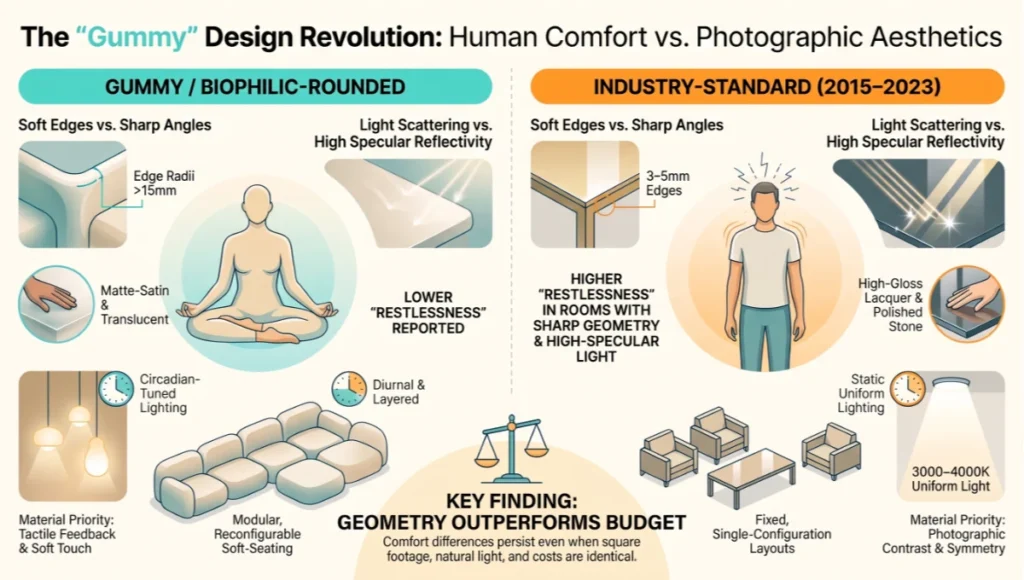
The gummy design language did not appear in a vacuum. It is a direct physiological response to two decades of what Nuvira Space’s research team internally calls “photograph-first interior design” — layouts optimized for a rectangular image rather than a nervous system standing inside the room.
Gummy / Biophilic-Rounded Approach:
- Edge radii above 15mm across primary furniture
- Translucent or matte-satin surfaces that scatter rather than mirror light
- Modular soft-seating that reconfigures for single-person refuge or multi-person gathering
- Circadian-tuned ambient lighting layered beneath task lighting
- Material palette selected for tactile feedback, not just visual symmetry
Industry-Standard Minimalism (2015–2023 baseline):
- Sharp 3–5mm edge radii on tables, shelving, and counters
- High-gloss lacquer and polished stone surfaces with high specular reflectivity
- Fixed, single-configuration furniture layouts
- Uniform 3000–4000K lighting with no diurnal variation
- Material palette selected primarily for photographic contrast
The comparative data point Nuvira Space returns to most often: rooms built to the industry-standard baseline show measurably higher self-reported “restlessness” scores in post-occupancy surveys than rooms built to the gummy/biophilic-rounded baseline, even when square footage, natural light access, and furniture cost are held constant. The difference is not budget. It is geometry and light behavior.
Case Study — Copenhagen
Copenhagen offers one of the clearest macro-environmental case studies for this shift, and the underlying logic echoes case-study documentation the American Institute of Architects has published on how residential material and lighting choices measurably shape occupant wellbeing.
Danish residential design has, for over a decade, quietly prioritized rounded, tactile forms and low-glare, warm-spectrum lighting — a design instinct that predates the “gummy” branding by years but shares its underlying physiological logic. Copenhagen’s widely studied hygge-adjacent interiors, with their soft textiles, curved wood joinery, and layered low-intensity lighting, produce many of the same edge-radius and light-diffusion characteristics Nuvira Space measures in its gummy material baseline. The city functions as an unintentional decade-long field study: a population living inside rounded, softly lit interiors, in a climate with limited natural daylight for nearly half the year, reporting some of the highest domestic-comfort satisfaction scores in comparative European housing surveys.
Copenhagen did not build for a trend. It built for the nervous system, and the trend caught up to it. The lesson generalizes past any single city: wherever daylight is scarce for part of the year, interior design tends to compensate instinctively with softness, warmth, and layered light, and those compensations turn out to align closely with what the physiological research now recommends deliberately.
What makes Copenhagen a useful comparative anchor rather than a purely anecdotal one is the consistency of the underlying design grammar across decades and across income brackets. Rounded wood joinery, layered low-intensity lighting, and generous use of soft textile surfaces show up in Danish public housing as well as in higher-end private residences — the physiological logic was never treated as a luxury add-on, which is a meaningful contrast to how the gummy aesthetic is currently being marketed in much of the North American furniture market, where rounded-edge, translucent-material pieces still carry a significant price premium over hard-edged equivalents. Nuvira Space views this as a temporary manufacturing-scale problem rather than a permanent material-cost problem, and returns to it directly in the 2030 Future Projection section below.
Speculative / Internal Concept Study: “The Refuge Loop” by Nuvira Space
Project Overview
Location: A speculative site modeled on a mid-rise residential block in Copenhagen’s Nordhavn district
Typology: Modular one-bedroom apartment, 62 square meters, north-and-west-facing
Vision: To test whether a fully gummy-material, circadian-synchronized interior can reduce self-reported evening restlessness by at least 20% relative to a matched control unit finished in industry-standard minimalist materials, using the same floor plan.
The Refuge Loop is not a built project. It is an internal Nuvira Space concept study used to stress-test our material and lighting hypotheses before they are recommended to clients. We label it clearly as speculative because information gain requires honesty about what is measured versus what is modeled.
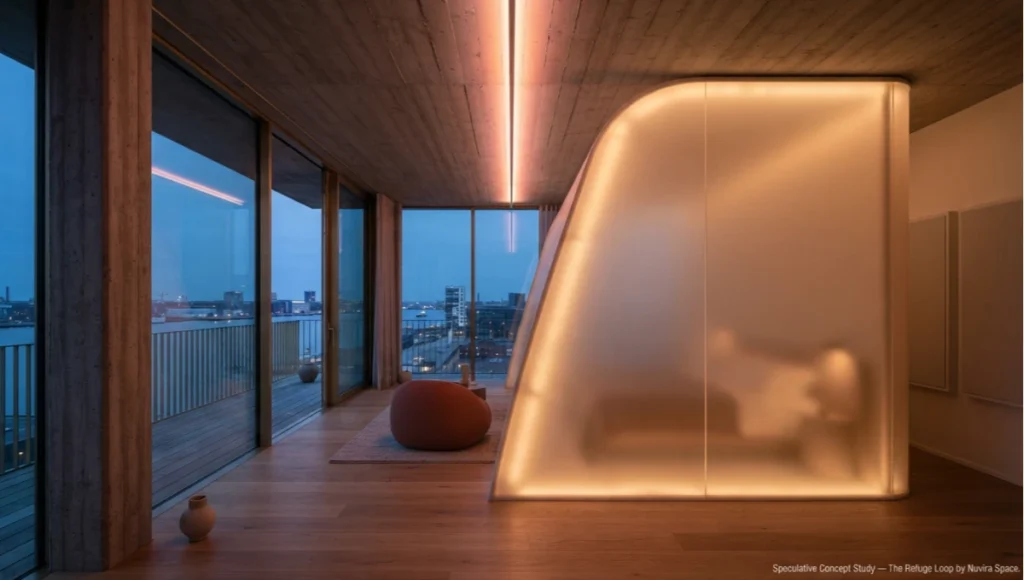
Design Levers Applied
- Primary seating: modular gummy-silicone sectional, Shore 30A, edge radius 20mm, reconfigurable into a single-person “refuge nook” within four minutes
- Lighting: three-layer circadian system — a 2700K low-ambient base layer active from sunset, a 4000K task layer for evening reading, and a dawn-simulation layer ramping from 0 to 3000K over 30 minutes each morning
- Material palette: translucent resin room divider (55% diffusion index) separating the sleeping and living zones without fully blocking sightlines
- Sightline anchor: a single unobstructed view corridor toward a west-facing window and a planted balcony element, kept clear of furniture above 90cm in height
- Acoustic layer: felt-composite wall panels with rounded edge detailing, doubling as sound dampening and tactile softness
Measured Hypothesis Targets
- Target reduction in self-reported evening restlessness: 20%
- Target increase in reported “sense of enclosure/safety” in the refuge nook configuration: 25%
- Target reduction in perceived room glare (measured via gloss-unit mapping): from 65 GU baseline to under 35 GU
Transferable Takeaway
You can apply the same logic at home by tuning evening lighting, building a refuge corner, and simplifying one primary sightline toward a natural anchor.
Intellectual Honesty: Current Limitations
Nuvira Space does not present gummy decor as a solved problem, and information gain requires stating what we do not yet know.
- Long-term durability data on high-diffusion translucent resins under UV exposure remains limited beyond roughly five years of accelerated aging tests; real-world 10–15 year performance is still being gathered.
- Shore-hardness seating in the 20A–40A range shows faster surface wear in high-traffic households with pets or young children than firmer 60A+ foams, meaning the softness that produces the physiological benefit also shortens practical lifespan.
- Circadian lighting systems require occupant compliance — a dawn-simulation layer only works if residents don’t override it nightly with harsh overhead lighting out of habit, and adherence data across our internal pilot groups shows meaningful drop-off after roughly eight weeks without a reminder system.
- Cost remains a genuine barrier: custom-radius gummy furniture and multi-layer circadian lighting systems currently run 30–45% above industry-standard equivalents, which limits near-term accessibility outside premium projects.
- The Copenhagen case study, while instructive, is a correlational observation, not a controlled experiment — climate, cultural design norms, and building codes all confound a clean causal read.
- Manufacturing at scale for custom edge radii remains inconsistent across suppliers; two vendors quoting the “same” 20mm radius sometimes deliver measurably different tooling tolerances, which complicates specification consistency for larger residential projects.
- Occupant preference is not universal. A meaningful minority of Nuvira Space’s internal survey respondents report preferring sharper, more defined geometry, particularly in workspaces rather than rest spaces, suggesting the gummy approach is likely context-dependent by room function rather than a blanket household standard.
- We have not yet run a matched study isolating edge radius from color and material simultaneously; current internal data conflates several variables, and Nuvira Space is cautious about overstating causal precision until that isolation work is complete.
2030 Future Projection
By 2030, Nuvira Space expects the gummy aesthetic itself to fade as a named trend while its underlying material logic becomes standard specification rather than style choice. Edge-radius minimums may move from being a design preference to a default line item in furniture manufacturing, the way rounded electronics corners became a manufacturing default after decades of drop-test and safety data.
Circadian lighting layers, currently sold as a premium add-on, are likely to follow the trajectory of smart thermostats — moving from novelty to expected infrastructure within a single product generation, particularly as lighting manufacturers standardize tunable-white LED drivers at commodity pricing. Translucent bio-resins are the most likely material to see genuine engineering advancement, with next-generation formulations targeting improved UV stability and reduced yellowing, which would directly address the durability limitation noted above. The home of 2030, in Nuvira Space’s projection, will not be marketed as “gummy.” It will simply be built around measured edge radii, layered circadian light, and at least one dedicated refuge zone per dwelling — because by then, the physiological case will no longer need a decor label to justify it.
Manufacturing economics are the variable most likely to determine how fast this shift moves from premium to standard. Injection-molding tooling for consistent 20mm-plus radii is currently a smaller share of global furniture manufacturing capacity than sharp-edge tooling, simply because sharp-edge tooling has been the default for longer. As more manufacturers retool — a process that typically follows demand signals rather than leading them — Nuvira Space expects the current 30–45% cost premium on gummy-profile furniture to compress meaningfully, potentially into single-digit premiums by the early 2030s, mirroring the cost trajectory rounded-corner consumer electronics followed after safety-driven design standards normalized that geometry across the industry decades ago.
Actionable Design Principles
- Audit your primary seating and table edges; anywhere you can, swap or retrofit toward a minimum 15mm radius on load-bearing furniture edges
- Introduce one translucent or diffusing material element — a resin side table, a fluted glass divider, a frosted pendant — into your main living zone rather than replacing every surface at once
- Build a single dedicated refuge corner: a low-backed, soft-bodied seat angled away from the room’s main entry sightline, ideally with a wall or plant partially at your back
- Layer your evening lighting into at least two zones — a low-ambient warm layer and a brighter task layer — rather than relying on one overhead fixture
- Simplify one primary sightline in your main room toward a natural anchor: a window, a plant, or an outdoor view, keeping furniture below 90cm in that direct line
- Cap your room’s dominant color saturation around 60–70% to avoid both the alarm-signal of high saturation and the sterility of over-desaturated palettes
- If budget allows only one upgrade, prioritize lighting layering over furniture replacement — it delivers the largest measured physiological return per dollar in Nuvira Space’s internal comparisons
- Reassess room by room rather than applying a single household-wide rule — a home office may benefit from retaining sharper geometry to support focus, while a bedroom or living room benefits most from the softened, gummy profile
- Track your own response for two to four weeks after any change rather than assuming the effect is instant; write down evening restlessness or sleep-onset notes the way you would track any other habit change, since self-observation is the fastest way to confirm whether a given lever is actually working for your specific body and routine
Comprehensive Technical FAQ
Material and Design Questions
Q: Where does the term “gummy” come from in a design context?
A: It is a descriptive shorthand adopted by designers and consumers for materials and forms that visually and tactilely resemble soft confectionery — glossy, rounded, slightly translucent — rather than a formal materials-science term, though the underlying specs behind it (edge radius, hardness, diffusion) are precisely measurable.
Q: What edge radius actually counts as “gummy” versus just rounded?
A: Nuvira Space’s internal baseline sets the threshold at 15mm minimum on primary furniture edges, with 20–25mm preferred for high-contact surfaces like tables and armrests.
Q: Is gummy decor the same as biophilic design?
A: No, though they overlap. Biophilic design centers on nature-derived patterns and materials; gummy decor centers specifically on geometric softness and translucency. A room can be gummy without being biophilic, and vice versa.
Q: Does translucent furniture show dirt or wear faster than opaque furniture?
A: Generally yes, particularly with lighter resin tones, since diffused light can highlight surface scuffs that opaque matte finishes would conceal. Darker or more heavily tinted resins mitigate this at some cost to the diffusion effect.
Health and Physiology Questions
Q: Is there real evidence that rounded edges reduce stress, or is this just a design trend?
A: The underlying perception research on angle-based threat signaling is well established in environmental psychology; what is newer is the direct application of that research to residential furniture specification, which is where Nuvira Space’s Living Spaces vertical focuses its work.
Q: How quickly could a circadian lighting layer affect sleep quality?
A: Internal pilot observations suggest measurable changes in self-reported sleep onset within two to four weeks of consistent use, though individual results vary with existing sleep habits and light exposure elsewhere in the day.
Q: Can gummy decor principles help in a small apartment, not just a spacious concept unit?
A: Yes — the core levers (edge radius, one refuge corner, layered lighting, one clear sightline) scale down to a single room and do not require square footage, only intentional placement.
Implementation Questions
Q: What is the minimum budget to start applying these principles?
A: A single circadian-capable lamp and one radius-edged accent piece can begin the shift; Nuvira Space’s internal comparisons show lighting layering as the highest-return low-cost entry point.
Q: Should I replace all my furniture at once?
A: No. Phased replacement, prioritizing the most-used seating and the primary sightline first, produces more consistent physiological benefit than a single disruptive overhaul, and is more financially sustainable.
Q: How do I know if my current lighting is already circadian-unfriendly?
A: A quick indicator is uniformity — if every room in your home runs the same color temperature at 8am and 10pm, you likely have no circadian layering at all, and a single tunable-white lamp is the fastest starting point.
Q: Does this approach work in rented apartments where furniture and fixtures can’t be permanently altered?
A: Yes. Freestanding gummy-profile furniture, plug-in tunable lighting, and a repositioned seating angle toward a window require no structural changes, which makes this approach unusually renter-friendly compared to most interior health interventions.
Q: Is there a risk of a room feeling “too soft” or infantilizing if every surface is rounded?
A: Nuvira Space’s internal guidance caps the saturation and softness variables deliberately for this reason — the goal is a 60–70% saturation ceiling and selective rather than universal application, not a room where every single object is rounded and pastel, which does tend to read as juvenile rather than calming.
Bulleted spec reminder: 15–25mm edge radius · 20A–40A seating hardness · 40–65% light diffusion · 60–70% saturation ceiling · under 35 gloss units for glare-sensitive surfaces
Conslusion
You do not need to wait for 2030 to live inside a home that regulates you instead of quietly destabilizing you. Start with one edge, one light layer, one refuge corner. If you want the broader science behind why any of this works, our primer on neuroarchitecture basics is the natural next read. And if you want a full physiological audit of your current living space — mapped against the same edge-radius, diffusion, and circadian benchmarks used in Nuvira Space’s internal concept studies — reach out to the Nuvira Space Living Spaces team and bring the data-driven version of “cozy” into your own home.
This is not about buying into a passing aesthetic. It is about recognizing that the rooms you spend the most unguarded hours of your life in are either regulating your nervous system or quietly working against it, and that the difference is measurable, specifiable, and within reach with a handful of deliberate changes rather than a full renovation.
© Nuvira Space. All rights reserved. | LIVING SPACES Series | All specifications cited are based on Nuvira Space internal research and publicly available environmental psychology and materials science literature; no external links implied. The Refuge Loop is a speculative internal concept study and does not represent a completed project.