

Table of Contents
KEY TAKEAWAYS
- The 2026 FIFA World Cup spans 16 host cities across the United States, Mexico, and Canada, forcing an unprecedented stress test of transit-oriented planning across three national infrastructure systems.
- Architectural ambition in this tournament is not decorative — it is measured in retractable roofs, thermal management systems, and the capacity of a stadium to reorganize the metropolitan fabric around it.
- Estadio Azteca in Mexico City becomes the first venue in history to host matches across three separate World Cups, anchoring the tournament’s most historically loaded case study.
- SoFi Stadium, AT&T Stadium, and Mexico City Stadium represent three competing philosophies of architectural ambition: technological maximalism, structural spectacle, and civic density.
- Canada’s BC Place and Toronto’s stadium mark the country’s hosting debut and test whether northern climates can support the same transit-first logic as their southern counterparts.
- The tournament’s real architectural legacy will not be the stadiums themselves but whether the transit corridors built around them outlive the event.
Nuvira Perspective
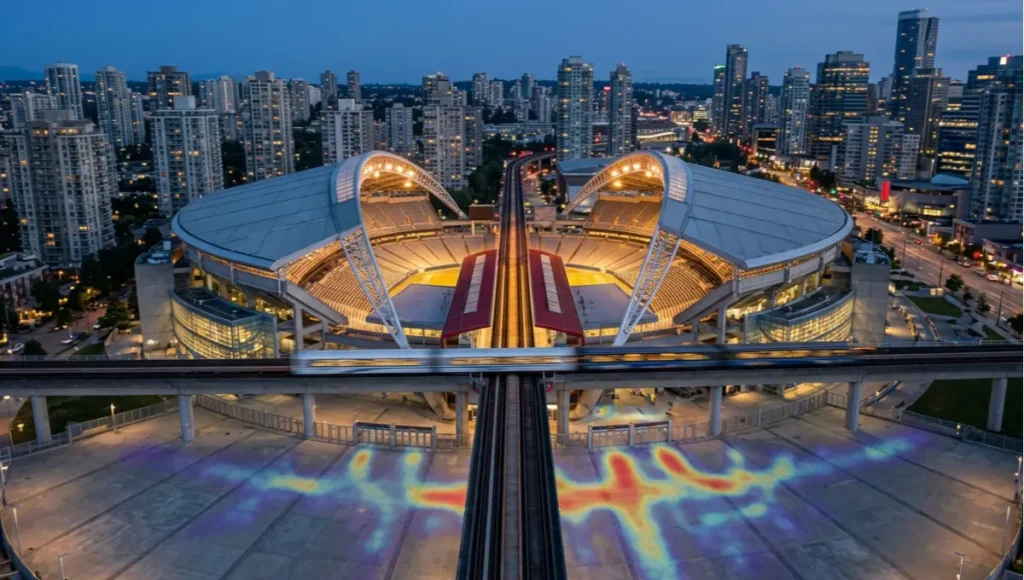
At Nuvira Space, we do not evaluate stadiums as isolated objects of spectacle. You are looking at forty-eight national teams, sixteen host cities, and a hundred and four matches — but you should be looking past the turnstiles entirely. A stadium in 2026 is not a building. It is a node in a system, a temporary organ grafted onto the circulatory system of a city, and its architectural ambition should be judged by how well it recalibrates the flows of people, capital, and infrastructure around it.
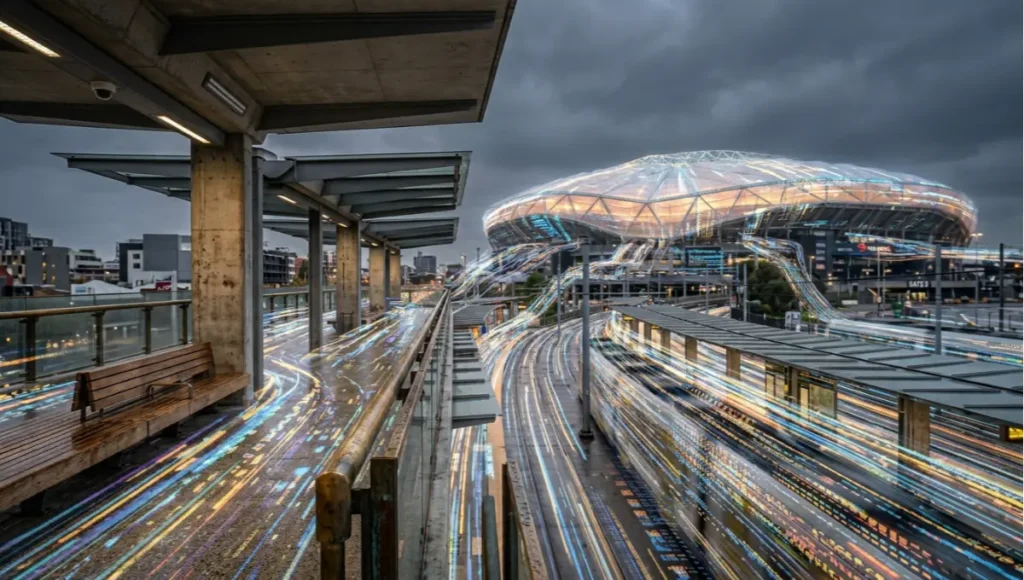
This is the discipline we call human-machine synthesis: the deliberate engineering of metropolitan fabric so that data-driven design decisions — sensor-fed crowd modeling, adaptive transit scheduling, thermal load balancing — produce measurable civic value long after the final whistle. You will not find that value in a stadium’s roofline alone. You will find it in whether the light rail extension survives the decade.
Macro-Observation Hook
You are standing at the center of the most architecturally ambitious World Cup 2026 stadiums ranking the sport has ever produced, and the scale should unsettle you before it excites you. Sixteen cities. Three countries. Eleven venues in the United States, three in Mexico, two in Canada. You are not watching a tournament — you are watching a continental-scale experiment in whether twenty-first-century infrastructure can absorb the single largest sporting migration in human history without collapsing into the same dystopian gridlock that defines so much of contemporary urban planning.
Atlanta, Boston, Dallas, Houston, Kansas City, Los Angeles, Miami, the New York–New Jersey metro, Philadelphia, the San Francisco Bay Area, Seattle, Guadalajara, Mexico City, Monterrey, Toronto, and Vancouver: each of these host cities is now a laboratory. Each stadium is a hypothesis. And you, the reader standing at the intersection of architecture and urbanism, deserve an analysis that treats these buildings as what they actually are — instruments of societal recalibration, not merely backdrops for penalty shootouts.
The prevailing narrative around World Cup infrastructure has always trended toward the celebratory: bigger roofs, louder crowds, more Instagrammable façades. You should reject that narrative outright. The architecturally ambitious stadium of 2026 is not the one with the most dramatic cantilever. It is the one that solves the hardest problem in contemporary city planning — how to move hundreds of thousands of bodies through dense urban cores without permanently degrading the transit systems those cities depend on for the other 360 days of the year.
Consider the sociological weight of what is actually being asked of these cities. A single World Cup match can draw a crowd larger than the daily ridership of an entire regional transit line. Multiply that by 104 matches across sixteen metropolitan regions, and you are no longer discussing sports architecture — you are discussing the single largest coordinated stress test of North American urban infrastructure in living memory.
Every stadium on this list will be judged twice: once by the television cameras during the tournament, and once by the neighborhoods that have to live with the consequences of that infrastructure for decades afterward. This analysis is concerned almost exclusively with the second judgment, because the first one has never told you anything useful about whether a building actually works.
The “Blueprint” Solution
Reframing Ambition as Systems Design
You need a new framework for judging these stadiums, because the old one — capacity, retractable roofs, price tag — measures spectacle, not intelligence. The Blueprint framework we use at Nuvira Space instead asks four questions of every venue:
- Does the stadium integrate with existing rail, bus rapid transit, or light rail infrastructure, or does it require new car-dependent sprawl to function?
- Does the building’s thermal and structural engineering respond to its specific climate, or is it a generic template dropped into an unrelated context?
- Does the stadium’s post-tournament legacy plan reduce or increase the surrounding neighborhood’s exposure to underused, oversized infrastructure?
- Does the venue’s design language communicate genuine architectural risk-taking, or does it repackage familiar arena tropes under a World Cup marketing budget?
Ranking the Field. World Cup 2026 Stadiums
Judged against that framework, a handful of venues separate themselves from the pack. The climate-responsiveness question in particular echoes principles we’ve detailed in our sponge city infrastructure guide, where resilient, absorptive urban systems are held to the same standard applied here to stadium engineering.
SoFi Stadium — Los Angeles / Inglewood
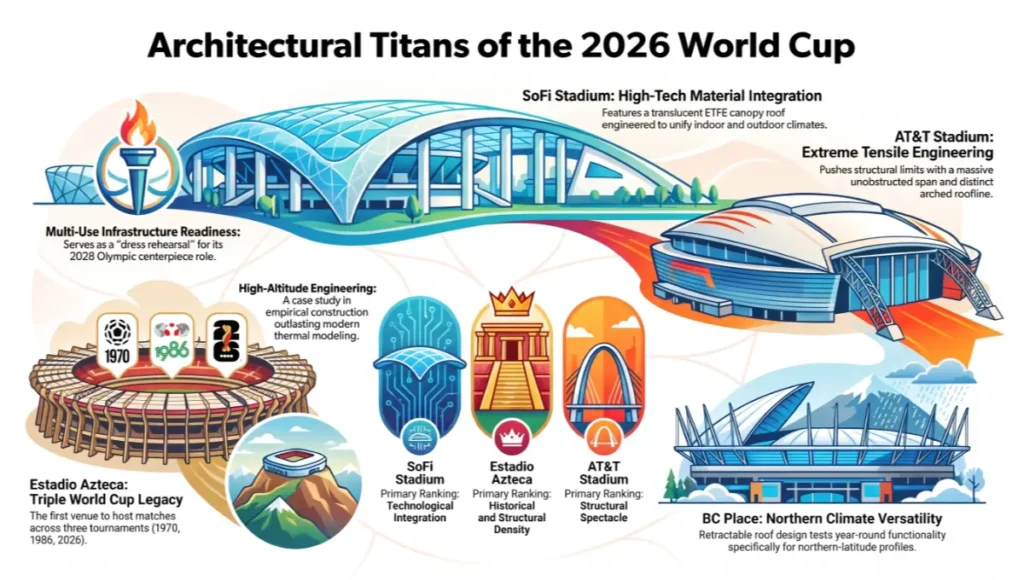
Ranks highest for technological integration. Its translucent ETFE canopy roof, built to unify indoor and outdoor climate conditions, represents one of the most ambitious material engineering decisions in modern stadium history — a distinction recognized in the American Institute of Architects’ official case study on the project. It will also serve as the centerpiece for the 2028 Los Angeles Olympics, making its World Cup deployment a genuine dress rehearsal for repeat-use infrastructure rather than a one-off spectacle.
Estadio Azteca — Mexico City
Ranks highest for historical and structural density. No other venue on earth carries the weight of hosting matches across three separate World Cup tournaments — 1970, 1986, and now 2026. Its high-altitude engineering, originally solved decades before modern thermal modeling existed, remains a case study in how empirical construction knowledge can outlast the technology used to formalize it.
AT&T Stadium — Dallas–Arlington
Ranks highest for structural spectacle, its arched roofline and massive unobstructed span pushing tensile engineering to genuine extremes. But you should note the tension here: raw structural ambition without adjacent transit investment risks becoming exactly the kind of car-dependent monument that undermines the sustainability case for hosting at all.
BC Place — Vancouver
BC Place and its Toronto counterpart carry the architectural burden of proving Canada’s hosting debut. BC Place’s retractable roof, engineered for a genuinely different climate profile than its American counterparts, tests whether northern-latitude stadium design can achieve the same year-round versatility that southern venues take for granted.
Comparative Technical Specifications
- SoFi Stadium — ETFE canopy roof, climate-unifying design, dual-tenant NFL integration, Olympic reuse pathway
- Estadio Azteca — Only stadium to host three World Cups (1970, 1986, 2026), high-altitude structural legacy
- AT&T Stadium — Long-span arched roof, maximal unobstructed sightlines, retractable roof system
- Mexico City Stadium — Capacity of approximately 87,500, opening-match host, dense urban integration
- BC Place — Retractable roof engineered for northern climate variability, Canada’s largest covered venue
- Levi’s Stadium (Bay Area) — Silicon Valley siting, dual-use with 2026 Super Bowl infrastructure
- Estadio Guadalajara — Volcano-inspired formal language, the only venue excluded from knockout-stage hosting
Feasibility Study: Economic and Political Barriers
The Cost of Ambition
You cannot evaluate architectural ambition honestly without confronting its price. A tournament spread across three sovereign nations means three separate regulatory regimes, three currencies of public investment, and three wildly different political appetites for stadium-adjacent infrastructure spending. The economic case for transit-oriented development around these venues is strong on paper — reduced congestion, higher property values, lower per-capita emissions — but the political case is far more fragile.
Where the Barriers Concentrate
- Cross-border logistics: Coordinating construction timelines, security protocols, and transit funding across the United States, Mexico, and Canada introduces friction no single-nation World Cup has ever faced.
- Municipal budget exposure: Host cities like Kansas City and Seattle have committed public funds to stadium-adjacent upgrades with no guarantee that post-tournament usage will justify the expense.
- NFL-stadium retrofitting tension: Venues like Lumen Field, Hard Rock Stadium, and Arrowhead Stadium were engineered primarily for American football, and their World Cup conversions expose the limits of multi-sport architectural flexibility.
- Public skepticism: You are operating in a political climate where large-scale public infrastructure spending faces persistent scrutiny, particularly when the primary beneficiary appears to be a global sporting body rather than the host neighborhood itself.
Kansas City’s outsized role in this feasibility picture deserves particular attention. As documented by AIA Kansas City’s sports architecture archive, 13 of the 16 stadiums hosting FIFA World Cup 2026 matches were designed by Kansas City-based sports architecture firms — a concentration of design authorship that makes the region’s own feasibility choices disproportionately influential on the tournament’s overall architectural character.
The honest feasibility conclusion is this: architectural ambition without political durability produces monuments, not infrastructure. The stadiums that will matter in 2036 are not necessarily the ones with the most dramatic rooflines in 2026 — they are the ones whose surrounding transit investments survive the inevitable post-tournament budget scrutiny.
The Currency Problem You Rarely See Discussed
You should also weigh a factor that receives almost no mainstream coverage: currency and labor-market asymmetry across the three host nations. Public infrastructure spending denominated in Mexican pesos behaves entirely differently, politically and economically, than the same category of spending denominated in Canadian or American dollars.
A transit extension that looks fiscally modest in Monterrey’s budgetary context can represent a far larger proportional commitment than an equivalent project in Los Angeles or Toronto. Treating all sixteen host cities as though they face an identical feasibility calculus — as so much World Cup commentary implicitly does — flattens exactly the kind of macro-environmental nuance that should inform genuine architectural criticism. You cannot rank ambition fairly without accounting for the wildly different fiscal ceilings each host government is operating under.
There is also the matter of construction labor markets. Cross-border tournaments of this scale strain specialized labor pools — the engineers capable of executing tensile canopy systems or retractable roof mechanisms are a finite global resource, and their availability shifts project timelines in ways that pure design ambition cannot control. The Blueprint framework accounts for this implicitly: a design that looks ambitious on paper but depends on labor capacity the host region does not actually possess is not ambitious. It is a liability.
Proof of Concept: Singapore, Tokyo, and the Precedents That Matter
You do not need to invent a theory of stadium-driven urban recalibration — it already exists, tested in cities that never hosted a World Cup at all.
Singapore’s Sports Hub demonstrates what happens when a stadium is planned as permanent civic infrastructure rather than a single-event monument. Its integration with the city-state’s broader transit network, and its deliberate underuse-mitigation programming — concerts, community events, year-round scheduling — offers a template that several World Cup 2026 venues are only partially applying.
Tokyo’s approach to the 2020 Olympics (delayed to 2021) offers a cautionary counter-case. Several venues built for that event faced significant post-Games underutilization, a reminder that architectural ambition divorced from long-term programming plans produces expensive vacancy rather than civic value. The lesson transfers directly to World Cup 2026 host cities: a retractable roof or record-setting seating capacity means little if the surrounding neighborhood has no reason to return once the tournament ends.
Barcelona’s long-term relationship with its 1992 Olympic infrastructure — much of which remains integrated into the city’s daily transit and recreational fabric decades later — stands as the strongest precedent for what North American host cities should be attempting. The stadiums that succeed architecturally are the ones designed from day one to outlive their headline event.
You should read these precedents as a warning wrapped in an opportunity. The infrastructure decisions being finalized right now in Atlanta, Houston, Monterrey, and Toronto will determine whether World Cup 2026 produces Barcelona-style legacy value or Tokyo-style stranded assets — a tension Nuvira Space also tracked in our reporting on Milan 2026 and circular stadiums, where a different global sporting event faced the identical legacy question.
A Closer Look at Density and Demand
You should also note how radically population density varies across the sixteen host regions, because density is arguably the single strongest predictor of whether transit-oriented stadium investment survives long-term. Mexico City and the New York–New Jersey metro area represent the tournament’s densest urban contexts, where existing rail infrastructure already carries enough baseline ridership to absorb stadium-driven demand without requiring entirely new systems.
Kansas City, by contrast, sits at the opposite end of that spectrum — a metropolitan region historically built around automobile infrastructure, where Arrowhead Stadium’s World Cup deployment will require far more deliberate intervention to avoid reinforcing car-dependent sprawl.
This is precisely why a single ranking of “most architecturally ambitious” cannot rest on roofline drama alone. A retractable roof in a low-density, car-dependent metro solves a different problem than the same roof in a dense, transit-rich one — and the latter should be read as the more architecturally sophisticated achievement, because it is operating within a system already capable of absorbing its consequences. Nuvira Space has explored this density logic at length in our coverage of car-free city district design, where the same principle applies well beyond the stadium-specific context.
Concept Project Spotlight — Speculative / Internal Concept Study: “Meridian Transit Pavilion” by Nuvira Space
Project Overview: Location / Typology / Vision
Location: A hypothetical secondary transit hub adjacent to a North American World Cup host stadium, modeled on the density challenges shared by Kansas City and Monterrey.
Typology: Multimodal transit pavilion with integrated public plaza, designed as permanent infrastructure independent of match-day demand.
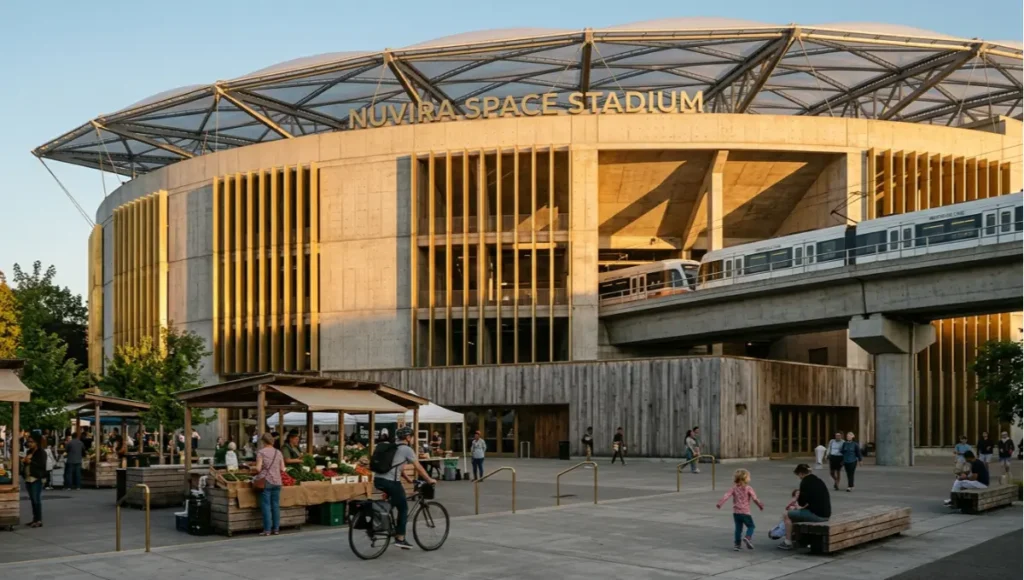
Vision: The Meridian Transit Pavilion exists to answer the single question the Feasibility Study above raises without resolving: what happens to World Cup-adjacent infrastructure investment once the tournament leaves town. Rather than treating the stadium as the primary architectural subject, this concept treats the transit corridor itself as the design problem, with the stadium repositioned as one node among several.
Design Levers Applied
- Modular platform canopies sized for match-day peak loads but reconfigurable to daily commuter volumes post-tournament
- Passive thermal shading calibrated to regional climate data rather than a generic stadium-district template
- Sensor-fed crowd modeling integrated into transit scheduling, allowing real-time headway adjustments during high-demand events
- A permanent public plaza designed for markets, civic gatherings, and informal recreation — explicitly engineered against the single-use-monument failure mode identified in the Tokyo precedent
- Phased construction sequencing that allows the transit spine to be completed independently of the stadium’s own build timeline, reducing political and budgetary interdependency
Transferable Takeaway
You should extract one principle from this concept study above all others: architectural ambition that terminates at the stadium’s perimeter is incomplete ambition. The Meridian Transit Pavilion’s core proposition — decoupling the long-term value of infrastructure investment from the short-term spectacle of the tournament itself — is the design lever every World Cup 2026 host city still has time to apply, provided political will catches up with engineering capability.
The concept also deliberately avoids a common failure mode in stadium-adjacent design: treating the plaza or transit hub as leftover space, an afterthought squeezed between parking structures. Instead, the pavilion’s public plaza is sized and programmed with the same seriousness as the stadium itself, on the theory that a transit node capable of hosting a farmers’ market on a Tuesday morning is doing more sustained civic work than a stadium that sits dark 350 days a year. This is the recalibration of the metropolitan fabric that Nuvira Space treats as the actual measure of architectural success — not the tournament’s opening ceremony, but the ordinary Tuesday that follows it.
2030 Future Projection
You are watching a rehearsal, not a finale. The 2030 World Cup, set to be jointly hosted across Spain, Portugal, and Morocco — with additional centenary matches played in Uruguay, Argentina, and Paraguay — will inherit every lesson North America either learns or ignores in 2026. If the transit corridors built around Estadio Azteca, SoFi Stadium, and BC Place demonstrate durable post-tournament value, expect 2030’s host cities to lean harder into transit-first stadium siting from the outset rather than retrofitting it under deadline pressure.
If, instead, the pattern of underused, car-dependent stadium districts repeats itself, you should expect increasingly vocal political resistance to future World Cup bids in cities without pre-existing rail infrastructure. The next decade of stadium architecture will be decided less by roof engineering and more by whether host nations treat transit-oriented development as a prerequisite rather than an afterthought.
You should also expect a shift in how architectural ambition itself gets defined. By 2030, the sociological framing this analysis applies — judging stadiums by their systemic integration rather than their spectacle — is likely to move from a critical minority position to the industry’s default evaluative lens. Sensor-fed crowd modeling, currently a differentiator limited to venues like SoFi Stadium, will almost certainly become baseline expectation rather than innovation.
The host cities of 2026 that resist this shift now, treating their stadiums as standalone monuments rather than integrated systems, will find themselves retrofitting under far greater public scrutiny than they face today, when the tournament’s afterglow still provides political cover for infrastructure decisions that a decade of hindsight will judge far less kindly.
Comprehensive Technical FAQ
Q: What makes a World Cup stadium “architecturally ambitious” rather than simply large?
A: Scale alone is not ambition. The most architecturally ambitious venues combine structural or material innovation — retractable roofs, tensile canopy systems, climate-responsive engineering — with genuine integration into their surrounding transit and urban fabric.
- Structural innovation: cantilevered roofs, long-span tensile systems, adaptive canopies
- Climate responsiveness: thermal load management suited to the specific host city’s conditions
- Transit integration: direct rail or bus rapid transit access reducing car dependency
- Post-tournament legacy planning: explicit design provisions for continued civic use
Q: Which stadium is the only venue to host matches across three separate World Cups?
A: Estadio Azteca in Mexico City, having hosted matches in 1970, 1986, and now 2026.
Q: How many countries are co-hosting the 2026 World Cup, and how are the venues distributed?
A: Three countries — the United States, Mexico, and Canada — are co-hosting, with eleven venues in the United States, three in Mexico, and two in Canada.
Q: What is the significance of SoFi Stadium’s dual role in 2026 and 2028?
A: SoFi Stadium will host World Cup matches in 2026 and then serve as a centerpiece venue for the Los Angeles Olympics in 2028, making it a genuine test case for repeat-use, multi-event stadium infrastructure rather than single-tournament construction.
Q: Why does Estadio Guadalajara stand out structurally despite not hosting knockout matches?
A: Its volcano-inspired formal language represents a distinct departure from the retrofitted NFL-stadium template used across much of the United States, even though its group-stage-only role limits its tournament prominence.
- Formal language: volcano-inspired massing, distinct from generic bowl-stadium templates
- Capacity: among the larger venues in Mexico’s host lineup
- Historical role: previously hosted continental and regional sporting ceremonies
Q: What is the biggest political barrier to transit-oriented development around these stadiums?
A: Fragmented public appetite for large infrastructure spending, particularly across three separate national regulatory and funding systems, creates persistent friction between architectural ambition and political feasibility.
Q: Will the 2026 stadiums leave a lasting urban legacy, or repeat the underused-venue pattern seen after past global sporting events?
A: The outcome depends on whether host cities prioritize permanent transit investment over stadium-specific spectacle — a distinction this analysis frames through the Singapore, Tokyo, and Barcelona precedents.
Conclusion
You have the framework now. The next time a headline celebrates a record-setting roof or a jaw-dropping seating capacity, you should ask the harder question instead: what happens to the neighborhood around that stadium in 2027, when the crowds are gone and the transit budget comes up for renewal. Architectural ambition that cannot answer that question is not ambition — it is expensive scenery. Follow Nuvira Space’s Urban Pulse series as we continue tracking which World Cup 2026 host cities convert stadium-driven momentum into permanent civic infrastructure, and which ones let it evaporate the moment the final whistle blows.
© Nuvira Space — All rights reserved. | URBAN PULSE Series | All specifications cited are based on publicly available tournament and venue reporting, including FIFA's official host city and stadium documentation (no external links included per publication policy). The Meridian Transit Pavilion is a speculative internal concept study and does not represent a completed project.