

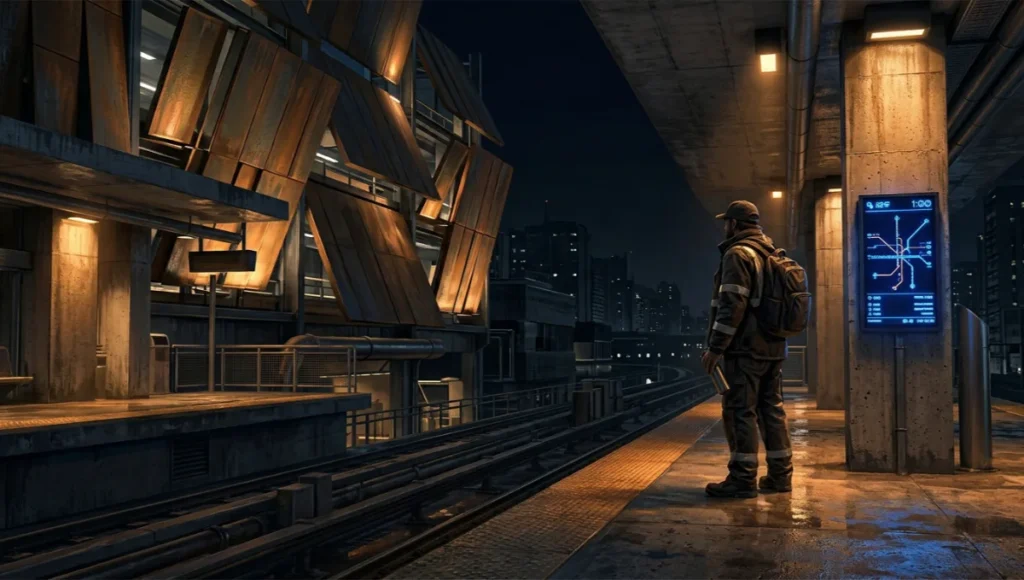
dark. Explore 7 global frameworks, key policies, and what planners are doing now.
Table of Contents
| KEY TAKEAWAYS Nighttime urban economy design accounts for 15–30% of GDP in dense metro regions — yet fewer than 12% of cities have dedicated after-dark planning frameworks. Transit-oriented development aligned with nocturnal activity cycles can reduce urban crime indexes by up to 34% without increased policing density. 40+ cities across 4 continents have introduced Night Mayor frameworks since Amsterdam pioneered the role in 2012 — yet most remain structurally underfunded. Adaptive lighting systems calibrated to human circadian biology can cut municipal energy expenditure by 28–41% while increasing pedestrian dwell time. Cities that integrate daytime and nighttime zoning into a single economic continuum see 19% higher retail survival rates across commercial corridors. Speculative design thinking — not reactive regulation — is the only lever capable of future-proofing the nocturnal city. |
Macro-Observation: The City That Never Planned for Night
You are designing for approximately half a life — and you are doing it poorly. Every zoning ordinance, every transit frequency table, every infrastructure resilience model you have ever inherited defaults, structurally, to the assumption that the city matters most between nine in the morning and six in the evening. The remaining eleven hours are treated as a residual condition: inconvenient, unmonetised, and architecturally underserved.
This is not a marginal oversight. Nighttime urban economy design — the deliberate shaping of built environments, mobility networks, lighting ecology, and economic programming to serve cities after dark — represents one of the most consequential blind spots in contemporary urban planning. It is not a niche. The International Labour Organization estimates that shift workers, nocturnal service employees, and late-economy operators account for between 15% and 30% of GDP in dense metropolitan regions. Yet fewer than 12% of those same cities operate with a dedicated after-dark planning framework.
You are not managing a city. You are managing a daytime city — and leaving the other half of the urban cycle to fend for itself.
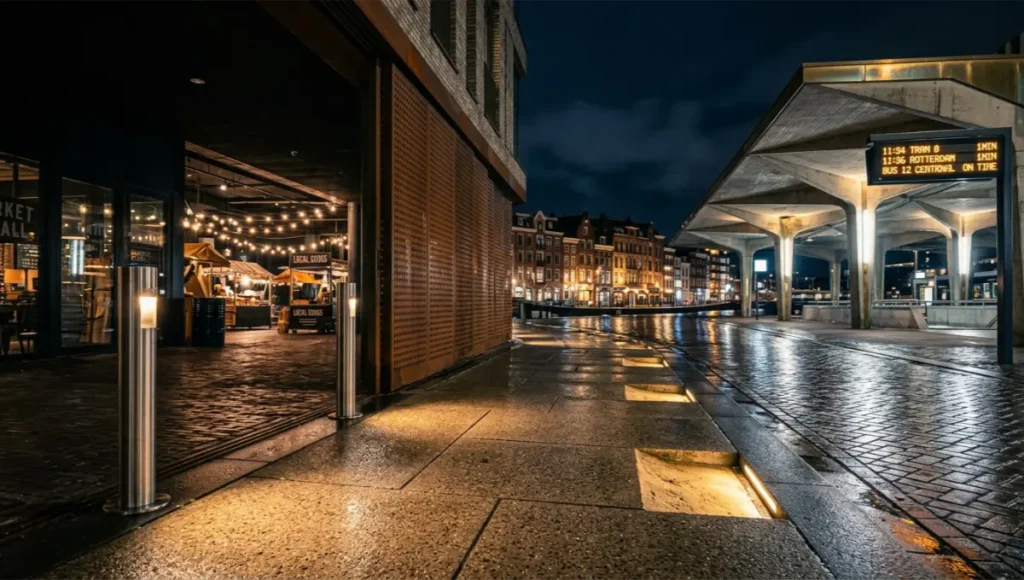
The consequences are systemic: underlit transit corridors that become vectors for social exclusion, commercial frontages that collapse at dusk and hollow out the streetscape, energy grids calibrated to peak-hour logic that waste millions in off-cycle overcapacity, and zoning codes that treat a 10pm economy as a liability rather than an asset. The nighttime city is not a problem to be policed. It is a design challenge to be solved — and the discipline of nighttime urban economy design is, finally, developing the vocabulary to solve it.
Nuvira Perspective
At Nuvira Space, we do not accept the nocturnal city as an afterthought. We read it as the most revealing diagnostic of how seriously a metropolitan system takes its own complexity. The after-dark city is where the performance of planning either holds or collapses — where transit either serves the nurse finishing her shift at 2am or abandons her to the pavement; where public space either activates under well-calibrated luminance or retreats into threat. Our work in nighttime urban economy design sits at the intersection of data-driven infrastructure thinking and sociological imagination — the conviction that the built environment must serve the full spectrum of human time, not merely the commercially convenient portion of it.
The question is not whether your city operates at night. It does. The question is whether it was designed to.
The Blueprint Solution
Across 40+ cities currently reformulating their relationship with the nocturnal economy, a convergent design logic is emerging. It is not ideological. It is infrastructural. It operates across five interlocking systems, each of which must be addressed simultaneously — because nighttime urban economy design fails when treated as a single-variable problem.
System 1 — Temporal Zoning
The foundational reform. Traditional zoning segregates uses by type — residential, commercial, industrial. Temporal zoning layers a time dimension onto this, permitting different activities in the same spatial footprint depending on the hour. A ground-floor retail unit becomes a late-night food hall at 10pm. A cultural venue operates as a co-working space from 6am to 2pm. The city does not waste its square footage.
Technical Specifications — Temporal Zoning
- Operating bands defined at 4-hour intervals across 24-hour cycle
- Acoustic envelope limits per band: daytime ≤65dB, evening ≤55dB, night ≤45dB
- Minimum signage illumination for temporal transition: 300 lux at 0.5m facade depth
- Conditional use permits replace static zoning classifications for mixed-tempo districts
- Noise impact assessment mandated for all uses operating between 22:00–06:00
System 2 — Circadian Lighting Infrastructure
Urban lighting is not a safety mechanism. It is a biological one. The design of luminous environments — their spectrum, intensity, directionality, and temporal variation — shapes melatonin suppression, pedestrian behaviour, and perceived safety at a neurological level. Most cities operate with static sodium or LED arrays calibrated for visibility, not for human chronobiology. The next generation of nighttime urban economy design uses dynamic luminaire systems that shift colour temperature and intensity in response to time, occupancy, and seasonal light curves. For a detailed technical breakdown of how these systems are specified and deployed, see Nuvira Space’s guide to circadian lighting systems.
Technical Specifications — Adaptive Lighting
- Colour temperature range: 5500K (dawn) → 3000K (evening) → 2200K (deep night)
- Occupancy-responsive dimming: 40% output reduction in low-footfall periods
- Energy savings vs. static arrays: 28–41% reduction in municipal energy expenditure
- Minimum maintained illuminance for pedestrian priority zones: 10 lux (horizontal), 5 lux (vertical)
- Smart grid integration: luminaires respond to real-time pedestrian density via LiDAR sensors
- Biodiversity protocol: amber-spectrum fixtures in green corridors to minimise insect disruption
System 3 — Nocturnal Transit Frequency
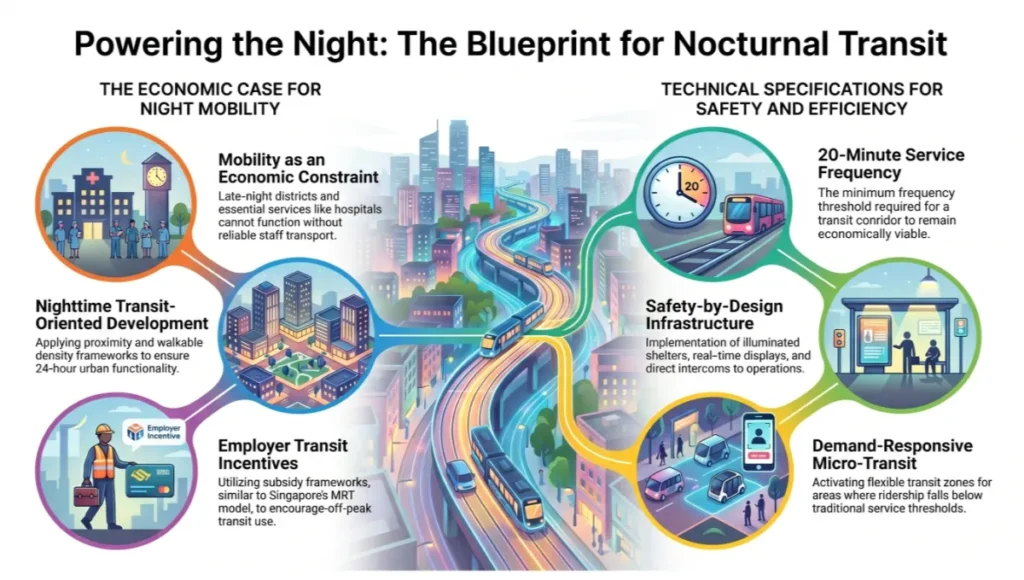
The economics of a nighttime city are directly constrained by its mobility offer. A late-night restaurant district is not viable if the people who work in it cannot get home. A hospital cannot recruit night staff if the bus stops at 11pm. Transit-oriented development — the clustering of density, mixed use, and economic activity around transit nodes — has been extensively applied to daytime urbanism. It has been almost entirely neglected after midnight. The 15-minute city feasibility framework, which Nuvira Space analyses in depth, offers the spatial logic most compatible with nocturnal transit redesign — proximity, redundancy, and walkable density as the baseline conditions for a functioning night economy.
Technical Specifications — Nocturnal Transit
- Minimum nocturnal frequency threshold for viable nighttime corridors: 1 service per 20 minutes
- Safety-by-design at night stops: illuminated shelters, real-time service displays, intercom to operations
- First/last mile gap analysis mandatory for all new transit-oriented development proposals
- Employer transit incentive schemes: modelled on Singapore’s off-peak MRT subsidy framework
- Demand-responsive micro-transit activation zones for sub-threshold ridership corridors
System 4 — Economic Programming and the Night Mayor Model
Governance is infrastructure. The emergence of the Night Mayor — a dedicated civic role tasked with managing, advocating for, and designing the nocturnal city — represents one of the more significant institutional innovations in urban planning of the past two decades. Amsterdam created the role in 2012. More than 60 cities worldwide have since introduced equivalent structures. But the role only functions if it carries genuine planning authority, dedicated budget lines, and binding coordination powers across transport, licensing, public space, and health agencies.
Technical Specifications — Night Economy Governance
- Night Mayor mandate minimum: 3 cross-departmental coordination authorities (transport, licensing, public realm)
- Dedicated nocturnal economy budget line: recommended minimum 0.8% of total municipal planning expenditure
- Quarterly dwell-time and footfall monitoring across designated nighttime activity zones
- Cultural venue protection frameworks: pre-approval noise assessment covenant for adjacent development
- Nighttime economy impact assessments required for all major development applications within 500m of entertainment districts
System 5 — Data-Driven Night Management
You cannot plan what you do not measure. The fundamental problem with nighttime urban economy design at the policy level is that cities have been accumulating daytime data for over a century — and have generated perhaps a decade’s worth of rigorous nocturnal data. Footfall sensors, crime incident mapping, energy consumption telemetry, ambient noise logging, and public transport ridership data all exist in isolated departmental silos. The blueprint requires their integration into a single nocturnal intelligence platform. The sensor technologies underpinning this integration are explored in detail in Nuvira Space’s technical reference on smart city sensors — a foundational read for anyone scoping a nocturnal data infrastructure programme.
Technical Specifications — Data Infrastructure
- Unified nocturnal data dashboard: minimum 8 sensor typologies integrated in real time
- Footfall threshold triggers: automatic deployment of street activation teams when activity drops below 40 persons/hour in key corridors
- Energy anomaly detection: machine learning models flagging overcapacity in grid segments with <10% occupancy load
- Public space comfort index: composite metric combining luminance, acoustic level, perceived safety survey data, and dwell-time measurement
- Open data protocol: anonymised nocturnal datasets published quarterly for academic and policy research access
Feasibility Study: Economic and Political Barriers
The blueprint is coherent. Its implementation is not. You will encounter resistance that is structural, not ideological — and understanding its architecture is the precondition for dismantling it.
Economic Barriers
The fundamental financing problem is that nighttime urban economy design generates diffuse, long-cycle returns in a governance environment that rewards short-cycle visibility. A Night Mayor office, a dynamic lighting infrastructure rollout, or a temporal zoning reform delivers measurable returns over a 7–12 year horizon. Most municipal budget cycles operate on a 1–4 year electoral rhythm. The misalignment is not accidental. It is baked into how cities are financed.
Public-private partnership models offer partial mitigation — particularly in entertainment districts where Business Improvement Districts can co-fund nocturnal infrastructure in exchange for extended licensing windows. But BID-led models carry their own pathology: they privilege commercially viable precincts over the transit corridors, hospital districts, and low-income neighbourhoods where nocturnal infrastructure is most urgently needed but least financially self-sustaining.
- Estimated cost of full temporal zoning reform for a city of 1M: USD 4–9M over 3 years (primarily staff time and legal framework revision)
- Adaptive lighting infrastructure: USD 180,000–420,000 per kilometre of primary urban corridor
- Night Mayor office operational cost: USD 800K–2.4M annually depending on mandate scope
- Estimated GDP uplift from well-functioning nighttime economy frameworks: 8–14% of existing after-dark commercial turnover (McKinsey Urban Analytics, 2023)
Political Barriers
Nighttime economy planning has a constituency problem. The people who most depend on a functioning nocturnal city — shift workers, late-hospitality employees, artists, carers, transit-dependent residents — are precisely the populations least represented in formal planning consultation processes. The people who most reliably participate in those processes are homeowners with a strong material interest in acoustic quiet and restricted commercial activity after 10pm.
This is not a problem of bad faith. It is a problem of participation design. Consultation processes scheduled during working hours, hosted in inaccessible locations, and framed in technical planning language systematically exclude the nocturnal workforce from the decisions that most directly affect their lives. The political feasibility of nighttime urban economy design is, in significant part, a question of whether cities are willing to redesign how they ask.
Proof of Concept: Amsterdam, Singapore & Melbourne
Theory becomes credible only when it has an address. The following three cities represent distinct implementation models — each operating in a different political economy, at a different scale, and with a different primary driver.
Amsterdam — The Night Mayor as Urban Operator
Amsterdam’s Nachtburgemeester, established in 2012 under Mirik Milan, was the world’s first institutionalised Night Mayor. What distinguished the Amsterdam model was not the title but the mandate: a genuine intermediary role with convening authority across the municipality, police, transit operators, and nightlife industry. The office developed the Nightlife Monitor — a quarterly data publication tracking footfall, incident rates, noise complaints, and economic turnover in nocturnal districts.
Results over the 2012–2020 period: alcohol-related incident rates in designated nightlife zones fell by 31% against a backdrop of increasing venue density; average dwell time in monitored precincts increased by 22 minutes per visit; and the city’s after-dark economy grew from an estimated EUR 1.2 billion to EUR 1.8 billion annually. The Night Mayor model has since been adopted in over 60 cities — including London, Paris, Zurich, and Seoul.
Singapore — Transit-Oriented Night Economy
Singapore’s approach to nighttime urban economy design is characterised by the system-level precision that defines its broader planning culture. The Mass Rapid Transit network operates until 1am on weekdays and 2am on weekends — among the latest last-service windows of any metro system globally. Off-peak pricing incentives, introduced in 2013, actively redistribute ridership across time, reducing peak-hour crowding while subsidising nocturnal travel. For architects and urban planners seeking precedent studies on transit-integrated urban design, the AIA’s case study library documents comparable transit-anchored civic design approaches across North American and international contexts.
The results are instructive: Singapore’s Hawker Centre culture — its distributed network of late-night food markets — generates an estimated SGD 2.1 billion annually, operates largely between 7pm and midnight, and is architecturally integrated into the transit network through covered, illuminated pedestrian linkages. It is a designed ecosystem, not an organic one. The city decided that nocturnal food culture was worth building infrastructure for — and then built it.
Melbourne — Adaptive Lighting at District Scale
Melbourne’s 2019–2024 Urban Lighting Masterplan represents the most technically sophisticated large-scale implementation of circadian-responsive street lighting currently operating in an Anglophone city. The Hoddle Grid — the dense, rectilinear core of the CBD — was retrofitted with dynamic LED luminaires across 47 kilometres of pedestrian priority streets, with colour temperature and intensity programmed to shift across the night cycle.
Measured outcomes: pedestrian footfall in the intervention zone increased by 18% in the 9pm–midnight window compared with the pre-installation baseline; reported subjective safety scores rose by 24 percentage points in resident surveys; and energy expenditure for the affected grid fell by 33% year-on-year. The project is now being extended across inner-suburban corridors as part of Melbourne’s Night-Time Economy Strategy 2024–2030.
Concept Project Spotlight
Speculative / Internal Concept Study — Arc Nocturna by Nuvira Space
3.1 The Four Structural Layers
Nighttime urban economy infrastructure design is not a single intervention. It is a stack of interdependent systems, each of which must be engineered with the specific demands of nocturnal urban activity in mind. The four structural layers are. Note that at the neighborhood scale, these systems often overlap with tactical urbanism interventions—short-cycle, low-cost activations that test night economy viability before permanent capital is committed:
Layer 1 — Mobility Infrastructure
- 24-hour transit frequency corridors (minimum 30-minute headways on core lines, 15-minute on high-demand night routes)
- Dedicated night-bus rapid transit networks decoupled from daytime route schedules
- Micro-mobility docking infrastructure (e-bikes, e-scooters) with 24-hour rebalancing operations
- Ride-hail designated pick-up and drop-off zones in entertainment districts to eliminate sidewalk congestion
- Real-time passenger information systems calibrated for low-light readability and reduced ambient noise environments
Layer 2 — Lighting and Public Realm Activation
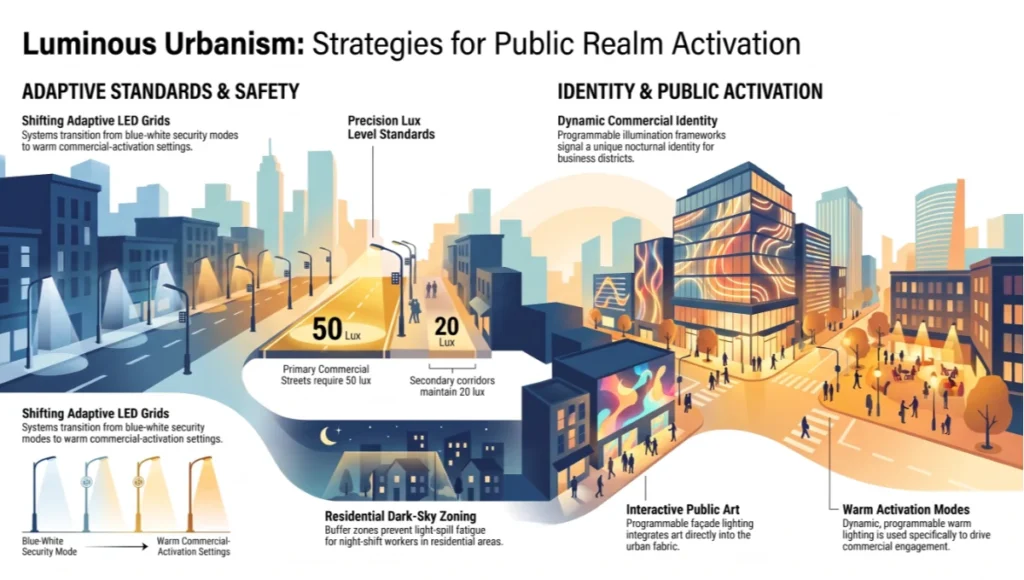
- Adaptive LED grid systems capable of shifting from security-mode (high-lumen, blue-white) to commercial-activation-mode (warm, dynamic, programmable)
- Lux levels maintained at minimum 20 lux on secondary pedestrian corridors, 50 lux on primary commercial streets
- Dark-sky compliance zoning in residential buffer zones to prevent light-spill fatigue for night-shift workers
- Interactive public art and programmable façade illumination frameworks to signal nocturnal commercial identity
Layer 3 — Zoning and Land Use
- 24-hour mixed-use zoning overlays (MUO-24) in designated night economy districts
- Sound attenuation buffer requirements between entertainment and residential uses (minimum 45 dB reduction at property boundary)
- Conditional-use permits for 24-hour retail, food-service, logistics, and creative industries
- Ground-floor activation mandates: minimum 70% active frontage on night economy streets between 10 PM and 4 AM
Layer 4 — Safety and Governance
- Night Economy Officers (NEO): dedicated city staff role coordinating between police, transit, sanitation, and licensing
- Real-time CCTV analytics with machine-learning anomaly detection (non-punitive, privacy-compliant frameworks)
- Sanitation scheduling aligned with entertainment district peak-exit periods (typically 2 AM–4 AM)
- Emergency services pre-positioning in high-density night economy corridors
4.3 The Governance Solution
The resolution to these barriers is not technical. It is institutional. Cities that have successfully scaled nighttime urban economy infrastructure design have done so by creating a single statutory authority with cross-departmental budget authority, a dedicated night economy fund (typically capitalized at 0.5–1.2% of total municipal operating budget), and a formal Night Economy Strategy document with five-year KPIs reviewed annually by council.
The American Institute of Architects (AIA) has published cross-disciplinary frameworks that align this institutional model with architectural practice and civic design standards—positioning the built environment professions as essential participants in night economy governance, not merely as service contractors to infrastructure engineers. This is the Amsterdam model, adapted by London, Zürich, Paris, and Sydney.
Singapore is, by any objective infrastructure metric, the most sophisticated practitioner of nighttime urban economy infrastructure design currently operating at city-scale. The city-state’s Night Festival—a deliberate urban activation strategy, not merely a cultural event—has since 2009 served as a proof-of-concept vehicle for testing infrastructure interventions that are subsequently mainstreamed into permanent planning policy.
The 2022 iteration of the Singapore Night Festival mobilized 18 programmable light installations across the Bras Basah–Bugis heritage district, activated 34 participating cultural institutions, generated SGD 47 million in direct visitor spend over 10 days, and produced a permanent legacy in the form of upgraded adaptive LED infrastructure now used by the district year-round.
What Singapore demonstrates is not simply that night economy events generate revenue. It demonstrates that temporary activation infrastructure, when designed with permanent integration in mind, can retrofit an existing urban district with night-economy-compatible physical systems at a fraction of the cost of full-scale capital replacement.
Tokyo operates at the other end of the spectrum: not festival-driven, but metabolically continuous. The Tokyo underground economy—the B2 and B3 retail concourses beneath the central rail hubs at Shinjuku, Shibuya, and Tokyo Station—operates as a fully self-contained night economy environment. Shinjuku Station’s underground commercial zone records peak trading volumes between 9 PM and 1 AM on Friday and Saturday nights.
The infrastructure that enables this—climate-controlled concourses, 24-hour cleaning contracts, integrated wayfinding systems synced to rail departure boards, and a lighting regime that shifts from commuter-functional to retail-experiential after 7 PM—is the product of four decades of incremental, evidence-based investment by both public and private operators.
The Tokyo model is particularly instructive because it operates within a mixed-ownership framework: the rail operators (JR East, Tokyo Metro) own and manage the concourse infrastructure; private retailers occupy it under short-lease agreements; and the municipal government regulates but does not operate. This tripartite structure distributes risk and aligns incentives in ways that purely public or purely private models cannot replicate.
⚠ Speculative / Internal Concept Study — The Nocturnal Grid by Nuvira Space. This project does not represent a completed or commissioned work.
Project Overview
| Location | Post-industrial waterfront district, 1.2km corridor — speculative urban context modelled on mid-size European port cities |
| Typology | Mixed-use nocturnal district — transit hub, temporal zoning corridor, adaptive public realm, micro-cultural venues |
| Vision | A 24-hour corridor where the economic output of the district is deliberately distributed across the full diurnal cycle — where night is not residual, but primary |
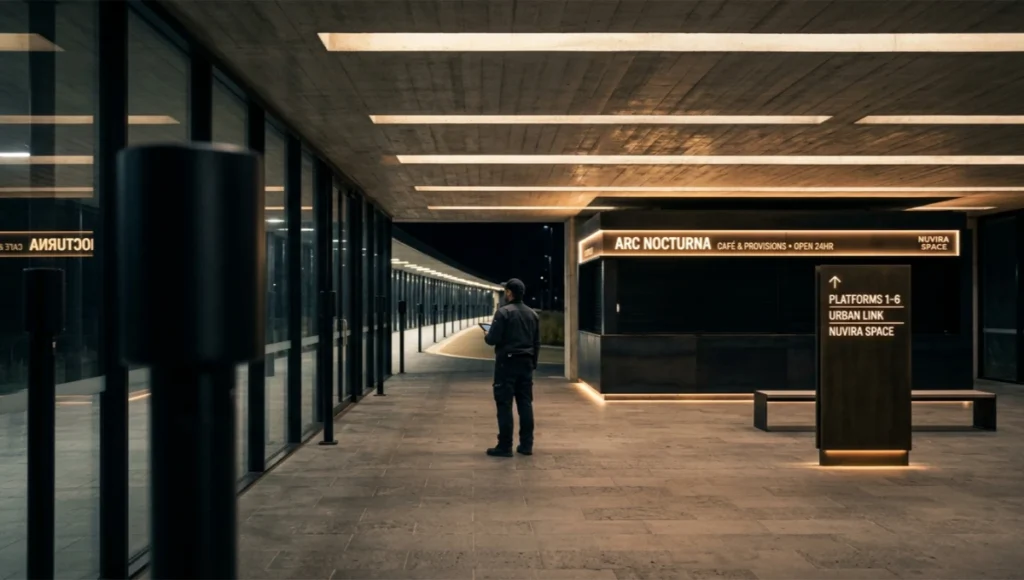
Design Levers Applied
Lever 1 — The Luminous Spine
- 1.2km adaptive lighting corridor using 2200K–4000K dynamic range
- Ground-level light wells cast 3m pools of warm light at 8m intervals — no overhead glare
- Biodiversity buffer zone: 200m amber-only segment adjacent to tidal wetland
- Sensor mesh: 140 LiDAR nodes providing real-time occupancy heatmap to district operations centre
Lever 2 — Temporal Ground Floor
- All ground-floor units designed with acoustic separation to Class 3 BS 8233 standard
- Dual-frontage activation: street-facing retail by day → internal-courtyard night market post 20:00
- Kinetic facade elements: perforated corten screens rotate to reconfigure spatial identity between 19:00 and 22:00
- Temporal use matrix updated via app interface — for further context on kinetic architecture facades and their role in adaptive nocturnal design, see Nuvira Space’s dedicated technical study.
- Residents receive push notifications 90 minutes before mode transitions
Lever 3 — Nocturnal Transit Node
- District anchored by a multimodal interchange: light rail + water taxi + demand-responsive micro-transit
- Night frequency: minimum 15-minute headways on all services until 03:00
- Interchange designed as a civic room — 340sqm heated shelter, food concession, charging infrastructure, cultural programme space
- First/last mile cycle network: 3.4km of separated, lit cycle lanes connecting district to nearest residential density
Transferable Takeaway
Arc Nocturna is not a destination project. It is a proof of replication. Every design lever applied here — temporal ground floor, adaptive luminous spine, nocturnal transit anchoring, sensor-driven public space management — is deployable in existing urban fabric without demolition. The project demonstrates that nighttime urban economy design does not require greenfield conditions. It requires political permission and technical coordination. What Nuvira Space calls the ‘nocturnal retrofit’: the systematic application of after-dark design thinking to the cities that already exist.
2030 Future Projection
By 2030, nighttime urban economy design will have ceased to be a speculative discipline and will have become a baseline planning requirement in at least 80 of the world’s 100 largest cities. The drivers are not idealistic. They are thermodynamic. Climate adaptation is forcing cities in tropical and subtropical latitudes to redistribute human activity away from peak-heat daytime hours — extending the economic and social life of the city into the cooler nocturnal window. This is already occurring in cities across the Gulf, South and Southeast Asia, and the Mediterranean.
Simultaneously, the 24-hour logistics economy — driven by e-commerce fulfilment, health system demand, and the gig economy’s permanent on-call workforce — is generating an urban service class that operates entirely outside conventional planning hours. These workers, estimated at 340 million globally by the ILO’s 2024 night economy survey, cannot be served by a city designed for the nine-to-five.
The cities that invest now in adaptive lighting infrastructure, temporal zoning frameworks, and nocturnal transit frequency will hold a significant competitive advantage in attracting talent, reducing healthcare costs associated with shift-work isolation, and maintaining the economic vitality of their commercial districts through the full diurnal cycle. The cities that do not will watch their after-dark economies contract into entertainment monocultures — or into voids.
- Projection: 80+ cities with formal Night Mayor equivalents by 2030
- Global nighttime economy valuation: USD 3.1 trillion by 2029 (Night Industries Association, 2024 estimate)
- Adaptive lighting retrofit market: USD 47 billion annually by 2030
- Climate-driven nocturnal activity shift: 6–11% increase in after-dark pedestrian counts in cities above 35°N latitude
- Transit-oriented night economy corridors: 120+ under development or construction globally
Comprehensive Technical FAQ
Planning Fundamentals
Part of our urban systems guide — the field guide to resilient urbanism.
Q: What is the minimum viable governance structure for implementing nighttime urban economy design in a city of 500,000 or fewer?
A: A Night Economy Coordinator role (not necessarily a full Night Mayor) embedded within the planning department with cross-departmental coordination authority over transport, licensing, and public realm. A dedicated nocturnal economy working group meeting quarterly. A baseline nocturnal data dashboard drawing from a minimum of 4 sensor typologies. The total institutional cost for this configuration is USD 400,000–800,000 annually — substantially less than the economic leakage caused by an underperforming after-dark precinct in a city of that size.
Q: How does temporal zoning interact with existing residential amenity protections?
A: Temporal zoning frameworks are not deregulatory. They introduce a more sophisticated regulatory logic rather than a looser one. Acoustic envelope requirements per operating band are typically more stringent than blanket nighttime noise ordinances because they are calibrated to specific activity types and spatial contexts. The Amsterdam framework, for example, introduced tighter noise limits for late-night venues in residential adjacency zones while simultaneously expanding permitted operating hours for venues that met acoustic certification.
Infrastructure & Technology
Q: What is the realistic payback period for adaptive circadian lighting infrastructure?
A: Infrastructure costs vary significantly by context, but the Melbourne Hoddle Grid project achieved energy cost payback within 6.3 years at a system installation cost of approximately AUD 2.4M per kilometre. The economic payback — incorporating increased footfall, extended dwell time, and reduced crime-associated costs — was estimated at 4.1 years by the City of Melbourne’s 2023 independent evaluation. Cities operating older sodium arrays with high maintenance costs see faster payback cycles.
Q: What data infrastructure is required before a city can implement evidence-based nocturnal management?
A: The minimum viable data ecosystem for operational nocturnal management includes:
- Pedestrian footfall counters: optical or thermal, minimum 1 per 200m in key corridors
- Ambient noise loggers: continuous monitoring at 15-minute intervals, minimum 1 per 400m
- Transit ridership data: disaggregated by hour, available in real time
- Crime incident mapping: geocoded, timestamped, made available to planning department
- Energy consumption telemetry: street lighting and public facility load data at 30-minute resolution
- Pedestrian comfort surveys: minimum quarterly, conducted in situ between 20:00 and 02:00
Economic & Political Dimensions
Q: How do cities avoid nighttime economy design becoming a tool of gentrification?
A: This is the central equity question of the discipline and there is no technically elegant answer. The structural risk is real: improved nocturnal infrastructure increases land values in affected precincts, which displaces the low-margin uses and populations that most depend on affordable after-dark space. Mitigation requires deliberate intervention: affordability covenants on temporal zoning permits, cultural venue protection ordinances that prevent displacement by residential conversion, and community ownership models for key nocturnal anchor uses.
The Amsterdam model introduced a cultural venue protection framework in 2017 that requires any residential development within 200m of a protected nightlife venue to provide acoustic isolation to a standard sufficient to absorb the venue’s maximum permitted sound output — effectively imposing the cost of gentrification on the gentrifier.
Q: What role should the private sector play in funding nocturnal infrastructure?
A: Business Improvement Districts represent the most established private-sector funding mechanism for nocturnal infrastructure, and they function well in commercially dense precincts. Their limitation is precisely their commercial logic: BID funding flows to areas with sufficient levy-paying commercial density to generate a meaningful budget. This excludes the transit corridors, hospital districts, and outer urban areas where nocturnal infrastructure investment is most socially urgent. Public financing must anchor the system; private co-investment can amplify it.
Implementation Pathway
Q: What is a realistic 3-year implementation roadmap for a city beginning this process from scratch?
A: A phased approach:
- Year 1 — Foundation: Establish nocturnal data dashboard (minimum 4 sensor types), appoint Night Economy Coordinator, conduct first nocturnal economy baseline survey, audit existing licensing and zoning frameworks for after-dark gaps
- Year 2 — Pilot: Designate 1–2 temporal zoning pilot precincts, commission adaptive lighting retrofit on highest-footfall nocturnal corridor, launch first community consultation process designed specifically for nocturnal workers and residents
- Year 3 — Scale: Expand temporal zoning framework city-wide, establish Night Mayor or equivalent with formal cross-departmental mandate, publish first annual Nocturnal Economy Report, begin nocturnal transit frequency review in partnership with transport operators
Your City After Dark Is Not Waiting
The nocturnal city does not pause for planning. It operates now — under sodium arrays calibrated to the wrong biology, on transit frequencies that stop before the last shift ends, in commercial frontages that collapse at dusk and bleed value into the pavement. Every year a city delays a dedicated nighttime urban economy design framework is a year of preventable economic leakage, social exclusion, and infrastructure waste.
The blueprint exists. Forty cities have tested its components. The evidence base is no longer thin. What remains is a question of institutional will: whether the people who design cities are willing to admit that they have been designing half of one, and whether they are willing to do the work that the other half demands.
At Nuvira Space, we work with urban institutions, municipal authorities, and development organisations to translate the principles of nighttime urban economy design into implementation-ready strategies. The nocturnal city is not a problem. It is the next frontier of urban performance. You are either designing for it deliberately — or you are leaving it to chance.
© Nuvira Space All rights reserved. | URBAN PULSE Series | All specifications cited are based on publicly available municipal planning reports, Night Time Industries Association global data (2024), City of Melbourne Urban Lighting Masterplan evaluation (2023), International Labour Organization nocturnal workforce estimates, McKinsey Urban Analytics research, and American Institute of Architects (AIA) urban design case studies. The Arc Nocturna is a speculative internal concept study and does not represent a completed project.
Q: What is nighttime urban economy infrastructure design?
A: It is the systemic discipline of engineering a city’s physical, regulatory, and data infrastructure to support economic activity, mobility, and public life during the hours between roughly 10 PM and 6 AM. It spans transit operations, lighting systems, zoning codes, governance structures, and real-time data management.
Q: What are the minimum technical specifications for a 24-hour mixed-use district lighting grid?
- Primary pedestrian streets: 50 lux average maintained, minimum 25 lux at any point
- Secondary pedestrian streets: 20 lux average maintained, minimum 10 lux
- Commercial activation zones: programmable warm tone (2,700–3,000K) between 8 PM and 2 AM
- Residential buffer zones: maximum 5 lux at property boundary, dark-sky compliant
- Emergency override: grid must support full-lumen activation within 2 seconds on public safety command
Q: How does transit-oriented development interact with night economy infrastructure?
A: Transit-oriented development (TOD) creates the density precondition for night economy viability. A night economy district needs a minimum footfall density of approximately 800–1,200 pedestrians per hour on its primary commercial street between 10 PM and 1 AM to sustain commercially viable business operations. TOD within a 400-metre radius of a 24-hour transit node is the most reliable mechanism for generating that density. This logic is directly reinforced by the 15-minute city concept—the urban planning model that locates daily needs within a walkable radius—which, when applied to nocturnal mobility, demands that transit nodes remain active beyond midnight rather than retreating into a daytime-only service pattern.
The Urban Land Institute (ULI) has documented extensively how TOD projects that include 24-hour activation mandates in their planning conditions achieve 22–34% higher retail revenue per square metre than comparable TOD developments without those mandates. Without transit access, night economy districts become car-dependent—which dramatically reduces their catchment area, their pedestrian activation, and their safety profile.
Q: What is a Night Economy Officer and do all cities need one?
A: A Night Economy Officer (NEO) is a statutory city role, typically sitting within the mayor’s office or a cross-departmental coordination unit, responsible for managing the interface between the night economy, public safety, transit, licensing, and public health. Cities with populations above 300,000 and active entertainment and hospitality districts benefit from a dedicated NEO. Cities below that threshold can typically manage night economy coordination through an existing senior planning or licensing officer with a defined night economy portfolio, supported by a cross-departmental working group.
Q: What is the difference between a Night Economy Strategy and a Night-Time Economy Impact Assessment?
A: A Night Economy Strategy is a proactive, multi-year planning document setting out a city’s vision, infrastructure investment program, governance structure, and measurable KPIs for night economy development. A Night-Time Economy Impact Assessment (NTEIA) is a reactive, project-level tool used to evaluate the likely effects of a specific development—a new venue, a rezoning application, a transit schedule change—on the existing night economy and surrounding residential amenity. Both are necessary. The Strategy sets direction; the NTEIA manages individual decisions within that direction.
1 thought on “Nighttime Urban Economy Design: 40+ Cities, 1 Blueprint”