

Table of Contents
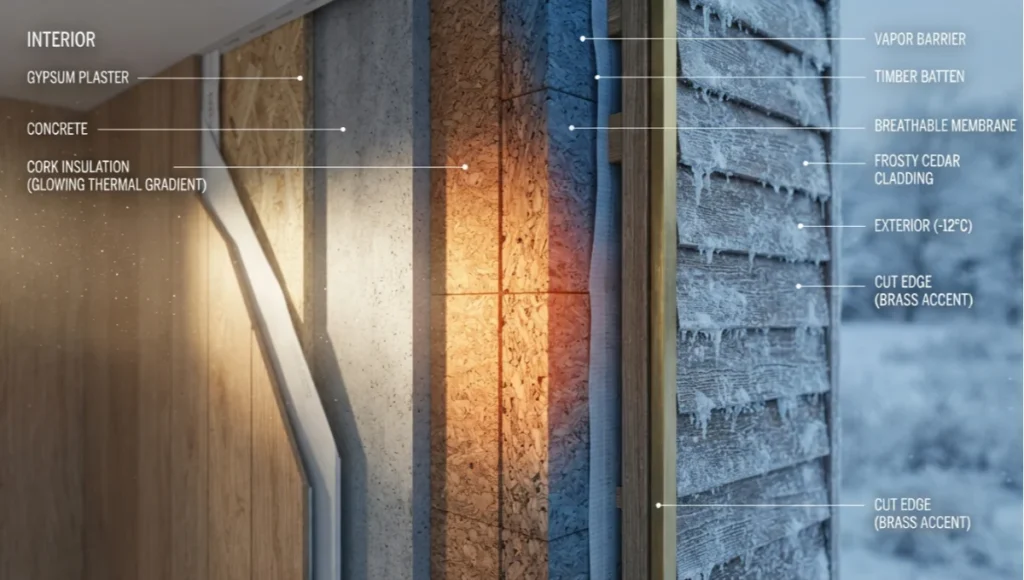
By 2050, more than 68 percent of the global population will live in urban centers, and every one of those buildings will need to answer the same question: how do you insulate a structure without extending its carbon debt for another 40 years? Cork wall panels sustainable interior systems are emerging as one of the few material answers that satisfies thermal, acoustic, and embodied-carbon requirements simultaneously.
As average summer temperatures in southern Europe have climbed by 1.5 degrees Celsius since 1990, and heating demand in northern climates has shifted toward more volatile shoulder seasons, architects are no longer choosing insulation on cost alone. They are choosing it on decade-scale carbon accounting — a shift the AIA-CLF Embodied Carbon Toolkit for Architects has formalized into standard practice guidance — and cork is winning that argument on the numbers.
You are not just spec’ing an insulation layer when you choose cork wall panels sustainable interior systems. You are making a 50-year bet on a building’s thermal behavior, its acoustic comfort, and its embodied-carbon ledger — three variables that used to be evaluated separately and are now, under tightening regulatory frameworks, evaluated as one number.
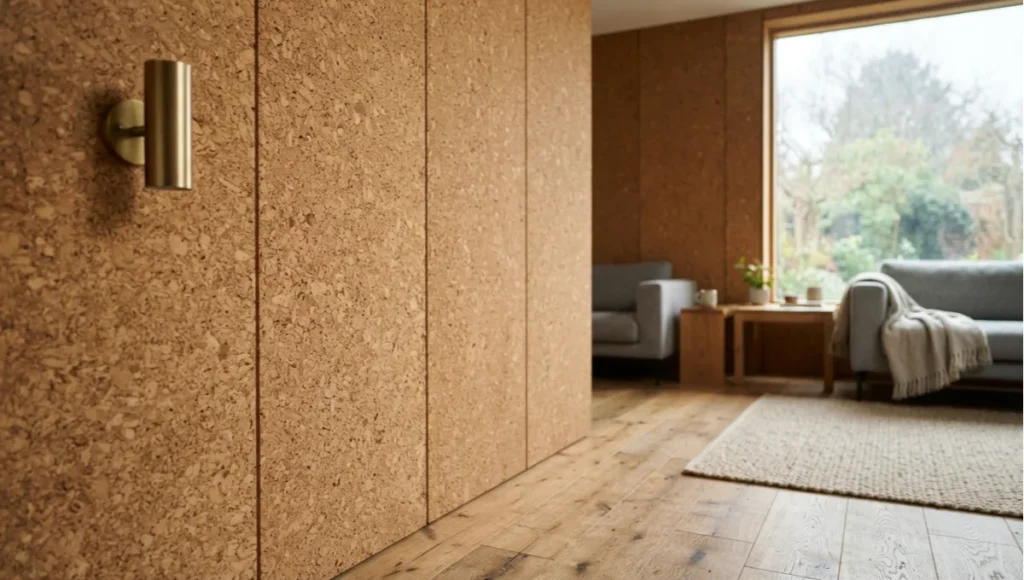
The building sector accounts for roughly 37 percent of global energy-related CO2 emissions, and a meaningful share of that figure comes not from operational energy but from the manufacturing, transport, and disposal of the materials themselves. Insulation has historically been treated as a commodity decision — whichever product hits the required R-value at the lowest installed cost wins the bid. That calculus is breaking down.
What changed is measurement. Whole-building life cycle assessment (LCA) tools have matured to the point where a specifier can model a material’s carbon impact across a 50-year service window with defensible precision. Run that model on cork versus synthetic foam, and the story shifts from R-value per dollar to which material keeps performing at year 30, which one degrades and needs replacement at year 25, and which one was carbon-negative before a single unit of heating energy was ever saved. Cork answers all three questions in ways most alternatives cannot.
Nuvira Perspective
At Nuvira Space, we do not treat material selection as an aesthetic decision made at the end of a project. We treat it as a structural and climate decision made at the beginning of one. Cork wall panels sustainable interior applications sit at the intersection of three disciplines we track closely: building physics, regenerative infrastructure planning, and long-term facilities cost modeling. A wall system is not just a boundary; it is a 50-year commitment to a building’s energy behavior.
Our position is straightforward. Carbon-negative materials that also perform structurally will define the next generation of institutional and residential architecture, and cork is one of the only widely available materials that is carbon-negative at the point of manufacture rather than merely low-impact. That distinction matters more than most specification sheets admit. It is also the throughline in our broader carbon-negative home design framework, which treats material sourcing as a primary design variable rather than a late-stage substitution.
This is not a nostalgic argument for a heritage material. It is a data argument. Every specification decision we make at Nuvira Space runs through a lifecycle filter that asks three questions in sequence: what does this material cost the atmosphere to produce, what does it save the occupant over its service life, and what happens to it when the building is eventually decommissioned or renovated. Cork answers the first question in negative numbers — its production process sequesters more carbon than it emits — and answers the third question with full biodegradability, a rare combination among materials that also deliver structural insulation performance.
We also think about material choice as a signal to the market. When an institutional client specifies cork wall panels sustainable interior systems at scale, that decision moves supply chains. Portugal alone produces roughly half of the world’s cork, harvested from managed montado forests that support one of the most biodiverse ecosystems in the Mediterranean basin. Specification decisions made in Rotterdam, Toronto, or Melbourne ripple back into land management decisions made in the Alentejo region of Portugal. That is the kind of systemic leverage we want architects thinking about when they open a materials schedule.
Technical Deep Dive
Cork’s performance as a wall panel material comes down to a specific set of measurable properties, not marketing language. You need the numbers to make a real specification decision, so here they are without rounding.
What follows is not a manufacturer’s data sheet dressed up in editorial language. It is the set of physical properties that actually determine whether a cork wall assembly will perform the way you need it to in a specific climate, a specific occupancy type, and a specific budget window. Each property below carries a direct consequence for how a room feels, how a heating bill behaves, and how a building ages.
Thermal Performance
Expanded cork insulation board delivers a thermal conductivity of 0.037 to 0.040 W/mK, compared to 1.7 to 2.6 W/mK for standard concrete and roughly 0.035 W/mK for extruded polystyrene. This places cork within 0.005 W/mK of synthetic foam insulation while avoiding the off-gassing and end-of-life landfill burden that comes with EPS and XPS. Translated into R-value, cork panels achieve 3.6 to 4.2 per inch of thickness, which means a 100 millimeter panel delivers thermal resistance comparable to nearly three times its thickness in standard mineral wool.
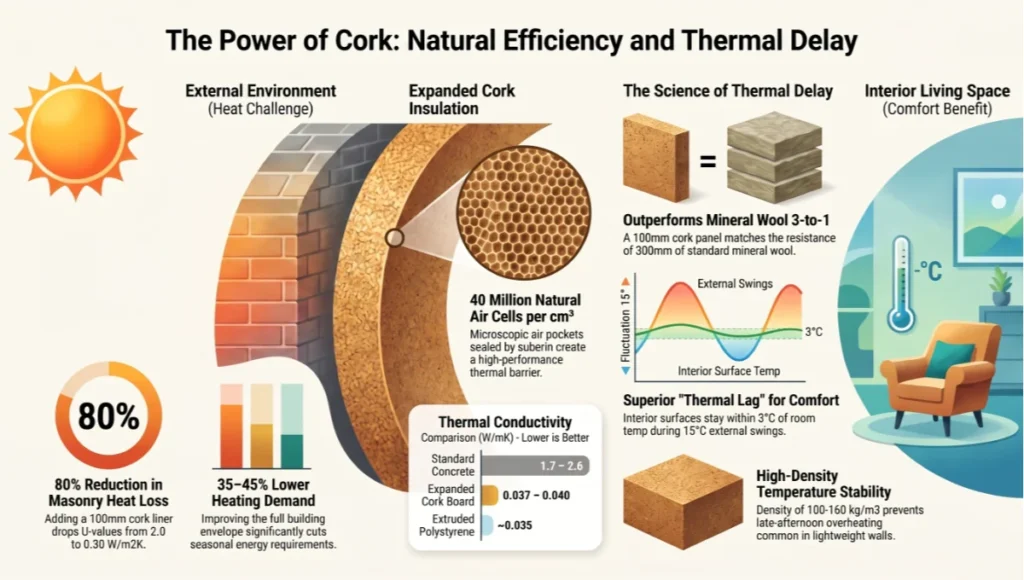
So what does that mean for the room you are standing in? At a density of 100 to 160 kg/m3, a cork wall assembly slows heat transfer enough that interior surface temperatures stay within 2 to 3 degrees Celsius of ambient room temperature even when exterior conditions swing by 15 degrees or more across a day. That thermal lag — sometimes called thermal delay — is what prevents the late-afternoon overheating you feel in lightweight, poorly insulated walls.
Thermal delay is worth dwelling on because it is the most under-specified property in residential insulation conversations. A material can hit a target R-value on paper and still let a room swing uncomfortably between morning cold and afternoon heat, because R-value measures resistance to steady-state heat flow, not a material’s capacity to absorb and release thermal energy over time.
Cork’s cellular structure — roughly 40 million air-filled cells per cubic centimeter, sealed by suberin, cork’s natural waxy binder — gives it a favorable balance of low conductivity and moderate thermal mass, producing a wall that responds slowly to temperature swings on either side of it. That is exactly the behavior you want in climates with wide diurnal temperature ranges, such as coastal Mediterranean cities or continental interiors with hot afternoons and cool mornings.
Consider what this means across a heating season. In a climate with an average winter design temperature of minus 5 degrees Celsius, a 100 millimeter cork liner applied to an existing masonry wall can reduce the U-value of that assembly from roughly 2.0 W/m2K, typical of uninsulated pre-1980s masonry, down to approximately 0.30 W/m2K — a reduction of more than 80 percent in heat loss through that wall element alone. Across a full building envelope, that kind of improvement routinely translates into heating demand reductions in the 35 to 45 percent range, depending on window-to-wall ratio and existing air-tightness.
Acoustic and Fire Behavior
Cork wall panels achieve airborne and impact sound reduction of 50 to 55 decibels (Rw), which is why they appear so frequently in recording studios, party-wall retrofits, and multi-unit residential construction where sound transmission between units is a legal specification, not a preference.
On fire safety, cork carries a Euroclass E rating and, critically, does not release toxic gases when exposed to flame — a meaningful difference from polyurethane foams, which can produce cyanide compounds under combustion. Cork also maintains dimensional and thermal stability across an operating range of -180 to 120 degrees Celsius, a spread that exceeds what almost any interior wall assembly will ever experience but which gives specifiers a wide safety margin.
The acoustic performance deserves closer attention because it is often treated as a secondary benefit when it should be a primary specification driver in dense urban housing. A reduction of 50 to 55 dB Rw sits comfortably above the 45 dB minimum typically required for party walls between residential units.
Cork’s sound dampening comes from the same cellular structure that gives it its thermal properties — millions of sealed air pockets scatter and absorb sound energy across a wide frequency range rather than simply blocking it, which is why cork performs particularly well against low-frequency impact noise transmitted through floors and shared walls, a category where many synthetic insulation products underperform relative to their airborne sound ratings.
On the fire question, the absence of toxic off-gassing is not a marginal detail. In an enclosed residential fire, smoke inhalation and toxic gas exposure account for the majority of fire-related fatalities, not direct flame contact. Materials that combust cleanly, even at a modest fire classification like Euroclass E, reduce the toxic load in an evacuation scenario. Cork’s natural composition — cellulose, suberin, and lignin, with no synthetic flame retardants required — means it does not require the halogenated fire-retardant chemicals commonly added to foam insulations, chemicals that themselves carry separate indoor air quality and long-term health concerns.
Durability and Lifecycle
Durability data is where cork most clearly separates itself from engineered alternatives, because the claims are backed by decades of installed, in-service performance rather than accelerated laboratory aging models.
- Panel lifespan: 50+ years without measurable loss of thermal or mechanical performance
- Water absorption: 0.30 kg/m2, giving cork strong resistance to interstitial condensation
- Vapor permeability: breathable assembly, reducing risk of trapped moisture in masonry retrofits
- Harvest cycle: cork oak bark is stripped every 9 years without felling the tree, and a single tree can be harvested more than 12 times across its lifespan
- Manufacturing footprint: production captures more CO2 than it emits, which is the technical basis for classifying cork as carbon-negative rather than simply low-carbon
Cork installed in buildings during the 1970s is still performing at its original specification today, more than 50 years later. That single data point is what separates cork from most engineered insulation products, which are typically rated for a 25 to 30 year service life before performance degrades. A peer-reviewed life cycle assessment of insulation cork board confirms this durability profile while noting that cork oak forests actively sequester carbon for the 200 to 250 year lifespan of the tree itself, independent of the panel’s own service life.
You should also weigh what durability means for a facilities budget over a 50-year building lifecycle. If a synthetic foam insulation product needs replacement at year 25 or year 30, that renovation cycle carries its own embodied-carbon cost: manufacturing, transporting, and installing a second generation of material, plus the disposal burden of the first. Cork’s 50-plus year service life means a building envelope insulated once with cork can outlast the mortgage on the property that contains it, avoiding an entire renovation cycle’s worth of embodied carbon, labor cost, and construction disruption.
Over a 100-year building horizon — increasingly the planning window used by institutional owners and municipal housing authorities — that single avoided renovation cycle can represent a larger carbon saving than the initial installation itself.
The harvest cycle deserves particular attention from a supply chain resilience standpoint. Because cork oak bark regenerates and can be harvested indefinitely without felling the tree, cork production does not compete with the deforestation pressures that affect timber-based insulation alternatives.
A managed cork oak forest, known as a montado in Portugal or a dehesa in Spain, functions simultaneously as an active carbon sink, a biodiversity reserve supporting endangered species such as the Iberian lynx, and a working agricultural landscape that has supported rural economies for centuries. Specifying cork wall panels sustainable interior systems is, in a very literal sense, an investment in the continued economic viability of one of the Mediterranean’s most ecologically significant working landscapes.
Comparative Analysis
Numbers in isolation do not make a specification case. What matters is how cork wall panels sustainable interior systems perform relative to the products they are most likely to replace on a bid sheet. The table below lines up cork against expanded and extruded polystyrene, the industry-standard synthetic foam insulations that dominate current construction specifications across residential and light commercial projects.
Cork Wall Panels vs. Industry Standard Insulation
| Property | Cork Wall Panels | Industry Standard (EPS/XPS) |
| Thermal conductivity | 0.037–0.040 W/mK | 0.030–0.035 W/mK |
| Service life | 50+ years, no degradation | 25–30 years typical |
| Fire behavior | Euroclass E, no toxic emissions | Toxic gas release under combustion |
| End-of-life | Biodegradable, carbon-negative production | Non-biodegradable, petroleum-based |
| Acoustic (Rw) | 50–55 dB | 30–40 dB typical |
| Vapor permeability | Breathable, moisture-buffering | Largely vapor-closed |
Synthetic foam insulation still edges out cork by roughly 0.003 to 0.005 W/mK in raw thermal conductivity. But when you weight that marginal difference against a service life that is nearly double, an end-of-life profile that is biodegradable rather than landfill-bound, and a manufacturing process that is carbon-negative rather than carbon-emitting, cork wall panels sustainable interior systems come out ahead on any lifecycle carbon model that runs past year 15. If you are weighing cork against other bio-based options, our comparison of hempcrete and aerogel insulation breaks down where each material outperforms the others by climate zone.
It is worth being precise about what the 0.003 to 0.005 W/mK gap actually costs you in practice. Across a 100 millimeter panel thickness, that difference translates into roughly a 10 to 12 percent variance in R-value between cork and top-tier synthetic foam. In a well-designed envelope where insulation thickness is not severely constrained by available wall depth, that gap can be closed entirely by specifying a marginally thicker cork panel — typically an additional 10 to 15 millimeters — while still delivering superior acoustic performance, fire safety, and end-of-life characteristics. In retrofit contexts where wall depth is constrained by existing structure, that gap becomes a genuine trade-off decision, and this is precisely where a full lifecycle carbon model, rather than a single-property comparison, should drive the specification.
The end-of-life column carries disproportionate weight in this comparison because building material end-of-life outcomes are becoming a regulated data point, not an afterthought. Extended producer responsibility frameworks are beginning to appear in EU construction policy, and several U.S. states have introduced legislation requiring disclosure of a material’s end-of-life pathway at the point of specification. A biodegradable, carbon-negative material like cork arrives at that regulatory future already compliant, while petroleum-based foam insulations face a structural disadvantage that no amount of thermal-conductivity optimization can fully offset.
Speculative / Internal Concept Study: Project Suberis by Nuvira Space
The following concept is a speculative internal study developed by Nuvira Space to explore how cork wall systems could perform in a real urban retrofit context. It is not a built or commissioned project.
We developed Project Suberis specifically to pressure-test the specification decisions outlined above against a realistic, constrained retrofit scenario, rather than a hypothetical new-build context where material choices are unconstrained by existing structure. Postwar concrete-frame housing represents one of the largest categories of underperforming building stock across Europe, and it is precisely the building type where the tension between historic-facade preservation and modern thermal performance requirements is most acute.
Project Overview
Location: Rotterdam, Netherlands
Typology: Mixed-use residential retrofit, converting a 1975 concrete-frame apartment block into a low-energy residential building
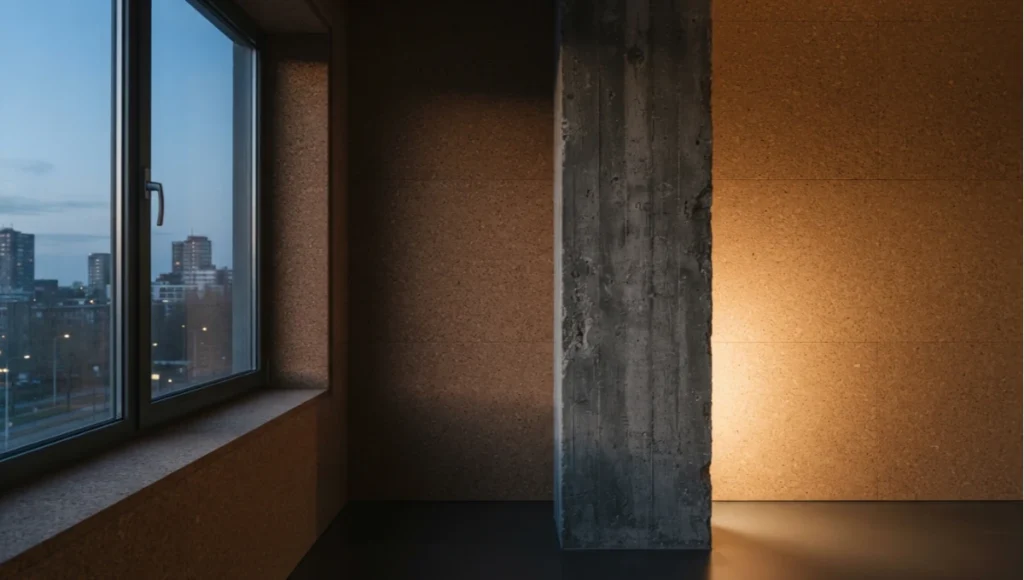
Vision: Rotterdam has committed to a fully circular economy by 2030 and has one of the highest concentrations of bio-based building retrofits in the European Union, making it a realistic testbed for cork-based envelope upgrades on aging concrete stock. Project Suberis imagines a 120-unit block retrofitted with an internal cork liner system to solve thermal bridging without altering the building’s historic street-facing facade — a common constraint across Rotterdam’s postwar housing stock.
Rotterdam’s postwar reconstruction, undertaken largely in the two decades following the 1940 bombing of the city center, produced a dense inventory of concrete-frame residential blocks that were never designed with contemporary thermal performance in mind. Many of these buildings carry heritage or streetscape protections that prohibit exterior cladding changes, which rules out external thermal insulation composite systems as a retrofit strategy. That constraint is exactly what makes an internal cork liner approach viable: it delivers the thermal performance improvement without touching the protected exterior envelope, while adding negligible weight to a structural frame that was engineered for a fundamentally different set of loads than a modern high-performance envelope would require.
Design Levers Applied
Envelope Strategy
- 120 millimeter expanded cork board applied to interior face of existing concrete walls, achieving a combined R-value of approximately 14.5
- Thermal bridging at window reveals addressed with 40 millimeter cork returns, reducing localized heat loss by an estimated 22 percent
- Acoustic separation between units upgraded to Rw 54 dB using cork panel cores at party walls
Carbon Accounting
- Embodied carbon of the cork retrofit layer: approximately 4 kilograms CO2-equivalent per square meter, offset by the material’s own carbon-negative production
- Projected heating demand reduction: 38 percent against pre-retrofit baseline, based on comparable cork retrofit case studies in similar climate zones
- Projected service interval before re-insulation: 50+ years, eliminating one full renovation cycle compared to mineral wool alternatives
Occupant Experience
- Interior surface temperature variance reduced to within 2 degrees Celsius of setpoint across a typical heating cycle, compared to 5 to 6 degrees in the unretrofitted baseline
- Impact noise transmission between units reduced by an estimated 15 dB, addressing a documented tenant complaint category in the existing building
- Interior air quality maintained through cork’s vapor-permeable assembly, avoiding the moisture entrapment risk associated with vapor-closed synthetic retrofits on solid masonry
Transferable Takeaway
The lesson from Project Suberis extends well beyond Rotterdam. Any postwar concrete-frame building — and there are millions across Europe and North America — can use an internal cork liner to meet modern thermal codes without altering exterior facades or triggering the permitting complexity that comes with facade-level intervention. For architects working on heritage-adjacent retrofits, this is the single most transferable insight: solve envelope performance from the inside, and let the material’s 50-year lifespan absorb the capital cost over a single generation of ownership. Our dedicated guide to 1970s home energy retrofits covers the permitting and sequencing details for exactly this building typology.
There is also a sequencing lesson embedded in this concept study that applies far beyond cork specifically. Internal insulation retrofits allow phased construction, unit by unit or floor by floor, without displacing an entire building’s occupants at once — a logistical and financial advantage that external envelope retrofits rarely offer. For housing authorities managing occupied buildings, that phasing flexibility can be the difference between a retrofit program that is financially and socially feasible and one that is not, regardless of which specific insulation material ends up specified.
2030 Future Projection
By 2030, expect cork wall panels sustainable interior systems to move from a specialist specification to a default option in three building categories: postwar concrete retrofits, mass-timber residential construction, and acoustic-sensitive commercial interiors. As embodied carbon reporting becomes mandatory under expanding EU and UK building regulations, materials that are carbon-negative at production — not just carbon-neutral over their lifecycle — will carry a measurable compliance advantage. Cork’s harvest cycle, which requires no felling and regenerates bark every 9 years, positions it as one of the few insulation materials that can scale supply without expanding land use or deforestation risk.
Expect panel manufacturers to push thickness efficiency further, targeting a 10 to 15 percent improvement in thermal conductivity by 2030 through higher-density binding processes, narrowing the gap with synthetic foam while retaining cork’s durability and end-of-life advantages.
Supply chain dynamics will also shift. Cork oak forests currently produce far more cork than the construction sector consumes, with most harvested cork still directed toward wine-stopper production. As construction demand grows, expect processing capacity to gradually reallocate toward insulation-grade cork board, since lower-grade bark — the material that does not meet wine-stopper appearance standards — is precisely the input best suited to expanded insulation board manufacturing. Growth in construction-sector demand therefore does not require expanding cork oak acreage; it requires redirecting an already-abundant byproduct stream toward higher-value use.
On the regulatory front, watch for embodied carbon caps to move from voluntary certification programs, such as LEED and BREEAM, into mandatory building code language. California’s forthcoming embodied carbon provisions and similar frameworks under discussion in several EU member states will likely set maximum allowable embodied-carbon thresholds per square meter of new construction.
Materials with negative embodied carbon, like cork, effectively create carbon budget headroom elsewhere in a project’s material palette — allowing a specifier to offset a carbon-intensive structural material, such as conventional concrete, with a carbon-negative envelope material, and still meet an aggregate project-wide carbon cap. That budget-offsetting function will likely become one of cork’s most valuable specification arguments over the next four years, independent of its thermal and acoustic performance.
Comprehensive Technical FAQ
Performance and Specification
Part of our sustainable building materials guide — selection, verification, and specification across fourteen bio-based families.
Q: What is the actual R-value of a standard cork wall panel?
A: A cork panel delivers 3.6 to 4.2 R-value per inch of thickness. A 100 millimeter (roughly 4 inch) panel therefore delivers an R-value in the range of 14.4 to 16.8, depending on density and binding process.
Q: How does cork compare to mineral wool for interior wall retrofits?
A: Cork’s thermal conductivity of 0.037 to 0.040 W/mK is close to mineral wool’s typical range of 0.032 to 0.040 W/mK, but cork adds structural rigidity, moisture buffering, and a 50-year service life that most mineral wool products do not match.
Q: Is cork suitable for high-humidity interiors like bathrooms or basements?
- Water absorption of 0.30 kg/m2 keeps moisture uptake low
- Vapor permeability allows moisture to migrate rather than accumulate
- Natural resistance to mold and mildew without chemical treatment
Q: What is the fire safety rating of cork wall panels?
A: Cork carries a Euroclass E fire rating and does not emit toxic gases under combustion, unlike many petroleum-based foam insulations.
Q: How long does a cork wall panel installation last before it needs replacement?
A: Properly installed cork panels maintain thermal and mechanical performance for 50 years or more, with documented installations from the 1970s still performing at original specification.
Q: Does cork wall paneling require special maintenance over its service life?
A: No specialized maintenance is required beyond standard interior surface care. Cork’s natural resistance to moisture, pests, and microbial growth means it does not need periodic chemical treatment. Sealed or finished surfaces can be cleaned with standard household methods, and surface wear typically affects only the finish layer, not the underlying insulation performance.
Q: What thickness of cork panel is typically specified for interior retrofit applications?
A: Interior retrofit applications commonly specify cork panels between 40 and 120 millimeters, depending on the target R-value and available wall depth. Thinner panels in the 20 to 40 millimeter range are typically used for acoustic-only applications or thermal bridging details at window and door reveals, while full-wall thermal retrofits generally specify 80 to 120 millimeter panels to achieve meaningful heating demand reductions.
Conclusion
If your next project involves a concrete-frame retrofit, an acoustic-sensitive interior, or any specification where embodied carbon reporting is now mandatory, cork wall panels sustainable interior systems deserve a place on your shortlist — not as a niche alternative, but as a primary material decision backed by 50 years of performance data. Compare the specifications. Run the lifecycle numbers against your current insulation standard. The data holds up.
The specification decisions you make today will still be performing, or failing to perform, in the buildings your clients occupy 30 and 40 years from now. Choose the material that answers that timeline honestly.
© Nuvira Space. All rights reserved. | ECO BLUEPRINT Series | All specifications cited are based on published third-party building-materials research and manufacturer technical data sheets (no external links included). Project Suberis is a speculative internal concept study and does not represent a completed project.