

Table of Contents
As the world’s eyes turn to the Italian Alps and the urban sprawl of Lombardy this February 2026, a quiet revolution is taking place beneath the shimmering lights of the Winter Games. While the athletes chase gold, architects and urban planners are chasing something arguably more enduring: the “circular” ideal. The Milan 2026 and Circular Stadiums narrative isn’t just about sports; it is a fundamental shift in how we conceive, build, and dismantle the giants of our urban landscape. In an era where “white elephant” stadiums have become the ghosts of Olympics past, Milan is offering a masterclass in architectural restraint and adaptive reuse.
The timing could not be more critical. As of February 2026, the global construction industry is under unprecedented pressure to reach “Net Zero” targets. The recent viral discussions surrounding the “Paris Legacy Loop”—where thousands of modular elements from the 2024 Games were shipped to Milan—have sparked a fresh debate on whether we should ever build a “permanent” stadium again. This article explores why the Milan 2026 model is the blueprint for the next decade of global urbanism.
The Dawn of the Circular Arena
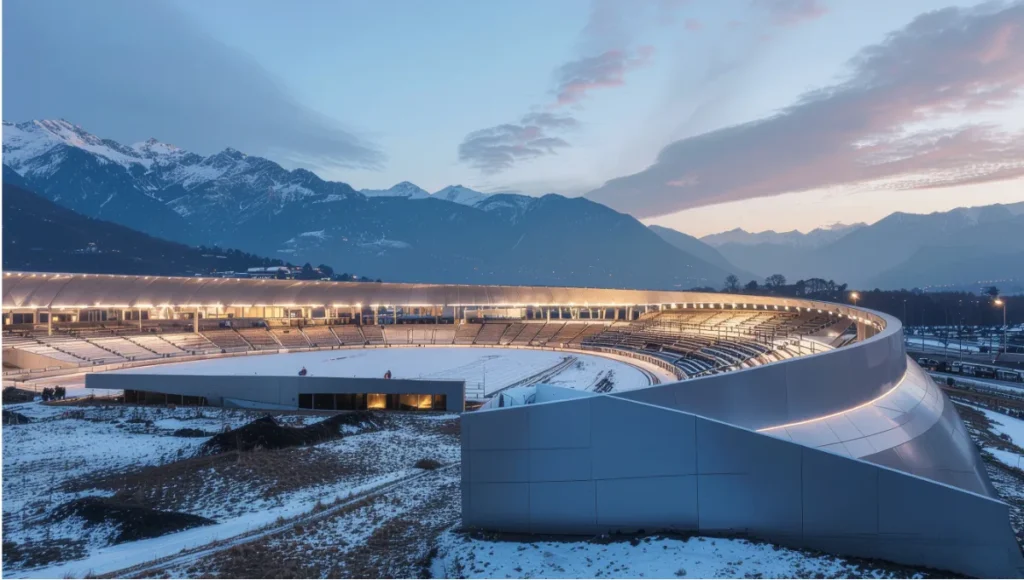
The opening ceremony at the San Siro didn’t just mark the start of the Games; it marked a celebration of a venue that refused to die. In a world where the average lifespan of a high-tech stadium is shrinking, the decision to center the 2026 Games around existing infrastructure is a radical act of sustainability. This is the heart of the circular economy: keeping materials and structures in use for as long as possible.
In 2026, “circularity” has moved from a niche buzzword to the primary metric of architectural success. We are no longer asking, “How iconic is the silhouette?” but rather, “How easily can this be taken apart?” The Milan 2026 strategy relies on a staggering 85% reuse rate of existing or temporary venues. This isn’t just an environmental choice; it’s a sophisticated urban planning move that integrates circular construction design into the existing fabric of northern Italy rather than forcing the city to adapt to the Games.
From Monuments to Modules: A Brief History
To understand the significance of Milan 2026, one must look at the “Edifice Complex” that plagued the early 21st century. From the abandoned venues of Athens 2004 to the underutilized giants of Rio 2016, the history of sports architecture has often been one of waste. Traditional stadium design followed a linear “Take-Make-Waste” model: extract resources, build a monument, and let it decay once the spotlight fades.
The shift began with the London 2012 “Olympic Stadium,” which introduced the concept of a “demountable” upper tier. However, the true evolution toward Milan 2026 and Circular Stadiums was catalyzed by the IOC’s “Olympic Agenda 2020,” which mandated that host cities prioritize existing venues. By the time Milan won the bid, the architectural community had embraced “Design for Disassembly” (DfD). This period saw a rise in robotic fabrication in architecture, allowing for the precision-cutting of modular components that could be easily reassembled elsewhere, a technique that Arup and David Chipperfield have perfected for the current Games.
Highlighting the 2026 Circuit: The Current Buzz
As we stand in the middle of the February 2026 Games, three major developments are dominating the headlines in architectural circles:
The Santa Giulia Arena
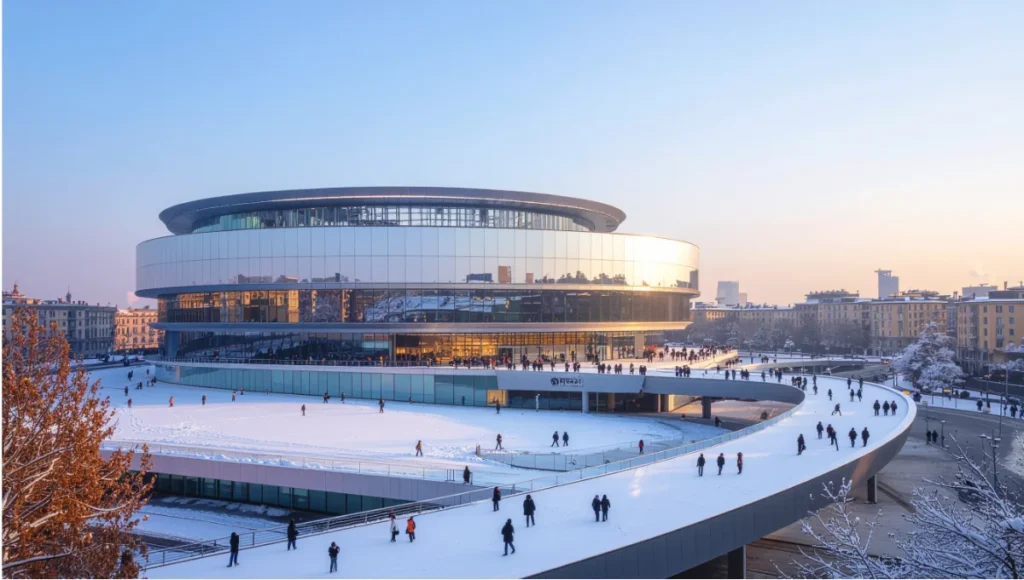
Designed by David Chipperfield Architects and Arup, this 16,000-seat venue is the crown jewel of the circular movement. Its three “floating” rings of shimmering aluminum aren’t just for show; they are part of a modular system designed for a “second life” as a premier concert and cultural hub.
The Porta Romana Olympic Village
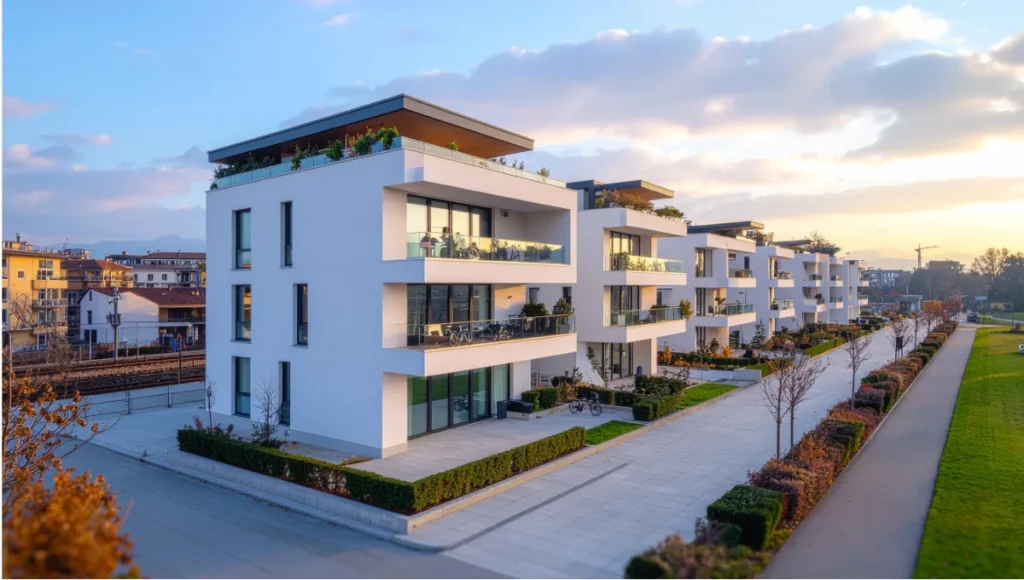
Completed by SOM (Skidmore, Owings & Merrill) just months ago, this project is already being hailed as the gold standard for adaptive reuse. In just six months, these athlete residences will transition into the city’s largest student housing complex. To manage this complex transition, the city utilized digital twins for smart cities to simulate post-games foot traffic and energy loads.
The “Paris-to-Milan” Material Transfer
For the first time in history, an immutable ledger powered by blockchain in architecture was used to create “material passports” for 24,000 items. This system tracked everything from modular seating to temporary HVAC units as they moved from the Paris 2024 Summer Games to the Milan 2026 venues, ensuring their provenance and structural integrity were preserved for the “second life” market.
Case Study: The Santa Giulia Arena and the Power of Parametrics
The Santa Giulia Arena serves as the ultimate case study for innovative architecture in 2026. Unlike the concrete monoliths of the 90s, Santa Giulia was built using a “zero-carbon design” approach that pushes the boundaries between net zero vs net positive performance.
Architectural Details
The arena stands on a raised podium that functions as a 10,000-square-meter public piazza. The façade consists of three stacked rings connected by transparent glass bands. These rings are more than static metal; they incorporate elements of kinetic architecture facades, where integrated LED strips and reflective aluminum tubes shift with daylight and event programming to transform the building into a massive media surface after dark.
Operational Efficiency
The building is “climate-resilient,” featuring a roof with 4,000 photovoltaic panels that generate approximately 1 MW of energy. But the true genius lies in its flexibility. The interior “bowl” can be reconfigured within 48 hours to host anything from ice hockey to a high-density tech conference. The parking infrastructure was even built with “convertible” floor heights, allowing the multi-story car park to be turned into office space or residential lofts if car ownership in Milan continues to drop.
Emerging Trends: The Death of the “White Elephant”
What does the success of Milan 2026 tell us about the broader future of urban planning and sustainable design?
Distributed Urbanism
By spreading the Games across Milan, Cortina, and the Valtellina, the organizers have avoided the “Event Island” effect. Instead of one massive Olympic Park that becomes a ghost town, we have dozens of micro-regenerations that feed back into the existing local economy.
Temporary-as-Permanent
The “pop-up” Alpine village in Fiames, built from high-end, wooden-clad modular units, proves that temporary structures can provide a “luxury” experience without a permanent ecological footprint. These units will be dismantled and sold as individual “tiny homes” or mountain cabins after the closing ceremony, effectively creating a zero-waste housing model.
Voices from the Field
“We are no longer building for two weeks of glory; we are building for twenty years of civic life,” says Marco Rossi, a lead consultant for the Milano Cortina 2026 Foundation. “The circular stadium is a living organism. It breathes with the city.”
Critics, however, remain cautious. “Circularity requires a massive upfront investment in logistics and digital tracking,” notes Dr. Elena Bianchi, an urbanism professor at the Politecnico di Milano. “While Milan is succeeding, the question is whether smaller cities can afford the technology required to make this work.”
Meanwhile, attendees at the Santa Giulia Arena are focused on the experience. “You can feel the lightness of the space,” says Sofia L., an architecture student visiting from London. “It doesn’t feel like a heavy, oppressive stadium. It feels like part of the neighborhood.”
Conclusion: A New Legacy for the Future of Design
The Milan 2026 and Circular Stadiums movement has fundamentally rewritten the rules of the game. It has proven that contemporary architecture trends must move beyond the “aesthetic of the new” and embrace the “intelligence of the reused.” By prioritizing 85% venue reuse and implementing modular, parametric designs like the Santa Giulia Arena, Milan is showing us that the most innovative building is often the one that was already there—or the one that knows how to disappear when its job is done.
As we look toward the 2030s, the legacy of Milan won’t be measured in medals, but in the tons of carbon saved and the vibrant, repurposed neighborhoods left behind. This is the architecture 2026 promised us: a future that is resilient, responsible, and, above all, circular.