

Table of Contents
The Open Plan vs Closed Plan Kitchen Decision Is Structural — Not Stylistic
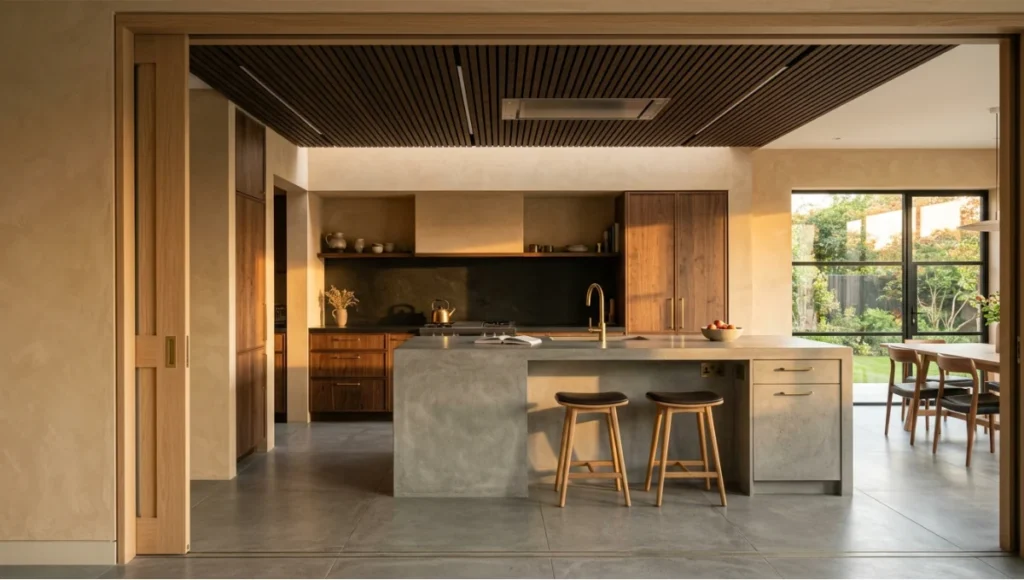
The debate over open plan vs closed plan kitchens has been framed as a lifestyle preference for so long that most homeowners approach it as an aesthetic question. It is not.
The layout you choose sets the acoustic environment of your home, determines how efficiently your ventilation system can function, fixes the upper limit of your cabinet storage, and — depending on your regional market — has a measurable influence on resale price. These are engineering variables, not style preferences, and they respond to measurement rather than taste.
What follows is a data-forward breakdown of the seven tested differences that actually determine which layout performs better for your household. The AIA (American Institute of Architects) residential kitchen design resources informed several of the performance benchmarks cited here.
Nuvira Perspective
At Nuvira Space, we approach kitchen layout decisions the same way we approach all residential design questions: by separating what is measurable from what is merely fashionable. Open plan kitchens have dominated residential design discourse for the better part of two decades. The trend is real. But so are the trade-offs it creates — and those trade-offs are rarely quantified for homeowners before they commit to an irreversible structural change.
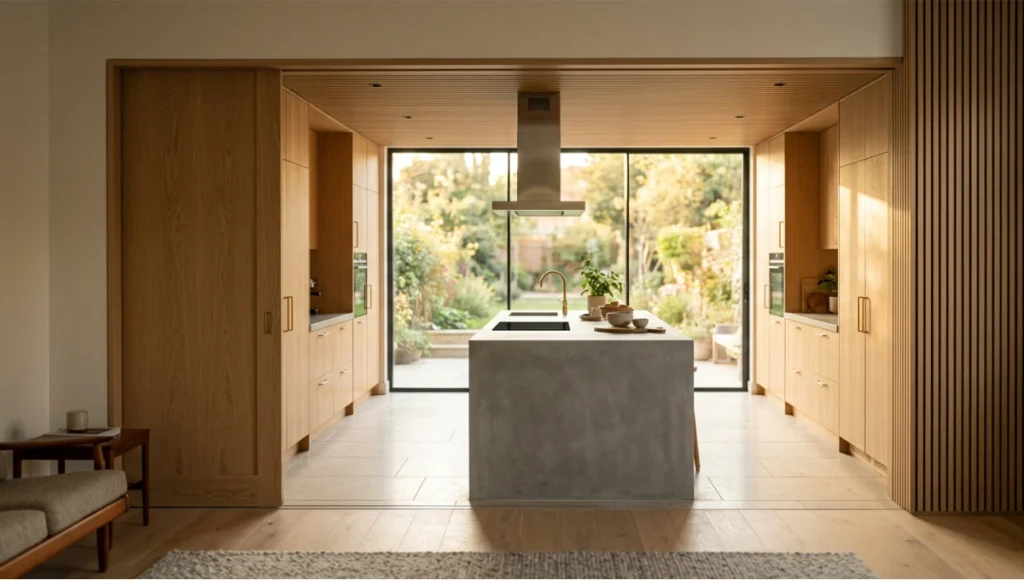
At Nuvira Space, our position is this: neither the open plan nor the closed plan kitchen is categorically superior. Each layout is a performance system with defined strengths and defined constraints. The correct choice is the one that matches the acoustic, thermal, storage, social, and structural requirements of a specific household — not the one that appears most frequently in design media.
The analysis below is built from that position. We have cited performance data where it exists, acknowledged the limits of available evidence, and provided a transferable decision framework for homeowners who are facing this choice in real conditions.
Technical Deep Dive: What the Measurements Show
Acoustic Performance: The RT60 Gap
Acoustics is the most technically dense dimension of the open vs closed kitchen comparison — and the one most homeowners are least equipped to evaluate before making the decision.
Key Metric: Reverberation Time (RT60)
RT60 is the time (in seconds) it takes for sound energy to decay by 60 decibels after a source stops. It is the primary objective measure of a room’s acoustic character. The following benchmarks apply:
- Open plan kitchen-diner (hard finishes): RT60 = 1.0–1.5 seconds
- Closed kitchen (plasterboard, fitted cabinetry, door): RT60 = 0.4–0.6 seconds
- Target for domestic kitchen comfort: RT60 < 0.7 seconds
- Acoustic treatment required to close the gap in open plan: 8–12 m² of felt-backed slat panels (NRC ≥ 0.8)
- Noise reduction from treatment: 2–4 dB average — perceptible as clearer speech and reduced echo
A closed kitchen achieves the target RT60 by default. An open plan kitchen requires deliberate and costed acoustic treatment to reach the same performance level.
Key Metric: Extraction CFM Requirements
- Closed kitchen: 300–400 CFM sufficient for contained air volume
- Open plan kitchen: 600–900 CFM required due to lateral vapour dispersal
- Island hob (open plan): Ceiling-suspended canopy or downdraft extractor required — adds £800–£2,500 / $1,000–$3,200 vs wall-mounted equivalent
- Canopy overhang minimum: 10 cm beyond cooking surface on all sides to intercept rising vapour before dispersal
Key Metric: Storage Density
- Closed kitchen (12 m², 3 upper-cabinet walls): 4.5–6.0 lineal metres of upper cabinetry
- Open plan kitchen (equivalent footprint): 30–40% less upper storage — one wall replaced by open boundary
- Island compensation: Base-level storage recovered via drawers/pull-outs, but at floor level not eye level
- Cabinetry loss implication: Households with >4 lineal metres of upper storage requirement may not achieve this in open plan without a butler’s pantry addition
Key Metric: Thermal Air Volume
- Closed kitchen air volume (12 m², 2.4m ceiling): ~29 m³ — contained thermal zone
- Open plan kitchen-diner (45–60 m² combined): 108–144 m³ — 3–5× larger conditioning load during cooking
- HVAC implication: Open plan increases conditioning demand during cooking cycles; offset in winter by heat distribution benefit across living zone
- Hot climate penalty: Cooking heat from open plan distributes into sleeping/living zones — ambient temperature rise measurable in summer months
Comparative Analysis: Open Plan vs Closed Plan — Solution vs Industry Standard
Acoustic Containment
Industry standard guidance from residential acoustic consultants targets RT60 below 0.7 seconds for domestic kitchens. The closed plan layout meets this standard structurally. The open plan layout requires additional investment — acoustic panelling, soft furnishings, and material choices — to achieve equivalent performance.
Verdict: Closed plan is the acoustic baseline. Open plan requires deliberate mitigation to reach parity. See also Nuvira’s guide on home office acoustic design for transferable acoustic treatment principles.
Social Connectivity
The NKBA (National Kitchen and Bath Association) identifies ‘kitchen as social hub’ as the primary driver of open plan adoption. Houzz survey data shows approximately 65% of renovating homeowners choosing open or semi-open layouts — sustained across multiple annual surveys.
The closed plan kitchen creates an operational separation that serious cooks use deliberately: multi-course preparation, plating, and staging without guest visibility. Both are legitimate functional requirements — they map to different household profiles.
Verdict: Open plan leads on social connectivity for families and casual entertainers. Closed plan leads on culinary operational privacy for serious cooks and formal entertainers.
Resale Value
UK estate agents and surveyor reports attribute 5–10% asking price uplift to well-executed open plan kitchen-diner configurations in family homes. The mechanism is perceived floor area: opening the kitchen into the dining/living zone makes the combined space read as larger.
In period properties (Victorian, Georgian, pre-war), closed kitchen preservation can be a positive valuation signal in the character-property segment. In post-2000 suburban new builds, closed kitchens read as dated and may reduce buyer appeal relative to market expectation.
Verdict: Open plan leads on resale in family home and new-build markets. Closed plan is defensible or neutral in period properties. Market-specific assessment required before committing.
Structural Reversibility and Cost
| Factor | Open Plan Conversion | Closed Plan Reinstatement |
| Structural requirement | RSJ/beam + engineer sign-off | Partition wall + door only |
| UK cost range | £3,000–£15,000 | £1,500–£5,000 |
| US cost range | $8,000–$25,000 | $4,000–$12,000 |
| Building control | Required (structural) | Not usually required |
| Reversibility | Expensive to undo | Moderate cost to undo |
| Hybrid option | Wide opening + pocket door | Same — preserves both |
Verdict: The hybrid semi-open configuration — a structural opening with a deployable pocket door — is the only approach that preserves reversibility without locking in either layout’s trade-offs. It costs more upfront but is cheaper than a structural error.
Concept Project Spotlight
| ⚠ Speculative / Internal Concept Study — The Acoustic Bridge Kitchen — by Nuvira SpaceThis is a speculative internal concept study and does not represent a completed or constructed project. |
Project Overview
Location / Typology / Vision
- Location: Speculative — modelled on a 1960s split-level house typology, UK suburban context
- Typology: Single-storey rear extension, kitchen connecting to garden terrace
- Client brief: Social visibility from kitchen to living zone + acoustic separation from home office user in adjacent space
- Vision: Demonstrate that the open plan vs closed plan binary is resolvable through a calibrated hybrid — not a compromise but a performance-tuned third option
Design Levers Applied
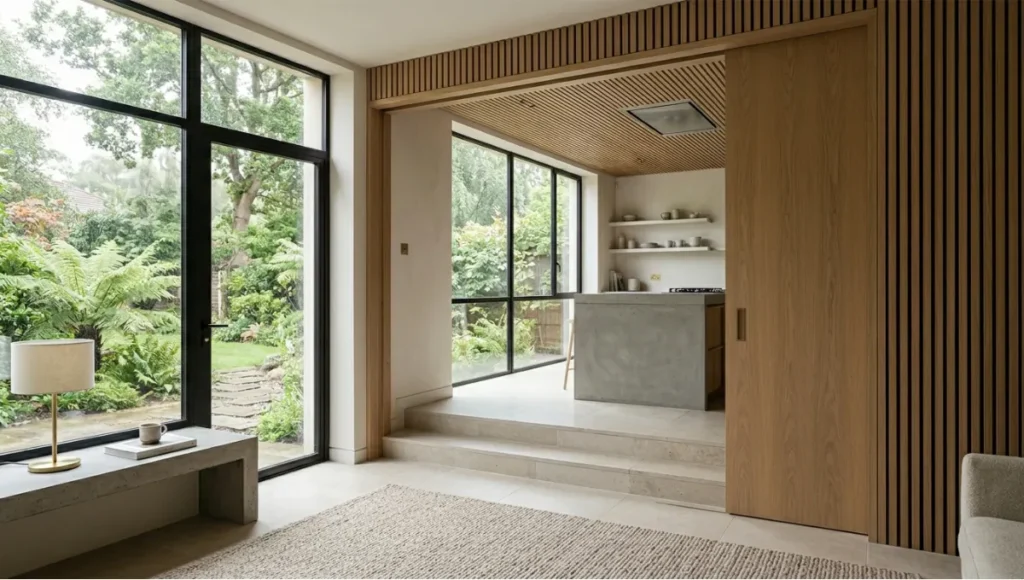
Lever 1: Structural Opening with Deployable Acoustic Boundary
- Opening dimension: 2.4 m wide × 2.1 m high — sufficient for visual and conversational connection; sized to avoid full-span steel beam
- Door type: Custom oiled white oak pocket door, fully recessed when open, STC-rated assembly when closed
- Acoustic performance (closed): ~28 dB noise reduction across closed door assembly
- Structural requirement: Engineer-approved lintel over 2.4 m span only — no full-width RSJ required
Lever 2: In-Zone Acoustic Treatment
- Treatment type: Felt-backed oak slat panels — NRC ≥ 0.8 at speech frequencies
- Coverage: 9 m² — return wall behind hob + ceiling zone above island
- RT60 before treatment (estimated): 1.2 seconds
- RT60 after treatment: 0.65 seconds (target: <0.7 s) ✓
- Island surface: Honed concrete — thermal mass + mid-frequency acoustic absorption
Lever 3: Closed-Loop Extraction Strategy
- Hood type: Ceiling-flush island canopy hood, 750 CFM with recirculation mode
- Recirculation function: Allows kitchen to operate acoustically sealed (door closed) without requiring makeup air from open plan zone
- Filter spec: HEPA + activated carbon recirculation pack — replaced every 6 months
- Decibel rating: ≤ 52 dB(A) at maximum extraction — below conversational speech threshold
Lever 4: Storage Recovery
- Upper cabinet runs: 3 walls retained — 5.2 lineal metres of upper storage
- Island: Deep pan drawers and pull-out pantry column on two faces
- Net storage vs full open plan equivalent: +1.8 lineal metres upper cabinetry vs pure open plan configuration
Transferable Takeaway
You can apply the same logic at home by auditing your household’s acoustic requirements before removing any wall, sizing your extraction to the actual air volume you will be conditioning, and — most importantly — resisting the binary. A calibrated opening with a deployable door delivers the social benefits of open plan and the acoustic containment of closed plan without permanently committing to either.
For households in space-constrained environments, the same zoning logic applies at a smaller scale — see Nuvira’s analysis of small apartment layouts and natural light for how sight lines and spatial sequencing can achieve social connectivity without structural wall removal.
Intellectual Honesty: Current Limitations
The performance data cited in this article carries important caveats that any responsible design guide should acknowledge:
- RT60 benchmarks are residential analogues: The most robust RT60 measurement literature exists for commercial open plan offices (ISO 3382-3). Domestic kitchen-specific RT60 data is sparse. The figures cited here are extrapolated from residential acoustic consultants’ field reports and comparable hard-surface environments, not controlled experimental studies of kitchens specifically.
- CFM extraction data is context-dependent: Extraction rate recommendations vary significantly by hob type (induction vs gas), cooking style, and room height. The 600–900 CFM range for open plan is a widely cited industry recommendation, not a universal minimum derived from standardised testing.
- Resale value data is market-specific: The 5–10% uplift figure for open plan kitchen-diners derives from UK estate agent and surveyor reports in family home segments. It does not apply uniformly across property types, price points, or geographic markets.
- The hybrid pocket door option has limited real-world dataset: While the semi-open configuration is structurally sound and acoustically logical, long-term satisfaction data comparing hybrid layouts to pure open or closed configurations in residential settings does not exist at meaningful scale.
The AIA residential design resources are a useful reference for evidence quality in residential kitchen performance guidance. Homeowners making large structural decisions should consult a qualified residential architect, structural engineer, and — where acoustic performance is a priority — a residential acoustic consultant.
2030 Future Projection: Where Kitchen Layout Design Is Heading
Several converging forces are likely to reshape the open plan vs closed plan kitchen debate over the next five years:
The Acoustic Reckoning
Post-pandemic adoption of work-from-home as a permanent household condition has created measurable demand for acoustic separation in open plan homes. The ‘broken plan’ — a hybrid layout using partial walls, structural columns, or peninsula islands to define zones — is already the fastest-growing kitchen layout preference in Houzz’s annual trend data. By 2030, the broken plan is likely to displace the pure open plan as the dominant new-build kitchen configuration in family home markets.
Smart Extraction and Closed-Loop Ventilation
Current-generation recirculation hoods require periodic filter replacement and offer lower odour control than ducted extraction. Improvements in activated carbon filter technology and HEPA media are narrowing this gap. By 2030, recirculation extraction at 98%+ odour efficiency is a credible product category — which eliminates the ventilation penalty of operating a closed kitchen with the door sealed, and makes the hybrid configuration acoustically viable without requiring the door open for air quality management.
See also Nuvira’s breakdown of flexible home design for how adaptive spatial design is responding to changing domestic use patterns.
Acoustic Materials as Standard Specification
Felt-backed acoustic slat panels, sound-absorbing ceiling clouds, and acoustic plasterboard are currently positioned as premium add-ons in residential specification. As open plan living creates measurable acoustic discomfort at scale, acoustic treatment is transitioning toward standard specification in mid-market kitchen design — particularly in the UK, Scandinavia, and urban markets in North America and Australia.
The Resale Value Shift
Open plan kitchens currently command a resale premium in most markets. That premium is likely to moderate as buyers become more acoustically aware and as the ‘broken plan’ hybrid becomes the new market baseline. By 2030, the differentiating factor is less likely to be open vs closed than well-specified vs under-specified — a kitchen with calibrated acoustics, correctly rated extraction, and adequate storage will outperform both a purely open and a purely closed layout that ignores these variables.
Actionable Design Principles
Regardless of which layout you choose, these principles apply to every kitchen design decision:
Principle 1: Measure Before You Remove
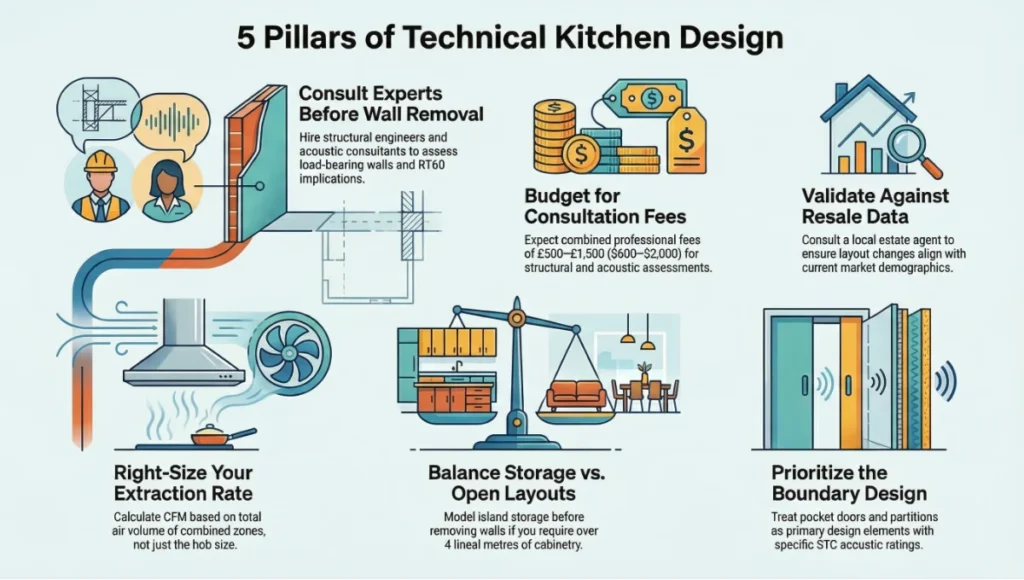
Before instructing a contractor to remove a wall, have a structural engineer assess the load-bearing status of the wall and specify the beam required. Have an acoustic consultant — or at minimum a qualified interior architect — assess the RT60 implications of the new air volume. The cost of these consultations (typically £500–£1,500 / $600–$2,000 combined) is negligible relative to the cost of a structural change you later need to mitigate.
Principle 2: Right-Size Your Extraction
Extraction rate should be calculated from the air volume of the space being served, not from the size of the hob. In open plan kitchens where the kitchen connects to a dining and/or living zone, the CFM calculation must account for the combined air volume — typically 2–3× the kitchen footprint alone.
Principle 3: Count Your Storage Before You Open
Establish how many lineal metres of upper cabinetry your household requires. If you need more than 4 lineal metres, model the open plan configuration with an island before removing any wall. If the island-compensated storage volume is insufficient, a closed or semi-open configuration is architecturally more appropriate.
Principle 4: Design for the Boundary, Not Just the Opening
If you choose a hybrid layout, the pocket door or partition element is a first-order design decision — not an afterthought. Its acoustic rating (STC value), materiality, hardware specification, and integration into the kitchen and living zone aesthetics determine whether the hybrid succeeds as a spatial experience. A poorly specified door in a well-designed opening defeats the purpose of the hybrid entirely.
Principle 5: Validate Against Your Resale Market Before Committing
Consult a local estate agent or chartered surveyor who specialises in your property type before committing to a structural layout change. The resale data cited in this article is a general indicator, not a universal guarantee. Market conditions, buyer demographics, and property typology all modulate the outcome.
Comprehensive Technical FAQ
Q: What is the single most important technical difference between open plan and closed plan kitchens?
A: Acoustic performance. The RT60 gap — between 1.0–1.5 seconds in a typical open plan kitchen-diner and 0.4–0.6 seconds in a closed kitchen — is the most consistently measurable and most consistently underestimated difference. It affects conversational comfort, concentration, and the perception of noise from appliances every single day, in a way that visual aesthetics do not.
Q: Can I achieve closed kitchen acoustics in an open plan layout?
A: Yes, but it requires investment. Covering 8–12 m² of surface area with felt-backed acoustic panels (NRC ≥ 0.8) can reduce RT60 from 1.0–1.5 seconds to approximately 0.6–0.7 seconds. Additional contributions come from:
- Soft furnishings (upholstered seating, wool rugs, curtains) in the adjacent living zone
- Low-decibel-rated appliances — especially range hoods (≤52 dB) and dishwashers (≤44 dB)
- Acoustic plasterboard on any retained walls
- Ceiling-mounted acoustic baffles or clouds above the cooking and dining zone
The combined cost of these measures in a 40–50 m² open plan kitchen-diner typically ranges from £2,000–£6,000 / $2,500–$8,000 depending on specification level.
Q: Does an open plan kitchen always cost more to heat and cool?
A: Not always — but it does always condition a larger air volume. In winter, cooking heat distributes across the open zone, which can reduce the heating load of the adjacent living space. In summer, the same mechanism raises the ambient temperature of the living area during cooking periods. Net energy cost impact depends on climate, HVAC system type, and occupancy patterns. In temperate northern climates, the winter benefit often offsets the summer penalty. In hot climates, the summer penalty typically dominates.
Q: How much does it actually cost to convert a closed kitchen to open plan?
A: The range is wide because the dominant cost variable is the structural beam required to carry the load of the structure above the removed wall. Key cost drivers:
- Wall type: Structural (load-bearing) walls require a RSJ or engineered timber beam — adds £1,500–£8,000 / $2,000–$12,000 to the base cost
- Beam span: A 3-metre opening costs more to beam than a 1.5-metre opening — beam cost scales non-linearly with span
- Services in wall: Plumbing and electrical runs within the wall add £500–£2,000 / $600–$2,500 for relocation
- Typical total UK range: £3,000–£15,000 including all works
- Typical total US range: $8,000–$25,000 including all works
Q: What is a ‘broken plan’ kitchen and is it better than a pure open plan?
A: The broken plan is a hybrid configuration that creates spatial zones within a single open volume using partial walls, structural columns, peninsula islands, level changes, or ceiling height variations. It is neither fully open nor fully closed.
Whether it is ‘better’ depends on your household’s requirements. The broken plan typically outperforms pure open plan on acoustics and storage, and outperforms pure closed plan on social connectivity and perceived space. It underperforms pure open plan on visual flow and openness, and underperforms pure closed plan on acoustic containment and storage density. It is the most flexible and the most specification-sensitive of the three options.
Q: Does a closed kitchen always have more storage than an open plan kitchen?
A: Structurally, yes — a closed kitchen with four perimeter walls has more linear wall surface for upper cabinets than an open plan kitchen of equivalent footprint. However, a well-designed open plan kitchen with a full-depth island and tall larder columns can substantially close the storage gap. The question is whether the compensatory storage is in the right location (upper cabinetry at eye level vs base-level island drawers) and whether the floor area required for the island fits the room.
Q: Will an open plan kitchen add value to my home?
A: In most family home markets, yes — typically 5–10% in the UK. But this is a market-specific figure that depends on property type, buyer demographic, and regional norms. In period properties, closed kitchens can be neutral or positive for value. The safest approach is to consult a local estate agent with direct experience in your property segment before making an irreversible structural decision on the basis of resale expectation alone.
Make the Decision That Performs, Not Just the One That Photographs
The open plan vs closed plan kitchen decision will shape how your home sounds, how it heats and cools, how much you can store, and how your household interacts with cooking — every day, for the entire time you own the property.
Start with the measurements. Establish your RT60 tolerance, your storage requirement, your extraction CFM calculation, and your structural reversibility budget before you begin any design work. Then use those parameters to select the layout that performs best for your specific household — not the one that performs best in design media.
If you are exploring layouts for a home renovation or new build, Nuvira’s flexible home design guide and home office acoustic design resource cover the spatial and acoustic principles that apply across all connected living zones — not just the kitchen.
The best kitchen layout is the one that disappears into daily life — where the acoustics are right, the storage is sufficient, the extraction keeps the air clean, and the spatial relationship between cooking and living matches the way your household actually functions. That outcome is engineered, not styled.
© Nuvira Space All rights reserved. | LIVING SPACES Series | All specifications cited are based on residential acoustic consultant field reports, NKBA Kitchen Trends Study 2023, Houzz Renovation Trends Study 2023, AIA Residential Design Resources, and UK estate agent and RICS surveyor benchmark data for kitchen renovation ROI. The Acoustic Bridge Kitchenis a speculative internal concept study and does not represent a completed project.