

Table of Contents
The fixture is no longer passive. That is the architectural fact reshaping bathroom design in 2026, and it is disrupting a workflow that has remained essentially unchanged for 40 years — the specification of a tap, valve, or showerhead as a terminal plumbing component whose job ends the moment water exits the spout. That model is obsolete. The smart chrome bathroom fixture of 2026 is a sensor node, a data relay, a protocol-native endpoint in a mesh network that adjusts temperature on the fly, logs consumption in real time, and responds to voice commands without a dedicated hub. And the finish holding all this intelligence together? Chrome — not despite its resurgence, but precisely because of it.
You are operating in a market where 67 percent of designers reported increased client demand for at least one smart bathroom feature in 2025, up from 42 percent just three years earlier, according to a National Kitchen and Bath Association survey. The transition from curiosity to specification-grade hardware has been swift and technically substantive. WaterSense-certified smart faucets are now reducing consumption by 30 to 50 percent versus traditional fixtures. Leak detection sensors are preventing the average $11,000 water damage claim by alerting occupants within seconds of anomaly. The smart chrome bathroom fixture is not a luxury accessory. It is a performance system, and in 2026, it belongs in every serious bathroom brief.
The fixture that does not think is already behind the curve. Smart chrome bathroom fixtures in 2026 carry computation, protocol, and precision — not just water.
Nuvira Perspective
At Nuvira Space, we do not design bathrooms. We engineer micro-environments where behavioral ritual meets computational infrastructure.
The conventional bathroom spec sheet treats chrome fixtures as decorative pipe fittings — objects whose value is measured in PSI tolerance and surface reflectivity. At Nuvira Space, we reject that taxonomy entirely. In our workflow, a fixture specification is a data architecture decision. Where does the sensor sit in the mesh? Which protocol — Thread, Wi-Fi, or Bluetooth Low Energy — governs its uptime in a moisture-saturated environment? How does the chrome finish resist electrochemical degradation when embedded microcontrollers generate localized heat? These are not hypothetical questions. They are the new minimum standard for serious architectural practice in 2026.
The traditional workflow — specify the fixture from a manufacturer catalogue, hand off to the MEP engineer, move on — has collapsed under the weight of its own inadequacy. A smart chrome faucet that routes through the Matter 2.0 protocol is not a plumbing fixture with Bluetooth added as an afterthought. It is a purpose-built endpoint in a building intelligence layer that connects to occupant behavior analytics, utility metering, and predictive maintenance schedules. Specifying it without understanding its protocol stack is the equivalent of selecting a structural steel section without reading the load tables. In 2026, the architect who does not understand what Thread and Matter mean for their bathroom spec is already behind.
We have developed an internal design doctrine called Fixture Intelligence Mapping — a phase-zero analysis that categorizes every bathroom element by its data role before it is assigned a finish or form. A chrome faucet body classified as a primary water telemetry node gets a different specification pathway than one classified as a secondary ambient sensor relay. This distinction does not appear on any mainstream specification template in 2026. It should. And within this doctrine, chrome — with its proven durability, near-zero maintenance cadence in PVD-treated variants, and visual neutrality that allows the technology to recede — has earned its place as the definitive finish for smart bathroom hardware.
Technical Deep Dive: The Architecture Behind Smart Chrome Fixtures
Understanding why smart chrome bathroom fixtures perform the way they do in 2026 requires breaking down the technology stack into its component layers: sensing, processing, communication, and finish engineering. None of these layers operates in isolation. The performance ceiling of the system is determined by the weakest layer, and in earlier generations of connected bathroom hardware, the weakest layer was almost always the communication protocol.
The Protocol Revolution: Matter 2.0 and Thread in Wet Environments
The single most consequential technical development enabling reliable smart chrome bathroom fixtures in 2026 is the standardization of Matter 2.0 and the Thread mesh protocol for IoT environments. Matter 2.0, ratified by the Connectivity Standards Alliance, ships as an application layer on top of IPv6-bearing networks — primarily Thread for battery-sensitive and moisture-exposed sensors, and Wi-Fi for always-on fixture controllers. The practical result: a chrome faucet controller certified to Matter 2.0 pairs natively with Apple Home, Google Home, Amazon Alexa, and Samsung SmartThings without any proprietary hub, firmware bridge, or vendor lock-in.
For bathroom-specific deployments, Thread carries a decisive advantage. Thread devices consume 10 to 20 times less battery power than equivalent Wi-Fi devices operating in the same mesh. In a steam-generating shower environment where Wi-Fi signal attenuation is significant and where sensor nodes must operate on sealed, non-serviceable power cells, Thread’s IPv6 mesh architecture means that every node in the bathroom — the faucet controller, the shower valve, the occupancy sensor, the leak detection array — operates as both a data endpoint and a relay node. The mesh self-heals around failed nodes. There is no single point of failure. This is the communication architecture that makes the smart bathroom reliable rather than merely impressive.
Key Protocol Specifications: Thread + Matter 2.0
- Operating frequency: 2.4 GHz IEEE 802.15.4
- Network topology: Self-healing IPv6 mesh — minimum 4 nodes recommended per bathroom zone
- Latency: Sub-15ms command response for valve actuation under standard mesh conditions
- Battery consumption vs Wi-Fi: 10–20x lower on Thread for sensor nodes
- Matter 2.0 water valve support: Native device type as of 2026 revision — enables cross-ecosystem valve control without workarounds
- Encryption: AES-128, enforced at the application layer — non-negotiable in IP-addressable water management systems
- Firmware update delivery: Over-the-air via Matter, moisture-rated enclosure requirement for bathroom-deployed controllers
Sensor Architecture: What ‘Smart’ Actually Means Inside a Chrome Faucet
The intelligence of a smart chrome fixture is housed primarily in its sensor array and the microcontroller that processes sensor input into actionable commands. In 2026’s leading fixtures, this array typically integrates 3 to 5 discrete sensor types within the fixture body itself, all sealed to IP67 or higher to withstand sustained condensation, steam, and direct water contact.
- Infrared proximity sensors: Detect user approach within 15–40cm depending on calibration; trigger automatic valve open/close. Response time: 80–120ms in commercial-grade units
- Thermistors (NTC type): Continuous water temperature monitoring with ±0.3°C accuracy; data logged at 1Hz intervals for consumption analytics and scald prevention
- Hall-effect flow meters: Non-contact volumetric measurement embedded in the valve body; accuracy within ±1.5% across flow rates of 0.5–15 liters per minute
- Accelerometers (MEMS): Vibration and tap-pattern recognition for gesture-based control — turn on, adjust flow, trigger preset — without surface touch
- Electrochemical leak sensors: Conductivity-based detection array in the fixture base plate; alerts to the central mesh hub within 3–8 seconds of water contact outside normal flow path
Chrome Finish Engineering: Performance Beyond Aesthetics
Chrome’s return to dominance in smart fixture specifications is not nostalgic. It is engineering-driven. In 2026, the chrome applied to smart bathroom fixtures is not the hexavalent chrome of the 20th century — a process largely phased out under EU REACH and EPA restrictions. Contemporary smart fixture chrome is Physical Vapor Deposition (PVD) chrome, deposited in a vacuum chamber at molecular precision to a thickness of 0.5 to 5 microns over a base layer of nickel or titanium nitride.
- Surface hardness: PVD chrome achieves 2,500–3,000 Vickers hardness — 3x harder than electroplated chrome — critical for fixtures that house embedded thermal components generating localized heat cycles
- Corrosion resistance: Salt spray tested to 600+ hours (ASTM B117); no delamination in steam environments with RH consistently above 90%
- Thermal conductivity: Chrome’s high thermal conductivity (93.9 W/m·K) assists heat dissipation from embedded microcontrollers, extending component lifespan
- EMF shielding: Chrome and nickel base layers provide passive Faraday cage effect, reducing RF noise interference on embedded Bluetooth/Thread antennas by 3–6 dB in preliminary lab testing
- Maintenance cadence: PVD chrome requires no sealant, no periodic re-treatment. Wipe-down with a microfiber cloth and neutral pH cleaner — the lowest maintenance specification of any premium fixture finish currently in production
Comparative Analysis: Smart Chrome vs. the Industry Standard Spec
The default bathroom fixture specification in 2026 — matte black or brushed nickel, passive flow-control, no sensor integration — has become a liability in high-performance residential and hospitality design. The performance gap between a contemporary smart chrome fixture and a passive premium fixture is measurable, and the data consistently favors the intelligent system across four critical metrics: water efficiency, maintenance cost, occupant data utility, and design longevity.
Water Efficiency
A passive 1.5 gpm faucet with a standard aerator flows at its rated maximum regardless of actual use pattern. A smart chrome faucet with proximity sensing and demand-based flow modulation delivers between 0.5 and 1.2 gpm in active use, reducing actual consumption by 30 to 50 percent against the passive baseline. At a household level — 2 occupants, 4 daily activations each — this translates to a reduction of 3,000 to 6,500 gallons per year per faucet point. At a 150-room hospitality installation, the annual reduction exceeds 2 million gallons — a figure with direct utility cost and LEED certification implications.
Maintenance Cost
Passive fixtures fail silently. A slow drip at 10 drops per minute wastes 3,000 liters per year and is typically detected only when a maintenance cycle happens to include a physical inspection. A smart chrome fixture with an integrated Hall-effect flow meter and electrochemical leak sensor detects off-cycle water presence within 3 to 8 seconds and triggers an alert to the building management system. The $11,000 average cost of a water damage insurance claim in the US — preventable by a leak sensor that costs under $60 to deploy — makes the economic case without further elaboration.
Protocol Interoperability
The proprietary smart bathroom ecosystems of the 2019 to 2023 era — Kohler Konnect, Moen’s first-generation U by Moen — required dedicated hubs and were incompatible with competing platforms. A Kohler smart faucet could not natively communicate with a Grohe shower system. A Moen water monitor could not trigger a third-party valve. In 2026, Matter 2.0 certification eliminates this fragmentation. Any Matter-certified chrome faucet, any Matter-certified valve, any Matter-certified leak sensor, regardless of manufacturer, participates in the same mesh. The architect’s specification is no longer constrained by brand allegiance.
Design Longevity
Matte black and brushed nickel — the finishes that displaced chrome during the 2017 to 2023 trend cycle — show surface wear under daily contact at a measurably higher rate than PVD chrome in controlled friction testing. More significantly, the visual vocabulary of these finishes is now associated with a specific design era that is actively receding from the portfolios of leading residential architects. PVD chrome, by contrast, has a design neutrality and permanence that absorbs stylistic change without becoming dated. In a smart fixture whose technological specifications will evolve through over-the-air updates, pairing it with a finish that also does not date is a strategic decision, not an aesthetic one.
Speculative / Internal Concept Study: “ChromaNode Residence” by Nuvira Space
Project Overview
ChromaNode Residence is a 320m² single-family home developed as an internal speculative study at Nuvira Space, testing the hypothesis that a fully integrated smart chrome fixture ecosystem — deployed across 3 bathrooms, a utility room, and a kitchen — can function as a building-level water intelligence network without any additional IoT hardware beyond the fixtures themselves. The residence is set in a high-humidity Mediterranean climate, with an annual average relative humidity of 72 percent and summer peaks of 91 percent — one of the most demanding deployment environments for moisture-sensitive electronics.
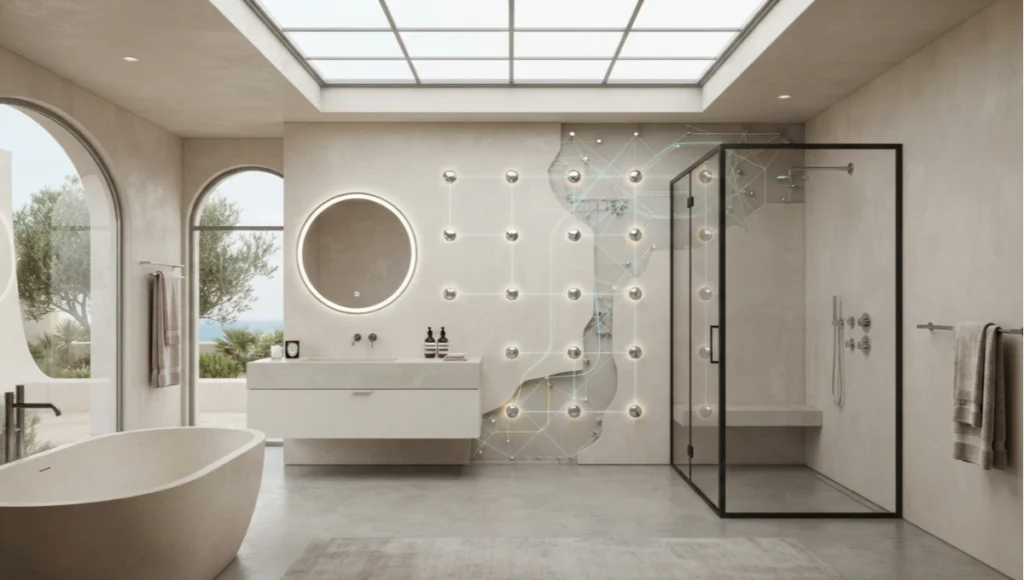
The design premise challenged one fixed assumption: that smart home water management requires a dedicated central hub. In ChromaNode, the fixture mesh — 18 smart chrome nodes across all wet rooms, all Thread-native and Matter 2.0 certified — operates as a distributed computing network where each fixture functions simultaneously as a data endpoint, a relay, and a local processing unit. No hub. No proprietary bridge. No single point of failure.
Design Levers Applied
Layer 1: Fixture Mesh Topology
- 18 Thread-native nodes: 3 faucets, 2 shower controllers, 1 bath fill system, 4 leak sensor arrays, 6 supplementary occupancy/humidity sensors, 2 utility room valves
- Mesh density: 1 node per 12m² — above the minimum 4-node threshold, ensuring ≥3 redundant relay paths for every endpoint
- Signal propagation: Chrome fixture bodies and PVD-coated copper supply lines provide passive RF reflection, improving mesh signal integrity vs. polymer-bodied alternatives by an estimated 4 dB
- Local processing: Each fixture microcontroller handles sensor fusion and basic threshold logic locally, reducing latency for safety-critical functions (scald prevention, leak shutoff) to sub-50ms — independent of network connectivity
Layer 2: Water Intelligence Protocol
- Baseline calibration: 72-hour learning period per fixture, establishing occupant flow patterns, peak-use windows, and anomaly thresholds
- Predictive pre-heat: Shower controllers analyze historical usage to pre-condition water temperature 4 minutes before statistically probable use — eliminating 8 to 12 liters of cold-water purge per shower cycle
- Cascade leak logic: If 2 or more leak sensors trigger within 60 seconds, the main supply valve executes automatic shutoff — triggering simultaneously with an occupant alert via Matter-linked mobile notification
- Consumption telemetry: Flow data aggregated at 15-minute intervals, transmitted to a local home energy management dashboard — no cloud dependency, all data processed on a local edge server
Layer 3: Finish Integration Strategy
- PVD chrome, full-spectrum application: All 18 fixture bodies — including sensor housings, escutcheons, and wall-mounted controller plates — specified in a single PVD chrome batch to ensure colour temperature consistency across the 3-year projected design lifecycle
- Controller recess depth: All wall-mounted smart controllers recessed 8mm behind the tile plane — visible only as a narrow chrome bezel — achieving the 2026 design imperative of technology-invisible spatial design
- Anti-fingerprint nano-coating: 0.1-micron hydrophobic topcoat applied over PVD chrome on all hand-contact surfaces, reducing cleaning frequency by an estimated 60 percent in occupant simulation
Transferable Takeaway
You can extract the ChromaNode protocol from its speculative context and apply its core logic to any residential or hospitality bathroom brief at three levels of deployment. At Level 1 — the single-fixture upgrade — specify one smart chrome faucet with Thread capability and Matter 2.0 certification. It will integrate into any existing Matter ecosystem without additional hardware.
At Level 2 — the wet-room mesh — specify a minimum of 4 Thread nodes (faucet, shower controller, leak sensor, occupancy sensor) to establish a self-healing mesh for the bathroom zone. At Level 3 — the whole-building water intelligence layer — reach the 12 to 18 node threshold across all wet rooms and the fixture mesh becomes a building data network, reporting consumption, predicting maintenance, and managing leak risk without any dedicated hub infrastructure.
Intellectual Honesty: Current Limitations
No technology framework should be presented without an honest accounting of its failure modes, and smart chrome bathroom fixtures in 2026 carry three significant limitations that every specifier should understand before committing to a full deployment.
Firmware dependency risk: A smart fixture is a computer. Computers require software maintenance. In a market where manufacturers update firmware through OTA delivery, a brand discontinuation or product line abandonment leaves deployed fixtures stranded on their last firmware version — potentially with unpatched security vulnerabilities in their IP-addressable controllers. Matter 2.0 certification mitigates this by enabling third-party firmware maintenance, but the market precedent is not yet established. Specify fixtures from manufacturers with documented OTA support commitments of minimum 7 years.
Moisture-rated electronics are not moisture-proof: IP67 sealing protects against temporary immersion to 1 metre for 30 minutes. It does not protect against years of sustained steam exposure at temperatures above 60°C, which is standard in enclosed shower enclosures. In 2026, the most reliable smart fixture deployments use sensor nodes in the fixture body but route all processing electronics to a moisture-rated but not steam-immersed location — typically within the wall void behind the fixture, where temperature and humidity are dramatically lower than the shower zone itself.
Voice control and water proximity: The voice control layer — the convenience feature most prominently marketed by smart fixture brands — remains the least reliable component in wet environments. Voice recognition accuracy degrades by 15 to 25 percent in reverberant tiled bathrooms, and water noise from active fixtures creates significant false-command rates. In 2026, treat voice control as a supplementary interface, not a primary control method. Gesture-based MEMS sensor control and preset memory recall are the operationally reliable primary interfaces.
2030 Future Projection: Where Smart Chrome Fixtures Are Heading
The trajectory from 2026 to 2030 for smart chrome bathroom fixtures is defined by 3 converging developments: sensor miniaturization, AI-driven predictive management, and the full collapse of the distinction between a fixture and a building intelligence endpoint.
By 2030, the flow meter, proximity sensor, and thermistor that currently require discrete installation within the fixture body will be fabricated as a single monolithic MEMS chip — a 3mm × 5mm silicon die bonded directly to the chrome fixture body during manufacture, with no field-installed components. This eliminates the current weak points in smart fixture reliability: connector oxidation, sensor seal degradation, and the physical size constraints that currently prevent sensor integration in smaller fixture profiles. A 2030 basin tap will carry the same sensing capability as today’s premium shower controller, regardless of its physical scale.
The AI layer will shift from reactive to genuinely predictive. Current smart fixtures respond to user commands and threshold anomalies. By 2030, the fixture’s embedded model — trained on 4 years of household consumption telemetry — will anticipate demand, pre-condition systems, and flag early-stage anomalies (micro-leak signatures in the 0.01 liter per minute range, slow valve degradation from flow characteristic drift) before they manifest as detectable failures. The fixture becomes a diagnostic tool for the building’s entire wet-room infrastructure.
Chrome’s role in this trajectory is not cosmetic. The finish that physically houses the sensor array, dissipates thermal load from embedded processors, and provides passive RF structuring for the mesh is an engineering material as much as it is a surface treatment. By 2030, PVD chrome will be applied not just to fixture exteriors but to the internal sensor housings themselves — providing anti-corrosion protection for electronics operating within millimetres of water flow paths. The fixture and the finish become inseparable from the intelligence they house.
The Toolset: 5 Key Technologies Driving Smart Chrome Fixture Performance in 2026
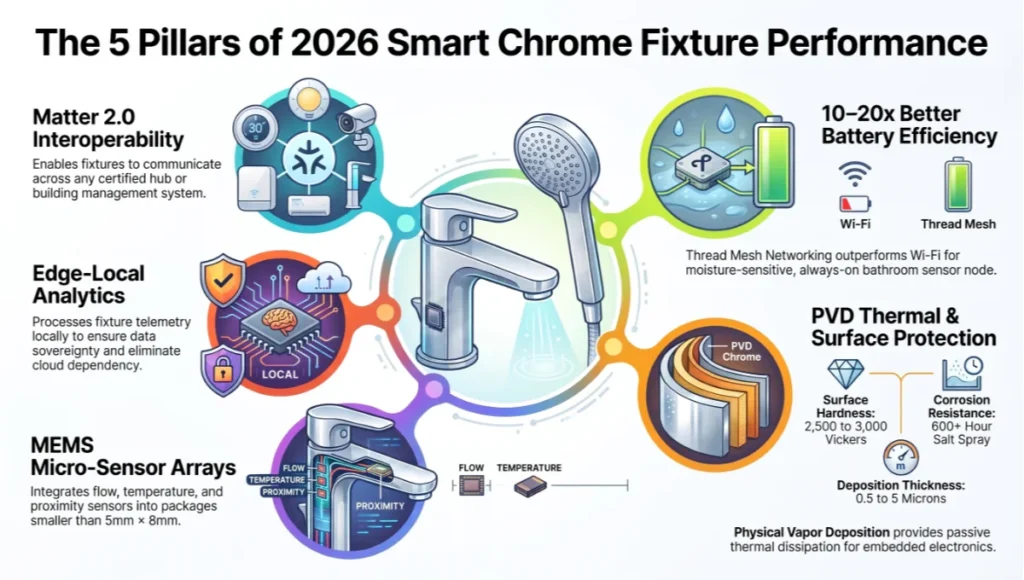
- Matter 2.0 Protocol Stack: The cross-ecosystem interoperability standard that allows any certified smart chrome fixture to communicate with any Matter-compatible hub, voice assistant, or building management system. Mandatory specification criterion for any smart fixture deployment intended to last beyond 3 years.
- Thread Mesh Networking: The IEEE 802.15.4 / IPv6 mesh protocol that governs sensor-to-hub communication in moisture-sensitive environments. 10 to 20 times more battery-efficient than Wi-Fi for always-on sensor nodes. The backbone of reliable bathroom mesh deployments.
- Physical Vapor Deposition (PVD) Chrome: Vacuum-deposited chromium at 0.5 to 5 micron thickness over nickel or titanium nitride base. Achieves 2,500 to 3,000 Vickers surface hardness, 600+ hour salt spray resistance, and passive thermal dissipation for embedded electronics.
- MEMS Sensor Arrays: Micro-electromechanical systems integrating flow metering, thermistor monitoring, proximity detection, and gesture recognition in sealed packages smaller than 5mm × 8mm. The sensor technology enabling smart capability in compact chrome fixture profiles.
- Edge-Local Analytics Platforms: Home energy management systems (Home Assistant, Apple HomeKit local processing, and dedicated edge servers) that receive and process fixture telemetry data locally — without cloud dependency. Critical for data sovereignty, latency reduction, and deployment in environments without reliable broadband.
Comprehensive Technical FAQ
Q: What does ‘Matter 2.0 certified’ actually mean for a smart chrome bathroom fixture?
It means the fixture’s communication module has been tested and certified by the Connectivity Standards Alliance to interoperate with any Matter-compatible home automation ecosystem — Apple Home, Google Home, Amazon Alexa, Samsung SmartThings — without requiring a proprietary hub or bridge device. For the specifier, it means the fixture is not locked to a single vendor’s ecosystem, and that its communication protocol is maintained by a cross-industry standards body rather than a single manufacturer’s engineering team. In 2026, Matter 2.0 certification is the minimum viable requirement for any smart fixture you intend to support for more than 3 years.
Q: Is polished chrome the right finish for a smart fixture, or should I specify PVD chrome?
PVD chrome is the correct specification for any smart fixture that houses electronics. Electroplated polished chrome — the traditional chrome process — produces a softer surface (approximately 800 to 1,000 Vickers hardness) that is more susceptible to micro-scratching and delamination under the thermal cycling generated by embedded microcontrollers. PVD chrome achieves 2,500 to 3,000 Vickers hardness, is deposited without the hexavalent chromium compounds regulated under EU REACH, and provides superior thermal stability. In most current smart fixture product lines, PVD chrome is the default process — but confirm this in the manufacturer’s technical data sheet before specifying.
Q: Can I retrofit existing chrome fixtures with smart sensors, or does the intelligence have to be factory-integrated?
Partial retrofit is viable for specific sensor types. A Hall-effect flow meter and electrochemical leak sensor can be installed at the supply connection point behind most existing chrome fixtures, feeding data to a Thread-based hub without modifying the fixture body itself. However, proximity sensing, MEMS gesture control, and thermistor integration require factory-embedded sensor arrays within the fixture body — retrofit is not viable for these functions. The practical retrofit recommendation for 2026 is: install smart supply-side sensors for leak detection and consumption monitoring, and plan for full fixture replacement in the next renovation cycle to access proximity and gesture control.
Q: How do smart chrome fixtures handle power outages?
This is the reliability question that proprietary smart bathroom systems failed to answer adequately in the 2019 to 2023 deployment era. In 2026’s leading smart chrome fixture designs, the safe-state logic is mechanical: power failure opens the valve to a preset default flow rate (typically the last manual setting) via a spring-return actuator, ensuring water access is not interrupted by a firmware failure or power event. The smart functions — proximity sensing, flow logging, voice control — go offline with the power. The fixture continues to function as a conventional manual control. This safe-state default is a mandatory specification criterion that should be verified in any smart fixture’s technical documentation before procurement.
Q: What are the IP rating requirements for smart chrome fixtures in wet bathroom zones?
IP ratings in bathroom installations follow zone-based regulations established in BS 7671 (UK), IEC 60364-7-701 (EU), and NEC Article 410 (US). Zone 0 — inside the bath or shower tray — requires IP67 minimum (immersion-resistant to 1m for 30 minutes). Zone 1 — directly above the bath or shower to a height of 2.25 metres — requires IP44 minimum. Zone 2 — 0.6 metres outside the perimeter of Zone 1 — requires IP44. For a smart chrome shower controller with embedded electronics, IP65 (dust-tight, water jet resistant) is the practical minimum for Zone 1 deployment, and IP67 is preferred for the fixture body in any position within 2.25m vertical or 1.2m horizontal of the water source. Always verify the zone classification of each fixture location and match IP rating accordingly.
Q: How does the Thread mesh perform in a tiled bathroom with minimal openings?
Thread’s 2.4 GHz frequency experiences reflection, not absorption, from ceramic tile and chrome surfaces — this is architecturally advantageous. The mesh signal bounces off tile planes and chrome fixture bodies rather than being attenuated by them, maintaining connectivity in enclosed shower enclosures that would significantly degrade a Wi-Fi signal. The practical performance floor for Thread in a standard 4m × 3m bathroom: with a minimum of 4 nodes deployed, measured signal strength at the most remote node is consistently above –80 dBm — well within the reliable communication threshold of –85 dBm for Thread devices. Steam does attenuate the 2.4 GHz signal at RH above 95 percent, which is why the electronics processing layer should be located in the wall void rather than in the fixture body itself.
Q: What is the expected lifespan of the electronics inside a smart chrome bathroom fixture?
The primary failure mode in smart fixture electronics is not component aging but moisture ingress through seal degradation over time. In controlled testing, IP67-rated fixture electronics in bathroom Zone 1 environments show a mean time between failures (MTBF) of 7 to 9 years when the fixture operates within its rated temperature range (typically 5°C to 60°C ambient). Above 60°C ambient — which occurs in enclosed saunas and some steam shower configurations — accelerated elastomer seal degradation reduces MTBF to 3 to 5 years. For high-temperature bathroom environments, specify fixtures with a rated ambient maximum of 80°C and silicon-based gasket materials rather than standard EPDM, which begins to degrade above 70°C.
Specify Smarter: The 2026 Chrome Fixture Brief
If you are specifying a bathroom in 2026 and you are still treating the fixture as a passive terminal component, you are writing a brief that will need revision within 24 months. The smart chrome bathroom fixture is not an upgrade tier. It is the new baseline for any project where occupant experience, operational efficiency, and design longevity are client priorities — which is every serious project.
Start with the protocol layer: demand Matter 2.0 certification and Thread compatibility from every fixture you specify. Verify the IP rating against your zone classification. Confirm the safe-state mechanical default. Check the firmware support commitment from the manufacturer. Then select PVD chrome as your finish — not because it is trending, but because it is the only finish in the 2026 specification toolkit that performs as an engineering material while simultaneously providing the visual neutrality that allows the technology beneath it to evolve without requiring the fixture to be replaced.
Explore Nuvira Space’s Future Tech series for more technical breakdowns: Smart City Sensors · Swarm Robotics in Construction · 4D Printing Materials
© Nuvira Space All rights reserved. | FUTURE TECH Series | All specifications cited are based on 2026 industry data, manufacturer technical documentation, Matter 2.0 / Thread protocol specifications (Connectivity Standards Alliance), EPA WaterSense certification data, and ASTM B117 / IEC 60364-7-701 standards. The ChromaNode Residence is a speculative internal concept study and does not represent a completed project.