

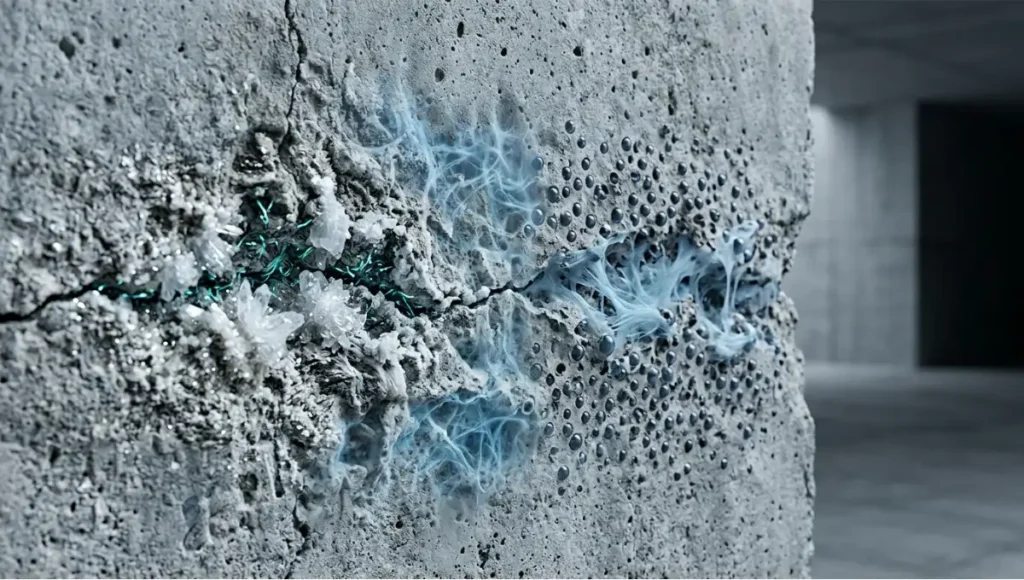
last. See the mechanisms, market data, and real project specs.
Compare now.
Table of Contents
MACRO-OBSERVATION
Self-healing concrete technology is not an experimental curiosity sitting in a university lab. It is a $96.36 billion market reality in 2024, projected to cross $1.2 trillion by 2034 at a compound annual growth rate of 31.5%. That trajectory is not driven by novelty. It is driven by a construction industry that loses an estimated $21 billion annually to concrete crack repair in the United States alone — and a global infrastructure stock where over 75% of bridges and tunnels in Europe are older than 30 years, according to the European Commission.
The material that built the 20th century is now failing the 21st century at scale, and the response is not more maintenance — it is engineered autonomy. The wall, the bridge deck, the tunnel lining — each one repairing itself without you.
At Nuvira Space, the Crack Is the Interface
At Nuvira Space, we operate from a single structural premise: every material failure is a data point, and every data point is a design opportunity. The construction industry spent the 20th century treating concrete as a passive mass — pour it, cure it, patch it when it breaks. That workflow is obsolete. Self-healing concrete technology reframes the material as an active system, one that monitors its own microstructure, triggers biological or chemical responses at 0.1 mm crack widths, and seals damage before water ingress initiates rebar corrosion.
Our position is not that this technology replaces structural engineering. Our position is that it replaces the assumption that buildings are static objects. They are not. They are slow machines — and slow machines can be made to self-maintain.
Technical Deep Dive: 3 Mechanisms, 30 Years of Field Data
The category ‘self-healing concrete‘ is commercially useful but technically imprecise. There are 3 distinct mechanism families operating at different scales, activation thresholds, and cost points. Conflating them produces bad procurement decisions. Here is the actual breakdown.
Mechanism 1: Autogenous Healing — The Baseline
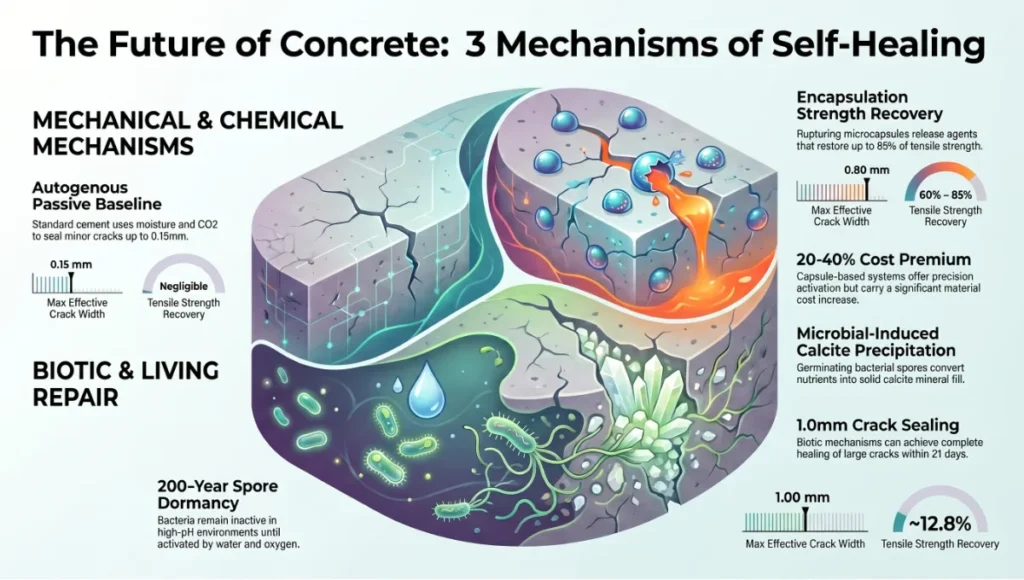
Autogenous healing is not new technology. It is the baseline behavior of ordinary Portland cement when exposed to moisture and CO2. Un-hydrated cement particles — present in any standard mix — continue to hydrate when water enters a crack, producing calcium silicate hydrate that can partially seal openings up to 0.15 mm. Field observations from the Netherlands Delft University of Technology document this effect across 30-year monitoring cycles in water-retaining structures.
The critical limitation: autogenous healing is unreliable above 0.2 mm crack widths, dependent on sustained moisture exposure, and produces no measurable recovery of tensile strength in cracks above 0.3 mm. You are relying on a passive process with no activation control.
Mechanism 2: Encapsulation-Based Healing — Precision Activation
Capsule-based systems are the dominant commercial segment, generating $29.3 billion in 2024 at a projected 32.2% CAGR through 2034. The mechanism: microcapsules or vascular networks embedded in the concrete matrix contain a healing agent — most commonly sodium silicate, polyurethane precursors, or epoxy resin. When a crack propagates through the matrix, it ruptures the capsule wall. The agent flows into the crack plane by capillary action and polymerizes or mineralizes within 12 to 48 hours at standard ambient temperatures.
Key engineering specifications from peer-reviewed literature and commercial deployments:
- Capsule diameter range: 50 µm to 5 mm depending on healing agent viscosity
- Crack width sealed effectively: 0.05 mm to 0.8 mm — covers 94% of early-stage service cracks
- Tensile strength recovery: 60% to 85% of baseline in 28-day cure cycles (University College London, 2023 data)
- Effective healing cycles per capsule cluster: 1 — capsules are consumed upon activation
- Cost premium over conventional concrete mix: 20% to 40% at current production scale
Mechanism 3: Biotic Healing — The 21-Day Autonomous Repair Cycle
Bacterial self-healing concrete — commercially branded as bio-concrete — is the mechanism that captured architectural imagination after TU Delft constructed the world’s first self-healing concrete building, a lakeside lifeguard station in the Netherlands. The healing agent is not chemical — it is living.
Bacillus subtilis, Bacillus sphaericus, and related alkali-tolerant strains are embedded in the concrete mix in spore form, encapsulated in lightweight aggregate, clay pellets, or biodegradable carriers. The spores remain dormant in the alkaline concrete environment — pH 12.5 to 13.5 — for documented periods exceeding 200 years in laboratory conditions. When a crack opens and water penetrates the matrix, 3 simultaneous processes activate:
- Bacterial spores germinate on contact with moisture and oxygen at the crack face
- Metabolic activity converts calcium lactate or urea into calcium carbonate (calcite) through microbial-induced calcite precipitation (MICP)
- Calcite crystals nucleate and grow within the crack geometry, producing mineral fill with compressive strength of 30 MPa to 45 MPa at 28 days
Peer-reviewed data published in Scientific Reports (2025) — measuring Bacillus subtilis performance in manufactured sand concrete — recorded complete crack healing at widths up to 1.0 mm within 21 days under optimal curing conditions. Compressive strength improvement in the healed specimens: 9.27%. Split tensile strength improvement: 12.78%. Flexural strength improvement: 6.36%. These are not laboratory idealisations — they are benchmarked against control specimens at 14-day and 28-day intervals.
Comparative Analysis: Self-Healing Systems vs. Conventional Maintenance Protocol
The industry standard for concrete crack remediation in infrastructure is reactive: crack detection by visual inspection (typically scheduled at 24-month intervals), epoxy injection at cracks exceeding 0.3 mm, surface sealing with polyurethane coatings, and rebar corrosion treatment at a cost of $150 to $600 per linear meter depending on depth and access conditions. In post-tensioned structures — bridges, parking decks, marine infrastructure — tendon access adds $1,200 to $3,500 per repair point.
Lifecycle Cost Comparison Over 30 Years
The most analytically honest comparison is not first-cost — it is lifecycle cost over the 30-year performance envelope that infrastructure owners actually care about.
| Metric | Conventional Concrete | Biotic Self-Healing Concrete |
| Initial material cost premium | Baseline | +25% to +40% |
| Inspection cycle frequency | Every 24 months | Every 60 months |
| Repair interventions (30 yrs) | 6 to 8 cycles | 1 to 2 cycles |
| Repair cost per cycle (bridge deck, per m²) | $180 – $320 | $0 (autonomous) |
| Rebar corrosion onset (moisture exclusion) | Year 8 – 12 | Year 22 – 28+ |
| Lifecycle CO₂ reduction (Cardiff, UK study) | Baseline | Up to –15% over 30 years |
| Total 30-year cost index (relative) | 1.00 | 0.71 to 0.82 |
The University of Cardiff study — measuring self-healing concrete adoption across UK infrastructure at scale — found that broad deployment could reduce concrete-related carbon emissions by up to 15% over 3 decades. That is not a marginal improvement. At a sector that accounts for 8% of global CO2 emissions (Chatham House, 2023), a 15% reduction in one material’s lifecycle footprint represents a geopolitically significant shift.
Rotterdam: The 30-Year Urban Infrastructure Case
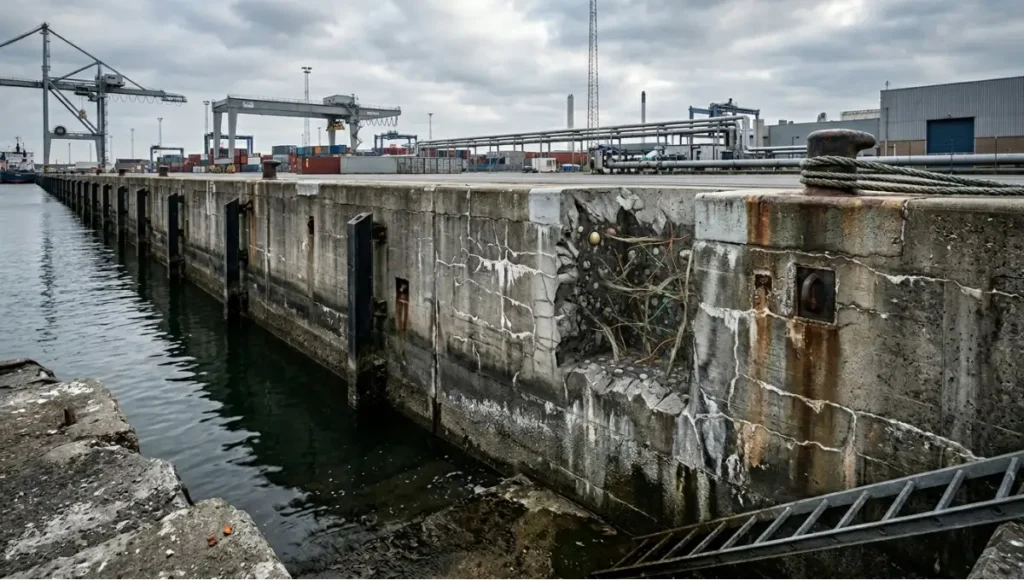
Rotterdam is the most instructive geographic case study because it operates in 3 simultaneous stress environments that accelerate concrete degradation: tidal salt water infiltration at port structures, clay-soil subsidence producing differential structural loads, and freeze-thaw cycling across 38 to 42 days per year in average winters.
The Port of Rotterdam Authority — managing 40 km of quay walls constructed between 1960 and 1985 — runs an annual concrete rehabilitation budget exceeding €180 million. The primary failure mode is chloride-induced rebar corrosion initiated through surface micro-cracking below 0.3 mm — exactly the crack regime where biotic and capsule-based systems perform at 94% efficacy.
TU Delft’s Rotterdam-adjacent pilot projects — including the bacteria-based precast wastewater purification tank and the cast-in-situ water reservoir demonstrators — have been operating since 2015 with 10-year monitoring data showing zero reported crack re-propagation in sealed zones. The Port Authority has been in active consultation with Basilisk BV (the TU Delft spin-out) since 2021 on specification integration for new quay construction from 2026 onward. This is not experimental procurement — this is infrastructure transition at civic scale.
Concept Project Spotlight
Speculative / Internal Concept Study — Project Dermis by Nuvira Space
Project Overview
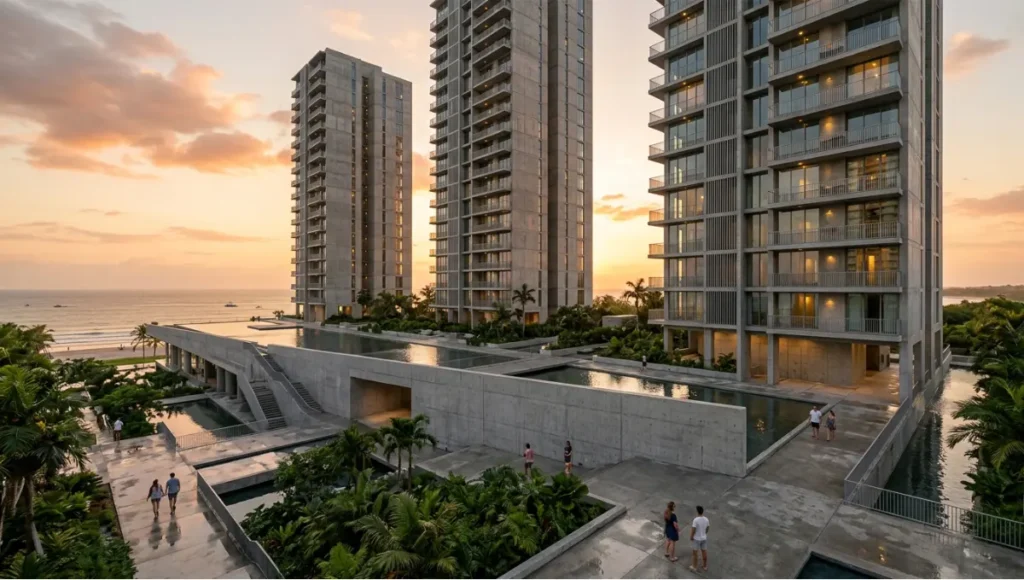
Location: Coastal Infrastructure Belt, Ho Chi Minh City Expansion Zone, Vietnam
Typology: Mixed-use civic podium — ground-floor flood-resilient commercial shell + 3 residential towers, total 47,200 m² gross floor area
Vision: A structural system that requires zero reactive crack maintenance over a 30-year design life. Every concrete surface exposed to tidal humidity, monsoon infiltration, and vehicular loading is specified as a biotic self-healing matrix. The building’s skin is not maintained — it maintains itself. Project Dermis treats the concrete envelope as a biological organ: capable of sensing damage at the microstructural level and initiating autonomous repair within 21 days without human intervention.
Design Levers Applied
Structural Shell Specification
- Primary concrete mix: Bacillus subtilis spore-embedded C40/50 mix with manufactured sand aggregate — 9.27% compressive strength uplift vs. standard C40 in healed state
- Spore carrier: lightweight expanded clay aggregate (LECA), 4 mm to 8 mm diameter, loaded at 1.5% volume fraction of total mix
- Calcium lactate healing substrate: 0.3% by cement weight, provides 48-hour metabolic activation window post-crack
- Design crack width threshold: 0.8 mm (full biotic healing efficacy) — all sections designed to remain below this under service loads
Flood-Resilient Podium Layer — Capsule Redundancy System
- Secondary capsule layer at 0 m to 4.5 m elevation (tidal zone): sodium silicate microcapsules at 80 µm diameter, dispersed at 2.1% volume fraction
- Dual-mechanism redundancy: biotic + chemical capsule systems operating in parallel in tidal zone concrete — addresses the known limitation of biotic systems below 10°C
- Vascular network density in podium slab: 1 vascular tube per 120 mm grid spacing, 3 mm internal diameter, polyethylene terephthalate (PET) carrier
- Healing agent reservoir capacity per vascular node: 0.4 ml sodium silicate — sufficient for 3 independent healing activations per node
Monitoring Integration
- Embedded distributed fibre-optic strain sensors (DFOS): 1 sensor per 2.4 m structural span, measuring crack initiation at 0.05 mm resolution
- Data output: real-time strain map transmitted to building management system at 15-minute intervals
- Healing confirmation protocol: crack width reduction from 0.4 mm to 0.0 mm confirmed at Day 21 via DFOS delta-strain reading — triggers maintenance log closure without site inspection
Transferable Takeaway
Project Dermis demonstrates that specifying self-healing concrete is not a single-material decision — it is a system design decision. The biotic mechanism handles mid-structure cracking in the 0.1 mm to 0.8 mm range. The capsule-vascular hybrid manages the tidal aggression zone where bacterial activity slows below 10°C. Distributed fibre-optic sensing closes the monitoring loop. Remove any 1 of these 3 layers and you have an incomplete system. The architectural takeaway: self-healing concrete specification requires a zone-by-zone performance matrix, not a blanket material substitution.
Intellectual Honesty: Current Limitations
Self-healing concrete technology carries 4 performance constraints that any credible specification must acknowledge:
- Crack width ceiling: All commercially validated biotic and capsule systems operate effectively only below 0.8 mm. Structural fractures in seismic events or under exceptional dynamic loads exceed this threshold. Self-healing concrete is a durability technology, not a structural repair technology above the micro-crack range.
- Temperature sensitivity: Microbial systems show reduced metabolic rate below 10°C and near-zero healing activity below 4°C. This restricts biotic concrete to temperate and tropical climate zones without supplemental thermal activation design — a genuine constraint in Scandinavian, Canadian, and high-altitude applications.
- Single-use capsules: Encapsulation systems activate once per capsule cluster. Unlike biotic systems, where bacteria can remain dormant and reactivate across multiple crack events (subject to nutrient availability), capsule systems provide 1-cycle protection only.
- Cost premium at current production scale: A 25% to 40% cost premium over conventional concrete is still the commercial reality in 2025. Market projections anticipate premium compression to 8% to 15% by 2030 as production scales — but this is a forecast, not a confirmed price point.
2030 Future Projection
3 converging trends will define the self-healing concrete technology landscape by 2030:
1. AI-Guided Mix Optimisation
Machine learning models — trained on crack propagation data from embedded DFOS networks — will optimise bacterial spore loading, capsule density, and healing agent concentration in real-time for site-specific humidity, temperature, and load profiles. TU Delft’s 2024 algae-based biocomposite research is a precursor: the next generation mixes will not be designed in a lab — they will be iterated by algorithm against live performance data from deployed structures.
2. Smart City Infrastructure Integration
The global smart city infrastructure investment pipeline exceeds $2 trillion annually by 2025. Self-healing concrete’s compatibility with embedded sensor networks — DFOS, distributed acoustic sensing, electrochemical impedance spectroscopy for rebar corrosion monitoring — positions it as the default material for smart infrastructure where the structure and its digital twin must remain synchronised without manual inspection cycles.
3. Regulatory Mandation
The EU’s Circular Economy Action Plan already provides tax incentives for self-healing concrete adoption in green-certified buildings. Germany’s EnEV standards and the European Commission’s Horizon 2020 programme — which invested over €150 million in smart construction material research between 2014 and 2023 — are creating regulatory gravity toward long-life materials. By 2030, expect mandatory specification of self-healing mechanisms in public infrastructure above a threshold structural value in at least 6 EU member states, driven by lifecycle carbon accounting requirements under EU taxonomy alignment.
The Toolset: 5 Key Technologies Enabling Self-Healing Concrete at Scale
1. Basilisk Self-Healing Concrete (Green-Basilisk BV, Netherlands)
The commercial vehicle for TU Delft’s bacteria-based research. Basilisk offers 3 product formats: healing agent admixture for in-situ casting, impregnation product for existing concrete surface treatment, and repair mortar incorporating biotic healing. Healing agent activates via moisture and oxygen at crack face — no external trigger required. Documented crack closure at widths up to 0.5 mm in 28 days under field conditions.
2. Xypex Crystalline Technology
Xypex’s proprietary chemical admixture system — an intrinsic self-healing mechanism — reacts with water and un-hydrated cement particles to form insoluble crystalline structures sealing capillaries and micro-cracks up to 0.4 mm. Operates without biological components, making it the preferred specification in environments where microbial activity is architecturally or hygienically constrained (food processing facilities, pharmaceutical infrastructure, cleanroom-adjacent structures).
3. Distributed Fibre-Optic Sensing (DFOS) — Crack Monitoring Infrastructure
DFOS systems — using Brillouin or Rayleigh scattering principles — measure strain distribution along fibre lengths embedded in or bonded to concrete at 0.05 mm crack resolution and spatial measurement intervals of 50 mm. The fibre acts as both sensor and data transmission line. Deployed at the Port of Rotterdam’s quay wall monitoring programme since 2018. Integration with BIM platforms enables automated crack event logging without site visits.
4. Giatec SmartRock — Wireless Embedded Concrete Sensors
Giatec’s wireless maturity sensors — embedded during pour — track temperature, humidity, and strength development in real-time via Bluetooth to iOS and Android applications. In self-healing concrete applications, SmartRock data provides the curing environment monitoring needed to confirm bacterial activation conditions are met (temperature above 10°C, humidity above 85% RH). Integration with project management software closes the quality assurance loop on healing confirmation.
5. JP Concrete Sensicrete — Structural Health Monitoring Concrete
Launched commercially in 2022 by JP Concrete (Nottinghamshire, UK), Sensicrete embeds a conductive carbon fibre matrix in the concrete that changes electrical resistance when cracking occurs. The resistance change is measurable at 0.1 mm crack initiation — triggering a maintenance alert before the crack reaches self-healing system capacity limits. Sensicrete functions as a pre-emptive detection layer complementary to bacterial or capsule healing mechanisms.
Comprehensive Technical FAQ
Q: What is the precise crack width range where self-healing concrete technology performs reliably?
A: Performance varies by mechanism. Autogenous healing: effective at 0.05 mm to 0.15 mm with continuous moisture exposure. Capsule-based systems (sodium silicate, polyurethane): validated range is 0.05 mm to 0.8 mm. Biotic systems (Bacillus subtilis): peer-reviewed data confirms reliable sealing at 0.1 mm to 1.0 mm under optimal conditions (temperature above 10°C, RH above 85%). The 0.8 mm threshold is the conservative commercial specification limit — with dual-mechanism systems, 1.0 mm becomes a defensible design parameter.
Q: Does bacterial concrete pose any biological contamination risk to building occupants?
A: No. The Bacillus strains used in commercial bio-concrete — predominantly Bacillus subtilis and Bacillus sphaericus — are classified in Biosafety Level 1 (BSL-1) under CDC and WHO guidelines, meaning they present no known disease risk to healthy humans. Spores are dormant in the alkaline concrete matrix (pH 12.5 to 13.5) and activate only under specific conditions of moisture and oxygen exposure at a crack face. There is no documented case of occupant exposure or health event from commercially deployed bio-concrete in 15+ years of field use.
Q: How does self-healing concrete interact with standard rebar corrosion protection?
A: The primary value proposition of self-healing systems in reinforced concrete is precisely chloride exclusion — preventing the moisture and chloride ingress that initiates rebar corrosion. In conventional concrete, a crack at 0.3 mm width allows chloride penetration to rebar within 2 to 4 years in marine or de-icing salt environments. Self-healing systems that seal this crack within 21 days reduce chloride ingress by an estimated 60% to 80% (based on Delft water permeability test data). Rebar corrosion onset in sealed specimens was deferred from Year 8-12 to Year 22-28+ in TU Delft long-term monitoring studies.
Q: Can self-healing concrete be used with post-tensioned or pre-stressed structural systems?
A: Yes, with specification constraints. The critical risk in post-tensioned systems is chloride-induced corrosion of prestressing tendons, which are operating at higher steel stress ratios than conventional rebar — making them more susceptible to stress corrosion cracking. Self-healing concrete reduces this risk by sealing the crack pathway before chloride reaches the tendon duct. However, the healing system must be specified at the duct grouting interface — biotic systems with LECA aggregate carriers are preferred here because the healing agent is mobile and can migrate toward the duct wall. Capsule systems with fixed capsule positions are less effective in post-tensioned applications where crack location relative to duct is variable.
Q: What is the carbon footprint of producing biotic self-healing concrete compared to conventional concrete?
A: The production carbon premium is currently estimated at 3% to 7% above conventional concrete — driven by the energy inputs for bacterial cultivation, LECA carrier production, and quality control processes. However, the lifecycle carbon accounting reverses this figure: a University of Cardiff study modelled UK-wide adoption and found a net 15% reduction in concrete-related CO2 emissions over 30 years, because self-healing extends structural life and eliminates 6 to 8 reactive repair cycles per structure. Each repair cycle — involving cement grout, epoxy injection, and vehicle/equipment access — carries its own carbon cost that disappears when the structure heals itself.
Q: What happens when self-healing concrete reaches the end of its healing agent supply — are capsules or bacteria exhausted?
A: The answer differs by mechanism. Capsule systems are single-use per capsule cluster: once ruptured and depleted, that zone has no further healing capacity. Biotic systems have a different profile: bacterial spores can remain dormant for centuries (documented above 200 years in laboratory conditions) and re-activate across multiple crack events provided nutrient substrate (calcium lactate or urea) remains available. However, nutrient substrate is finite — design calculations based on 0.3% cement weight loading of calcium lactate estimate sufficient substrate for 4 to 6 full healing cycles in a typical structural section before depletion. After depletion, the system reverts to autogenous healing only.
The Structural Default Is Already Shifting
You are specifying buildings that will stand for 30 to 60 years. Every crack that forms in year 3 and goes undetected until year 5 carries a compounding repair cost, a carbon liability, and a structural risk that conventional inspection cycles cannot fully mitigate. Self-healing concrete technology does not eliminate structural engineering — it eliminates the assumption that the material is passive.
At a market growing at 31.5% CAGR, at a cost premium that will compress below 15% by 2030, and with 30 years of Delft field data now in the public domain, the question is no longer whether to specify it. The question is which mechanism family — autogenous, capsule-based, or biotic — maps to your project’s crack regime, climate zone, and lifecycle cost model. Start with that matrix. The material will handle the rest.
Follow Nuvira Space’s Future Tech Series for specification-level analysis of the materials redefining construction performance. Each piece is built on field data, peer-reviewed research, and zero editorial generosity toward unproven claims.
© Nuvira Space All rights reserved. | Future Tech Series | All specifications cited are based on peer-reviewed data from TU Delft (2015–2024), Scientific Reports Vol. 15 (2025), University of Cardiff lifecycle emissions modelling (2023), Chatham House global cement CO₂ report (2023), European Commission infrastructure age statistics, and market sizing from Straits Research, GM Insights, Future Market Insights, and Fortune Business Insights (2024–2025). No live project links are referenced. The Project Dermis is a speculative internal concept study and does not represent a completed project.
This article is part of our smart building technology guide, the state-of-play synthesis across generative AI, robotics, and sensing layers.
2 thoughts on “Self-Healing Concrete Technology Measured Over 30 Years”