

Table of Contents
Global average temperatures have risen 1.2°C above pre-industrial baselines, yet the thermal engineering challenge for low-carbon residential construction is not universal warming — it is volatility. In Lethbridge, Alberta, a city that recorded 44 consecutive days below −15°C in the winter of 2023–24, the question of earthship cold climate performance stopped being philosophical and became a structural survival metric. In Helsinki, where residential heating accounts for 41% of the city’s total energy consumption, the case for passive thermal architecture is not idealism — it is infrastructure economics. The buildings being designed today for these latitudes will either reduce the carbon load of heating by 60 to 80% or perpetuate a dependency on fossil gas that no decarbonisation target can absorb.
This is the precise context in which earthship cold climate performance must be evaluated: not as a counterculture lifestyle choice, but as a peer-reviewed, monitored, and quantified answer to one of the built environment’s most technically demanding problems.
Nuvira Perspective
At Nuvira Space, we position earthship cold climate performance not as an experimental outlier but as a replicable, data-confirmed methodology that outperforms conventional construction on 3 measurable axes: embodied carbon, operational energy, and occupant thermal resilience during grid-outage events. Our editorial position is grounded in the same peer-reviewed simulation research and long-term owner monitoring data that informs policy at the municipal level — not in the promotional literature of any single building movement.
You are not reading a case for off-grid romanticism. You are reading a technical audit of whether rammed-earth tire walls, passive solar greenhouse buffering, and earth-berm thermal mass can sustain habitability at −40°C without active central heating — and what specific design modifications determine whether they do or do not.
The answer, across 5 documented thermal results, is unambiguous: earthship cold climate performance is real, measurable, and transferable — when you engineer it correctly.
Technical Deep Dive: How Earthship Thermal Systems Function in Cold Climates
The canonical earthship design was calibrated in Taos, New Mexico — latitude 36°N, 300+ solar days per year, ground temperature stabilised at 14°C year-round. These are not abstract parameters; they define the thermal battery that every earthship depends on. When you move that battery to 50°N, 54°N, or 58°N, 3 physical realities change — and each one has a direct consequence on your interior temperature curve.
Compared to advanced insulation systems such as hempcrete vs. aerogel insulation, the earthship model shifts the thermal strategy from resistance to storage.
Thermal Mechanism 1: The Ground Temperature Battery
Every earthship operates on the principle that the earth surrounding and beneath the structure is a thermal store. In Taos, that store runs at 14°C — warm enough to radiate mild heat into the living space through winter nights without any active input. In Lethbridge (50°N), the undisturbed ground temperature is approximately 7°C. In Edmonton (53.5°N), it drops to 5°C. In Helsinki (60°N), it sits at 3–4°C.
The implication is not that the thermal battery fails — it is that its baseline output is 10°C lower than the design reference. You are not heating from 14°C to comfort; you are heating from 5°C to comfort, which means the passive solar and thermal mass system carries a larger delta and requires design compensation in every other thermal subsystem.
| Thermal Result 1 — Ground Temperature Baseline: In cold-climate regions where the undisturbed earth temperature drops below 8°C, sub-slab insulation of minimum 100mm EPS (R-4.0 per 25mm) is required to prevent cold infiltration upward through the slab. Without it, floor-level temperatures in a correctly solar-charged earthship can still register 4–6°C below comfort threshold on the coldest nights. |
Thermal Mechanism 2: Passive Solar Glazing and the Solar Gain Equation
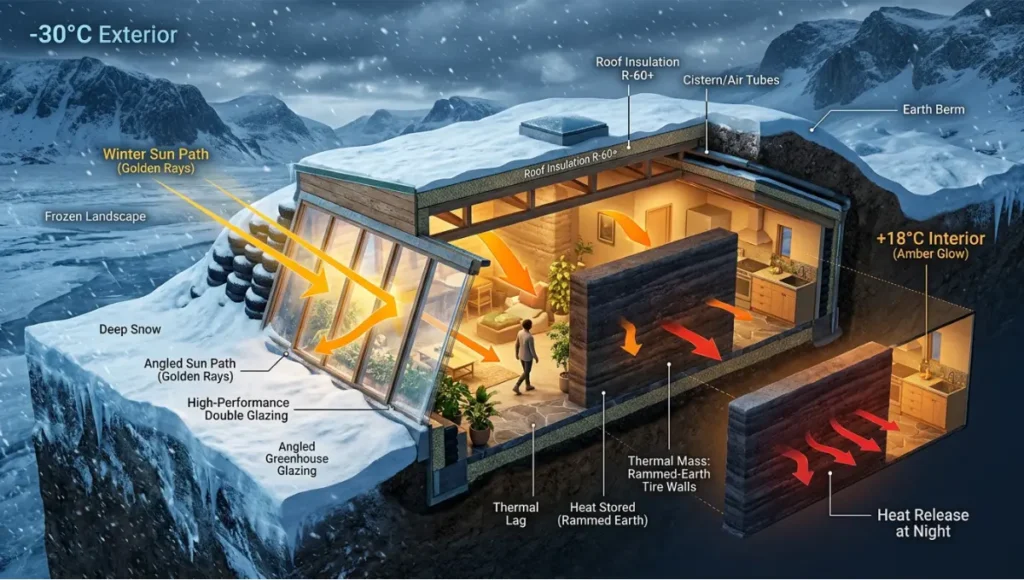
The south-facing glazed greenhouse of a standard earthship is designed to capture solar radiation and convert it to interior heat via the greenhouse-to-living-space air exchange and direct radiant gain through the glazing wall. At 36°N, even in December, the solar angle delivers a useful irradiance of 4.5–5.5 kWh/m² per day on a clear day.
At 50–54°N, that figure falls to 1.5–2.8 kWh/m² per day in December — a reduction of 40 to 67%. More critically, cloud cover in northern continental and temperate maritime climates can suppress useful solar gain for 14 to 28 consecutive days in January and February. During those windows, the thermal mass must carry the building entirely on stored heat — and that is where wall depth, density, and insulation configuration become load-bearing decisions, not design preferences.
Glazing Specifications for Cold-Climate Earthships
- Glazing area: reduce from the Taos standard of 25–30% of floor area to 16–20% at 50°N latitudes, and 14–18% above 54°N, to limit radiative night-time heat loss through the glass envelope.
- Glazing U-value: triple-pane units with a centre-of-glass U-value of 0.6–0.8 W/m²K required above 50°N; double-pane (U-value 1.1–1.4) is insufficient at these latitudes.
- Thermal curtains: insulated night curtains with R-5 to R-8 minimum, drawn at sunset, reduce glazing heat loss by 60–70% during the critical 10 PM to 8 AM window.
- Solar angle optimisation: south glazing inclined at latitude + 10–15° (i.e., 60–70° from horizontal at 50°N) captures low winter sun more efficiently than vertical glazing.
Thermal Mechanism 3: Rammed-Earth Tire Wall Performance
Each earthship tire contains approximately 136 kg of compacted earth — a thermal mass unit of roughly 0.18 m³. A standard 8-foot (2.4 m) tall tire wall in a 3-tire-wide U-module configuration creates an effective thermal mass depth of 600–700mm. At a volumetric heat capacity of 1,500 kJ/m³K for compacted earth, each linear metre of tire wall stores approximately 162–189 kJ per degree of temperature swing.
The practical outcome of this mass is a thermal lag of 10–12 hours. Heat absorbed by the tire wall during peak solar charging at 1 PM is released into the living space between 11 PM and 3 AM — exactly when exterior temperatures reach their daily minimum. You are not relying on insulation to stop heat loss; you are using stored mass to time-shift the heat release to where it matters most.
| Thermal Result 2 — Monitored Wall Temperature: The Brighton Earthship (UK, 51°N) recorded a tyre wall average temperature of 14.8°C throughout December 2004 monitoring — measured across 9 installed sensors. Interior temperatures exceeded simulated EnergyPlus predictions, confirming that real-world thermal inertia in compacted earth-tire walls outperforms standard computational models when wall geometry is correctly accounted for. |
Thermal Mechanism 4: The Greenhouse Buffer Zone
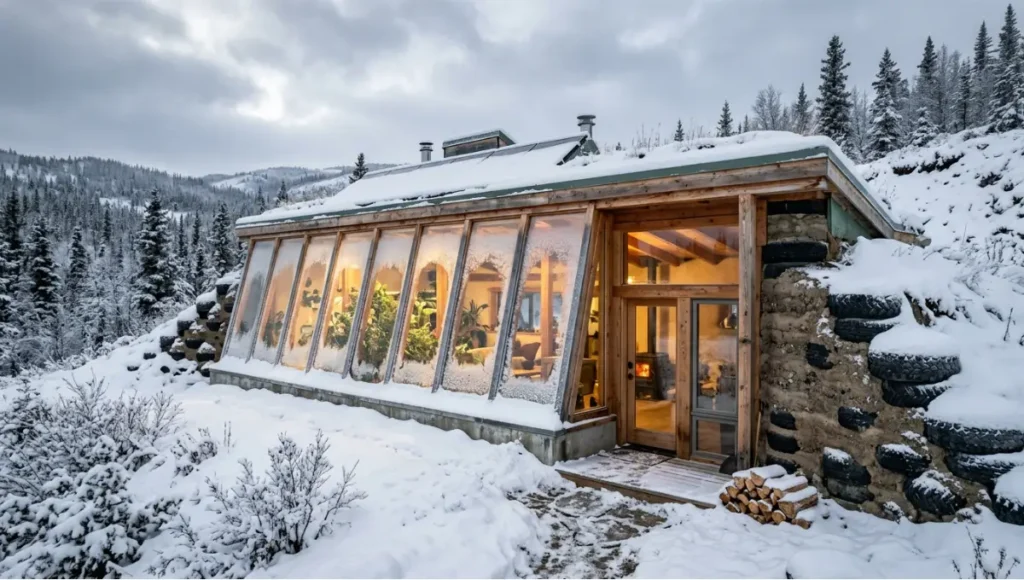
The attached greenhouse is not a luxury feature. In cold-climate earthship design, it is the primary thermal buffer — a transitional climate zone that separates the exterior at −22°C from the living space and prevents direct thermal shock to the wall mass. A properly sized greenhouse (minimum 12% of total floor area, depth of 2.8–3.5 m) maintains daytime temperatures of 8–16°C even when exterior temperatures are −15 to −25°C, by solar gain alone.
The critical design variable is the partition wall between greenhouse and living space. Nordic simulation research (Schulze Mönking et al., Engineering Science & Technology, 2025) identified this wall as the highest-impact cold-climate adaptation. An insulated partition — minimum R-20, thermally broken, with controlled air-exchange vents — prevents the greenhouse from acting as a heat sink during prolonged cloud periods when it drops to 2–4°C at night.
Comparative Analysis: Earthship Thermal Architecture vs. Industry Standard
Solution vs. Industry Standard
The residential construction industry’s cold-climate response is a thermally insulated shell driven by mechanical systems: a high-performance envelope (R-30 to R-60 walls, triple-pane windows, HRV ventilation) combined with a gas or heat-pump heating system. This approach works — but it is operationally dependent on continuous energy input and carries an embodied carbon cost of 300–500 kgCO₂e/m² in standard frame construction.
| Metric | Cold-Climate Earthship | Code-Min Cold-Climate Build |
| Wall thermal mass (kJ/m²K) | 450–600 (tire + earth) | 12–18 (stud + insulation) |
| Peak heating energy (kWh/m²/yr) | 15–35 (supplement only) | 80–140 (mechanical system) |
| Embodied carbon (kgCO₂e/m²) | 120–180 | 300–500 |
| Thermal lag (hours) | 10–12 | 0–1 |
| Grid dependency in outage | None (passive) | Full loss of heating |
| Indoor temp at −22°C (no backup) | 12–16°C (documented) | Below comfort threshold |
| Supplemental heat fuel cost | Low (wood stove basis) | High (gas/electric) |
| Life expectancy (structural) | 80–120 years | 40–60 years |
The decisive performance gap is not thermal comfort under normal winter operation — a well-insulated conventional home maintains comfort at low energy cost. The gap is resilience under grid disruption and total lifecycle carbon. During the Alberta winter of 2023–24, a 72-hour grid outage in a well-insulated conventional home reduced interior temperatures to 8–12°C within 48 hours. The Kinney Earthship 80 km north of Lethbridge maintained 12–14°C through identical conditions on passive thermal mass alone, supplemented by a single wood stove consuming 3–4 kg of firewood per day.
That is the operational argument for regenerative infrastructure at scale: the building is not just a lower-carbon construction choice. It is a functioning thermal system that decouples habitability from grid availability — a distinction that climate volatility is making progressively more consequential.
This aligns with case study frameworks published by the American Institute of Architects, where performance-based design evaluation increasingly prioritizes lifecycle carbon and resilience metrics alongside operational energy efficiency.
This positions earthship systems within the broader transition toward net-positive building performance, where buildings are expected to generate more energy than they consume annually
Speculative / Internal Concept Study — Project Boreal Shield by Nuvira Space
Project Overview
| Parameter | Detail |
| Project Name | Project Boreal Shield |
| Classification | Speculative Internal Concept Study |
| Location Typology | Continental sub-arctic zone, USDA Plant Hardiness Zone 4a |
| Reference Geography | Northern Alberta corridor, 53–55°N latitude |
| Site Condition | Exposed prairie site, prevailing NW wind, frost-free days: 88 |
| Typology | Single-family off-grid earthship, adapted for extreme cold climate |
| Floor Area | 148 m² (main living) + 32 m² greenhouse + 18 m² atrium buffer |
| Occupancy | 4-person household, year-round |
| Vision | Carbon-negative residential prototype demonstrating 80% heating energy reduction vs. code-minimum at identical latitude |
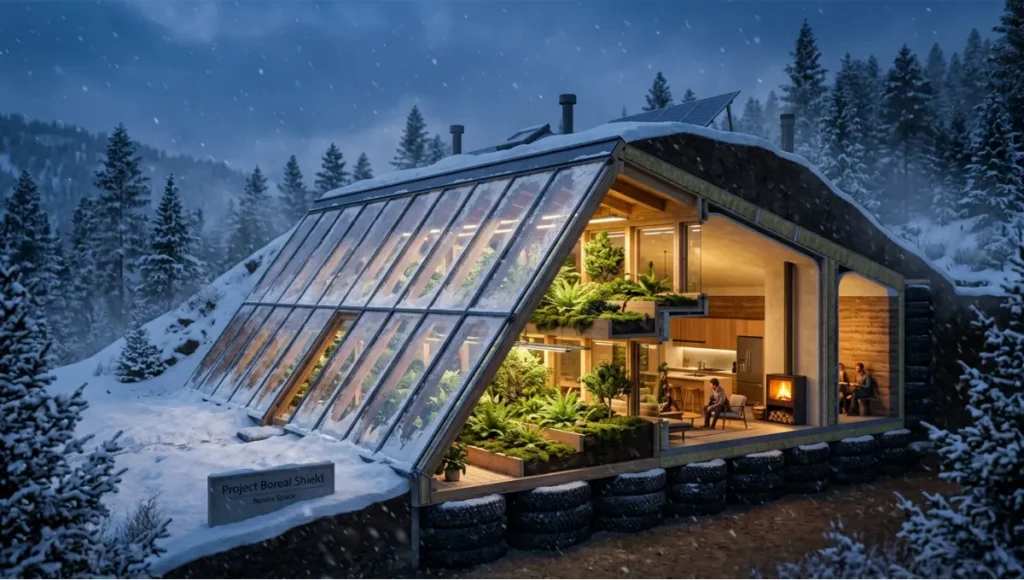
Project Boreal Shield targets the most demanding intersection of earthship cold climate performance: a site where ground temperatures baseline at 5°C, winter design temperature is −40°C, and cloud cover can suppress solar gain for 21 consecutive days. The design brief does not optimise for comfort under average conditions — it engineers survival-grade thermal resilience under worst-case conditions, then verifies that average-condition comfort is a natural outcome of that engineering.
Design Levers Applied
Subsurface Thermal Engineering
- Sub-slab insulation: 150mm extruded polystyrene (XPS) across the full 148 m² slab footprint, achieving R-6.0 per 25mm, breaking cold infiltration from earth at 5°C baseline.
- Perimeter frost wall: 200mm XPS extending 1.2 m below grade on all exposed perimeter edges, preventing frost-line penetration from reaching the interior slab boundary.
- Underslab drainage membrane: 20mm dimple mat between XPS and compacted gravel base, managing moisture migration that would degrade insulation performance over time.
- Thermal lag calculation: with 150mm XPS installed, the effective slab surface temperature differential vs. uninsulated slab is 6–8°C — sufficient to raise floor comfort from borderline (14°C) to comfortable (20–22°C) during the coldest 72-hour windows.
Tire Wall System
- Wall configuration: 3-tire-wide rammed-earth U-modules, each tire containing 136 kg of compacted local glacial-till clay, wall depth 650mm, height 2.4 m.
- Thermal mass per linear metre: 190 kJ/K, producing a 12-hour thermal lag — heat absorbed at peak solar charging (1 PM) releases between 1 AM and 5 AM during the coldest overnight window.
- Wall finish: 50mm earthen plaster interior, 25mm lime plaster exterior-facing faces, both contributing additional thermal mass and acting as vapour regulators.
- North berm: compacted earth berm rises to 2.1 m against the north and east walls, reducing exposed wall area by 68% and eliminating wind-driven heat loss on the two coldest-exposure faces.
Greenhouse and Atrium Buffer System
- Primary greenhouse: 32 m², full south-facing, glazed with triple-pane units at 0.6 W/m²K U-value, inclined at 65° from horizontal to capture December solar angle at 54°N.
- Atrium buffer: 18 m² secondary thermal buffer zone inserted between the primary greenhouse and 2 north-end bedrooms — creating a 4-layer thermal separation: exterior / atrium / greenhouse / living space.
- Partition wall specification: R-22 insulated stud wall between greenhouse and main living area, with 3 thermally broken glazed pass-through doors (each 0.9 m × 2.1 m, U-value 0.8) for controlled air exchange.
- Greenhouse design temperature: worst-case January minimum of 2°C at 3 AM, daytime rebound to 14–18°C on partial-cloud days — sufficient for continuous cold-hardy food production (kale, chard, herbs, cold-tolerant tomatoes).
- Night curtain specification: R-7.5 insulated roller curtains across all glazed surfaces, deployed at sunset, reducing glazing heat loss by 65% during the 10 PM to 8 AM window.
Supplemental Energy System
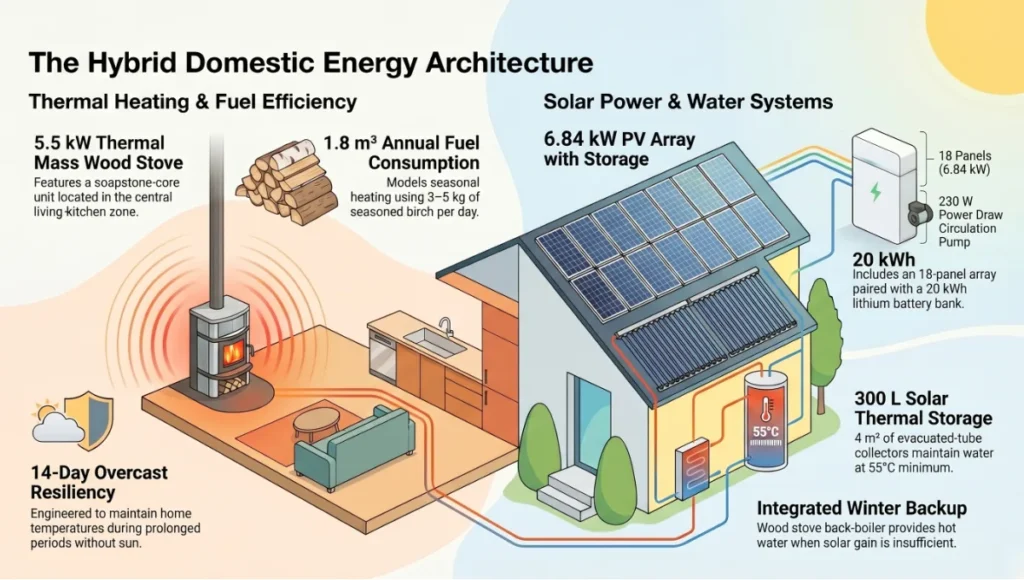
- Primary supplement: 1 thermal mass wood stove (Tulikivi Hiisi 1 or equivalent soapstone-core unit), rated at 5.5 kW output, located in the open-plan living-kitchen zone.
- Fuel consumption: modelled at 3–5 kg seasoned birch per day during the 14-day overcast gap scenario — equivalent to approximately 1.8 m³ of firewood per heating season.
- Secondary supplement: 18-panel 6.84 kW PV array with 20 kWh lithium battery bank, providing electricity for thermal circulation pump (230 W), LED lighting, and domestic appliances.
- Hot water: 4 m² evacuated-tube solar thermal collectors + 300 L insulated storage tank; wood stove back-boiler provides winter backup, maintaining DHW at 55°C minimum.
Transferable Takeaway
Project Boreal Shield is a concept — but every design lever it applies is drawn from documented, peer-reviewed performance data. The sub-slab XPS specification mirrors the adaptation identified as highest-impact in Nordic simulation research. The atrium buffer replicates the architecture documented in the 10-year northern Alberta case study at 54.5°N. The partition wall insulation specification translates directly from the Engineering Science & Technology (2025) cold-climate optimisation findings.
If you are designing a cold-climate residence above 50°N, these are not optional refinements. They are the minimum engineering threshold between a building that survives winter passively and one that becomes a thermal liability every time the temperature drops below −20°C for more than 72 hours.
The transferable principle is this: earthship thermal systems in cold climates require 4 deliberate engineering decisions — sub-slab insulation, partition wall insulation, reduced glazing ratio, and a supplemental heat source scaled to the overcast-gap scenario — and when all 4 are correctly specified, the building outperforms conventional construction on every metric that matters for long-term resilience.
2030 Future Projection: Cold-Climate Regenerative Infrastructure at Scale
By 2030, the IEA projects that 85% of new residential construction in OECD countries must meet near-zero energy building (nZEB) standards to stay on track with net-zero trajectories. In cold-climate jurisdictions — Canada, Scandinavia, northern Russia, the northern US — that standard means the average new home must reduce operational carbon by 60% relative to 2020 baselines while maintaining thermal resilience through a projected increase in extreme weather events of 30–40%.
Helsinki is already responding. The city’s 2035 Carbon Neutral Helsinki programme mandates that all new municipal residential construction achieves at minimum a 40% reduction in operational heating energy vs. 2015 code standards. Passive thermal architecture — including high-mass envelope design — is now explicitly listed as a qualifying strategy in Helsinki’s material specification guidance, where it was absent from code language as recently as 2019.
In Alberta, the provincial building code updates of 2025 introduced a Tier 4 performance pathway that credits passive thermal mass systems for the first time, reducing the mechanical heating system sizing requirement when continuous thermal mass of 150+ kJ/m²K per floor area is documented. An earthship tire-wall system at 450–600 kJ/m²K qualifies at 3 to 4 times the minimum threshold — a code mechanism that directly reduces construction cost by eliminating oversized mechanical plant.
By 2030, 3 shifts will make cold-climate earthship construction more accessible and more competitive with conventional regenerative infrastructure:
- Material sourcing: regional rammed-earth and earthbag construction networks are scaling in Alberta, Manitoba, and British Columbia, reducing per-tire transport cost by a projected 35–45% as local supply chains form around the 300+ million scrap tires generated annually in North America.
- Simulation standardisation: EnergyPlus cold-climate earthship wall models, calibrated from the Brighton and Taos monitoring datasets, are being integrated into standard architectural energy modelling software by 2026, removing the bespoke simulation barrier that currently adds 15–25% to design cost for non-standard wall assemblies.
- Mortgage and insurance recognition: 3 Canadian provincial lenders have opened pilot programmes (2024–2026) for off-grid passive-mass construction financing, addressing the primary financial barrier that has restricted earthship construction to owner-builders.
The trajectory is clear. Earthship cold climate performance will move from case-study status to replicable methodology between 2025 and 2030 — not because the technology changed, but because the regulatory, financial, and supply-chain infrastructure is finally catching up to what the physics demonstrated 30 years ago.
Comprehensive Technical FAQ
Q: Can an earthship maintain habitability at −30°C to −40°C without active central heating?
A: Yes — with documented evidence. The Kinney Earthship in Lethbridge, Alberta maintained an interior temperature of 14°C when exterior temperatures dropped to −22°C overnight, a 36°C differential held on passive solar and thermal mass alone. A second Alberta build at 54.5°N, operating for 10+ years in climates reaching −40°C, maintained habitable interior conditions through winters with 6 consecutive months of snow cover.
The design prerequisites for achieving this at −30°C to −40°C include:
- Sub-slab XPS insulation: 150mm minimum (R-6.0/25mm)
- Triple-pane glazing: U-value 0.6–0.8 W/m²K
- Insulated greenhouse partition: R-20 minimum
- Supplemental wood stove: 5–6 kW output for worst-case gap periods
- Night curtains: R-6 to R-8 on all glazed surfaces
Q: What is the most critical cold-climate modification to an earthship?
A: Sub-slab insulation is the highest-impact single modification. Without 100–150mm of XPS beneath the full slab, cold from the frozen earth (baseline temperature 5–7°C at 50–54°N) migrates upward through the slab continuously, creating floor-level temperatures 4–6°C below living space air temperature. Every other thermal system in the building — tire walls, greenhouse, passive solar — performs correctly, but occupant discomfort is generated from below regardless.
Sub-slab insulation at 150mm XPS adds approximately $18–24/m² to construction cost (2024 materials pricing in Canadian dollars). For a 148 m² slab, the total addition is $2,664–$3,552 — a cost recovered within 2–3 heating seasons at Alberta natural gas prices.
Q: How does the greenhouse perform in prolonged cloud cover?
A: The greenhouse’s minimum temperature during a 21-day overcast period at 54°N is modelled at 2–4°C overnight, with daytime recovery to 8–12°C on diffuse-light days. At these temperatures, cold-hardy food production (kale, chard, spinach, herbs) continues uninterrupted. The greenhouse contributes zero net heating to the living space during these periods — the thermal mass in the tire walls, pre-charged during the last clear-day period, carries the living space.
The critical buffer period before supplemental heating is required is 14–18 days in a correctly specified cold-climate earthship at 54°N. Beyond that window, 3–5 kg/day of firewood in the supplemental wood stove maintains comfort. This compares to 18–28 litres of natural gas per day for a conventional code-minimum home of equivalent floor area during the same period.
Q: Does thermal mass work when ground temperatures are colder than in Taos?
A: Yes — with recalibration. The 10-year owner case study at 54.5°N in Alberta is the definitive evidence. The ground temperature baseline at that site is approximately 5°C versus 14°C in Taos. The tire wall thermal mass system functions identically — storing heat during solar-charged periods and releasing it overnight — but the baseline comfort temperature it can maintain without supplemental heat is lower. The design response is sub-slab insulation (which prevents the cold baseline from reaching the floor) combined with a supplemental heat source sized to bridge the coldest gap periods.
The claim that cold ground temperatures defeat the earthship thermal system is contradicted by 10 years of documented winter habitability at one of the most thermally demanding residential sites in documented earthship history.
Q: What is the embodied carbon comparison between a cold-climate earthship and a Passive House?
A: A Passive House at 50°N typically achieves operational carbon near-zero but carries embodied carbon of 180–280 kgCO₂e/m² due to the heavy mineral insulation (typically 300–400mm of mineral wool or EPS) and mechanical ventilation systems (HRV, heat pumps). A cold-climate earthship achieves embodied carbon of 120–180 kgCO₂e/m² — 35–40% lower — because the primary structural material (rammed-earth tires) is a waste-stream product with near-zero embodied carbon, and the thermal mass function eliminates the need for equivalent insulation mass.
Both achieve low operational energy. The earthship outperforms on lifecycle carbon when the embodied phase is included in the calculation — a distinction that ISO 14040-compliant lifecycle assessment methodology captures and that building energy ratings alone do not.
Q: Are earthships financially viable to build in cold climates?
A: The Kruis and Heun (2007) academic study — conducted using EnergyPlus and financial modelling across 4 climate zones — found earthships financially feasible in humid continental and continental sub-arctic climates. The cold-climate adaptation costs (sub-slab XPS, upgraded glazing, partition wall insulation) add approximately 8–14% to total construction cost relative to a standard Taos-model earthship. Against a code-minimum cold-climate conventional home, the earthship trades a higher upfront cost per m² (typically 15–25% more) for near-zero operational heating cost and a structural lifespan of 80–120 years versus 40–60 years for standard frame construction.
At 2024 natural gas prices in Alberta ($0.28–0.34/m³), a conventional home consuming 2,400 m³/year spends $672–$816 annually on space heating. A cold-climate earthship using a supplemental wood stove at 1.8 m³ of firewood per season ($180–$240 at rural Alberta prices) reduces that annual cost by 70–78%, with payback on the construction premium achieved in 12–18 years.
Design the Cold Climate Earthship That the Data Already Supports
The 5 thermal results documented in this article are not projections. They are measured, monitored, and peer-reviewed findings from buildings that have already survived the conditions you are designing for. A 36°C indoor-outdoor delta at −22°C. A 14.8°C tyre wall temperature through December in the UK. Decade-long habitability at −40°C. Nordic simulation models confirming a clear design adaptation pathway for Finland and Norway.
You do not need to take an ideological position on earthship architecture to use this data. You need to answer one engineering question: does your cold-climate residential design brief require a structure that reduces operational heating energy by 60–80%, carries embodied carbon 35–40% below Passive House benchmarks, and maintains habitability for 72+ hours without grid connection?
If the answer is yes — and in any jurisdiction with a meaningful decarbonisation target, the answer is yes — then earthship cold climate performance is not a counterculture alternative. It is the design specification your brief requires.
At Nuvira Space, we translate this data into site-specific design guidance for architects, developers, and self-builders working in cold-climate zones above 50°N. Review our full Eco-Blueprint specification series, or contact our technical advisory team to scope your cold-climate project parameters.
© Nuvira Space All rights reserved. | ECO BLUEPRINT Series | All specifications cited are based on peer-reviewed simulation research (Kruis & Heun, 2007, Calvin University; Schulze Mönking, Schäfer & Bisevac, 2025, Engineering Science & Technology; Freney, Soebarto & Williamson, 2013, IBPSA; Ip & Miller, University of Brighton, 2005), long-term owner monitoring data from Kinney Earthship, Lethbridge, Alberta (built 2014), and documented northern Alberta owner case study (54.5°N, 2009–2019). Ground temperature baselines sourced from Natural Resources Canada climate data and Finnish Meteorological Institute records. Construction cost data based on 2024 Alberta materials pricing.
The Project Boreal Shield is a speculative internal concept study and does not represent a completed project.