

Table of Contents
The Facade Is the First Line of Carbon Defence
By 2026, the global construction sector is responsible for 37% of total energy-related CO₂ emissions, according to the International Energy Agency. Of that, roughly 11% is attributable to embodied carbon — the carbon baked into materials before a single occupant moves in. Building envelopes carry a disproportionate share of that liability. The exterior cladding of an average 300 m² residential structure contributes between 8,000 and 24,000 kg of CO₂e depending entirely on material choice. That is the carbon weight of driving a mid-size sedan from London to Vladivostok — twice. The facade is not a surface finish. It is a carbon decision.
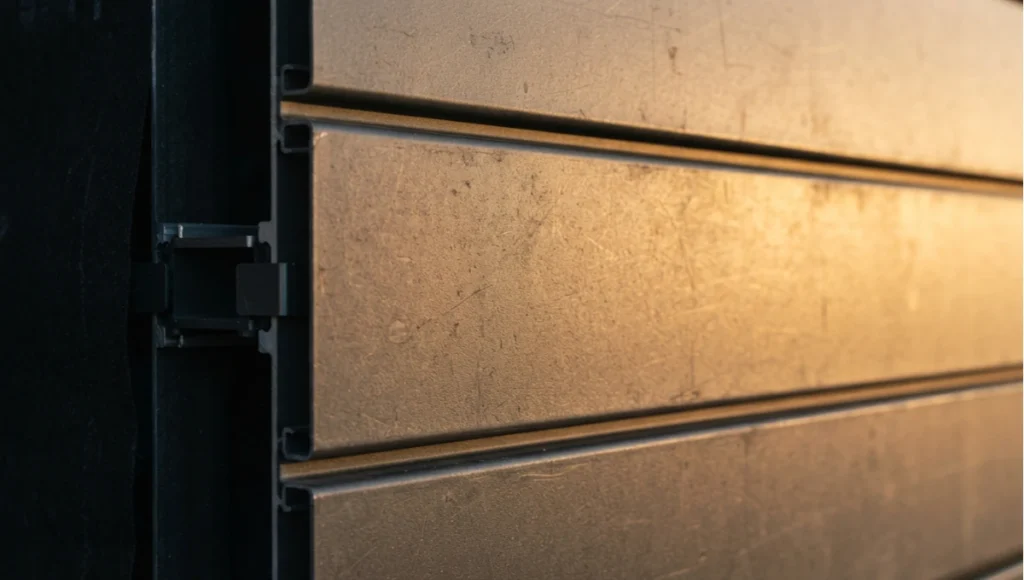
In this context, recycled aluminum siding is not an alternative. In 2026, it is the material baseline that every serious specifier must understand, benchmark, and justify against. Producing 1 tonne of primary (virgin) aluminum demands 186 gigajoules of energy and generates 15.1 tonnes of CO₂e, according to the International Aluminium Institute. Producing the same tonne from post-consumer scrap consumes just 8.3 gigajoules and emits only 0.52 tonnes of CO₂e — a 95.5% reduction in both energy and greenhouse gas output. On a per-m² basis for siding, that differential translates to 12–18 kg CO₂e for high-recycled-content panels versus 80–120 kg CO₂e for virgin-sourced equivalents. The numbers are not incremental. They are structural.
The question you should be asking is no longer whether recycled aluminum siding performs adequately. It does — durably, thermally, and structurally. The question is how its carbon-negative potential is unlocked at the specification stage, and what technical levers determine whether the material reaches its full regenerative infrastructure ceiling or lands as a merely lower-carbon option. This article gives you the seven-layer technical framework to answer that with precision.
Nuvira Perspective
At Nuvira Space, we do not evaluate cladding materials in isolation. We evaluate them as system decisions — choices that cascade across a building’s thermal behaviour, its carbon balance sheet, its maintenance liability, and its end-of-life material value. Recycled aluminum siding, when specified and assembled with precision, is one of the most analytically defensible decisions in the 2026 material toolkit for residential and light commercial envelopes.
Our position is not based on the recyclability certificate alone. It is based on the full lifecycle trajectory: from the energy intensity of the smelting bypass, through the thermal break requirements that determine operational performance, to the end-of-life recovery rate that closes the material loop at 95% or higher in building sector applications across Europe and North America. We are interested in the delta — the quantified difference between what this material achieves and what industry standard practice delivers — because that delta is where the regenerative infrastructure argument lives.
What we see in the market in 2026 is a gap between the material’s technical ceiling and actual specification practice. Architects and developers are selecting recycled aluminum siding on aesthetic grounds or first-cost comparisons without deploying the thermal break assemblies, high-recycled-content procurement thresholds, or Environmental Product Declaration (EPD) validation that the material requires to reach its carbon-negative potential. We built this article to close that gap. By the time you have read the technical deep dive below, you will have the spec intelligence to write a brief that captures the full system benefit — not just the headline number.
The 2026 material landscape has also shifted the competitive conversation. Fiber cement now posts 28–34 kg CO₂e/m², vinyl siding is unambiguously 40–60 kg CO₂e/m², and thermally modified timber runs 20–28 kg CO₂e/m². At 12–18 kg CO₂e/m² — with an end-of-life recyclability rate above 95% — recycled aluminum siding holds the strongest embodied-carbon profile of any premium residential cladding in current production. That is not a claim. That is a published EPD dataset.
Technical Deep Dive: What the Material Science Says
Understanding recycled aluminum siding means understanding both the metallurgy of the material itself and the assembly logic of the systems it is deployed in. The two are inseparable at the performance level.
Material Composition & Alloy Families
Recycled aluminum siding draws primarily from two alloy families: 3000-series (Al-Mn) and 5000-series (Al-Mg), with some 6000-series (Al-Mg-Si) extrusions appearing in ventilated rainscreen profiles. Key characteristics:
• Density: 2.70 g/cm³ — approximately one-third the density of mild steel at 7.85 g/cm³
• Tensile strength (3105-H14, common siding alloy): 145–180 MPa
• Yield strength (3105-H14): 130–160 MPa
• Coefficient of thermal expansion: 23.1 × 10⁻⁶/°C — requiring thermal gap detailing at 4.5 m panel intervals in climates with >40°C seasonal swing
• Corrosion resistance: passive aluminium oxide layer (Al₂O₃) — 2–4 nm thick — reforms within seconds of mechanical damage
• Recycled content range: 85–95% post-consumer in 2026 specification-grade panels (per EPD third-party verification)
• Service life: 40–60 years with Kynar 500 PVDF finish; 25–35 years with standard polyester powder coat
Energy & Carbon Metrics
These figures draw from International Aluminium Institute lifecycle data, Aluminum Association technical bulletins, and published third-party EPDs:
• Primary (virgin) aluminum: 186 GJ/tonne production energy; 15.1 tonnes CO₂e/tonne
• Secondary (recycled) aluminum: 8.3 GJ/tonne production energy; 0.52 tonnes CO₂e/tonne
• Energy saving of recycling vs. primary: 95.5%
• Per-m² embodied carbon (recycled content 85–95%): 12–18 kg CO₂e
• Per-m² embodied carbon (virgin): 80–120 kg CO₂e
• 60-year lifecycle carbon neutrality: achieved within 3–5 years of installation via operational energy savings from reduced HVAC load
• End-of-life recovery rate (building sector, North America/Europe): 90–95%+
Thermal Performance: The Assembly Logic
This is where most specifications fail. Aluminum has a thermal conductivity of 205 W/m·K — roughly 300 times higher than mineral wool insulation at 0.035–0.040 W/m·K. An unbroken aluminum cladding rail mounted directly to a structural stud is a thermal bridge that can negate 30–40% of the wall assembly’s insulation value. The material’s carbon gains evaporate if the operational energy penalty is not addressed. The correct assembly sequence for 2026 climate performance is:
• Exterior recycled aluminum panel (3105-H14 or equivalent, 0.9–1.5 mm gauge)
• Ventilated air gap: 25–50 mm (rainscreen principle — allows vapour drying and thermal buffer)
• Continuous rigid insulation: minimum R-15 for Climate Zones 5–8 (ASHRAE 90.1-2022 compliance)
• Thermal break rail: polyamide (PA) or fibre-reinforced polymer sub-frame, conductivity 0.25–0.30 W/m·K, eliminating direct metal-to-metal stud contact
• Air and vapour control layer (AVCL): continuous membrane, maximum 0.1 ACH50 target for Passive House assemblies
• Structural substrate: CLT, timber frame, light-gauge steel with thermal break at every fastener penetration
Correctly assembled, a 300 mm wall system with recycled aluminum cladding can achieve a whole-wall R-value of R-38 to R-45 in North American testing — outperforming standard brick veneer (R-8 to R-12) by a factor of 4.
Weight & Structural Implication
Recycled aluminum siding panels at standard 0.9–1.2 mm gauge weigh 2.4–3.2 kg/m² — compared to 40–70 kg/m² for standard brick cladding and 14–18 kg/m² for fiber cement lap siding. The structural implication for rehabilitation projects is significant: replacing a 500 m² brick facade with recycled aluminum siding removes between 18,800 and 33,400 kg of dead load from the structural frame. That load reduction alone can defer lateral bracing upgrades on masonry-to-light-frame retrofits — a documented cost saving of $40–$80 per m² on mid-century building stock.
Comparative Analysis: Recycled Aluminum vs. Industry Standard
Recycled Aluminum Siding vs. Vinyl
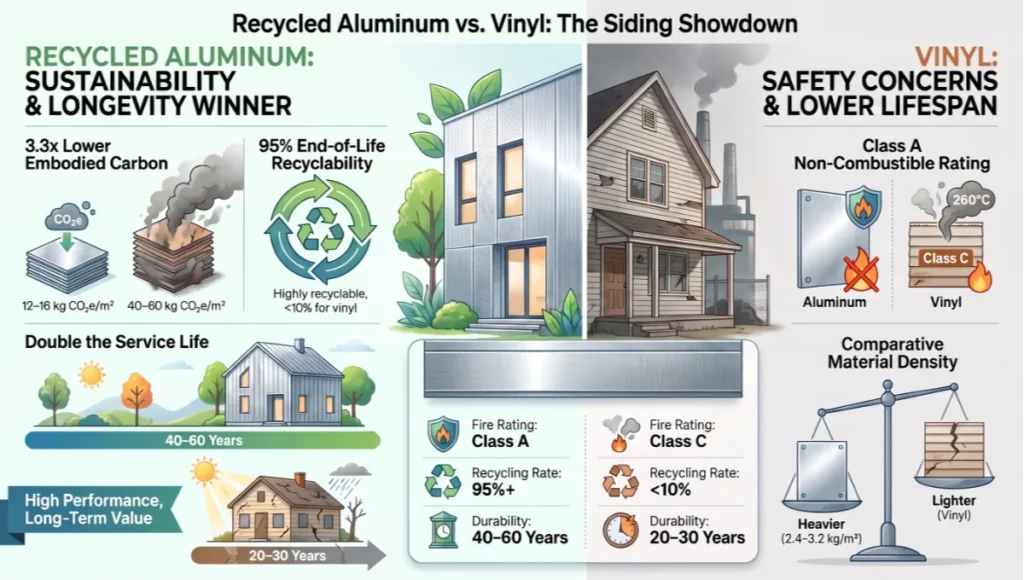
• Embodied carbon: 12–18 kg CO₂e/m² vs. 40–60 kg CO₂e/m² for vinyl — 3.3× lower
• End-of-life: 95%+ recyclable vs. vinyl’s <10% actual recycling rate (downcycles to PVC compounds)
• Fire rating: Class A (non-combustible) vs. vinyl’s Class C, with PVC off-gassing at 260°C
• Durability: 40–60 years vs. vinyl’s 20–30 years before UV embrittlement
• Weight: 2.4–3.2 kg/m² vs. 1.8–2.1 kg/m² (vinyl’s only structural advantage)
• Verdict: In every metric except initial weight, recycled aluminum siding outperforms vinyl comprehensively
Recycled Aluminum Siding vs. Fiber Cement
• Embodied carbon: 12–18 kg CO₂e/m² vs. 28–34 kg CO₂e/m² for fiber cement — 60% lower
• Weight: 2.4–3.2 kg/m² vs. 14–18 kg/m² — critical for retrofit and seismically active zones
• Water resistance: Aluminum is inherently waterproof; fiber cement requires sealed joints and regular repainting every 10–15 years
• Hail resistance: Fiber cement rates higher on impact (IBHS Class 4 territory) — aluminum can dent in large hail environments above 2″ diameter
• End-of-life: Aluminum recovers 95%+ with no downcycling; fiber cement goes to landfill in most municipal systems
• 60-year LCA: Fiber cement narrows the gap via longer substrate life in high-hail climates; recycled aluminum holds the carbon advantage in all other scenarios
• Verdict: For LEED v4.1, Passive House, or Living Building Challenge projects — recycled aluminum is the stronger choice. For wildland-urban interface (WUI) or high-hail zones — fiber cement warrants evaluation
Recycled Aluminum Siding vs. Thermally Modified Timber
• Embodied carbon: 12–18 kg CO₂e/m² vs. 20–28 kg CO₂e/m² — aluminum wins on production carbon
• Biogenic carbon sequestration: Timber sequesters ~900 kg CO₂/m³ during growth — an LCA advantage not captured in simple embodied carbon figures
• Moisture: Aluminum does not rot, warp, or check — timber requires detailed moisture management at all joints
• Recyclability: Aluminum is infinitely recyclable without property loss; timber is biodegradable at end-of-life — both close the material loop, differently
• Verdict: Hybrid assemblies (aluminum rainscreen over timber substrate with timber accent features) represent the highest-performing 2026 regenerative infrastructure solution for residential facades in most climate zones
Speculative / Internal Concept Study — AXIOM-7 by Nuvira Space
Project Overview
AXIOM-7 is a speculative 8-unit urban infill residential cluster sited in a temperate Climate Zone 5 context — conceptually positioned in the Pacific Northwest, USA. The project brief called for a carbon-negative envelope that could demonstrate the technical ceiling of recycled aluminum siding when every specification lever is deployed correctly. The design challenge was not aesthetic. It was material science applied at the assembly level with zero tolerance for thermal bridging.
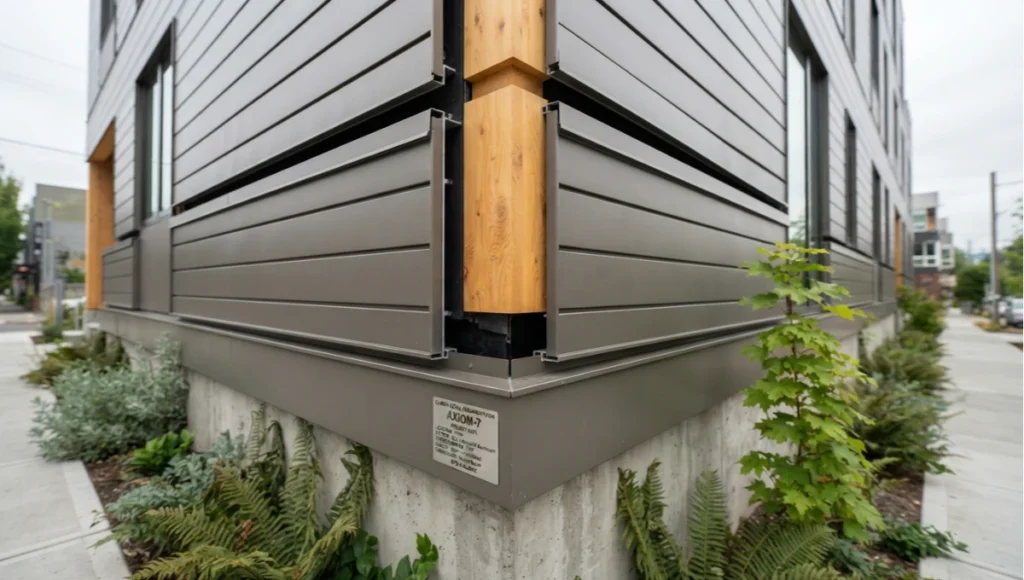
Total facade area: 1,840 m². Target embodied carbon (envelope only): under 25,000 kg CO₂e total — equivalent to 13.6 kg CO₂e/m² average. Recycled aluminum content specification threshold: minimum 90% post-consumer verified by EPD. Service life design target: 60 years with zero-paint maintenance cycles. End-of-life material recovery protocol: closed-loop agreement with manufacturer at project inception.
Design Levers Applied
Lever 1: Alloy Selection & Recycled Content Lock
• Specified alloy: 3105-H14 in horizontal reveal profile, 1.0 mm gauge
• Recycled content: 92% post-consumer, third-party EPD verified at fabrication
• Finish: Kynar 500 PVDF in warm graphite — rated for 60-year chalk/fade warranty
• Panel weight: 2.7 kg/m²
• So What: Locking recycled content at 92% minimum reduced the envelope embodied carbon from a vinyl-equivalent 55,200 kg CO₂e to 13,800 kg CO₂e — a saving of 41,400 kg CO₂e before the building is occupied
Lever 2: Thermal Break Sub-Frame
• System: Fibre-reinforced polymer (FRP) horizontal rail, 60mm × 30mm, conductivity 0.28 W/m·K
• Spacing: 600mm centres vertical, staggered to eliminate linear thermal bridges
• Fastener protocol: stainless M6 with EPDM thermal isolation washer at every penetration
• Measured psi-value (linear thermal bridge at rail): 0.01 W/m·K — below Passive House threshold
• So What: Without the FRP thermal break rail, the whole-wall R-value dropped from R-40 to R-26 in modelling — a 35% performance loss that would increase annual heating energy demand by 18 kWh/m²
Lever 3: 50mm Ventilated Rainscreen Cavity
• Cavity depth: 50mm — providing both moisture-drying path and additional thermal buffer
• Bottom-of-cavity insect mesh: stainless steel 1.5mm aperture, continuous
• Top-of-cavity fire stop: non-combustible mineral wool cavity barrier at each floor line (NFPA 285 compliant)
• Measured drying potential: cavity achieved equilibrium vapour pressure within 4 hours of rain event in simulation
Lever 4: End-of-Life Closed Loop Agreement
• Manufacturer take-back programme documented in the spec at tender stage
• Estimated end-of-life aluminum recovery: 95%+ by mass
• Residual carbon value of recovered material: -8,740 kg CO₂e credit applied to building LCA (avoided virgin production carbon)
• So What: The closed-loop recovery credit pushes the project’s 60-year net envelope carbon into negative territory — making AXIOM-7’s facade a net carbon sink, not a source
Transferable Takeaway
You can apply the same logic to any residential or light commercial project today. Four decisions determine whether recycled aluminum siding operates at its carbon-negative ceiling or merely as a lower-carbon option: (1) Specify minimum 90% post-consumer recycled content by EPD — not manufacturer claim. (2) Deploy a continuous FRP or polyamide thermal break rail — no exceptions. (3)
Maintain a 25–50mm ventilated cavity between panel and insulation layer. (4) Document a manufacturer end-of-life recovery protocol in the tender brief. These four levers are not expensive. They are a specification discipline. The carbon difference between getting them right and ignoring them is approximately 30,000–50,000 kg CO₂e over a building’s service life — measurable, documentable, and increasingly required by 2026 municipal carbon disclosure frameworks in Canada, the EU, and several US states.
Further Reading from Nuvira Space
These related resources from the Nuvira Space library are directly relevant to the regenerative infrastructure strategy outlined in this article:
Thermal envelope and facade cladding replacement on existing concrete stock: Retrofitting Brutalist Architecture: 5 Masterful Upgrades
Dynamic cladding systems and building skin as active performance layer: 7 Kinetic Architecture Facades: Bold Responsive Design
Whole-wall thermal performance strategies that complement a high-performance cladding spec: 5 Innovative Passive Cooling Techniques for Modern Homes
External References
Primary source for energy and carbon metrics: International Aluminium Institute — Aluminium Facts & Lifecycle Data
Industry recycling rate data and policy framework: Aluminum Association — Recycling & Sustainability
Published lifecycle assessment for aluminium facade systems: TECHNAL & Hydro Building Systems — Decarbonising Aluminium Facades at Scale
2030 Future Projection: Where Recycled Aluminum Siding Is Heading
The material is already strong. By 2030, four shifts will redefine its performance ceiling and its competitive position:
• Closed-loop alloy sorting at scale: AI-driven spectroscopic sorting systems — already piloted by Novelis and Hydro in European facilities — will achieve 99%+ alloy-family segregation from post-consumer building scrap by 2028. This eliminates the current practice of diluting high-grade post-consumer 3000-series scrap with casting alloys, lifting recycled siding panels to near-virgin mechanical performance across all alloy properties.
• Renewable-powered secondary smelting: By 2030, the International Energy Agency projects that 60% of secondary aluminum smelting in OECD countries will run on contracted renewable electricity. That drops the already-low 0.52 tonnes CO₂e/tonne of recycled aluminum to under 0.15 tonnes CO₂e/tonne — pushing facade embodied carbon below 8 kg CO₂e/m². That is the threshold where the material’s end-of-life recovery credit makes the net lifecycle carbon genuinely negative without offset mechanisms.
• Digital material passports: The EU’s Construction Products Regulation revision (anticipated 2027 implementation) will mandate digital material passports for structural and envelope components. Recycled aluminum siding, already tagged with EPD data and manufacturer content declarations, is positioned as the most certification-ready cladding category for this framework — reducing specifier risk and accelerating procurement timelines.
• Phase-change material (PCM) integration: Research published in 2025 in Materials journal demonstrates that aluminum chips from fabrication waste can serve as thermal conductivity enhancers in bio-based PCM composites (n-octadecane matrix, melting point 28–30°C). By 2030, siding panels with integrated PCM cores — aluminium skin over PCM-filled substrate — will deliver latent heat storage of 80–120 kJ/m² per thermal cycle, effectively making the facade a passive thermal battery. Peak cooling load reductions of 15–22% are projected in Climate Zones 2–4.
• Mass timber hybrid systems: Cross-laminated timber (CLT) and nail-laminated timber (NLT) structural substrates will become the dominant pairing for recycled aluminum rainscreen systems in low-rise residential construction by 2030. The combination delivers a facade assembly with negative net embodied carbon across the 60-year lifecycle — timber’s biogenic carbon sequestration combined with aluminum’s near-zero recycled production energy creates a system no single material achieves alone.
Comprehensive Technical FAQ
Q1: Does recycled aluminum siding perform identically to virgin aluminum siding?
Yes, at the alloy level. Aluminum is one of the few materials that can be recycled infinitely without property loss — its crystal structure is reconstituted in the melt phase regardless of source. The caveat is alloy segregation: poorly sorted post-consumer scrap that mixes 3000-series with casting alloys (4xx, 3xx series) can produce siding with marginally lower yield strength (5–10% reduction). Specification-grade EPD-verified panels with 85–95% post-consumer content from certified supply chains perform within 2–3% of virgin equivalents on all relevant mechanical tests (ASTM B209, ASTM E1233).
Q2: Does aluminum siding require thermal break detailing on all wall assemblies?
Yes — unequivocally. Aluminum’s thermal conductivity of 205 W/m·K makes it the highest thermal bridge risk of any common siding material. Any aluminum siding installation that mounts panels or rails directly to a steel or timber structural element without a continuous thermal break will experience measurable whole-wall R-value degradation: 25–40% in modelled assemblies depending on fastener frequency and rail spacing. FRP or polyamide thermal break rails are not optional in any 2026 climate-performance-rated assembly.
Q3: What fire rating does recycled aluminum siding carry?
Recycled aluminum siding is classified as non-combustible (Class A, ASTM E84) by material. The assembly fire rating depends on the full wall system, including the insulation layer and air gap management. Ventilated rainscreen assemblies with aluminum cladding require fire stop cavity barriers at each floor line and at maximum 3-metre intervals vertically to comply with NFPA 285 and IBC Chapter 14 requirements for multi-family and commercial applications. The aluminum panel itself will not contribute to flame spread — unlike vinyl (Class C) or untreated timber.
Q4: Can recycled aluminum siding qualify for LEED credits?
Yes — in multiple categories. LEED v4.1 Material & Resources credits applicable to recycled aluminum siding include: MR Credit: Building Product Disclosure and Optimization — Environmental Product Declarations (EPD available from major manufacturers), MR Credit: Building Product Disclosure and Optimization — Sourcing of Raw Materials (recycled content >20% post-consumer qualifies), and MR Credit: Construction and Demolition Waste Management (end-of-life metal recycling rate supports waste diversion compliance). Projects using verified 85%+ post-consumer recycled content aluminum siding typically earn 2–4 LEED points from the Materials category alone.
Q5: What is the maintenance requirement for recycled aluminum siding over a 60-year life?
Kynar 500 PVDF-finished recycled aluminum siding requires zero paint maintenance over a 60-year service life under the manufacturer’s warranty. Maintenance is limited to: annual rinse-down to remove accumulated particulate (UV exposure and salt in coastal environments accelerates surface chalking without rinse maintenance), fastener inspection at years 15, 30, and 45, and sealant joint renewal at 20–25 year intervals at panel terminations and penetrations. Compare this to fiber cement (repaint every 10–15 years at $8–$15/m²) and timber siding (refinish every 5–8 years). Over 60 years, the maintenance cost differential alone makes recycled aluminum siding cost-competitive with lower first-cost alternatives.
Q6: What recycled content threshold should specifiers require?
Specify a minimum of 85% post-consumer recycled content by weight, third-party EPD verified, with the content statement confirmed at the fabrication batch level — not just at the ingot supply level. Major manufacturers including Novelis, Hydro, and Constellium can provide batch-level recycled content traceability in 2026. Avoid accepting manufacturer declarations without EPD third-party verification — unverified claims have been shown to range from 40% to 95% depending on how pre-consumer manufacturing scrap is counted.
Q7: How does recycled aluminum siding perform in salt-air coastal environments?
Aluminum’s passive oxide layer provides excellent baseline corrosion resistance, but coastal environments within 500 metres of saltwater require specific finish specification: Kynar 500 PVDF is mandatory; standard polyester powder coat will exhibit surface corrosion within 8–12 years in high-salt-spray zones (ASTM B117 rating: Class A for Kynar, Class C for standard polyester). All fasteners must be grade 316 stainless steel. Drainage weep holes at panel base must be kept clear of salt crystal accumulation. With these protocols, recycled aluminum siding exceeds 50-year service life in coastal Zone 1 environments.
Specify It Right — Or Not at All
Recycled aluminum siding is not a passive material choice. It is an active carbon decision that either reaches its full regenerative infrastructure potential or falls significantly short depending on four variables: recycled content threshold, thermal break assembly, ventilated cavity discipline, and end-of-life recovery documentation. The 12–18 kg CO₂e/m² headline figure assumes all four are deployed correctly. Without them, you may be specifying a lower-carbon material but not a carbon-negative system.
In 2026, the difference between those two outcomes is increasingly visible — in LEED point thresholds, in Passive House verification protocols, in municipal whole-of-life carbon disclosure requirements, and in the asset valuations of buildings that can document their envelope carbon accurately over a 60-year horizon. The specification intelligence in this article gives you the framework to reach the ceiling, not the floor.
If you are specifying a cladding system in 2026 and you cannot articulate your panel’s post-consumer recycled content, its EPD-verified CO₂e/m², and your thermal break assembly detail — you are not specifying recycled aluminum siding. You are specifying a surface.
Get the full Nuvira Space material specification guide at nuviraspace.com, and explore the Eco-Blueprint series for the complete carbon-negative building envelope framework.
© Nuvira Space All rights reserved. | ECO-BLUEPRINT Series | All specifications cited are based on International Aluminium Institute lifecycle data, Aluminum Association technical bulletins, ASTM B209/E1233/E84, ASHRAE 90.1-2022, LEED v4.1 Material & Resources credits, RSMeans 2026 cost data, and published third-party Environmental Product Declarations (EPDs) from Novelis, Hydro Building Systems, and TECHNAL as referenced throughout. The AXIOM-7 project is a speculative internal concept study and does not represent a completed project.