

Table of Contents
KEY TAKEAWAYS
- Pop-up public spaces urban design is no longer an experimental curiosity — it is a measurable, data-backed driver of urban economic recovery, social cohesion, and long-term policy transformation.
- San Francisco’s Great Streets Project documented foot traffic increases of up to 37% and a 30% rise in the number of people stopping and sitting following parklet installations.
- Rotterdam’s Schieblock — converted from an 80,000 sq ft vacant office block into a living urban laboratory — became a model reproduced across Europe after receiving the Berlin Urban Intervention Award and the Rotterdam Architecture Award.
- Seven structural design trends are reshaping how planners prototype cities before committing to costly permanent infrastructure.
- Tactical urbanism costs, on average, 1/10th the price of permanent interventions while generating equivalent or superior community feedback loops.
- By 2030, analysts project that over 60% of major cities will institutionalize pop-up zoning frameworks as standard planning instruments.
Macro-Observation Hook
Cities are failing in real time — and the evidence is geometric. Across the developed world, urban planners have spent decades designing for the car, the investor, and the abstract ideal of “flow,” while the human being — the pedestrian, the child, the elder, the informal community — has been systematically edited out of the civic equation. The result is what you see when you walk through the underbelly of any major metropolis: dead plazas, hostile surfaces, underused parking lots stacked between towers that serve capital more fluently than they serve people.
Pop-up public spaces urban design is the architecture world’s most disruptive counter-argument to this trajectory. It operates on a radical premise: that cities do not need to wait for the grand masterplan, the billion-dollar bond, or the decades-long rezoning cycle to become more human. They can prototype their way there — quickly, cheaply, measurably. And the data, from San Francisco to Rotterdam, from Singapore to Indianapolis, is now unambiguous. Temporary is not inferior. In many cases, it is transformative in ways permanence never was.

This is not a trend born of optimism. It was born of crisis — the 2008 financial collapse that left buildings empty and streets hollow, the pandemic that forced cities to rethink sidewalks overnight, and the long, grinding demographic shift that is turning cities into pressure vessels of inequality. Pop-up design stepped into the void where conventional planning refused to go.
Nuvira Perspective
At Nuvira Space, we do not regard pop-up public spaces as a workaround or a stopgap. We regard them as the most honest architectural language currently in circulation — the one format that forces a city to confront its spatial politics in real time, with real people, at real cost. The recalibration of the metropolitan fabric does not begin with a zoning amendment or a developer’s pitch deck. It begins when a parking space becomes a garden, when a derelict forecourt becomes a cinema, when a road lane becomes a bike boulevard — and the city watches what happens.
That watching, that measurement, that iterative refinement: this is the human-machine synthesis that defines 21st-century urban intelligence. Data-driven design is not the province of smart-city dashboards alone. It belongs in the street, embedded in temporary furniture, responsive to weather, usage, and demographic pulse. Pop-up public spaces are, in this reading, the city’s most sophisticated sensor network. And in 2025, they are proving it at scale.
The “Blueprint” Solution: 7 Structural Trends Reshaping Urban Space
Pop-up public spaces urban design has matured past the guerrilla installation. It now operates within — and frequently rewrites — formal planning frameworks. The following seven trends define the current structural arc of the discipline.
1. Parklet Programs as Municipal Infrastructure
What began as a guerrilla gesture — Rebar Studio’s 2005 Park(ing) Day installation in San Francisco, a parking meter paid for an afternoon, a bench and a patch of grass — has become codified urban policy in cities across four continents. San Francisco’s Pavement to Parks Program has since converted 109 parking spaces into 19,620 square feet of open space, with measurable consequences:
- +37% increase in foot traffic near parklet installations (SF Great Streets Project, 2011)
- +30% increase in people stopping and sitting
- +30% revenue increase at Mojo Café following adjacent parklet installation
- +20% revenue increase at Green Line Café in Philadelphia
- Crime rates adjacent to parklet sites: statistically reduced (Harvard Kennedy School analysis)
Design specifications — standard parklet module:
- Replaces 1–2 parallel parking spaces or 3 perpendicular spaces
- Street speed limit: ≤ 25 mph
- Grade: ≤ 5% slope
- Required: wheel stops, reflective corner elements, ADA-compliant access ramps
- Materials: temporary and fully removable per permit conditions
- Permit renewal: annual, with documented community support required
2. Tactical Urbanism as Policy Prototype
The term “tactical urbanism,” systematized by Mike Lydon and Anthony Garcia of The Street Plans Collaborative and formalized in their 2015 Island Press publication, reframes small-scale interventions not as acts of urban disruption but as acts of municipal research. When New York City temporarily removed vehicles from Times Square in 2009 and measured the results — retail sales rose, pedestrian injuries fell — it built the evidentiary base that justified permanent pedestrianization. When Bogotá institutionalized the weekly Ciclovía, temporarily converting 75 miles of roads to cyclists and pedestrians, it generated a public health dataset that influenced urban policy globally.
The mechanism is always the same: lighter, quicker, cheaper intervention → public use data → policy revision → permanent transformation. For an in-depth look at how pedestrianization logic scales to full districts, see Nuvira’s guide to car-free city district design.
Core tactical urbanism typologies:
- Pop-up pedestrian plazas (residual street space reclaimed in 48–72 hours)
- Painted crosswalk activations (cost: $500–$3,000; permanence potential: high)
- Parklets (cost: $8,000–$80,000 depending on materials and scale)
- Temporary bike lane barriers (cost: $2–$15 per linear foot)
- Pop-up markets and street vendors (no infrastructure cost; maximum social activation)
3. Vacant Space Activation as Economic Recovery
The 2008 financial crisis created an unintended laboratory for pop-up urbanism. Across European and North American cities, vacant commercial and office buildings — stranded by the collapse of development pipelines — became staging grounds for temporary creative economies. Rotterdam’s Schieblock is the canonical case (addressed in depth in Section 5), but the pattern repeated in Detroit’s warehouse district, London’s Southwark, and Berlin’s Kreuzberg.
The economic logic is structural: vacant property generates zero tax revenue, attracts vandalism, and depresses surrounding property values. Even sub-market temporary activation — pop-up bars, cooking workshops, exhibition spaces, short-term creative studios — generates foot traffic, rental income, and neighborhood capital that compounds over time.
Activation cost comparison:
- Traditional retail buildout: $80–$200/sq ft
- Pop-up activation (minimal fit-out): $5–$30/sq ft
- Municipal grant programs (e.g., West Hollywood’s $25,000 parklet grants): offset initial cost entirely
4. Modular Design as Scalable Infrastructure
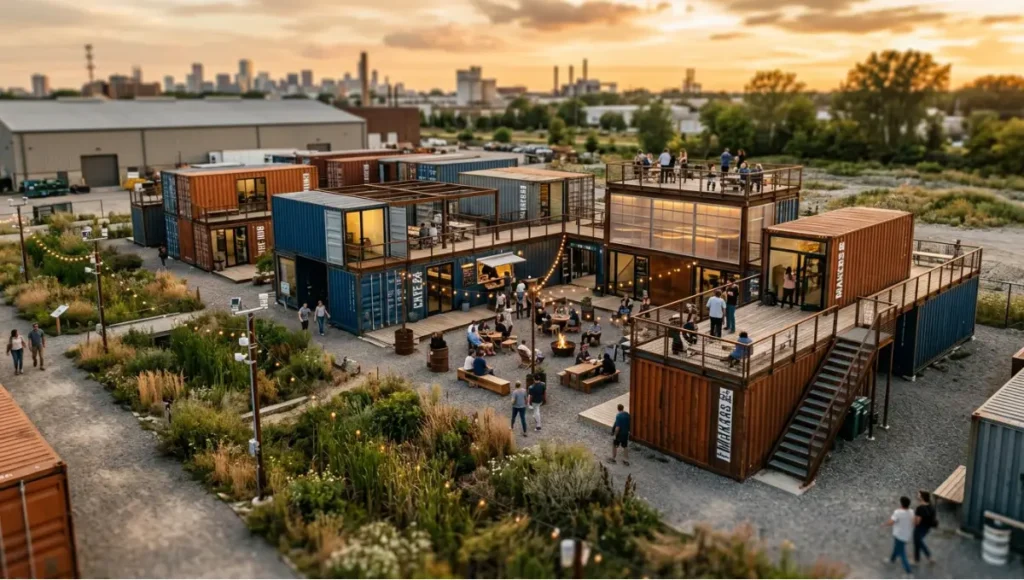
The emergence of modular, demountable spatial systems has transformed pop-up design from ad hoc improvisation into an engineered discipline. Shipping container architecture — once celebrated for its rawness — has matured into precision-engineered modular frameworks capable of forming retail clusters, cultural pavilions, co-working nodes, and community health centers with predictable structural performance.
Modular pop-up system specifications:
- Base module: 20 ft ISO container (2.44 m × 6.06 m × 2.59 m) or custom flatpack equivalent
- Stack capacity: up to 4 stories without structural reinforcement
- Thermal: spray foam or aerogel panel insulation (R-20 to R-38)
- Power: grid-connected or off-grid solar (2–8 kW rooftop array per module)
- Water: grey-water recycling loop where permitted
- Assembly time: 48–96 hours with 4-person crew
- Demount/relocate: full disassembly in 24 hours
5. Community Co-Design as Democratic Infrastructure
The most persistent failure mode in conventional urban design is the consultation theatre — the public meeting where plans are presented to a community that had no hand in shaping them. Pop-up urbanism inverts this model. The intervention itself is the consultation. By placing a prototype in the street — movable seating, a temporary market, a painted bike lane — and measuring how people actually use it, planners gather qualitative and quantitative data that no focus group can replicate.
Milan’s Piazze Aperte (Open Squares) program, launched in 2018 and expanded through 2024, embedded this principle at municipal scale. Using paint, planters, and movable furniture, the city transformed 15 underperforming intersections and residual spaces across outer neighborhoods — areas historically excluded from high-investment public realm projects — into activated plazas. Usage data collected post-intervention consistently showed increased pedestrian dwell time, reduced vehicle incursion, and elevated resident satisfaction scores.
6. Biophilic Integration in Temporary Structures
The intersection of pop-up design and biophilic urbanism — the deliberate incorporation of natural systems into the built environment — is accelerating as cities face urban heat island intensification and growing evidence of green space’s impact on mental health outcomes. Temporary green installations are demonstrating measurable microclimatic effects:
- Urban tree canopy modules: reduce adjacent surface temperature by 3–8°C during peak summer
- Green wall panels (modular): reduce ambient noise by 5–10 dB; improve air quality indices within 10m radius
- Bioswale strips integrated into parklets: manage up to 80% of stormwater from adjacent impervious surfaces during moderate rainfall events — a principle explored in full in Nuvira’s sponge city infrastructure guide
- Pollinator corridors: established in as little as one growing season using native seed mixes
Specification note: Modular biophilic components must account for substrate weight (green roof modules: 80–150 kg/m²) when integrating with demountable structural systems.
7. Data-Instrumented Activation Zones
The newest frontier in pop-up public spaces urban design is the marriage of physical intervention with real-time data infrastructure. Sensor-embedded street furniture — pedestrian counters, thermal cameras, air quality monitors, decibel meters — transforms a temporary plaza into a living research instrument. Cities including Amsterdam, Barcelona, and Kansas City have piloted instrumented pop-up zones where usage data is streamed to public dashboards, informing decisions about permanent capital allocation in near real-time.
Sensor stack for a data-instrumented pop-up zone:
- Pedestrian counter (infrared beam): ±2% accuracy; cost $300–$800/unit
- Thermal imaging: surface temperature mapping at 0.1°C resolution
- Air quality (PM2.5, CO₂, VOC): continuous monitoring; data API-connected
- Acoustic sensor: dB(A) measurement, crowd density proxy
- Edge compute node: Raspberry Pi 4 or equivalent; data transmitted via LoRaWAN or 4G
- Total instrumentation cost per 100m² zone: $4,000–$12,000
Feasibility Study: Economic and Political Barriers
The Permanence Bias in Planning
The most entrenched obstacle to pop-up public spaces urban design is not financial — it is institutional. Western planning culture has internalized a deep bias toward permanent infrastructure. Budget cycles reward capital expenditure. Political careers are built on ribbon-cuttings, not prototypes. And liability frameworks in most jurisdictions were written for fixed structures, not adaptive ones.
Temporary installations require planners to operate in a mode of institutional discomfort: proposing spending on something that may be removed, defending a process rather than a product, and measuring success in behavioral data rather than built square footage. This is a profound cultural shift that most municipal bureaucracies resist instinctively.
Permit Frameworks and Regulatory Friction
Regulatory frameworks have not evolved at the pace of practice. In many cities, a pop-up installation occupying street space requires navigation of multiple overlapping jurisdictions — public works, transportation, planning, fire safety, health — each with independent permit timelines. The result can be a process that costs more in administrative labor than the intervention itself.
Typical permit timeline (U.S. urban context):
- Community outreach documentation: 4–8 weeks
- Traffic impact assessment: 2–6 weeks
- Structural engineering sign-off (if applicable): 2–4 weeks
- Fire egress review: 1–3 weeks
- Total: 3–6 months for a structure that may stand for 30 days
Cities that have streamlined this process — San Francisco with its annual parklet permit cycle, New York with its Open Streets program codified post-pandemic — demonstrate that the friction is regulatory design, not regulatory necessity. It can be engineered out.
Equity and Displacement Risk
Pop-up urbanism carries a documented risk that demands direct acknowledgment: when temporary activation increases foot traffic and perceived neighborhood desirability, it can accelerate gentrification. The research is nuanced but consistent. Parklets and plazas in already-transitioning neighborhoods may hasten displacement of lower-income residents and legacy businesses by signaling neighborhood “improvement” to real estate capital.
Mitigation levers:
- Community land trust partnerships to buffer adjacent property speculation
- Anti-displacement covenants tied to public pop-up permit approval
- Prioritization of activation grants in historically under-resourced neighborhoods
- Community ownership models for long-running pop-up markets and collective spaces
Proof of Concept: Rotterdam and the Schieblock Doctrine
Rotterdam’s Central District in 2009 presented the precise conditions that conventional planning finds unworkable: a massive vacant office block — the Schieblock, approximately 80,000 square feet — stranded by the collapse of commercial real estate demand following the financial crisis, surrounded by a neighborhood with a deteriorating reputation, in a city grappling with the structural obsolescence of its port-era built fabric.
ZUS Architects (Zones Urbaines Sensibles), working with urban design studio CODUM, made a counter-intuitive argument: the building’s vacancy was not a problem to be solved by a new masterplan. It was an opportunity to demonstrate an alternative model of urban development — one operating from the bottom up, with temporary uses as starting points rather than permanent programs as endpoints.
By leasing space below market rate — 90€/m² versus the prevailing 200–240€/m² — ZUS attracted a dynamic coalition of entrepreneurs, cultural institutions, and creative studios. The results were structural:
- Pop-up exhibition spaces, cooking workshops, dance schools, and mini-warehouses occupied the formerly hollow building, generating consistent revenue and foot traffic
- The Dakakker, a rooftop farm installed as part of the 5th International Architecture Biennale Rotterdam, demonstrated that even the building’s roof could be productive — supplying local restaurants with vegetables and herbs
- ZUS crowd-funded the Luchtsingel, a pedestrian bridge connecting the Schieblock to adjacent blocks — a piece of permanent infrastructure financed not by municipal capital but by community investment
- The project received the Berlin Urban Intervention Award and the Rotterdam Architecture Award, and was designated an IABR Test Site for research by design alongside Istanbul and São Paulo
- Between 2012 and 2014 alone, the IABR documented the transformation as a model for shifting from top-down real estate development to bottom-up urban activation
The Schieblock is not a story about a building. It is a story about an urban doctrine: that temporary use is not the absence of vision — it is vision operating at the speed of reality.
Concept Project Spotlight
Speculative / Internal Concept Study — “Switchboard” by Nuvira Space
Project Overview (Location / Typology / Vision)
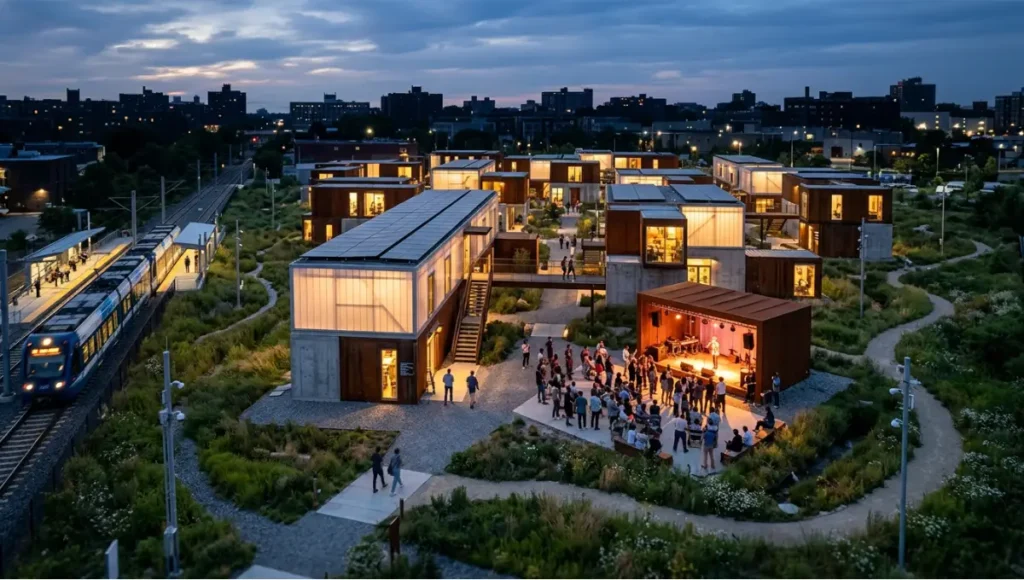
Location: A 3.2-hectare post-industrial brownfield site adjacent to a light rail corridor in a mid-sized European city (population 400,000–600,000), where a former logistics depot has sat vacant for 11 years following port operations relocation.
Typology: Data-Instrumented Modular Activation District — a phased, demountable urban intervention designed to serve as a live policy laboratory before any permanent master-planning commitment is made.
Vision: Switchboard operates on the premise that cities do not know what they need until they see what they use. Rather than commissioning a masterplan for a 11-year void, Nuvira Space proposes a 36-month activation cycle in which the site hosts sequenced, data-monitored pop-up programs — each measuring behavioral, environmental, and economic output — before a single line of permanent infrastructure is drawn.
Design Levers Applied
Phase 1 — Ground Activation (Months 1–6)
- Deployment of 24 ISO-standard flatpack modules (6.06m × 2.44m each)
- Configuration: market stalls (8 units), maker studios (6 units), food and beverage (4 units), community meeting rooms (4 units), open-air stage (2 unit platform system)
- Power: 48 kW rooftop solar array + grid tie-in
- Sensor deployment: 12 pedestrian counters, 4 air quality nodes, 6 acoustic monitors
- Cost estimate: €280,000 total (including sensor infrastructure)
Phase 2 — Data Synthesis (Months 7–12)
- Real-time public dashboard displaying usage patterns, peak hours, demographic proxies
- Community co-design workshops using Phase 1 behavioral data as primary evidence base
- Spatial reconfiguration based on revealed preferences: underused modules relocated or reprogrammed
Phase 3 — Permanent Infrastructure Specification (Months 13–36)
- Evidence-based brief for permanent development drawn directly from Switchboard data
- Minimum 3 community organizations given right-of-first-refusal on ground-floor commercial tenancies in any permanent structure
- Community land trust established to hold 30% of site equity
Specification summary:
- Total site area: 3.2 ha
- Modular footprint: 0.6 ha (Phase 1)
- Green space: 1.8 ha (biophilic ground cover, bioswale corridors, urban orchard)
- Infrastructure cost (Phase 1): €280,000
- Instrumentation cost: €65,000
- Projected annual maintenance: €42,000
- Data outputs: 24/7 sensor feed; quarterly public reports; API open to municipal planners
Transferable Takeaway
The Switchboard model is applicable to any city holding vacant land pending political consensus on permanent development. Its core contribution is methodological: it replaces the guesswork of the masterplan with the evidence of lived use. The 36-month cycle costs approximately 4% of what permanent infrastructure planning and construction would require for an equivalent site — and produces a behavioral dataset that makes every subsequent decision more defensible, more equitable, and more likely to endure.
2030 Future Projection
The trajectory of pop-up public spaces urban design between now and 2030 is not speculative — it is already embedded in the policy pipelines of cities that moved early. Several structural shifts are now probabilistic rather than merely possible.
Institutionalization of temporary zoning: Cities following the lead of San Francisco, Milan, and Indianapolis are codifying pop-up space frameworks into their zoning ordinances. By 2030, analysts at the Project for Public Spaces and the Urban Land Institute project that over 60% of cities with populations above 500,000 will have formal temporary activation permit pathways — reducing current approval timelines from months to weeks.
Sensor-integrated street furniture as standard: The cost of IoT sensor hardware has fallen approximately 80% over the past decade. By 2030, instrumented public furniture — benches with pedestrian counters, planters with air quality sensors, modular shade structures with thermal cameras — will be cost-competitive with conventional urban furniture at approximately $2,000–$5,000 per unit fully instrumented.
Climate adaptation as pop-up driver: As urban heat island effects intensify and extreme weather events increase in frequency, the speed advantage of pop-up infrastructure becomes a climate resilience asset. Deployable shade structures, emergency bioswale networks, and modular flood barriers that can be repositioned seasonally represent the next generation of climate-adaptive pop-up design.
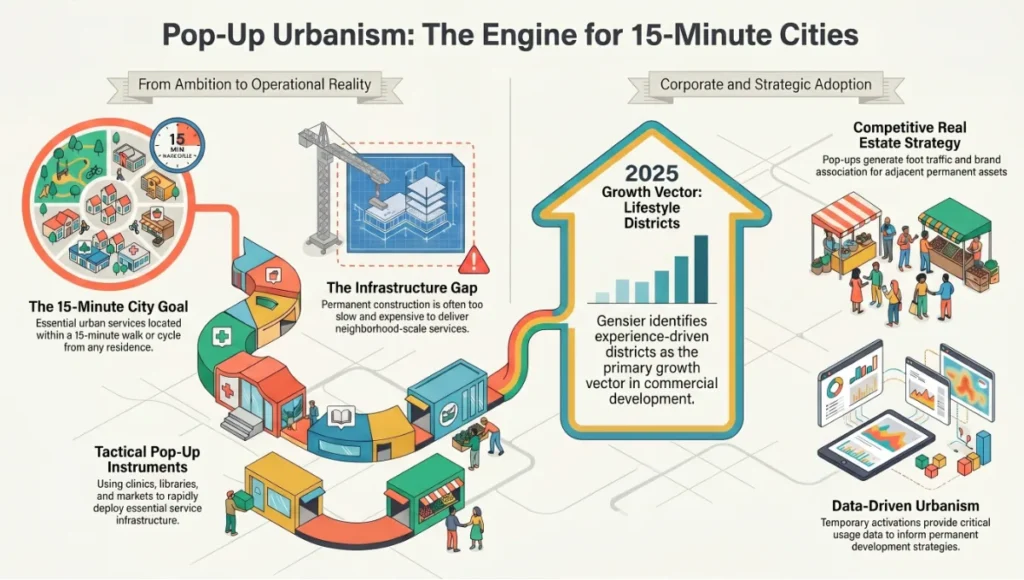
The 15-minute city and pop-up proximity: The 15-minute city concept — which posits that all essential urban services should be accessible within a 15-minute walk or cycle from any residence — requires neighborhood-scale service infrastructure that permanent construction cannot deliver quickly or affordably enough. Pop-up formats: health clinics, libraries, childcare nodes, food markets, and co-working clusters are the tactical instrument through which 15-minute city ambitions become operational realities in the near term.
Corporate and institutional adoption: Gensler’s 2025 Design Forecast identifies experience-driven lifestyle districts as a primary growth vector in commercial urban development. This trend is accelerating corporate interest in pop-up public space not as philanthropy but as competitive real estate strategy — temporary activations that generate foot traffic, brand association, and usage data for adjacent permanent assets.
Comprehensive Technical FAQ
Q: What is the regulatory basis for pop-up public space installations in most jurisdictions?
A: Most cities classify pop-up street installations under temporary encroachment or street use permits rather than standard building permits. Key distinctions:
- Structures under a height threshold (typically 2.5m–3.5m) are often exempt from building code review
- Fully demountable structures without permanent footings generally avoid foundation engineering requirements
- Food and beverage operations require health department approval regardless of structure type
- ADA accessibility compliance applies to all publicly accessible installations in U.S. jurisdictions
Q: How long does a typical pop-up space permit take to obtain?
A: In cities with mature programs (San Francisco, New York, Melbourne, Milan):
- Fast-track permits: 4–8 weeks
- Standard process: 3–6 months
- In cities without dedicated pop-up frameworks: 6–18 months, frequently requiring individual department approvals
Q: What structural standards apply to modular pop-up systems?
A: Specifications vary by jurisdiction, but baseline standards include:
- Wind load: ASCE 7-22 minimum (varies by exposure category)
- Snow load: applicable to permanent structures; often waived for seasonal pop-ups
- Fire separation: 3m minimum between demountable structures in most codes
- Egress: minimum 1.2m clear width, maximum 15m travel distance to exit
- Electrical: NFPA 70 / IEC 60364 compliance required where grid-connected
Q: Can pop-up installations be permanent?
A: Yes — and this is frequently the intended outcome. The Indianapolis SPARK on the Circle explicitly describes its pop-up as a “testing lab for a long-term vision.” Rotterdam’s Luchtsingel pedestrian bridge, crowd-funded during the Schieblock temporary activation period, became permanent infrastructure. San Francisco’s parklets, originally issued as revocable annual permits, often remain in place for 20–97 months. The key distinction is process: permanent commitment follows evidence of use rather than preceding it.
Q: What does a complete pop-up public space cost?
A: Cost ranges by format:
- Minimal activation (paint, furniture, planters): $2,000–$15,000
- Parklet (1–2 parking spaces): $8,000–$80,000
- Modular container cluster (4–8 units): $60,000–$250,000
- Data-instrumented activation district (1,000m²): $200,000–$500,000
- Costs can be offset by municipal grants, business improvement district funding, crowd-funding, and corporate sponsorship
Q: How is success measured?
A: Rigorous pop-up evaluations track multiple output categories:
- Pedestrian: foot traffic count, dwell time, return visit frequency
- Economic: adjacent retail sales tax data, vacancy rates, property value delta
- Environmental: surface temperature, air quality index, stormwater volume managed
- Social: survey-based wellbeing and satisfaction; demographic diversity index
- Policy: whether the temporary intervention generates permanent planning change
The City You Live In Is a Draft
Your city is not finished. The masterplan that claimed to fix it was written for conditions that no longer exist — demographic projections from a decade ago, economic assumptions that collapsed in 2008, climate models that underestimated what 2025 would look like in practice. The permanent infrastructure that surrounds you is, in many cases, the fossilized artifact of a planning failure.
Pop-up public spaces urban design is the discipline that treats the city as a living draft — something to be tested, observed, revised, and improved in real time, with real people, at real cost. The evidence base is no longer thin. From San Francisco’s 37% foot traffic gains to Rotterdam’s Schieblock doctrine, from Milan’s Piazze Aperte to Indianapolis’s SPARK, the data is consistent: temporary is not inferior. In most cases, it is the most rigorous urban design methodology currently available.
At Nuvira Space, we invite you to engage with this evidence. Study the precedents referenced here. Interrogate the metrics. Push back on the assumptions. And then look at your own city — at the vacant lot you pass every morning, the underused plaza you cross without stopping, the road that could be a park — and ask what a 90-day prototype would reveal.
The city you live in is a draft. It is waiting for you to revise it.
Explore the AIA’s Design for Human Health resources for evidence-based frameworks connecting public space design to community wellbeing outcomes. The Project for Public Spaces publishes ongoing case study research at pps.org. For tactical urbanism guides and open-source material resources, visit tacticalurbanismguide.com.
© Nuvira Space. All rights reserved. | URBAN PULSE Series | All specifications cited are based on data from the SF Great Streets Project (2011), NACTO Urban Street Design Guide, Harvard Kennedy School Policy Analysis (Grohsgal & Qian, 2014), IABR Test Site Rotterdam documentation (2012–2014), Milan Piazze Aperte Program Reports, and the Project for Public Spaces 2024 Impact Report. The "Switchboard" is a speculative internal concept study and does not represent a completed project.