

Table of Contents
The traditional architectural workflow is a ghost in the machine. For decades, firms have operated on a linear, fragmented model: design in isolation, export to static 2D or 3D files, sign paper contracts with “wet” ink, and hope the builder interprets the intent correctly. This process is bleeding value. It is prone to litigation, design plagiarism, and the “Information Gap” where 30% of project data is lost during the transition from design to construction.
The next era isn’t just digital; it is immutable. We are moving toward a reality where blockchain in architecture acts as the connective tissue between parametric flux and the physical site.
Nuvira Perspective
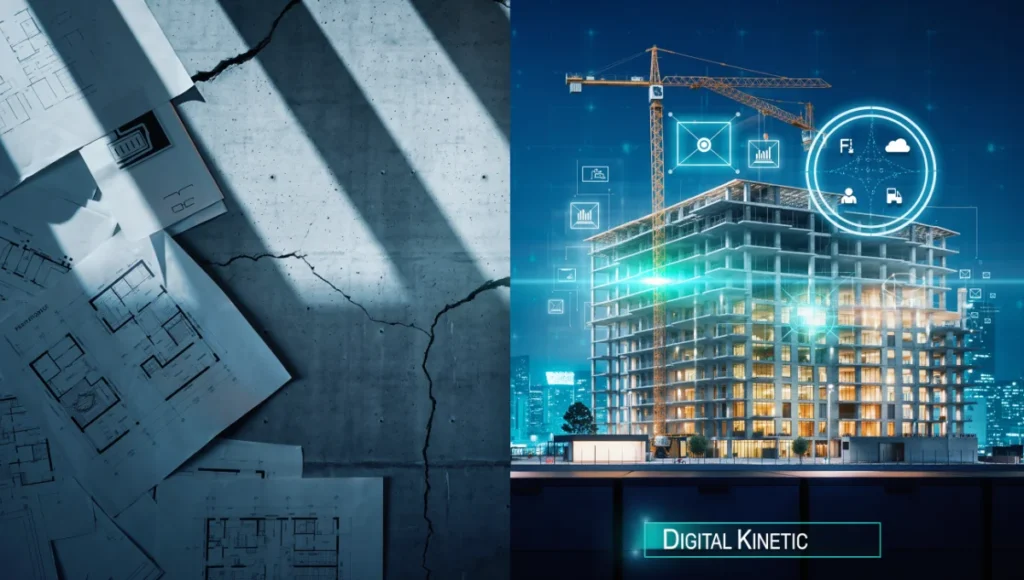
At Nuvira Space, we view the built environment not as a collection of static objects, but as a high-fidelity synthesis of human intent and machine execution. We are the architects of the “Digital Kinetic,” where every structural node is a data point and every design iteration is a verifiable transaction. We don’t just design spaces; we architect the protocols of trust that allow 8-axis robotic arms and generative algorithms to build with the precision of a Swiss timepiece. The following analysis is our manifesto for a decentralized AEC (Architecture, Engineering, and Construction) industry.
Technical Deep Dive: The Parametric Chain
The synthesis of blockchain and parametric design moves us beyond “BIM” into “Distributed BIM” (d-BIM). Here, the model is not a single file on a server, but a series of cryptographically signed updates. This shift is essential as we transition toward more complex systems like 3D printed neighborhoods, where the precision of the digital file directly dictates the structural integrity of the printed concrete.
8 Vital Impacts of Blockchain in Architecture and IP

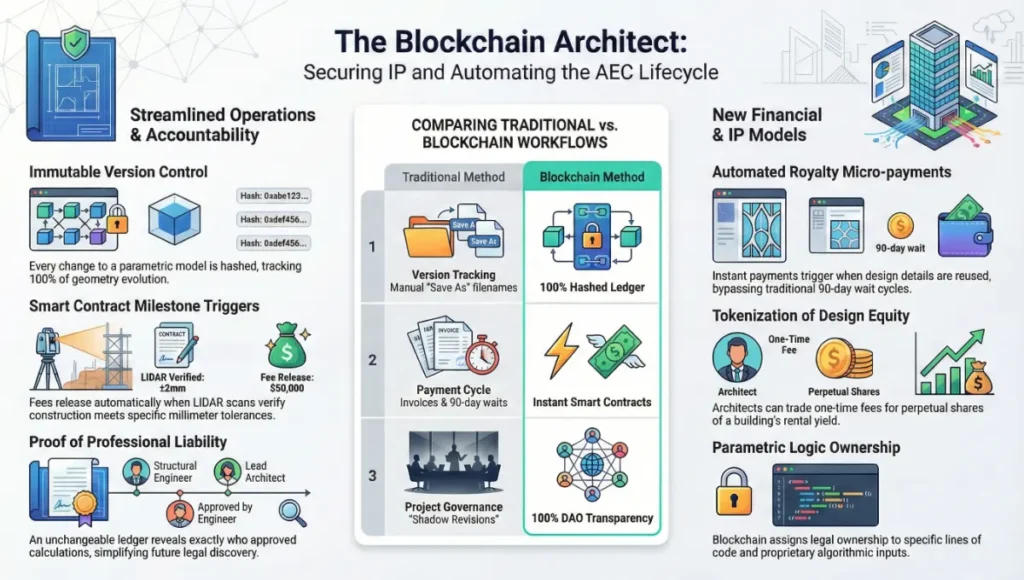
- 1. Immutable Version Control: Every push to a parametric model is hashed. You no longer “Save As” V2_Final_Final. Instead, you commit a change to a ledger that tracks 100% of the geometry’s evolution. In a project with 4,000+ individual components, knowing the exact timestamp of a change to a 5-millimeter tolerance joint is the difference between a successful build and a catastrophic failure.
- 2. Automated Royalty Micro-payments: When a specific 3D-printed joint detail you designed is reused in another project, a Smart Contract triggers an instant payment. No invoices. No 90-day wait cycles. We are moving toward a “Creative Commons” for professional AEC assets where high-performance details are licensed automatically.
- 3. Provenance of Sustainable Materials: In cities like Copenhagen, blockchain is being tested to track the lifecycle of materials in circular construction and design. We can now verify that a reclaimed timber beam has a moisture content of 12% and a verified origin from a specific deconstructed 1920s warehouse with 0.001% margin of error in its carbon footprint report.
- 4. IP Protection in Collaborative Environments: In a project with 15+ different consultants, who owns the “Parametric Logic”? Blockchain assigns ownership to the specific lines of code and algorithmic inputs. This is particularly vital for radical typologies like urban earthships, where proprietary off-grid systems must be protected while allowing for site-specific adaptations.
- 5. Smart Contract Milestone Triggers: Payments are tied to the “As-Built” model. When a LIDAR scan verifies that a wall is placed within a 2-millimeter tolerance, the blockchain releases 15% of the contractor’s fee automatically. This removes the “Trust Deficit” that currently plagues the AEC sector.
- 6. Decentralized Project Governance: Large-scale developments can utilize DAOs (Decentralized Autonomous Organizations) for stakeholder voting on design variations, ensuring 100% transparency. This prevents the “Shadow Revisions” that often lead to budget overruns in 90% of government-funded infrastructure projects.
- 7. Proof of Professional Liability: If a structural failure occurs 10 years later, the immutable ledger reveals exactly who signed off on the 4th iteration of the load-bearing calculations, removing the “he-said, she-said” of legal discovery. The American Institute of Architects (AIA) has noted in various whitepapers the increasing need for integrated project delivery; blockchain is the technological fulfillment of that need.
- 8. Tokenization of Fractional Real Estate: Architects can now retain 2% equity in their designs through tokenized shares. Instead of a one-time fee of $50,000, an architect might receive $5,000 upfront and a perpetual 0.5% share of the building’s rental yield, turning a service into a long-term yield asset.
Securing IP and Automating the AEC Lifecycle
Comparative Analysis: The New Standard
| Feature | Industry Standard (Legacy) | Nuvira Solution (Blockchain-Enabled) |
|---|---|---|
| Contract Execution | Manual invoicing, 30-60 day delays | Smart Contracts, instant 0-day settlement |
| IP Ownership | Copyright filing, easily plagiarized | Cryptographic hashing, immutable proof |
| Data Integrity | Siloed PDF/DWG files | Unified Distributed Ledger (d-BIM) |
| BIM Updates | Centralized server, prone to overwriting | Multi-signature verification for all edits |
| Liability Tracking | Fragmented email chains | Single Source of Truth (SSOT) Ledger |
| Supply Chain | Opaque, prone to “greenwashing” | 100% transparent material provenance |
Concept Project Spotlight: Speculative / Internal Concept Study “NEXUS-01” by Nuvira Space
Project Overview: Singapore / Vertical Habitat / Autonomous Fabrication
NEXUS-01 is a 45-story modular residential tower designed for the high-density climate of Singapore. The vision is a “Self-Actualizing Building”—a structure that manages its own maintenance contracts and structural upgrades through a decentralized autonomous protocol.

Design Levers Applied:
- Algorithmic Growth: The tower’s floor plates are generated using a multi-agent system that optimizes for 100% solar autonomy for every unit.
- Fabrication Specs: 12-axis robotic extruders utilized a proprietary carbon-reinforced polymer with a tensile strength of 450 MPa.
- Blockchain Integration: Each of the 1,200 modular units is an NFT (Non-Fungible Token) that contains the complete structural history, maintenance schedule, and energy-usage data of that specific dwelling.
- Thermal Performance: The facade utilizes biometric sensors to adjust 250 micro-flaps based on real-time humidity levels in Singapore.
Transferable Takeaway
The “So What?” is clear: When the building becomes a verifiable asset on the blockchain, the risk for insurers drops by 22%, and the resale liquidity of the property increases because the buyer has 100% certainty of the building’s “medical record.” We are no longer buying “structures”; we are buying “Verified Data Packages Wrapped in Material.”
Intellectual Honesty: Current Limitations
We are not in a utopia yet. The current “Gas Fees” on public blockchains make micro-transactions for every BIM edit cost-prohibitive. Furthermore, while organizations like the AIA provide frameworks for contracts, the legal system in 95% of jurisdictions does not yet recognize a Smart Contract as a legally binding document in a court of law. We are currently navigating a “Hybrid Era” where the ledger acts as a secondary verification layer rather than the primary legal one.
Data privacy is another hurdle. In a “Public Ledger” world, how do we protect the security secrets of a high-profile client? The solution lies in Zero-Knowledge Proofs (ZKPs), which allow us to prove a change was made without revealing the specific geometry of a high-security vault or private residence.
2030 Future Projection
By 2030, we predict the “Architectural Fee” as we know it will vanish. Architects will instead become “Protocol Designers.” We will design the generative systems and the smart contracts that govern them, earning a “Lived-Experience Royalty” every time a person enters a space or a building optimizes its own energy grid. The physical building will be merely a 3D print of a digital contract. In this future, the “Master Builder” is the one who masters the “Master Code.”
The Toolset: 5 Key Tools
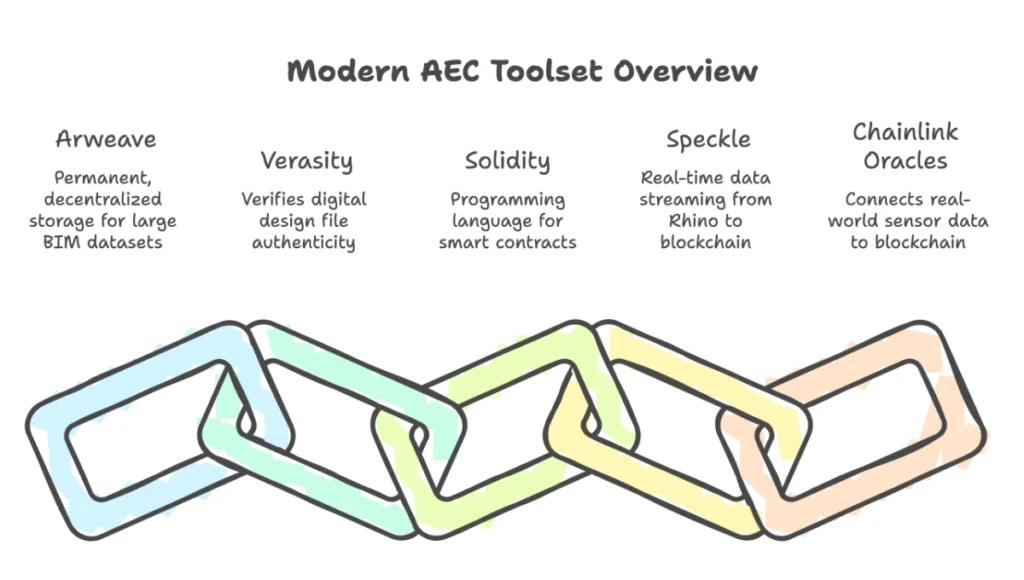
- Arweave: For permanent, decentralized storage of massive 3D BIM datasets (we are talking 500GB+ models).
- Verasity: For verifying the authenticity of digital design files to prevent the “Copy-Paste” culture of the last 2 decades.
- Solidity: The programming language for writing the Smart Contracts that govern our projects—now a required skill for the modern designer.
- Speckle: The “Git for AEC” that allows us to stream data from Rhino to the blockchain in real-time.
- Chainlink Oracles: To connect real-world sensor data (like wind-load or temperature) to our blockchain contracts, triggering automated responses in the building’s skin.
Comprehensive Technical FAQ
Q: Does blockchain in architecture slow down the design process?
A: No. In our NEXUS-01 study, utilizing a Layer-2 scaling solution reduced data latency to less than 200 milliseconds. It actually speeds up the “Sign-off” phase by 40% because stakeholders don’t need to manually review paper sets. The “Lag” in modern architecture isn’t the software; it’s the human bureaucracy.
Q: How do you handle file sizes of 5GB+ on a ledger?
A: We don’t put the file on the chain. We use IPFS (InterPlanetary File System). The blockchain only stores the “Hash” (the 64-character fingerprint) of the file. If even 1 pixel of the 5GB file changes, the hash breaks, alerting us to unauthorized tampering. This ensures 100% data integrity with 0% bloat.
Q: Can I use blockchain with Revit?
A: Yes, through custom API integrations. We currently use a 2-way bridge that pushes Revit “Worksets” to a private Ethereum-compatible sidechain every 10 minutes. This creates a high-fidelity audit trail that is accessible via any web browser.
Q: What does this mean for small firms?
A: It levels the playing field. A 2-person firm in Singapore can now compete on global projects because their IP is protected by the chain, and they can receive payments from international clients via stablecoins with 0.1% transaction fees instead of 5% bank wires.
Q: Is this compatible with sustainable standards?
A: It is the only way to verify them. Without blockchain, “Net Zero” is just a marketing claim. With blockchain, every Watt of energy consumed by the 12-axis robotic arms during fabrication is recorded and offset on-chain.
The New Foundation
The era of the “Star-chitect” is being replaced by the “System-chitect.” If you are still relying on traditional contracts and siloed IP, you are designing for a world that no longer exists. At Nuvira Space, we are building the infrastructure for the next 100 years of design. Join the synthesis.
Securing the Digital Kinetic: Audit Your Design Protocol
The digital foundations of your next project are already being laid. Is your Intellectual Property secure? Join Nuvira Space as we pioneer the transition to d-BIM and immutable design logic. Contact us for a Protocol Audit today and ensure your firm is 2030-ready.