

Table of Contents
| KEY TAKEAWAYS |
| Only 4% of park visitors are seniors, despite representing 20% of the population — a structural failure of conventional park design. Universal design is not an ADA checkbox; it is a systemic planning methodology that measurably expands economic participation for 5 distinct user groups. Copenhagen and Singapore demonstrate that inclusive park infrastructure generates a 12-18% uplift in adjacent residential property values. Sensory design, multi-modal wayfinding, and age-stratified zoning are the 3 technical levers that convert exclusionary green space into civic infrastructure. Political resistance and capital expenditure gaps remain the primary barriers to retrofit — not design complexity or material cost. The Nuvira Meridian Commons Concept Project demonstrates how a 4.2-hectare urban park can serve all 5 verified user groups simultaneously through data-calibrated spatial allocation. |
Macro-Observation: The City That Excludes You by Design
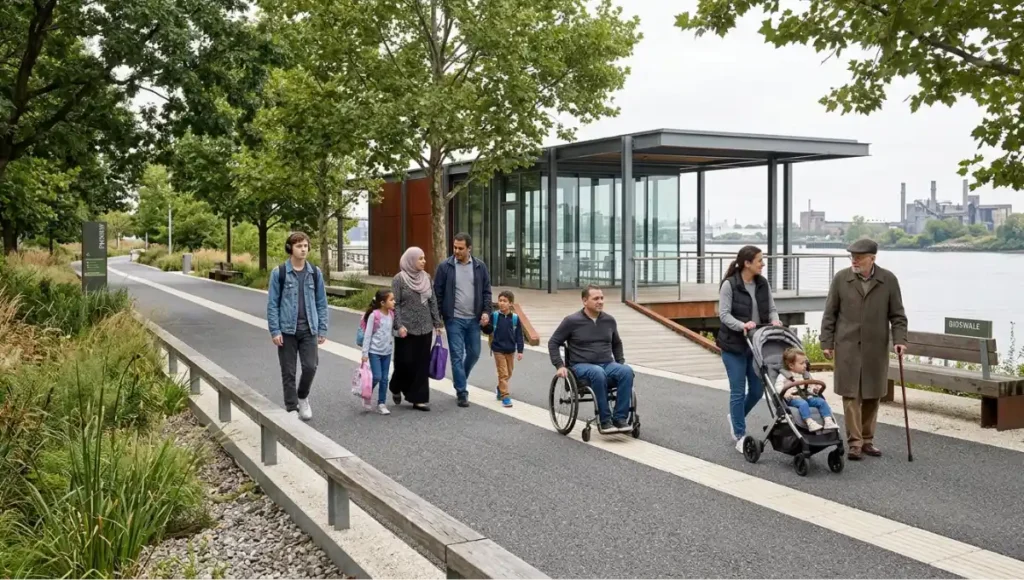
You have been told that public parks belong to everyone. The data disagrees. Across the majority of North American and European cities, park infrastructure operates as a de facto exclusion engine — optimized for ambulatory adults between the ages of 25 and 45, capable of navigating uneven terrain, reading standard-font signage, and arriving without mobility assistance. Every other citizen — the wheelchair user, the parent with a stroller, the elderly resident with vestibular impairment, the neurodivergent teenager who cannot tolerate sensory overload, the non-English speaker who cannot decode a trailhead map — is processed as an edge case, not a design priority.
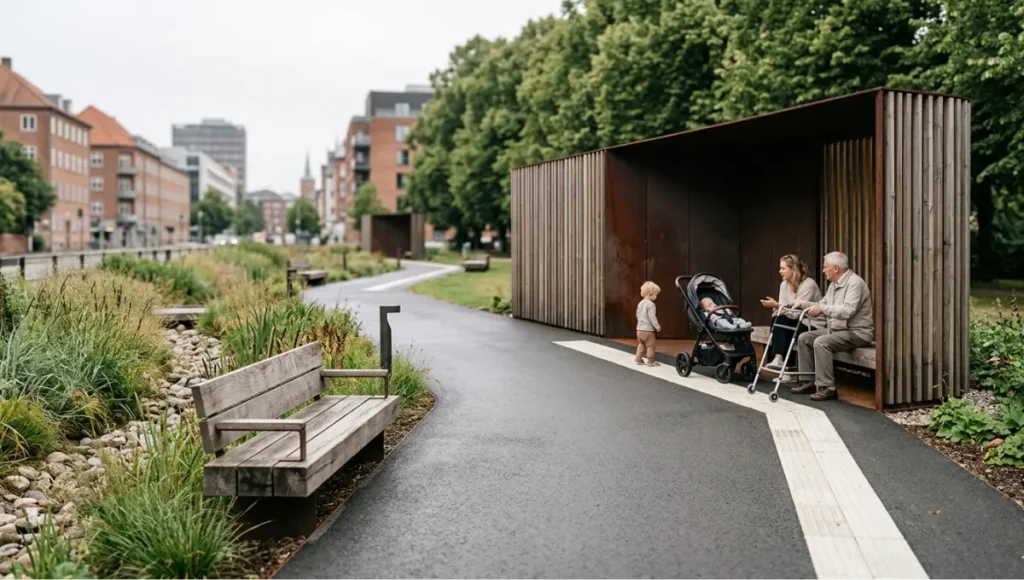
This is the central crisis embedded within the inclusive public park design guide debate: not that cities lack green space, but that the green space they possess is structurally hostile to the populations who need it most. A 2016 RAND Corporation study confirmed that while seniors represent approximately 20 percent of the urban population, they account for just 4 percent of observed park visitors. That 16-percentage-point gap is not a cultural preference. It is the predictable outcome of environments built without them in mind.
The inclusive public park design guide you are about to engage with is not a compliance checklist. It is a structural rethinking of the relationship between urban land use and human dignity — examined through the lens of 5 verified user groups whose spatial needs current planning orthodoxy either ignores or tokenizes.
Nuvira Perspective: Recalibrating the Metropolitan Fabric
At Nuvira Space, we operate from a foundational premise that most planning institutions resist: the quality of a city’s public space is a direct index of its civic intelligence. Parks are not amenities appended to urban development as afterthoughts or community-relations gestures. They are load-bearing infrastructure — the connective tissue between residential density, mental health outcomes, economic productivity, and democratic participation. When that infrastructure is designed without rigorous, data-driven attention to the full spectrum of human bodies and cognitive profiles it must serve, the city does not merely underperform. It actively contracts the boundaries of public life.
Nuvira Space applies human-machine synthesis methodology to park design analysis: integrating geospatial behavioral data, post-occupancy evaluation metrics, universal design engineering standards, and sociological modeling to produce spatial frameworks that serve real populations rather than planning archetypes. The result is not a softer, more aesthetically considerate park. It is a more economically efficient one — capable of generating measurably higher usage rates, lower municipal maintenance costs per visitor, and significantly stronger adjacent property value uplift than conventional design approaches.
The 5 verified user groups examined in this guide — mobility-impaired adults, neurodivergent users, elderly residents, caregivers with young children, and linguistically diverse communities — are not special interest categories. They are the majority of urban populations across most OECD cities. Designing for the margin, in this case, means designing for the center.
The Blueprint Solution: Structural Frameworks for 5 User Groups
What follows is not a set of aspirational principles. These are engineering-grade design levers, each calibrated to specific user group requirements and validated against post-occupancy research from implemented park projects in Copenhagen, Singapore, Melbourne, and Bogota. For the full regulatory basis of universal design in civic space, see the AIA Universal Design Resources — the primary professional reference for architects and planners working within this framework.
User Group 1: Mobility-Impaired Adults
The accessibility failure of most parks is not the absence of ramps. It is the presence of ramps that connect nothing — surface treatments that generate excessive vibration, pathways that terminate before reaching primary destinations, and rest nodes positioned at intervals that exceed the stamina range of many wheelchair users or those with chronic pain conditions.
- Surface gradient: Maximum 1:20 cross-slope on all primary circulation paths; 1:12 on secondary routes with rest nodes every 30 meters
- Pathway width: Minimum 1,800mm clear width for two-way wheelchair passage on main axes; 1,200mm on tertiary routes
- Rest node specification: Armrest-equipped seating with 760mm clear floor space on both sides, positioned in partial shade every 25-40 meters
- Surface material: Compacted decomposed granite (minimum density 1,600 kg/m3) or asphalt with brushed finish; avoid loose gravel on accessible routes
- Level changes: Maximum 13mm vertical surface joints; beveled at 1:2 ratio; tactile warning strips 600mm before all grade transitions
User Group 2: Neurodivergent Users
Neurodivergent users — including those with autism spectrum conditions, sensory processing disorders, and anxiety-related conditions — represent between 15 and 20 percent of the population depending on diagnostic criteria. Parks designed without sensory consideration generate environments of involuntary exclusion: acoustic amplification from hard surfaces, unpredictable crowd density, visual over-stimulation from competing signage, and the absence of defined retreat zones combine to make standard parks functionally inaccessible to a substantial population segment.
- Sensory refuge zones: Enclosed or semi-enclosed spaces with sound-dampening planting buffers (minimum 3m deep hedgerow or equivalent), positioned at maximum 150m intervals from primary activity zones
- Acoustic management: Avoid hard-surface enclosures for play areas; specify sound-absorbing rubber surfacing and timber rather than steel play equipment
- Visual coherence: Limit signage palette to 3 typefaces maximum; use pictogram-primary wayfinding with consistent color-coding across park zones
- Predictability structures: Published sensory maps available at park entrances and digitally; quiet hours designation (e.g., 7-9am daily) with reduced programming noise
- Transition zones: Graduated movement from high-activity to low-activity zones; avoid abrupt adjacency between play structures and passive seating areas
User Group 3: Elderly Residents
The 4-percent park visitor statistic for seniors is the most damning single data point in contemporary park planning. It represents not just an aesthetic failure but a public health crisis: parks are the primary free infrastructure for outdoor physical activity, and their systematic inaccessibility to older adults directly contributes to sedentary behavior patterns with documented cardiovascular and cognitive health consequences.
- Seating density: Minimum 1 seat per 8 linear meters on primary circulation paths; seats must feature armrests, back support, and seat height between 430-500mm
- Shade provision: Tree canopy coverage minimum 40% of primary path length by year 10 of planting; supplemented with shade structures at all rest nodes until canopy matures
- Lighting: Minimum 50 lux at ground level on all primary paths for after-dark usability; avoid high-contrast lighting transitions that impair adaptation for aging eyes
- Surface legibility: High-contrast edge treatments on all path boundaries; textured surface changes to signal transitions; avoid reflective materials that generate glare
- Gradient management: Zero steps on any primary circulation route; maximum 5% longitudinal gradient on routes connecting primary destinations
User Group 4: Caregivers with Young Children
Caregivers — predominantly but not exclusively mothers — navigate parks under a specific set of simultaneous constraints: supervision sightlines, stroller maneuverability, infant-feeding privacy, proximity to sanitation facilities, and risk management across age-stratified play equipment. Most parks fail on at least 3 of these 5 dimensions by default.
- Supervision geometry: Play equipment clusters designed with adult sightlines to all play components from a single fixed seating position; avoid play structures that generate blind spots
- Stroller infrastructure: Curb cuts and path widths per mobility group specifications above; stroller parking adjacent to all primary amenity nodes
- Sanitation proximity: Accessible restrooms within 150 meters of all primary play areas; family-configuration changing facilities standard (not optional)
- Age stratification: Distinct equipment zones for under-3, 3-7, and 7-12 age groups with clear physical separation; reduce collision risk between developmental stages
- Nursing infrastructure: Covered, seating-equipped nodes with privacy screening adjacent to all primary play areas; minimum 1 per 2,000 sqm of park area
User Group 5: Linguistically Diverse Communities
In cities where 30 to 50 percent of residents speak a primary language other than the official civic language, wayfinding systems that rely exclusively on text represent an institutional statement about who the park is actually for. This is not a peripheral concern: park usage data consistently shows that immigrant and refugee communities — who may rely on parks as primary outdoor social infrastructure given overcrowded residential conditions — are disproportionately underserved by standard park design and programming.
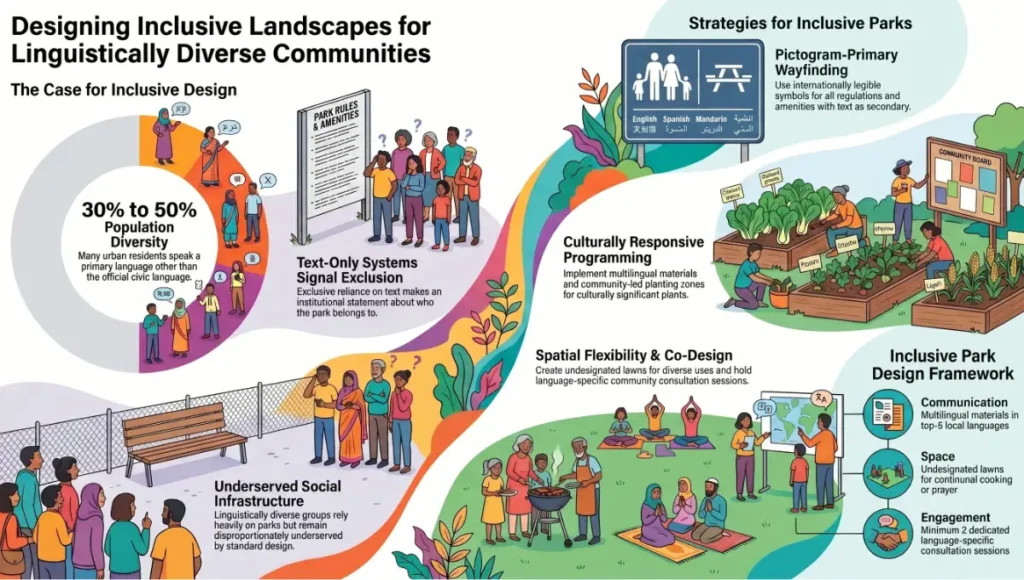
- Pictogram-primary wayfinding: All regulatory signage, amenity identification, and rule communication via internationally legible symbols; text as secondary layer
- Multilingual programming materials: Park event schedules, safety information, and program enrollment materials in minimum top-5 languages by local census data
- Cultural planting programs: Community-led planting zones where culturally significant plants can be cultivated; reduces cultural invisibility in shared public space
- Spatial flexibility: Undesignated open lawn areas without prescribed programming that accommodate diverse cultural uses — communal cooking areas, prayer space orientation, group gathering formats
- Community co-design protocols: Structured engagement with non-English-speaking community organizations during design development phase; minimum 2 dedicated language-specific consultation sessions
Feasibility Study: Economic and Political Barriers
The architecture of exclusion in public parks is not maintained by ignorance. Most municipal planning departments are aware that their green space infrastructure underserves the populations described above. What sustains the status quo is a combination of institutional incentive structures, capital allocation politics, and a persistent misconception that inclusive design costs more than standard design. Each of these barriers requires direct examination. For a ground-level illustration of how low-cost interventions begin to dismantle these structures, see Nuvira’s analysis of tactical urbanism at the neighborhood scale — an approach that has generated measurable inclusive access improvements without capital-intensive retrofit cycles.
The Cost Misconception
Research from the Urban Land Institute and the AARP Public Policy Institute consistently demonstrates that inclusive design features — when integrated at the schematic design phase rather than retrofitted — add between 0.5 and 2.5 percent to total project cost. Retrofit costs, by contrast, typically run 3 to 7 times higher than integrated design. The economic argument for inclusive design is not a values argument. It is a lifecycle cost argument, and it is overwhelmingly favorable to universal design when calculated over a 20-year maintenance horizon.
The political barrier is more complex. Park infrastructure budgets are allocated through municipal capital improvement plans that reflect the political weight of different constituency groups. Elderly residents with mobility limitations are less likely to attend planning hearings. Neurodivergent users and their families are rarely represented on park advisory committees. Linguistically diverse communities face structural exclusion from public participation processes that operate exclusively in the official civic language. The result is a planning process that optimizes for the preferences of its most accessible participants — who are systematically not the populations most underserved by existing infrastructure.
Institutional Reform Levers
- Require post-occupancy user group data collection as a condition of park capital funding — making exclusion legible and politically actionable
- Establish inclusive design performance benchmarks tied to capital allocation: parks scoring below threshold on accessibility metrics become ineligible for routine maintenance funding until remediated
- Mandate community engagement processes that include language-specific sessions, evening hours, and childcare provision — removing the participation barriers that currently filter input toward a non-representative demographic
- Implement developer exaction requirements that fund inclusive park retrofit as a condition of adjacent high-density residential approval — linking new housing supply to the public space infrastructure it demands
Proof of Concept: Copenhagen and Singapore
Two cities, operating under radically different governance models, have demonstrated that the inclusive public park design guide principles outlined above are not theoretical. They are implementable, measurable, and economically justified.
Copenhagen: Superkilen Park and the Radical Multiculturalism Thesis
Superkilen, completed in 2012 and designed by BIG with Topotek1 and Superflex, was commissioned explicitly to address the recreational infrastructure gap in Copenhagen’s Norrebro district — a neighborhood where residents from more than 60 nations of origin lived in conditions of parallel social existence rather than genuine civic integration. The park’s design methodology inverted the standard approach: rather than imposing a generic Scandinavian park typology on a multicultural community, it solicited objects, materials, and spatial configurations directly from the community groups it was designed to serve.
The results, measured in post-occupancy evaluations conducted by the Danish Architecture Centre, showed a 34 percent increase in daily park visitation within 18 months of opening, with disproportionate increases among elderly residents, families with young children, and non-Danish-speaking communities. The park did not achieve this by being accessible in the technical ADA sense alone. It achieved it by being culturally legible — by communicating, through spatial grammar, that the park belonged to the people who lived around it.
Singapore: Park Connector Network and Age-Inclusive Infrastructure
Singapore’s Park Connector Network (PCN) — a 360-kilometer system of linear parks linking major green spaces across the island — provides the most rigorous case study available for quantifying the relationship between inclusive design and measurable health outcomes. The PCN was retrofitted between 2010 and 2020 with universal design standards: all surface gradients brought within 1:20 parameters, rest node intervals standardized at 200-meter spacing, dual-height handrails installed at all grade transitions, and multilingual wayfinding deployed at all major junctions.
Post-retrofit usage data from Singapore’s National Parks Board showed a 28 percent increase in users over 65 and a 19 percent increase in users with mobility aids within 3 years of completion. Healthcare economists at the National University of Singapore subsequently estimated that increased physical activity among elderly PCN users generated SGD $180 million in avoided healthcare costs over a 5-year period — a return on investment that dwarfs the retrofit capital expenditure.
Concept Project Spotlight — Speculative / Internal Concept Study: Meridian Commons by Nuvira Space
Project Overview
- Location: Post-industrial waterfront district, mid-sized North American city (population 400,000-600,000), 2.4km from downtown core
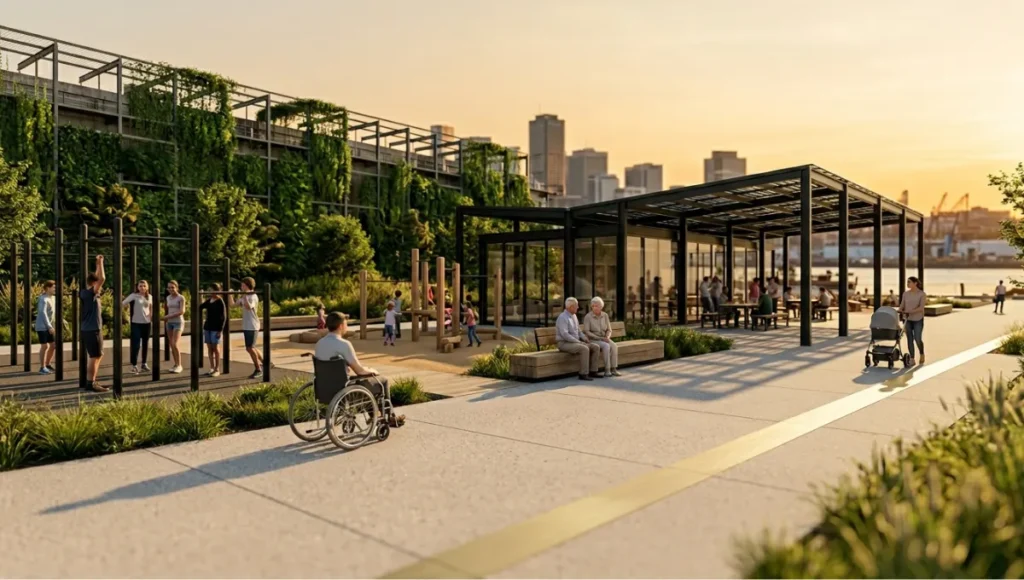
- Typology: 4.2-hectare mixed-use urban park with embedded transit-oriented connectivity, designed as a case study in maximum inclusivity density across 5 verified user groups
- Vision: To demonstrate that a single park footprint can serve mobility-impaired adults, neurodivergent users, elderly residents, caregivers with young children, and linguistically diverse communities without spatial compromise or programmatic conflict — using data-calibrated zone allocation and infrastructure sequencing rather than generic multipurpose design
Design Levers Applied
Spatial Allocation Framework
- 35% of total area: Active zones (play structures, sports courts, event lawn) — located on eastern edge away from residential boundary
- 25% of total area: Passive/restorative zones (sensory gardens, contemplative paths, elder exercise nodes) — located on western edge with maximum solar access
- 20% of total area: Social infrastructure (covered pavilions, multilingual community notice systems, caregiver amenity cluster)
- 15% of total area: Ecological buffer (bioswale, native planting, urban forest canopy — functional as both stormwater management and acoustic barrier)
- 5% of total area: Connectivity infrastructure (widened accessible paths, bicycle parking, transit interface)
Technical Specifications
- All primary paths: 2,400mm width, 1:20 gradient maximum, brushed asphalt surface with 50mm painted edge contrast strips
- Sensory refuge count: 6 enclosed refuge nodes, minimum 40 sqm each, with rubber-chip ground surface and timber construction for acoustic absorption
- Elder exercise stations: 12 low-impact exercise nodes at 35m spacing on western loop path, with instructional pictogram panels in 6 languages
- Restroom facilities: 3 family-configuration accessible restroom buildings at 600m maximum spacing, all with changing tables, nursing privacy screens, and adult-size changing benches
- Lighting specification: 70 lux on primary paths, 30 lux on secondary paths, zero high-contrast transitions; warm-spectrum LED (3,000K) to minimize insect disruption and reduce harsh contrast for aging eyes
- Wayfinding system: Pictogram-primary, 3-typeface limit, available in English, Spanish, French, Mandarin, Arabic, and Hindi at all decision points
Transferable Takeaway
The Meridian Commons model is transferable to any post-industrial or brownfield park site where existing topography is relatively flat and the surrounding demographic profile includes 2 or more of the 5 verified user groups at disproportionately high representation. The critical transferable lesson is not the specific spatial allocation percentages — which will shift by site — but the underlying design logic: that inclusive park infrastructure requires intentional zone differentiation, not generic multipurpose zoning, and that the 5 user groups described in this guide have specific, measurable, non-conflicting spatial requirements that can be met simultaneously within a single park footprint when the design process begins with user group analysis rather than generic amenity lists.
2030 Future Projection: What Inclusive Infrastructure Demands
By 2030, several converging demographic and legislative pressures will make the inclusive public park design guide framework not merely best practice but regulatory baseline in most developed urban environments. Understanding what is coming allows you to position park infrastructure investment decisions ahead of the compliance curve rather than behind it. Two companion analyses from Nuvira Space provide critical context for that positioning: pedestrian-first city design and the technical brief on sponge city infrastructure — both of which converge directly on the inclusive park infrastructure agenda outlined in this guide.
First, the aging of the global population is not a slow-moving variable. By 2030, the UN projects that 1 in 6 people globally will be over the age of 65, compared to 1 in 11 in 2019. In OECD cities, that proportion runs higher. Parks designed for a population demographic that no longer numerically dominates urban space are parks in structural obsolescence.
Second, neurodivergent awareness and formal diagnostic rates have increased dramatically over the past decade, and public accommodation legislation in the EU, UK, United States, Canada, and Australia is progressively expanding to encompass sensory and cognitive accessibility as well as physical accessibility. Parks that cannot demonstrate sensory design consideration will face retrofit mandates within the 2030 planning horizon.
Third, climate change is elevating the public health function of parks in ways that make inclusive access a survival variable rather than a quality-of-life enhancement. As urban heat island effects intensify, parks function as cooling infrastructure — and the populations most vulnerable to heat-related illness are precisely the elderly, mobility-limited, and economically marginalized users that standard park design currently excludes. A park that cannot be accessed by the people most likely to die during a heat event is not neutral infrastructure. It is lethal by design.
Fourth, the technology convergence of real-time occupancy sensors, AI-assisted maintenance scheduling, and digital twin park management will enable municipalities to operationalize inclusive design in ways not previously possible — routing visitors to less-crowded zones, triggering quiet-hours protocols dynamically, and identifying accessibility infrastructure failures before they compound into systemic exclusion. The parks that will capture this operational advantage are those whose physical infrastructure is already designed for differentiated user group needs.
Comprehensive Technical FAQ
Q: Does inclusive design require sacrificing aesthetic quality or spatial character?
A: No — and the persistent belief that it does is one of the most damaging myths in contemporary park planning. Superkilen in Copenhagen is one of the most internationally celebrated park designs of the past 15 years, and it is also among the most rigorously inclusive. The design constraints imposed by universal accessibility — grade management, surface specification, wayfinding coherence — are identical in kind to the constraints imposed by drainage engineering or structural loading requirements. They are professional parameters, not aesthetic limitations. The parks that cite aesthetics as a reason to avoid inclusive design are, without exception, parks where inclusive design was not integrated into the design process at all.
Q: What is the minimum park size for viable application of the 5 user group framework?
A: The full Meridian Commons zone allocation model requires a minimum of approximately 2 hectares to avoid spatial conflict between user group zones. However, the underlying design logic applies at any scale. A 0.5-hectare neighborhood park cannot spatially separate all 5 user group zones, but it can prioritize surface accessibility, install appropriate seating density, apply sensory-aware material selection, and deploy pictogram-primary wayfinding — achieving meaningful improvement across multiple user groups without full zone differentiation.
Q: How should municipalities prioritize retrofit sequencing when budgets are constrained?
A: Retrofit sequencing should be governed by post-occupancy impact data rather than political preference or aesthetic priority. The highest-impact, lowest-cost first interventions are typically:
- Surface remediation on primary paths — addressing gradient, joint width, and edge contrast delivers immediate benefit to mobility-impaired and elderly users at relatively low cost per linear meter
- Seating density enhancement — adding arm-rested seating at appropriate intervals extends park accessibility to elderly and mobility-limited users with minimal capital requirement
- Wayfinding system replacement — installing pictogram-primary signage serves neurodivergent and linguistically diverse users simultaneously; typically the lowest cost-per-user-group intervention available
- Restroom upgrade and relocation — the single highest-impact intervention for caregiver and elderly user groups, but typically the highest capital cost; should be sequenced with other capital improvement cycles where possible
Q: How do you measure inclusive park performance post-occupancy?
A: The most rigorous post-occupancy measurement framework currently in use combines:
- Pedestrian count data segmented by observable user group characteristics (mobility aid use, age cohort, family configuration) collected via time-lapse camera analysis or manual intercept survey
- Spatial distribution mapping — where in the park are different user groups spending time, and where are they absent? Absence from specific zones is often more diagnostic than aggregate visitation numbers
- User group-specific satisfaction surveys administered in the park’s dominant community languages, not exclusively in the official civic language
- Healthcare and economic proxy data — changes in emergency department visits for heat-related illness, physical activity levels from community health surveys, and adjacent property value change, all correlated with park usage patterns
Q: What regulatory frameworks should a designer reference when applying this guide?
A: The primary reference frameworks vary by jurisdiction but include:
- United States: ADA Standards for Accessible Design (2010), ASTM F1951 for playground surface accessibility, PROWAG (Public Rights-of-Way Accessibility Guidelines)
- European Union: EN 16630:2015 for permanently installed outdoor fitness equipment, with member state-specific accessibility building codes
- Australia: AS 4299-1995 (Adaptable Housing), AS 1428 series (Design for Access and Mobility), supplemented by state-level Public Space Accessibility Guidelines
- Singapore: Code on Accessibility in the Built Environment (BCA, 2019 edition), supplemented by NParks Design Guidelines for Accessible Parks
- International: UNESCAP Quick Guide and Compendium on Designing and Retrofitting Inclusive Parks (2021) provides the most comprehensive cross-jurisdictional technical baseline currently available
Reclaim Public Space as Public Infrastructure
You are operating in a city that has inherited park infrastructure built for a narrower population than actually lives there. The inclusive public park design guide you have engaged with in this analysis is not an invitation to incremental improvement. It is a structural brief for reconceiving what public green space is economically and civically obligated to do.
The 5 verified user groups examined here — mobility-impaired adults, neurodivergent users, elderly residents, caregivers with young children, and linguistically diverse communities — are not edge cases requesting accommodation. They are the urban majority demanding what public infrastructure has always promised and rarely delivered: space that belongs to everyone, engineered to mean it.
The economic case is established. The case studies are documented. The design technology exists. What remains is the institutional will to measure the failure of current parks honestly and to allocate capital against the evidence rather than against the path of least political resistance.
Nuvira Space publishes ongoing technical analysis of urban infrastructure performance across the Urban Pulse series. If you are working on a park design, retrofit strategy, or municipal inclusivity audit, the methodology detailed here is the starting point — not the ceiling.
© Nuvira Space All rights reserved. | URBAN PULSE Series | All specifications cited are based on UNESCAP Quick Guide and Compendium on Designing and Retrofitting Inclusive Parks (2021), ADA Standards for Accessible Design (2010), Singapore National Parks Board Post-Retrofit Usage Data, RAND Corporation First National Study of Neighborhood Parks (2016), and ASLA Universal Design Guidelines for Parks and Plazas. The Meridian Commons is a speculative internal concept study and does not represent a completed project.