

make you happy. These 8 core traits cover what it is, how it
works, and where to start.
Table of Contents
Dopamine Decor Interior Design Is Not About “Pretty”—It Is About Rewiring Your Biology
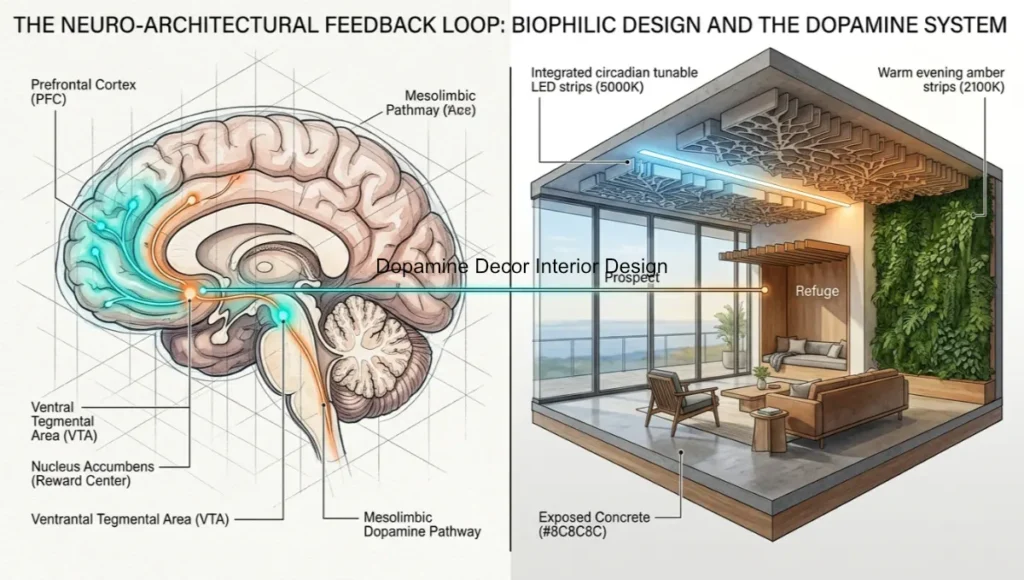
You have been told that interior design is a matter of taste. That “dopamine decor” means painting your walls coral and buying a chartreuse chair. But your brain does not care about trend cycles. It cares about survival. Every square meter of your home is a signal environment—an interface between your nervous system and the built world. When you walk into a room, your ventral tegmental area (VTA) is already firing, your nucleus accumbens is assigning value, and your prefrontal cortex is deciding whether this space is worth your attention or your retreat. Dopamine decor interior design is not a style. It is a neuro-architectural discipline that treats your home as a programmable health machine.
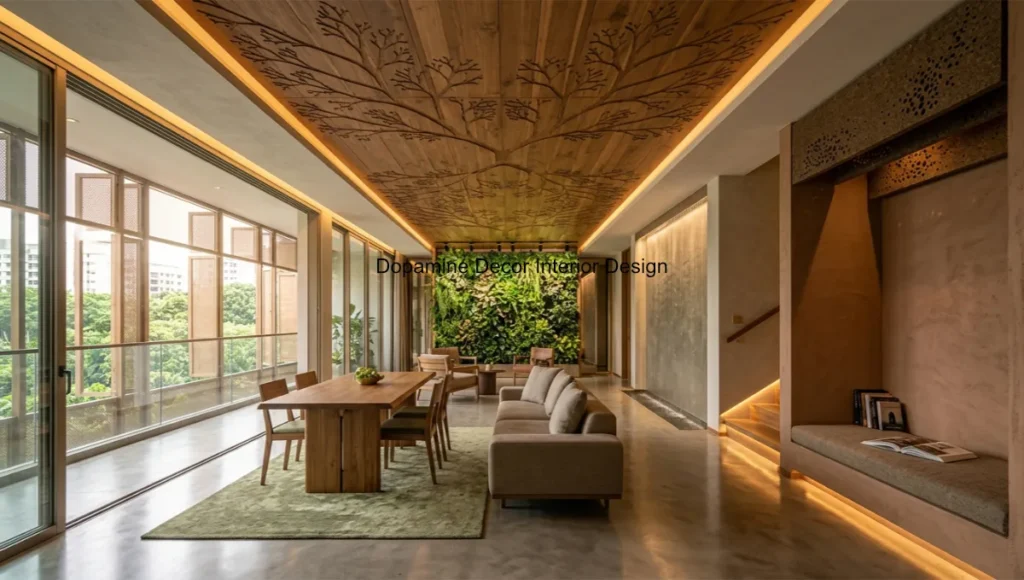
The global shift toward dopamine-centric interiors is not happening because people suddenly love color. It is happening because the evidence is now overwhelming: your spatial environment modulates dopamine release, circadian entrainment, stress recovery, and cognitive performance at a scale that rivals pharmacological intervention. The question is no longer whether your space affects your brain. The question is whether you are designing with intent—or allowing your neurochemistry to be dictated by default.
Nuvira Perspective
At Nuvira Space, we do not believe in “decor.” We believe in environmental programming. The home is no longer a container for furniture. It is a health machine—a modular, adaptive organism that synchronizes with your circadian biology, responds to your physiological state, and evolves as your life evolves. We operate at the intersection of human-machine synthesis and spatial neuroscience, designing environments where modular adaptability and circadian synchronization are not features but foundational operating principles. The next era of domestic life will be defined by spaces that think, breathe, and heal. This article is our field manual for that transition.
Technical Deep Dive: The Neuroscience of Spatial Dopamine
What Dopamine Actually Does in Your Brain
Before you can design for dopamine, you must understand what dopamine is not. It is not a “pleasure chemical.” It is a motivation signal. The mesolimbic pathway—VTA to nucleus accumbens to prefrontal cortex—drives every goal-directed behavior you have ever performed. Research demonstrates that dopamine D1-receptor organization follows a gradient across the cortical hierarchy, with higher density in associative cortex than in somatosensory regions, directly mirroring functional brain architecture.
This means your brain’s reward system is not primitive. It is the most flexible motivation engine in the animal kingdom, responsive to curiosity, novelty, social connection, and spatial exploration. Your home can either nourish this system or starve it.
The Eight Spatial Levers of Dopamine Decor Interior Design
1. Prospect and Refuge Balance
Your brain evolved on the African savanna. For millions of years, survival depended on two spatial instincts: the ability to see threats and opportunities across distance (prospect), and the ability to withdraw into protected shelter (refuge). These are not aesthetic preferences. They are hardwired neurological requirements.
The Terrapin Bright Green 14 Patterns framework identifies Prospect as “an unimpeded view over a distance” and Refuge as “a place for withdrawal… in which the individual is protected from behind and overhead.” When you design a living room with a single dominant sightline toward a window or garden, you are not creating a “view.” You are activating the same neural networks—place cells, grid cells, border cells in the hippocampal-entorhinal region—that map your position in space and regulate your sense of safety.
Technical Specs:
- Minimum focal length for prospect activation: ≥6 meters (20 feet), optimally 30 meters
- Refuge threshold: overhead protection + at least two-sided enclosure
- Optimal prospect-to-refuge ratio in residential spaces: 60:40 open to enclosed
2. Fractal Geometry and Stress Reduction
Natural environments are fractal. Tree branching, river deltas, cloud formations—all exhibit self-similar patterns across scales. Your visual system is fluent in this language. Research funded by NASA demonstrated that exposure to mid-dimensional fractal patterns reduced physiological stress by 60% as measured by skin conductance during stress-recovery tasks.
This is not decoration. This is environmental medicine. When you incorporate fractal patterns—through biomorphic light fixtures, organic textile weaves, or natural wood grain—you are providing your visual cortex with the complexity it evolved to process, triggering parasympathetic recovery rather than sympathetic overload.
Technical Specs:
- Preferred fractal dimension (D-value) for stress reduction: 1.3–1.5 for statistical fractals
- Exact fractals tolerate higher D-values (1.5–1.7) due to reduced randomness
- Application: wallcoverings, lighting diffusion patterns, floor treatments, ceiling baffles
3. Ceiling Height and Cognitive Mode
Joan Meyers-Levy’s research at the University of Minnesota established a direct causal link between ceiling height and cognitive processing mode. Subjects in 10-foot (3-meter) ceilings engaged in “freedom-oriented processing”—abstract, creative, holistic thinking. Subjects in 8-foot (2.4-meter) ceilings defaulted to “confinement-oriented processing”—detail-focused, analytical thinking.
Your ceiling is not a surface. It is a cognitive switch. Design your creative spaces with volume. Design your focus spaces with containment. This is not preference. It is neuro-architecture.
Technical Specs:
- Creative/abstract zones: ceiling height ≥3.0 meters (10 feet)
- Focus/detail zones: ceiling height 2.4–2.7 meters (8–9 feet)
- Perceived height amplification: lighter ceiling values increase perceived height by 10–15%
4. Circadian Lighting and Melatonin Architecture
Your circadian system is exquisitely sensitive to light. Recent research analyzing 52 distinct lamp technologies found that “cool” white LEDs suppress melatonin at a median rate of 12.3%, while tunable LEDs shifted to warm evening settings (2100K) reduced suppression to 0.1–0.2%.
Typical indoor evening lighting (150–200 lux) suppresses melatonin production by 50–70% within two hours. Even dim lighting (50–100 lux) reduces melatonin by 20–30%. Suppression begins within 15 minutes and persists for 1–2 hours after lights are extinguished.
Your dopamine decor interior design is incomplete without a lighting protocol that protects your sleep architecture. Because sleep is when your brain consolidates reward learning, clears metabolic waste, and resets dopamine receptor sensitivity.
Technical Specs:
- Evening ambient lighting: <50 lux, CCT ≤2700K
- Pre-sleep transition: <10 lux melanopic equivalent daylight illuminance (m-EDI)
- Morning activation: ≥250 lux at eye level, CCT 5000–6500K for 30 minutes
- Tunable LED systems: violet-pump technology (Sunlike) eliminates blue spike at 450–460 nm
5. Biophilic Materiality and Tactile Resonance
Your somatosensory cortex does not distinguish between visual texture and physical texture. Natural materials—wood, stone, clay, wool—activate evolutionary recognition patterns that synthetic surfaces cannot replicate. Research consistently shows that smooth, cold, synthetic surfaces correlate with elevated stress markers, while natural materials trigger positive emotional processing.
When you touch oak, your brain recognizes the fractal grain structure it has processed for millions of years. When you touch laminate, it registers absence.
Technical Specs:
- Minimum natural material surface area: 40% of visible interior envelope
- Tactile diversity: minimum 3 distinct natural textures per room
- Thermal mass: natural stone/concrete for temperature stability; wood for acoustic dampening
6. Non-Rhythmic Sensory Stimuli
Your brain is a prediction machine. It habituates to repetition and is aroused by stochastic, unpredictable natural stimuli—the flicker of firelight, the rustle of leaves, the movement of water. Terrapin Bright Green identifies Non-Rhythmic Sensory Stimuli as a core biophilic pattern that “positively impacts heart rate, systolic blood pressure, and sympathetic nervous system activity.”
In dopamine terms, predictable environments produce dopaminergic habituation. Slightly unpredictable environments sustain engagement.
Technical Specs:
- Water feature: minimum 1 per 100 m² for auditory non-rhythmic stimulus
- Dynamic light: programmable variation in intensity ±15% over 10-minute cycles
- Airflow variability: 0.1–0.3 m/s fluctuation, not constant HVAC output
7. Color Psychology and Cross-Modal Perception
Research by neurobiologists Semir Zeki and Tomohiro Ishizu demonstrates that aesthetically pleasing visuals activate the brain’s reward center with a neural signature similar to romantic love. Cross-modal perception studies from Oxford’s Crossmodal Lab confirm that one sensory channel influences another: a joyful room makes coffee taste richer and fabrics feel softer.
Color is not surface treatment. It is a neurochemical event. Greens and warm oranges encourage social interaction. Buttery yellows elevate mood. But these effects are context-dependent and must be calibrated to circadian phase and spatial function.
Technical Specs:
- Social spaces: greens (wavelength 520–560 nm) and warm oranges (590–620 nm)
- Restorative spaces: blues (450–495 nm) at low saturation
- Evening spaces: warm whites and ambers; avoid blue-enriched spectra after 18:00
- Color ratio: 60% dominant, 30% secondary, 10% accent
8. Mystery and Controlled Risk
The final lever is the most counterintuitive. Your dopamine system responds to controlled challenge. Terrapin’s Risk/Peril pattern—”an identifiable threat coupled with a reliable safeguard”—produces short dopamine pulses that support motivation, memory, and problem-solving.
A glass floor over a void. A balcony with a transparent barrier. A partially obscured view that promises revelation. These are not stunts. They are neurological calibration tools.
Technical Specs:
- Mystery threshold: 20–40% visual occlusion with navigable path forward
- Risk/Peril: perceived threat must be inert; safeguard must be trusted and visible
- Application: transitional thresholds, mezzanine overlooks, screened garden views
Comparative Analysis: Solution vs. Industry Standard
The Conventional Interior Design Model
The industry standard treats interior design as a visual styling exercise. The workflow is: select a palette, choose furniture, arrange for balance, add accessories. The metrics of success are photographic and social. The physiological impact is accidental.
Industry Standard Characteristics:
- Fixed layouts optimized for single-phase occupancy
- Static lighting (single CCT, fixed intensity)
- Synthetic material dominance for cost and maintenance
- Decorative biophilia (potted plants as accessories)
- No circadian protocol
- No acoustic design
- No fractal or biomorphic pattern integration
The Nuvira Neuro-Architectural Model
The Nuvira model treats the home as an adaptive health platform. Every design decision is filtered through its impact on dopaminergic motivation, circadian entrainment, stress recovery, and cognitive performance.
Nuvira Solution Characteristics:
- Modular layouts that reconfigure with life-phase changes
- Circadian lighting systems with astronomical programming
- Natural material palettes with tactile diversity
- Integrated biophilia (living walls, water features, natural ventilation)
- Evidence-based spatial psychology (prospect/refuge, mystery, complexity/order)
- Acoustic zoning and non-rhythmic sensory programming
- Post-occupancy physiological monitoring
The Gap: The industry standard asks “Does this look good?” The Nuvira model asks “Does this heal?”
Speculative / Internal Concept Study: The Syntropic Loft by Nuvira Space
Project Overview
Location: Singapore (inspired by the biophilic urbanism of the Parkroyal on Pickering and the Gardens by the Bay Supertrees)
Typology: 180 m² urban residential loft for a dual-income, remote-work household with variable circadian needs
Vision: To create a domestic environment that functions as a circadian-synchronized, dopamine-modulated health machine, using Singapore’s tropical biophilic context as both inspiration and calibration reference
Singapore is the world’s leading biophilic city. Its Urban Redevelopment Authority has embedded biophilic requirements into all new development through the Singapore Green Plan 2030, the Biophilic Towns framework, and mandatory GREENMARK certification requiring sky gardens, vertical greenery, and daylit spaces. The Khoo Teck Puat Hospital in Yishun—designed as a “healing environment” with a green plot ratio of 3.92 (total greenery surface nearly four times the land area)—demonstrates what happens when biophilic intent is executed at institutional scale. Post-occupancy evaluation of 200 users found that KTPH outperformed a conventional hospital on perceived beauty, self-reported well-being, and nature awareness. Over 80% of respondents affirmed that hospitals should invest in blue-green elements.
The Syntropic Loft translates these macro-scale biophilic principles into a domestic prototype.
Design Levers Applied
Circadian Infrastructure
- Full-spectrum tunable LED system (Sunlike CRI >97) with GPS-calibrated astronomical clock
- Dawn simulation sequence: 2200K → 3500K over 45 minutes, synchronized to actual Singapore sunrise
- Evening wind-down: 5000K → 2100K over 90 minutes, with melanopic illuminance dropping below 10 m-EDI by 21:00
- Bedroom sanctuary: <5 lux amber-only lighting after 22:00
Prospect-Refuge Programming
- Primary living volume: 3.2-meter ceiling with uninterrupted 12-meter sightline to a vertical garden wall
- Refuge module: acoustically isolated reading alcove with overhead timber canopy, three-sided enclosure, and tactile wool upholstery
- Mystery sequence: curved transition corridor with filtered daylight creating partial occlusion before the main volume reveal
Fractal and Biomorphic Integration
- Ceiling installation: CNC-milled timber paneling with fractal branching pattern (D = 1.4)
- Living wall: 12 m² vertical garden with integrated irrigation and grow-light supplementation
- Floor: reclaimed teak with natural grain variation; no two planks within 2-meter radius share identical pattern
- Lighting diffusion: COB LED strips in deep-reveal profiles producing continuous, shadowless illumination
Material and Tactile Protocol
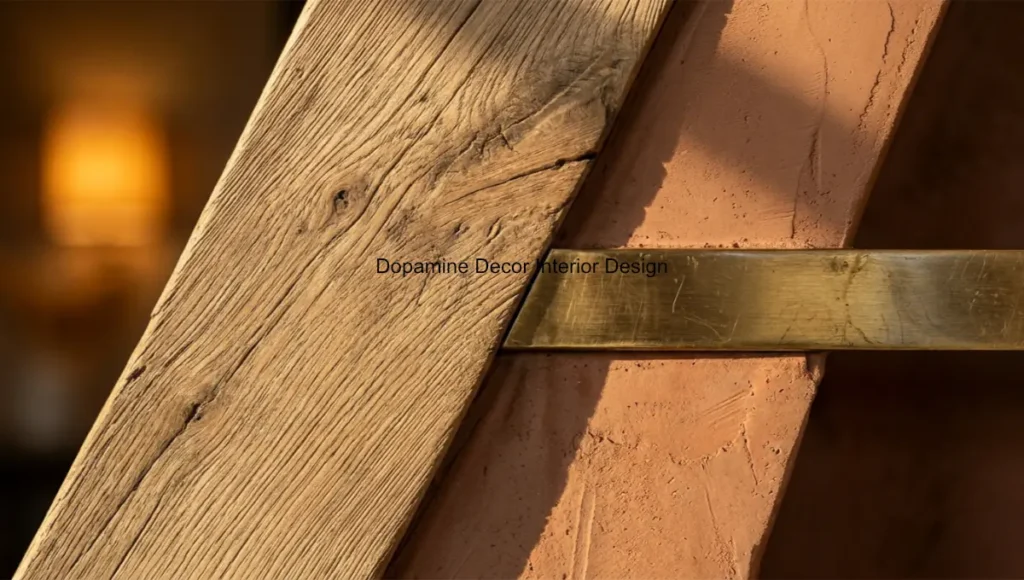
- Natural material coverage: 68% of interior envelope (timber, stone, clay plaster, linen, wool)
- Thermal zoning: polished concrete thermal mass in living areas; timber flooring in refuge zones
- Acoustic treatment: cork ceiling baffles with fractal perforation pattern
Dynamic Sensory Layer
- Water feature: 2-meter vertical rain curtain with variable flow rate (0.5–2.0 L/min) controlled by occupancy sensors
- Airflow: natural ventilation through operable facade panels supplemented by low-velocity displacement ventilation
- Non-rhythmic light: programmable 10-minute intensity cycles (±15%) during daylight hours
Transferable Takeaway
You can apply the same logic at home by tuning evening lighting, building a refuge corner, and simplifying one primary sightline toward a natural anchor.
Even if you cannot install a full circadian system, three changes will shift your home from passive container to active health machine:
- Tune your evening lighting. Replace cool-white bulbs with warm 2700K or lower fixtures in all spaces used after sunset. Keep ambient light below 50 lux in the two hours before sleep. Use dimmers. Your melatonin will thank you.
- Build a refuge corner. Identify a spot in your home where you can sit with your back protected and overhead cover. Add a high-backed chair, a small side table, and a directional reading light. Use it for 20 minutes of daily cognitive restoration.
- Simplify one primary sightline. Clear a single dominant view from your main living space to a natural element—a window, a plant, a water feature. Remove visual clutter in that corridor. The 6-meter minimum focal length activates your brain’s prospect response and reduces baseline stress.
Intellectual Honesty: Current Limitations
What the Science Cannot Yet Promise
We must be transparent about the boundaries of current knowledge.
Individual Variability: Melatonin suppression thresholds vary significantly between individuals. Some people show suppression at light levels as low as 25–30 lux; others tolerate 100+ lux without measurable effect. Age, chronotype, and genetic factors all modulate sensitivity. The 50-lux evening guideline is a population average, not a universal guarantee.
Fractal Research Gap: While laboratory studies demonstrate robust stress reduction from fractal exposure, on-site studies in real architectural settings remain preliminary. The NASA-funded research used image projection, not built environments. We do not yet know whether the 60% stress reduction transfers at full scale or whether aesthetic adaptation reduces effect over time.
Dopamine Measurement Limitations: Most biophilic design research relies on proxy measures—heart rate variability, cortisol levels, self-reported well-being—not direct dopamine quantification. The link between spatial design and dopaminergic activity is theoretically sound but empirically indirect.
Cost and Accessibility: Full circadian lighting systems, natural material palettes, and integrated biophilic infrastructure carry premium costs. The Syntropic Loft concept is calibrated for a high-budget, design-literate client. Scaling these principles to mass housing requires technological cost reduction and regulatory support.
Maintenance Reality: Living walls require ongoing care. Water features demand filtration and cleaning. Natural materials age and require renewal. The “health machine” model assumes active stewardship, not passive consumption.
2030 Future Projection
The Home as Prescription
By 2030, the convergence of spatial neuroscience, IoT sensing, and adaptive architecture will produce a fundamental shift: your home will be prescribed.
Physicians will write “environmental prescriptions” specifying circadian light protocols, acoustic profiles, and spatial configurations for conditions ranging from seasonal affective disorder to ADHD to post-surgical recovery. Insurance providers will incentivize homes that meet biophilic performance standards. Building codes will incorporate circadian lighting requirements alongside fire safety and structural integrity.
Modular adaptability will become standard. Wall systems will reconfigure via voice command or biometric trigger. A room that serves as a high-ceiling creative studio at 10:00 will compress into a low-ceiling focus pod by 14:00, then expand into a refuge sanctuary by 20:00. Your home will not have a floor plan. It will have a behavioral protocol.
Singapore’s Biophilic Towns framework and GREENMARK certification will be replicated in Rotterdam, Copenhagen, and Vancouver. The city itself will become a circadian organism, with street lighting that shifts spectral output after sunset and building facades that modulate thermal mass in response to biometric data from occupants.
The distinction between “medical device” and “furniture” will dissolve. Your sofa will measure heart rate variability. Your ceiling will adjust color temperature based on your cortisol curve. Your window will tint to protect your melatonin while preserving your view.
This is not science fiction. The sensors exist. The algorithms exist. The neuroscience exists. What remains is the will to design with intent rather than default.
Actionable Design Principles
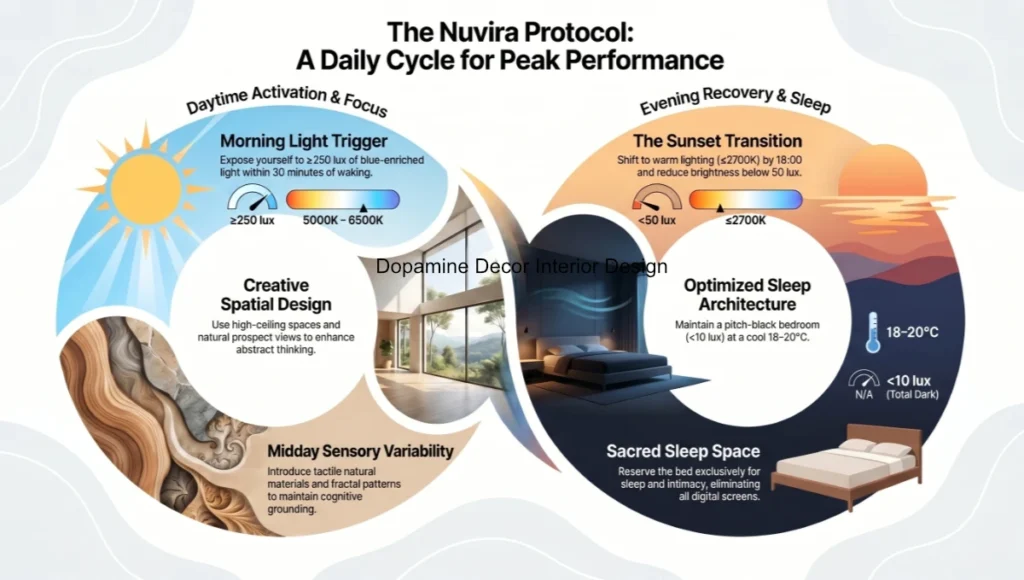
A Daily Cycle for Peak Performance
The Nuvira Protocol for Dopamine-Optimized Living
Morning Activation
- Expose yourself to ≥250 lux of blue-enriched light (5000–6500K) within 30 minutes of waking
- Position yourself in a high-ceiling or high-perceived-volume space for abstract/creative work
- Maintain a clear prospect view toward a natural element during morning routines
Midday Sustenance
- Introduce non-rhythmic sensory stimuli: open a window, turn on a water feature, vary your position
- Use natural materials for tactile grounding during focused tasks
- Ensure fractal visual complexity in your peripheral field (plant placement, organic patterns)
Evening Wind-Down
- Transition all lighting to ≤2700K by 18:00
- Reduce ambient illuminance to <50 lux by 20:00
- Retreat to your refuge corner for 20 minutes of low-stimulation recovery
- Eliminate blue-enriched screens or use hardware blue-light filtering
Sleep Architecture
- Maintain bedroom at <10 lux, ideally <5 lux
- Use blackout conditions with no LED indicator lights
- Ensure thermal comfort: 18–20°C core temperature support
- Reserve the bed exclusively for sleep and intimacy—no work, no screens
Weekly Recalibration
- Spend 2+ hours in a high-prospect natural environment (park, coastline, elevated viewpoint)
- Audit your home for synthetic material dominance and replace one surface with natural material monthly
- Review your lighting protocol: are your evening bulbs truly warm, or do they merely appear warm while emitting circadian-disrupting blue spike?
Comprehensive Technical FAQ
Circadian and Lighting Questions
Q: What is the exact lux level I need for morning circadian activation?
A: Minimum 250 lux at eye level for 30 minutes. Optimal: 500–1000 lux. This is roughly equivalent to overcast daylight near a large window. If natural light is insufficient, supplement with a 10,000-lux light box for 20–30 minutes.
Q: Can I just use my phone’s “night mode” instead of changing my bulbs?
A: No. Software blue-light filtering reduces but does not eliminate circadian-active wavelengths. The hardware blue spike in standard LEDs persists. For true protection, you need warm-CCT hardware (≤2700K) or violet-pump Sunlike technology that eliminates the 450–460 nm spike entirely.
Q: How quickly does melatonin suppression begin after light exposure?
A: Suppression begins within 15 minutes of exposure to typical room lighting (150–200 lux) and persists for 1–2 hours after lights are turned off. This is why you cannot simply “turn off the lights and fall asleep.” Your circadian system needs a transition protocol.
Spatial Psychology Questions
Q: What if my apartment has 2.4-meter ceilings everywhere? Can I still create a high-ceiling cognitive effect?
A: Yes. Use lighter ceiling colors (white or pale tones) to increase perceived height by 10–15%. Install vertical elements (tall shelving, floor-to-ceiling drapery) that draw the eye upward. Use recessed lighting to eliminate the visual “ceiling plane” and create perceived volume. The psychological effect is partially perceptual, not purely metric.
Q: How small can a refuge space be and still provide psychological benefit?
A: Minimum effective dimensions: 1.2 m width × 1.0 m depth × 2.2 m height. The critical factor is not size but enclosure quality: protection from behind, overhead cover, and visual separation from the main flow of activity. A high-backed chair in a corner can function as a refuge if the back is oriented toward the wall and a side table creates partial lateral shielding.
Q: Do I need real plants, or do artificial plants provide the same biophilic benefit?
A: Real plants provide superior benefit because they contribute to air quality, humidity regulation, and non-rhythmic sensory stimuli (movement, scent). However, research on biophilic responses indicates that even high-quality artificial greenery can provide partial visual benefit if the fractal complexity and color variation approximate natural forms. The ideal is living plants supplemented by natural material textures.
Material and Tactile Questions
Q: What is the minimum percentage of natural materials needed for measurable stress reduction?
A: Current evidence suggests 40% natural material coverage of visible surfaces as a threshold for consistent stress-recovery benefit. This includes timber, stone, clay, wool, linen, cork, and leather. Synthetic materials are not “toxic”—they are simply neurologically inert, creating a sensory deficit that your brain registers as environmental impoverishment.
Q: Can I combine multiple wood species, or should I match them?
A: Fractal diversity is neurologically preferable to uniformity. Multiple wood species with distinct grain patterns, color temperatures, and tactile qualities provide richer sensory stimulation than matched sets. The brain evolved to process environmental complexity, not catalog perfection.
Dopamine and Color Questions
Q: Is there a “best” color for dopamine decor interior design?
A: No single color optimizes dopamine for all contexts. Greens (520–560 nm) enhance social interaction and reduce eye strain. Warm oranges (590–620 nm) elevate mood and stimulate conversation. Blues (450–495 nm) at low saturation promote calm and focus. The critical factor is alignment with circadian phase and spatial function, not color choice in isolation.
Q: How does the 60-30-10 color rule interact with dopamine optimization?
A: The 60-30-10 rule (60% dominant, 30% secondary, 10% accent) provides visual order without overwhelming the perceptual system. For dopamine optimization, ensure the 10% accent contains at least one circadian-appropriate hue (warm for evening, cool for morning) and that the dominant 60% is a natural neutral (warm white, soft gray, earthy tone) that does not compete with the circadian lighting protocol.
Your Home Is Either Healing You or Harming You. There Is No Neutral.
You have now read the evidence. You understand that your ceiling height modulates your creativity. Your evening light suppresses your melatonin. Your material choices either nourish your nervous system or starve it. Your spatial layout either activates your brain’s reward circuitry or leaves it dormant.
The dopamine decor interior design movement is not about buying happier furniture. It is about recognizing that your environment is a biological input with physiological consequences. Every room is a prescription. Every surface is a signal. Every light source is a circadian intervention.
At Nuvira Space, we design environments that honor this reality. We do not decorate. We program. We do not style. We synthesize. We believe the home of the future is a health machine—and that future is available to you now, in whatever space you inhabit, at whatever scale you can manage.
Start with the three transferable takeaways. Tune your evening lighting. Build your refuge corner. Simplify one sightline toward a natural anchor. These are not aesthetic upgrades. They are neurological upgrades. And they cost less than your monthly streaming subscription.
The question is not whether you can afford to design for dopamine. The question is whether you can afford not to.
© Nuvira Space All rights reserved.| LIVING SPACES Series | All specifications cited are based on peer-reviewed research from the Journal of Consumer Research (Meyers-Levy & Zhu, 2007), Nature Scientific Reports (2025), Building and Environment (2024), Terrapin Bright Green's 14 Patterns of Biophilic Design (2014/2024), and post-occupancy evaluation data from Khoo Teck Puat Hospital, Singapore (2016). The Syntropic Loft is a speculative internal concept study and does not represent a completed project.