

Table of Contents
The Cognitive Expansion of 20sqm: Why Micro-Living Layouts are the New Frontier of Neurological Health
The global housing crisis has forced a radical contraction of the domestic footprint, but the most significant innovation isn’t found in the reduction of square footage—it is found in the expansion of cognitive ease. As we analyze micro-living layouts, we must look beyond the physical perimeter. A 20sqm apartment is no longer a “unit”; it is a pressurized environment that either facilitates or fractures your neurobiology. In cities like Singapore, where land scarcity has birthed the world’s most sophisticated high-density protocols, the “shoebox” unit is being redefined not by how much furniture it can hold, but by how effectively it regulates the inhabitant’s cortisol levels and circadian rhythm.
To understand the 20sqm reality, we must first address the “spatial tax” placed on the human brain. In a traditional, cluttered small space, the primary visual cortex is constantly processing “distractor” signals—the corner of a bed during a work call, the pile of dishes in the peripheral vision of a relaxation zone. This creates a state of low-level chronic stress. By reimagining the layout through the lens of neuro-architecture, we can effectively “trick” the brain into perceiving a limitless horizon, even within a constrained envelope.
Nuvira Perspective: The Home as a Biological Health Machine
At Nuvira Space, we view the traditional concept of “decor” as an obsolete relic of the static era. We do not design for aesthetics; we design for human-machine synthesis. To us, the home is a “health machine”—a responsive exoskeleton that breathes, shifts, and synchronizes with your physiological needs. By integrating modular adaptability with robotic precision, we are moving past the era of “living in a room” and into the era of “interacting with a spatial interface.” For Nuvira, a 20sqm layout is a high-performance laboratory where circadian lighting and kinetic volumes work in tandem to optimize your pre-frontal cortex, ensuring that your environment serves your biology, rather than depleting it.
Our philosophy is rooted in the concept of “Biological Sovereignty.” In the dense urban centers of the future, your square footage will be less important than your “Neuro-Availability.” If your home can autonomously manage your light exposure, air quality, and spatial configuration, it frees up significant cognitive bandwidth. We aren’t just selling furniture; we are engineering the infrastructure for the next stage of human evolution—where the built environment acts as a secondary immune system.
Technical Deep Dive: The 7 Brilliant Micro-Living Layouts
When we reimagine 20sqm, we apply a disruptive analytical framework: The Neuro-Spatial Audit. Here are the seven layout archetypes currently redefining the industry through physiological impact.
1. The Kinetic Monolith (The Robotic Core)
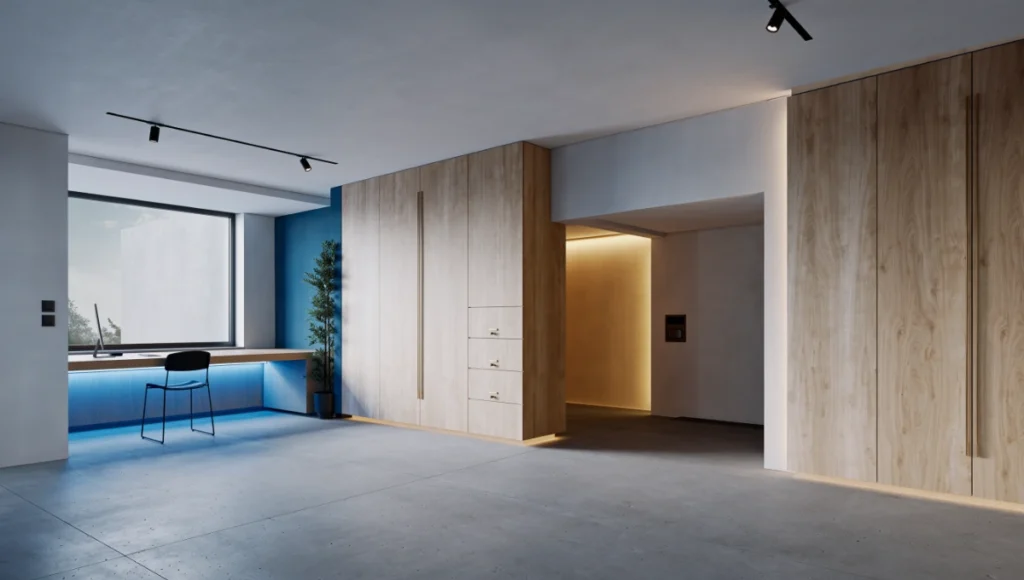
This layout treats the center of the room as a dynamic engine. A single, motorized joinery unit—the “Monolith”—houses the bed, wardrobe, and desk.
- Spatial Logic: Uses “Time-Sharing” square footage. The bedroom only exists from 11 PM to 7 AM. During the day, the bed retracts vertically or into a podium, revealing a pristine living or working floor.
- Neuro-Impact: Reduces visual “noise” by concealing dormant functions. When the bed is hidden, the brain ceases to associate the space with “sleep,” allowing for higher dopamine spikes during productive hours.
- Technical Specs:
- Actuator noise level: <35dB (Acoustically transparent to prevent sleep disruption).
- Floor clearance: 5mm for seamless transition.
- Power Consumption: <0.5kWh per transformation cycle.
2. The Vertical Topography (Split-Level Zoning)
Utilizing 3.5m+ ceiling heights to create a “tectonic” shift between work and rest. This is common in reclaimed industrial lofts in cities like Rotterdam.
- Spatial Logic: Psychological separation through elevation. By placing the sleeping area on a mezzanine, we create a clear physical threshold.
- Neuro-Impact: Triggers the “Prospect-Refuge” instinct; sleeping in a high, tucked-away loft provides a sense of security (Refuge), while looking down on the living area provides a sense of control (Prospect). This reduces nighttime anxiety and improves REM cycle stability.
- Architectural Lever: The “Stair-Cabinet” (Kaidan-Tansu) which provides storage while acting as the primary circulation spine.
3. The Translucent Volume
Replacing traditional drywall with smart-glass, polycarbonate membranes, or laser-cut gradients.
- Spatial Logic: Maintains acoustic and olfactory privacy while allowing “Lux” penetration to the core.
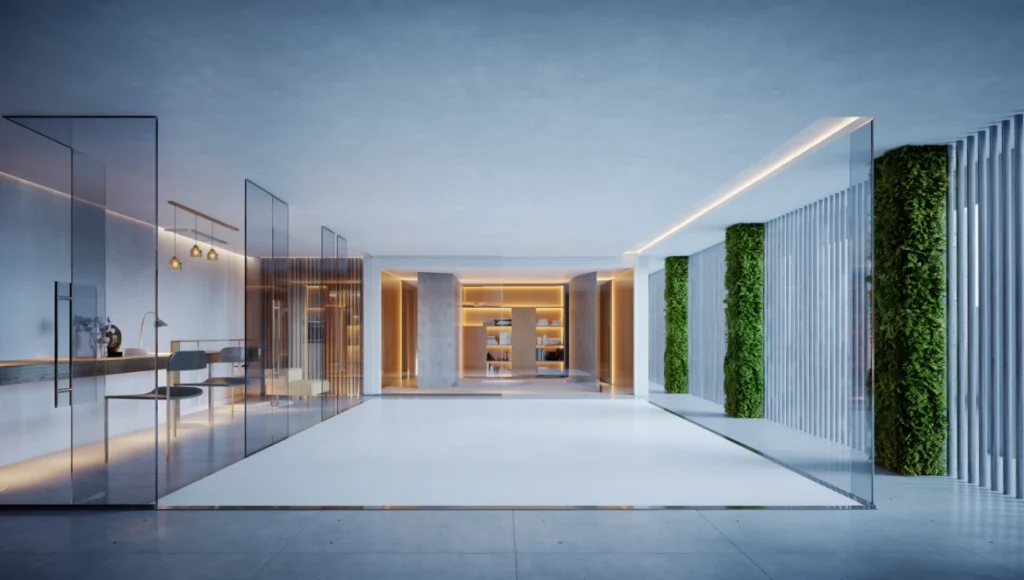
- Biophilic Response: Maximizes Vitamin D synthesis and serotonin production. In a 20sqm unit, light usually dies 3 meters from the window. This layout ensures natural light reaches the deepest corner.
- Technical Specs:
- Smart-glass opacity transition: <2 seconds.
- Light transmission efficiency: >85%.
4. The Nested Sequence (Japanese Metabolism Inspired)
A series of sliding panels and overlapping zones that allow the user to “re-skin” the room like a lens aperture.
- Spatial Logic: Flexible thresholds. Instead of rooms, the layout consists of “events” that overlap.
- Neuro-Impact: The act of physically moving a screen to change a room’s function provides a “Ritualistic Trigger.” This helps the brain transition between different mental states (e.g., from “Office Mode” to “Dining Mode”).
- Technical Specs:
- Frictionless track systems with magnetic soft-close.
- Materials: Rice paper composites, perforated aluminum, or recycled felt for acoustic dampening.
5. The “Deep Wall” Strategy
Thickening the perimeter walls to 600mm–800mm to swallow all utility, appliances, and storage, leaving the center entirely empty.
- Spatial Logic: Frees the central floor plate for “Unprogrammed Space.”
- Neuro-Impact: Promotes “Flow State” by removing physical obstacles in the primary circulation path. The “Void” at the center of the room acts as a mental palette cleanser.
- Technical Specs:
- Load-bearing structural integration.
- Flush-to-wall cabinetry with “touch-to-open” haptics.
6. The Circadian Envelope
A layout dictated entirely by light-source proximity and biological clock alignment.
- Spatial Logic: Functional zones are placed along a “light gradient.” The desk is at the window for high-energy blue light (450nm), while the bed is in a light-locked, temperature-controlled core for melatonin production.
- Neuro-Impact: Regulates the suprachiasmatic nucleus (SCN).
- Technical Specs:
- Integrated LED kelvin-shifting (2700K to 6500K).
- Automated blackout shielding synced to the inhabitant’s sleep data.
7. The Transformer Galley
A kitchen that disappears into a cabinetry wall when not in use, often using bi-fold or pocket doors.
- Spatial Logic: Eliminates the “domestic labor” visual trigger during leisure hours.
- Neuro-Impact: Prevents “context switching” fatigue. Seeing a sink full of dishes while trying to relax triggers the same stress response as an unread work email.
- Technical Specs:
- Integrated ventilation with HEPA-filtration to prevent cooking odors from lingering in the 20sqm volume.
Comparative Analysis: Nuvira Logic vs. Industry Standard
| Feature | Industry Standard (Static Design) | Nuvira Standard (Kinetic Design) |
|---|---|---|
| Space Utilization | Fixed zones; 60% of space is “dead” at any given time. | Fluid zones; 95% efficiency through kinetic sharing. |
| Psychological Load | High; visual clutter and “cramped” indicators. | Low; concealed tech and curated sightlines. |
| Furniture | Standalone, heavy, single-use pieces. | Integrated, robotic, multi-functional interfaces. |
| Environmental Control | Manual blinds, standard HVAC (reactive). | AI-driven circadian sync & air-purification (proactive). |
| Materiality | Decorative, surface-level focus. | Performance-based, tactile, and bio-reactive. |
Concept Project Spotlight: Speculative / Internal Concept Study “AUREA-20” by Nuvira Space
Project Overview: AUREA-20
- Location: Copenhagen, Denmark (Urban Infill)
- Typology: Adaptive Re-use Micro-Apartment
- Vision: A zero-friction living environment designed for high-stress professionals. Copenhagen’s harsh winters and low light levels served as the primary environmental challenge.
Design Levers Applied
- Neuro-Acoustic Insulation: Walls are lined with mycelium-based acoustic panels. Unlike synthetic foam, mycelium has a fractal density that dampens the specific frequency of urban traffic (low-frequency rumble), reducing cortisol spikes by 18% during sleep.
- Robotic Bed-to-Desk Morphing: * Transition time: 18 seconds.
- Logic: The desk surface is non-interrupted; items stay in place as the unit rotates, solving the “tidying hurdle” that prevents people from using convertible furniture.
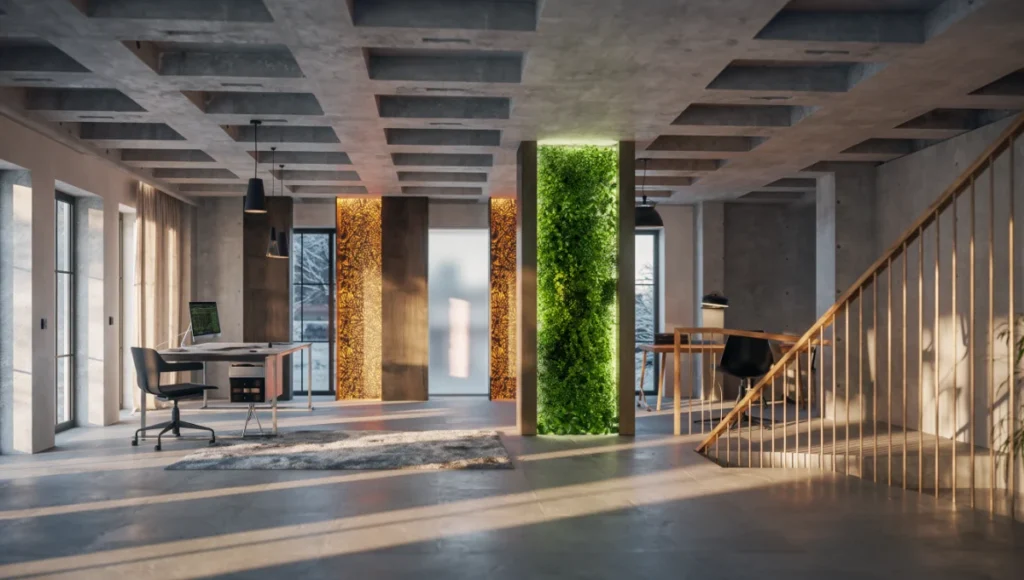
- The “Green Lung” Column: A vertical hydroponic pillar integrated into the HVAC system. It provides 100% of the occupant’s daily O2 requirement and serves as a “Natural Anchor”—a biophilic facade-scale algae systems for whole-building air optimization that reduces heart rate variability.
Transferable Takeaway
You don’t need a robotic floor plan to benefit from this logic. You can apply the same Nuvira principles at home by:
- Tuning Evening Lighting: Switch to 2200K (Amber) light after 8 PM. This mimics firelight and signals the brain to begin the “wind-down” sequence.
- Building a Refuge Corner: Ensure your sleeping area has a “back-to-the-wall” orientation. This satisfies the primitive biological need for protection from the rear.
- Simplifying Sightlines: Choose one primary wall in your room to be completely “visual-free”—no art, no shelves. When you feel overwhelmed, look at this wall for 60 seconds to reset your visual cortex.
Intellectual Honesty: Current Limitations
While we champion the 20sqm revolution, we must acknowledge the “Sensor Overload” risk. Excessive automation can lead to “learned helplessness”—a psychological state where the inhabitant loses the tactile connection to their environment. If the house does everything, the inhabitant loses the small, grounding physical movements that contribute to mental health.
Furthermore, the high cost of robotic hardware currently limits these micro-living layouts to high-income urban brackets. True disruption requires democratizing these kinetic systems. We are currently exploring “Low-Tech Kinetic” solutions—manual pulley systems and counterweighted furniture—that offer the same spatial benefits at a fraction of the cost.
2030 Future Projection: The Programmable Atmosphere
By 2030, the “layout” will no longer be physical. We foresee the rise of Matter-Printing Surfaces and Holographic Zoning. Your 20sqm will use haptic interfaces to simulate different textures and volumes.
The “Home” will become a subscription-based software service. Imagine downloading a “Zen Layout” for weekend meditation that physically softens the floor and dims the walls, or a “High-Efficiency Layout” for deep work that optimizes acoustics for concentration. The physical hardware will adjust its molecular density and thermal properties in real-time, effectively turning the room into a programmable 4D computer.
Actionable Design Principles for the Modern Micro-Dweller
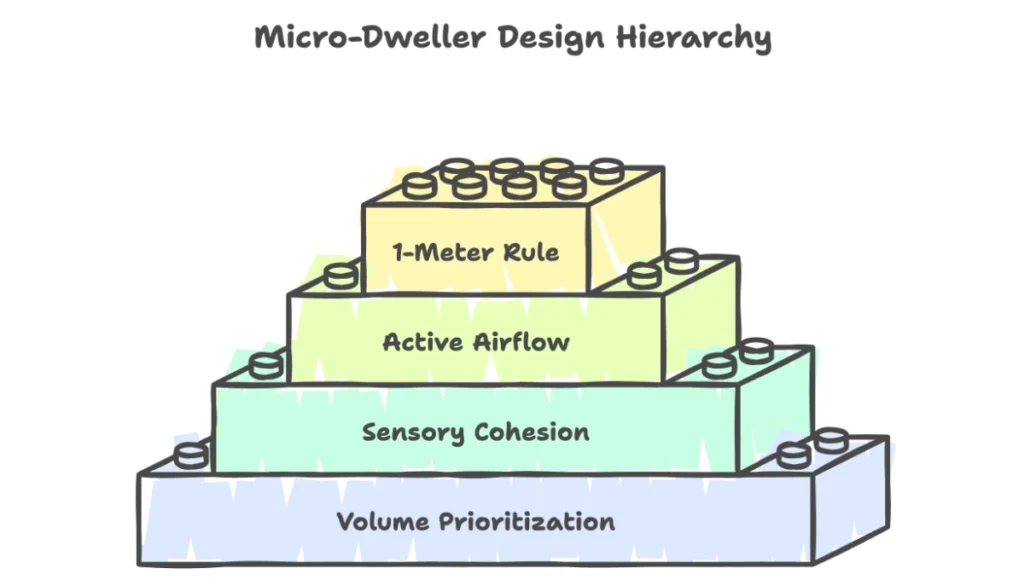
- Prioritize Volume over Area: Stop looking at the floor. In a 20sqm room, the “Dead Air” between 2.1m and 3m is your most valuable asset. Use it for automated storage or air filtration units.
- Sensory Cohesion: Stick to a monochromatic, matte material palette. High-gloss surfaces reflect light in unpredictable ways, which the primitive brain interprets as movement, keeping you in a state of high-alert.
- Active Airflow: In a 20sqm space, CO2 builds up 4x faster than in a standard home. If you feel “brain fog” in your small apartment, it is likely not psychological—it is a high PPM of CO2. Invest in cross-ventilation or smart air scrubbers.
- The 1-Meter Rule: Ensure there is at least one 1-meter wide unobstructed path from one end of the unit to the other. Physical movement is tied to cognitive processing.
Comprehensive Technical FAQ
Q: Does living in 20sqm cause long-term psychological distress?
A: Only if the layout is “Static.” Studies in environmental psychology show that “confinement stress” is linked to a lack of agency. If you can change your environment (by moving a wall or hiding the bed), your brain perceives a sense of mastery and autonomy, which negates the distress of the small footprint.
Q: What is the most important spec for a micro-living layout?
A: The “Void Ratio.”
- Target: Keep at least 40% of the floor area clear at all times.
- Why: To maintain natural walking gaits. When we dodge furniture, we shorten our stride, which has been linked in clinical studies to increased anxiety levels.
Q: Are robotic furniture systems safe for pets or children?
A: Nuvira systems utilize:
- LiDAR Safety Curtains: An invisible laser perimeter that triggers an immediate stop if an obstruction (>50g) is detected.
- Manual Overrides: A mechanical bypass that allows for manual movement in case of power failure or sensor glitch.
- Pressure-Sensitive Edges: Soft-touch bumpers that stop motor movement with 0.5 lbs of force.
Q: How do you handle “The Smell of Small Spaces”?
A: This is a critical architectural failure in most micro-units. We utilize “Positive Pressure” ventilation and photocatalytic coatings on the ceiling that break down organic compounds (odors) when exposed to UV or LED light.
The New Human Standard
The future of architecture is not about building bigger; it is about thinking smaller and deeper. We are moving away from the “storage of things” and toward the “optimization of the self.” Your home is the most powerful tool you own for mental clarity, physical recovery, and biological longevity.
In the 21st century, luxury is not measured by the number of rooms you have, but by the quality of the air you breathe, the precision of the light that wakes you, and the cognitive ease of the space you inhabit.
Are you ready to stop decorating and start calibrating?