

stage — not after. See 3 real projects, the numbers behind them, and
what’s deployable.
Table of Contents
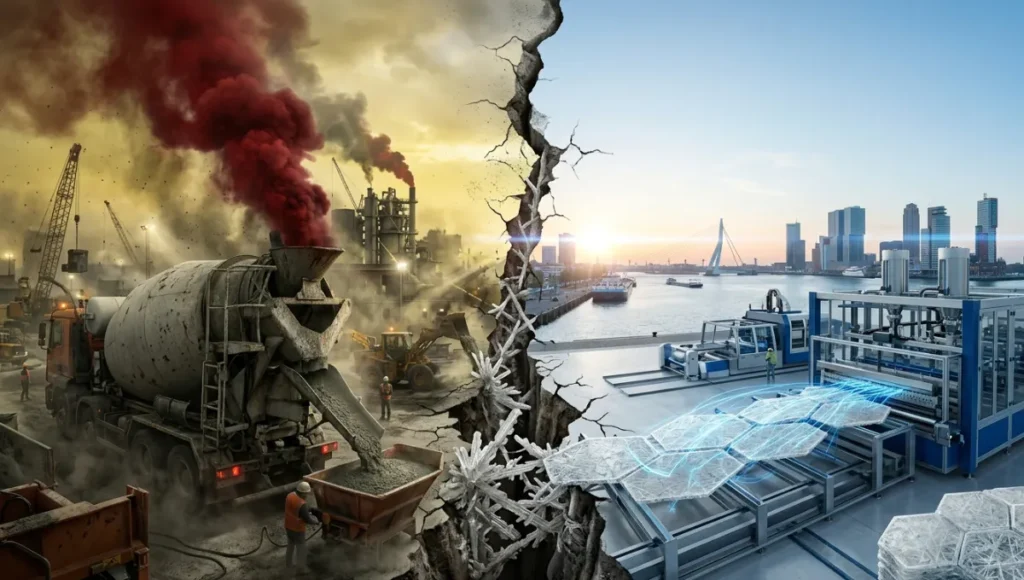
The construction industry still builds the way it destroys: laying cement, walking away, and counting the emissions afterward. But carbon capture building materials are collapsing that logic. These are not offset plays. They are not carbon-credit wrappers. They are physical substrates—wall panels, roof decks, precast modules—that pull CO₂ out of the atmosphere and lock it into their molecular structure during the production process itself. The benchmark is no longer “less bad.” At 6 kg of CO₂ sequestered per m³, the benchmark is carbon-negative from the first pour.
Nuvira Perspective
At Nuvira Space, we do not celebrate materials for their ambition. We interrogate them for their performance data, their failure modes, and their real-world transferability. When enzymatic structural material (ESM) arrived in the journal Matter in late 2025, we did not treat it as a press release. We treated it as a data set. What we found is that the intersection of bioinspired chemistry, carbonic anhydrase enzyme kinetics, and low-temperature mineral crystallization has produced something the industry has never delivered at structural grade: a load-bearing substrate that is net-negative in embodied carbon before it has even been installed.
You are building in a period where the regulatory floor is rising faster than most project timelines. The EU’s Carbon Border Adjustment Mechanism is already repricing imported construction materials. Singapore’s carbon tax reached SGD 25 per tonne in 2024 and is on a legislated path to SGD 45–80 by 2030. Rotterdam’s Porthos CCS infrastructure, which began drilling in April 2024, is engineered to store 2.5 million tonnes of CO₂ per year by 2026—a macro signal that European industrial cities are not waiting for voluntary commitments.
The Nuvira position is this: you cannot design for the next decade using materials costed for the last one. Carbon capture building materials are not a sustainability badge. They are a hedge against a future where embodied carbon is taxed, disclosed, and priced into every project budget.
Technical Deep Dive
How Enzymatic Structural Material (ESM) Works
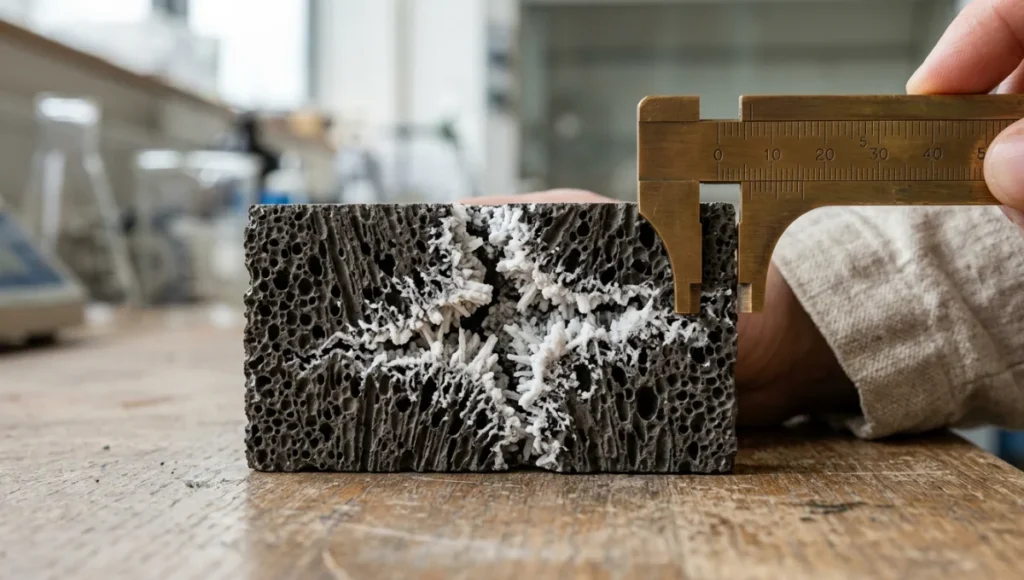
The core mechanism is carbonic anhydrase—an enzyme found in human red blood cells whose biological function is to accelerate the conversion of CO₂ into bicarbonate. WPI’s research team, led by Professor Nima Rahbar, extracted that function and redirected it into a construction context. The enzyme catalyses the transformation of atmospheric CO₂ into solid calcium carbonate (CaCO₃) crystals. Those crystals then grow inside a hydrochar scaffold—a porous, carbon-rich framework derived from biomass—binding the matrix together through a capillary suspension process. The result is a composite that cures within hours at mild temperatures, requires no kiln firing, and permanently sequesters atmospheric carbon inside its microstructure.
Core Metric 1 m³ of ESM sequesters >6.1 kg of CO₂ during production. 1 m³ of conventional concrete emits 330 kg. Net swing: 336.1 kg per m³ in favour of ESM—not relative to a baseline, but as an absolute reversal.
ESM Specification Sheet
| Parameter | Value |
|---|---|
| Compressive strength | 25.8 MPa average (structural concrete minimum threshold: 25 MPa) |
| Curing time | <8 hours under mild temperature conditions vs. 28 days for Portland cement concrete |
| CO₂ sequestered per m³ | >6.1 kg, permanently mineralised as CaCO₃ |
| CO₂ emitted per m³ by conventional concrete | 330 kg (Portland cement production baseline) |
| Water durability | superior to most bio-based structural materials in comparative testing |
| Self-healing | carbonic anhydrase reactivates at crack faces; millimetre-scale fractures seal autonomously within 24 hours |
| Recyclability | full material recovery cycle without chemical degradation |
| Primary applications | roof decks, wall panels, modular building components, precast units |
| Scalability pathway | capillary suspension process compatible with both batch and continuous production |
CarbonCure: The Commercially Deployed Parallel
While ESM is transitioning from lab to pilot scale, CarbonCure Technologies has already deployed CO₂ mineralisation in over 650 concrete plants across North America, Europe, and Southeast Asia. Its mechanism is distinct: recycled CO₂ is injected under pressure into ready-mix concrete wagons during batching, where it reacts with calcium ions to form calcium carbonate nano-particles permanently embedded in the matrix. The resulting material is stronger than the baseline mix, which allows cement content reduction—compressing the carbon footprint from two directions simultaneously.
CarbonCure Performance Specifications
- CO₂ saved per m³ (Ready Mix alone): 7–11 kg
- CO₂ saved per m³ (Ready Mix + Reclaimed Water combined protocol): 12–22 kg
- Compressive strength improvement over baseline: 3–5%, enabling proportional reduction in cement content
- Technology model: retrofit-compatible, no new plant infrastructure required
- Cumulative CO₂ reduction documented: >126,130 tonnes in the most recent 12-month reporting period
- Commercial plants operating the technology globally: 650+
At 725 Ponce in Atlanta—a 360,000-sq-ft mixed-use development completed in 2019—CarbonCure mineralised concrete was used for all 48,000 cubic yards of the structure, delivering a documented 750-tonne reduction in carbon footprint. That is the kind of project-scale evidence that converts a laboratory concept into a procurement specification.
Blue Planet Systems: Aggregate-Scale Mineralisation
San Jose-based Blue Planet Systems operates at a different point in the material supply chain, producing synthetic limestone aggregate from captured CO₂ streams. Their process permanently mineralises 440 kg of CO₂ per tonne of aggregate—a sequestration ratio that exceeds ESM’s volumetric figure by an order of magnitude, though in a different material format: aggregate rather than structural panel. In February 2025, Blue Planet’s aggregate was used in the world’s first net-zero embodied carbon concrete slab placement—a commercial milestone, not a laboratory demonstration.
- CO₂ sequestered per tonne of aggregate: 440 kg (permanently mineralised, no re-emission pathway)
- CO₂ source flexibility: compatible with dilute industrial streams at any concentration
- Material output: synthetic limestone aggregate, drop-in replacement for virgin quarried stone
- Milestone: net-zero embodied carbon concrete slab, February 2025
Comparative Analysis: Solution vs. Industry Standard
Carbon Performance and Structural Viability Side-by-Side
The table below isolates the parameters that matter at the design and procurement stage. You are not comparing aesthetics or brand positioning. You are comparing carbon debt, structural performance, project timeline compatibility, and regulatory exposure trajectory.
Table
| METRIC | ESM / CARBONCURE / BLUE PLANET | CONVENTIONAL CONCRETE |
|---|---|---|
| CO₂ per m³ (production) | ESM: −6.1 kg (net sequestration) | CarbonCure combined: −12–22 kg saved | Blue Planet: 440 kg/tonne mineralised | Emits +330 kg per m³ |
| Compressive strength | ESM: 25.8 MPa | CarbonCure: baseline +3–5% | 25–40 MPa (standard mix grade) |
| Curing time | ESM: <8 hours | CarbonCure: standard cure schedule | 28 days (standard cure) |
| Retrofit compatibility | CarbonCure: YES (plug-in to existing plant) | ESM: pilot stage only | N/A (baseline technology) |
| Recyclability | ESM: full material recovery | CarbonCure: standard demolition cycle | Partial (aggregate recovery only) |
| Self-healing | ESM: YES (enzyme reactivation at crack face, <24 hours) | NO |
| Market readiness (2026) | CarbonCure: fully commercial | Blue Planet: early commercial | ESM: R&D-to-pilot | Fully commercial globally |
| Regulatory cost exposure (2030) | Reduced: sequestration built into the structure | High: 330 kg/m³ exposure as carbon pricing scales |
Concept Project Spotlight
Speculative / Internal Concept Study — The Carbonite District — by Nuvira Space
Project Overview
Location / Typology / Vision
- Project name: The Carbonite District — Nuvira Space Internal Concept Study
- Location: Rotterdam Harbour District, Netherlands
- Typology: Mixed-use civic and residential precinct; 12-storey maximum height; 40,000 m³ total built volume
- Vision: A district where every cubic metre of structure actively participates in atmospheric drawdown—not passively neutral, but continuously negative across a 50-year lifecycle
Rotterdam is not a hypothetical backdrop. The Porthos CCS pipeline began construction in April 2024 and is projected to reach 2.5 million tonnes of CO₂ per year storage capacity by 2026, with Shell, ExxonMobil, Air Liquide, and Air Products as anchor participants. The harbour district sits at the industrial-urban interface where captured CO₂ streams are proximate to construction activity. You do not need to build a theoretical argument for carbon-capture architecture in Rotterdam. The infrastructure argument is already being made in steel and concrete below the Maasvlakte seawall.
Design Levers Applied
Material System
- Structural shell: ESM panels at 25.8 MPa compressive strength, replacing 60% of conventional concrete volume across wall and deck assemblies
- Remaining 40%: CarbonCure Ready Mix + Reclaimed Water combined protocol, saving 12–22 kg CO₂ per m³ on all cast-in-place pours
- Aggregate specification: Blue Planet synthetic limestone, 440 kg CO₂ mineralised per tonne, used in all slab pours
- Gross sequestration estimate at 40,000 m³ total built volume: ~244,000 kg (244 tonnes) CO₂ locked into the structure at practical completion
- Comparison: a conventional concrete structure of equivalent volume would emit ~13,200 tonnes of CO₂ from materials alone
Fabrication and Assembly
- Prefabrication rate: 85% of ESM panels produced offsite via automated capillary suspension casting
- Modular bay grid: 3.6 m x 3.6 m structural module for maximum panel interchangeability and tolerance-controlled assembly
- ESM panel curing cycle per batch: <8 hours (vs. 28-day minimum for equivalent precast concrete panels)
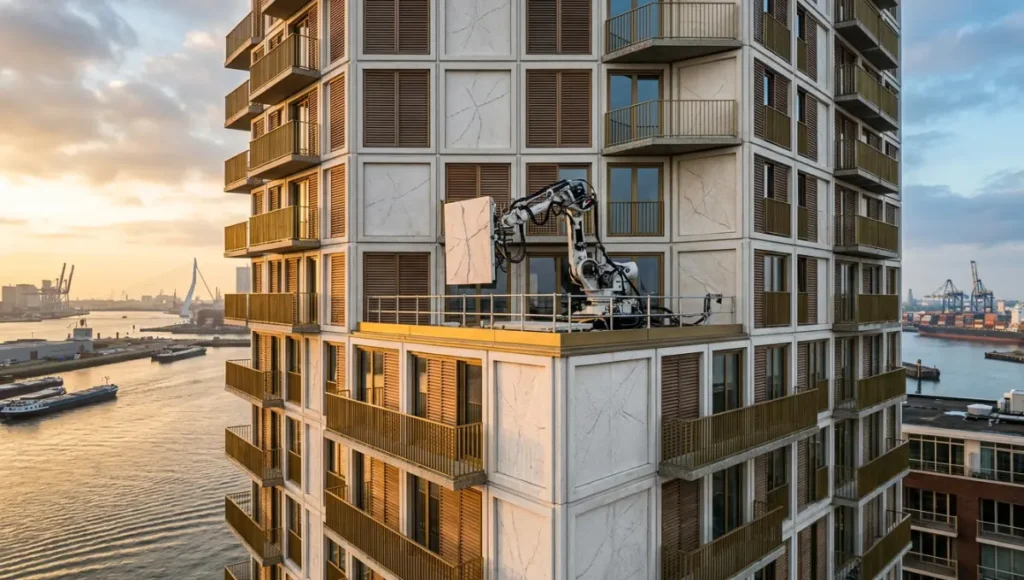
- Robotic assembly: 6-axis robotic arms deployed for panel placement in tight harbour-district setbacks and restricted access conditions
- Structural joint specification: CO₂-cured precast connectors throughout; zero Portland cement in the joint system
Environmental Sensor Integration
- Embedded CO₂ sensor array: 1 sensor per 12 m³ of installed ESM surface area
- Monitoring frequency: real-time at 5-minute intervals, feeding a district-level carbon performance dashboard
- Integration: sensor data linked to building management system for occupancy-responsive ventilation tuning and ongoing embodied carbon tracking
Transferable Takeaway
Design Principle
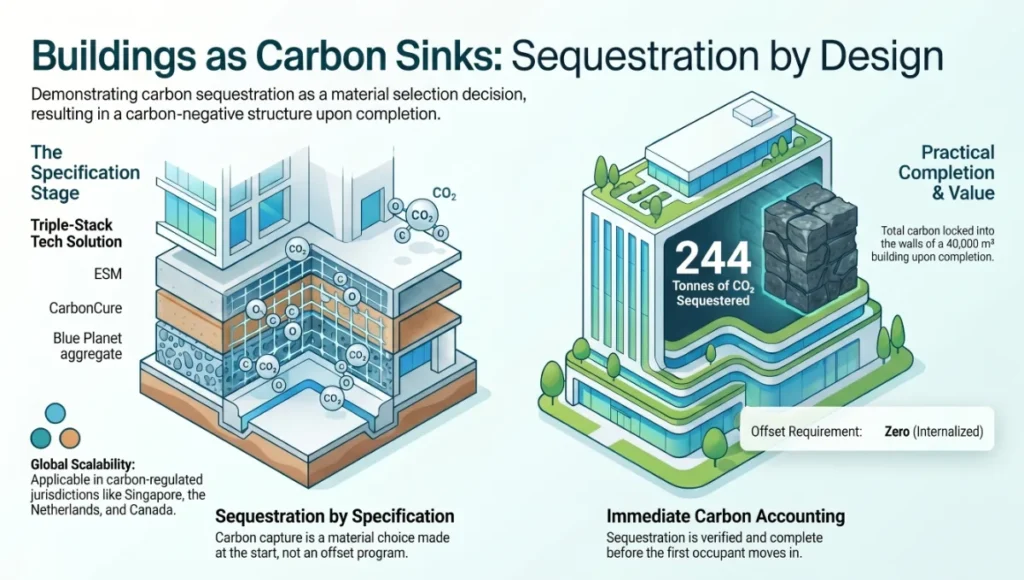
The Carbonite District demonstrates that carbon sequestration is a material selection decision made at the specification stage—not a post-occupancy add-on. A 40,000 m³ building using the ESM + CarbonCure + Blue Planet aggregate stack does not require a carbon offset programme. It arrives at practical completion with 244 tonnes of CO₂ already locked into its walls. That is the architectural value proposition: the structure is its own carbon sink, and the accounting is done before the first occupant moves in. Any project team operating in a carbon-regulated jurisdiction—Singapore, the Netherlands, Canada—can extract the same logic and apply it at their own scale.
Intellectual Honesty: Current Limitations
Carbon capture building materials are not a solved problem. You need to understand the documented gaps before you specify.
ESM: Lab-to-Pilot, Not Yet Procurement-Ready
- 25.8 MPa clears residential and light commercial structural thresholds—but falls below the 40–70 MPa required for high-rise cores, long-span post-tensioned slabs, and bridge decks
- Production is currently batch-based; continuous manufacturing lines at commercial volume do not yet exist
- Carbonic anhydrase enzyme cost at industrial volume has no published benchmark; supply chain pricing remains a variable
- Long-term carbonation stability across freeze-thaw cycles, high-humidity tropical climates, and chloride exposure has not been documented beyond controlled lab environments
CarbonCure: Significant but Not Net-Negative
- 7–11 kg CO₂ saved per m³ (Ready Mix alone) represents 2–3% of total embodied carbon in a concrete-heavy structure. Material, not transformative on its own
- CarbonCure reduces the carbon footprint of concrete; it does not make concrete carbon-negative. That framing requires pairing with other interventions
- CO₂ supply chain dependency: requires consistent industrial CO₂ sourcing, which in isolated markets may not be logistically available
Blue Planet: Aggregate Replacement, Binder Unchanged
- 440 kg CO₂ per tonne of aggregate is high-performance sequestration, but aggregate is 60–70% of concrete by volume—the Portland cement binder, which drives the majority of emissions, is not addressed by aggregate substitution alone
- The February 2025 net-zero slab is a milestone; it is 1 data point, not a generalised performance standard
Cross-System Accounting Gaps
- No single standardised LCA protocol governs sequestration claims across ESM, CarbonCure, and Blue Planet simultaneously—system boundaries and GWP accounting differ between methods
- Procurement pipelines at most architectural practices are not configured to specify these materials; supply chain development lags material science by 3–5 years in most markets
2030 Future Projection
The trajectory is a function of 3 converging forces: regulatory pressure, investment volume, and material maturity. Each is independently directional. Together they are compounding.
Regulatory Pressure
Singapore’s carbon tax is legislated at SGD 45–80 per tonne by 2030. The EU Carbon Border Adjustment Mechanism is in its transitional phase, already repricing imported materials. Any project team procuring conventional concrete in a regulated market without a sequestration strategy is building a future cost liability into today’s budget. By 2030, embodied carbon will be a mandatory disclosure item in at least 34 jurisdictions. By 2035, it will be a procurement gate in most European public tenders.
Investment Volume
- Global investment in CO₂ utilisation technologies: USD 4.8 billion in 2025, a 62% increase over 2024
- CarbonCure’s projected market size for carbon utilisation: USD 800 billion–USD 1 trillion by 2030
- Porthos (Rotterdam): 2.5 million tonnes CO₂/year storage from 2026 creates regional CO₂ supply infrastructure that lowers feedstock cost for CarbonCure-type processes across the Northwest European construction market
Material Maturity
- Lakka will begin industrial-scale CO₂-cured concrete production in 2026—a commercial parallel that de-risks the ESM scalability argument
- ETH Zurich’s 3D-printed photosynthetic bacterial material (2025): 26 mg CO₂ absorbed per gram of material over 400 days; 2 demonstration tree-trunk structures binding 18 kg CO₂/year each—a second-generation biological sequestration mechanism entering the architectural material vocabulary
- Reasonable 2030 market structure: (1) CarbonCure as the retrofit standard in concrete plants globally; (2) ESM at commercial pilot scale for modular and prefabricated systems; (3) living materials at demonstration-project scale in civic and cultural buildings
The Toolset: 5 Key Technologies
These are the instruments that make carbon-negative construction physically possible today, or within a 24-month deployment window from mid-2026.
Table
| # | TOOL / TECHNOLOGY | PRIMARY FUNCTION |
|---|---|---|
| 01 | Carbonic Anhydrase Enzyme (ESM production) | Converts atmospheric CO₂ into CaCO₃ crystals in real time; the sequestration engine at the molecular level of the material system |
| 02 | CarbonCure Injection System (Ready Mix + Reclaimed Water) | Retrofit CO₂ mineralisation at the batching plant; saves 12–22 kg CO₂/m³ combined; fully commercial at 650+ plants globally |
| 03 | Hydrochar Scaffold Framework | Biomass-derived porous matrix hosting enzyme activity and binding CaCO₃ crystals into load-bearing geometry; enables self-healing via enzyme reactivation |
| 04 | Capillary Suspension Casting | Low-temperature moulding process enabling ESM to form structural components within <8 hours; no kiln, no 28-day cure schedule |
| 05 | Accelerated Carbonation Technology — ACT (OCO Technology + Mission Zero Technologies) | Direct air capture CO₂ fed into waste aggregate mineralisation; carbon-negative aggregate from atmospheric drawdown; operational at Norfolk, UK facility; C2I 2025 Energy Award winner |
Comprehensive Technical FAQ
Q: Is 25.8 MPa actually sufficient for structural use?
A: Yes, for most residential and mid-rise commercial applications. The structural concrete minimum for load-bearing elements under most building codes is 25 MPa. ESM at 25.8 MPa clears that threshold. Where it does not yet apply:
- High-rise cores requiring 40–70 MPa (C40–C70 mix grades)
- Long-span post-tensioned slabs where deflection control demands >35 MPa
- Civil infrastructure exposed to chloride environments requiring additional durability classifications
Q: How does ESM’s 6 kg/m³ compare to CarbonCure’s 7–22 kg/m³?
A: They are not equivalent figures. ESM’s 6.1 kg/m³ is a net sequestration number—CO₂ captured and locked in, with no Portland cement in the mix. CarbonCure’s 7–22 kg/m³ is a reduction figure relative to a conventional concrete baseline that still emits 330 kg/m³. ESM is the only system of the 3 that is genuinely carbon-negative at a material level from a net perspective. CarbonCure and Blue Planet reduce embodied carbon; ESM reverses it.
Q: What is the Rotterdam Porthos project and why does it matter for material specification?
A: Porthos is a CO₂ transportation and storage infrastructure project in the Port of Rotterdam. Construction began in April 2024; operational target is 2026 at 2.5 million tonnes CO₂/year for a minimum of 15 years. Participants include Shell, ExxonMobil, Air Liquide, and Air Products. For specifying architects and engineers, the significance is supply-chain economics: as CO₂ capture infrastructure scales in Rotterdam and equivalent industrial port cities, the feedstock cost for CarbonCure-type processes decreases. The material economics of carbon mineralisation improve as the capture infrastructure matures.
Q: What is Accelerated Carbonation Technology (ACT) and how does it differ from ESM or CarbonCure?
A: ACT, developed by OCO Technology (UK), transforms waste materials—demolition rubble, industrial residues—into aggregate using a CO₂ feed. In a first-of-kind integration at a Norfolk facility, Mission Zero Technologies (MZT) is supplying CO₂ captured directly from the atmosphere via direct air capture (DAC) to OCO’s ACT process. The output is building aggregate with a negative lifecycle carbon footprint: the raw material is waste, the process gas is atmospheric CO₂, and the product is a standard construction aggregate. This project won the C2I 2025 Energy Award. Unlike CarbonCure (which works on fresh concrete) or ESM (which replaces concrete), ACT operates on the aggregate input stream.
Q: Can these materials qualify for LEED, BREEAM, or WELL certification?
A: CarbonCure is documented as contributing to LEED v4 Materials & Resources credit categories. ESM and Blue Planet aggregate would each require a project-specific Environmental Product Declaration (EPD) to qualify formally. Key technical requirements:
- Third-party-verified EPD following EN 15804+A2 (Europe) or ISO 21930 (global)
- LCA boundary set to cradle-to-gate minimum; cradle-to-grave for full lifecycle credit
- Sequestration claims must use consistent Global Warming Potential (GWP) accounting
- LEED v4.1 has a specific pathway for materials demonstrating negative GWP; engage LEED reviewer at material specification stage, not post-design
Q: What does self-healing mean in an ESM structure and what is the maintenance implication?
A: The carbonic anhydrase enzyme remains active in the cured ESM matrix. When micro-cracks form from thermal cycling, live loading, or impact, the enzyme at the crack face catalyses re-precipitation of CaCO₃ crystals, autonomously re-bridging the fracture. WPI’s precursor ECM research documented autonomous crack sealing at millimetre scale within 24 hours under controlled conditions. The maintenance implication is a lower inspection frequency and reduced repair mortar volume over the building lifecycle. In a 50-year building, that translates to lower total material throughput and a reduced secondary carbon cost from maintenance interventions.
Q: Is there a standard way to specify these materials in a project tender?
A: Not yet for ESM or Blue Planet at a universal code level. CarbonCure can be specified as a concrete admixture with a performance requirement: e.g., ‘CO₂ mineralisation process achieving minimum 10 kg CO₂ saved per m³ as demonstrated by third-party LCA.’ For ESM and Blue Planet aggregate, the specification route is currently via EPD-referenced performance criteria within Cl/SfB or NBS-format clauses. For architects navigating this gap, the AIA-CLF Embodied Carbon Toolkit for Architects provides a structured framework for integrating embodied carbon reduction into specification workflows. Expect a standardised specification pathway to emerge in UK, Netherlands, and Singapore markets between 2026 and 2028 as EPD databases accumulate project data.
What Comes Next: Specify Differently or Absorb the Cost
The argument for carbon capture building materials does not rest on environmental principle alone. It rests on regulatory logic, procurement economics, and the compounding reality that conventional concrete carries an invisible surcharge—330 kg of CO₂ per m³—that is being legislated into visibility across every major construction market, on a timeline that has already started.
You are not being asked to build with science fiction. CarbonCure is operational in 650+ concrete plants. Blue Planet aggregate has been used in a net-zero embodied carbon slab. OCO Technology and Mission Zero Technologies have integrated direct air capture into aggregate production at a live Norfolk facility. ESM is in a peer-reviewed journal, tested to 25.8 MPa, and heading toward pilot-scale manufacturing. The material science is real. The performance data is published. The sequestration claims are supported by primary research.
The question your next project specification needs to answer is not ‘should we consider carbon-capture materials?’ It is: ‘What is our documented justification for not specifying them?’
Nuvira Action Framework
Start with CarbonCure at the concrete specification stage—retrofit-compatible, no capital investment, 12–22 kg CO₂ saved per m³ using the combined Ready Mix + Reclaimed Water protocol. Layer Blue Planet synthetic limestone aggregate where mix design allows. Monitor ESM for modular prefabrication packages from 2026 onward as Lakka’s industrial-scale production begins. Build your material specification around a sequestration audit, not a carbon offset ledger. The first is embedded in the structure. The second is a cheque.
For teams ready to operationalise this approach, our parametric material specification workflows provide a framework for embedding carbon performance criteria directly into procurement clauses—so sequestration targets become enforceable contract terms, not aspirational footnotes. And as the material landscape evolves, our future tech series overview tracks the next generation of carbon-negative systems entering the architectural vocabulary, from bacterial photosynthetic materials to graphene-enhanced structural composites.
© Nuvira Space — All rights reserved. Future Tech Series | All specifications cited are based on peer-reviewed research published in Matter (Elsevier, December 2025), Worcester Polytechnic Institute press releases, CarbonCure Technologies product documentation (2024–2025), Blue Planet Systems technical publications and milestone announcements, OCO Technology / Mission Zero Technologies C2I 2025 project data, and Porthos CCS project reporting (Port of Rotterdam, 2024–2026). The Carbonite District is a speculative internal concept study and does not represent a completed project.