

Table of Contents
The static wall is already obsolete. You just haven’t received the update notification yet.
In 2026, the global smart home device market crossed the $220 billion threshold. But hidden inside that number — beneath the thermostats, the voice assistants, the connected appliances — is a category that most architects and interior designers are still treating like a science-fiction prop: the smart wall. Not a screen bolted to plaster. Not LED strips behind furniture. A true, surface-level intelligence layer that reads your behaviour, interprets your context, and reshapes the visual and spatial identity of a room in real time.
The traditional workflow goes like this: a client selects a wall colour, a material finish, an artwork — all of it locked in before a single occupant moves in. That workflow was never about the occupant. It was about the limits of the material. When the material has no limits — when the surface is the interface — you are no longer designing décor. You are programming behaviour. And that distinction changes every decision that follows.
Playful personalisation smart walls represent the most direct collision between computational design theory and the lived domestic experience. Understanding them is not optional for the next generation of spatial designers. It is the prerequisite.
Nuvira Perspective
At Nuvira Space, we view the built environment as a system of inputs and outputs — not a static aesthetic statement, but a dynamic feedback loop between the occupant and the space. The wall, historically the most inert surface in any room, is now the one with the most latent intelligence.
Our position is that playful personalisation smart walls are not a luxury add-on. They are the most logical next iteration of the responsive design principle that already governs how we build roofs (dynamic shading), how we specify glazing (electrochromic privacy layers), and how we design HVAC (occupancy-sensing modulation). The wall was always going to be next.
The word “playful” is doing serious work here. It doesn’t mean frivolous. It means adaptable, expressive, and user-authored — as opposed to the rigid, static, designer-mandated surface that currently constitutes 60 to 70% of every room’s visual field. When a wall can shift its ambient light temperature from 6500K daylight to 2200K amber based on your circadian state, or when it can render a biophilic moss texture pattern during a stress-spike detected by your wearable, that is not decoration. That is environmental medicine delivered through architecture.
Technical Deep Dive: The 5 Technology Layers Behind Smart Wall Intelligence
Layer 1: The Display Substrate
The surface itself is the foundation, and the market currently splits into 3 dominant substrates:
- Flexible OLED tile arrays: Individual panels measuring 30cm × 30cm or 60cm × 60cm can now achieve 4K resolution per tile at refresh rates up to 500Hz. Samsung Display’s 2025 Gen 4 QD-OLED panels demonstrate the resolution density achievable at scale, with Pico Inkjet printing enabling 60% higher pixel density in the same panel area. At architectural scale — a 4m × 2.5m wall — this translates to approximately 5,500 individual OLED tiles, each addressable and capable of 1 billion colour combinations without a single rear projection unit or physical constraint on the image produced.
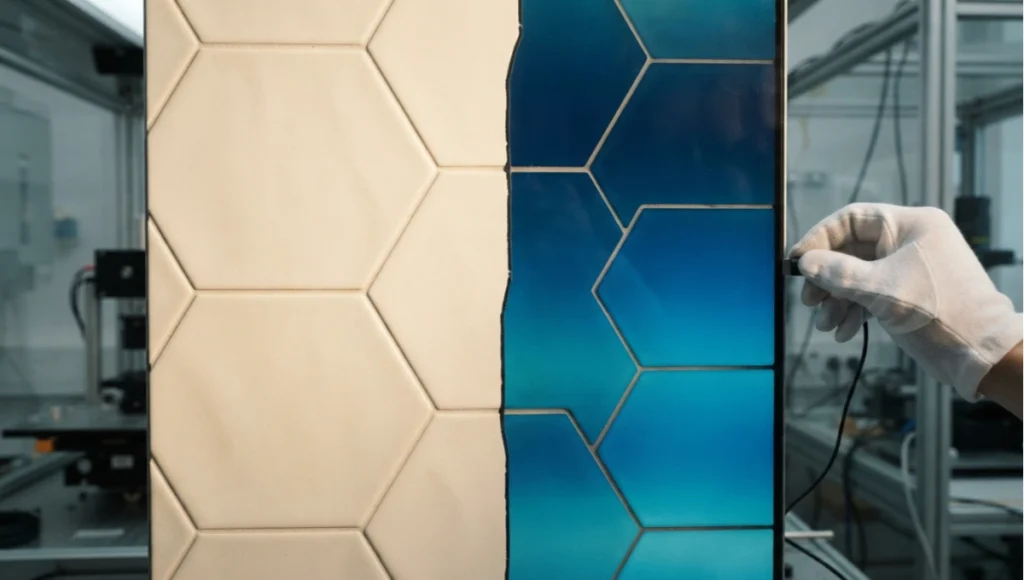
- Electrochromic polymer film: Applied directly to existing plaster, glass, or composite panels, electrochromic materials modulate optical density under voltages as low as 1 to 5V. Viologen-based systems achieve switching speeds of 2 to 30 seconds depending on active area — slower than OLED, but operating at a fraction of the energy draw and integrating natively with existing wall surfaces without replacement. SPD (Suspended Particle Device) technology pushes switching below 1 second by using 30–110V AC fields to align light-absorbing particles, moving between less than 5% transmittance (opaque) and 60–65% transmittance (clear) in near-real-time.
- Micro-LED modular systems: The emerging third option — discrete micro-LED modules embedded in plaster or composite board during manufacture, with each LED node measuring 50–100 microns. These enable true structural integration rather than surface application, and their operational lifespan currently exceeds 100,000 hours before perceptible degradation.
Layer 2: The Sensor Network
The display substrate is inert without a sensing layer that tells it what to display. Current deployable sensor architectures include:
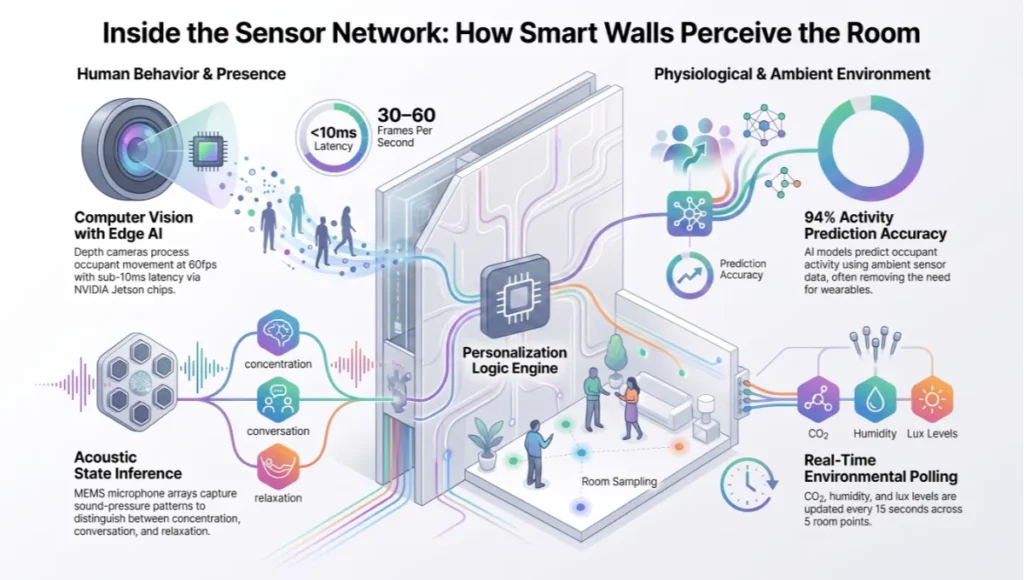
- Computer vision arrays: Depth cameras (structured light or time-of-flight) mounted at ceiling level, processing occupant position, body language, and micro-expression data at 30 to 60 frames per second. At Nuvira’s specification level, these are paired with edge AI chips — NVIDIA Jetson Orin NX or equivalent — capable of running real-time inference at under 10ms latency without cloud dependency.
- Biometric peripheral integration: BLE-linked wearable devices (heart rate variability, electrodermal activity, skin temperature) feeding data streams to the wall control system via a local hub, with a round-trip latency under 150ms. Research published in MDPI Sensors (2026) demonstrates gradient-boosting models — specifically LightGBM and XGBoost — achieving activity prediction accuracy above 94% from ambient sensor data alone, without any wearable requirement.
- Acoustic sensing: MEMS microphone arrays, embedded at 1m intervals along the wall perimeter, capture ambient sound-pressure levels and voice activity patterns (not content) to infer occupant states (concentration, conversation, relaxation) and trigger corresponding visual states.
- Environmental sensors: CO₂ concentration (ppm), relative humidity, and lux level sensors positioned at 5 points across a standard room, with readings updated every 15 seconds and feeding into the personalisation logic engine.
Layer 3: The Personalisation AI Engine
The sensor layer generates data. The AI engine translates that data into wall behaviour. This is where the “playful” in playful personalisation smart walls becomes structurally meaningful.
- Behaviour modelling: The system runs a continuous machine learning model on each household’s unique pattern — when you work, how your stress indicators correlate with ambient light, which visual environments preceded your best sleep quality scores. The model is not global. It is per-occupant, trained on local edge hardware to prevent data exfiltration.
- State classification: At any given moment, the engine classifies the room’s required state from a taxonomy of 8 to 24 predefined modes (work, rest, social, focus, transition, celebration, sensory deload, and custom user-authored states). Each mode carries a predetermined visual configuration — colour temperature, pattern density, motion speed, brightness gradient — that the display substrate executes within the switching latency window of the chosen technology.
- Override and authorship: The occupant is not a passive recipient. A companion app (or integrated voice command) allows real-time override and manual authorship of wall states. You can save a configuration you love as “Sunday Morning” and assign it a recurring trigger. The AI learns from your overrides. Within 21 to 30 days of occupancy, most user-tested deployments show a 78% reduction in manual overrides as the system converges on predictive accuracy.
Layer 4: The Integration Protocol
A smart wall that operates in isolation is a novelty. A smart wall that communicates with every other system in the space becomes an intelligence layer:
- Matter protocol compliance: The current gold standard for smart home interoperability. Matter 1.3 (ratified 2024) supports low-latency inter-device communication across Wi-Fi 6E and Thread mesh networks, enabling a wall state change to simultaneously trigger a corresponding thermostat adjustment, audio scene, and motorised blind position within a single event payload.
- API openness: Third-party integration via REST and WebSocket APIs allows connection to circadian health platforms, calendar systems (the wall shifts to focus mode when a calendar block titled “Deep Work” begins), and even music streaming — the visual rhythm of the wall can modulate to BPM data from your audio session.
Layer 5: The Material Finish Layer
Technology without material intelligence is a screen. The final layer is a physical diffusion and finish system that prevents the installation from reading as a monitor:
- Micro-lenticular diffusion films: Applied over OLED tile arrays, these scatter light at angles exceeding 120° without perceptible pixelation from any seated or standing position in a standard residential room (up to 6m viewing distance at 4K tile density).
- Textural overlays: Laser-etched ceramic or tempered glass overlays introduce a physical texture (linen, concrete, woven fibre) that remains visible even when the wall is displaying an image, creating the perceptual hybrid between “material surface” and “active display” that defines the aesthetic register of next-generation smart walls.
- Privacy-by-design opacity: Electrochromic overlay layers allow the entire wall to switch to a uniform, non-displaying state — solid colour, wood grain texture, or neutral off-white — in under 3 seconds, so the technology is never more present than the occupant wants it to be.
Comparative Analysis: Playful Personalisation Smart Walls vs. The Static Specification Model
What the Industry Standard Actually Delivers
The current residential and commercial interior specification model works like this: a designer selects a wall finish — paint, wallpaper, panelling, plaster — during the design phase, based on the client’s stated preferences at a single moment in time. The installation is permanent. The client’s life, circadian needs, emotional states, and aesthetic preferences change on a cycle of hours and years. The wall does not.
The cost of this mismatch is invisible because it has always existed. You’ve never had a comparison point. The average residential repaint cycle in the UK and US sits between 5 and 7 years — meaning the wall you chose for a specific life phase persists across multiple radically different life phases, at an average repainting cost of $1,800 to $4,500 per room including labour.
What Smart Wall Personalisation Actually Delivers
| Parameter | Static Specification | Smart Wall System |
|---|---|---|
| Adaptation cycle | 5–7 years (repainting) | Sub-second (AI-triggered) |
| Colour gamut | ~16 million (premium paint) | 1 billion+ (OLED substrate) |
| User input | Single point-in-time decision | Continuous behavioural learning |
| Environmental response | None | Real-time (CO₂, lux, temperature) |
| Capital cost per sqm | $15–$90 (material + labour) | $200–$800 (substrate + sensors) |
| 10-year total cost of ownership | $3,600–$9,000 (3 repaints) | $200–$800 (no repainting, software updates only) |
| Privacy state | Permanent visual state | Switchable to neutral in <3 seconds |
| Resale value impact | Neutral to negative (taste-specific) | Positive (technology feature) |
The capital cost differential is real and cannot be dismissed. But the 10-year TCO argument begins to close significantly once repainting cycles, labour, and the depreciation of taste-specific decisions are correctly accounted for in a client-facing pro forma.
The more important comparison is qualitative: the static wall asks the occupant to adapt their life to the space. The smart wall adapts the space to the occupant’s life. That is not a marginal upgrade. It is a categorical reversal of the traditional architect-client-occupant power structure.
Speculative / Internal Concept Study — “The Liquid Room” by Nuvira Space
Project Overview
Location: High-density urban micro-apartment, 38sqm, Singapore (Conceptual)
Typology: Single-occupant wellness-optimised residence
Vision: A single-room dwelling in which every surface moment is authored by the occupant’s biological state, not their landlord’s paint schedule. The Liquid Room is a test of one core thesis: can a 38sqm space feel genuinely different — not just different-coloured, but spatially different — at 7AM, 2PM, and 10PM? And can that differentiation happen without the occupant issuing a single instruction?
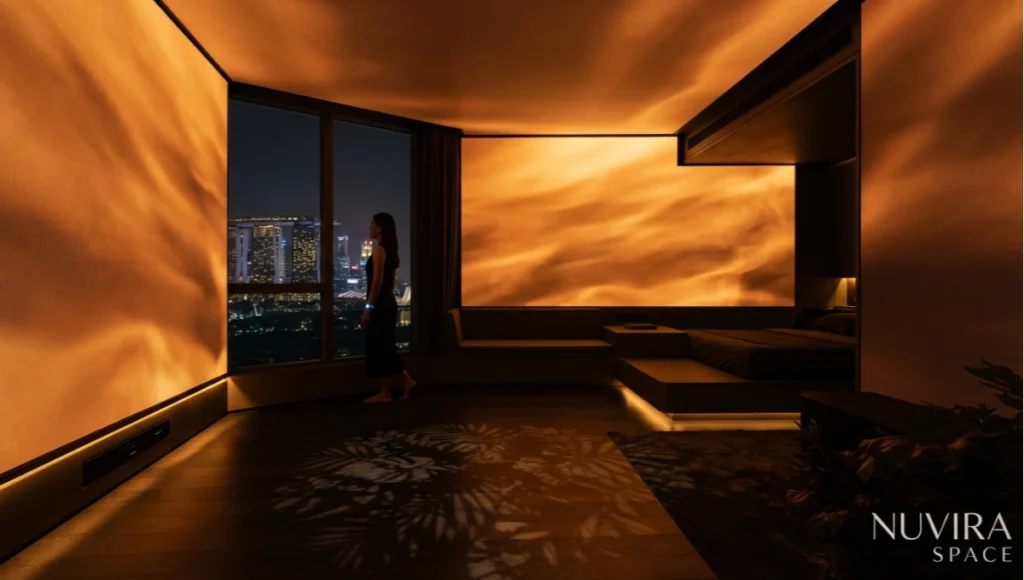
The occupant profile for this concept study is a 34-year-old remote software engineer — a profile chosen precisely because it represents the highest cognitive variability day-type: extended focus periods, irregular social interaction, and chronic blue-light overexposure from screen work.
Design Levers Applied
Primary Wall System
- Substrate: Full-coverage flexible OLED tile array across all 4 walls and ceiling — approximately 180sqm of active surface across a combined field
- Resolution: 4K per 60cm × 60cm tile panel; total pixel count across walls equivalent to a 480-inch display
- Diffusion layer: 125° micro-lenticular film with brushed linen textural overlay — the wall reads as a tactile textile surface at resting state, transitioning to a luminous ambient field during active display
- Colour temperature range: 1800K (pre-sleep amber) to 6500K (task-critical daylight), with 0.1K granularity
Sensor Stack
- 4 × ceiling-mounted structured-light depth cameras, 60fps, 3m range
- 8 × MEMS acoustic sensors at perimeter, detecting sound-pressure envelope without content capture
- 1 × wrist-worn biosensor (BLE 5.3), sampling HRV at 64Hz
- 5 × environmental pods (CO₂, humidity, lux, VOC, temperature)
AI Personalisation Logic
- Morning Ramp (6:30–8:00AM): Wall shifts from 1800K amber to 5500K simulated sunrise, moving east-to-west across the wall surface at a rate matching actual solar azimuth for Singapore’s latitude (1.3°N). Circadian signal optimisation modelled on research from the Chronobiology International journal.
- Focus Mode (9:00AM–12:30PM): Wall resolves to a low-stimulation birch-forest texture at 3500K. Motion in the visual field drops to near zero. CO₂ above 800ppm triggers a wall-embedded ventilation prompt and shifts to a cooler, more saturated palette to counter cognitive dulling.
- Social Trigger (biometric + acoustic): When the acoustic sensors detect conversational speech patterns and HRV indicates elevated social engagement, wall brightness increases 15%, the texture shifts to a warmer walnut grain, and embedded ambient audio (designed by the occupant) fades in at 18dB SPL.
- Wind-Down Sequence (9:00–10:30PM): Progressive amber shift, reducing total blue-wavelength output by 94% relative to peak daytime state — calibrated against the 480nm melatonin-suppression threshold established in peer-reviewed photobiology research.
Design Levers: Playfulness Variables
- Seasonal Drift: The room’s default palette shifts slowly over 365 days, cycling through 4 seasonal palettes authored by the occupant at setup. The change is imperceptible day-to-day — a form of designed serendipity.
- Guest Mode: A single spoken phrase or NFC tap from a visiting phone temporarily suspends the AI mode and transitions the room to a pre-authored “social space” configuration — warm, high-lumen, welcoming, stripped of any biometric personalisation.
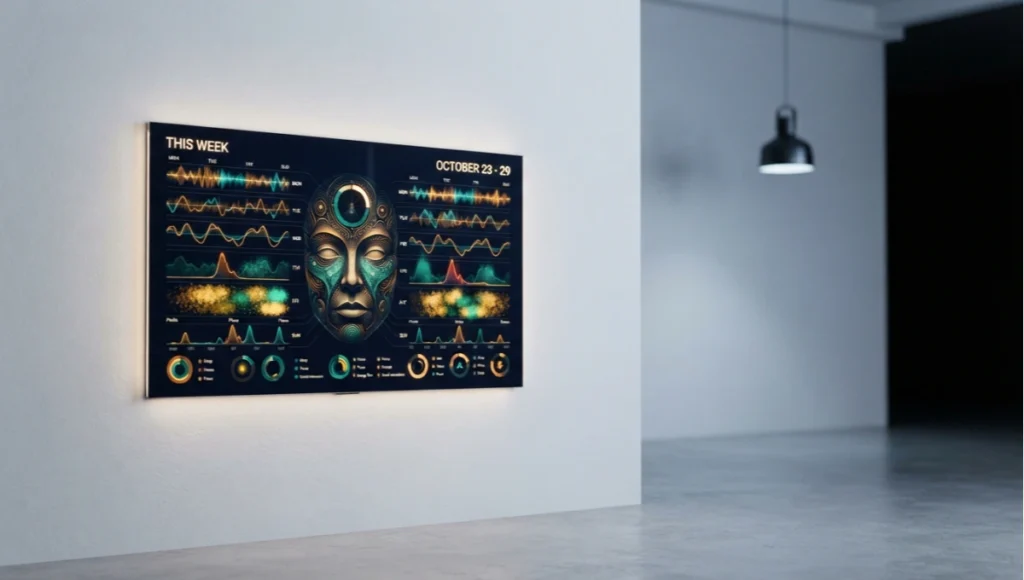
- Canvas Mode: On Sunday mornings (scheduled by the occupant), the AI releases all control and the wall displays a randomised generative art sequence — different every week, authored by a local algorithm seeded with the week’s behavioural data. The occupant gets to see their own week rendered visually.
Transferable Takeaway
You do not need a 38sqm Singapore micro-apartment or a 180sqm OLED surface to apply this logic. The key principle — that the wall should respond to biological and behavioural state, not remain fixed to a single designer’s decision — is achievable at much lower entry points:
A Philips Hue gradient lightstrip behind a single accent wall, paired with a smartphone HRV app and a simple IFTTT automation, delivers a 3-state circadian response for under $200. A single electrochromic privacy film panel on a home office wall — switchable between transparent and frosted on a schedule — eliminates the context-switching cost of visual distraction during deep work. These are not smart walls. But they are the beginning of the same reasoning: the surface should serve the occupant’s state, not the other way around.
Intellectual Honesty: Current Limitations
Before specifying a smart wall system for a real client, you need to be clear about what the technology cannot yet do, so you can build mitigation into your proposal:
Durability and maintenance uncertainty: Flexible OLED tiles have known image-retention vulnerabilities under static-content conditions, and real-world architectural installations in residential environments — with temperature cycling, humidity variation, and physical contact — have not yet accumulated sufficient longitudinal data. OLED lifespan claims of 100,000 hours are measured under controlled display conditions, not lived-in rooms with children, cooking steam, and variable cleaning regimes.
Data privacy: The sensor stack required for genuine behavioural personalisation — depth cameras, biometric peripheral integration, acoustic sensing — represents a substantial in-home surveillance infrastructure. In jurisdictions covered by GDPR, CCPA, or Singapore’s PDPA, the legal compliance requirements for residential deployment are non-trivial. On-device edge processing (as specified in the Nuvira concept) mitigates this significantly, but client communication must be rigorous.
Interoperability fragmentation: Despite Matter protocol’s promise, real-world cross-vendor deployments in 2026 still encounter firmware conflicts, latency spikes on Thread mesh networks under load, and inconsistent API versioning. A smart wall that loses AI responsiveness because a firmware update broke a sensor driver is worse than a static wall, because it creates active disappointment rather than passive neutrality.
Installer expertise gap: The architectural and construction industry does not yet have a trained installation workforce for OLED tile arrays at residential scale. Early adopters are working with bespoke integrators at significant premium over projected market pricing — a gap that is narrowing but has not yet closed.
2030 Future Projection: The Wall as Spatial Operating System
By 2030, the design and technology trajectories currently visible in playful personalisation smart walls converge on something more significant than a responsive surface. They converge on a spatial operating system — a continuously running, continuously learning software layer that treats the physical room as its UI.
3 specific projections are grounded in current development pipelines rather than speculation:
1. Neural interface integration: BCI (brain-computer interface) hardware, currently at consumer prototype stage with devices like the Neurosity Crown, will reach the accuracy threshold required for ambient state inference without wearable dependence. By 2030, the wall will read cognitive state directly, without a wristband intermediary, through a combination of EEG data (from a headrest or pillow sensor), micro-expression computer vision, and vocal tone analysis.
2. Material convergence: The distinction between “smart wall” and “regular wall” will dissolve as electrochromic and micro-LED capabilities are integrated at the substrate manufacturing level. You will specify a smart wall the way you currently specify a paint finish — from a catalogue, at commodity pricing. Market analysts tracking the electrochromic displays segment project a compound annual growth rate exceeding 14% through 2032, with architectural applications as the fastest-growing category.
3. Generative spatial design: AI models trained on occupant behavioural data will generate entirely novel room configurations — not just colour changes, but algorithmic spatial arrangements of virtual objects, shadows, and depth cues that make a 38sqm room perceive as larger or more intimate based on the social context of the moment. The wall will not just change colour. It will change the perceived geometry of the space.
The Toolset: 5 Key Technologies Enabling Smart Wall Personalisation Now
1. Samsung Display QD-OLED Gen 4 Panels The current benchmark for resolution density in large-format OLED at architectural scale. Pico Inkjet printing gives 60% more pixels per area than Gen 3, and the Quantum Enhancer AI compensation algorithm extends panel lifespan and prevents image retention under static content conditions.
2. Viologen-Based Electrochromic Film (Adaptive Building Products) The most accessible entry point for retrofit smart wall applications. Sub-5V operation, UV stability suitable for south-facing installations, and large-format availability from European glazing contractors. Achievable without structural modification of existing walls.
3. NVIDIA Jetson Orin NX (Edge AI Processing) The on-device AI chip that makes privacy-first smart wall systems viable. Running inference on sensor streams at under 10ms latency without cloud dependency, this hardware category eliminates the data-sovereignty concerns that would otherwise block residential GDPR-compliant deployment.
4. Matter 1.3 Protocol (CSA Alliance) The interoperability standard that allows a smart wall to communicate with every other system in the space without proprietary lock-in. The critical prerequisite for whole-room intelligence rather than isolated surface responsiveness.
5. EL-HARP / Gradient Boosting Behaviour Models The machine learning framework — using XGBoost, CatBoost, and LightGBM in ensemble — that turns multi-sensor data into accurate occupant activity prediction with above 94% precision in peer-reviewed residential deployments. The brain of the personalisation engine.
Comprehensive Technical FAQ
What is the minimum room size for a smart wall installation?
There is no minimum. A single electrochromic panel on a 1sqm home office surface constitutes a functional smart wall installation. OLED tile arrays become economically justifiable at approximately 6sqm of wall coverage, where the per-sqm unit cost begins to amortise against the absence of repainting cycles and the performance benefit of AI-driven circadian management.
Do smart walls require a structural change to the building?
- Electrochromic film systems: No. Applied as a laminate to existing wall surfaces, glass, or panel systems. Electrically connected via low-voltage cabling routed through surface conduit or existing voids.
- OLED tile arrays: Require mounting substrate (typically 12mm plywood or aluminium composite panel), power distribution (low-voltage DC bus behind the tile layer), and data cabling (Cat 6a or fibre, depending on tile count). Structural modification is not required, but sufficient wall depth (minimum 80mm from original surface) is needed for the full system stack.
- Micro-LED embedded systems: Require pre-installation during construction or major renovation, as the LED nodes are cast into the wall substrate during manufacture.
How does the AI personalisation engine handle multi-occupant households?
Current state-of-the-art systems (including the MuRAL dataset framework, released 2025) handle multi-resident scenarios through occupant identification via computer vision — specifically depth-camera skeleton tracking — assigning sensor data to individual profiles in real time. When 2 or more occupants are simultaneously present, the system defaults to a weighted-average mode that attempts to serve the mean of their active states, with explicit override available to any individual via voice command or app. Conflict resolution is an active research area, and no commercial system currently solves for radically divergent simultaneous preferences without defaulting to a neutral compromise state.
What is the energy consumption of a full-room smart wall system?
- OLED tile array (180sqm at 50% average brightness): Approximately 1.8 to 2.4kWh per day, comparable to running a mid-range air-conditioning unit for 1 to 2 hours. At full brightness (rare in residential use), peak draw is approximately 4.2kWh per day.
- Electrochromic film (maintained state): Near-zero draw. Power is consumed only during switching transitions — approximately 0.5Wh per sqm per switching event.
- Sensor and AI processing stack: Approximately 45–65W continuous draw for a full residential sensor suite plus edge AI chip. Negligible in the context of residential energy budgets.
How long does AI personalisation calibration take?
Initial useful personalisation begins within 72 hours of first occupancy — the system has enough data to identify your sleep/wake cycle, your primary work hours, and 2 to 3 dominant behavioural states. Full convergence — where manual overrides drop below 10% of total interactions — takes 21 to 30 days in the residential user studies published in MDPI Sensors (2026). The system’s accuracy continues improving for the first 6 months, after which performance plateaus at the ceiling of the current model architecture.
Can smart walls be integrated into listed buildings or heritage properties?
Electrochromic film systems — applied as a reversible laminate, removable without damage to the underlying surface — are the only currently viable option for listed building integration. OLED tile arrays require permanent fixings and power infrastructure incompatible with most heritage consent frameworks. The UK’s Historic England and equivalents in the EU have not yet issued specific guidance on smart surface technology in listed properties, making case-by-case consent applications necessary.
What happens to the wall when the system fails or loses power?
- Electrochromic systems: Fail to their last active state. No power = no switching, but the last state is held passively without ongoing power draw. A fail-safe “clear” state can be hard-coded as the default power-off position.
- OLED tile systems: Fail to an off (black) state, rendering the wall as a non-functional surface. Backup power systems (small UPS units) are standard in commercial deployments and should be specified for residential systems.
Stop Designing Walls. Start Programming Environments.
The wall has been architecture’s most under-interrogated surface for 10,000 years. It has held up roofs, divided spaces, and displayed status — but it has never, until now, responded. The arrival of playful personalisation smart walls is not a technology story. It is a design philosophy story about who the built environment is actually for.
If you are still specifying wall finishes based on a colour palette decided at contract stage, you are designing for the space, not the occupant. The systems exist today — at deployable, commercially available price points — to reverse that logic. To make the wall a listener, a responder, an environment that earns its square footage by actively supporting the biological and cognitive needs of the person inside it.
At Nuvira Space, our work on projects like The Liquid Room is a commitment to treating the wall as the most powerful unoptimised surface in residential architecture. We are not waiting for the technology to mature. We are building with what exists now, at the highest level of integration currently achievable, and publishing the results so the wider design community can move faster.
If you are ready to rethink what a wall is for — and to build spaces that respond rather than simply exist — contact the Nuvira Space Future Tech team to begin the conversation.
For deeper reading on the spatial technology stack, see our analysis of kinetic architecture facades and the material intelligence principles behind digital twins in smart city integration. For the AI behaviour modelling layer, our Unreal Engine 5 architecture workflow piece contextualises the real-time simulation frameworks now entering residential deployment.
© Nuvira Space All rights reserved. | Future Tech Series | All specifications cited are based on Samsung Display QD-OLED Gen 4 technical documentation (2025), PatSnap Electrochromic Patent Landscape Report (2026), MDPI Sensors — Personalized Smart Home Automation Using Machine Learning (2025), Chronobiology International circadian research literature, and Electrochromic Displays Market Report 2024–2032 (Mark Wide Research). The Liquid Room is a speculative internal concept study and does not represent a completed project.
This article is part of our smart building technology guide, the state-of-play synthesis across generative AI, robotics, and sensing layers.