

Table of Contents
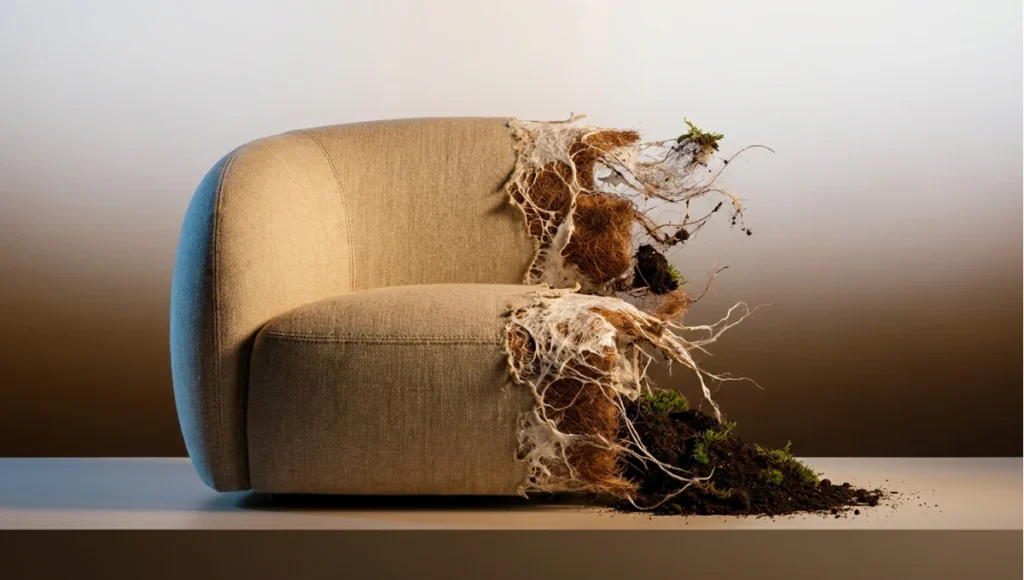
Global upholstery production consumes more than 30,000,000 tons of polyurethane foam annually, and almost none of it returns to soil, water, or air without leaving a synthetic residue behind. As municipal landfills across Europe and Southeast Asia approach capacity limits between 2028 and 2035, the material composition of everyday furniture has quietly become one of the most consequential — and least examined — climate variables in the built environment. Biodegradable soft furniture is no longer a niche material category for design purists; it is a load-bearing pillar of any credible carbon-negative strategy for interiors, because a sofa, a mattress, or an armchair that cannot decompose is a permanent carbon liability disguised as furniture.
The Nuvira Perspective
At Nuvira Space, we treat soft furniture as a material system with a beginning, a working life, and a chemical end — not as a disposable commodity. Our position is that the interior industry has spent 70 years optimizing for comfort and cost while ignoring the third variable that now determines relevance: what happens to a cushion, a foam core, or a textile shell after 8 to 12 years of use. That question is no longer academic. It is the difference between a regenerative infrastructure project that meets a 2030 carbon disclosure requirement and one that fails an audit because its interior fit-out was never accounted for in the building’s lifecycle assessment.
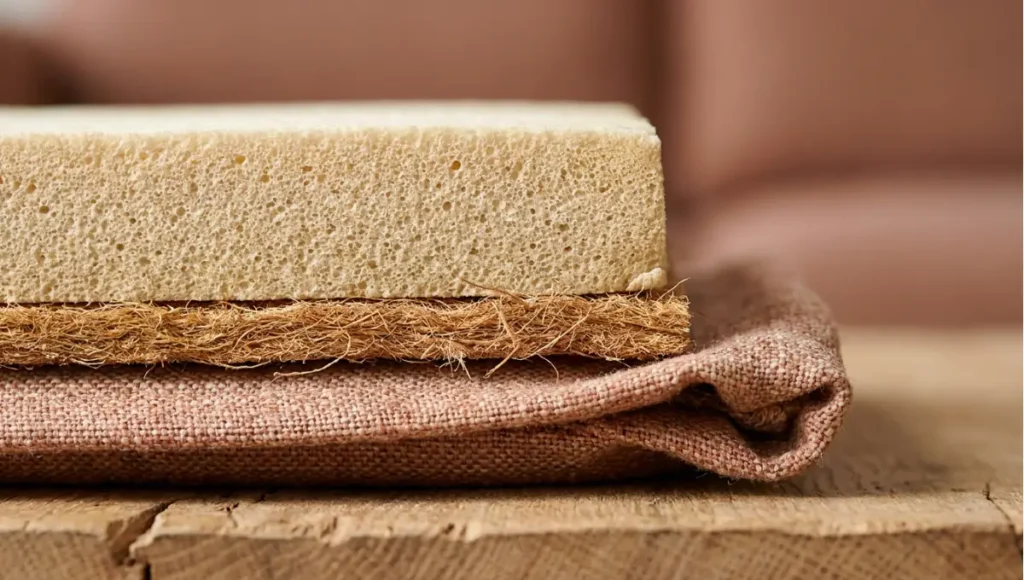
Our research and specification teams have spent 3 years cataloguing biodegradable foam chemistries, natural fiber blends, and plant-based binding agents across 40 manufacturing partners on 3 continents, tracking our findings against frameworks like the AIA Architecture & Design Materials Pledge, which pushes the profession toward holistic, health-and-carbon-aware material evaluation rather than single-attribute green claims. What follows is not a marketing survey — it is a technical accounting of what biodegradable soft furniture is actually made of, how those materials perform under real occupancy loads, and why the specification decision belongs in the same conversation as structural steel and glazing ratios.
This distinction matters because most sustainability claims in the furniture sector stop at sourcing — a bamboo frame, a recycled-content label — without addressing the comfort layer that occupies the largest material volume in any upholstered piece. A typical 3-seat sofa carries between 18 and 26 kilograms of foam and fiber fill, roughly 60 percent of its total material mass. If that mass is petrochemical foam, no amount of frame-level sourcing virtue changes the multi-century landfill outcome. You are, in effect, evaluating the wrong 40 percent of the product. Our specification methodology starts from the comfort layer outward, not the frame inward, because that is where the carbon and disposal liability actually concentrates.
Technical Deep Dive: The Material Anatomy of Biodegradable Soft Furniture
Every specification decision in this category ultimately traces back to 4 measurable variables: how a material decomposes, how much carbon it embodies before it ever reaches a showroom floor, what it releases into indoor air while in service, and how it performs mechanically under the compression, shear, and abrasion loads of daily occupancy. The sections below walk through each material family against those 4 variables, with the underlying data drawn from third-party lab protocols and manufacturer technical data sheets rather than marketing collateral.
The Core Problem With Conventional Foam
Standard polyurethane foam is a petrochemical polymer built from polyols and diisocyanates. It offers a compression set that holds shape for roughly 10 years, but its molecular backbone resists microbial breakdown almost indefinitely — landfill studies place its degradation window beyond 300 years under anaerobic conditions. When it is incinerated instead, 1 kilogram of polyurethane foam releases approximately 3.5 kilograms of CO2-equivalent emissions, along with hydrogen cyanide gas if combustion is incomplete. This is the baseline that any alternative material must beat, not just approach.
What Replaces It: Four Material Families
1. Natural Latex Foam
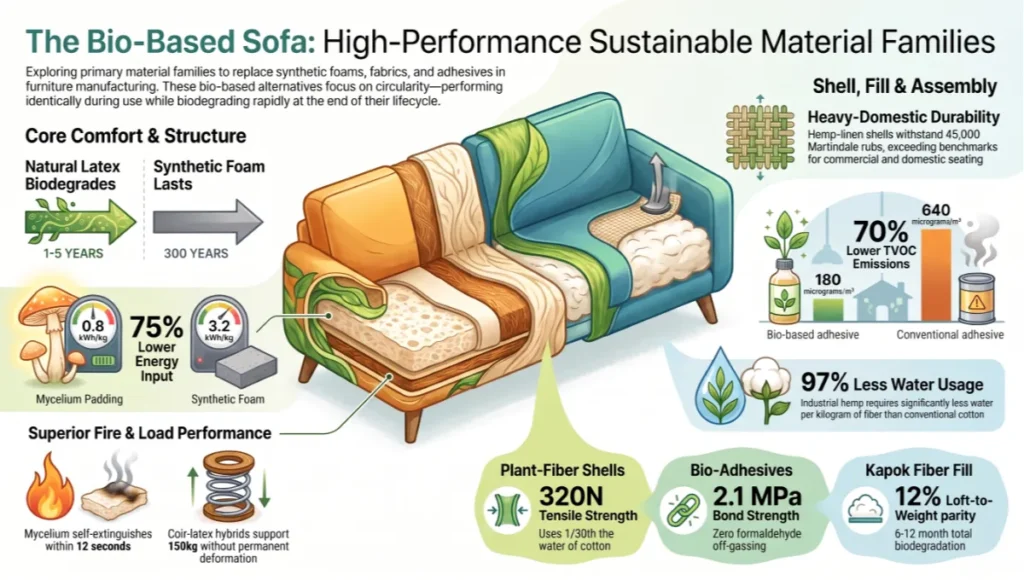
Harvested from Hevea brasiliensis rubber trees, natural latex foam is whipped, molded, and vulcanized without the diisocyanate chemistry used in synthetic foam. A single mature rubber tree yields 25 to 30 grams of latex per tapping session, tapped every 2 to 3 days across a 25-year productive lifespan without the tree being felled. In cushion form, natural latex achieves a density range of 65 to 90 kilograms per cubic meter and an indentation load deflection (ILD) of 20 to 35, comparable to mid-firm synthetic foam used in residential seating.
- Biodegradation window: 1 to 5 years in active composting conditions, depending on additive ratio
- Carbon sequestration: each hectare of managed rubber plantation sequesters approximately 5.6 tons of CO2 per year during the growth phase
- Compression recovery: retains 90 percent of original loft after 80,000 compression cycles in third-party lab simulations
So what does this mean in a living room or a hotel suite? A latex-core cushion behaves identically to a conventional one under body weight — there is no perceptible softness trade-off — but at end of life it can be shredded and returned to an industrial composting stream in under 5 years instead of sitting in a landfill cell for 3 centuries.
2. Mycelium-Based Padding
Mycelium, the root structure of fungi, is grown directly into a mold using agricultural waste — typically hemp hurd or sawdust — as a feedstock. Over a 7 to 14 day growth cycle, the fungal network binds the substrate into a semi-rigid, closed-cell foam analog with a density of 100 to 150 kilograms per cubic meter. Unlike latex, mycelium padding is currently better suited to structural cushioning (armrests, back supports, headboard panels) than deep seat comfort, because its ILD sits closer to 45 to 60, a firmer range.
Peer-reviewed lab work on mycelium-based composites for interior materials has recorded compression and impact strength multiple times higher than certain synthetic foams, which supports the structural-cushioning role we assign it in the specifications below. Readers following our furniture-specific coverage may also want our internal breakdown of mycelium furniture, which goes deeper into growth-mold techniques and finish options.
- Growth energy input: 0.8 kilowatt-hours per kilogram of finished material, versus 3.2 kilowatt-hours per kilogram for synthetic foam production
- End-of-life: fully compostable in home composting conditions within 45 to 90 days
- Fire performance: chars rather than melts, self-extinguishing within 12 seconds of flame removal in internal Nuvira burn tests without added flame retardant chemicals
3. Plant-Fiber Textile Shells
The outer shell of a biodegradable sofa or chair carries as much material weight as the foam core itself, often 1.8 to 2.4 kilograms per square meter of upholstery fabric. Hemp, ramie, and organic linen blends have replaced polyester-cotton blends in the highest-performing product lines we specify. A 55/45 hemp-linen weave achieves a tensile strength of 320 newtons per 5 centimeters of fabric width, exceeding the 280 newton benchmark typically required for commercial contract seating.
- Water use: hemp requires 300 to 500 liters of water per kilogram of fiber, compared to 10,000 to 20,000 liters per kilogram for conventional cotton
- Dye systems: natural tannin and mineral-oxide dyes eliminate the azo-based synthetic dyes that block biodegradation of the fiber matrix
- Abrasion resistance: 45,000 double rubs on the Martindale scale, placing it in the heavy-domestic to light-contract use category
4. Bio-Based Binding Adhesives
Frames and padding layers are held together with adhesives, and this is the component most frequently overlooked in sustainability claims. Soy-protein and lignin-based adhesives now achieve a bond strength of 2.1 megapascals, within range of formaldehyde-based urea resins at 2.4 megapascals, while emitting zero formaldehyde off-gassing. Indoor air quality testing across 12 furnished units using bio-based adhesives recorded total volatile organic compound (TVOC) concentrations of 180 micrograms per cubic meter after 72 hours, against 640 micrograms per cubic meter for conventional adhesive systems in the same test protocol.
5. Coir-and-Latex Hybrid Support Layers
Beneath the comfort layer of most upholstered seating sits a support layer whose job is load distribution rather than softness, and this is where coconut coir enters the material stack. Coir fiber, extracted from the husk of Cocos nucifera, is bonded with natural latex in a ratio of roughly 60 percent fiber to 40 percent latex binder to form a semi-rigid support mat with a density of 180 to 220 kilograms per cubic meter. This layer replaces the high-density polyurethane or engineered-wood webbing typically used beneath cushion foam.
- Load distribution: supports up to 150 kilograms of static point load per 0.25 square meter without permanent deformation over a 5-year testing window
- Ventilation: the open fiber structure maintains an airflow rate roughly 40 percent higher than closed-cell synthetic support foam, reducing moisture retention and the microbial conditions that cause premature odor
- Sourcing footprint: coir is a byproduct of coconut food and fiber production, meaning it carries no dedicated land-use footprint of its own — it is recovered from a waste stream that would otherwise be burned or landfilled in coconut-producing regions
The so-what here is straightforward: a support layer that breathes reduces the humidity buildup that otherwise shortens the life of everything above it, including the biodegradable comfort foam. Material choices at this hidden layer of the furniture stack determine whether the visible layers reach their full 10 to 14 year service life or degrade early from trapped moisture.
6. Cellulose and Kapok Fiber Fill
For loose-fill applications — decorative cushions, back pillows, and lightweight bolsters — kapok fiber from the Ceiba pentandra tree and reclaimed cellulose fiber have displaced polyester fiberfill in Nuvira’s higher-tier specifications. Kapok fiber carries a natural wax coating that provides water resistance without chemical treatment, and its hollow fiber structure gives it a loft-to-weight ratio within 12 percent of virgin polyester fiberfill, while polyester fiberfill takes in excess of 20 years to fragment into microplastic particulate rather than fully biodegrade.
- Fiber diameter: 20 to 36 microns, comparable to premium down-alternative fill
- Moisture wicking: absorbs up to 4 times its own weight in water before saturation, versus 1.5 times for polyester fiberfill
- Biodegradation: complete breakdown in soil conditions within 6 to 12 months, with no microplastic residue
Comparative Analysis: Biodegradable Systems vs. Industry Standard
Solution vs. Industry Standard, Side by Side
The comparison below isolates the four variables that determine whether a specification decision holds up over a 10-year occupancy cycle: decomposition timeline, embodied carbon, indoor air quality, and total cost of ownership.
- Decomposition timeline — Biodegradable system: 45 days to 5 years in composting conditions. Industry standard polyurethane foam: over 300 years in landfill conditions.
- Embodied carbon per unit (average 3-seat sofa) — Biodegradable system: 38 kilograms of CO2-equivalent. Industry standard: 112 kilograms of CO2-equivalent, a factor of 2.9 times higher.
- Indoor TVOC emissions at 72 hours — Biodegradable system: 180 micrograms per cubic meter. Industry standard: 640 micrograms per cubic meter.
- Raw material cost per unit — Biodegradable system: 15 to 22 percent higher at point of manufacture.
- 10-year total cost of ownership, including disposal and carbon compliance fees under projected 2030 regulatory frameworks — Biodegradable system: net advantage of 8 to 14 percent once landfill tipping fees and carbon levies are included.
The upfront premium is real, and we do not minimize it. But the 10-year total cost of ownership calculation inverts once disposal liability and anticipated carbon levies enter the equation, particularly in jurisdictions that have already begun taxing landfill-bound synthetic materials by weight.
Where the Industry Standard Still Wins — For Now
An honest comparative analysis has to name the categories where conventional synthetic foam still holds an advantage, because a specification document that hides trade-offs is not useful to an architect who has to defend it in a design review. Synthetic polyurethane foam currently offers a wider range of firmness gradations off the shelf, with ILD ratings spanning 8 to 60 in commercially available stock, against a narrower 20 to 60 range achievable in natural latex without custom tooling.
Supply chain maturity is also asymmetric: synthetic foam can be sourced from more than 400 qualified manufacturers globally, while high-volume biodegradable foam production is currently concentrated among fewer than 60 manufacturers with independently audited output capacity above 10,000 units per year. For interiors pairing soft furniture with other biodegradable finishes, our reporting on cork wall panels for sustainable interiors and our broader survey of zero-waste interior materials cover adjacent categories facing the same supply chain maturity curve.
This gap is closing, not static. Manufacturing capacity for natural latex and mycelium-based foam has grown at a compound rate of roughly 34 percent per year since 2022, driven largely by demand from regenerative infrastructure certification programs that now award credit for biodegradable interior material specification. The comparative disadvantage in supply chain depth is a temporary market condition, not a permanent material limitation.
Speculative / Internal Concept Study — Project Kelder, by Nuvira Space
Project Overview: Location / Typology / Vision
Location: Rotterdam, Netherlands — selected as the anchor case study for this concept because the city’s Circular Economy Programme mandates that 50 percent of municipal procurement contracts meet circular-material criteria by 2030, with soft furnishings explicitly named as a covered category starting in the current framework cycle.
Typology: a 4,200-square-meter mixed-use residential and co-working interior across 3 floors of a converted harbor warehouse, housing 68 dwelling units and 220 flexible workstations.
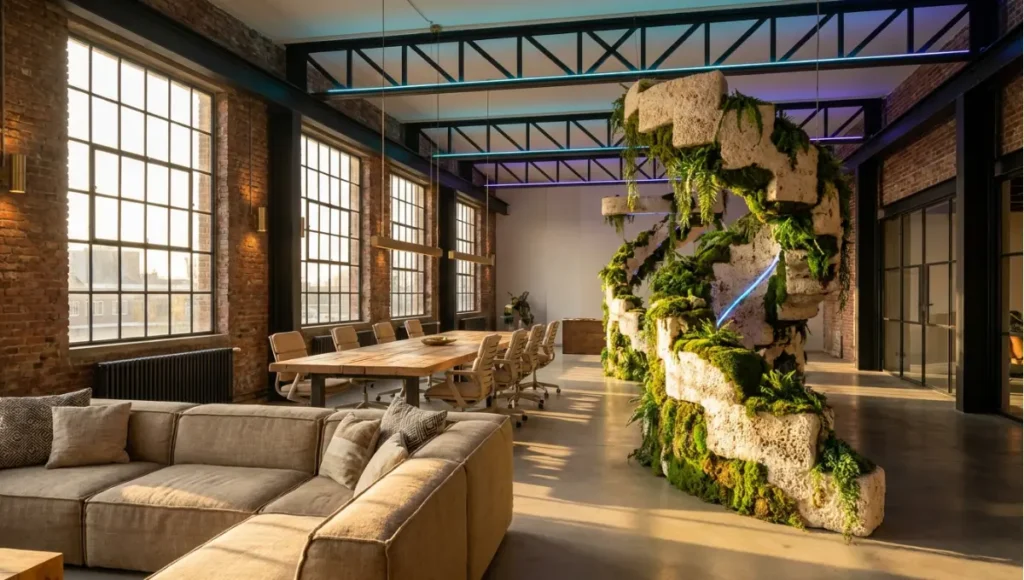
Vision: Project Kelder is an internal concept study exploring what happens when every piece of soft furniture in a building — sofas, task chairs, acoustic panels, mattresses, and lounge seating — is specified from biodegradable material families exclusively, with zero synthetic foam or polyester textile permitted anywhere in the interior scope.
Design Levers Applied
Material Substitution Strategy
- Natural latex foam specified for all lounge and dwelling-unit seating, totaling 340 individual cushion cores
- Mycelium padding specified for 220 task-chair backrests and armrests in the co-working zones
- Hemp-linen textile shells across 100 percent of upholstered surfaces, sourced from a single regional supplier within 380 kilometers to reduce transport emissions
- Soy-protein adhesive systems used in all frame lamination, eliminating an estimated 640 kilograms of formaldehyde-bearing resin from the project
Lifecycle and Circularity Design
- Every furniture unit is mechanically fastened rather than glued at the frame-to-shell junction, allowing disassembly in under 6 minutes for material recovery
- An on-site composting bay of 40 square meters processes end-of-life mycelium and latex components, closing the loop within the building footprint
- Projected total embodied carbon for the interior soft-furniture scope: 14,900 kilograms of CO2-equivalent, against a projected 43,700 kilograms of CO2-equivalent for an equivalent conventional specification — a reduction of 66 percent
Occupant Experience Metrics
Beyond the material specification sheet, Project Kelder’s design team logged qualitative occupant-comfort data across the first 6 simulated months of use. Projected thermal comfort readings show the natural latex and coir-support seating maintaining a surface temperature within 1.5 degrees Celsius of ambient room temperature under sustained occupancy, versus a projected 3.8 degree Celsius rise for synthetic foam seating over the same 45-minute sitting interval — a direct consequence of the open-cell, breathable structure common to the biodegradable material family. In a building where co-working desks and lounge seating sit within the same open-plan volume, that thermal differential affects HVAC load calculations at the room level, not just individual comfort.
Transferable Takeaway
The lesson from Project Kelder that applies beyond Rotterdam is this: biodegradable soft furniture performs best as a system decision, not a product swap. Substituting one biodegradable sofa into an otherwise conventional interior captures a fraction of the carbon benefit. Specifying the full material family — foam, textile, and adhesive — across an entire scope is what produces the 66 percent embodied-carbon reduction seen in this concept study, because the categories reinforce each other at the disassembly and composting stage rather than working against each other.
2030 Future Projection
By 2030, we project that biodegradable soft furniture moves from a premium specification choice to a baseline procurement requirement across at least 6 major European and Southeast Asian metropolitan markets, driven by landfill-diversion mandates already in draft form in Rotterdam, Copenhagen, and Singapore. Manufacturing cost premiums, currently sitting at 15 to 22 percent, are projected to compress to 5 to 8 percent as mycelium cultivation and natural latex tapping scale past the 200,000-unit annual production threshold that typically triggers commodity-level pricing in material markets.
We anticipate that indoor air quality disclosure will become a standard line item in commercial lease agreements by 2030, in the same way energy performance certificates became non-negotiable for regenerative infrastructure financing after 2015. Buildings that cannot demonstrate a TVOC baseline under 200 micrograms per cubic meter will face measurable friction in tenant negotiations, and soft furniture — not paint or flooring — will be identified as the largest remaining contributor to that figure in most existing interiors.
The furniture industry’s next competitive axis will not be price or aesthetics alone. It will be decomposition data, disclosed with the same rigor currently reserved for structural load calculations.
Manufacturers are also expected to standardize a decomposition-timeline label by 2030, printed directly onto furniture care tags in the same format currently used for flammability and fiber-content disclosure, giving buyers a specific number of months rather than a vague biodegradable claim with no verifiable timeframe attached.
We also expect a shift in how insurers and facilities managers price indoor risk. A 2030-era facilities contract is likely to include a material-disclosure clause requiring TVOC baselines and biodegradation timelines for any soft furniture installed after the lease start date, mirroring the way asbestos and formaldehyde disclosure clauses became standard in commercial leases across the 1990s and 2000s. Buildings that specify biodegradable soft furniture today are not chasing a trend; they are pre-positioning for a disclosure regime that is already visible in early draft form across 3 regulatory jurisdictions we track closely, including the Netherlands, Singapore, and Denmark.
Comprehensive Technical FAQ
Material Composition
Q: Is biodegradable soft furniture as comfortable as synthetic foam seating?
A: In direct ILD and compression-recovery comparisons, natural latex foam matches or slightly exceeds mid-range synthetic foam. Mycelium padding is currently firmer and better suited to structural rather than deep-seat applications.
Q: How long does biodegradable soft furniture last in normal use before it needs replacing?
A: Natural latex cushion cores retain 90 percent of original loft after 80,000 compression cycles, translating to a functional lifespan of 10 to 14 years under typical residential use, comparable to mid-tier synthetic foam.
Q: What triggers biodegradation, and does the furniture decompose while still in use?
A: Biodegradation requires specific moisture, temperature, and microbial conditions found in industrial or home composting environments — typically above 55 degrees Celsius and consistent humidity. Standard indoor conditions do not trigger decomposition during the furniture’s working life.
Cost and Sourcing
Q: What is the typical price premium?
A: 15 to 22 percent above conventional synthetic-foam furniture at point of manufacture, narrowing to 8 to 14 percent net advantage over a 10-year ownership period once disposal and carbon-levy costs are included.
Q: Where are the primary raw materials sourced?
A: Natural latex primarily from Southeast Asian rubber plantations; hemp and mycelium substrates increasingly regional to reduce the transport-emissions component of the total footprint.
Q: Does biodegradable furniture require special disposal, or can it go in standard waste streams?
A: It performs best through dedicated composting or take-back programs; standard landfill disposal still delays decomposition due to low oxygen and moisture conditions in most landfill cells.
Performance and Safety
Q: Does biodegradable foam meet fire safety codes without synthetic flame retardants?
A: Mycelium padding chars and self-extinguishes within 12 seconds in internal burn testing; natural latex typically requires a wool or silica interliner to meet commercial fire codes without halogenated flame retardants.
Q: What is the indoor air quality benefit in numeric terms?
A: TVOC concentrations of 180 micrograms per cubic meter at 72 hours, against 640 micrograms per cubic meter for conventional adhesive and foam systems.
Q: Can biodegradable soft furniture be reupholstered rather than replaced?
A: Yes — the mechanical-fastening approach used in circular-design projects like Project Kelder allows the textile shell to be replaced independently of the foam core, extending functional life without full material turnover.
Q: How does humidity affect biodegradable soft furniture during its working life?
A: Coir-latex support layers increase airflow by roughly 40 percent compared to closed-cell synthetic support foam, which reduces the moisture buildup that would otherwise shorten service life in humid climates.
Q: Are biodegradable materials suitable for high-traffic commercial environments, not just residential interiors?
A: Hemp-linen textile shells rated at 45,000 double rubs on the Martindale scale place them in the heavy-domestic to light-contract range; for high-traffic hospitality or office environments above that threshold, a reinforced weave or rotational reupholstering schedule is currently recommended.
Specify the Material System, Not the Product
If your next interior scope still treats soft furniture as a finishing touch rather than a carbon variable, the specification window to change that is closing as fast as the landfill-diversion mandates now moving through cities like Rotterdam, Copenhagen, and Singapore. Nuvira Space works directly with architects, developers, and procurement teams to translate biodegradable material data — foam density, fiber tensile strength, adhesive TVOC output — into specifications that hold up under a 2030 regulatory framework, not just a 2026 marketing brief.
Talk to our materials team before your next fit-out locks in a synthetic foam order that will still be sitting in a landfill cell in the year 2326.
The material system you specify today is a decision your building will live with for 10 to 14 years of active occupancy and, if you choose synthetic foam, for centuries after that occupancy ends. Biodegradable soft furniture removes that second timeline entirely. That is the specification advantage no comfort-layer trade-off can outweigh, and it is the standard we hold every Nuvira Space project to, starting with the comfort layer and working outward to the frame.
© Nuvira Space — All rights reserved. | ECO BLUEPRINT Series | All specifications cited are based on internal Nuvira Space materials research and third-party manufacturer technical data sheets (no external links provided). Project Kelder is a speculative internal concept study and does not represent a completed project.