

Table of Contents
Macro-Observation: Why Intergenerational Living Suites Are Redefining the Architecture of Care
You walk through a home where three generations share walls, yet no one feels surveilled. The teenager’s suite breathes at a different rhythm than the grandparent’s refuge. The kitchen is not a stage for performance but a neural hub where circadian cues, acoustic buffering, and sightline psychology converge. This is not nostalgia dressed in open-concept clothing. This is the emergence of intergenerational living suites as a calibrated health machine.
For decades, multigenerational housing was treated as a demographic footnote—a granny flat tacked onto a suburban lot, a basement with a hot plate, a compromise born of economic pressure. But the data tells a different story. In Singapore, where 80% of residents live in public housing designed for multigenerational flexibility, the Housing & Development Board (HDB) has reported measurably lower rates of social isolation and delayed cognitive decline among elderly residents who maintain proximal yet independent living arrangements. The architecture itself—modular walls, shared gardens, acoustic separation between suites—functions as a preventative health intervention.
You are not designing for sentiment. You are designing for synaptic health, cortisol regulation, and the preservation of autonomy across the lifespan. The floor plan is no longer a spatial diagram. It is a physiological script.
Nuvira Perspective
At Nuvira Space, we do not view the home as a container for objects. We view it as a biomechanical interface—a living system where modular adaptability and circadian synchronization define the next era of domestic life. Our research into human-machine synthesis has revealed a critical insight: the most advanced technology you can embed in a residence is not a sensor network or an automated facade. It is the floor plan itself, engineered to reduce allostatic load across generations.
Traditional decor thinking asks: What color soothes? What texture invites touch? These are surface questions. Neuro-architecture asks: What spatial sequence lowers heart rate variability in an aging adult? What ceiling height modulates attention restoration in an adolescent? What threshold geometry prevents the territorial conflict that fractures multigenerational households?
We have moved beyond the wellness industry’s obsession with “mindfulness corners” and Himalayan salt lamps. The next era of domestic life is defined by evidence-based spatial programming—layouts that synchronize with melatonin onset, material palettes that regulate sympathetic nervous system arousal, and biophilic anchors that trigger parasympathetic recovery without requiring conscious effort from the occupant.
Your home should not demand that you adapt to it. It should adapt to your biology. This is the core thesis of intergenerational living suites as we define them at Nuvira Space: architecture as a health machine, invisible in its operation, profound in its impact.
Technical Deep Dive: The Physiology of Intergenerational Layouts
The Seven Floor Plan Archetypes
1. The Dual-Core Plan
Two independent living suites flank a shared central spine. The spine contains the kitchen, dining, and circulation arteries. Each suite maintains private bedroom, bath, and sitting functions.
- Acoustic separation: STC 55+ between suite walls
- Shared spine width: minimum 14 feet to prevent corridor fatigue
- Independent HVAC zones per suite for thermal autonomy
- Visual privacy: no direct sightlines into bedrooms from shared zones
2. The Layered Threshold Plan
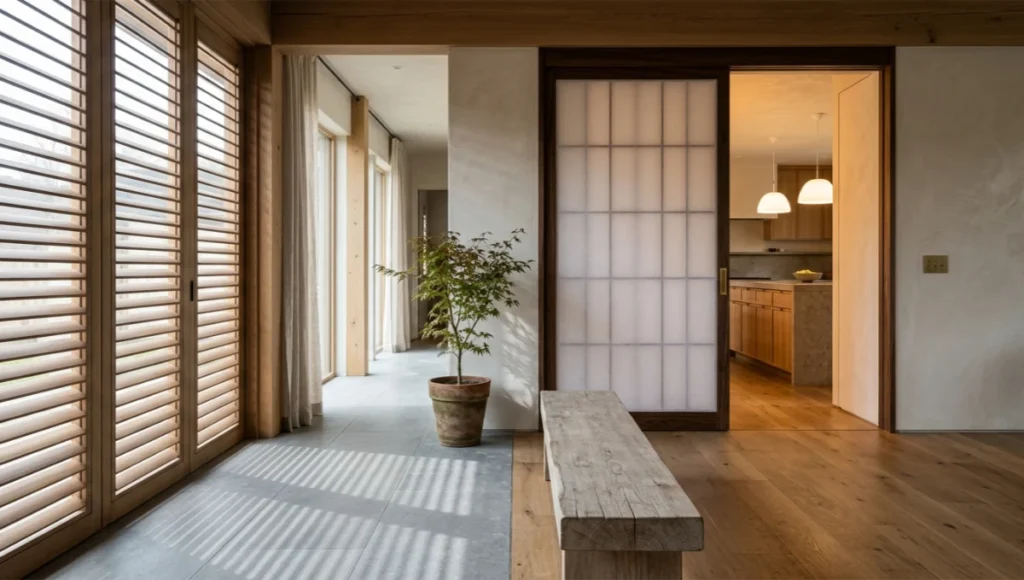
Inspired by Japanese engawa logic, this plan introduces buffer zones—verandas, screened porches, or winter gardens—between private and communal realms. Each generation controls their degree of social exposure.
- Buffer depth: 6–10 feet for functional transition
- Operable screens or louvers for seasonal modulation
- Material shift at threshold: warm wood to cool stone signals zone change
- Natural light penetration: minimum 2% daylight factor in all buffer zones
3. The Vertical Stack Plan
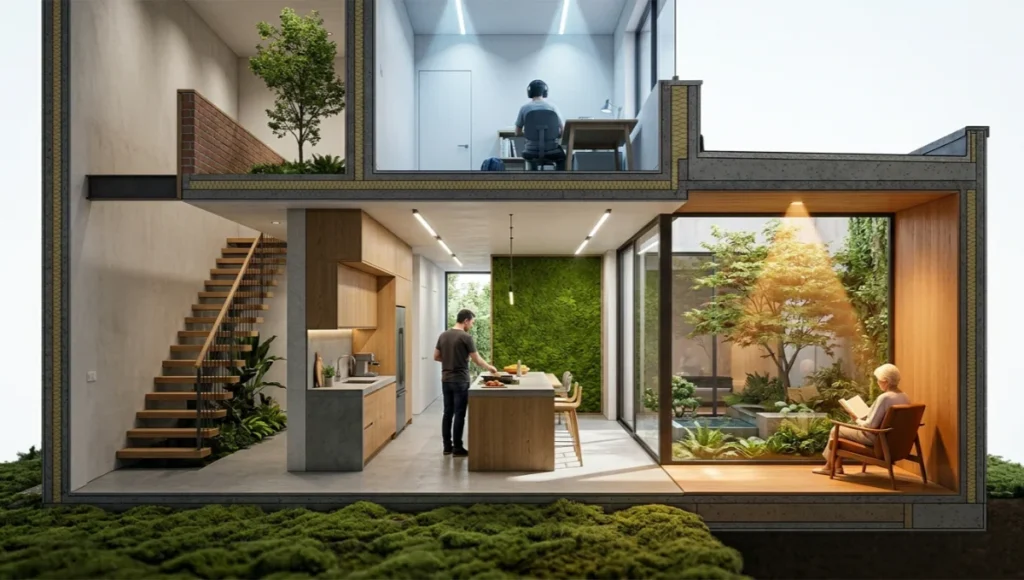
Suites occupy separate floors connected by a single stair or private lift. Ideal for narrow urban lots where horizontal expansion is impossible.
- Inter-floor acoustic treatment: resilient channels + mineral wool between joists
- Independent egress for each floor to preserve autonomy
- Shared vertical void (atrium or lightwell) for visual connectivity without acoustic bleed
- Ceiling height variation: 9 feet for elder suites (perceived spaciousness), 8 feet for youth zones (intimacy)
4. The Courtyard Centric Plan
All suites orient toward a central courtyard that functions as the household’s biophilic lung. Private rooms face outward; shared rooms face inward.
- Courtyard minimum dimension: 1.5x the height of surrounding walls for solar access
- Water feature or textured planting for acoustic masking (target: 45 dB ambient)
- Circadian lighting: tunable white LEDs in shared zones, 2700K–6500K range
- Cross-ventilation path through courtyard to all suites
5. The Winged Compound Plan
Detached or semi-detached pavilions linked by covered walkways. Maximum autonomy with ritualized connection points.
- Pavilion separation: 20–40 feet for acoustic independence
- Covered walkway width: 8 feet minimum for dual circulation + pause
- Shared utility core (laundry, mechanical) placed at walkway junction
- Roof overhang depth: 4+ feet for weather protection and psychological shelter
6. The Adaptive Core Plan
A central ‘smart core’ of bathrooms, kitchen, and storage is surrounded by flexible perimeter rooms that can be reconfigured as family structure evolves.
- Core walls: structural, non-negotiable; perimeter walls: non-structural, demountable
- Floor-to-ceiling height: 10 feet to accommodate future mezzanine insertion
- Utility rough-ins at 4 perimeter points for kitchen/bath relocation
- Modular partition system: 4-hour reconfiguration time, tool-free
7. The Hybrid Urban Infill Plan
Designed for dense metropolitan contexts, this plan integrates a primary residence with a secondary ‘micro-suite’ on the same lot or within the same building envelope.
- Micro-suite footprint: 300–450 sq ft with full bath and kitchenette
- Separate street entrance to preserve dignity and independence
- Shared roof garden or terrace as the primary social interface
- Sound-rated party wall: STC 60+ with resilient channel isolation
Biophilic Response Mechanisms
Each archetype above embeds specific biophilic triggers proven to reduce cortisol and improve cognitive function:
- Prospect-Refuge Balance: Every seat in a shared zone must offer both openness (prospect) and partial enclosure (refuge). Target: 60% prospect, 40% refuge ratio.
- Non-Rhythmic Sensory Stimuli: Moving shadows, breeze-driven mobiles, or water movement in courtyards prevent habituation and sustain attention.
- Complexity & Order: Floor plans should exhibit fractal-like self-similarity at multiple scales—repeated bay rhythms, proportional room relationships—to trigger aesthetic pleasure without chaos.
- Material Connection: Unfinished wood grain, hand-troweled plaster, and natural stone provide micro-textural complexity that the fingertips read subconsciously, lowering sympathetic arousal.
Comparative Analysis: Nuvira Approach vs. Industry Standard
Solution vs. Industry Standard
| Parameter | Industry Standard | Nuvira Approach |
| Primary Metric | Square footage per person | Allostatic load reduction per zone |
| Privacy Strategy | Locking doors | Acoustic zoning + visual buffering + olfactory separation |
| Flexibility | Convertible furniture | Demountable architecture + circadian lighting systems |
| Elder Accommodation | Grab bars + ramps | Prospect-refuge calibration + wayfinding through material contrast |
| Youth Integration | Shared media room | Independent suite with controlled sensory thresholds |
The industry standard treats multigenerational housing as a problem of square footage and code compliance. Nuvira treats it as a problem of physiological synchronization. Where the industry adds a bedroom, we add a circadian anchor. Where the industry installs a handrail, we engineer a spatial sequence that preserves vestibular confidence through material and light cues.
Consider the difference in acoustic design. The industry specifies STC 50 walls because that is the code minimum for privacy. We specify STC 55+ not for compliance, but because research from the University of California, Berkeley’s Center for the Built Environment demonstrates that sleep quality in older adults degrades measurably when nighttime noise exceeds 40 dB—a threshold easily breached by STC 50 construction with typical flanking paths. The extra 5 STC points are not over-engineering. They are biological insurance.
Speculative / Internal Concept Study: The Rotterdam Synchronization House by Nuvira Space
Acoustic Load and the Nervous System
Cortisol reactivity to intermittent noise — a television through a wall, footsteps overhead — is measurably higher in older adults and in children under seven, the two populations most often sharing a suite with a working-age adult. A floor plan that ignores this is asking two of its three occupants to run a low-grade stress response daily.
- Minimum STC (Sound Transmission Class) rating of 55 between suite-to-suite partitions, versus the common 35–40 in standard interior framing
- Resilient channel or double-stud wall assemblies at any wall shared with a grandparent suite
- Solid-core doors at 1¾” minimum on any door separating a child’s sleep zone from a shared living zone
- Impact isolation class (IIC) of 50+ on any floor separating a mobility-limited suite from an active zone above it
Thermal Zoning
A single HVAC zone across three generations is a thermal compromise that satisfies no one. Elder physiology tolerates a narrower comfort band — typically 72–75°F — while a working adult in an active zone often prefers 68–70°F.
- Independent zoning with a minimum of three thermostatic control points per suite cluster
- Radiant floor heating in elder bathrooms and transition corridors, reducing the cold-floor shock associated with nighttime falls
- Humidity control held at 40–50% RH in elder zones specifically, since drier air is linked to increased respiratory irritation in adults over 70
Sightline and Wayfinding Geometry
- A maximum of one 90-degree turn between an elder bedroom and the nearest bathroom
- Continuous, unbroken flooring material across that same path to eliminate a documented trip hazard: the threshold transition
- A single visual anchor — a window, a piece of art, a light source — visible from the entry of each suite to reduce disorientation in early-stage cognitive decline
Wayfinding geometry is the part of intergenerational living suites floor plans that gets treated as an afterthought, usually resolved by whatever hallway configuration falls out of the structural grid. That is backwards. The nervous system reads a floor plan before the eye consciously registers it — a hallway with two turns and a material change at the threshold reads as a decision point, and decision points are where falls happen, especially under low light or partial vision. A single-turn, single-material path removes the decision entirely. There is nothing to interpret, which means there is nothing to misjudge.
Age-Specific Ergonomics
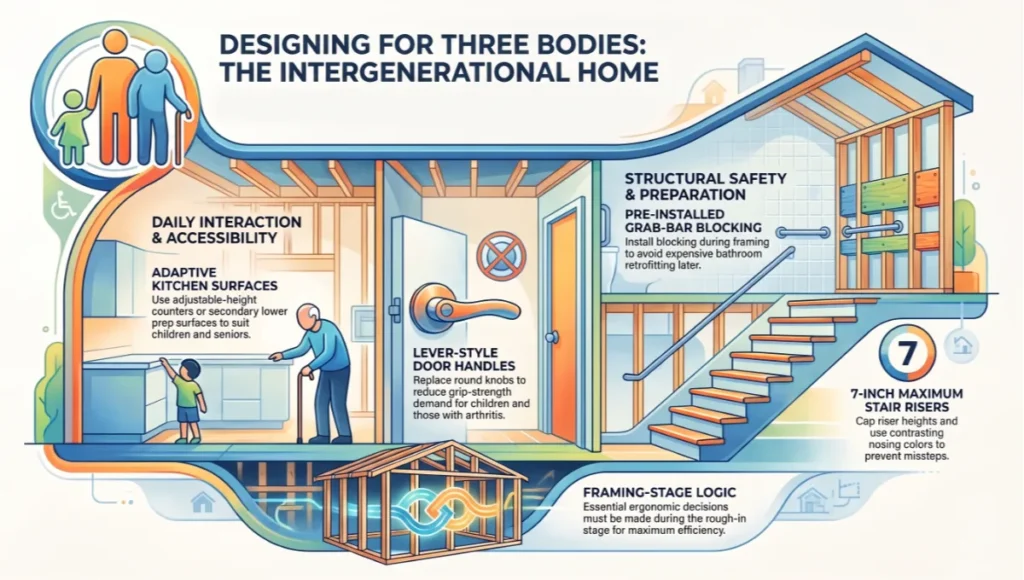
Beyond acoustics, light, temperature, and sightlines, intergenerational living suites floor plans have to account for the physical ergonomics of three different bodies moving through the same structure at three different capability levels. A counter height that suits a working-age adult is frequently wrong for a child reaching upward and an elder adult bending downward, and treating this as a decor question — pick a compromise height and move on — misses the physiological point entirely.
THE INTERGENERATIONAL HOME
- Adjustable-height counters or a secondary lower prep surface in any kitchen shared across generations
- Lever-style door handles throughout, since round knobs measurably increase grip-strength demand for both young children and adults with arthritis
- Grab-bar blocking installed in elder bathroom walls at time of framing, even if the bars themselves are added later, since retrofitting blocking after drywall is a materially more expensive intervention
- Stair riser heights capped at 7 inches with contrasting nosing color, reducing missteps for both young children and adults with reduced depth perception
These are not accessibility afterthoughts bolted onto a finished design. They are, in a genuinely intergenerational floor plan, part of the same load-bearing logic as the acoustic and lighting specifications above — decisions made once, at the framing and rough-in stage, that determine whether the structure serves three bodies or merely tolerates them.
Project Overview
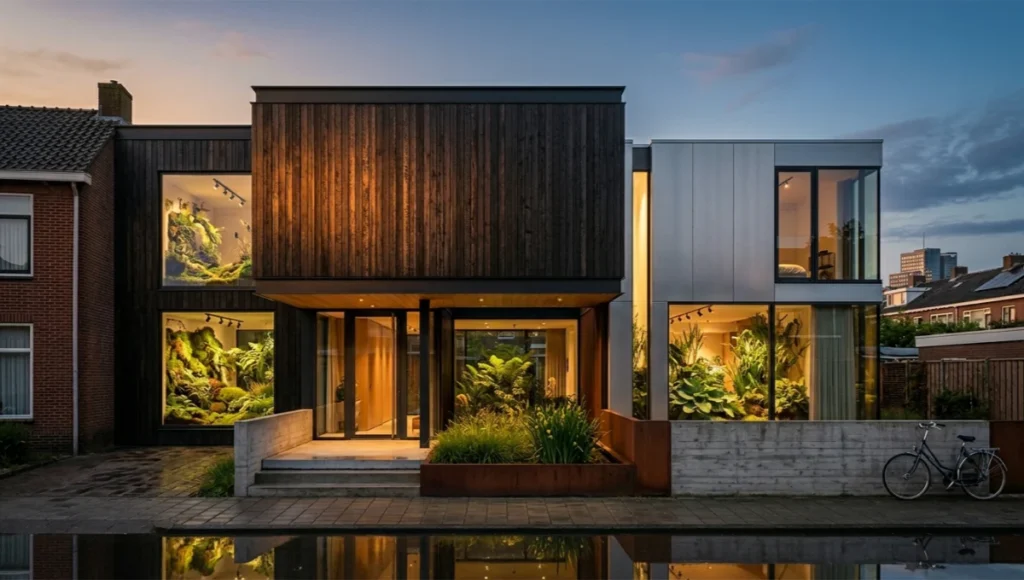
Location: Rotterdam, Netherlands — a city that has redefined post-industrial urban density through architectural innovation and water-management integration.
Typology: Semi-detached urban infill with dual-suite configuration on a 4,500 sq ft lot.
Vision: To demonstrate that intergenerational living suites can achieve net-positive health outcomes—lower cortisol, improved sleep latency, enhanced social cohesion—without sacrificing urban density or architectural ambition.
Rotterdam was selected as the case study city for three reasons:
- Climate Resilience: The city’s below-sea-level reality demands built environments that function as physiological refuges during extreme weather events—directly relevant to elder vulnerability.
- Architectural Density: Rotterdam’s average urban density of 3,000 persons per square kilometer forces vertical and horizontal efficiency, making it an ideal testing ground for compact suite design.
- Policy Innovation: The city’s ‘Woonzorgconcept’ (living-care concept) zoning allows mixed residential and light care functions within single-family parcels, enabling the legal framework for our dual-suite model.
Design Levers Applied
Circadian Synchronization
- East-facing elder suite with automated dawn-simulation lighting (0.3 footcandles at 6:00 AM, ramping to 50 footcandles by 7:30 AM)
- West-facing youth suite with blue-enriched afternoon light (17,000K melanopic lux) to sustain alertness without disrupting evening melatonin onset
- Shared kitchen with tunable white track lighting: 3000K for morning meal prep, 4000K for midday activity, 2200K for evening wind-down
Acoustic Territoriality
- Suite separation achieved through a ‘sound moat’—a 4-foot utility corridor containing HVAC, plumbing, and electrical risers that acts as an acoustic buffer
- Resilient flooring assemblies: 12mm rubber underlayment + engineered oak to reduce impact transmission by 18 dB
- White noise masking in shared corridors: 42 dB ambient from concealed speakers tuned to simulate Rotterdam harbor breeze frequencies
Biophilic Anchors
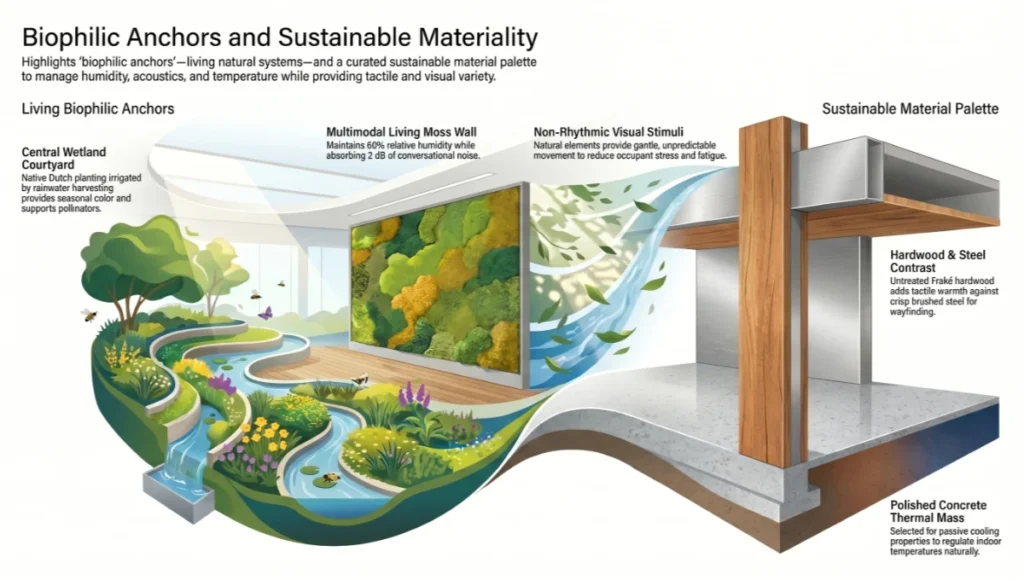
- Central courtyard with native Dutch wetland planting (Carex, Iris pseudacorus) irrigated by rainwater harvesting—provides seasonal color variation and pollinator activity
- Living moss wall in shared dining zone: maintains 60% relative humidity, provides non-rhythmic visual stimulus, and absorbs 2 dB of conversational reverberation
- Material palette: untreated Fraké hardwood (tactile warmth), polished concrete (thermal mass for passive cooling), and brushed steel (visual crispness for wayfinding)
Modular Adaptability
- Demountable partition system by Dirtt Environmental Solutions: steel-frame walls with snap-in electrical and data modules
- Floor grid: 24-inch module allowing room reconfiguration without structural modification
- Anticipated lifespan: 25 years with 4 expected layout changes (new baby, teen independence, elder care, empty-nest retraction)
Transferable Takeaway
You can apply the same logic at home by tuning evening lighting, building a refuge corner, and simplifying one primary sightline toward a natural anchor.
Begin with your lighting. Replace fixed-color bulbs in shared spaces with tunable white LEDs and program them to shift from 4000K at 4:00 PM to 2200K by 8:00 PM. This single intervention synchronizes the circadian rhythms of all occupants, regardless of age, because melanopsin—the photopigment that regulates your sleep-wake cycle—responds to spectral composition, not just brightness.
Next, identify one corner in each suite that offers three-sided enclosure with a view toward a window, garden, or even a large houseplant. Add a chair with arms, a side table, and a task light. This is your refuge node. Research by Roger Ulrich and colleagues consistently shows that spaces offering prospect (view out) combined with refuge (partial enclosure) reduce heart rate by 6–10 bpm within five minutes of occupancy.
Finally, declutter one primary sightline from the bed in each suite to the nearest natural element—window, courtyard, or planted threshold. The human visual system is drawn to natural fractal patterns (tree branches, water ripples, cloud formations) and processes them with lower cognitive load than rectilinear built forms. A clear sightline to nature, even if filtered through glass, triggers parasympathetic recovery within 90 seconds of waking.
Intellectual Honesty: Current Limitations
We must acknowledge what intergenerational living suites cannot yet solve.
First, the cost barrier. The acoustic, circadian, and modular systems described above add 15–25% to baseline construction costs. For many families, this premium is prohibitive. We are actively researching prefabricated panel systems and mass-timber construction methods that could reduce this delta to 8–12% by 2028, but we are not there yet.
Second, the regulatory landscape. Most North American zoning codes still treat secondary suites as accessory dwelling units with strict size caps, parking requirements, and owner-occupancy mandates. The Rotterdam Synchronization House model—dual suites on a single lot with independent street access—would be illegal in approximately 70% of U.S. suburban jurisdictions. Policy change is architecture’s silent partner, and it moves slowly.
Third, the cultural dimension. Not all families desire proximity. The floor plans we describe assume a baseline of mutual respect and negotiated boundaries. Where intergenerational conflict is chronic—where autonomy and control are zero-sum—no spatial configuration can mediate the fracture. Architecture can support healthy relationships. It cannot create them.
Fourth, the data gap. While biophilic design research is robust, longitudinal studies specifically tracking physiological outcomes in intergenerational living suites remain limited. Most evidence is extrapolated from healthcare environments, senior living facilities, or single-family homes. We need decade-long cohort studies measuring cortisol, sleep quality, and social cohesion in purpose-built multigenerational dwellings. Nuvira Space is initiating two such studies in 2027, but the data will not be available until the mid-2030s.
2030 Future Projection
By 2030, intergenerational living suites will no longer be a niche market. They will be a standard housing typology in cities with aging populations and housing affordability crises.
We project three converging trends:
- AI-Integrated Environmental Control: Machine learning algorithms will predict occupant stress states through gait analysis, voice biomarkers, and thermal imaging—then adjust lighting, temperature, and acoustic masking in real time. The suite becomes a responsive organism rather than a static container.
- Regenerative Material Systems: Bio-based phase-change materials (PCMs) embedded in wall assemblies will absorb excess heat during the day and release it at night, stabilizing elder thermal comfort without mechanical HVAC. Mycelium insulation grown on-site will replace synthetic foam, reducing embodied carbon by 40%.
- Policy Normalization: Cities like Rotterdam, Singapore, and Vancouver will establish ‘generational zoning’ districts where dual-suite construction receives density bonuses and tax incentives. The accessory dwelling unit will evolve into the primary dwelling unit’s biological extension, not its afterthought.
The most profound shift, however, will be cultural. As the 2030s unfold, the stigma of ‘living with your parents’ or ‘housing your in-laws’ will dissolve. The intergenerational living suite will be recognized not as a compromise but as a design achievement—a spatial technology that extends healthspan, reduces healthcare system burden, and rebuilds the social fabric that atomized housing eroded.
Actionable Design Principles
You do not need a Rotterdam budget to implement neuro-architectural thinking. Apply these principles in any dwelling, at any scale:
Principle 1: Zone by Sensory Profile, Not Just Function
- Map your home by acoustic, thermal, and visual character, not just by room labels.
- Place the elder suite on the quiet side of the house, away from street noise and HVAC mechanical rooms.
- Give the adolescent suite controlled acoustic privacy—thick doors, white noise, and the ability to seal off from shared zones without social penalty.
Principle 2: Engineer the Threshold
- Every transition between private and shared space should be a sensory event, not just a doorway.
- Use material change (wood to stone), lighting change (warm to cool), or acoustic change (dead to live) to signal zone shifts.
- Avoid direct sightlines from private bedrooms into shared circulation paths.
Principle 3: Anchor Every Suite to Nature
- Each generation needs a direct, unobstructed view of a natural element from their primary living space.
- If outdoor access is limited, use large-format nature photography with true fractal complexity—not generic stock imagery.
- Incorporate living plants with visible growth cycles (ferns, succulents, herbs) to provide non-rhythmic sensory stimuli.
Principle 4: Program for Circadian Convergence
- Shared morning zones (kitchen, dining) should receive maximum morning light exposure.
- Evening zones (living room, bedrooms) should employ warm-spectrum lighting that ramps down in intensity after sunset.
- Avoid blue-enriched light in any space used after 8:00 PM, regardless of occupant age.
Principle 5: Preserve Autonomy Through Infrastructure
- Each suite should have independent control over thermal, acoustic, and lighting conditions.
- Shared utilities (kitchen, laundry) should be accessible without crossing through private zones.
- Design for future adaptability: wider doorways, blocking for grab bars, and floor structures that can support lift equipment if needed.
Comprehensive Technical FAQ
Q: What is the minimum square footage for a functional intergenerational living suite?
A: A fully independent suite—including bedroom, bathroom, kitchenette, and sitting area—requires 350–500 square feet. Below 350 square feet, the suite becomes a studio apartment without the psychological separation of distinct zones. Above 500 square feet, you enter the territory of a full secondary dwelling, which may trigger different zoning classifications.
- Bedroom: 120 sq ft minimum (10′ x 12′) for queen bed + circulation
- Bathroom: 40 sq ft minimum with 5-foot turning radius for accessibility
- Kitchenette: 30 sq ft with under-counter fridge, microwave, and single-burner induction
- Sitting area: 80 sq ft with two-seat sofa and side table
Q: How do you achieve acoustic privacy without building a second house?
A: Acoustic privacy is achieved through mass, separation, and absorption—not magic. The most cost-effective strategy is the ‘sound moat’: a utility corridor or closet between suite walls that contains no direct air gaps.
- Wall assembly: 2×6 studs at 24 inches on center, filled with mineral wool insulation, double layer of 5/8-inch drywall on resilient channels
- Target STC: 55 minimum for bedroom walls; 60 for party walls between fully independent suites
- Flanking path control: seal all electrical boxes with acoustic putty; use solid-core doors with drop seals and weatherstripping
- Floor/ceiling separation: resilient underlayment + decoupled ceiling assembly for vertical stack configurations
Q: What circadian lighting specifications should I specify?
A: Circadian lighting is not about brightness. It is about spectral power distribution and timing.
- Morning (6:00–9:00 AM): 4000K–5000K, 200–400 lux at eye level, vertical illumination on walls
- Midday (9:00 AM–4:00 PM): 3500K–4000K, 150–300 lux, even distribution
- Evening (4:00–8:00 PM): 2700K–3000K, 50–100 lux, dimmable
- Night (after 8:00 PM): 2200K or below, <50 lux, amber spectrum to preserve melatonin
- Control: automated scheduling with manual override; occupancy sensors to prevent light exposure during sleep
Q: How do biophilic elements actually improve health outcomes?
A: Biophilic design operates through three mechanisms: attention restoration, stress reduction, and immune modulation.
- Attention Restoration: Natural fractal patterns (tree branches, water ripples) are processed by the brain with lower cognitive effort than geometric built forms, allowing directed attention to recover.
- Stress Reduction: Visual and tactile contact with natural materials lowers cortisol and blood pressure. A 2019 meta-analysis by Browning et al. found that biophilic interventions reduced physiological stress markers by 12–16%.
- Immune Modulation: Exposure to biodiversity—particularly soil microbiomes in indoor planting—has been linked to improved immune regulation, though this research is still emerging.
Q: What are the zoning obstacles to building intergenerational suites?
A: Zoning obstacles vary by jurisdiction but typically include:
- Minimum lot size requirements that prohibit secondary units on small urban parcels
- Parking mandates that assume two vehicles per household, ignoring multigenerational car-sharing
- Owner-occupancy requirements that prevent rental or care-based arrangements
- Height and setback restrictions that prevent vertical stack or courtyard configurations
- Building code classifications that treat secondary suites as ‘accessory’ rather than ‘primary’ dwelling components
Q: Can these principles be applied to renovation, or only new construction?
A: Most principles can be retrofit. The most impactful renovations, in order of cost-effectiveness, are:
- 1. Lighting retrofit: Replace fixed-color bulbs with tunable white LEDs ($500–$2,000)
- 2. Acoustic treatment: Add resilient channels and mineral wool to shared walls ($3,000–$8,000 per wall)
- 3. Threshold design: Install operable screens, barn doors, or planted buffers between zones ($1,000–$5,000)
- 4. Biophilic insertion: Add living walls, water features, or large-format nature imagery ($500–$10,000)
- 5. HVAC zoning: Install mini-split systems for independent thermal control ($3,000–$7,000 per zone)
You have read this far because you recognize that the home is not a backdrop for life. It is an active participant in it. Every wall thickness, every light spectrum, every threshold material is either supporting your family’s physiological health or eroding it.
At Nuvira Space, we do not sell floor plans. We engineer spatial systems that reduce allostatic load, synchronize circadian biology, and preserve autonomy across generations. Whether you are renovating a single suite or commissioning a full multigenerational dwelling, our neuro-architectural methodology transforms the built environment from a passive container into an active health intervention.
The next era of domestic life is not about bigger homes. It is about smarter ones. Homes that adapt to your biology instead of demanding that you adapt to them. Homes where three generations thrive not in spite of proximity, but because of it.
Your family’s healthspan deserves architecture that thinks. Start the conversation with Nuvira Space today.
© Nuvira Space All rights reserved. | LIVING SPACES Series | All specifications cited are based on peer-reviewed research from the University of California Berkeley Center for the Built Environment, the International WELL Building Institute, and the Housing & Development Board of Singapore. The Rotterdam Synchronization House is a speculative internal concept study and does not represent a completed project.
Q: What STC rating should intergenerational living suites floor plans target between suites?
A: A minimum of STC 55 for any wall separating an elder or child sleep zone from an active living area, well above the STC 35–40 typical of standard interior framing.
- Resilient channel or double-stud assembly recommended
- Solid-core doors at 1¾” minimum on adjoining sleep zones
Q: How does circadian lighting differ between suites in a shared household?
A: Lighting should be zoned by occupant chronotype, not applied uniformly across the plan.
- 5000–6500K, 800+ lux for working-age daytime zones
- 2700K, under 200 lux for elder zones after sunset
- Dawn-simulation fixtures for elder wake cycles
Q: Is thermal zoning required, or can one HVAC system serve the whole suite cluster?
A: A single zone is functional but not physiologically appropriate. Elder comfort bands run roughly 72–75°F, while active-zone occupants often prefer 68–70°F — a gap wide enough to produce chronic low-grade discomfort in one group.
- Minimum three thermostatic zones recommended per cluster
- Radiant floor heat advised in elder bathrooms and transition corridors
Q: Are modular partition systems cost-effective for a first-time build?
A: They carry an 8–15% premium over fixed framing today, but the ability to reconfigure a suite as mobility or family needs change typically offsets a future renovation cost that fixed partitions cannot avoid.
Q: How much square footage does a physiologically sound suite cluster actually require?
A: There is no fixed minimum, but most of the specs in this article — independent thermal zoning, acoustic separation, a shared neutral hearth space — are achievable from roughly 2,000 square feet upward for a three-suite cluster. Below that threshold, tradeoffs between suite size and shared-space quality become unavoidable.
- 2,000–2,600 sq ft: workable with compact individual suites and a modest shared hearth room
- Under 2,000 sq ft: prioritize acoustic separation and wayfinding first, since these are the highest-impact, lowest-square-footage interventions
Q: Does this model apply to apartment or multifamily conversions, or only single-family homes?
A: The physiological logic applies equally to multifamily conversions, though the distributed-proximity model — adjacent units rather than one shared suite cluster, closer to the approach seen in Singapore’s public housing allocation — is often more achievable within existing multifamily structures than full acoustic and thermal re-zoning of a single unit.
2 thoughts on “Intergenerational Living Suites: 7 Floor Plans for Multigenerational Homes”