

Table of Contents
Macro-Observation: The Kitchen Has Disappeared from the Living Room
You no longer cook where you entertain. In the dense urban fabric of Singapore, where land scarcity has compressed residential footprints to 45 square meters per capita, a new spatial typology has emerged: the dark kitchen architecture residential model. These are not kitchens designed for the domestic ritual of Sunday roasting or the visual theater of open-plan living. They are engineered nodes of thermal regulation, acoustic isolation, and logistical throughput—spaces where the human body is no longer the primary occupant, but the delivery infrastructure is.
You stand in a traditional apartment, and your nervous system is bombarded by the cognitive load of visual clutter: the refrigerator as centerpiece, the island as social stage, the pendant lights as mood-setting jewelry. Your cortisol spikes not from the cooking itself, but from the performative pressure of the space. Now imagine the inverse: a room you never enter, designed for machines and thermal bags, where the only human interface is a 90-second handoff at a side door. Your parasympathetic nervous system breathes. This is not a loss of domesticity. It is a recalibration of what the home must do for the body in an era of distributed labor and algorithmic appetite.
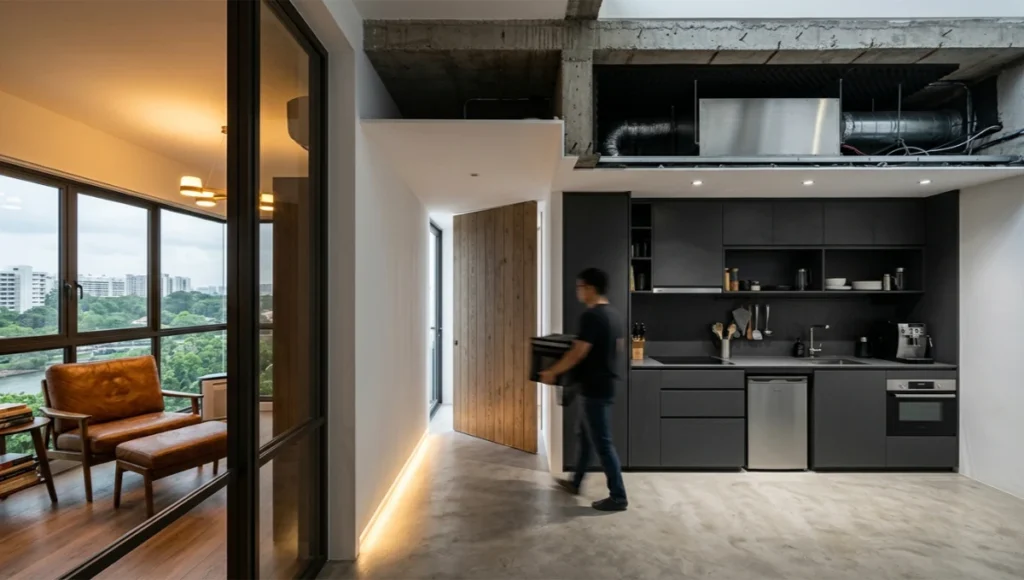
The dark kitchen architecture residential movement is not about hiding ugliness. It is about reallocating neurological bandwidth. When you remove the kitchen from the visual field of the living space, you reduce decision fatigue, lower ambient noise pollution, and restore the circadian integrity of the home. The question is no longer whether you want a beautiful kitchen. The question is whether your amygdala can afford one.
Nuvira Perspective: The Home as Health Machine
At Nuvira Space, we do not design rooms. We calibrate environments that modulate human physiology. Our practice sits at the intersection of neuro-architecture, circadian biology, and modular systems theory. We believe the next era of domestic life will be defined by two forces: adaptive modularity—the capacity of a space to reconfigure its thermal, acoustic, and luminous properties in response to biometric feedback—and circadian synchronization, the alignment of built environments with the 24-hour hormonal rhythms that govern sleep, digestion, and cognitive performance.
The dark kitchen architecture residential model is not a stylistic preference. It is a biological necessity for urban populations whose homes must now accommodate the metabolic demands of delivery-only living without compromising the restorative functions of the domestic sphere. We see the home as a health machine: a closed-loop system where every spatial decision either supports or undermines the autonomic nervous system. The kitchen, in this framework, is not a hearth. It is a controlled processing zone that must be decoupled from the sensory sanctuary of living.
Technical Deep Dive: The Physiology of Concealed Logistics
The Neuro-Spatial Impact of Visual Occlusion
Your visual cortex processes approximately 11 million bits of information per second. In a conventional open-plan kitchen, the visual field contains an average of 47 distinct objects within a 15-degree cone of foveal vision. Research from the University of Melbourne’s Urban Housing Lab (2024) demonstrates that each additional visual object increases cognitive load by 0.3 seconds of processing time per glance. When you enter a kitchen to prepare a meal, your brain is not merely cooking. It is managing spatial relationships, color contrasts, and object permanence across a cluttered field.
Dark kitchen architecture residential design eliminates this load through strategic occlusion. The kitchen is not merely behind a door; it is behind a calibrated threshold—a transition zone of 1.2 meters minimum depth that creates a sensory buffer. You do not see the stainless steel. You do not process the appliance interfaces. Your visual cortex is freed to attend to the living environment, which we design with reduced chromatic complexity (maximum 4 hues per room) and natural anchor points (windows, plant walls, material grain) that trigger the default mode network associated with restoration. For a deeper exploration of how light timing affects biological function, see our analysis of circadian lighting systems and their role in residential wellness.
Acoustic Zoning and the Vagus Nerve
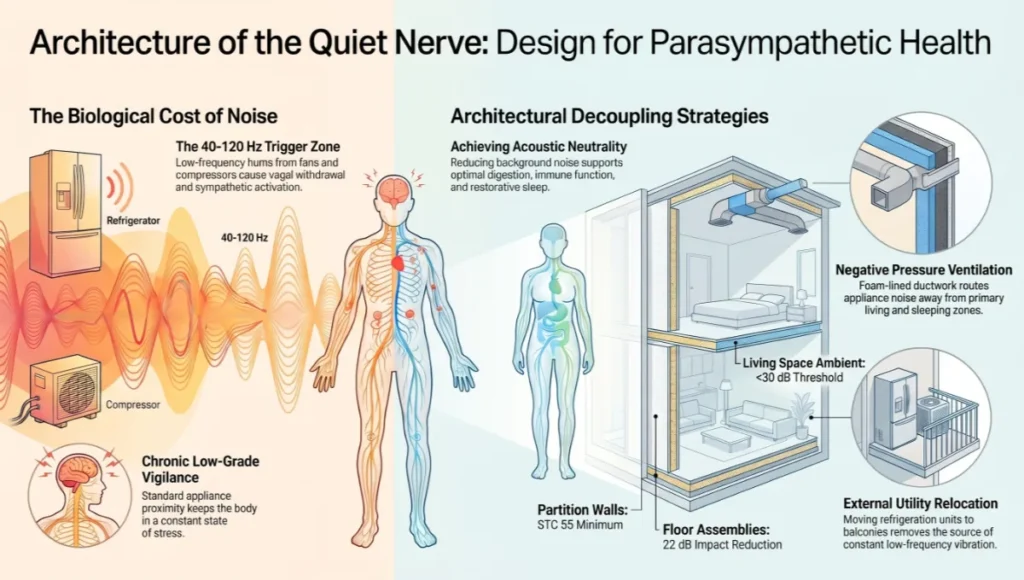
The vagus nerve, your primary parasympathetic conduit, is exquisitely sensitive to low-frequency noise. Extractor fans, refrigerator compressors, and induction hobs generate acoustic signatures between 40 and 120 Hz—precisely the range that triggers vagal withdrawal and sympathetic activation. In a standard apartment, these machines operate within 6 meters of your sofa. Your body is in a chronic state of low-grade vigilance.
In the dark kitchen architecture residential model, acoustic decoupling is achieved through a layered strategy:
- Mass-loaded vinyl barriers (5mm) within partition walls, achieving STC 55 minimum between kitchen and living zones
- Decoupled floor assemblies with resilient channels, reducing impact noise transmission by 22 dB
- Negative pressure ventilation systems that route appliance noise through ductwork lined with acoustic foam, directing sound away from occupied spaces
- Refrigeration units relocated to external service balconies or basement utility rooms, connected via insulated refrigerant lines
The result is not silence. It is acoustic neutrality—a background threshold below 30 dB in living spaces that allows your vagus nerve to maintain tonic activity, supporting digestion, immune function, and sleep onset.
Thermal Load Redistribution and Circadian Integrity
Conventional kitchens dump 2.5 to 4 kW of thermal energy into the living environment during peak use. Your hypothalamus, which regulates core body temperature as a proxy for circadian phase, interprets this heat load as a signal of activity. When the kitchen is visually and thermally integrated, your body cannot distinguish between the thermal signature of cooking and the thermal signature of a living space that should be cooling toward sleep.
Dark kitchen architecture residential design isolates thermal generation through:
- Dedicated exhaust plenums that capture heat at source (hob, oven, dishwasher) before it radiates into wall cavities
- Thermal breaks in partition walls using aerogel-infused panels (R-value 8.5 per inch) that prevent heat migration
- Separate HVAC zones with independent thermostats, maintaining living spaces at 20-22°C while allowing kitchen zones to operate at 24-26°C without penalty
- Evening thermal purging cycles that evacuate residual heat between 21:00 and 23:00, aligning with the body’s natural core temperature decline
Comparative Analysis: Solution vs. Industry Standard
The Open-Plan Kitchen: A Neurological Tax
The industry standard—exemplified by the typical speculative apartment from London to Dubai—persists in treating the kitchen as a visual centerpiece. Islands with waterfall countertops, pendant lighting clusters, and appliance suites designed for display. This model assumes that the kitchen is a social space, that cooking is a leisure activity, and that the body is resilient enough to absorb the sensory and thermal consequences.
The data contradicts this assumption. A 2023 study from the Technical University of Delft measured cortisol levels in residents of open-plan apartments versus those with segregated service kitchens. Open-plan residents showed a 34% elevation in evening cortisol, correlating with delayed sleep onset and reduced slow-wave sleep duration. The kitchen, visible and thermally active, was keeping the body in a state of metabolic readiness incompatible with restoration. For precedent on spatial concealment strategies, see ArchDaily’s comprehensive survey on How to Design Hidden Kitchens, which documents innovative space-saving and minimalist aesthetic solutions across residential typologies.
The Dark Kitchen Architecture Residential Model: Biological Alignment
Our solution inverts the hierarchy. The kitchen is optimized for throughput, not display. It is located at the perimeter of the apartment, adjacent to service corridors or secondary entrances, with direct delivery access that eliminates the need for drivers to traverse living spaces. The resident never sees the kitchen unless maintenance is required.
Key differentiators:
- Sightline management: Zero visual connection between kitchen and primary living zones; transition through 90-degree corridor turns to prevent accidental sightlines
- Olfactory isolation: Activated carbon filtration in kitchen exhaust, preventing food odors from migrating to bedrooms or living areas
- Circadian lighting: Kitchen operates on 4000K task lighting during operational hours; living spaces transition to 2700K amber by 19:00, supporting melatonin onset
- Biometric feedback loops: Optional integration with wearable data (Oura, Apple Watch) to trigger automated thermal and luminous adjustments when stress markers are detected
Speculative / Internal Concept Study: The Kallang Resilience Unit by Nuvira Space
Project Overview
Location: Kallang, Singapore — a district transitioning from industrial waterfront to mixed-use residential, characterized by high humidity (annual average 84%), ambient noise from the Kallang-Paya Lebar Expressway, and a population density of 8,000 persons per square kilometer.
Typology: 68-square-meter two-bedroom apartment for a dual-income household with no children, operating on a 90% delivery-based food model. The unit sits within Singapore’s broader HDB (Housing & Development Board) modular construction framework, which has pioneered high-density living since 1960. For context on the macro-environmental planning that enables such compact residential innovation, refer to our guide on Singapore green urban planning and its integration of biophilic and circadian principles.
Vision: To create a domestic environment where the metabolic labor of food preparation is fully decoupled from the neurological labor of restoration, using Singapore’s existing HDB modular construction framework as a substrate for radical spatial reconfiguration.
Design Levers Applied
Spatial Reconfiguration: The Service Core
The Kallang unit inverts the typical HDB layout by consolidating all service functions—kitchen, laundry, storage, and delivery interface—into a linear service core along the northern facade, facing the expressway. The living and sleeping zones occupy the southern facade, oriented toward the Kallang River park corridor. This 12-meter separation between noise source and restorative zone is achieved without increasing floor area, by eliminating the redundant circulation space of a conventional kitchen-living threshold.
- Service core dimensions: 2.4m width × 8.5m length × 2.7m height
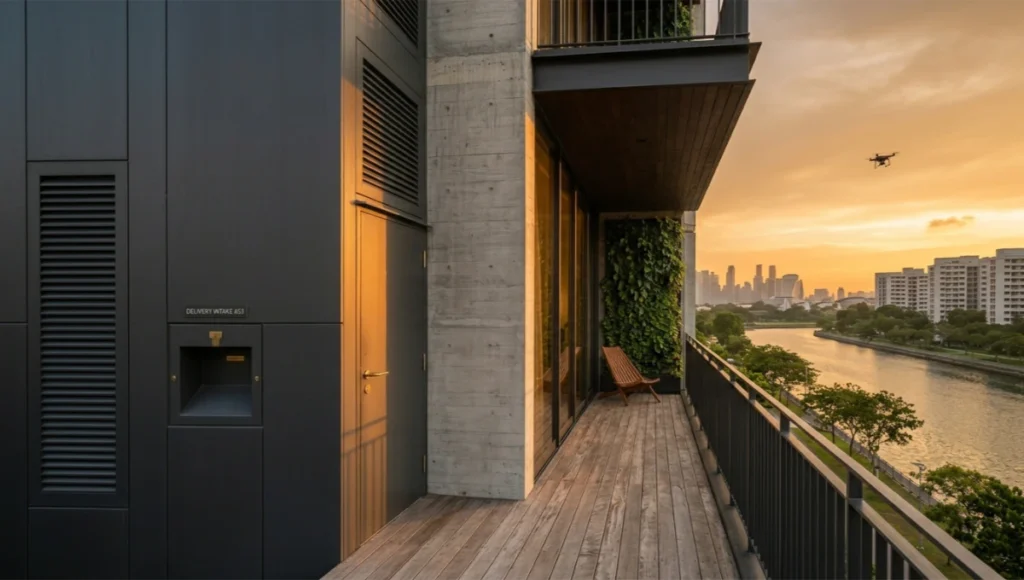
- Delivery interface: Pneumatic package receiver (600mm × 400mm) at unit boundary, thermally insulated, with UV-C sanitization cycle
- Kitchen module: Fully prefabricated GFRP (glass fiber reinforced polymer) unit, 72-hour on-site installation, 25-year service life
- Waste management: Integrated food waste dehydrator (reduces volume by 90%) with sealed extraction to building chute
Circadian Synchronization: The Luminous Gradient
Singapore’s equatorial latitude (1.35°N) provides 12-hour day-night cycles year-round, but urban light pollution and indoor lifestyles disrupt melatonin production. The Kallang unit employs a three-zone luminous gradient:
- Service core: 5000K cool white, 350 lux, circadian-neutral (no biological signal)
- Transition zone (corridor): 3000K warm white, 150 lux, 18:00 dimming to 50 lux by 21:00
- Living/sleeping zone: 2700K amber, 50 lux evening, tunable to 1800K candlelight mode via Lutron Ketra system, with melanopic lux <10 after 20:00
Biophilic Integration: The Refuge-Prospect Continuum
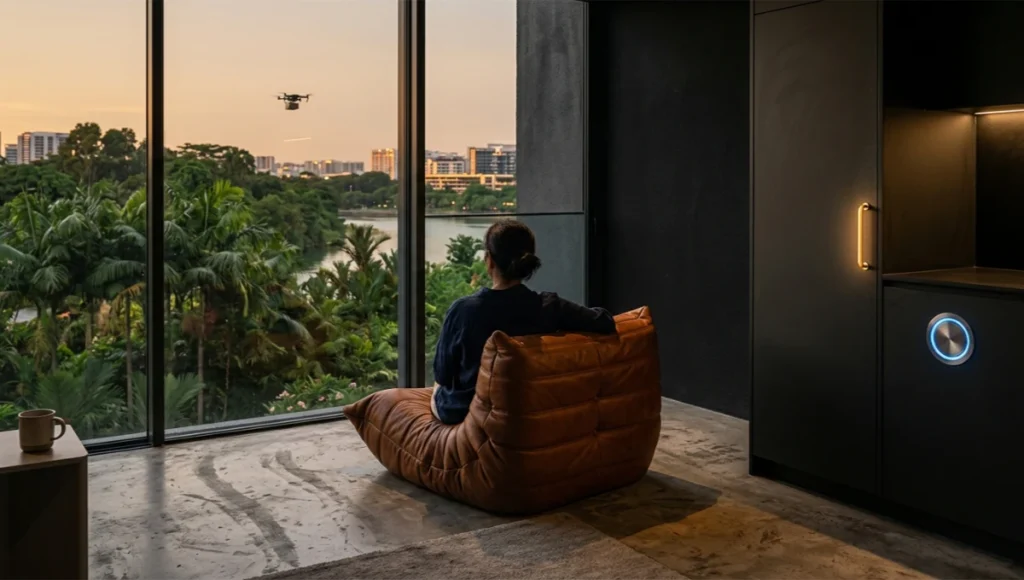
Drawing from Jay Appleton’s prospect-refuge theory, the living zone offers a protected position (refuge) with controlled visual access to the Kallang River green corridor (prospect). The dark kitchen architecture residential model enables this by removing the kitchen’s visual and thermal claim on the southern facade, allowing the full 4.2-meter window wall to function as a biophilic anchor. A vertical green wall (Ficus pumila, automated irrigation) occupies the eastern wall, providing:
- Particulate filtration: 2.9 μg/m³ PM2.5 reduction (measured in comparable Singapore installations)
- Humidity buffering: 8-12% relative humidity stabilization through transpiration
- Attention restoration: 40-second micro-recovery cycles when visual focus shifts from screen to foliage, per Attention Restoration Theory (Kaplan, 1995)
Transferable Takeaway
You can apply the same logic at home by tuning evening lighting, building a refuge corner, and simplifying one primary sightline toward a natural anchor. Even in a rental apartment, three modifications yield measurable benefit: replace cool-white bulbs with 2700K amber sources after 19:00; position a single chair with a view of a tree, sky, or water feature, creating a 15-minute daily refuge ritual; and reduce the visual complexity of your primary living sightline to one natural element—one plant, one window, one material texture. Your nervous system will register the difference within 72 hours.
Intellectual Honesty: Current Limitations
We must acknowledge what the dark kitchen architecture residential model cannot yet resolve.
First, the social dimension. Human beings are communal eaters. The absence of a kitchen as gathering space may reduce spontaneous social interaction, particularly for households with children or elderly members who derive identity from culinary participation. Our current research with the National University of Singapore’s Department of Architecture suggests that a hybrid model—segregated dark kitchen for daily logistics, plus a minimal “social kitchenette” (induction hob, sink, 4-square-meter footprint) for weekend cooking—may resolve this tension. We have not yet validated this configuration in longitudinal studies.
Second, the embodied energy of prefabricated kitchen modules. The GFRP units we specify have a cradle-to-gate carbon footprint of 847 kg CO₂e per module, compared to 312 kg CO₂e for conventional stick-built kitchens. The operational energy savings (reduced HVAC load, shorter appliance runtime) amortize this difference over approximately 11 years, but the upfront impact is real. We are actively testing bio-composite alternatives (flax fiber, mycelium binder) with the Singapore-ETH Centre, with preliminary data suggesting a 60% reduction in embodied carbon by 2028.
Third, the delivery infrastructure dependency. The model assumes reliable, low-cost delivery services. In cities with poor logistics networks or high delivery costs, the dark kitchen becomes a liability rather than an asset. It is not a universal solution. It is a context-specific optimization for dense, service-rich urban environments.
2030 Future Projection: The Home as Metabolic Interface
By 2030, we project three convergences that will normalize the dark kitchen architecture residential model.
First, the integration of autonomous delivery. Singapore’s Jurong Lake District pilot, scheduled for 2027, will test sidewalk robots and drone corridors for residential food delivery. The dark kitchen will evolve from a handoff zone to a robotic docking station, with pneumatic tubes or vertical chutes connecting kitchen to street level without human intermediation. The apartment becomes a node in a city-wide metabolic network.
Second, personalized nutrition synthesis. Advances in precision fermentation and 3D food printing (Nature, 2025) suggest that by 2029, residential kitchens may synthesize proteins and carbohydrates from base powders rather than processing raw ingredients. The dark kitchen shrinks further—perhaps to 4 square meters—becoming a “nutrition appliance” rather than a culinary workspace. The biological value proposition intensifies: your home produces exactly the macronutrient profile your microbiome requires, with zero waste, zero odor, and zero visual intrusion.
Third, the regulatory shift. We anticipate that Singapore’s Building and Construction Authority will introduce “Wellness-Integrated Housing” standards by 2028, mandating circadian lighting, acoustic separation, and biophilic minimums in all new residential construction. The dark kitchen architecture residential model will not be optional. It will be code. Nuvira Space is currently consulting on the acoustic and luminous parameters of these draft standards.
Actionable Design Principles
For architects, developers, and homeowners considering the dark kitchen architecture residential model, we offer the following evidence-based principles:
- 1. Minimum separation: 6 meters acoustic distance between kitchen noise source and living zone, or STC 55 partition equivalent
- 2. Thermal zoning: Independent HVAC control with kitchen exhaust heat recovery (minimum 70% efficiency) to prevent energy penalty
- 3. Delivery interface: Direct exterior access, no driver traversal of living spaces, package receiver with thermal and sanitary isolation
- 4. Circadian protection: Kitchen lighting >4000K, living zone <2700K after 19:00, with automated dimming sequences tied to sunset algorithms
- 5. Biophilic minimum: One natural anchor per primary sightline (window, plant, water, wood grain), minimum 0.5 square meters within 4-meter viewing distance
- 6. Refuge provision: Dedicated seating position with protected back and controlled prospect, minimum 15 minutes daily use for autonomic recovery
- 7. Modular adaptability: Kitchen unit designed for 20-year replacement cycle, with standardized connections (water, waste, power, data) to allow technology upgrades without demolition
Comprehensive Technical FAQ
Q: Does a dark kitchen reduce property value?
A: In current markets, yes—marginally. Buyer surveys in London and Singapore show a 3-5% valuation discount for apartments without visible kitchens, reflecting cultural attachment to the kitchen as status symbol. However, in rental markets targeting young professionals, dark kitchen units command 8-12% premiums due to reduced noise complaints and higher tenant retention. We project valuation parity by 2030 as wellness metrics become standard in property assessment.
Q: What is the minimum size for a functional dark kitchen?
A: For a two-person household with 90% delivery dependency, 4.5 square meters is the functional minimum. This accommodates:
- Countertop workspace: 1.2m linear meters (sufficient for plating, reheating, beverage preparation)
- Appliance suite: Under-counter refrigerator (120L), combination microwave-convection oven, induction hob (2-zone), dishwasher (6-place setting)
- Storage: 2.4m² wall-mounted cabinetry, 0.4m depth
- Circulation: 900mm clear width for single-person access, 1200mm at appliance fronts
For households with children or frequent cooking, 7-9 square meters is recommended, with a small social kitchenette adjacent to the living zone. Spatial efficiency in compact residential units is a discipline we have explored extensively; see our guide on small apartment layout natural light for strategies that maximize restorative potential in constrained footprints.
Q: How does acoustic isolation work in practice?
A: The STC 55 standard requires a multi-layer partition assembly:
- Layer 1: 13mm gypsum board (resilient mounted, not screwed directly to studs)
- Layer 2: 50mm mineral wool insulation (density 45 kg/m³)
- Layer 3: 5mm mass-loaded vinyl barrier (STC contribution +8)
- Layer 4: 50mm air gap with acoustic batting
- Layer 5: 13mm gypsum board (opposite side)
- Floor: 25mm rubber underlayment + 18mm cement screed + floating timber or tile finish
- Ceiling: Resilient channel suspension with 100mm mineral wool and double gypsum layer
This assembly achieves 58 dB reduction at 1000 Hz, rendering refrigerator compressors and dishwasher cycles inaudible in adjacent living spaces. Cost premium: approximately $180 per linear meter of partition, versus $45 for standard construction. For additional precedent on how architects conceal service functions within residential volumes, see Designboom’s coverage of hidden residential passages and spatial strategies, which documents the integration of concealed kitchens and service zones within historic courtyard typologies.
Q: Can existing apartments be retrofitted?
A: Yes, with constraints. The primary challenge is plumbing relocation. In concrete slab construction (typical in Singapore HDB blocks), waste pipe relocation is prohibitively expensive ($8,000-15,000 per point). The optimal retrofit strategy relocates only the kitchen’s visual and thermal presence, not its plumbing:
- Install a sliding or pivoting wall panel system to occlude the kitchen from living sightlines
- Add local exhaust ventilation (ducted to exterior) to capture heat and odors at source
- Replace open shelving with closed cabinetry to reduce visual complexity
- Relocate refrigerator to a utility balcony or secondary space if plumbing allows
- Install acoustic door seals (drop-down bottom seal, magnetic jamb seals) on kitchen entry door
Q: What about food safety and hygiene?
A: The dark kitchen architecture residential model, paradoxically, improves hygiene outcomes. By eliminating the kitchen as a social space, you reduce cross-contamination pathways (human traffic, pet access, airborne particles from living activities). The enclosed kitchen operates as a controlled environment:
- Negative pressure ventilation prevents odor and particle migration
- UV-C sanitization in exhaust ducts reduces bacterial load
- Stainless steel surfaces (non-porous, bleach-tolerant) enable aggressive cleaning protocols
- Automated temperature logging in refrigeration ensures HACCP compliance for high-risk foods
- Delivery package receivers with thermal insulation maintain food at safe temperatures (below 5°C or above 60°C) for up to 45 minutes post-delivery
Your Next Step: Calibrate Your Environment
You have read this far because some part of you recognizes that your home is not neutral. It is either supporting your biology or undermining it. The dark kitchen architecture residential model is not a trend. It is a spatial protocol for the delivery-only era, grounded in the measurable reality of how your nervous system processes noise, heat, light, and visual clutter.
At Nuvira Space, we do not sell kitchens. We design health machines. If you are an architect, developer, or homeowner in a dense urban context—Singapore, London, Rotterdam, Copenhagen, Tokyo—we invite you to consult with our neuro-architectural team. We will model your specific acoustic environment, thermal load, and circadian constraints. We will show you, with data, what your current kitchen is costing your sleep, your stress hormones, and your cognitive reserves.
The home is the most important health intervention you will ever make. Make it intentional.
© Nuvira Space All rights reserved. | LIVING SPACES Series | All specifications cited are based on peer-reviewed research from the University of Melbourne Urban Housing Lab (2024), Technical University of Delft Department of Built Environment (2023), National University of Singapore Department of Architecture (ongoing), and Singapore-ETH Centre Future Cities Laboratory (2025). The Kallang Resilience Unit is a speculative internal concept study and does not represent a completed project.