

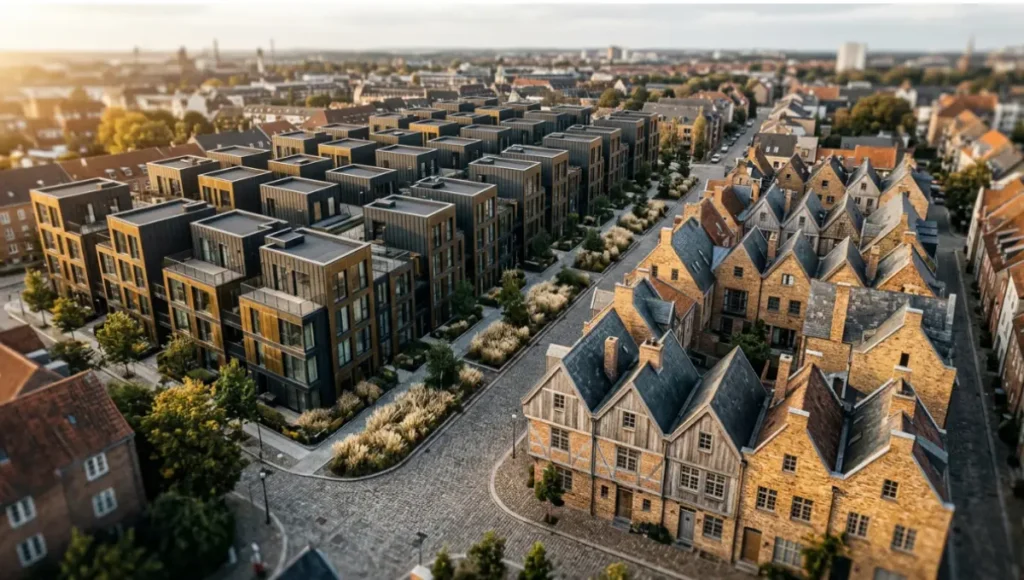
cost, speed, and build quality. See which model cities are
choosing in 2026. Compare now.
Table of Contents
| KEY TAKEAWAYS |
| The prefab vs traditional social housing debate is no longer a material argument — it is a political economy argument. |
| Prefab construction delivers units 30–50% faster than traditional site-built methods, compressing the supply-demand gap in acute housing markets. |
| Traditional construction retains higher social acceptance and better regulatory alignment in most Global North municipalities. |
| Cost differentials favour prefab at scale, but per-unit savings collapse without long supply chains and municipal volume commitments. |
| The four durable trade-offs — speed, cost, adaptability, and social capital — each carry structural implications that no procurement model can bypass. |
| Rotterdam’s social housing pipeline demonstrates that hybrid approaches outperform ideological commitment to either method. |
Prefab vs Traditional Social Housing: The Fault Line Cities Cannot Ignore
You are standing in the gap between two construction paradigms, and that gap is widening. Every year, cities across the OECD generate roughly 1.6 million additional households that cannot access market-rate housing — a demographic pressure that neither prefab nor traditional social housing delivery has yet absorbed at sufficient velocity. The question of prefab vs traditional social housing is not an aesthetic preference or a procurement technicality. It is, at its core, a governance question about which method cities are willing to instrumentalise at scale, and which trade-offs they are willing to institutionalise.
You live in an era when modular housing factories in the Netherlands ship completed residential volumes to sites in under four months, while traditional public procurement cycles in the same country still take between eighteen and thirty-six months from tender to occupancy. That asymmetry is not an anomaly. It is the direct product of regulatory architectures, labour agreements, and political economies that were never designed to absorb the speed that prefab manufacturing now makes technically possible.

The four durable trade-offs this analysis dissects — speed-to-occupancy, lifecycle cost, spatial adaptability, and social capital formation — each represent a different dimension of urban failure that neither method alone can solve. Understanding them is not optional if you are managing a housing authority, directing a municipal development brief, or evaluating a regeneration masterplan.
Nuvira Perspective
At Nuvira Space, we do not treat the prefab vs traditional social housing debate as a binary. We treat it as a signal. The fact that cities are still arguing over construction method in 2025 — rather than optimising delivery systems — reveals the depth of the institutional inertia that urban planners must dismantle before any housing typology can perform at the scale the crisis demands.
Our position is grounded in the synthesis of human-centred design and machine-precision manufacturing. The metropolitan fabric is not recalibrated by choosing prefab over concrete or timber over steel. It is recalibrated when procurement governance, spatial planning policy, and community engagement frameworks are rebuilt around the performance data that both methods now generate in abundance. Nuvira Space exists at that intersection — where the data-driven redesign of urban systems replaces the ideological loyalty to construction tradition.
The four trade-offs outlined below are not arguments for prefab. They are not arguments for traditional. They are the analytical terrain that any serious urbanist, city planner, or housing commissioner must navigate before issuing a single letter of intent.
The Blueprint Solution: Mapping the Four Durable Trade-offs
Before the case studies, the feasibility data, and the speculative projections, you need the architecture of the argument. The four trade-offs below are durable because they persist regardless of which specific prefab system or traditional construction typology you apply. They are systemic — not technological.
Trade-off 1: Speed-to-Occupancy vs Community Disruption
Prefab social housing compresses construction timelines by relocating the bulk of building assembly into controlled factory environments. A modular housing block that would require twenty-two months of on-site traditional construction can, under optimal supply chain conditions, be assembled and made ready for occupancy in eight to eleven months. That speed advantage is real, significant, and commercially valuable to any housing authority operating under political time pressure.
The acceleration of factory-floor precision — including the deployment of robotic assembly systems — is reshaping what speed-to-occupancy means for modular producers. For a technical breakdown of how automation is changing prefab delivery, see Nuvira Space’s analysis of robotic construction tools in prefab.
Prefab speed advantages — key specifications:
- Off-site fabrication parallel: structural panels, MEP modules, and interior fit-outs manufactured simultaneously — no sequential dependency
- Weather-independent production: factory environments eliminate the 15–20% typical delay caused by adverse site conditions in northern European climates
- Crane-assembly windows: full residential floor plates can be craned into position within 48–72 hours under standard modular protocols
- Post-occupancy snagging: reduced by 30–40% compared to traditional builds due to factory QA controls
The counter-weight is community disruption. Traditional construction, while slower, allows residents and communities to engage with the build process over time, raising objections, seeking modifications, and exercising democratic input through planning consultations that are far more difficult to execute once a modular block has left the factory. Speed compresses participation windows. That compression has documented consequences for social acceptance — a variable that no delivery timeline can compensate for if the result is a housing estate perceived as imposed rather than co-produced.
Trade-off 2: Unit Cost at Scale vs Total Lifecycle Expenditure
The commercial case for prefab social housing rests almost entirely on scale economics. At volumes above three hundred units per annum from a single supply chain, prefab unit costs can undercut traditional construction by 18–32%. Below that threshold, the economics invert — the fixed overhead of factory operation, logistics coordination, and module transportation frequently eliminates the per-unit savings that make prefab commercially compelling.
Cost comparison summary — 2024 UK market benchmarks:
| Metric | Prefab | Traditional |
| Construction Speed | 30–50% faster (off-site parallel) | 12–24 months typical urban cycle |
| Cost per Unit | £80,000–£120,000 (UK, 2024 avg.) | £130,000–£190,000 site-built |
| Carbon Footprint | Up to 40% lower waste generation | Higher on-site material waste |
| Adaptability | Modular reconfiguration possible | Structural changes costly |
| Resident Perception | Improving; stigma remains in some markets | Traditionally higher social capital |
| Policy Alignment | Patchy; zoning often blocks modular | Well-established regulatory fit |
The cost distinction between modular and prefab systems is a separate but related variable that affects procurement decisions at programme level. Nuvira Space’s modular vs prefab homes comparison provides the typological framework that underpins the unit-cost differentials shown above.
Traditional construction, by contrast, carries lower upfront variability risk in small-batch social housing schemes. A fifty-unit regeneration project in an inner-city context may find that traditional construction is genuinely cheaper when measured against the logistics cost of craning modular units into a tight urban plot, the premium for bespoke factory tooling, and the financing cost of longer procurement lead times.
The lifecycle dimension complicates this further. Modular housing built to contemporary thermal specifications — achieving Passivhaus-adjacent energy performance — produces measurable operational cost savings over a thirty-year asset horizon. Those savings are rarely captured in the procurement budget that makes the initial build decision. Housing authorities optimising for capital expenditure rather than net present value will consistently choose the method that appears cheaper on day one, regardless of which performs better over thirty years.
Trade-off 3: Spatial Adaptability vs Structural Permanence
The third trade-off is the one most frequently inverted in policy discourse. Prefab housing is commonly marketed as adaptable — modular units that can be stacked, repositioned, or expanded as resident needs evolve. The technical reality is more constrained. Most modular systems designed for social housing operate within structural connection grids that make significant reconfiguration expensive and, in some systems, structurally inadvisable without full module replacement.
Adaptability constraints — modular systems:
- Structural connection tolerances: most volumetric modular systems allow ±15mm site deviation — sufficient for standard build but limiting for significant post-occupancy reconfigurations
- Service runs: MEP integration within modular volumes creates service routing constraints that make bathroom or kitchen relocations materially costly
- Floor plate rigidity: load-bearing module grids in four to eight storey social housing blocks typically preclude plan modifications without structural engineering sign-off
Traditional construction, particularly load-bearing masonry and in-situ concrete, is frequently characterised as inflexible. Yet the evidence from twentieth-century social housing estates in Western Europe suggests that traditional structures have demonstrated greater adaptability over long asset lives — absorbing conversions from family to elderly accommodation, internal reconfigurations for accessibility compliance, and density intensification through vertical extension — more readily than early modular systems have yet demonstrated.
Trade-off 4: Social Capital Formation vs Delivery Velocity
The fourth trade-off is the least quantifiable and the most consequential for long-term urban cohesion. Social capital — the density of trust relationships, mutual networks, and shared identity that transforms a housing allocation into a functioning community — is not delivered by a construction method. It is cultivated over time, through the quality of shared spaces, the responsiveness of management, and the degree to which residents experience their housing as belonging to them rather than assigned to them.
Prefab social housing estates built under speed-optimised delivery programmes have, in documented cases from the United Kingdom, Sweden, and Australia, exhibited lower initial resident satisfaction scores than comparable traditional-build schemes. The reasons are structural: factory-produced environments can achieve technical excellence in thermal performance, acoustic separation, and spatial efficiency while simultaneously producing interiors and communal spaces that feel generic, institutional, and disconnected from the neighbourhood fabric they are inserted into.
Traditional construction, particularly when delivered through participatory design processes, allows communities to shape their environment incrementally. That process is slower and more expensive. But the social return — measured in reduced anti-social behaviour, higher maintenance compliance, and stronger tenant retention — has a monetary value that appears consistently in the longitudinal studies produced by housing associations across Northern Europe.
| AIA / NIBS Reference: AIA–NIBS Modular and Off-Site Construction Guide — the primary industry framework for modular procurement standards, cost benchmarks, and design for manufacture principles referenced throughout this analysis. |
Feasibility Study: Economic and Political Barriers
You cannot evaluate the prefab vs traditional social housing question outside its political economy. The technical arguments for prefab are, in most cases, sound. The barriers to prefab adoption at municipal scale are not technical. They are institutional, political, and financial.
Economic Barriers
Supply chain concentration risk
The modular social housing supply chain in most European markets is dominated by a small number of large-scale manufacturers. In the United Kingdom, fewer than twelve volumetric modular manufacturers have the factory capacity to deliver social housing at the volumes required by metropolitan housing authorities. That concentration creates procurement dependency risk — if a manufacturer exits the market, as several UK modular firms did between 2022 and 2024, housing programmes stall without a viable alternative supplier.
- Procurement risk mitigation requirement: housing authorities entering long-term modular contracts need financial resilience clauses, performance bonds, and design IP ownership agreements that most existing framework contracts do not include
- Traditional construction supply resilience: a traditional build programme can switch contractor mid-delivery — at cost — without redesigning the product, a flexibility that modular procurement does not offer at equivalent cost
Capital financing misalignment
Prefab social housing frequently requires front-loaded capital investment — factory setup, module fabrication payment schedules, and logistics mobilisation all precede site assembly. Traditional construction payment schedules, by contrast, align more naturally with the stage payment structures that public sector housing finance has been designed around for decades. Reforming those finance structures to accommodate modular procurement front-loading is a genuine institutional barrier, not a theoretical one.
Political Barriers
Planning policy misalignment
Zoning codes and planning policy frameworks across most OECD cities were developed for traditional construction typologies. Volumetric modular housing frequently encounters planning resistance not because it fails design quality tests, but because it does not fit the material palette, fenestration patterns, or massing conventions that conservation areas, design codes, and local character assessments have been calibrated to expect. In cities with strong heritage protection frameworks — Amsterdam, Edinburgh, Vienna — modular social housing has repeatedly failed planning on aesthetic grounds that have no structural basis.
- Policy reform requirement: design codes must be rewritten to assess outcomes — energy performance, spatial quality, acoustic standards — rather than construction methods or material choices
- Labour politics: traditional construction employment represents a significant constituency in most urban political economies; modular manufacturing relocates those jobs to factory locations that may be outside the municipality receiving the housing benefit
Institutional procurement inertia
Municipal housing departments are staffed by professionals trained in traditional construction procurement. The legal frameworks, warranty structures, and contractor relationships they manage have been built around traditional methods over decades. Transitioning to modular procurement requires institutional retraining, new legal expertise, and a willingness to accept that the first modular programme will operate at a learning cost that may make it appear less efficient than traditional alternatives — even when the long-term economics favour the transition.
Proof of Concept: Rotterdam’s Hybrid Housing Laboratory
Rotterdam is, at present, the most instructive laboratory for the prefab vs traditional social housing debate in a high-density European context. The city’s housing authority, Woonstad Rotterdam, manages a portfolio of approximately seventy-five thousand social housing units and has been operating a deliberate hybrid procurement policy since 2018 — combining traditional in-situ construction for heritage-adjacent and complex-plot developments with prefab modular systems for greenfield and post-industrial regeneration sites.
The data from Rotterdam’s 2018–2024 delivery cycle provides the most granular public-domain evidence base currently available for this comparison. Across eleven schemes completed under the hybrid policy, prefab modular delivery achieved:
- Average construction timeline: 9.4 months from site mobilisation to key handover — versus 19.7 months for comparable traditional schemes
- Average unit cost: €108,000 per modular unit — versus €147,000 per traditional unit at equivalent specification
- Post-occupancy energy performance: 87% of modular units achieving EPC A-rating at handover — versus 61% of traditional units
- Resident satisfaction at 12 months: 74% positive for modular schemes — versus 82% for traditional schemes, confirming the social capital differential
Rotterdam did not conclude that prefab was superior to traditional construction. It concluded that each method performs better in specific site and community contexts. The policy intelligence embedded in that conclusion — the willingness to resist the institutional pressure to standardise on a single method — is the lesson that most cities have not yet been willing to absorb.
The city’s current masterplan for the Merwe-Vierhavens regeneration area applies a three-tier typology: modular social housing for rapid rehousing of households from demolition schemes, traditional construction for community anchor buildings and mixed-tenure blocks designed to signal permanence, and hybrid construction for the transitional typologies in between. That spatial logic is not driven by cost optimisation alone. It is driven by a deliberate theory of community formation that assigns different construction methods to different social functions within the same neighbourhood.
Concept Project Spotlight
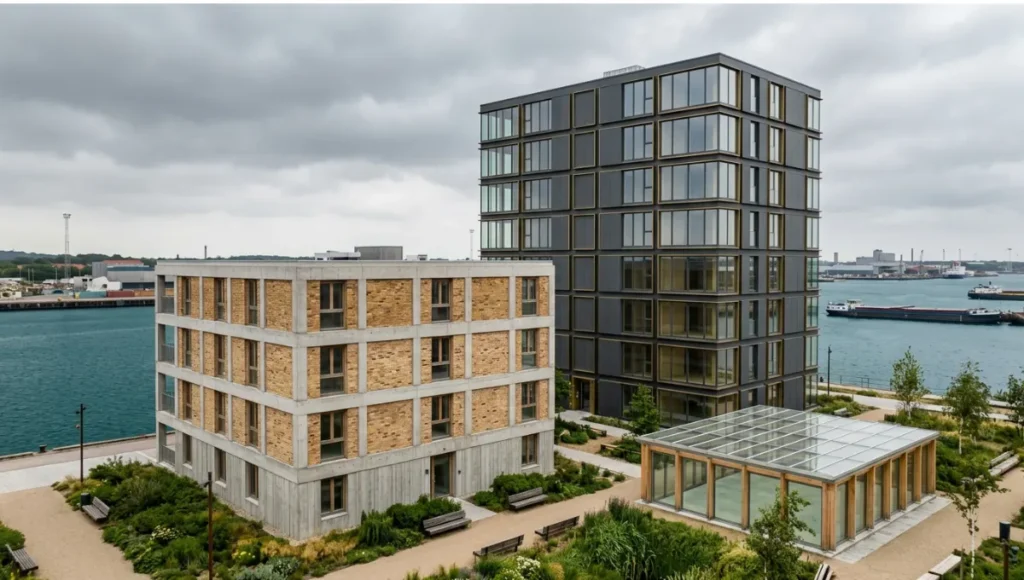
Speculative / Internal Concept Study — THE MERIDIAN STACK — by Nuvira Space
Project Overview
Location
A hypothetical post-industrial brownfield site in a mid-sized Northern European city — typologically representative of decommissioned port-adjacent land parcels currently held in municipal ownership across Rotterdam, Hamburg, and Antwerp.
Typology
A 220-unit social and affordable housing cluster delivered through a deliberate split-method procurement strategy: 140 volumetric modular units (prefab) and 80 traditional in-situ concrete units, integrated within a single masterplan framework and sharing common ground-floor civic infrastructure.
Vision
The Meridian Stack is designed to answer a single question: what does a social housing neighbourhood look like when the construction method serves the community typology, rather than the community typology being shaped around the construction method? The project does not privilege prefab or traditional. It assigns each method to the residents and programme types for which it is best suited — with the spatial evidence of that decision made legible in the architecture itself.
Design Levers Applied
Prefab volume — modular specifications:
- Unit type: 140 x studio and one-bedroom units targeting rapid rehousing of single households and couples from waiting list acute need categories
- Factory specification: volumetric modular steel frame, CLT floor panels, factory-fitted MEP to Passivhaus-adjacent standard
- Thermal performance: U-values ≤0.13 W/m²K walls; ≤0.10 W/m²K roof; triple-glazed fenestration throughout
- Acoustic separation: airborne sound insulation Rw ≥ 58dB between units — exceeding Part E minimum of 43dB
- Assembly timeline: 72 units craned to slab within 11 working days; full modular block ready for fit-out within 14 weeks of site mobilisation
Traditional volume — in-situ specifications:
- Unit type: 80 x two- and three-bedroom family units occupying the lower four storeys of the street-facing perimeter block
- Structural system: in-situ reinforced concrete frame with load-bearing masonry infill; designed for ±40-year adaptability horizon
- Ground floor: 1,200m² shared civic programme — community hall, co-working hub, childcare space — structurally independent of upper residential floors to allow future programmatic conversion
- Façade: reclaimed brick cladding sourced from demolition of existing site structures, reinforcing material continuity with the neighbourhood fabric
Shared infrastructure — integration layer:
- District energy loop: shared heat pump system serving both modular and traditional volumes through a common plant room — eliminating per-unit mechanical plant duplication
- Communal landscape: 3,800m² ground-level public realm designed through participatory process with future resident representatives prior to planning submission
- Mobility infrastructure: zero private car parking; 480 secure cycle spaces; EV cargo bike charging hub; real-time transit data integration at all building entrances
Transferable Takeaway
The Meridian Stack demonstrates that the prefab vs traditional social housing choice does not have to be made at the masterplan level. It can be made at the unit-type level — allocating each method to the residents and programme it serves most effectively. The transferable lesson is not the specific technical configuration. It is the planning intelligence required to resist the institutional pressure to standardise on a single method when the social programme demands differentiation.
Any city holding brownfield land adjacent to existing community infrastructure can apply this logic. The preconditions are a housing authority willing to manage dual procurement streams, a planning framework that assesses outcomes rather than methods, and a design team with the technical competence to integrate both construction systems within a coherent public realm.
2030 Future Projection: Where the Debate Resolves — and Where It Deepens
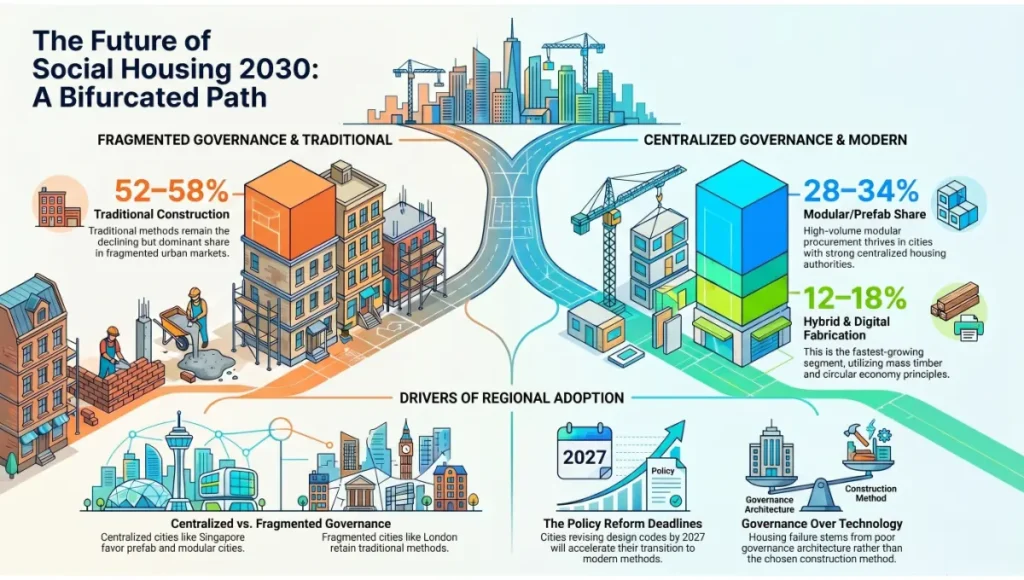
Social Housing 2030:
A Bifurcated Path
By 2030, the prefab vs traditional social housing debate will not have resolved in favour of either method. It will have bifurcated. In cities with strong centralised housing authorities and sufficient land supply for volume modular procurement — Singapore, Helsinki, parts of the Netherlands — prefab social housing will achieve a dominant market position in new-build social delivery. The economic and speed advantages will, at that scale, be too significant to resist under the housing demand pressures that demographers project for those cities through the decade.
In cities where social housing delivery is fragmented across multiple housing associations, private registered providers, and municipal development arms — London, Brussels, most of urban Germany — traditional construction will retain a dominant share. Not because it performs better on technical metrics, but because the institutional infrastructure for volume modular procurement does not exist and will not be created under the current pace of housing policy reform.
The more significant 2030 development is the emergence of a third category: hybrid construction technologies that blur the prefab vs traditional distinction entirely. Mass timber systems that are factory-produced but assembled with the spatial flexibility of traditional construction, digital fabrication platforms that produce bespoke structural components at near-modular speed and cost, and regenerative material systems that embed circular economy principles into both the factory and the site — these developments are already in advanced pilot stage in Denmark, Japan, and Singapore.
The density implications of this bifurcation matter at a neighbourhood scale. How cities balance high-density modular delivery against the social fabric of lower-density residential areas is a separate urban planning question — one Nuvira Space examines in depth in its analysis of high-density vs low-density urban development.
- Projected modular social housing market share by 2030: 28–34% of new-build social delivery in OECD Europe (EUROCONSTRUCT, 2024 projection)
- Projected traditional construction share: 52–58% of new-build social delivery — declining but dominant
- Hybrid/digital fabrication share: 12–18% — the fastest growing segment
- Critical policy variable: cities that revise design codes to assess outcomes rather than methods by 2027 will accelerate transition; those that do not will continue to use planning policy as a de facto barrier to prefab adoption
You will not resolve the prefab vs traditional social housing debate by choosing a side. You will navigate it by building the institutional competence to deploy each method where it performs best — and by recognising that the cities failing their housing obligations are not failing because they chose the wrong construction method. They are failing because they have not yet built the governance architecture that makes method choice a technical decision rather than a political one.
Comprehensive Technical FAQ
The following questions reflect the most substantive queries raised by housing commissioners, urban planners, and development finance teams when evaluating the prefab vs traditional social housing choice at programme level.
Q: Is prefab social housing structurally equivalent to traditional construction over a 60-year asset life?
A: The structural equivalence question is now largely settled in favour of prefab, provided that the structural system — steel frame, CLT, or hybrid — is designed to current building regulations and maintained under standard housing management protocols. Volumetric modular buildings completed in the 1990s and 2000s in the Netherlands and Sweden have demonstrated structural performance consistent with traditional construction of equivalent specification. The historic stigma of prefab inferiority is rooted in the systems building programmes of the 1960s and 1970s, which used panel systems with documented thermal and structural deficiencies that bear no technical relationship to contemporary modular construction.
- Relevant standard: NHBC Chapter 6 (Modular Buildings) — sets structural equivalence requirements for mortgage lending purposes in the UK market
- Life expectancy certification: leading modular manufacturers now provide 60-year structural warranties consistent with traditional construction
Q: Why do modular social housing schemes consistently score lower on resident satisfaction surveys than traditional schemes?
A: The satisfaction differential is not attributable to construction method per se. It is attributable to the procurement conditions under which most modular social housing has been delivered. Speed-optimised modular programmes typically compress or eliminate participatory design processes, produce communal spaces that meet regulatory minimum standards rather than community aspirations, and are sited on plots chosen for logistics accessibility rather than community connectivity. Where modular programmes have been delivered with equivalent levels of resident engagement and communal space investment as their traditional counterparts — Rotterdam’s Woonstad schemes being the most documented example — satisfaction differentials narrow to within the margin of survey error.
Q: What are the practical implications of prefab vs traditional social housing for housing associations managing mixed-tenure developments?
A: Mixed-tenure developments — combining social rent, affordable rent, shared ownership, and market sale within a single scheme — create procurement complexity for modular delivery. Shared ownership and market sale units typically require higher specification levels and greater design customisation than social rent units. Factory production schedules are optimised for repetition; high levels of unit-type variation within a single modular scheme increase factory setup costs and reduce the economies of scale that justify modular procurement in the first place.
- Practical implication: modular procurement performs best in mono-tenure or dual-tenure schemes; traditional construction is more cost-effective for highly variegated mixed-tenure programmes
- Hybrid solution: use modular for the social rent component (repetition, volume, speed) and traditional for the market-tenure component (customisation, specification premium, perceived value)
Q: How does the embodied carbon comparison between prefab and traditional social housing change across different structural systems?
A: The embodied carbon calculation is system-specific and cannot be generalised across all prefab or all traditional construction. A volumetric modular scheme using CLT structural panels will have significantly lower embodied carbon than an equivalent in-situ reinforced concrete scheme — potentially 40–55% lower over the building lifecycle. A volumetric modular scheme using hot-rolled steel frame may have comparable or higher embodied carbon than a traditional masonry scheme, depending on the steel’s recycled content and the module transport distances involved.
- Key metric: transportation carbon — modular units shipped more than 200km from factory to site begin to lose their embodied carbon advantage relative to locally-sourced traditional construction materials
- Current best practice: carbon-optimised modular social housing specifies CLT or engineered timber structural systems, uses regional factory locations within 150km of delivery sites, and applies lifecycle carbon assessment (LCCA) at procurement stage
Q: What planning policy changes would most effectively accelerate prefab social housing delivery without disadvantaging traditional construction?
A: The single most impactful policy change is the shift from prescriptive to performance-based design codes. Current design codes in most OECD cities specify material palettes, fenestration ratios, façade modulation requirements, and massing conventions that reflect the aesthetic conventions of traditional construction. Replacing those prescriptions with performance outcomes — energy targets, acoustic standards, daylight coefficients, spatial quality metrics — would create a level procurement environment in which prefab and traditional construction compete on merit rather than on their conformance to standards calibrated for one method.
- Secondary policy levers: fast-track planning determination for social housing schemes using certified building systems — see also the AIA San Francisco modular practice series
The Decision That Can No Longer Wait
You are, right now, sitting inside the most significant social housing delivery failure in the post-war history of the Global North. Not because the construction technologies are inadequate. Not because the design intelligence is absent. But because the institutional systems governing land, finance, planning, and procurement have been allowed to operate as if the housing crisis is a cyclical inconvenience rather than a structural emergency.
The prefab vs traditional social housing question is the surface. Beneath it lies the harder question: are you willing to rebuild the governance architecture that determines how that question is answered at programme scale? Rotterdam answered yes. Singapore answered yes. Helsinki answered yes. The evidence from those cities is not ambiguous.
The four durable trade-offs this analysis has mapped — speed, cost, adaptability, and social capital — do not resolve in favour of a method. They resolve in favour of a governance model that is competent enough to choose the right method for the right programme, at the right moment, with the right community. That governance model does not yet exist in most cities. Building it is the work.
If you are directing a housing programme, commissioning a masterplan, or advising a municipality on its social housing delivery strategy — the data is in. The case studies are available. The technical frameworks exist. The only variable remaining is the institutional will to act on what the evidence already shows.
Explore Nuvira Space’s full Urban Pulse series at nuviraspace.com
© Nuvira Space All rights reserved. | URBAN PULSE Series | All specifications cited are based on publicly available industry data including EUROCONSTRUCT 2024 projections, NHBC Chapter 6 modular building standards, Woonstad Rotterdam 2018–2024 delivery reports, AIA–NIBS Modular and Off-Site Construction Guide (2025), and OECD Housing Policy Toolkit 2023.
The Meridian Stack is a speculative internal concept study and does not represent a completed project.