

Table of Contents
| KEY TAKEAWAYS Underground urban farming cities are converting disused tunnels, wartime bunkers, and metro voids into controlled-environment food systems — not as experiments, but as permanent infrastructure. 7 leading cities — London, Singapore, Tokyo, Seoul, Paris, Stockholm, and Montreal — are investing in subterranean agriculture as a policy-driven response to climate volatility and food supply chain fragility. Hydroponic and aeroponic systems operating underground use up to 70% less water than conventional open-field agriculture, with zero pesticide dependency. The economic barrier is real: capital expenditure for underground farm fit-outs ranges from $2,000 to $5,000 per square metre, demanding new public-private financing frameworks. The trend is not vertical versus underground — it is a convergence of both in transit-oriented development nodes, where density, logistics, and food production overlap. |
The City Is Not Running Out of Space — It Is Running Out of Vision
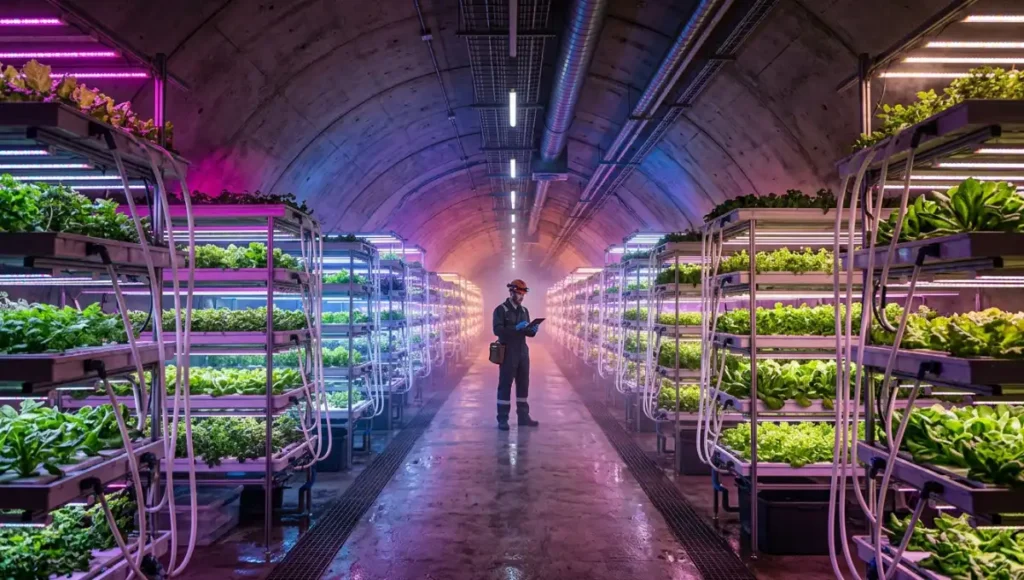
You have been told, with the confidence of a hundred urban planning committees, that cities are full. That density is the ceiling. That the vertical axis — the stacked glass tower, the elevated park, the rooftop farm — is where the future of urban food production lives. But beneath your feet, cut through bedrock and Victorian brick, lies an infrastructure of voids that no city grid has ever formally claimed for nourishment.
Underground urban farming in cities is not a niche proposition. It is a systemic recalibration of what urban space means — and which layers of it you have chosen, until now, to ignore.
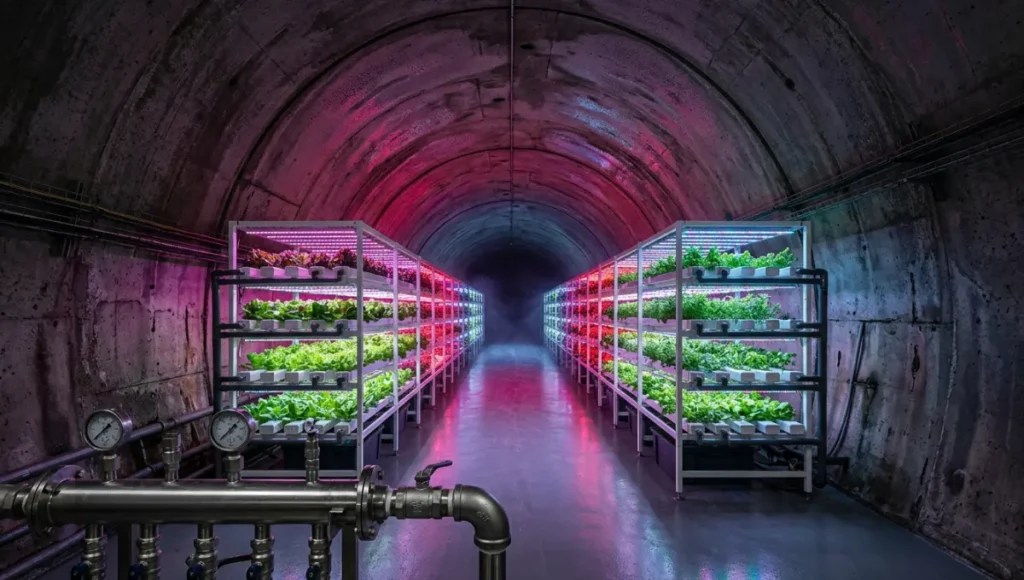
The data is not ambiguous. By 2050, the United Nations projects that 68% of the global population will live in cities. The Food and Agriculture Organisation already counts more than 800 million people participating in urban agriculture globally. Yet the vast majority of food grown in cities still clings to the surface: rooftops, balconies, pocket parks. The subterranean layer — tunnels decommissioned after wartime, metro expansion voids, basement car parks made redundant by autonomous transport — remains largely fallow.
That is beginning to change, and the shift is accelerating in seven cities that have moved past the pilot phase into the realm of policy-embedded infrastructure. This is not a story about salad. It is a story about the reconfiguration of the metropolitan food chain from a linear import dependency into a circular, resilient, proximity-driven system — one that begins below street level.
At Nuvira Space, We Read the City Differently
At Nuvira Space, the metropolitan fabric is not a fixed diagram. It is a living system of decision layers — infrastructure choices that compound over decades and produce either adaptive cities or brittle ones. The emergence of underground urban farming as a genuine urban planning category is not a technological surprise to us. It is the logical consequence of three intersecting forces: the climate crisis destabilising surface-level agriculture, the post-pandemic re-evaluation of food supply chain sovereignty, and the growing sophistication of controlled-environment agriculture (CEA) technology that no longer requires sunlight to produce food at scale.
At Nuvira Space, we position underground urban farming not as an agrarian novelty but as a data-driven infrastructure intervention — one that integrates transit-oriented development, urban metabolism modelling, and resilient food network design into a single spatial strategy. The cities going deeper are not retreating. They are advancing into the one frontier that conventional urban planning left unmapped.
The Blueprint: What Underground Urban Farming Actually Requires
Before treating the subterranean farm as a romantic concept, you need to understand its material logic. The infrastructure requirements are non-trivial, and the cities doing this seriously are not improvising.
2.1 Core Technical Architecture
Controlled-Environment Agriculture (CEA) Stack
- LED grow-light arrays: full-spectrum, tunable to plant-specific photosynthetic peaks (400–700nm PAR range)
- Hydroponic or aeroponic delivery systems eliminating soil dependency and reducing water consumption by 70–90% versus field agriculture
- CO2 injection and atmospheric management systems maintaining optimal 800–1200ppm concentrations
- HVAC redundancy: underground thermal stability (typically 10–14°C baseline) reduces conditioning loads but humidity control remains critical
- IoT sensor mesh: real-time monitoring of temperature, humidity, nutrient concentration, light intensity, and plant stress indicators
- Digital twin integration: virtual farm models updated continuously from sensor data, enabling predictive yield management and energy optimisation
Spatial Typologies in Active Use
- Wartime infrastructure: repurposed bomb shelters and civil defence tunnels (London, Helsinki)
- Decommissioned transit voids: disused metro station platforms and tunnel sections (Paris, Stockholm)
- Underground parking structures: abandoned or underutilised car parks converted to multi-tier grow rooms (Seoul, Montreal)
- Purpose-built subterranean volumes: new-build underground levels integrated into transit-oriented development masterplans (Singapore, Tokyo)
2.2 Crop Profile and Yield Logic
Not every crop belongs underground. The economics of underground urban farming cities are dictated by yield-per-square-metre logic against energy cost. The current viable crop matrix:
- Microgreens and baby leaf salads: 7–14 day cycles, high price-per-kilo, dense planting configurations
- Herbs (basil, coriander, chives, mint): consistent demand from restaurant supply chains, short delivery radius achievable
- Mushrooms: no photosynthesis requirement, low lighting cost, high protein density per m2
- Strawberries and soft fruits: emerging category as LED efficiency improves and premium retail pricing justifies energy input
- Pharmaceutical-grade botanicals: the frontier category — regulated cultivation environments enable pharmaceutical crop production at scale
Feasibility Study: Economic and Political Barriers
Underground urban farming is not stalling because the technology is unready. It is stalling because the economic and regulatory frameworks built for surface-level agriculture are structurally incapable of pricing subterranean food production accurately. You need to understand where the friction lives.
3.1 Capital Expenditure Reality
The cost of fitting out underground space for controlled-environment agriculture ranges from $2,000 to $5,000 per square metre depending on the depth, existing infrastructure condition, and required HVAC complexity. This is 3 to 8 times the fit-out cost for a surface-level vertical farm. The barrier is not operational — underground farms, once running, achieve lower water costs, near-zero pesticide cost, and stable energy consumption profiles. The barrier is the gap between capital commitment and the timeframe over which returns materialise.
- Average payback period for underground CEA installations: 7 to 12 years
- Energy cost as a percentage of operational expenditure: 35–55% (LED arrays remain the dominant cost driver)
- Renewable energy integration (rooftop solar feeding subterranean operations) reduces energy cost by an estimated 18–32% depending on latitude
- Public-private financing models emerging in Singapore, Rotterdam, and Seoul are restructuring the capital stack — treating underground farm infrastructure as civic utility rather than private enterprise
3.2 Political and Zoning Barriers
The regulatory landscape for underground urban farming is, in most cities, a legal grey zone. Planning codes were not written for food production 30 metres below street level. The barriers:
- Zoning classification: most underground commercial space is classified for logistics, parking, or utility — not food production; rezoning requires legislative action
- Food safety certification: underground environments introduce novel biosecurity considerations that existing food safety frameworks were not designed to evaluate
- Ownership and access rights: subsurface rights in many jurisdictions are poorly defined, creating long negotiation timelines for private operators seeking public tunnel access
- Energy pricing: underground farms that consume significant electricity are often subject to commercial energy tariffs that make them uncompetitive without subsidy or preferential pricing agreements
Cities in Toronto, Berlin, and Singapore have begun revising zoning laws to formally incorporate urban agriculture into land use planning — but underground agriculture remains a subset that most reform efforts have not yet addressed with specificity.
The American Institute of Architects has documented how adaptive reuse frameworks are being applied to subsurface civic infrastructure — see the AIA Continuing Education resources on adaptive infrastructure reuse for relevant case studies on how architects are navigating zoning ambiguity in underground development contexts.
3.3 The Political Will Gap
Here is the uncomfortable reality: underground urban farming in cities requires municipal governments to make long-horizon infrastructure commitments in a political environment that rewards short-cycle visibility. A rooftop garden photographs well. A subsurface farm does not generate the same civic optics, despite being exponentially more scalable and resilient. The cities succeeding are those where food sovereignty has been elevated to a national security issue — not an environmental aspiration. Singapore is the clearest example of this reframing.
Proof of Concept: 7 Cities Going Deeper
London, United Kingdom — The Pioneer Under Clapham
Growing Underground, located 33 metres below the streets of Clapham in a decommissioned Second World War air raid shelter, established the global proof of concept in 2015. Operating in tunnels that a post-war plan had once proposed connecting to the London Underground, the farm produces microgreens, herbs, and salad varieties using 70% less water than conventional open-field farming. A digital twin developed in collaboration with the University of Cambridge monitors every environmental variable in real time, enabling continuous yield optimisation and providing the engineering blueprint for a second, larger facility.
- Depth: 33 metres below street level
- Farm footprint: approximately 2.5 acres across tunnel sections
- Water reduction: 70% versus field agriculture
- Supply radius: produce delivered to New Covent Garden Market within 8 hours of harvest
- Technology: hydroponic systems, full-spectrum LED, Cambridge-built digital twin
The digital twin model used at Growing Underground represents the same management logic now being applied to smart buildings globally — an approach covered in depth in our analysis of digital twin building management systems and their role in optimising urban infrastructure at scale.
Singapore — Food Sovereignty as Infrastructure Policy
Singapore’s relationship with underground urban farming is inseparable from its ’30 by 30′ national food security mandate: produce 30% of the country’s nutritional needs domestically by 2030, up from a current position of roughly 10%. With only 1% of Singapore’s land formally designated for farming, the city-state has pivoted to underground and vertical integration as a sovereign infrastructure imperative. Underground facilities are being designed to enable the simultaneous cultivation of non-photosynthetic crops and livestock in controlled subterranean environments, equipped with solar-linked sustainable energy systems.
- Policy mandate: 30% domestic food production by 2030 (Singapore Food Agency)
- Underground typology: purpose-built subterranean volumes and converted subsurface voids
- Indoor multi-storey systems achieving 10 to 15 times the yield of conventional farms per unit area
- Strategic Protein Reserve: underground climate-controlled vaults now physically operational, storing high-protein crops (mung beans, soybeans, engineered rice) to buffer regional climate shocks
Singapore’s subsurface food strategy does not exist in isolation — it is embedded within one of the world’s most sophisticated urban sustainability frameworks. Our detailed breakdown of Singapore’s green urban planning model maps the policy architecture behind the ’30 by 30′ mandate and its relationship to land-use density decisions across the city-state.
Tokyo, Japan — Transit Infrastructure as Agricultural Infrastructure
Tokyo has taken the most architecturally integrated approach to underground urban farming, embedding food production within transit-oriented development nodes. Office buildings and underground station structures have been adapted for vertical farming operations, creating a model where commuter infrastructure and food supply infrastructure share the same building footprint. This is the urban planning logic Nuvira Space finds most transferable: food production embedded not in agricultural zones but in the connective tissue of the city.
Seoul, South Korea — The Car Park Conversion
Seoul’s contribution to this global pattern is the conversion of underutilised underground car parks — made structurally redundant by declining private vehicle use and the expansion of public transit — into multi-tier growing facilities. This typology is significant because it requires no new civil engineering: the structure, ventilation pathways, and electrical capacity already exist. Seoul’s approach demonstrates that the capital barrier for underground urban farming is reducible when the host infrastructure is already sunk.
Paris, France — Subterranean Secrets Policy
Paris has 34 kilometres of underground tunnels, car parks, and disused station infrastructure catalogued under what the city has called its Subterranean Secrets programme. Proposals for urban farm conversion have been formally tabled for multiple sites, and while several have not yet been approved, the policy framework for underground food production has been established. Paris’s long tradition of underground mushroom cultivation — the ‘champignons de Paris’ were historically grown in the catacombs — provides both cultural legitimacy and a demonstrated typological precedent.
Stockholm, Sweden — Heat Recovery Integration
Plantagon CityFarm has proposed and partially advanced an underground farm model in Stockholm that addresses the energy cost barrier in a structurally novel way: the heat generated by LED grow arrays, rather than being expelled as waste, is recovered and used to heat the office tower above. This closed-loop energy integration reduces the net energy cost of underground production and creates a symbiotic relationship between the farm and the building it inhabits — turning what is typically an operational cost into an infrastructural asset.
Montreal, Canada — Climate Resilience as Design Brief
Montreal’s underground city — the RÉSO network — is already the world’s largest underground pedestrian network, connecting 33 kilometres of pathways, metro stations, shopping centres, and civic buildings. The integration of food production nodes into this existing subterranean civic infrastructure is an emerging planning conversation, driven by the city’s need to build food resilience against increasingly severe Canadian winters. Montreal’s RÉSO represents the most advanced existing model of underground urbanism and the most logical host network for scaled underground urban farming.
Concept Project Spotlight
Speculative / Internal Concept Study — The SubStrata Agri-Node by Nuvira Space
Project Overview
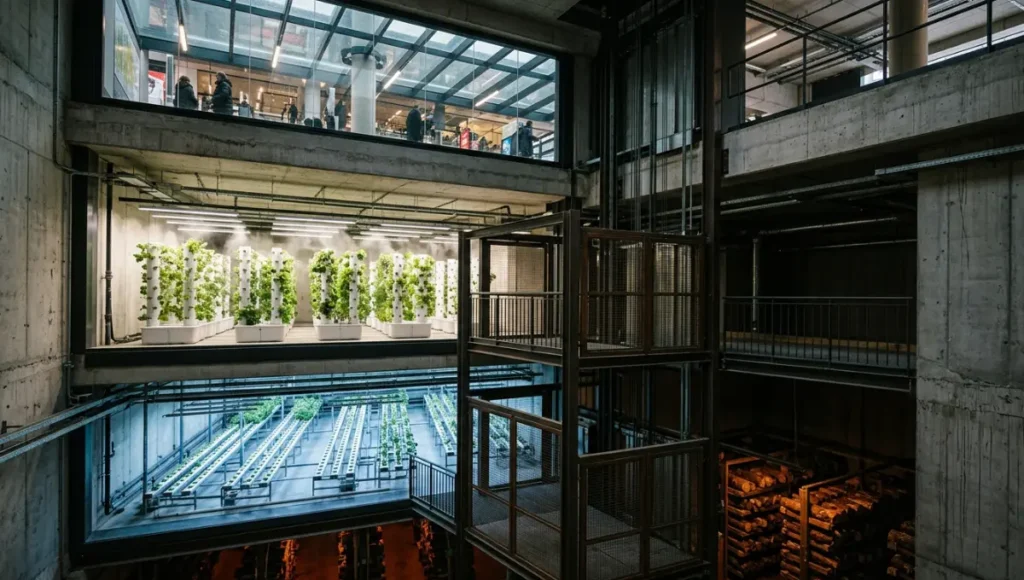
- Location: Rotterdam, Netherlands — integrated into the Blaak transit interchange and underground retail level
- Typology: Transit-Embedded Subterranean Agricultural Node
- Vision: To demonstrate that underground urban farming in cities is most economically viable when treated as an integrated civic layer of transit infrastructure — sharing HVAC, electrical, and logistics systems with the host building — rather than as a standalone agricultural facility
Design Levers Applied
Spatial Configuration
- 3 cultivation levels, each 800m2, stacked below the existing underground retail floor
- Level B1: Herb and microgreen production (highest yield per m2, shortest cycle, premium price point)
- Level B2: Leafy greens and baby vegetables (medium cycle, high volume, local supermarket supply chain)
- Level B3: Mushroom and pharmaceutical botanical cultivation (minimal light requirement, highest margin per kilo)
Technology Integration
- Full-spectrum tunable LED arrays: 400–700nm PAR, adjustable red/blue ratio per crop type
- Aeroponic delivery on Level B1 (mist-based, zero soil, 90% water reduction)
- Hydroponic NFT (Nutrient Film Technique) channels on Level B2
- Passive substrate cultivation chambers on Level B3 (mushroom logs, temperature-managed)
- Rotterdam municipal waste-heat loop integration: excess heat from Rotterdam’s district heating system diverted to maintain Level B3 temperature stability, reducing HVAC energy draw by an estimated 28%
- Digital twin: real-time IoT sensor mesh, predictive yield modelling, energy consumption dashboard accessible to Rotterdam municipal urban planning team
Logistics and Supply Chain
- Direct connection to Blaak market level: produce moves from harvest to retail in under 2 hours
- Electric cargo bike distribution hub integrated into Level B1 access corridor
- Zero cold chain requirement for Levels B1 and B2 produce — proximity eliminates refrigerated transport
Transferable Takeaway
The SubStrata Agri-Node demonstrates that the capital barrier for underground urban farming in cities drops significantly when the host infrastructure is shared. Rotterdam’s transit interchange provides structural shell, electrical capacity, HVAC pathways, and public access without a separate civil engineering project. The model is replicable in any city with a developed underground transit-retail-civic layer — which includes every city in this article’s case study portfolio. The design lever is not the agriculture. It is the infrastructure sharing agreement between the farm operator and the transit authority.
2030 Future Projection
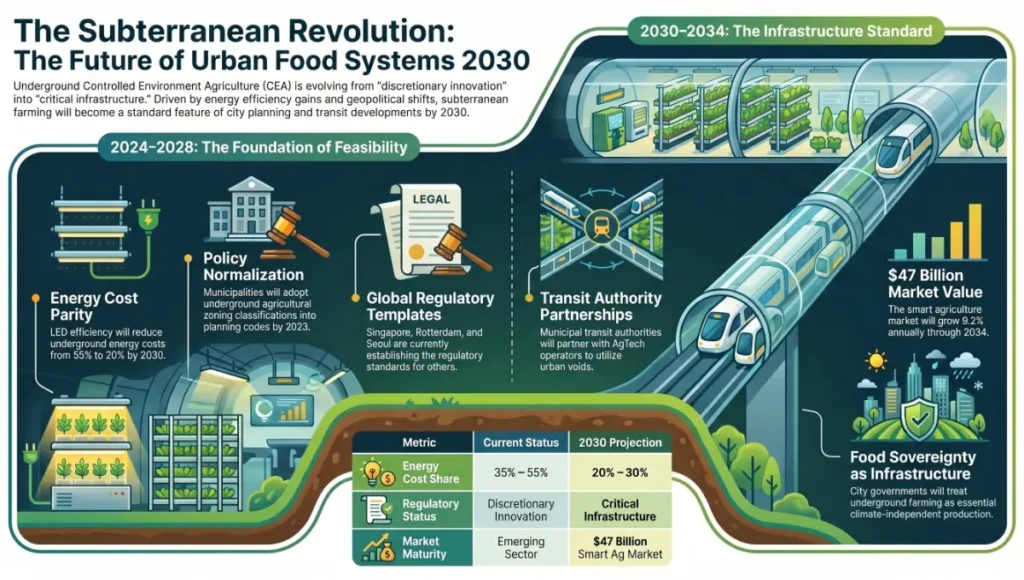
The Future of Urban Food Systems 2030
You are looking at a sector that is 5 years from becoming unignorable in city planning documents and 10 years from becoming standard in major transit-oriented development briefs. Here is what the trajectory indicates:
- Energy cost parity: LED efficiency is improving at a rate that will reduce the energy cost share of underground farm operations from the current 35–55% to an estimated 20–30% by 2030, restructuring the economic feasibility threshold
- Policy normalisation: Singapore, Rotterdam, and Seoul are establishing the regulatory templates that other cities will adopt — underground agricultural zoning classifications will appear in major municipal planning codes by 2027–2028
- Transit authority partnerships: the most scalable model will not be private underground farms but public-private joint ventures between municipal transit authorities (who own the voids) and agricultural technology operators (who run the systems)
- The smart agriculture market, valued at a compound annual growth rate of 9.2% through 2034 and projected to reach USD 47 billion, will increasingly direct capital toward underground CEA as the highest-density, most climate-independent production model
- Food sovereignty reframing: the geopolitical disruptions of 2020–2025 have permanently altered how city governments price food supply chain risk — underground urban farming will be treated as critical infrastructure, not discretionary innovation, in the next urban planning cycle
- Rotterdam, Amsterdam, and Copenhagen will likely be the first European cities to formally integrate underground farming nodes into their urban masterplans as civic infrastructure, citing climate adaptation and food security simultaneously
The 2030 convergence of underground and vertical production is already visible in how cities are approaching food-integrated building typologies. Our parallel analysis of urban farming skyscrapers maps the above-ground counterpart to this subterranean shift — together they define the full vertical spectrum of the metropolitan food system.
Comprehensive Technical FAQ
Q: Can underground farms realistically replace significant volumes of imported food?
A: At current technology and scale, no — and that is the wrong benchmark. Underground urban farming cities are not designed to replace global food trade. They are designed to build a resilient local supply layer for high-frequency, perishable produce — herbs, salads, microgreens, mushrooms — that currently incur the highest transport emissions and waste rates in the urban food chain. If a city can supply 15–25% of its fresh herb and baby leaf demand from within its own subterranean infrastructure, it has achieved a meaningful food security and emissions outcome without requiring a land area it does not have.
Q: How does underground farming perform on carbon emissions compared to conventional supply chains?
A: The comparison is context-dependent, but the direction is favourable for underground production when renewable energy is used. The primary emission category for underground farming is the electricity consumed by LED arrays. When powered by renewable energy sources — as Growing Underground committed to from its inception — the operational carbon footprint falls significantly below that of imported produce factoring transport, refrigeration, and packaging. The University of Wroclaw’s FOCUSE project (running February 2024 to January 2027) is building the most rigorous city-scale analysis of underground farm emissions within urban metabolism models.
Q: What crops are not viable underground?
A: Staple crops — wheat, rice, maize, legumes — are not viable in underground controlled-environment agriculture at any economically rational cost point. These crops require vast horizontal areas and produce low value-per-kilo returns that cannot offset the energy and capital costs of underground production. The underground farming value chain is currently confined to:
- High-value, fast-cycling crops: microgreens, baby leaf, herbs, edible flowers
- Non-photosynthetic crops: mushrooms, mycoprotein substrates
- Emerging pharmaceutical botanicals: regulated high-value cultivation
- Aquaponic integration: fish protein combined with hydroponic vegetable production in closed-loop systems
Q: How is water managed in underground farms?
A: Water management in underground CEA systems operates on closed-loop principles. In hydroponic and aeroponic configurations, nutrient-rich water is continuously recirculated through the growing system rather than being applied to open soil and lost to drainage or evaporation. This is the mechanism behind the 70–90% water reduction statistic. Underground environments also benefit from natural humidity stability, reducing the evaporative load that surface-level greenhouses must compensate for. Condensate recovery from HVAC systems can be recaptured and reintroduced into the irrigation loop, further reducing freshwater intake.
Q: What is a digital twin in the context of underground farming?
A: A digital twin is a real-time virtual model of the physical farm, built from continuous data feeds across an IoT sensor mesh monitoring temperature, humidity, CO2 concentration, light intensity, nutrient levels, and plant stress indicators. In the Growing Underground installation, Cambridge engineers built a digital twin that updates continuously from tunnel sensor data, enabling the farming team to optimise growing conditions without physical inspection and to simulate hypothetical second-farm configurations during the engineering and planning phase — dramatically reducing capital risk on new installations. This technology is the single most important enabler of underground farm scalability.
Q: Is underground urban farming economically viable without subsidy?
A: For premium-positioned produce sold into high-value restaurant and retail supply chains, yes — at current technology costs and with renewable energy access. For bulk commodity vegetable production, no — not without public subsidy, preferential energy tariff agreements, or shared-infrastructure arrangements that reduce capital and operational overheads. The cities moving fastest are those treating underground food infrastructure as a public utility investment comparable to water or transit — not requiring it to compete on pure commercial terms against externally subsidised agricultural imports. This is the correct policy frame.
The Cities That Go Deeper Will Eat Better
You can continue to plan cities from the surface up. You can argue that rooftop farms and urban agriculture districts represent sufficient ambition for the metropolitan food system. Or you can look at what seven cities on four continents are doing beneath your assumptions — and recognise that the next layer of urban resilience has already been excavated.
Underground urban farming in cities is not a marginal experiment. It is a convergence of food sovereignty policy, controlled-environment technology, transit infrastructure reuse, and circular energy design into a single spatial strategy that conventional urban planning frameworks have not yet learned to evaluate properly. That gap is closing, and the cities that close it fastest will hold a structural food security advantage that compounds over decades.
At Nuvira Space, we are mapping the subterranean frontier of the metropolitan food system — not because it is novel, but because it is necessary. The question is not whether underground urban farming belongs in your city’s infrastructure strategy. The question is which department is responsible for it, and whether they know yet.
© Nuvira Space All rights reserved. | URBAN PULSE Series | All specifications cited are based on published academic research (University of Wroclaw FOCUSE Project, 2024–2027; University of Cambridge Digital Twin Study, 2020), industry case data (Growing Underground, Singapore Food Agency, FAO Urban Agriculture Report 2024), and municipal planning documents from Singapore, Rotterdam, London, Tokyo, Seoul, Paris, Stockholm, and Montreal. The SubStrata Agri-Node is a speculative internal concept study and does not represent a completed project.