

walls. Get zone layouts, stair logic, lighting specs, and
acoustic tips for multi-level living.
Table of Contents
In the compressed verticality of the modern city, the question is not whether an open concept townhouse floor plan can be beautiful. It obviously can. The question is whether it can be biologically coherent across three stacked levels — and what happens to your cortisol, your sleep architecture, and your cognitive load when the answer is no.
Urban housing stock in cities like Amsterdam, Copenhagen, and Singapore has tested this question at scale for decades. The narrow-footprint, multi-story townhouse is the dominant form of attached urban dwelling across the northern hemisphere. Yet the open concept treatment of that typology remains poorly understood, applied by taste rather than physiology, and rarely evaluated through the lens of how spatial continuity affects the nervous systems of the people living inside it.
This article does not ask whether you like open concept design. It asks whether your body can thrive inside the specific version of it that a three-level townhouse demands — and gives you the analytical tools to answer that question for your own floor plan.
Nuvira Perspective
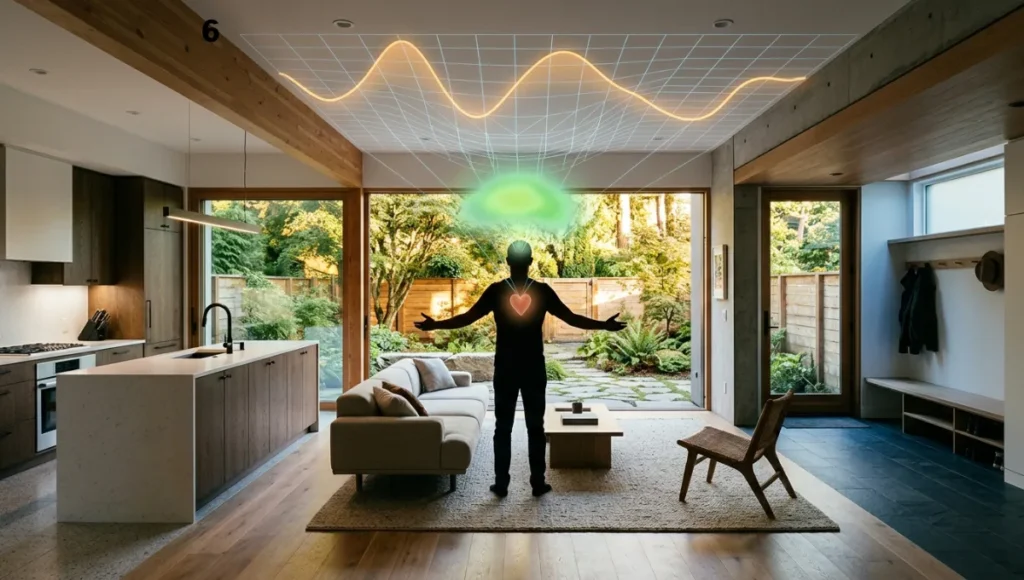
At Nuvira Space, we do not design rooms. We engineer physiological environments. The home, in our framework, is not a shelter or a status object — it is a health machine: a calibrated system in which every material decision, every sightline, and every transition between zones carries a measurable downstream effect on the biological state of its inhabitant.
The open concept townhouse floor plan sits at the intersection of our two central research vectors: modular adaptability and circadian synchronization. A layout that flows across three levels but fails to modulate light temperature by time of day is not an open plan — it is a biological liability. A layout that appears flexible but locks occupants into a single acoustic environment from kitchen to bedroom landing is not adaptable — it is a sensory trap.
What we are building at Nuvira Space is a framework for evaluating multi-level open layouts not by how they photograph, but by how they perform as human environments across a 24-hour biological cycle. This article is a window into that framework.
Technical Deep Dive
To evaluate whether an open concept townhouse floor plan works across three levels, you need to understand the three spatial-physiological systems that a vertical open layout puts under stress: the acoustic envelope, the circadian light path, and the cognitive load generated by visual complexity.
The Acoustic Envelope in Multi-Level Open Plans
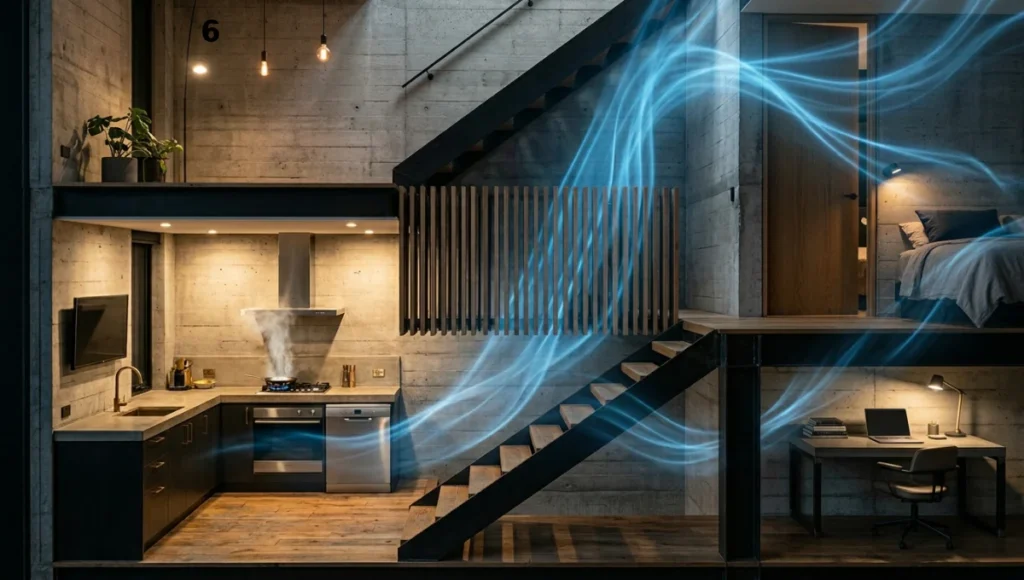
Sound in a single-story open plan disperses laterally. Sound in a three-level open plan stacks vertically. The staircase void — the most common feature linking levels in an open concept townhouse — functions as a direct acoustic shaft. Kitchen noise, media audio, and conversation generated at Level 1 travel upward through the stair opening at an attenuation rate of approximately 6–8 dB per open floor transition, compared to 20–25 dB for a fully walled and doored floor separation.
That difference is not aesthetic. It is neurological. Chronic low-level noise — the kind produced by a dishwasher or background television bleeding into a bedroom landing — activates the hypothalamic-pituitary-adrenal (HPA) axis even during sleep, elevating baseline cortisol and degrading slow-wave sleep architecture. In a poorly planned open concept townhouse floor plan, the bedroom on Level 3 is not separated from the kitchen below. It is acoustically connected to it.
Acoustic Specifications: Open Stair vs. Enclosed Stair
- Open riser staircase (glass balustrade): 6–8 dB attenuation per level
- Partial-open stair (closed base, open upper section): 10–13 dB attenuation per level
- Fully enclosed staircase (solid wall + door): 22–26 dB attenuation per level
- WHO residential night guideline (sleeping areas): ≤30 dB Leq
- Acoustic screen at Level 2 landing (40–50% void coverage): +5–7 dB additional attenuation
The Circadian Light Path
Circadian biology runs on light. The suprachiasmatic nucleus — your brain’s master clock — entrains to ambient light intensity and spectral composition across the day. In a correctly designed home, morning light is bright and blue-shifted (5,500–6,500K), midday light is neutral, and evening light is warm and dim (1,800–2,700K). Most homes deliver none of this intentionally.
In a three-level open concept townhouse floor plan, the light path is vertical. Front windows deliver morning light to Level 1. Rear skylights or clerestories (where they exist) illuminate upper levels. The spatial connection between floors means that the light environment on one level bleeds into adjacent zones — a benefit in the morning, a biological liability at night.
Circadian Light Specifications: Townhouse Context
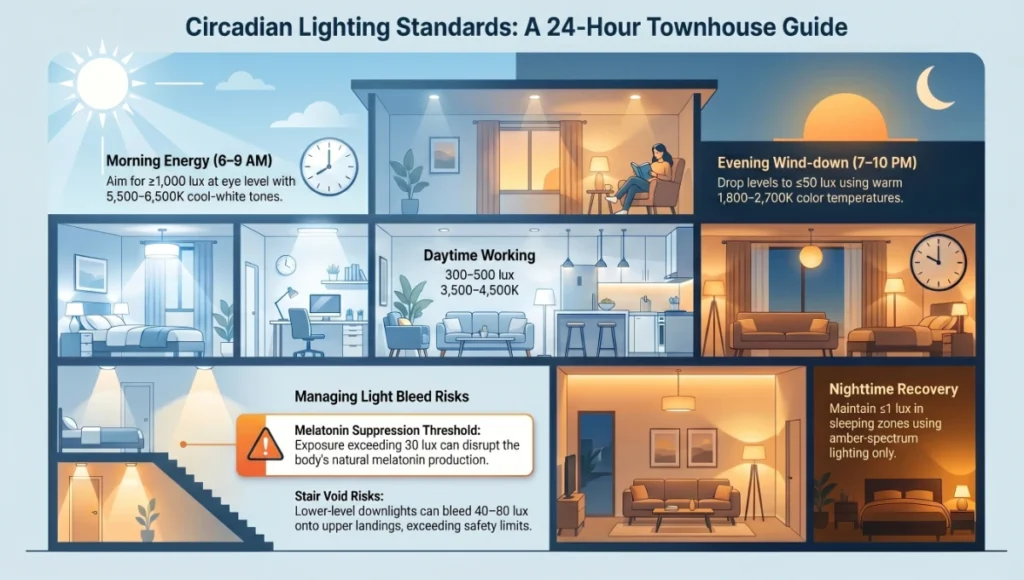
- Morning target (6–9 AM): ≥1,000 lux at eye level · 5,500–6,500K
- Daytime working target: 300–500 lux · 3,500–4,500K
- Evening wind-down target (7–10 PM): ≤50 lux · 1,800–2,700K
- Night (sleeping zones): ≤1 lux · amber-spectrum only
- Stair void light bleed risk: LED downlights at 300 lux on Level 1 can register 40–80 lux at Level 2 landing — above melatonin suppression threshold (30 lux)
Cognitive Load and Visual Complexity
Open plan design is frequently praised for its visual expansiveness. That expansiveness carries a neurological cost that goes largely undiscussed. The visual cortex processes every surface, object, and transition within its field of view simultaneously. In a well-zoned open plan, visual complexity is managed through spatial hierarchy: foreground, midground, background. Each zone reads as a distinct plane, reducing processing demand.
In a poorly zoned open concept townhouse floor plan — where kitchen clutter, living furniture, dining chairs, and the stair rail all compete for visual attention within a single 180-degree sweep — the cognitive load is measurably higher. Research from the Environmental Design Research Association indicates that occupants in visually unstructured open environments score 12–18% lower on sustained attention tasks and report higher perceived fatigue within 90 minutes of exposure.
The antidote is not more walls. It is deliberate sightline management: one primary visual anchor per zone, controlled depth layering, and a resolved background that terminates the sightline with a point of calm.
Comparative Analysis: Open Concept Townhouse vs. Industry Standard
The gap between what most multi-level open concept townhouses deliver and what the spatial-physiological evidence recommends is significant. Below is a direct comparison across four dimensions that matter most for occupant health and function.
Light Management
Industry Standard
- Single-circuit lighting per floor with no circadian scheduling
- LED downlights at uniform 3,000–4,000K regardless of time of day
- No consideration of stair void light bleed between levels
Nuvira Approach
- Zone-specific tunable LED systems (1,800K–6,500K, dimmable to 0.1%)
- Automated circadian scenes tied to local sunrise/sunset data
- Stair lighting on separate circuit — warm amber (2,200K) at night, inert during sleep hours
Acoustic Separation
Industry Standard
- Open riser staircase selected for aesthetics — 6–8 dB per level attenuation
- No acoustic treatment at level transitions
- Kitchen appliances specified by visual design, not operational dB rating
Nuvira Approach
- Partial-open stair with acoustic screen at Level 2 landing — 15–18 dB effective attenuation
- Dishwasher specification: ≤44 dB operational rating
- Range hood: ≥400 CFM, ducted to exterior — mandatory in open-plan kitchen context
- Layered rugs, upholstered furniture, and fabric panels as primary acoustic absorbers in Zone 2
Spatial Zoning
Industry Standard
- Single open volume on Level 1 — undefined transition between kitchen, dining, and living
- Furniture placed by intuition rather than zone logic
- No deliberate sightline management or visual anchor designation
Nuvira Approach
- Three distinct sub-zones within Level 1 open volume, each with dedicated floor material, rug, and lighting circuit
- Primary sightline terminated by a resolved natural anchor (rear garden, art wall, or planted feature)
- Island axis runs parallel to building width — never perpendicular — to preserve lateral circulation path
Concept Project Spotlight
Speculative / Internal Concept Study — Project Kronborg by Nuvira Space
Project Overview: Location / Typology / Vision
- Location: Copenhagen, Denmark — mid-terrace townhouse in the Østerbro district · 15.5 ft wide · 3 storeys · built 1910 · gutted to shell
- Typology: Attached urban row house · open concept main level · 2,100 sq ft total · 3 bed / 2 bath
- Vision: Demonstrate that a pre-war narrow-footprint townhouse can deliver circadian-calibrated, acoustically coherent open concept living across all three levels without sacrificing the spatial generosity that makes the typology desirable
Copenhagen was not selected arbitrarily. Denmark’s latitude (55.7°N) produces extreme seasonal light variation — more than 17 hours of daylight in June, fewer than 7 in December. This makes circadian light management not a luxury feature but a functional imperative. If a three-level open concept townhouse floor plan can be physiologically tuned for Copenhagen’s light envelope, it can be tuned for any northern city.
“Project Kronborg was designed to answer one question: can a 110-year-old urban townhouse become a 21st-century health machine? The answer, we found, is yes — but only if you treat the staircase as the building’s central nervous system rather than a circulation afterthought.” — Nuvira Space Design Notes
Design Levers Applied
Acoustic Architecture
- Partial-open staircase: closed timber base (risers 1–5 enclosed in cabinetry), open upper section with cable balustrade — effective attenuation: 14 dB per level transition
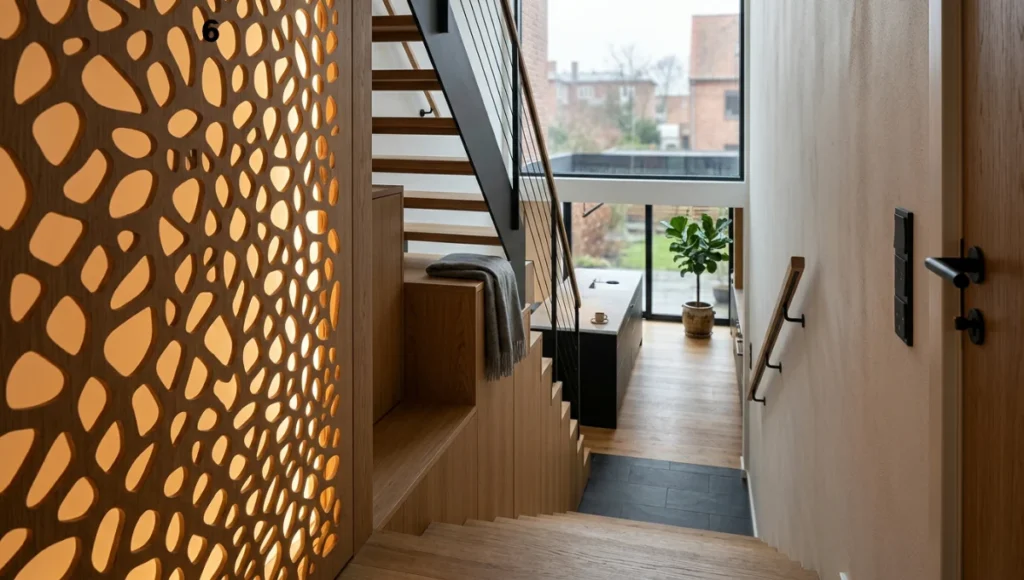
- Perforated oak acoustic screen at Level 2 landing: 50% void coverage · density 18 kg/m² · transmission loss: +6 dB
- Kitchen island on parallel axis, 18 ft from stair base — maximum acoustic distance within floor plate
- Dishwasher: Bosch Serie 8 (42 dB) · Range hood: Bora Pro ducted unit at 650 CFM — routed through rear wall
Circadian Light System
- Level 1 open zone: DALI-addressable LED track system · 1,800K–6,500K tunable · scene automation via Home Assistant with Copenhagen sunrise/sunset API feed
- Stair lighting: 2,200K amber striplight · motion-activated · dims to 5 lux after 10 PM
- Level 3 bedroom: blackout-rated glazing · zero ambient bleed from stair void (acoustic screen doubles as light baffle)
- South-facing rear glazing on Level 1: 2.4m × 2.1m double-height glass door — 1,200 lux at desk height on clear winter mornings
Spatial Zoning: Level 1
- Zone 1 Entry: 7 ft deep · slate tile floor (contrasts with oak throughout) · lowered ceiling soffit to 8 ft 2 in
- Zone 2 Living: 10 × 14 ft · 9.8 ft ceiling · 9 × 12 ft wool rug · floating sofa 16 in from rear wall
- Zone 3 Dining: 8 × 10 ft · 48 in round table · pendant at 31 in above surface
- Zone 4 Kitchen: parallel island · 15 in overhang · 2-seat casual eating on living side · quartz continuous with dining credenza
- Primary sightline: terminated by rear garden through full-height glazing — 22 ft uninterrupted depth
Transferable Takeaway
You can apply the same logic at home by tuning evening lighting to amber below 2,700K from 7 PM onward, building a refuge corner on your highest occupied level with sound-absorbing materials on at least two surfaces, and simplifying one primary sightline through your open plan toward a natural anchor — a window, a plant wall, or an uncluttered rear view — that gives your visual cortex a resting point within the open volume.
Intellectual Honesty: Current Limitations
The physiological case for a carefully calibrated open concept townhouse floor plan is strong. But three honest constraints deserve direct acknowledgment.
Cost of implementation. The tunable lighting, acoustic screening, and structural beam work required to execute a three-level open plan well adds $18,000–$40,000 to a standard renovation budget in most northern European and North American markets. This is not a minor premium. For buyers selecting a pre-planned townhouse from a developer’s catalog, these features are rarely available as standard.
Occupant behaviour variability. Circadian light automation is only as effective as its programming and the discipline of its users. A household that routinely uses Level 1 downlights at full brightness after 9 PM will negate the melatonin-protective design intent regardless of what the system is capable of. Technology cannot substitute for behavioural alignment.
Structural unpredictability. Pre-1970s attached townhouses frequently contain load-bearing walls in positions that conflict with open concept zone logic. Party wall conditions, chimney stacks, and mid-floor tie beams can make the preferred acoustic or spatial configuration structurally non-viable without engineering interventions that exceed most renovation budgets. Always commission a structural engineer’s report before any open plan conversion — budget $400–$800 for the assessment.
2030 Future Projection
By 2030, the open concept townhouse floor plan will not be evaluated by its square footage or its visual openness. It will be evaluated by its biosynchrony score — a composite metric assessing how well a residential layout supports circadian entrainment, acoustic recovery, and cognitive restoration across a 24-hour cycle.
Three technological shifts will make this evaluation routine rather than specialist:
- Embedded environmental sensing: Wall-integrated lux, decibel, and VOC sensors will produce real-time biological stress maps within each zone — available to homeowners and architects as standard building data by 2027 in markets following EU Green Deal residential standards.
- AI-driven spatial recommendation: Floor plan software will incorporate neuro-architectural parameters by default, flagging acoustic vulnerability, light path conflicts, and sightline complexity before a plan is built — not after.
- Material-integrated acoustic and thermal tuning: Electrochromic glazing with programmable tint (commercially available since 2024) will become standard in multi-level open plans, allowing circadian light modulation and acoustic dampening within the glass layer itself — eliminating the trade-off between openness and biological privacy.
The townhouse that delivers all three will not merely be desirable. It will be the only residential typology that a health-literate buyer will accept.
Actionable Design Principles
Whether you are designing from scratch or evaluating an existing open concept townhouse floor plan, these principles give you the analytical foundation to assess it honestly.
- Treat the staircase as an acoustic instrument, not a circulation afterthought. Its position, enclosure level, and material specification determine the acoustic relationship between every level in the building.
- Zone Level 1 into three distinct sub-zones with separate floor materials, rugs, and lighting circuits. Visual hierarchy reduces cognitive load. Separate lighting circuits enable circadian differentiation within the open plan.
- Specify appliances by decibel rating, not appearance. In an open plan kitchen, the dishwasher, range hood, and refrigerator compressor all contribute to the ambient acoustic environment of the adjacent living zone.
- Terminate every primary sightline with a resolved natural anchor. A rear garden, a framed artwork, or a planted wall — the visual cortex needs a resting point within an open volume to avoid sustained processing fatigue.
- Automate evening light reduction below 2,700K by 7 PM minimum. This single intervention is the highest-return circadian health action available in a residential context — cost-effective, reversible, and biologically significant.
- Audit the stair void for light bleed before finalising the upper level bedroom position. A bedroom landing that receives 40+ lux from Level 1 downlights at 11 PM is not a sleeping zone — it is a melatonin suppression zone.
Comprehensive Technical FAQ
Q: Is an open concept townhouse floor plan suitable for families with children across 3 levels?
A: Yes, with specific acoustic mitigation. The critical intervention is the stair enclosure level. A partial-open stair with acoustic screen at Level 2 landing delivers 14–18 dB attenuation per level — sufficient to bring Level 3 bedroom ambient noise below WHO’s 30 dB Leq night guideline even when Level 1 kitchen and media are in active use. Without that mitigation, children’s sleep quality on the upper level will be directly compromised by Level 1 activity.
Q: What is the minimum width for a three-level open concept townhouse floor plan to function without feeling claustrophobic?
A: The functional minimum sits at 15 ft 6 in (4.7 m) clear interior width after party wall and structural framing. Below that threshold, the parallel island kitchen configuration — the only orientation that preserves lateral circulation — becomes too narrow to accommodate a 48-inch dining table without blocking the main flow path. Townhouses between 14 ft and 15 ft 6 in should use a peninsula rather than an island, and consider a rear-loaded kitchen to maximise living depth.
Q: How do I manage cooking odours in an open concept kitchen without walls to contain them?
A: Ventilation specification is the primary tool, not architecture. Minimum recommendations:
- Range hood extraction: ≥400 CFM, ducted to exterior
- Duct routing: Through rear wall or roof — not recirculated through charcoal filter (insufficient for open plan volume)
- Supplementary: HEPA air purifier in living zone · flow rate ≥300 m³/hr · positioned between kitchen and primary seating
Q: Can I convert an existing walled three-level townhouse to an open concept layout?
A: Yes, but three assessments must be completed before any design work begins:
- Structural survey: Identify load-bearing walls. In pre-1970s attached townhouses, the central spine wall is almost always structural — budget for LVL beam replacement ($4,500–$9,000 installed for a standard 16 ft span)
- Services mapping: Identify gas, electrical, and plumbing runs within walls proposed for removal
- Acoustic baseline: Measure ambient noise levels on each floor before opening the plan — this establishes the attenuation you are trading away and helps specify compensating interventions
Q: What flooring strategy works best for zoning an open concept townhouse floor plan without walls?
A: The most spatially effective strategy uses a base material throughout (engineered oak or large-format stone tile) with deliberate directional variation or material shifts at zone transitions:
- Entry zone: Contrasting material (slate, terrazzo, or porcelain tile) — signals zone boundary without a step or wall
- Kitchen sub-zone: Same base material as living, but board direction rotated 90° — subtle visual separation without material cost premium
- Living sub-zone: 8 × 10 ft minimum rug in wool or natural fibre — primary acoustic absorber and visual zone anchor
Q: How does the open concept affect resale value in urban townhouse markets?
A: Open concept townhouse floor plans consistently outperform comparable closed-plan units in urban resale markets, but the margin varies significantly by execution quality. A well-zoned, acoustically competent open plan commands a 7–12% premium over a comparable closed-plan townhouse in high-density urban markets (London, Amsterdam, Melbourne). A poorly executed open plan — one with acoustic bleed, undefined zones, and inadequate ventilation — can trade at parity or below, as buyers increasingly recognise the difference between openness as aesthetics and openness as a functional living system.
Design Your Space with Intention
The open concept townhouse floor plan is not a style decision. It is a biological one. When designed with acoustic intelligence, circadian light logic, and deliberate spatial hierarchy, it becomes one of the most human-centric residential configurations available in the urban typology. When designed by aesthetics alone, it becomes a source of chronic low-grade physiological stress that accumulates across years of daily inhabitation.
You now have the framework to tell the difference — and to ask the right questions of any floor plan you are designing, selecting, or living inside.
At Nuvira Space, we build living environments that perform for the people inside them — not just for the camera. If your current or planned townhouse layout has acoustic exposure, light bleed risk, or undefined zone logic, we want to hear about it.
© Nuvira Space All rights reserved. | LIVING SPACES Series | All specifications cited are based on peer-reviewed environmental psychology literature, WHO Environmental Noise Guidelines for the European Region (2018), CIBSE Lighting Guide LG10, and published circadian biology research including studies from Harvard Medical School (Czeisler et al.) and the University of Oxford (Foster et al.). The Project Kronborg is a speculative internal concept study and does not represent a completed project.