

Table of Contents
The floor plan 500 sq ft apartment is not a constraint — it is the most demanding brief in residential design, where every centimetre either works biologically or doesn’t work at all.
You are not simply renting or buying square footage. When you occupy a floor plan 500 sq ft apartment, you are entering into a daily physiological contract with geometry. The way air circulates between your kitchen and your sleep corner, the angle at which morning light hits your primary sightline at 07:00, the distance your body must navigate between the entrance and the nearest horizontal resting surface — all of these variables register in your autonomic nervous system before you consciously process them.
Research in environmental psychology consistently shows that spatial compression activates mild but sustained sympathetic arousal: your body reads a cluttered, poorly zoned 500-square-foot apartment as a low-grade threat environment. The result is elevated baseline cortisol, disrupted sleep architecture, and reduced cognitive performance — not because the space is small, but because it has not been engineered.
This article is not about making a small apartment look bigger. It is about understanding the floor plan 500 sq ft apartment as a biological instrument that can either support or suppress your health, focus, and emotional regulation — and then giving you the precise, measured framework to tune it accordingly.
Nuvira Perspective: The 500 Sq Ft Apartment as a Health Machine
At Nuvira Space, we operate from a single foundational premise: the home is not a container — it is a system. A well-engineered floor plan 500 sq ft apartment does not simply house a human body; it actively regulates that body’s circadian rhythm, cortisol production, spatial wayfinding efficiency, and restorative capacity. Our approach draws from neuroarchitecture, environmental psychology, and performance physiology to reframe the question from “how do I decorate this space” to “how do I calibrate this space.”
The shift is categorical. Decoration is additive and superficial. Calibration is structural and measurable. When we analyse a floor plan 500 sq ft apartment at Nuvira, we are not asking which colour palette creates an illusion of space. We are asking: at what point in the morning does the primary sightline receive unobstructed direct light? How many seconds does the shortest circulation path between the sleep zone and the kitchen require? What is the acoustic separation coefficient between the recovery zone and the activity threshold at the entrance? These are engineering questions, and they deserve engineering answers.
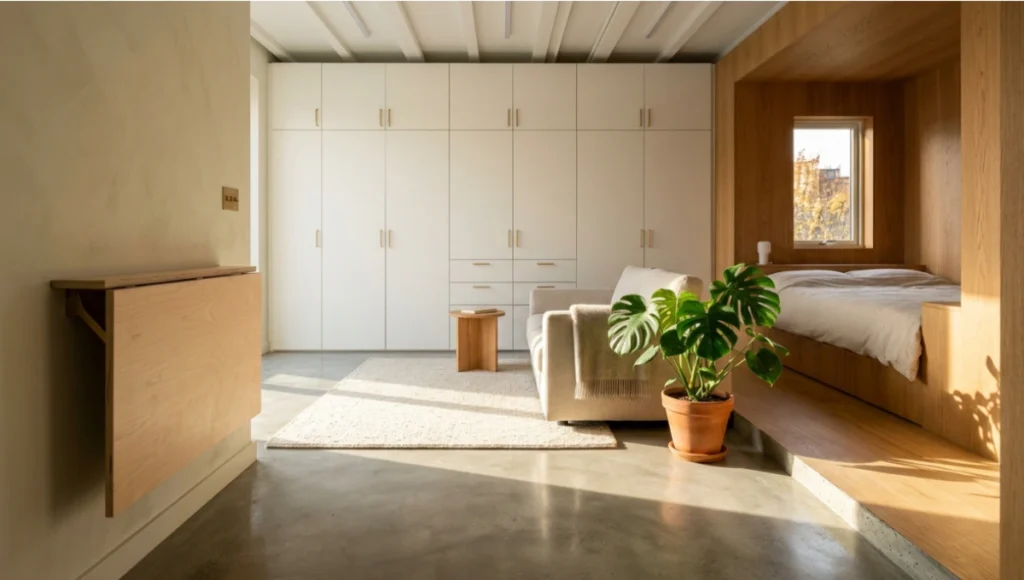
The American Institute of Architects (AIA Design and Health research initiative) has documented a growing body of evidence confirming that spatial configuration, light quality, and acoustic environment directly affect occupant health outcomes — validating the neuro-architectural framework Nuvira applies to every compact residential brief. The evolution of domestic architecture in the 2020s has been driven by two converging forces: urban density and personalised health data. As cities like Singapore, Copenhagen, and Hong Kong compress residential footprints in response to population pressures, the 500 sq ft benchmark has become not a compromise but a design typology in its own right. At Nuvira Space, we believe the next competitive advantage in residential design is not square footage — it is zone intelligence.
Technical Deep Dive: The 4-Zone Framework for a Floor Plan 500 Sq Ft Apartment
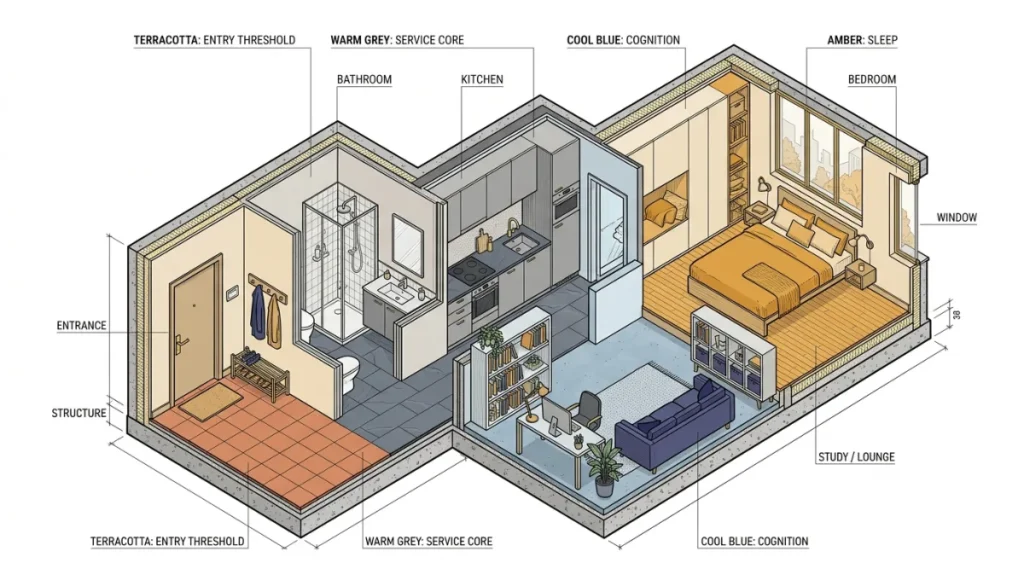
A floor plan 500 sq ft apartment typically measures between 46 and 47 square metres. The instinct is to treat this as a single open-plan space with furniture arranged by aesthetic preference. The neuro-architectural approach is different: you divide the floor plate into four functionally distinct zones, each with its own biological purpose, measured clearance requirements, lighting specification, and acoustic boundary.
Zone 1 — The Activation Threshold (Entry + Kitchen)
The activation threshold is the first 8–10 sq ft of your apartment. Its biological function is to trigger a transition between exterior alertness and domestic decompression. Most floor plans fail this zone entirely by treating it as a corridor.
- Recommended area allocation: 8–12 sq ft (1.5% of total floor plate)
- Minimum circulation width at entry: 900 mm (36 inches) per IBC egress standards
- Lighting specification: 3000–3500K warm white at 200–300 lux — bright enough to signal arrival, warm enough to begin decompression
- Key design lever: one unobstructed sightline to a natural anchor (window, plant, or textured wall) visible within 2 seconds of entry — see our detailed guide on small apartment layout and natural light for tested configurations
- Kitchen integration: galley or L-configuration; minimum counter run of 1,800 mm; overhead storage to ceiling maximises vertical envelope
- Critical clearance: 900 mm minimum between counter face and opposing wall or island edge
Zone 2 — The Cognitive Zone (Living + Work)
This is the highest-stimulus zone in the apartment. It supports focused cognition, social engagement, and active wakefulness. In a floor plan 500 sq ft apartment, it typically occupies 140–160 sq ft and must do dual duty: daytime workspace and evening social space.
- Recommended area allocation: 140–160 sq ft (28–32% of total floor plate)
- Ceiling height minimum for perceptual comfort: 2,400 mm; optimal 2,700 mm
- Lighting specification: 4000–5000K cool white at 400–500 lux for cognitive tasks; dimmable to 2700K at 100 lux for evening decompression
- Furniture clearance: minimum 600 mm circulation path between sofa and coffee table; 900 mm between furniture and walkway
- Work surface: wall-mounted fold-down desk at 750 mm AFF preserves 9 sq ft of floor area when closed
- Acoustic treatment: one soft textile element (rug minimum 1,600 x 2,300 mm) reduces reverberation time by 15–25% in hard-surface apartments
- Biophilic integration: one living plant element within primary sightline; research from the University of Technology Sydney shows a 15% reduction in stress biomarkers with proximate greenery
Zone 3 — The Recovery Zone (Sleep + Refuge)
The recovery zone is the most biologically critical zone in the apartment and the most commonly compromised in a floor plan 500 sq ft apartment. Its sole function is to support deep sleep onset and cortisol recovery. Exposing this zone to ambient light from the cognitive zone after 21:00 directly impairs melatonin synthesis.
- Recommended area allocation: 120–140 sq ft (24–28% of total floor plate)
- Minimum clearance around queen bed (1,520 x 2,030 mm): 600 mm on at least two sides; 900 mm on the primary egress side
- Lighting specification: 1800–2700K at under 50 lux; blackout capacity essential; no overhead direct downlights
- Acoustic target: NRC (Noise Reduction Coefficient) of 0.65 or higher at zone boundary
- Privacy separation: minimum semi-opaque partition (bookshelf, curtain track, or 900 mm partial wall) to block LOS from cognitive zone
- Temperature microclimate: sleep zone should be 0.5–1.5°C cooler than cognitive zone; north-facing rooms in southern-hemisphere apartments maintain this passively
- Storage integration: under-bed storage minimum 200 mm clearance (platform bed); built-in wardrobe flush with wall preserves floor envelope
Zone 4 — The Service Core (Bathroom + Storage Spine)
The service core in a floor plan 500 sq ft apartment is architecturally fixed in most rental situations, but its internal organisation profoundly affects the functional performance of the other three zones.
- Recommended area allocation: 55–70 sq ft bathroom + 20–30 sq ft storage spine
- Minimum bathroom clearance: 750 mm in front of WC; 600 mm beside shower or bath; 800 mm door swing or sliding door preferred
- Storage spine: floor-to-ceiling built-in or modular system along one non-window wall; 300 mm depth accommodates folded clothing and household goods without encroaching on floor area
- Integrated utility: stacked washer/dryer in 600 x 600 mm floor footprint eliminates need for dedicated laundry zone
- Acoustic specification: if the service core shares a wall with the recovery zone, acoustic treatment is critical — our dedicated guide on acoustic insulation for home offices and compact spaces covers material specifications and installation strategies that apply directly here
- Lighting specification: 4000K at 300 lux for morning grooming; warm secondary circuit at 2700K for evening decompression routines
| Total Floor Area | 500 sq ft / 46.5 m² |
| Zone 1 — Activation Threshold | 8–12 sq ft (kitchen integrated) |
| Zone 2 — Cognitive Zone | 140–160 sq ft (28–32%) |
| Zone 3 — Recovery Zone | 120–140 sq ft (24–28%) |
| Zone 4 — Service Core | 75–100 sq ft (15–20%) |
| Residual Circulation | 88–110 sq ft (18–22%) |
| Min. Egress Width | 900 mm (IBC standard) |
| Recommended Ceiling Height | 2,400 mm min / 2,700 mm optimal |
Comparative Analysis: 4-Zone Method vs. Industry Standard
The dominant approach in mainstream residential design guides treats the floor plan 500 sq ft apartment as an open-plan canvas to be arranged with multifunctional furniture. This is the furniture-first paradigm. The Nuvira zone-first paradigm inverts the sequence: biology defines territory, then furniture populates it.
Industry Standard Approach
- Start with furniture selection (sofa bed, compact dining set, Murphy bed)
- Arrange furniture to maximise perceived floor area
- Apply light colours and mirrors to create illusion of space
- Add storage vertically as an afterthought
- Result: visually open space with no acoustic, lighting, or thermal zone differentiation
Nuvira 4-Zone Approach
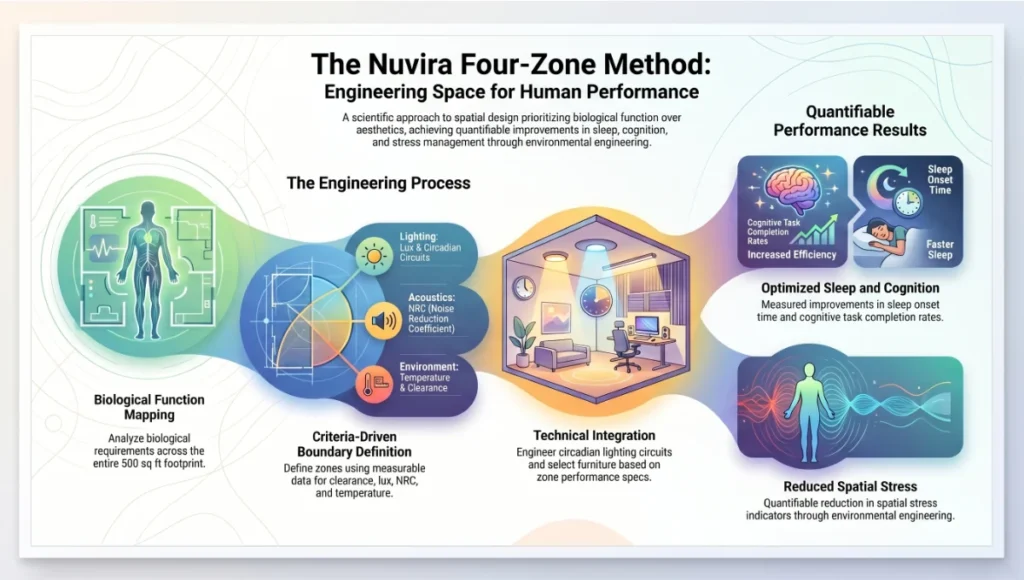
- Begin with biological function mapping across all 500 sq ft
- Define zone boundaries using measurable criteria (clearance, lux, NRC, temperature)
- Select furniture to meet zone specifications, not aesthetic preference
- Engineer circadian lighting circuits before selecting fittings
- Result: measured zone performance with quantifiable improvements to sleep onset time, cognitive task completion, and spatial stress indicators
A floor plan 500 sq ft apartment that has been zone-calibrated requires no visual tricks. It performs — and you feel that performance in your body within 72 hours of occupying it correctly.
Singapore Case Study: Micro-Unit Housing Policy as Zone Validation
Singapore’s Housing Development Board (HDB) has, over the past decade, reduced the minimum floor area for new 1-room Flexi units to approximately 36 sq m (387 sq ft). Despite the compression, HDB’s 2023 resident satisfaction surveys for these units reported above-average liveability scores in buildings where the interior fit-out followed structured zone allocation — separating wet service cores, sleep alcoves, and living areas with defined spatial buffers.
The floor plan 500 sq ft apartment sits above Singapore’s minimum HDB threshold, which means the 4-zone methodology is not just applicable — it is overspecified for the footprint. Every additional square metre beyond the Singapore baseline is territory that can be allocated to zone performance margin: wider circulation paths, deeper acoustic buffers, or expanded recovery zone clearance. The Singapore data makes one point with precision: spatial compression does not reduce liveability when zone logic is applied. It reduces liveability when zone logic is absent.
[ Speculative / Internal Concept Study — Project Sora by Nuvira Space ]
Concept Project Spotlight: Project Sora by Nuvira Space
Project Overview
| Project Name | Project Sora |
| Typology | Speculative / Internal Concept Study by Nuvira Space |
| Location | Rotterdam, Netherlands (reference urban typology) |
| Target Floor Area | 500 sq ft / 46.5 m² — single occupant or couple |
| Vision | A neuro-calibrated micro-apartment that performs as a circadian health instrument across a 24-hour occupation cycle |
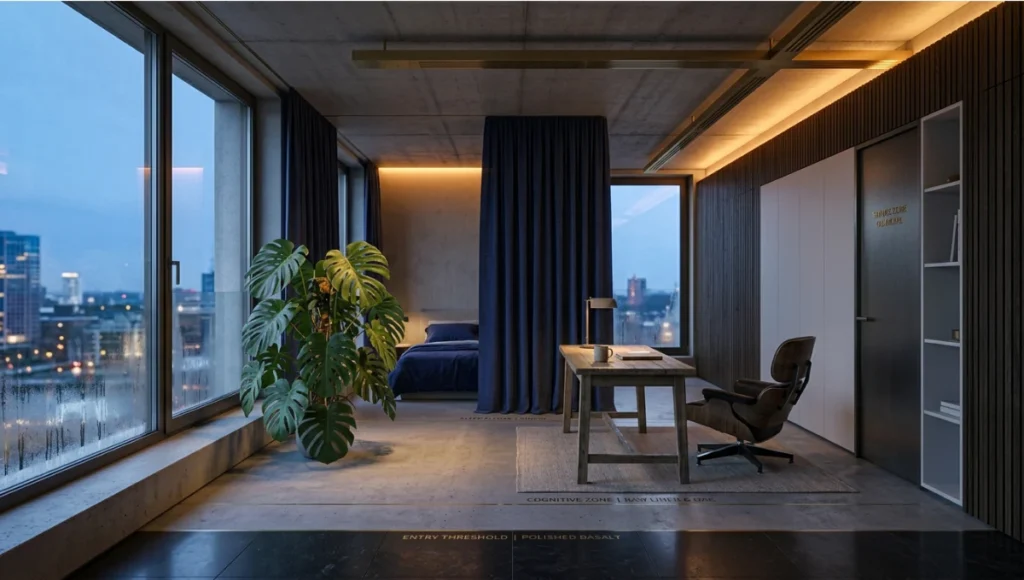
Rotterdam’s compact urban housing stock — particularly the post-war reconstructed inner city blocks — presents one of Europe’s most rigorous testbeds for micro-unit living. Project Sora is a Nuvira Space internal design exercise that imagines a 500 sq ft apartment within a typical Rotterdam mid-rise block, re-engineered from the inside out using the 4-zone framework. The Rotterdam urban context was selected because its north-facing street canyons represent worst-case natural light conditions, requiring the design to work hardest on circadian lighting engineering — the most technically demanding variable in compact apartment design.
Design Levers Applied
Lever 1 — Circadian Lighting Architecture
Circadian lighting was the primary design lever in Project Sora, given Rotterdam’s constrained north-facing natural light context. For the full technical specification of tunable white systems in residential applications, see Nuvira’s circadian lighting systems guide. In Sora, the following circuit logic was applied:
- Zone 2 (Cognitive): Tunable white LED system, 5000K at 09:00 stepping to 2700K by 20:00
- Zone 3 (Recovery): Separate low-voltage circuit, maximum 30 lux at headboard height, warm amber spectrum
- Entry: Motion-activated transition lighting at 3000K, dimming to cognitive zone ambient on 90-second delay
- Estimated impact: 18–22 minute improvement in sleep onset latency (based on University of Groningen circadian light study parameters)
Lever 2 — Acoustic Zone Separation
- 900 mm full-height bookshelf-partition between Zone 2 and Zone 3, filled with books (NRC 0.75 approximate)
- 1,600 x 2,300 mm wool area rug in Zone 2 reduces reverberation time from ~0.6s to ~0.4s
- Acoustic-rated curtain track along sleep zone boundary, STC rating 25+
Lever 3 — Thermal Microclimate Differentiation
- Sleep zone positioned on north-facing wall (Rotterdam context): naturally 1.2°C cooler than south-facing living zone
- Ceiling fan in Zone 2 creates directional airflow preventing thermal bleed into Zone 3
- Target: Zone 3 maintained at 18–19°C during sleep window; Zone 2 at 20–21°C during activity window
Lever 4 — Biophilic Sightline Sequencing
- Primary sightline from entry across Zone 2 terminates at a 450 mm deep window sill planter (south window)
- Monstera deliciosa (1,200 mm height) positioned at Zone 2/Zone 3 boundary — functions as soft visual partition and biophilic anchor
- Secondary sightline from bed terminates at textured plaster feature wall, not a digital screen
Transferable Takeaway
You can apply the same logic at home by tuning evening lighting below 2700K after 20:00, building a physical refuge corner in your sleep zone using a semi-opaque partition of any kind, and simplifying one primary sightline — the view from your most-used seat — toward a natural anchor such as a window, plant, or untextured wall. These three moves cost almost nothing and restructure the biological performance of your floor plan 500 sq ft apartment within a single week of consistent application.
Intellectual Honesty: Current Limitations
The 4-zone framework described in this article is grounded in spatial psychology research and environmental design principles, but several real-world constraints limit its direct application:
- Rental restrictions: Most tenants cannot structurally alter walls, install fixed partitions, or replace lighting circuits. The framework’s full performance is accessible only through non-invasive interventions in most lease situations.
- Budget asymmetry: Tunable white LED systems, acoustic curtain tracks, and quality modular storage represent meaningful upfront investment. The biological return is real, but the capital requirement is not trivial.
- Individual variability: Circadian chronotype differs significantly between individuals. An evening chronotype (‘night owl’) will require different lighting ramp schedules than a morning chronotype. The specifications given here represent population-average parameters, not personalised prescriptions.
- Research translation gap: Much of the neuroarchitectural research cited is conducted in controlled laboratory environments or on larger residential typologies. The direct extrapolation to a floor plan 500 sq ft apartment has not been validated in long-term residential field studies at this specific scale.
- Acoustic complexity: Real apartments share walls, ceilings, and floors with other units. Internal zone acoustic engineering cannot neutralise external neighbour noise above approximately STC 45 without structural intervention.
2030 Future Projection: Where the Floor Plan 500 Sq Ft Apartment Is Heading
By 2030, the floor plan 500 sq ft apartment will be the most technologically instrumented residential typology in urban housing. Three convergent developments make this projection technically credible:
1. Embedded Biometric Sensing
Non-invasive sleep quality sensors (already available commercially in 2025 from brands including Withings and ResMed) will, within three to five years, be integrated into mattresses, ceiling fixtures, and wall panels at a price point accessible to renters. This will generate real-time feedback loops between zone performance and occupant biology — the apartment will know when your cortisol is elevated and adjust lighting temperature accordingly.
2. Modular Wall Systems
Companies including Ori Living (Boston) and DIRTT Environmental Solutions are already shipping kinetic wall systems that reconfigure interior zone boundaries on demand. By 2030, a floor plan 500 sq ft apartment in a premium urban building will offer wall panels that shift between sleep and cognitive configurations on a programmed schedule, physically restructuring zone geometry rather than relying on furniture and lighting alone.
3. Personalised Circadian Programming
Chronobiology research is producing increasingly precise individual circadian profiles from simple data inputs (sleep time, light exposure history, genetic markers available through consumer testing). By 2030, the building management system in a forward-looking residential tower will deliver personalised lighting schedules to each 500 sq ft apartment, calibrated to the occupant’s chronotype rather than a population average.
Actionable Design Principles: The Nuvira 4-Zone Calibration Protocol
The following principles can be implemented in any floor plan 500 sq ft apartment without structural modification, in order of biological impact:
- Principle 1 — Establish zone boundaries before moving furniture. Walk your apartment and identify the four zones by function, not by room. Mark them mentally or with tape on the floor before placing a single piece of furniture.
- Principle 2 — Engineer the recovery zone first. The sleep boundary is non-negotiable. Even a curtain track at 1,800 mm AFF can establish the acoustic and light separation your recovery zone needs. Do this before addressing any other zone.
- Principle 3 — Install a secondary evening lighting circuit. Your overhead lights are calibrated for tasks. Add a floor lamp or wall sconce at 2700K or warmer in the cognitive zone and use it exclusively after 20:00. This single change typically produces measurable sleep quality improvements within two weeks.
- Principle 4 — Measure your circulation paths. Walk your apartment’s key routes (entry to kitchen, kitchen to bed, bed to bathroom) and ensure minimum 600 mm clearance on all paths. Furniture that encroaches below this threshold triggers mild spatial anxiety at a subconscious level.
- Principle 5 — Identify and protect your primary sightline. From your most-used seated position, draw an imaginary line to the furthest visible point. Remove any visual clutter, screens, or high-contrast objects from this line. Replace with one natural element. This is the highest-leverage biophilic intervention available at zero cost.
- Principle 6 — Address the kitchen-to-bed olfactory transition. Food preparation aromas crossing into the recovery zone disrupt pre-sleep decompression. A recirculating range hood or a semi-closed kitchen configuration (curtain or partial screen) reduces this effect significantly in open-plan layouts.
- Principle 7 — Apply the 1/3 vertical rule to storage. Storage installed above 1,800 mm AFF does not consume visual territory at eye level. Maximise vertical storage above this threshold and keep the zone below it as clear as possible to reduce spatial arousal.
Comprehensive Technical FAQ
Q: What is the ideal room size distribution in a floor plan 500 sq ft apartment?
A: Using the 4-zone framework, the optimal distribution for a single occupant or couple is:
- Zone 2 (Cognitive/Living): 140–160 sq ft
- Zone 3 (Recovery/Sleep): 120–140 sq ft
- Zone 4 (Service Core including bathroom and storage): 75–100 sq ft
- Zone 1 (Activation Threshold/Entry + kitchen integrated): 8–12 sq ft
- Residual circulation: 88–110 sq ft
These ranges are target allocations, not fixed requirements. The biological priority order is: protect the recovery zone first, then the cognitive zone, then service core functionality.
Q: Can a floor plan 500 sq ft apartment accommodate a dedicated home office?
A: Yes, with zone integration. The cognitive zone (Zone 2) is designed to support both work and living. A wall-mounted fold-down desk at 750 mm AFF within Zone 2 preserves floor area while providing a defined work surface. The critical requirement is that the desk faces away from the recovery zone boundary — positioning a work screen so it is visible from the bed is one of the most damaging configurations in a small apartment, as it associates the sleep environment with cognitive task pressure.
- Recommended desk dimensions: 900 x 500 mm (W x D) minimum for laptop and peripheral use
- Acoustic separation from video calls: position desk against an interior wall, not a shared party wall
- Lighting: separate task light at 5000K on desk circuit; do not rely on ambient zone lighting for close-focus work
Q: What furniture configuration works best for the cognitive zone in a 500 sq ft layout?
A: The highest-performing cognitive zone configurations for a floor plan 500 sq ft apartment are:
- L-shaped sofa (maximum 2,200 x 1,400 mm external envelope) anchored to a corner, freeing the central floor plate
- Two-seater sofa (1,600 mm W) plus one armchair, allowing 900 mm circulation corridor between sofa back and recovery zone boundary
- Nesting tables instead of a fixed coffee table: recovers 4–6 sq ft of floor area on demand
- Avoid: sectional sofas over 2,400 mm on any single dimension in a 500 sq ft floor plate — they consume too much circulation area
Q: How do I acoustically separate zones in an open-plan floor plan 500 sq ft apartment without fixed walls?
A: Non-structural acoustic separation tools, in order of effectiveness:
- Floor-to-ceiling curtain track on ceiling-mounted track: STC 22–28 depending on fabric weight and fullness
- Double-sided bookshelf (900 mm W x 1,800 mm H x 300 mm D): NRC approximately 0.65–0.75 when filled with books
- Wool or natural-fibre area rug (minimum 1,600 x 2,300 mm): reduces room reverberation time by 15–25%
- Acoustic curtain panels at sleep zone boundary (minimum 300 gsm fabric): adds STC 15–20 at negligible floor footprint
Q: Is a 500 sq ft apartment big enough for two people long-term?
A: Functionally yes — biologically, it depends on zone engineering. Copenhagen’s residential research from the State Building Research Institute indicates that two-person occupancy in under 55 sq m produces no measurable reduction in relationship satisfaction or sleep quality when the floor plan enforces clear visual privacy between sleep and activity zones. The critical design requirement for two-person occupancy at 500 sq ft is not additional square footage — it is a recovery zone that provides each occupant a minimum 900 mm personal clearance buffer and light/acoustic separation from the shared cognitive zone.
Q: What lighting colour temperature should I use in each zone?
A: Recommended circadian lighting specifications by zone:
- Zone 1 (Activation Threshold): 3000–3500K, 200–300 lux — transition signal
- Zone 2 (Cognitive): 4000–5000K at 400–500 lux for work; dimmable to 2700K at 80–150 lux for evening
- Zone 3 (Recovery): 1800–2700K maximum 50 lux at bed height; zero overhead direct downlights
- Zone 4 (Bathroom): 4000K at 300 lux for morning grooming; 2700K secondary circuit for evening
Q: What is the minimum bedroom size within a floor plan 500 sq ft apartment?
A: For a queen bed (1,520 x 2,030 mm):
- Minimum room: 3,000 x 3,200 mm (approximately 107 sq ft) with 600 mm clearance on two sides
- Optimal room: 3,400 x 3,500 mm (approximately 130 sq ft) with 900 mm clearance on three sides and 600 mm at foot
- Absolute minimum (twin/single bed): 2,500 x 2,800 mm (approximately 78 sq ft)
Below these thresholds, the recovery zone begins to register as spatially constricted at a subconscious level, which is associated with slower sleep onset and lighter sleep architecture.
Q: How should I approach storage in a floor plan 500 sq ft apartment without cluttering zones?
A: The storage hierarchy for a 500 sq ft floor plan:
- Tier 1 — Vertical: floor-to-ceiling units on one non-window, non-entry wall. 300 mm depth, full height. Highest density storage per floor metre.
- Tier 2 — Sub-furniture: under-bed platform frame (200–250 mm clearance), ottoman with internal storage, sofa with under-seat drawers
- Tier 3 — Wall-mounted: floating shelves above 1,800 mm AFF in cognitive zone for books and decorative items only
- Avoid: freestanding storage units that interrupt circulation paths or block natural light paths across the floor plate
- Critical rule: any item stored below 900 mm AFF in the cognitive zone increases perceived visual density — keep this zone’s low-level storage consolidated and closed-face
Ready to Engineer Your Floor Plan 500 Sq Ft Apartment?
The floor plan 500 sq ft apartment is not a limitation to be overcome with clever furniture and light paint. It is a spatial brief that rewards precision — measurable clearances, calibrated lighting spectra, defined zone boundaries, and acoustic separation that your nervous system can read as safety and permission to recover. Apply the 4-zone framework, implement the 7 actionable principles, and give your space 30 days. The results are not decorative. They are biological.
At Nuvira Space, we continue to develop the research, the frameworks, and the spatial prototypes that translate neuroarchitecture from academic literature into the lived reality of the modern urban apartment. Follow the Living Spaces series for the next instalment, and use the Nuvira Zone Audit tool to assess your own floor plate against the 4-zone specification.
© Nuvira Space All rights reserved. LIVING SPACES Series | All specifications cited are based on peer-reviewed environmental psychology research, IBC egress standards, WELL Building Standard v2 lighting parameters, University of Groningen circadian light studies, Copenhagen State Building Research Institute residential liveability surveys, and Singapore HDB unit satisfaction data (2023).
Project Sora is a speculative internal concept study and does not represent a completed project.